
Best Chargeback Protection: A 2026 Buyer's Guide
Your payments lead is staring at four bad options. Refund the alert and lose the sale. Fight the filed dispute and spend staff time on a case you may not win. Buy a fraud guarantee and pay for liability shift up front. Or stitch together several network tools, processor integrations, and manual workflows just to keep your dispute ratio under control.
That's why the best chargeback protection isn't really a brand contest. It's a decision about which problem you need to solve first. Some merchants need earlier notice so they can intercept disputes before they count against processing health. Some need fraud liability moved off the balance sheet. Others need a services-heavy partner because nobody on the team can monitor alerts, write evidence, and reconcile outcomes every day.
The economics are unforgiving. Visa's monitoring framework has long used thresholds such as 100 disputes at 0.90% for a standard level and 1,000 disputes at 1.80% for an excessive level, with later program materials showing a 1.50% monitoring ratio and the same lower 0.90% warning threshold in key program logic, which is why staying well below low single-digit dispute rates matters for merchants at scale (Visa monitoring program guide).
Use that context when you compare tools. The right lens is prevention timing, access to RDR, CDRN, and Ethoca, automation quality, evidence handling, processor integrations, pricing transparency, operational effort, and whether the model fits your margin structure. If your team is already escalating payment risk internally, this practical escalation guide for teams is also worth a look.
1. Disputely
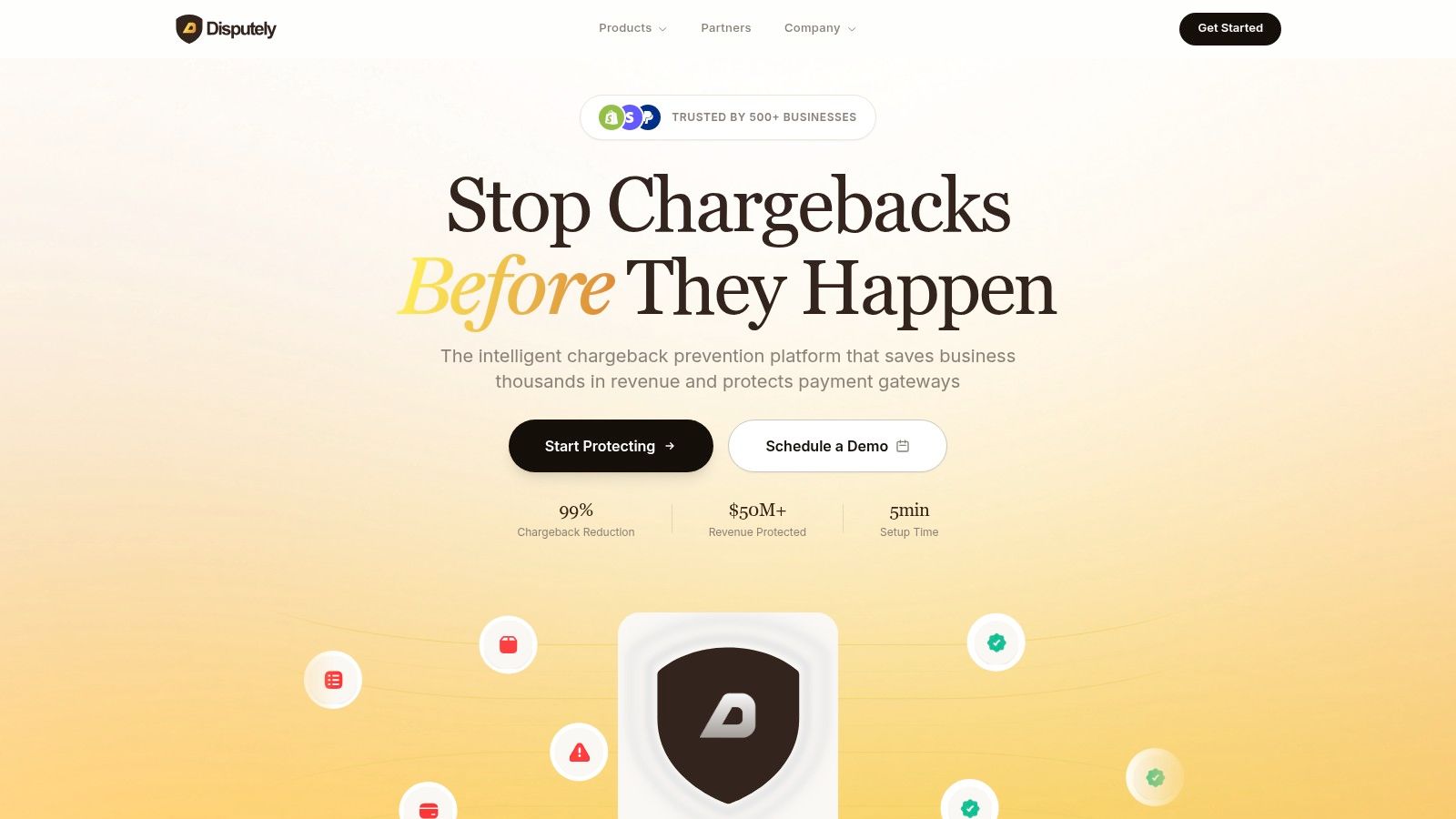
A familiar scenario: disputes start rising, the processor asks questions, and the finance team needs a way to cut incoming cases before they become formal chargebacks. Disputely fits that decision better than it fits a broad "all-in-one" chargeback label. Its core job is pre-dispute interception through Visa Rapid Dispute Resolution, Mastercard CDRN, and Ethoca, with automated routing that can trigger refunds or internal workflows fast enough to matter.
That makes Disputely less of a recovery tool and more of a ratio-protection tool.
The distinction matters. If your main problem is preserving authorization volume and avoiding monitoring trouble, early alerts often have better economics than post-dispute fighting. You usually give up some recoverable revenue because many alerts still end in a refund, but you can avoid the larger operational and compliance cost of letting the case mature into a chargeback.
Where Disputely is strongest
Disputely earns its place with merchants that need alert coverage across the main card-network programs without building a large manual review process around them. The practical appeal is workflow fit. The platform is designed to pull alerts into one queue, apply rules, and reduce the time between issuer notice and merchant action.
That operating model is a good fit for recurring billing, digital goods, DTC, and other environments where dispute volume can spike quickly and where a short response window makes manual handling unreliable.
It also helps that Disputely is not limited to alerts. The platform includes representment support for disputes that do get filed, plus reporting that helps finance and operations teams separate three different questions: how many cases were intercepted early, how many still became chargebacks, and whether the alert program is reducing ratio pressure enough to justify its cost.
Why the pricing model changes the buying decision
Disputely's pay-per-alert model, with no setup fee and no contract, is one of its clearest differentiators. That structure lowers testing risk for merchants with uneven dispute volume or teams that want to validate alert yield before committing to a broader managed-service contract.
The tradeoff is cost variability. A month with more alerts can also be a month with a higher bill, and the savings depend on what those alerts prevent. Merchants with thin margins should model the refund rate, average order value, processor risk exposure, and internal labor savings before assuming the platform will produce a strong net return.
This is also where Disputely differs from fraud-guarantee vendors. It does not solve the same problem as a provider that approves orders and absorbs some fraud losses. It is better evaluated against manual alert handling, gateway-native dispute tooling, or service firms that manage alerts and representment for you.
Best fit and tradeoffs
Use Disputely if the first merchant decision is, "Do we need to stop more disputes before they hit the processor?" That is the right lens for businesses under ratio pressure, merchants with fast fulfillment cycles, and teams that cannot staff alert monitoring throughout the day.
The limits are straightforward. Alert products never cover every dispute source, and coverage depends on network participation, processor setup, and payment mix. Merchants with fragmented acquiring setups, non-card payment methods, or a loss profile driven more by true criminal fraud than customer disputes may need a different primary tool.
- Best for pre-dispute prevention: Merchants that need RDR, CDRN, and Ethoca in one operating flow will usually get more value here than from a representment-only platform.
- Best for lean teams: Automation matters when the alternative is missing alert windows or asking support staff to make refund decisions manually.
- Less ideal for liability shift: If your goal is to move fraud loss off the balance sheet, a fraud guarantee platform is a better comparison set.
- Less ideal for full outsourcing: Teams that want a services-heavy partner to own disputes end to end may prefer a managed model over a software-first workflow.
The bottom line is practical. Disputely is strongest when the cost of a refund is lower than the cost of another counted dispute, and when implementation speed matters more than broad outsourcing.
2. Ethoca
A cardholder calls the bank in the morning about a transaction they do not recognize. By the afternoon, the merchant has a small window to cancel shipment, issue a refund, or contact the customer before that complaint turns into a formal chargeback. Ethoca is built for that decision.
That framing matters because Ethoca does not solve every chargeback problem. It solves one specific merchant question well: can we intercept issuer-reported fraud or dispute activity early enough to avoid a counted dispute? For merchants with meaningful Mastercard volume, the answer can be yes. For merchants looking to recover revenue after a chargeback is filed, Ethoca is only one layer of the stack.
The strongest case for Ethoca is operational, not theoretical. Early alerts have value only when the merchant can act inside the response window. That usually favors ecommerce businesses with same-day refund authority, subscription teams that can quickly identify billing confusion, and fraud teams that can stop fulfillment before goods leave the warehouse.
Consumer Clarity adds a different type of value. Instead of focusing on fraud liability or representment, it addresses recognition problems at the issuer inquiry stage by supplying more transaction context. That can help merchants whose disputes come from unclear descriptors, family-member purchases, or expected-delivery confusion. It will not fix underlying service issues, but it can reduce avoidable escalation when the problem is customer recognition.
Ethoca is less attractive if your first priority is shifting fraud loss off your balance sheet. A guarantee provider is the better comparison there. It is also a partial answer for merchants with split network volume, because the workflow benefit depends on where alerts are available and how your processor, acquirer, and internal systems are configured.
Three buying questions usually separate a good Ethoca fit from an expensive extra tool:
- Are you trying to prevent disputes or win them later? Ethoca is strongest before the chargeback stage, not in representment.
- Can your team act fast enough to use the alert? If refunds, shipping holds, and customer outreach still require manual handoffs, alert value drops quickly.
- Are you buying direct network access or managed operations around it? The commercial difference matters because setup effort, alert handling, and reporting support vary by provider model.
The practical tradeoff is clear. Ethoca often protects dispute ratios better than it protects revenue, because many prevented cases still end in a refund. That is still a rational outcome for merchants under monitoring pressure or for teams where avoiding another formal dispute is worth more than defending a marginal transaction.
3. Verifi
A cardholder calls their bank about a charge they do not recognize. If the issuer can see merchant details, past order data, or refund logic in time, that call may end as a resolved inquiry instead of a formal Visa dispute. That is the decision Verifi is built for.
Verifi fits merchants whose biggest problem is preventing avoidable Visa chargebacks before representment starts. Its value comes from three separate workflows. Order Insight surfaces transaction details to issuers during a cardholder inquiry. Rapid Dispute Resolution, or RDR, applies refund rules automatically to selected disputes. CDRN helps merchants receive and act on certain dispute notifications earlier in the process.
The buying question is less "does Verifi reduce chargebacks?" and more "which part of the dispute economics are you trying to improve?" If your losses come from preventable recognition disputes, Order Insight can help. If your team already knows which low-value cases should be conceded, RDR can protect dispute ratios and reduce manual review. If your goal is fraud liability shift, Verifi is the wrong tool category, which is why the next comparison with guarantee platforms matters.
Verifi also requires a narrower coverage assumption than some merchants expect. It is strongest on Visa workflows. Merchants with meaningful Mastercard volume often end up pairing it with Ethoca or accessing both through a provider that manages multi-network alert operations. That creates a practical selection rule. Direct Verifi access makes the most sense when Visa is the larger source of disputes, your processor setup supports the integration cleanly, and your team can maintain refund rules without constant manual exceptions.
RDR is where the ROI logic gets more nuanced. Auto-refunding a dispute can be financially correct when the order value is low, the win rate is poor, or the internal labor cost to review the case is high. It is a weak fit if your disputes are concentrated in defendable service cases where evidence quality is strong and margins justify recovery work. In other words, Verifi can reduce operational drag and dispute counts, but it may also convert some otherwise recoverable revenue into intentional refunds.
A practical way to evaluate Verifi is to pressure-test five points before signing:
- Decision solved: Preventing Visa disputes, not recovering them after they mature.
- Network coverage: Strongest for Visa. Mixed-network merchants may need another layer for broader alert coverage.
- Workflow fit: Best for teams that can route inquiry data, automate refunds, and reconcile outcomes without slow handoffs.
- Pricing logic: The model only works if prevented dispute costs and reduced manual effort outweigh alert and operational costs.
- Operational effort: Setup is rarely just technical. Support, finance, and dispute teams usually need new rules for refunds, reporting, and exception handling.
That makes Verifi a better fit for merchants optimizing dispute prevention at the issuer inquiry stage than for merchants shopping for full-service chargeback outsourcing. The strongest use case is a Visa-heavy merchant with repeatable dispute patterns, clear concession rules, and enough transaction volume for workflow automation to matter.
4. Signifyd
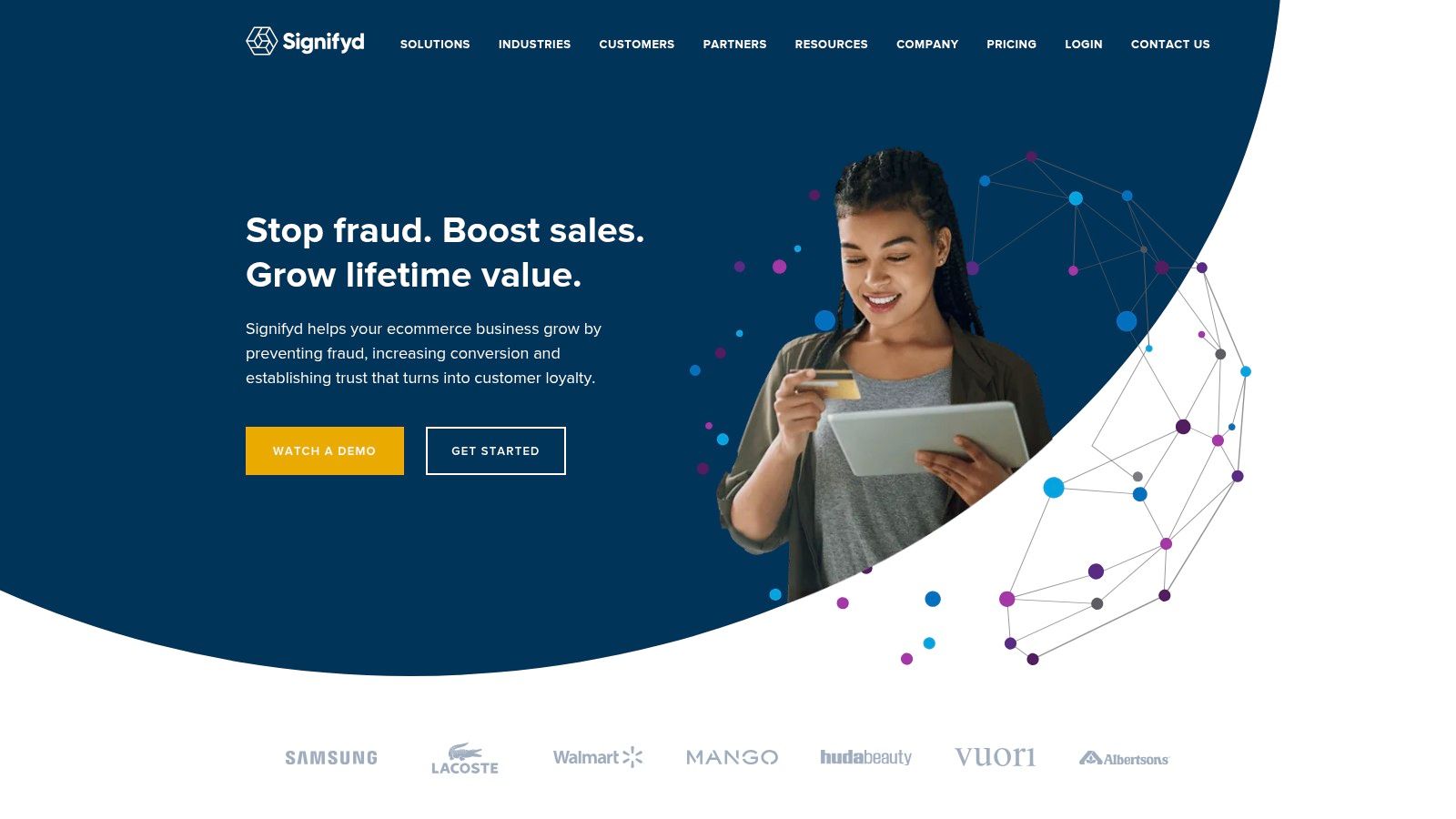
A merchant approves more orders to protect conversion during peak season. Two months later, fraud disputes rise, the review queue grows, and finance still cannot predict exposure. Signifyd is built for that decision. It addresses fraud cost at the order-approval stage by attaching a guarantee to approved transactions, rather than trying to intercept disputes after the sale.
That makes it a different purchase from Ethoca or Verifi. Those tools are mainly about pre-dispute intervention through issuer-side alerts or inquiries. Signifyd is closer to outsourced fraud decisioning with liability shift on covered fraud outcomes. If your losses come from card-not-present fraud and manual review is slowing approvals, that distinction matters more than another feature checklist.
The tradeoff is straightforward. You can reduce internal fraud-review effort and make fraud expense more predictable, but you are not buying broad chargeback coverage across every reason code.
A practical way to assess Signifyd is to start with the merchant decision it solves, then test the gaps it leaves behind:
If the problem is fraud liability: Signifyd can fit well because the value comes from guaranteed approvals on covered orders. This is strongest for merchants that want higher acceptance rates without holding a large in-house risk team.
If the problem is alert coverage: It is a weaker match. Signifyd is not the primary tool for Ethoca-style or Verifi-style pre-dispute prevention across card networks.
If the problem is recovery of non-fraud disputes: Expect to need another layer. Friendly fraud, service complaints, subscription confusion, and fulfillment disputes often sit outside the core guarantee logic or require a separate process.
If the problem is operational outsourcing: Signifyd can remove work upstream in fraud review, but it does not automatically replace downstream dispute operations unless the merchant's dispute mix is heavily fraud-led.
For Shopify merchants, this usually becomes a workflow question before it becomes a pricing question. Brands deciding between order-level fraud guarantees and post-transaction dispute tools should compare both paths directly. This overview of Shopify chargeback protection options is useful for that split decision.
The commercial model also needs close review. Guarantee-based pricing can look efficient when fraud pressure is high and internal review costs are real. It can look expensive when average order value rises, approval volume scales, or the actual dispute mix turns out to be dominated by customer claims that the guarantee does not absorb. Contract terms, exclusions, and evidence requirements deserve as much scrutiny as the machine-learning pitch.
Signifyd is usually strongest for merchants that want to shift fraud liability and simplify approval operations. It is less complete for merchants whose chargeback losses come from service failures, recurring billing disputes, or a broad mix of non-fraud reason codes.
5. Riskified
A large retailer sees the same pattern each quarter. Manual review slows approvals, fraud losses remain unpredictable, and the dispute team still inherits chargebacks that were supposed to be reduced upstream. Riskified is designed for the merchant making a specific decision in that situation: shift fraud liability on approved orders and move risk decisions into an enterprise fraud stack, rather than start with alerts or representment.
That distinction matters. Riskified is strongest if the main objective is to approve more orders with less internal fraud review while converting part of fraud exposure into a contracted cost. Merchants shopping for Ethoca or Verifi are usually solving a different problem. They want to intercept disputes before they become chargebacks. Merchants comparing Justt, Midigator, or Chargebacks911 are often focused more on recovery operations after a dispute already exists.
Riskified's value rises when fraud, account abuse, and policy abuse sit close together operationally. Large ecommerce teams often do not want separate tools for order approval, abuse screening, and parts of the post-purchase dispute process. In that workflow, Riskified can make sense because the buying decision is not just about chargeback reduction. It is about whether the merchant wants one vendor tied to approval logic, fraud liability coverage, and adjacent abuse controls.
The tradeoff is narrower than the broader platform story can suggest. The guarantee model is most meaningful on covered fraud outcomes tied to approved orders. It does not erase non-fraud disputes such as product issues, service complaints, recurring billing confusion, or fulfillment-related claims. If those reason codes drive losses, the merchant may still need pre-dispute alerts, representment support, or an internal service fix.
Implementation effort is also part of the ROI math. Riskified usually fits teams that can support enterprise integration, rule calibration, and contract review across multiple operating groups. A merchant that only needs lighter post-dispute workflow help may find the setup and commercial structure heavier than necessary, especially if chargeback volume is moderate and the bottleneck is operational follow-through.
Three questions usually separate a good fit from an expensive one:
- Are fraud approvals suppressing revenue? If internal controls are declining or routing too many good orders to review, liability shift can justify higher platform cost.
- How much of the dispute mix is fraud? If non-fraud claims dominate, the guarantee covers less of the loss picture than the headline promise implies.
- Do you want outsourced decisioning or just dispute reduction? Merchants that mainly need alert coverage or representment may get better economics elsewhere.
Riskified is usually a strong choice for enterprise merchants that want to buy down fraud volatility and reduce internal review effort. It is less efficient for merchants whose biggest problem sits downstream in non-fraud chargebacks, fragmented alert coverage, or recovery operations rather than order-approval risk.
6. ClearSale

A merchant that sits between two bad options, high false declines or rising fraud losses, is usually deciding something different from "which chargeback tool has the longest feature list." The choice is whether to automate approvals, buy a fraud guarantee, keep analysts in the loop, or outsource more of the review workload. ClearSale is one of the few vendors in this list that can fit several of those decisions instead of forcing a single model.
That matters for merchants with uneven risk patterns. Cross-border orders, high-ticket items, reseller channels, and categories with frequent manual exceptions often produce edge cases that fully automated systems can mishandle.
ClearSale's value sits upstream, before the dispute stage. Its mix of machine scoring and human review is designed to improve approval decisions while containing fraud exposure, which makes it closer to a fraud operations partner than to an alerts provider or a representment specialist. If your main objective is preventing issuer disputes through Ethoca or Verifi alerts, or recovering revenue after a chargeback has already landed, ClearSale addresses a different bottleneck.
The buying question is simpler than the product menu suggests. Do you want liability protection on approved fraud orders, analyst support for hard-to-score transactions, or a broader managed-service layer because your team cannot keep up internally? ClearSale is usually strongest when the answer includes at least two of those three.
Its tradeoff is coverage. Fraud guarantees can be valuable, but they do not erase losses tied to service complaints, recurring billing confusion, friendly fraud framed as merchandise issues, or operational defects outside the original order decision. Merchants with a mixed dispute portfolio should map reason codes before treating ClearSale as a full chargeback program.
A practical way to evaluate fit:
- Choose ClearSale to improve approval quality: Human review can help when rigid rules or pure automation reject too many legitimate but unusual orders.
- Choose it to shift some fraud liability: The economics work best when fraud chargebacks are a material share of total disputes and approved-order losses are volatile.
- Pass if your main problem starts after the sale: Merchants that mostly need pre-dispute alerts, representment, or workflow recovery may get more direct value from dispute-focused platforms.
- Check implementation and contract logic closely: Flexible packaging can help procurement, but it also means pricing, scope, and operational ownership need careful review before ROI is clear.
ClearSale is usually a better fit for merchants trying to make smarter accept-or-reject decisions without giving up all human judgment. It is less compelling for teams whose largest losses come from non-fraud disputes or who only need a lighter post-dispute operations layer.
7. Kount (Kount 360 Chargeback Management)
A common enterprise problem looks like this: fraud sits in one system, alerts in another, representment deadlines live in email, and finance sees the loss only after the chargeback posts. Kount is designed for merchants trying to fix that operating model, not just add another alert feed.
That distinction matters. Kount 360 Chargeback Management is usually a stronger fit for merchants whose main decision is operational consolidation. Other products in this list solve a narrower problem first, such as pre-dispute interception, fraud liability shift, or outsourced recovery. Kount is more appealing when the goal is to connect those stages inside one workflow and give risk, payments, and dispute teams a shared view of what happened before and after the transaction.
The practical value depends on how your losses are created.
If your dispute volume is spread across preventable fraud, alert-driven deflection, and post-dispute handling, Kount can help tie those signals together. That makes root-cause analysis easier and can reduce the handoff errors that happen when one team approves an order, another receives the alert, and a third owns representment. If your losses come mostly from one narrow issue, such as needing Ethoca or Verifi coverage as cheaply as possible, an all-in-one environment can cost more than the problem requires.
A useful way to judge Kount is by the tradeoff it asks you to make:
- Choose Kount if workflow coordination is the bottleneck: It is strongest when multiple teams touch the same dispute lifecycle and need shared case data, reporting, and task routing.
- Choose it if you want dispute management tied to a broader fraud stack: The value improves when Kount is part of the wider risk program rather than a standalone post-purchase tool.
- Be cautious if you want a clean liability shift: Kount is not primarily a fraud guarantee play, so merchants comparing it with Signifyd, Riskified, or ClearSale should separate workflow benefits from direct loss transfer.
- Be cautious if implementation speed is the priority: Platforms built around a single function, such as alerts or representment automation, are often easier to roll out and explain internally.
- Review pricing and scope carefully: Bundled platforms can look efficient at the dashboard level while hiding variable service costs, integration effort, or enterprise contract terms that only pay back at higher scale.
Kount is usually not the first pick for merchants seeking the simplest path to alert coverage or the most aggressive outsourced recovery. It makes more sense for larger teams asking a different question: how do we run fraud prevention, dispute intake, and response operations in one system without losing context at each handoff?
8. Chargebacks911
A card network deadline hits at 4 p.m., the evidence file is incomplete, and nobody on the merchant side owns the case end to end. That is the decision Chargebacks911 is built for. It is less about adding another prevention feed and more about taking over the messy parts of dispute operations: intake, case triage, evidence assembly, submission timing, and post-case analysis.
That operating model matters because recovery is still inconsistent across merchants. Federal Reserve researchers found that merchants successfully disputed only 20% to 30% of chargebacks, with a large share of losses never recovered through representment, and they also measured measurable chargeback costs relative to sales volume and value (Kansas City Fed chargeback research). For merchants with weak internal ownership, the practical problem is not access to alerts. It is whether evidence gets built correctly and submitted on time.
Chargebacks911 stands out most when the merchant wants operational outsourcing, not just tooling. Its Intelligent Source Detection and root-cause reporting are meant to sort disputes by likely cause, such as friendly fraud, merchant error, or criminal fraud, so the next action changes by case type instead of sending every dispute through the same workflow. That is a more useful distinction than a generic "full-service" label because it affects ROI. A merchant with high preventable merchant-error disputes needs process fixes, while a merchant facing first-party misuse may care more about representment quality and compelling evidence logic.
The tradeoff is straightforward:
- Choose Chargebacks911 if staffing is the main constraint: It fits merchants that need a partner to run evidence collection and submission as an ongoing service, not just software for an existing team.
- Choose it if representment discipline is the missing piece: Merchants comparing providers for chargeback fighting support and managed dispute recovery should ask how cases are triaged, what documentation is required from the merchant, and who owns deadlines.
- Be careful if your main goal is fraud liability shift: Chargebacks911 is not a guarantee-first model like Signifyd, Riskified, or ClearSale. It can reduce loss through process execution, but it does not turn fraud exposure into a fixed underwriting arrangement.
- Be careful if you only need alert optimization: Merchants with strong in-house operations may get more value from direct alert coverage or a lighter workflow platform than from a service-heavy contract.
- Review pricing definitions closely: Managed recovery economics depend on fee structure, win-rate calculations, exclusions, and how refunded, unwinnable, or low-value cases are handled.
This makes Chargebacks911 a fit for merchants asking, "Who can run this function for us with fewer misses?" It is less compelling for teams that already have disciplined operations and mainly want broader network coverage, lower variable cost, or a cleaner liability model.
9. Midigator
A common merchant scenario looks like this. Alerts are available, representment is possible, and reporting exists in separate systems, but no one has a reliable process for deciding which cases should be refunded, fought, or closed. Midigator fits that operational gap better than it fits merchants looking for a fraud guarantee or a fully outsourced service.
Midigator is strongest when the decision is about control. It gives in-house teams a system for alert intake, dispute workflow, and reporting across providers, which matters more than another feature list if your real problem is inconsistent execution. That puts it in a different bucket from vendors that mainly solve fraud liability shift or managed recovery.
The practical value is workflow fit. Merchants using multiple PSPs, acquirers, or channels often struggle less with access to alerts than with what happens after an alert arrives. Midigator helps standardize those next steps, assign ownership, and show whether alert costs are reducing downstream losses. Teams comparing internal handling against lighter-touch software can also use this guide to free chargeback fighting options and their staffing tradeoffs.
There is also a coverage question. Midigator is useful if you want one operating layer across prevention and dispute handling, but its value depends on the networks, processors, and workflows you already use. Buyers should ask where automation starts and stops, which integrations are native versus custom, and how much manual review remains for edge cases.
One caution matters more here than in several other tools on this list. Midigator is being folded into Kount 360 Chargeback Management, so the purchase decision is partly about transition risk.
Ask three direct questions before signing:
- What functions are staying in the current product versus migrating into Kount 360?
- How will pricing, support ownership, and contract terms change during that transition?
- If your team builds reporting and SOPs around Midigator now, what reimplementation work is likely later?
Midigator is a sensible choice for merchants that want to run chargeback operations themselves with better structure and measurement. It is less compelling if your main goal is guaranteed fraud coverage, hands-off representment, or the broadest possible pre-dispute network access at the lowest variable cost.
10. Justt
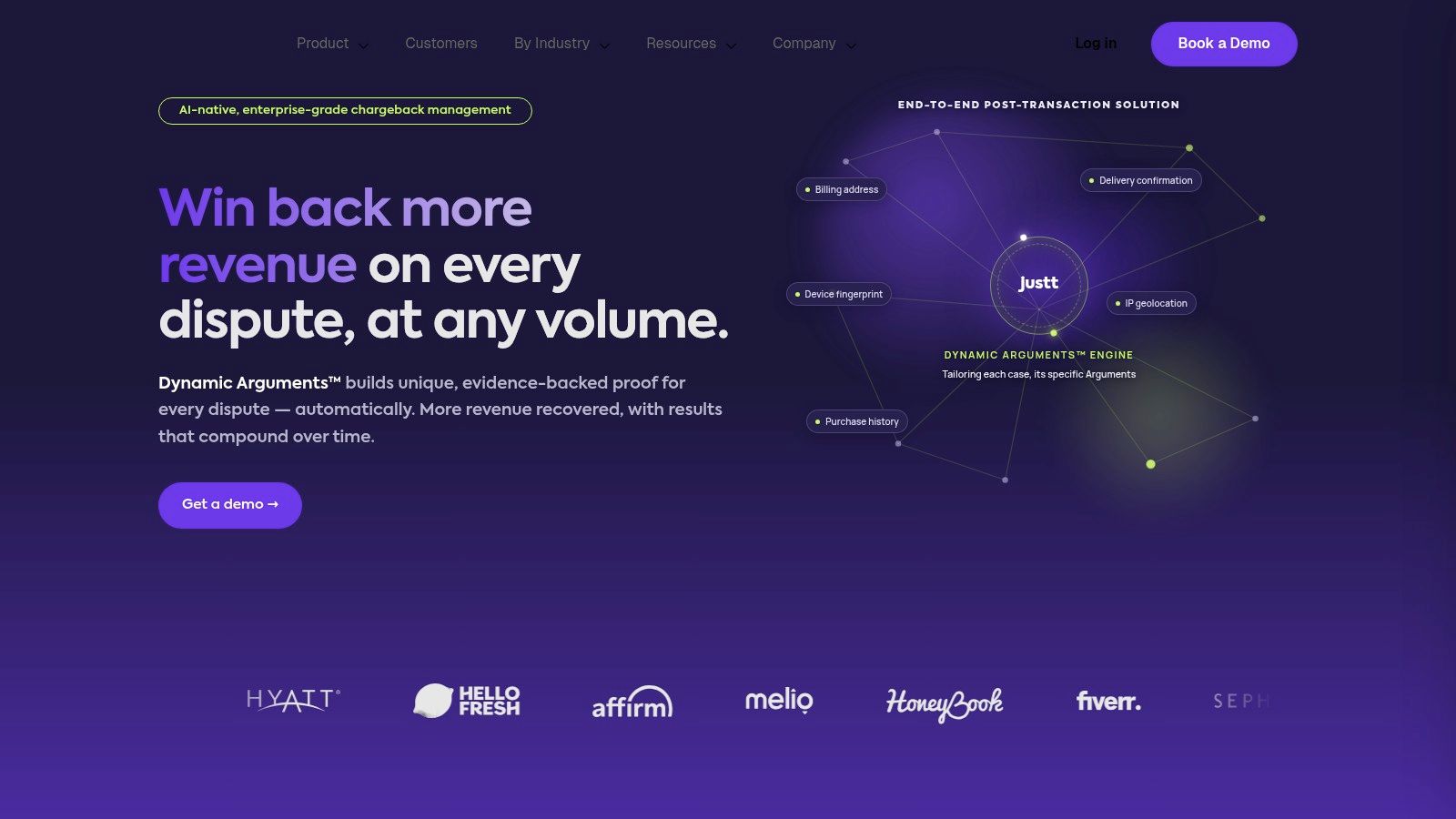
A merchant with rising dispute volume usually hits the same bottleneck first. Alerts may be connected, chargebacks may still be fought, but the failure point is operational consistency across thousands of cases, multiple PSPs, and changing issuer behavior. Justt is built for that decision. It is less about buying the widest alert network or a fraud guarantee, and more about automating recovery work that otherwise depends on analysts, templates, and manual evidence collection.
That distinction matters because Justt solves a different problem than products focused on prevention or liability shift. If your main goal is stopping disputes before they post, Ethoca, Verifi, or a network-first platform will usually matter more. If your goal is transferring fraud risk on approved orders, Signifyd, Riskified, or ClearSale are the closer comparison set. Justt is strongest when the merchant accepts that some disputes will still happen and wants higher throughput, better evidence packaging, and less manual casework after the fact.
The value case depends on workflow fit more than on feature count. A team with large post-dispute volume, fragmented payment operations, or weak internal representment discipline can justify automation quickly. A lower-volume merchant, or one already resolving most risk through alerts and fraud screening, may find the platform heavier than necessary.
A practical way to evaluate Justt is to ask what work it removes:
- Pre-dispute handling: useful if you want alert intake connected into the same operating flow, but this is not the category leader if broad alert coverage is your primary buying criterion.
- Representment automation: stronger fit for merchants where evidence gathering, response drafting, and submission quality are the main source of loss.
- Integration breadth: more valuable for merchants spread across several PSPs, geographies, or sales channels.
- Operational outsourcing: helpful if the internal team wants less hands-on dispute assembly, though buyers should still confirm where automation ends and human review begins.
- Pricing logic: often makes more sense when recovered revenue and labor savings are both material, not just when dispute counts are high.
The main caution is economic, not conceptual. Justt can be a sound choice for merchants with enough dispute volume to benefit from optimization at scale, but the ROI can narrow if your losses come mostly from preventable fraud or from alertable disputes that another tool could deflect earlier and more cheaply. Ask for detail on network coverage, representment scope by reason code, pricing triggers, contract minimums, and the amount of merchant involvement still required for edge cases.
Justt is a credible option for merchants choosing to improve recovery operations rather than prioritize alert prevention or fraud liability transfer. That makes it a narrower answer than "chargeback protection" suggests, but for the right loss model, it is a rational one.
Top 10 Chargeback Protection Comparison
| Product | Core features ✨ | Target audience 👥 | Effectiveness ★ | Pricing/value 💰 | Why choose / Unique selling point 🏆 |
|---|---|---|---|---|---|
| Disputely 🏆 | Real‑time RDR/CDRN/Ethoca alerts; AI filtering; auto‑refunds; 24/7 monitoring | Subscription/SaaS, high‑volume e‑commerce, DTC, high‑risk merchants | ★★★★★, up to 99% reduction; ~99.7% accuracy | 💰 Pay‑per‑alert, no setup/no contracts; ROI calculator | 🏆 Disputely: Direct network integrations + automated refund/evidence flows; fast 2–5 min setup |
| Ethoca | Near‑real‑time issuer alerts; Consumer Clarity data sharing | High‑volume U.S. e‑commerce & subscription businesses | ★★★★, fast deflection of friendly disputes | 💰 Per‑alert; refunds often required to avoid chargeback | ✨ Broad issuer coverage; receipt/order data sharing with issuers |
| Verifi (Visa) | Order Insight; RDR auto‑refunds; CDRN issuer alerts | Visa‑heavy merchants, U.S. card mix | ★★★★, strong Visa integrations & automations | 💰 Varies (via Visa channels); may complement Ethoca | ✨ Direct Visa dispute flows and RDR automation |
| Signifyd | ML decisioning; fraud guarantee on approved orders; dispute tooling | DTC & subscription brands wanting liability shift | ★★★★, liability shift improves approvals | 💰 % of GMV or plan fees; can be costly on high AOV | ✨ Financial guarantee on approved orders; reduces fraud exposure |
| Riskified | 100% fraud chargeback guarantee; Dispute Resolve; enterprise modules | Large retailers/platforms with high GMV | ★★★★, predictable fraud costs; revenue lift | 💰 Enterprise pricing; best for high GMV merchants | ✨ Full guarantee + broad post‑purchase suite |
| ClearSale | ML + human analyst review; Protection or Guarantee options | SMB to enterprise merchants needing nuanced review | ★★★★, flexible, accurate for tricky cases | 💰 Per‑approved‑order/percent pricing; may be higher for high AOV | ✨ Hybrid analyst+ML decisions; flexible contracting |
| Kount (360 CM) | Centralizes Ethoca/Verifi alerts, reporting & workflows; pairs with Kount fraud | Merchants wanting unified fraud + dispute platform | ★★★★, good for combined ops and scaling teams | 💰 Sales‑quoted; value tied to broader Kount adoption | ✨ Single dashboard for alert management + fraud screening |
| Chargebacks911 | Alert aggregation + managed representment; proprietary analytics | Merchants needing outsourced dispute remediation | ★★★★, services‑heavy recovery & representment | 💰 Contract/success‑fee model; pricing not public | ✨ Managed remediation + Intelligent Source Detection analytics |
| Midigator | Automated alert intake, workflows, dashboards & ROI reporting | Merchants focused on automation and data | ★★★, strong automation; helpful analytics | 💰 Not public; volume‑dependent; migrating to Kount 360 | ✨ Automation-first alert processing and reduction playbooks |
| Justt | AI‑native automation; Dynamic Arguments; A/B testing; pre‑dispute alerts | Teams seeking hands‑off dispute ops and optimization | ★★★★, automation drives scale and consistency | 💰 Success‑based or platform fees; best value at scale | ✨ Dynamic Arguments + testing to optimize representments |
Match the Platform to Your Loss Model
The best chargeback protection depends on what's hurting the business. If your biggest risk is processor pressure, rising dispute ratios, or the chance of reserves and account review, start with alert-first prevention. That means looking hard at tools that can intercept disputes in the short window before they become formal chargebacks. For many merchants, that's where the fastest ROI appears because it protects both revenue operations and compliance posture.
If network reach matters most, compare Ethoca and Verifi as separate layers, not interchangeable logos. Ethoca is often central for Mastercard-side alerting and issuer-connected visibility. Verifi is the stronger fit when Visa workflows such as Order Insight, CDRN, and RDR are where you can gain advantage. Merchants with a mixed card base usually shouldn't pick one and assume full coverage. They should map actual card mix, processor compatibility, and operational response capacity.
If fraud losses are the primary problem, the better question is whether liability shift is worth percentage-based or approval-linked pricing. That's where Signifyd, Riskified, and ClearSale become more relevant than pure alert platforms. They can stabilize fraud exposure and reduce manual review, but they usually won't eliminate the need for separate handling of non-fraud disputes.
If your bottleneck is staffing, not technology, look more seriously at Kount, Chargebacks911, Midigator, and Justt. They each solve the work problem differently. Kount is stronger when consolidation and reporting matter. Chargebacks911 is more services-heavy. Midigator is workflow and analytics oriented. Justt is the automation-first option for teams with enough dispute volume to justify deeper orchestration.
Category matters too. Industry benchmarks suggest average chargeback rates are about 0.12% in restaurants, around 0.66% for software and SaaS, and just over 1% in education and training, which is a reminder that merchants should evaluate tools against vertical realities, not a generic average (vertical chargeback rate benchmarks). A subscription business sitting near the common warning zone for acquirers has a different urgency than a low-dispute local merchant.
The safest buying approach is a pilot with a baseline. Measure avoided chargebacks, refunded revenue, recovery rate, labor saved, fees paid, false refunds, and dispute-ratio impact. Don't accept broad promises without stack-specific validation. The platform that looks expensive on a fee line may be cheap if it preserves processing continuity. The platform that looks efficient on paper may disappoint if coverage gaps leave too many disputes untouched.
For merchants who want quick setup, direct access to RDR, CDRN, and Ethoca, processor integrations, transparent pay-per-alert pricing, and automated pre-dispute workflows, Disputely is one of the most relevant options in this market. It won't be the right answer for every loss model, and merchants should still validate coverage and refund economics across their payment stack. But if the main goal is stopping disputes before they harden into chargebacks, it addresses that decision cleanly.
Disputely gives merchants a fast way to intercept disputes through Visa RDR, Mastercard CDRN, and Ethoca alerts, then automate the refund and response logic that protects chargeback ratios before cases hit the merchant account. If that's the problem you need to solve, visit Disputely and compare its pay-per-alert model, processor integrations, and workflow automation against your current dispute costs.


