
7 Best Chargeback Software Platforms in 2026

The best chargeback software isn't necessarily the platform with the highest advertised recovery rate. A recovery tool acts after a chargeback posts. A network-level alert can give you time to refund before that happens. A checkout guarantee can shift eligible liability before fulfillment, while representment software assembles evidence only after the issuer has already created a formal case. Those are different interventions, costs, and outcomes.
That distinction matters as projected global chargeback volume rises from 238 million disputes in 2023 to 337 million in 2026, according to ChargebackCost's chargeback statistics. The U.S. alone is projected to reach 146 million cases valued at $15.3 billion by 2026](https://chargebackcost.com/statistics). The right comparison therefore covers prevention stage, processor and network integrations, automation depth, pricing model, operational control, merchant fit, and measurable savings.
Use a simple ROI model: prevented chargeback value plus retained revenue and recovered cases, minus proactive refunds, platform fees, and internal labor. In that framework, Disputely is the prevention-first benchmark, but the strongest choice depends on where your disputes begin and who owns the workflow.
1. Disputely
Best for merchants that want to intercept disputes before they become chargebacks
Disputely earns consideration because it owns the workflow before a formal chargeback reaches the merchant account. It receives network alerts, applies merchant-defined rules, and can issue refunds for eligible cases before they become posted disputes. The platform also filters cases that may justify evidence submission instead of an automatic refund. That filtering matters because the Kansas City Fed found that merchants in its studied card-scheme environment successfully disputed only 20% to 30% of chargebacks, while merchant loss ratios reached roughly 70% to 80% depending on scheme and reason code, as documented in its chargeback study.
The operational advantage is workflow ownership. Merchants can set refund criteria, process alerts in real time, and reserve higher-value cases for representment. Disputely's product materials describe setup in under five minutes. For chargebacks that still post, the platform supports automated evidence compilation and shipping and tracking analytics for delivery-related claims.
A prevention-first model changes the ROI calculation. Avoiding a chargeback can preserve the transaction, reduce manual case handling, and limit pressure on processor monitoring. Visa's updated VAMP framework combines fraud and disputes into one ratio, uses a 1.5% threshold, applies a separate 20% enumeration ratio limit, and can impose an $8 fee per violation month, according to Forter's explanation of VAMP. This makes earlier intervention relevant for high-volume ecommerce, subscription, DTC, travel, and nutraceutical merchants, although refunds still trade revenue for operational and account-risk protection.
Disputely uses a pay-per-alert model, with no setup fee or long-term contract stated in its materials. The per-alert amount is not publicly listed. Merchants should compare alert volume, refund tolerance, false-positive rates, avoided labor, and the value of cases that evidence could retain.
Practical rule: Set refund logic around dispute economics, not simply alert volume. A blanket refund policy may reduce chargebacks while giving away revenue that better evidence could have retained.
The model fits teams seeking rapid deployment without building a large internal dispute operation. Review chargeback fighting workflows to assess how prevention and representment can share ownership.
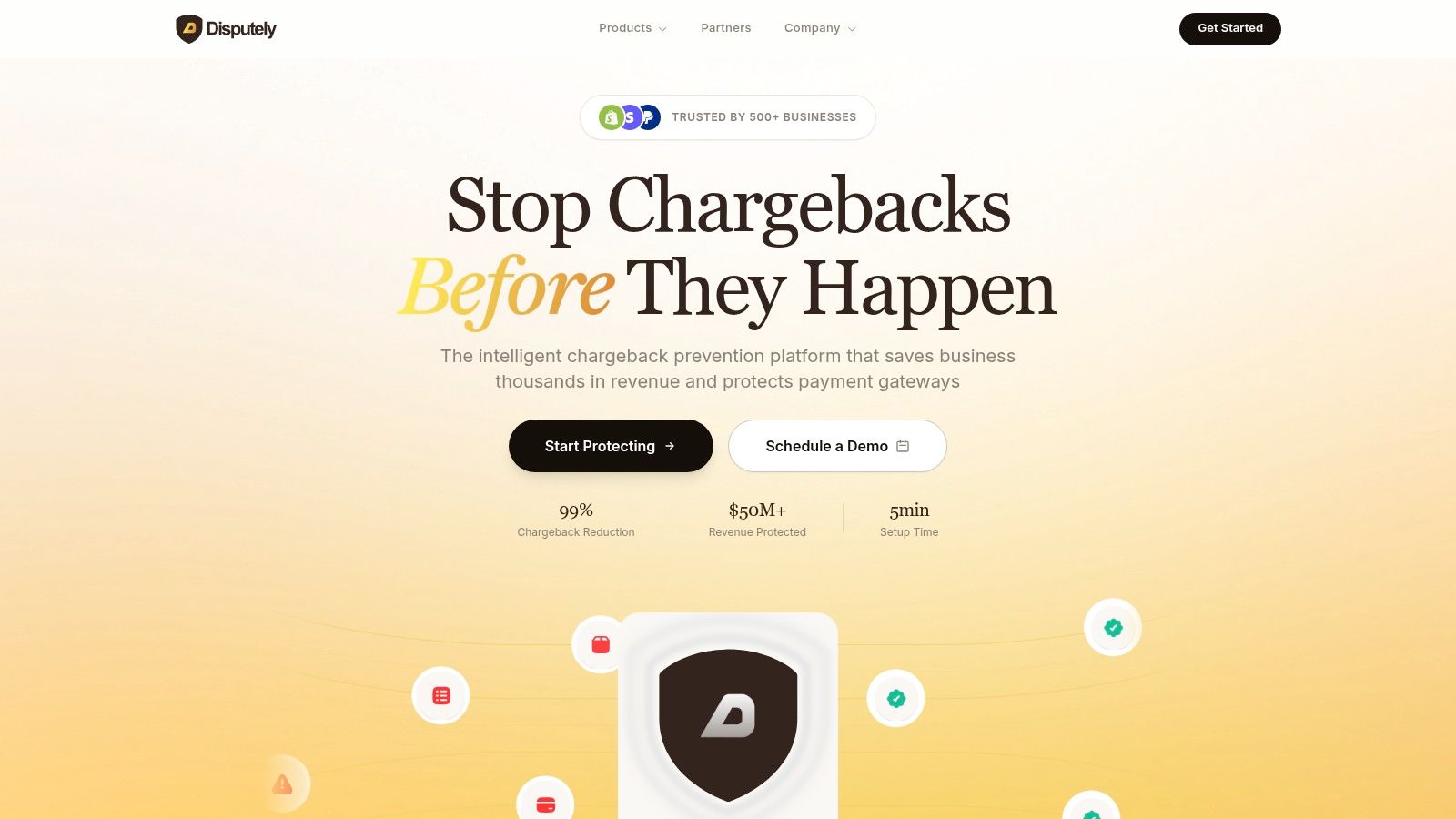
Disputely's strongest position is before the chargeback posts. Merchants with limited processor coverage, low alert volume, or strict refund controls should test whether the avoided labor and account risk justify the pay-per-alert cost.
2. Verifi
Best for Visa-centered merchants that need issuer-level prevention
Verifi is the strongest fit when Visa coverage drives the buying decision. Its network-native products include Order Insight, which presents transaction details such as receipts, merchant identifiers, and order context to issuers, and Rapid Dispute Resolution, which lets merchants configure rules for accepting or declining eligible cases before they become formal chargebacks. Verifi also supports CDRN workflows and connects with Visa issuer platforms, including Visa Resolve Online, according to the capabilities described on the Verifi platform website.
The distinction from a conventional representment platform is important. Verifi is designed to improve issuer visibility and resolve a dispute before it counts against the merchant's monitoring position. That can be more valuable than winning a case later, particularly where the merchant's priority is keeping dispute ratios below program thresholds rather than maximizing post-chargeback recovery.
Where Verifi fits operationally
Verifi works best when a merchant can respond automatically. A payment or order-management team needs to map transaction data, establish refund rules, and ensure that issuer-facing information remains accurate. That can require engineering involvement, especially for custom carts, complex subscriptions, partial shipments, and orders that move across multiple processors.
Pricing isn't publicly listed in the provided materials, and contracting may occur through Verifi or an acquirer or PSP. That makes total-cost comparison less straightforward than a transparent per-alert product. Ask whether fees apply to alerts, resolved cases, network access, or bundled services, and confirm how the provider handles cases that don't qualify for pre-dispute resolution.
Visa-only coverage is also a constraint. A merchant with meaningful Mastercard volume may need Ethoca access as well, either through a separate relationship or an aggregator. Verifi is therefore a precise choice, not a universal one. It suits a processor environment where Visa disputes dominate and the technical team can support rules-based issuer workflows.
3. Ethoca
Best for Mastercard-heavy merchants that can act quickly on alerts
Ethoca, a Mastercard company, operates at the alert stage. Its Ethoca Alerts service notifies merchants when participating issuers identify a transaction that may become a fraud or customer dispute. The merchant can then refund the transaction, stop fulfillment, or investigate before a formal chargeback posts. Its Ethoca platform also includes Consumer Clarity, which enriches digital banking displays with transaction information such as merchant branding, receipts, item details, and subscription context.
That second layer addresses a common source of “I don't recognize this” disputes. A clearer descriptor, logo, or itemized receipt can help a cardholder identify a legitimate purchase before escalating it through the bank. It won't solve every dispute, and its impact depends on issuer participation and the merchant's actual Mastercard mix, but it gives the brand a chance to reduce confusion before the dispute becomes operationally expensive.
The workflow is only as good as the response
Ethoca is not a set-and-forget representment engine. Alerts arrive within a tight operational window, so the merchant needs an owner for refund decisions, fulfillment holds, subscription cancellation, and customer communication. A delayed workflow can turn a potentially preventable case into a posted chargeback.
This makes Ethoca a natural fit for merchants with responsive payment operations, especially those shipping physical goods and able to stop an order before fulfillment. Subscription brands also need rules for whether an alert should trigger a refund, cancellation, account review, or customer-service outreach.
The trade-off is coverage specificity. Ethoca is most useful where Mastercard volume and issuer participation justify the relationship. A merchant with a balanced Visa and Mastercard portfolio should evaluate Ethoca alongside Visa RDR or a platform that aggregates both pathways. Pricing isn't public in the supplied materials, so buyers should request the full fee structure and determine whether the service includes only alerts or also workflow automation.

4. Midigator
Best for technical teams that want unified prevention, analytics, and representment control
Midigator takes a broader operations approach. It ingests Verifi and Ethoca alerts, RDR notices, and posted chargebacks, then gives merchants tools for automated refunds, fulfillment stops, evidence workflows, and portfolio-level analysis. Its prevention and events APIs, along with webhooks, make it a strong candidate for high-volume ecommerce and subscription businesses with custom order, CRM, or payment infrastructure. More information is available on the Midigator website.
The platform's main advantage is consolidation. Instead of treating alerts, chargebacks, reason codes, and representment as separate queues, a merchant can view the lifecycle across a portfolio. That supports root-cause work, such as identifying whether disputes cluster around delivery, recurring billing, unclear descriptors, or a specific processor path.
Control comes with implementation work
Midigator is best when the merchant has technical ownership. The team may need to connect order records, refund systems, fulfillment events, customer communications, and payment data before automated decisions become reliable. A basic dashboard can provide visibility quickly, but the deeper ROI comes from connecting the platform to the systems that determine whether an order should ship, refund, cancel, or receive a response.
Pricing isn't public and the product is typically positioned as an enterprise engagement. That may be excessive for a small store with occasional disputes, but it can make sense for a multi-processor merchant that needs common rules and reporting across brands or payment accounts.
The key trade-off is flexibility versus simplicity. Midigator offers more operational control than a fully managed service, but that control creates ownership. Your team remains responsible for choosing thresholds, reviewing exceptions, measuring alert coverage, and checking whether automated refunds are protecting the right cases.
A unified dashboard is useful only when it connects to the decisions your operations team already makes. Otherwise, it becomes another reporting layer rather than a prevention system.
Merchants evaluating a lower-friction starting point can also review free chargeback fighting resources, while larger teams should test Midigator with real order and dispute data before committing.

5. Chargeflow
Best for Shopify-led ecommerce teams that prioritize automated representment
Chargeflow is built around ecommerce dispute automation, with a particularly strong fit for merchants using Shopify or Shopify Plus. It pulls relevant order information into a workflow that builds and submits evidence for posted disputes, while also offering alert integrations and analytics intended to support earlier deflection. Its Chargeflow platform is available through the Shopify App Store, which can make initial evaluation easier for Shopify merchants than an enterprise integration project.
The platform's center of gravity is still representment. That matters because a merchant must distinguish between recovering a posted chargeback and preventing one from counting in the first place. Automated evidence can reduce repetitive work and improve consistency, but it doesn't erase the financial or ratio impact that may already exist once the chargeback is filed.
Why Shopify fit changes the evaluation
Shopify merchants often have structured access to order, fulfillment, customer, and tracking data. Chargeflow can use that data to build dispute responses without requiring the merchant to assemble every document manually. The result is a practical option for DTC brands that want a quick pilot and don't have a dedicated chargeback analyst.
The trade-off becomes clearer outside Shopify. A custom cart, unusual processor, or fragmented fulfillment stack may require API work and data mapping. Buyers should test partial refunds, subscription renewals, split shipments, digital goods, and missing evidence rather than evaluating only a straightforward physical-order example.
Chargeflow uses transparent, success-based pricing according to the supplied product notes. That aligns expense with recovered revenue, but merchants should calculate the net result after the success fee and compare it with the value of cases that could have been prevented through alerts. For Shopify merchants, Shopify chargeback protection guidance can help frame that prevention-versus-recovery decision.
6. Justt
Best for merchants that want a managed, success-based dispute workflow
Justt combines pre-dispute alert handling, automated representment, analytics, and managed decisioning. Its AI-driven workflow is designed to determine whether pursuing a case makes economic sense, then build and submit evidence when the expected recovery justifies the effort. The Justt platform is therefore aimed at U.S. subscription and ecommerce brands that want less internal handling across a broad payment stack.
This model answers a different problem from a self-operated alert platform. Instead of asking a payment team to monitor alerts, assess evidence, and manage deadlines, the merchant delegates much of that process. That can be valuable for recurring-billing businesses where dispute work competes with retention, billing support, and fraud operations.
The trade-off is transparency
Managed automation reduces workload, but it can also reduce direct control. Buyers should ask how Justt's system decides which cases to pursue, what evidence sources it can access, how exceptions are escalated, and whether the merchant can inspect submissions before or after filing. A live dashboard helps, but dashboard access isn't the same as ownership of the underlying logic.
Success-based pricing can align the vendor's incentives with recovered revenue. It can also make costs harder to forecast if the merchant's dispute mix changes or if a larger share of cases becomes eligible for representment. The contract should define recovered revenue, excluded case types, fees for alerts or prevention, and what happens when the merchant supplies incomplete evidence.
Justt fits a merchant that values hands-off execution more than granular workflow control. A brand with an experienced internal payments team may prefer APIs and configurable rules. A lean subscription operation may prefer to outsource evidence collection and submission while retaining oversight of refunds, cancellation, and customer communication.
7. Signifyd
Best for ecommerce merchants that want liability transfer at checkout
Signifyd intervenes earlier than representment platforms. It evaluates orders at checkout and can offer a financial guarantee on approved transactions, with options described in the supplied materials for fraud-only coverage or broader protection that may include certain non-fraud chargebacks. Its Signifyd commerce protection platform integrates with ecommerce environments including Shopify, BigCommerce, Salesforce Commerce Cloud, and Adobe Commerce.
The commercial proposition is different from paying for evidence recovery. Signifyd can shift eligible financial liability away from the merchant on approved orders, giving the retailer a more predictable exposure profile. It also supports automated chargeback recovery and representment, so the platform can address some downstream work after its checkout decision.
Liability coverage requires contract precision
A guarantee isn't the same as universal chargeback protection. Merchants need to confirm whether coverage applies to fraud only, which non-fraud categories are included, what exclusions apply, and what documentation or operational requirements remain with the merchant. The guarantee scope may matter more than the headline approval or protection message.
Signifyd's broad ecommerce integration ecosystem suits retailers that want fraud screening and financial protection embedded into order approval. It may be less attractive for a low-risk merchant that mainly needs inexpensive alert handling, especially because custom pricing and a per-order percentage can weigh more heavily when the underlying dispute exposure is limited.
The strongest fit is a retailer that values predictable P&L treatment and is willing to pay for risk transfer before fulfillment. Subscription merchants should examine recurring-payment coverage separately, while high-risk businesses should verify processor, category, geography, and reserve-related terms rather than assuming a checkout guarantee solves every account-level problem.
Top 7 Chargeback Software Comparison
| Product | Implementation 🔄 | Resources ⚡ | Expected outcomes 📊⭐ | Ideal use cases 💡 | Pricing / contracts |
|---|---|---|---|---|---|
| Disputely | 🔄 Low, plug‑and‑play with major processors; live in ~5 min | ⚡ Low internal effort; minimal engineering for common stacks | 📊 Very high prevention (vendor claims up to 99%); ⭐ Strong for stopping disputes pre‑chargeback; auto‑evidence & shipping analytics | 💡 Subscription, high‑volume ecommerce, DTC, high‑risk merchants | Pay‑per‑alert, transparent calculator; no setup fees/long contracts |
| Verifi | 🔄 Medium, network/acquirer integrations and RDR workflows | ⚡ Moderate; requires issuer/acquirer links and automation for best results | 📊 High impact on Visa disputes (US network reach); ⭐ Mature RDR & Order Insight tooling | 💡 Merchants with substantial US Visa volume and acquirer support | Not public; typically provisioned via acquirer/PSP contracts |
| Ethoca | 🔄 Medium, issuer alerts and Consumer Clarity onboarding | ⚡ Moderate ops; merchants must act quickly on alerts | 📊 Reduces first‑party/friendly fraud by improving statement clarity; ⭐ Effective for Mastercard volume | 💡 Merchants with significant Mastercard transactions or subscription services | Not public; value depends on issuer participation |
| Midigator | 🔄 High, consolidates multiple providers, requires integrations | ⚡ Higher engineering/ops overhead (APIs, webhooks, CRM/order links) | 📊 Strong portfolio analytics and centralized ops; ⭐ Good for complex/enterprise workflows | 💡 High‑volume ecommerce/subscription merchants needing centralized chargeback ops | Not public; typically enterprise engagements |
| Chargeflow | 🔄 Low–Medium, Shopify app quick install; APIs for other platforms | ⚡ Low for Shopify merchants; moderate for non‑Shopify integrations | 📊 Good recovery and deflection for Shopify stores; ⭐ Automated representment & analytics | 💡 Shopify / Shopify Plus merchants wanting fast pilot and automation | Transparent, success‑based pricing; easy to trial via App Store |
| Justt | 🔄 Low, managed end‑to‑end service with integration options | ⚡ Low internal workload; managed service reduces ops burden | 📊 Automated representment with AI decisioning; ⭐ Balances win‑rate vs cost (economics‑driven) | 💡 Merchants preferring hands‑off, managed dispute handling | Not public; managed/success‑based pricing via sales |
| Signifyd | 🔄 Medium, integrates at checkout and post‑capture with many platforms | ⚡ Moderate; integration + contractual setup; real‑time decisioning | 📊 Shifts financial liability on approved orders for predictable P&L; ⭐ Strong for fraud+chargeback guarantees | 💡 Retailers seeking liability shift and integrated fraud protection | Custom pricing; per‑order percentage or contract with defined exclusions |
Choose by Dispute Stage, Not Feature Count
The best chargeback software depends on where your losses begin. If a cardholder dispute can be intercepted through a network alert, a refund or fulfillment decision may prevent the case from affecting the account. If the dispute has already posted, representment automation can reduce labor and recover eligible revenue. If fraud risk begins at checkout, a guarantee may be worth evaluating because it changes who carries the covered loss.
Choose Disputely when rapid, processor-connected alert prevention and pay-per-alert economics are the priority. It fits merchants that want to connect Stripe, PayPal, Shopify Payments, Authorize.net, or Square, define refund rules, and act before formal filing. Choose Verifi when Visa-specific issuer coverage is central, or Ethoca when Mastercard alerts and transaction clarity are the main requirement. Their network focus can be an advantage, but merchants with mixed card-network volume should account for the coverage gap.
Choose Midigator when technical teams need unified APIs, webhooks, alert intake, analytics, and representment control. Choose Chargeflow for Shopify-led automation and success-based evidence recovery. Choose Justt when a managed workflow and reduced internal workload matter more than hands-on case control. Choose Signifyd when checkout-time risk decisions and liability transfer are more important than a pure dispute-management tool.
Use this buyer's checklist before requesting proposals:
- Alert sources: Confirm whether the platform receives Visa RDR, Mastercard CDRN, Ethoca, or other relevant alerts.
- Processor integrations: Verify support for every gateway, PSP, storefront, and merchant account in production.
- Refund and fulfillment rules: Ask whether the system can refund, cancel, hold, or escalate based on order status and dispute type.
- Evidence automation: Check which order, delivery, billing, and customer-service records the platform can retrieve.
- Reporting: Require ratio, reason-code, alert-coverage, refund, representment, and outcome reporting.
- Pricing basis: Identify per-alert, subscription, success-fee, per-order, guarantee, implementation, and support charges.
- Contract scope: Review exclusions, covered chargeback definitions, network limitations, renewal terms, and liability language.
- False-positive controls: Test how the platform avoids refunding cases that evidence could resolve.
- Implementation effort: Ask what engineering, data mapping, webhook, and operational changes are required.
- Support ownership: Clarify who handles missed alerts, processor failures, evidence gaps, and urgent deadlines.
Estimate savings without treating vendor claims as guarantees. Compare the value of prevented chargebacks and recovered cases with refunds, platform fees, processor costs, and internal labor. Also include the operational value of reducing monitoring exposure, reserves, and account holds. The category itself is expanding, with the global chargeback management software market estimated at USD 1.88 billion in 2025 and projected to reach USD 10.78 billion by 2035, a 15.8% CAGR, according to Business Research Insights' market estimate. That growth doesn't identify a winner for your business, but it does reinforce the need to choose by intervention stage rather than by feature count.
North America remains the largest regional market in one independent estimate, exceeding 36.1% of global revenue and reaching USD 0.94 billion in 2025, as reported by Market.us's chargeback management analysis. For buyers in that region, processor monitoring and issuer-network access deserve the same scrutiny as recovery performance.
Visit Disputely to connect your payment stack, review alert-based prevention, and model whether early resolution produces better economics than fighting every chargeback after it posts. Its prevention-first workflow is most relevant for subscription, DTC, high-volume ecommerce, and high-risk merchants that need to protect both revenue and processor access.


