
Big Commerce vs Shopify
Shopify holds 73% of the global share among the top 800 direct-to-consumer brands, making it the default choice for most DTC merchants, while BigCommerce remains a much smaller platform. Shopify's scale and centralized dispute tooling favor high-volume operators, but BigCommerce is often better suited to complex catalogs that need native B2B or multi-storefront capabilities.
That market-share gap changes the practical meaning of a platform decision. You're not only choosing a storefront editor, checkout, or app marketplace. You're choosing how your team will route payments, monitor disputes, preserve transaction evidence, and respond when a processor raises a chargeback. A large ecosystem can reduce integration friction, while a more feature-rich core can reduce the number of external systems your team has to maintain.
| Decision area | Shopify | BigCommerce |
|---|---|---|
| Market position | Default platform for many DTC brands, with 73% share among the top 800 DTC brands | Smaller, niche position across broad merchant datasets |
| Operating model | Managed, app-driven ecosystem with centralized Shopify Payments dispute visibility | More native commerce functionality and flexible payment-gateway choice |
| Catalog and B2B fit | Strong for DTC, subscriptions, and ecosystem-led expansion | Strong for complex catalogs, native B2B, and multi-storefront operations |
| Dispute workflow | Disputes surface inside the Shopify admin when using Shopify Payments | Disputes are handled through the selected payment processor |
| Main operational risk | Payment ecosystem concentration and app dependency | Fragmented alerts, deadlines, evidence formats, and processor workflows |
| Best strategic question | Can the team standardize payment operations inside Shopify? | Can the team manage gateway complexity without losing response speed? |
The Real Scale Gap Between BigCommerce and Shopify
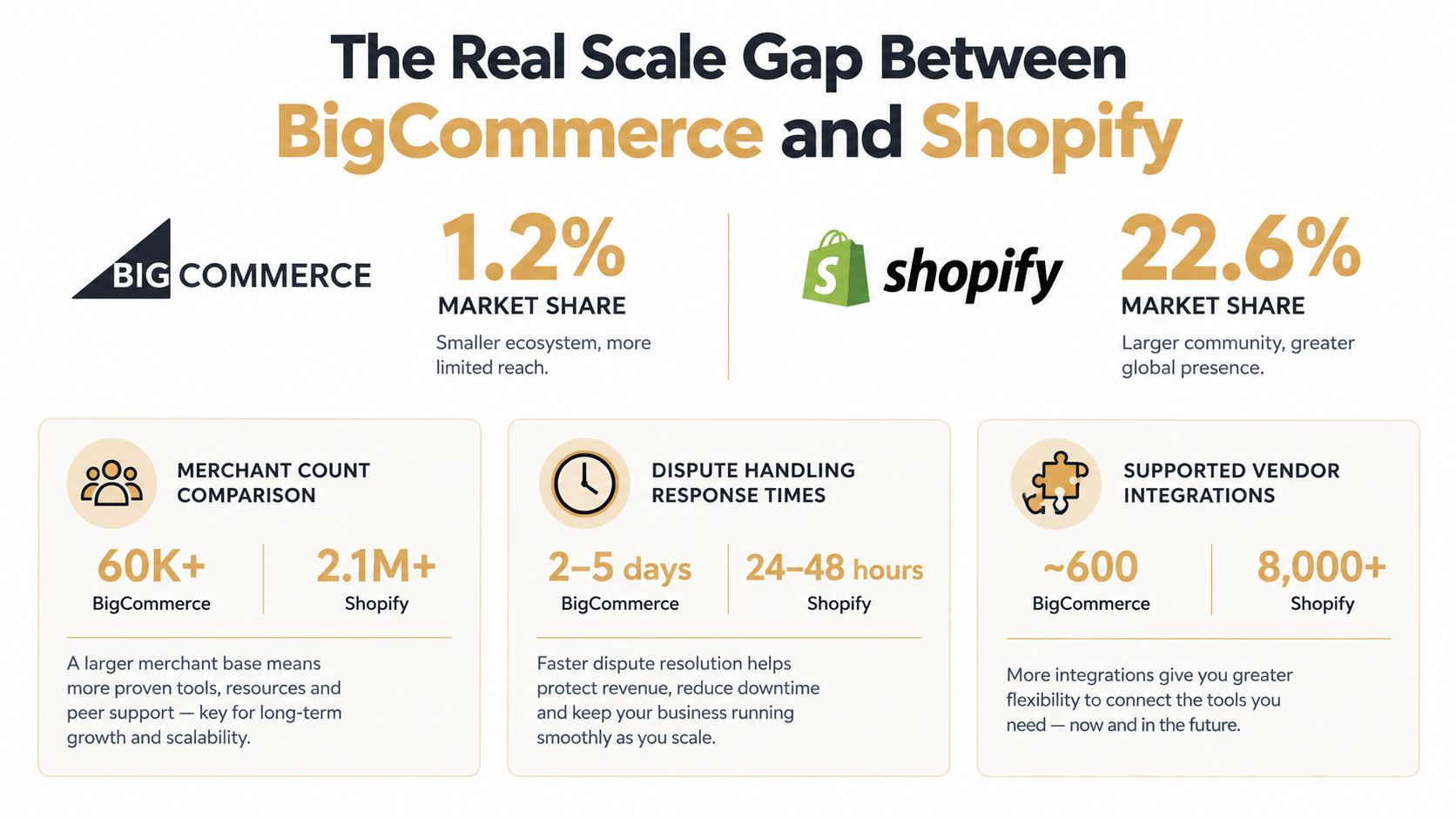
The 73% versus roughly 3% contrast is more than a popularity contest. One 2026 comparison placed Shopify at 73% of the global share among the top 800 DTC brands, while BigCommerce held roughly 3% of the U.S. ecommerce software market and less than 1% of ecommerce websites on the open web, according to Shopify's BigCommerce comparison. Those datasets measure different populations, so they shouldn't be treated as a single market-share calculation. Together, they show a consistent direction: Shopify operates at a much broader ecosystem scale.
Consider a subscription brand choosing between the platforms. Its team may value BigCommerce's native catalog controls, but it also needs payment integrations, recurring-billing tools, customer-service workflows, analytics, and dispute alerts that work together. Shopify's larger footprint makes it more likely that the required integration already exists and has been tested across a broad merchant base. That doesn't eliminate operational risk, but it can reduce the amount of custom coordination required.
Scale affects resilience
A platform's size also influences how merchants evaluate support, partner availability, and the long-term maintenance of payment connections. It doesn't guarantee faster dispute resolution or better chargeback outcomes. It does, however, affect the depth of the surrounding ecosystem and the number of implementation patterns available to agencies and payment teams.
The trade-off explains why Shopify store owners explore alternatives. Some merchants want more control over gateways, catalog logic, or storefront architecture, even if Shopify's larger ecosystem offers a smoother default path.
Operational rule: Choose the platform that makes your highest-risk workflow repeatable, not the one with the longest feature list.
BigCommerce's smaller market presence shouldn't be mistaken for irrelevance. Its appeal is concentrated among merchants that need capabilities such as native B2B workflows, multiple storefronts, open APIs, and deeper catalog configuration. Shopify is the broader default. BigCommerce is the more specialized architectural choice.
Revenue and Market Position in 2026
The commercial scale difference becomes clearer when revenue and merchandise volume enter the comparison. 2026 reporting described Shopify as generating more than $11 billion in annual revenue, with first-quarter revenue cited between $2.13 billion and $2.34 billion and quarterly gross merchandise volume above $74.75 billion, according to D2C Times' 2026 comparison. The same reporting cited BigCommerce first-quarter revenue between $85.4 million and $88.4 million, with annual recurring revenue between $330 million and $350.8 million.
These figures don't prove that Shopify is the right choice for every merchant. They do establish a substantial difference in operating scale. A platform processing commerce across a much larger merchant base is likely to attract more agencies, app developers, payment partners, and integration vendors. For a growing merchant, that can make it easier to replace a failing tool or add a new operational connection.
What financial momentum means for merchants
The market-value comparison is even more dramatic. One 2026 analysis placed Shopify's market value at about $204 billion, compared with roughly $200 million for Commerce and BigCommerce. The same analysis looked back to August 2020, when Shopify was valued at around $120 billion and BigCommerce at about $4.8 billion, a 25x spread that later widened substantially, as reported in the same D2C Times analysis.
Market value isn't a service-level agreement. It can't tell a payment manager whether a specific processor will deliver alerts in the format the team needs. It can provide context about corporate momentum, investment capacity, and the likelihood that a platform will continue expanding its ecosystem.
For Shopify merchants, the risk is concentration. A large platform can simplify the experience, but the merchant may become more dependent on the platform's preferred payment environment and operating rules. For BigCommerce merchants, the risk is fragmentation. Gateway choice can remain more flexible, but the internal team carries more responsibility for making those gateways work as a coherent system.
A more useful interpretation
Shopify's scale makes it the safer default for many DTC and subscription brands that prioritize ecosystem reach and managed operations. BigCommerce's smaller scale makes it less universal, but its niche positioning can work in its favor when the merchant's requirements are already clear and technical.
The key question isn't which company has more momentum. It's whether your business benefits more from ecosystem breadth or native operational depth.
Cost, Speed, and Conversion Performance
Base subscription prices alone won't settle the BigCommerce versus Shopify decision. The more relevant comparison includes checkout behavior, storefront performance, and the internal cost of keeping the payment and commerce stack reliable.
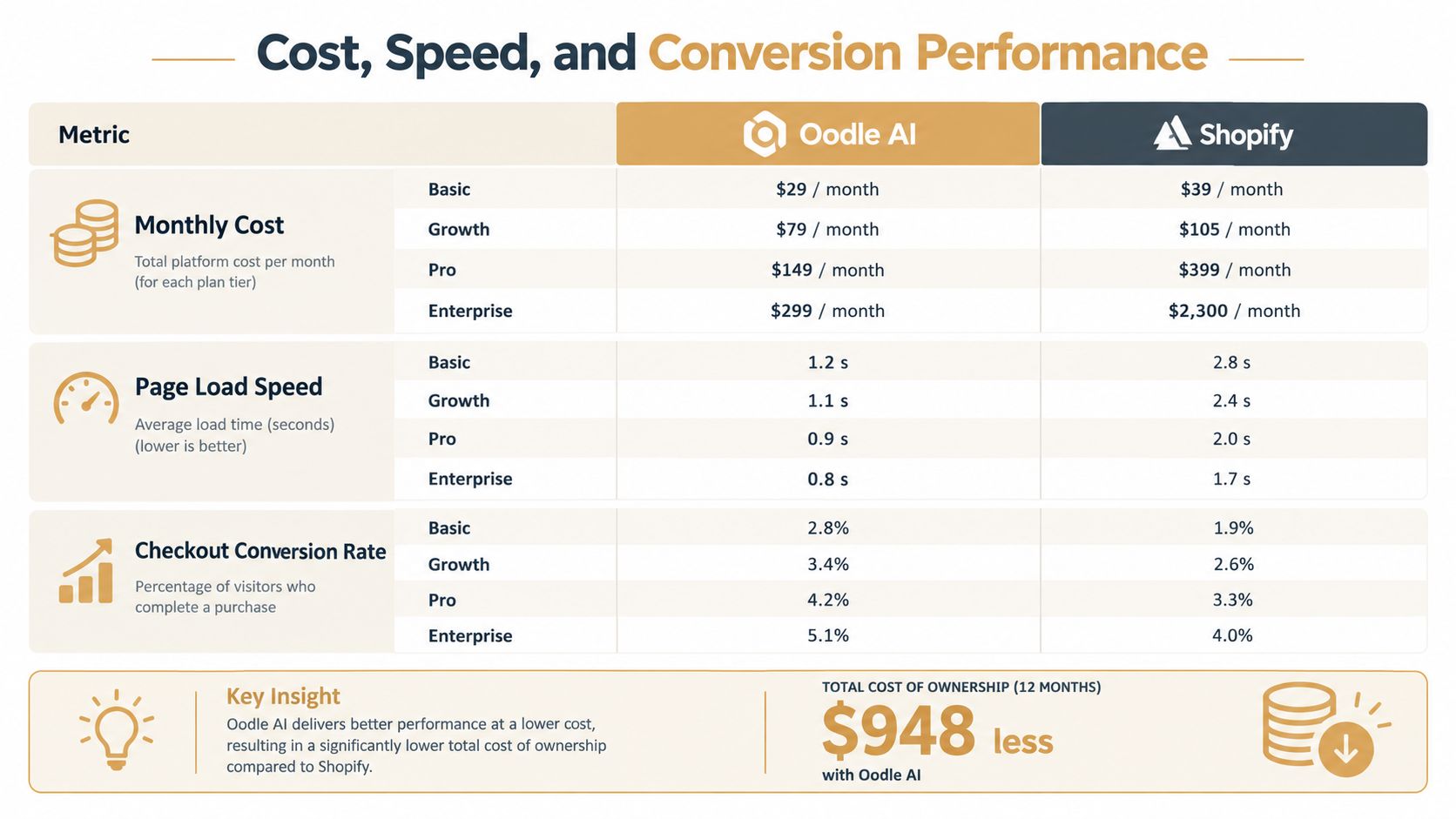
Shopify reports that BigCommerce's total cost of ownership is 45% higher on average, while Shopify Checkout produces a 12% higher average checkout conversion rate than BigCommerce in the commissioned comparison cited by Shopify Enterprise. Because Shopify commissioned the comparison, merchants should treat the figures as vendor-reported evidence rather than a neutral industry benchmark.
| Performance area | Shopify | BigCommerce |
|---|---|---|
| Reported average total cost of ownership | Baseline | 45% higher on average, according to Shopify's comparison |
| Reported checkout conversion | Baseline | 12% lower than Shopify Checkout on average, according to Shopify's comparison |
| Reported server speed | BigCommerce comparison baseline | Shopify server speed reported as 1.9x faster |
| Reported storefront speed | BigCommerce comparison baseline | Shopify storefronts reported as 1.4x faster on average |
| Stores classified as fast | 93% | 80% |
The same Shopify Enterprise comparison reports that Shopify's managed global hosting stack makes its server speed 1.9 times faster and storefronts 1.4 times faster on average, with 93% of Shopify stores classified as fast compared with 80% of BigCommerce stores.
Where the operational cost actually appears
A faster storefront can reduce friction before a customer reaches payment, but it doesn't automatically improve dispute resilience. A merchant can gain checkout efficiency and still lose money if payment alerts arrive in disconnected systems, evidence is incomplete, or the team misses a processor deadline.
BigCommerce's architecture can be financially attractive when native features replace a collection of external tools. Shopify's architecture can be attractive when managed infrastructure, a larger ecosystem, and faster implementation reduce internal workload. The cheaper option depends on which form of complexity your team can control.
The most important distinction is therefore not platform fee versus platform fee. It is managed simplicity versus configuration responsibility. Shopify tends to centralize more of the experience. BigCommerce gives merchants more room to select and configure the components around the platform.
A high-volume merchant should test both models with a workflow exercise. Create a payment dispute, route it through the selected gateway, assign it to an operator, collect evidence, and record the outcome. The exercise reveals more than a plan comparison because it exposes who owns each step after the transaction has already gone wrong.
Catalog Complexity and Built-In Commerce Features
BigCommerce earns its place in the comparison through product architecture rather than market reach. Its platform supports up to 600 variant SKUs per product and 250 option values per option, while also including native multi-storefront, B2B capabilities, open APIs, and flexible checkout customization, as described in BigCommerce's platform comparison.
For a merchant selling configurable industrial products, apparel with many combinations, or products shared across distinct storefronts, those capabilities can reduce dependence on add-ons. The value isn't limited to the number of fields available. Native support can keep catalog rules, customer access, pricing, and storefront presentation closer to the commerce system itself.
Native depth versus app flexibility
Shopify typically approaches specialized functionality through its app ecosystem and platform extensions. That model gives merchants a broad menu of tools and can shorten the path to a niche requirement. It also creates more dependencies, more renewal decisions, and more points where a checkout or customer-data workflow can break.
BigCommerce places more capability inside the core platform, but native depth doesn't mean zero configuration. A complex B2B operation still needs clear data ownership, pricing rules, customer permissions, fulfillment logic, and payment controls. The platform can reduce app dependency while increasing the importance of deliberate implementation.
| Catalog requirement | Shopify tendency | BigCommerce tendency |
|---|---|---|
| Standard product catalog | Fast to configure with ecosystem support | Strong native capability |
| Complex variants | May require tier or extension review | Supports up to 600 variant SKUs per product |
| B2B commerce | Often depends on platform tier and configuration | Native B2B capability is a central strength |
| Multi-storefront | Available through Shopify's ecosystem and platform structure | Native multi-storefront support |
| Custom integrations | Mature ecosystem and platform APIs | Open APIs and flexible configuration |
Teams that advertise across multiple channels should also keep product data structured at the source. A practical guide to centralize product data for ads is useful when a catalog feeds paid media, marketplaces, and multiple storefronts.
Architecture test: If your catalog rules are business-critical, count how many external apps must remain healthy before an order can be priced, paid for, fulfilled, and refunded.
The decision turns on where complexity belongs. Shopify lets merchants buy or build around a highly standardized core. BigCommerce lets merchants keep more of the commerce model inside the platform. For a DTC operator with a straightforward catalog, Shopify's ecosystem may be the faster route. For a B2B or multi-brand operator, BigCommerce's native structure may reduce long-term integration risk.
Dispute Visibility and Payment Routing Differences
The clearest operational difference appears after a customer disputes a transaction. Shopify Payments orders surface disputes inside the Shopify admin, and the chargeback fee in the United States is $15, according to Chargeflow's comparison of Shopify and BigCommerce. BigCommerce routes disputes through the payment processor the merchant selected, so deadlines, evidence requirements, interfaces, and fees vary by gateway.
That distinction changes who owns the workflow. A Shopify Payments team can look for dispute activity in the Shopify environment, while a BigCommerce team may need to monitor Stripe, PayPal, Authorize.net, or another processor separately. BigCommerce's flexibility can be valuable when a merchant needs a particular gateway, but every additional processor creates another operational surface to reconcile.
Centralization has a cost
Shopify's centralized visibility can make alerts easier to find and assign. It can also encourage merchants to concentrate payment operations inside Shopify's ecosystem. If the business later needs a different processor for regional coverage, risk policy, subscription rules, or alternative payment methods, the team must evaluate how that change affects visibility and response procedures.
BigCommerce provides a different kind of control. The merchant selects the processor and can design a payment stack around its own requirements. The price is fragmentation. A dispute team must know which processor owns the transaction, which evidence format applies, when the response is due, and whether refunds or representment actions update the correct order record.
| Operational question | Shopify Payments workflow | BigCommerce gateway workflow |
|---|---|---|
| Where does the dispute appear? | Inside the Shopify admin | Inside the selected processor's system |
| Who defines the deadline? | The payment environment and dispute process | The selected gateway or processor |
| Are fees uniform? | Shopify cites a $15 U.S. chargeback fee | Fees vary by processor |
| Main strength | Centralized visibility | Gateway flexibility |
| Main risk | Ecosystem concentration | Fragmented monitoring and evidence handling |
A dispute workflow should be judged by response speed and consistency, not just by the published payment fee. A merchant that receives an alert but can't assign it quickly may lose more than a merchant paying a less favorable processing rate with better controls.
Payment operations principle: The best routing model is the one your team can monitor continuously, document consistently, and audit after the outcome.
For Shopify merchants reviewing protection options, Shopify chargeback protection is one example of a specialized workflow to evaluate alongside native admin tools, processor alerts, and internal case management. The important question is whether the chosen system can preserve order context and support the team's evidence process without creating another disconnected queue.
Which Platform Fits High-Volume Subscription and DTC Models
The right answer depends on the interaction between transaction volume, catalog complexity, payment routing, and dispute exposure. A subscription merchant may prefer Shopify because its broader ecosystem can support recurring billing, customer lifecycle tools, and DTC operations. A B2B manufacturer may prefer BigCommerce because native catalog and account controls can reduce the number of external dependencies.
Match architecture to exposure
Choose Shopify when:
- DTC is the primary motion: A direct-to-consumer brand that values ecosystem reach, managed infrastructure, and a familiar merchant admin will usually find Shopify the more natural default.
- Subscriptions drive repeat billing: The platform's surrounding ecosystem can provide more options for recurring commerce, but the merchant must test how subscription events, failed payments, refunds, and disputes appear across the selected tools.
- The payment team wants a central operating view: Shopify Payments can keep dispute visibility inside the Shopify admin, which may simplify assignment and escalation.
- The team has limited technical capacity: A more standardized platform can reduce the need to maintain custom connections between catalog, checkout, payment, and reporting systems.
Choose BigCommerce when:
- B2B is central to revenue: Native B2B capabilities can outweigh Shopify's broader ecosystem when customer-specific pricing, account structures, and business purchasing workflows are core requirements.
- The catalog is structurally difficult: The support for up to 600 variant SKUs per product and 250 option values per option makes BigCommerce a stronger candidate for products that don't fit a simple DTC catalog, as documented by BigCommerce.
- Multiple storefronts share operational data: Native multi-storefront capability can reduce the need to assemble that structure from separate systems.
- Gateway choice is strategic: Merchants with processor requirements that don't fit a concentrated payment model may value BigCommerce's gateway flexibility, provided they can operate the resulting workflows.
A useful decision matrix has two axes: the complexity of the commerce model and the cost of payment fragmentation. Shopify is strongest when the commerce model is relatively standardized and the team benefits from centralized operations. BigCommerce becomes more compelling as native catalog and B2B requirements grow, but only if the merchant can invest in processor monitoring and governance.
Subscription operators should run a failure simulation before signing. Test a recurring charge dispute, a refund, a canceled subscription, and an alert that arrives outside normal working hours. A platform can look efficient in a demo while leaving the payment team with unclear ownership during the most expensive events.
For teams using Klaviyo in retention and lifecycle workflows, a Klaviyo chargeback connection can also be part of the evaluation. The question isn't whether marketing data and dispute data should be connected in theory. It's whether the connection helps the team identify the customer, transaction, and policy context required for a timely decision.
Migration Considerations for Dispute-Heavy Accounts
A platform migration can preserve storefront content while damaging payment operations. Product records and theme assets are visible migration tasks. Dispute alerts, processor credentials, refund rules, evidence history, and ownership queues are easier to overlook because they sit outside the storefront.
Start with a processor continuity map. List every gateway, payment method, recurring-billing connection, fraud tool, alert source, and refund path attached to the current store. Then identify which records will remain in the processor, which will move to the new platform, and which will need a replacement integration.
A practical migration checklist
Map dispute ownership before the build begins. For each processor, document who receives alerts, who approves refunds, who prepares evidence, and who confirms the final outcome. Don't assume the new platform will reproduce the old workflow.
Test alert routing with real event types. A successful test payment doesn't prove that a pre-dispute alert, formal chargeback, refund, or representment event reaches the right queue. Use the processor's supported test process and record the destination for each event.
Preserve transaction identifiers. Match the order ID, processor transaction ID, customer record, subscription reference, and refund record wherever possible. Without consistent identifiers, the team may struggle to connect an incoming dispute to the evidence needed to answer it.
Validate recurring-payment behavior. Subscription merchants should test renewals, failed renewals, cancellations, refunds, and customer-initiated disputes. A migration that handles the initial purchase but loses context on later recurring transactions creates avoidable exposure.
Rebuild evidence workflows. Confirm where receipts, delivery records, cancellation terms, customer communications, and product details are stored. Review the process described in chargeback fighting guidance and compare it with the team's actual processor requirements.
Run a controlled cutover. Keep an owner assigned to payment exceptions during launch and reconcile the new platform against processor records. The transition isn't complete when the storefront loads. It's complete when alerts, refunds, and dispute outcomes are being recorded correctly.
Migration rule: Treat payment operations as a separate workstream with its own test cases, owners, and launch approval.
Shopify is usually the more practical choice when a DTC merchant wants a broad ecosystem and centralized administration. BigCommerce is often the better fit when native catalog, B2B, and multi-storefront architecture outweigh the cost of managing gateway-specific dispute workflows. For dispute-heavy accounts, the winning platform is the one that lets your team see every alert, connect it to the right order, and act before a preventable issue becomes a formal chargeback.
Disputely connects payment processors such as Stripe, PayPal, Shopify Payments, and Authorize.net, then routes dispute alerts and refund decisions through configurable workflows. Visit Disputely to assess whether its alert handling fits your Shopify or BigCommerce payment-operations model before you migrate.


