
Charge Back on Credit Card Explained and How to Handle It
You check your credit card statement and spot a charge you don't recognize. Maybe the merchant name looks unfamiliar. Maybe you canceled a subscription, yet another payment appeared. Or perhaps a package never arrived, and the seller hasn't answered. You could contact the merchant, ask for a refund, or call your bank and request a charge back on credit card transaction.
Those choices may look similar from the cardholder's side, but they create different processes. A refund comes from the merchant. A chargeback is a payment reversal initiated through the cardholder's issuing bank and processed under card-network rules. For merchants, that difference affects cash flow, evidence, staff time, and payment-account risk.
Chargebacks have become a large consumer and merchant issue. In the United States, cardholders disputed $65.214 billion in credit card charges in 2023, averaging 5.7 chargebacks per cardholder at about $76 each, according to the 2024 Cardholder Dispute Index from Chargebacks911. A separate industry analysis reported global chargeback volume rising from 238 million transactions in 2023 to 337 million in 2026, a 41% increase, highlighting the pressure on ecommerce, subscription billing, and card-not-present businesses.
This guide is for cardholders who want a clear explanation, and especially for merchants who need to understand the economics behind each dispute. You'll learn what happens after a charge is challenged, why a bank may reverse a payment, which evidence matters, and why confusion and recurring billing often create more preventable disputes than stolen cards.
Introduction to Charge Backs on Credit Cards
A customer sees “XYZ Digital” on a statement, but remembers buying from a brand with a completely different name. The customer searches their inbox, finds nothing obvious, and calls the bank. The bank records the complaint as a dispute, and the merchant may later receive a chargeback notice without ever speaking to the customer first.
From the customer's perspective, contacting the bank can feel safer and easier than finding the right support address. From the merchant's perspective, the sale can suddenly become a debit, accompanied by evidence requests and a response deadline. The merchant may also lose the product, shipping cost, service time, and internal labor connected to the original order.
Key idea: A chargeback is a network-managed reversal of a card payment. It isn't the same thing as asking a merchant to refund a purchase.
Chargebacks exist as a consumer-protection mechanism. They can help when a card was used without authorization, a transaction was processed incorrectly, a promised credit never appeared, or goods and services weren't delivered as expected. They also create room for misunderstandings. A cardholder may forget a purchase, misunderstand a recurring-billing policy, or fail to recognize a statement descriptor.
The merchant's response depends on the reason for the dispute. A genuine unauthorized transaction needs a different response from a duplicate charge. A canceled subscription requires different records from a delivery claim. Treating every case as fraud makes prevention less precise.
A useful guide must therefore answer two questions at once:
- What happened to the cardholder's money?
- What operational failure caused the dispute?
By the end, you'll be able to distinguish a merchant refund from a chargeback, follow the main handoffs between banks and card networks, identify the four root-cause categories, and decide when evidence supports representment. Merchants will also see why a fast, proactive refund can sometimes cost less than defending a dispute after it has formally posted.
What a Charge Back on Credit Card Really Means
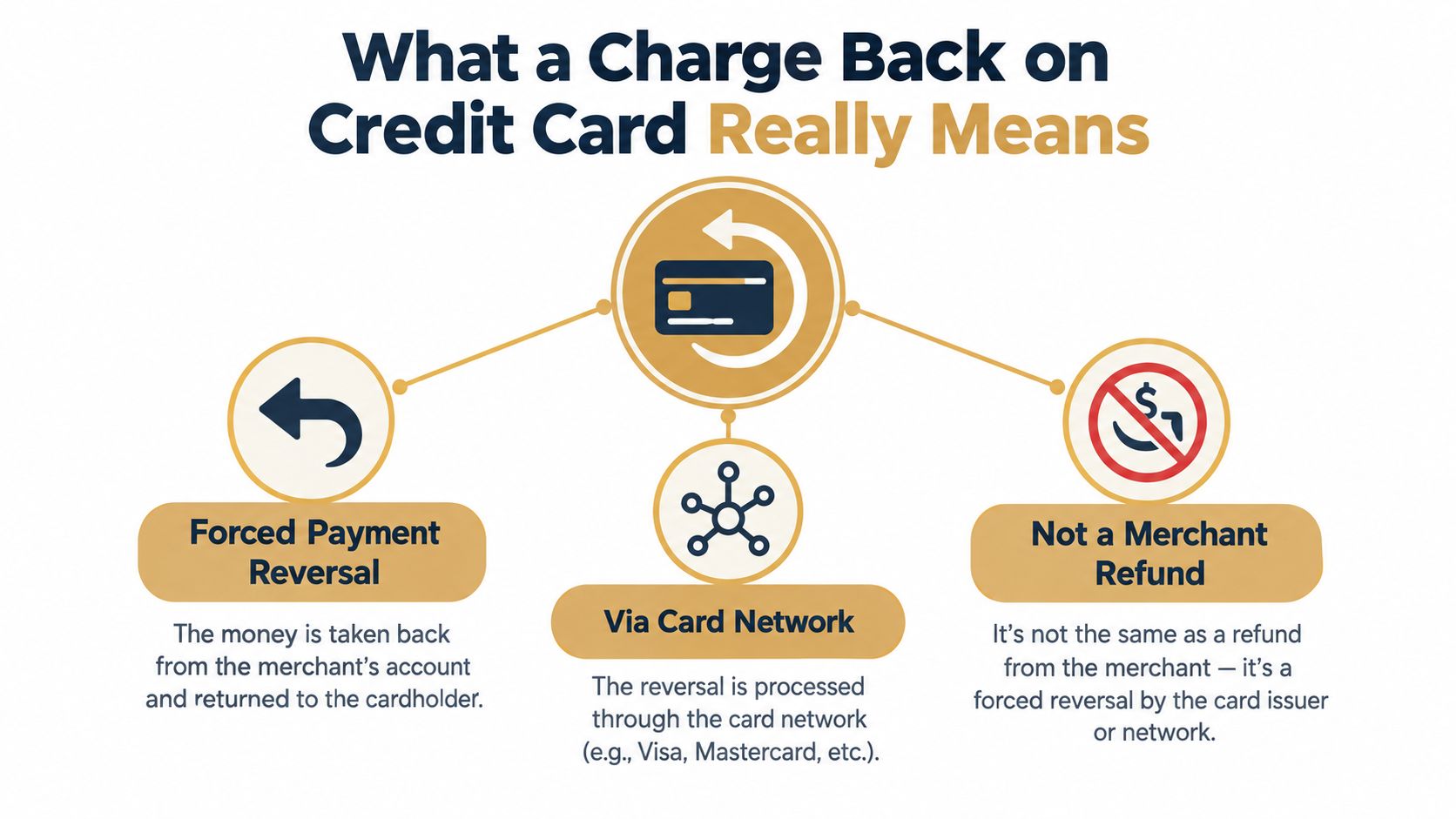
A chargeback happens when the cardholder's issuing bank reverses a card transaction through the payment network. The bank removes, or seeks to remove, the transaction value from the acquiring side and returns the disputed funds to the cardholder under the applicable dispute rules.
The easiest analogy is a sports referee. A customer and merchant complete a play, and the merchant receives payment. Later, the cardholder tells the issuing bank that the play was invalid. The card network supplies the rulebook and process, while the banks move the money backward until the case is reviewed.
The main participants are:
- Cardholder, the person whose account was charged.
- Merchant, the business that accepted the payment.
- Issuing bank, the institution that provided the card.
- Acquiring bank, the merchant's payment-side bank.
- Card network, such as Visa or Mastercard, which sets network rules and routes dispute information.
Chargeback versus refund
A refund starts with the merchant. The merchant agrees to return money, sends the credit through its processor, and usually controls the customer communication.
A chargeback starts with the issuing bank after a cardholder dispute. The merchant's account can be debited before the merchant reviews the case. The merchant then chooses whether to accept the reversal or submit evidence challenging it, a process commonly called representment.
A retrieval request or information request is different again. It asks for transaction records and may occur before a formal financial reversal. A dispute is the cardholder's claim. A chargeback is the payment action that can follow that claim.
A refund is a conversation between customer and merchant. A chargeback is an escalation into the banking and card-network process.
Merchants that want a deeper operational overview can consult this Suby chargeback guide for merchants, particularly when building internal procedures for evidence collection and response handling.
How the Chargeback Process Works Step by Step
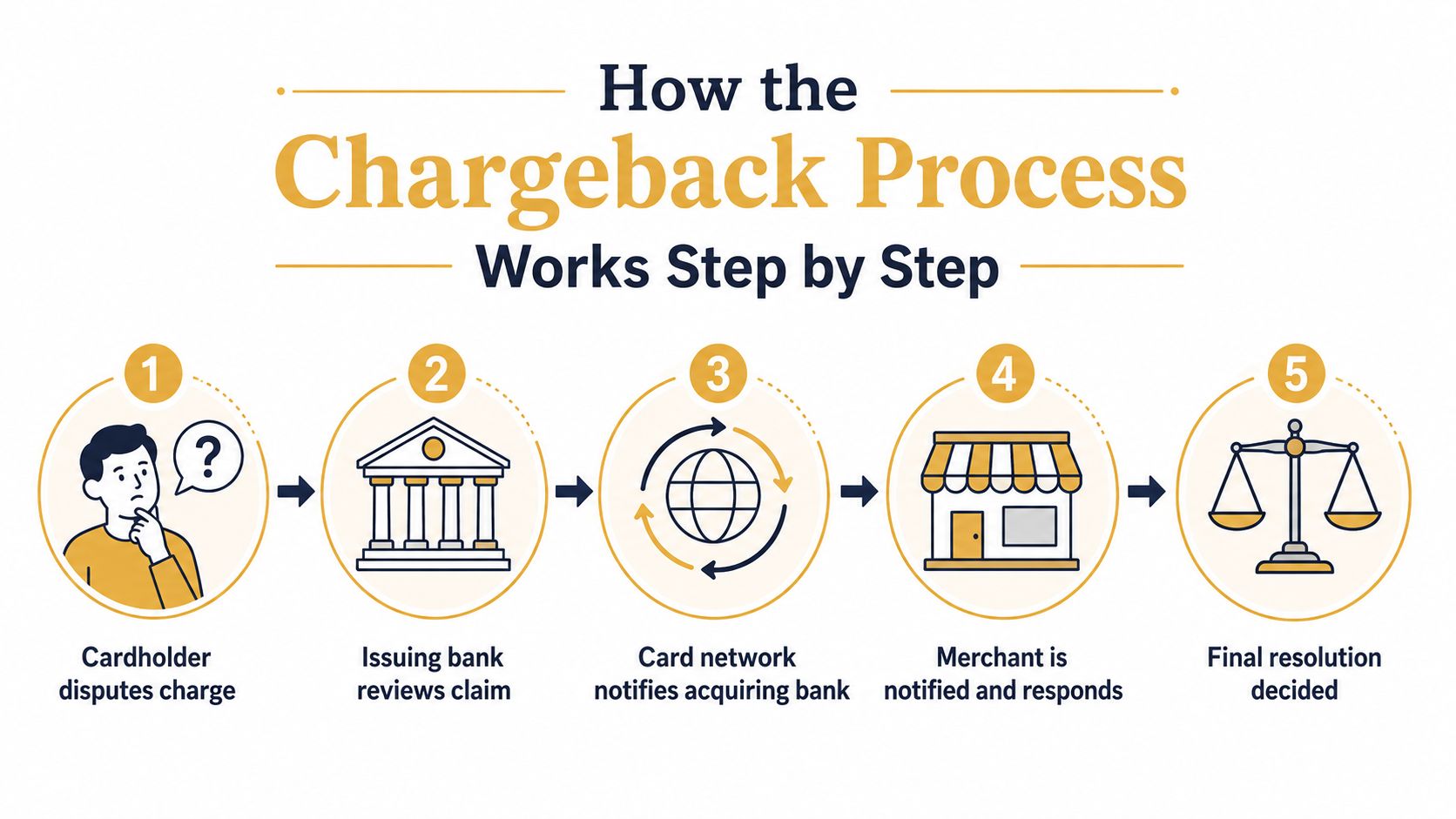
The process begins with a cardholder who believes a transaction is invalid, unauthorized, incorrect, or unresolved. The cardholder contacts the issuing bank, explains the problem, and provides whatever information the bank requests.
The issuer reviews the claim against its dispute rules. If the claim qualifies, the issuer may provide provisional credit to the cardholder while the case moves through the banking and network channels. That credit isn't always the final decision. It gives the cardholder temporary relief while the merchant has an opportunity to respond.
The five main handoffs
First, the cardholder disputes the charge. The customer may contact the merchant first, but they can also go directly to the issuer. The reason selected at this point shapes the evidence the merchant will later need.
Next, the issuing bank evaluates the claim. The issuer checks whether the complaint fits an eligible dispute category and sends the case through the relevant network route. Exact rules and deadlines vary by network and dispute type, so merchants should use the deadline supplied by their processor or acquirer.
Then, the network and acquiring bank notify the merchant side. The acquiring bank debits or places the disputed amount against the merchant account and passes along the case details. The merchant may also receive a chargeback fee or administrative notice.
The merchant accepts or responds. Acceptance closes the matter from the merchant's side, while representment requires a focused rebuttal and supporting evidence. Useful records can include authorization information, transaction details, customer messages, cancellation records, delivery confirmation, and proof that the transaction matched the stated dispute reason.
Finally, the issuer decides whether the evidence changes liability. If the issuer accepts the merchant's case, the disputed funds may return to the merchant. If the issuer upholds the chargeback, the merchant may have an escalation or arbitration option, depending on the network and case type.
A response deadline can arrive before the merchant notices the notification, because network clocks often begin at an earlier process stage. That's why dispute teams need a monitored intake queue rather than a workflow based only on the date an employee opens an email.
Operational rule: Treat every notification as time-sensitive, even when the transaction value appears small.
The embedded video below provides another visual explanation of the process and its participants.
Common Reasons for Charge Backs on Credit Cards
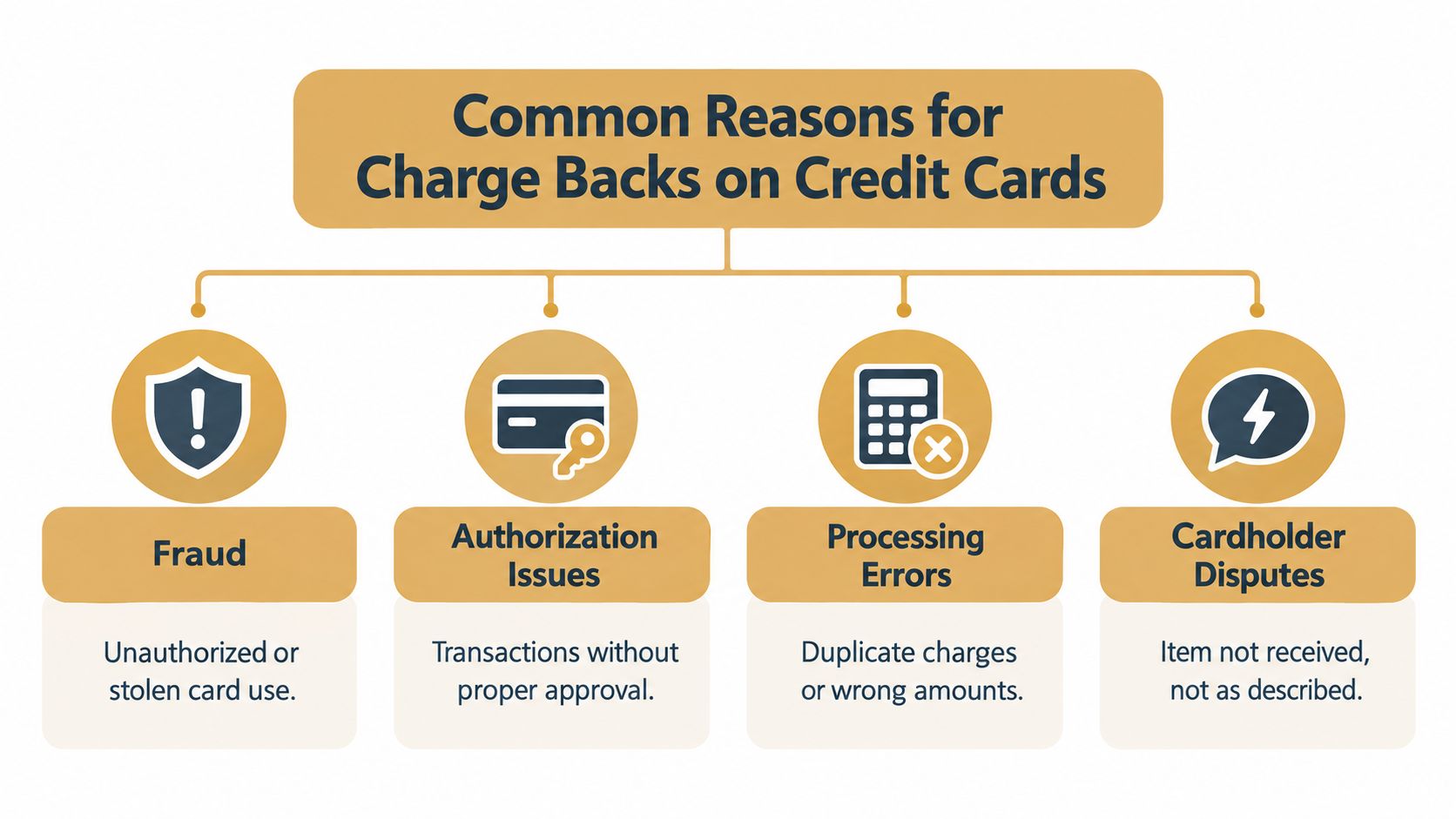
A customer may dispute a payment because a card was stolen, a subscription kept billing after cancellation, or a receipt looked unfamiliar. Each cause points to a different prevention step. Operationally, the four broad root-cause classes are fraud, authorization, processing errors, and cardholder disputes, as described in Fiserv's chargeback handling guidance.
Fraud and authorization problems
Fraud involves a transaction the cardholder says they did not authorize. Relevant records can include authentication results, device and transaction signals, delivery information, and evidence that the payment passed available security checks. These records support the merchant's response, but they do not guarantee a favorable outcome.
Authorization issues concern whether the merchant obtained valid approval and followed the required payment process. A transaction may fail because authorization was missing, invalid, expired, or handled incorrectly. The remedy usually belongs in payment controls, authentication, and transaction-flow design rather than a general customer-service reply.
Processing errors and customer disputes
Processing errors include duplicate charges, wrong amounts, confusing descriptors, and failures during capture, settlement, or refund handling. Gateway logs, order records, refund events, and settlement data can show whether a technical or operational defect caused the dispute.
Cardholder disputes include goods not received, services not provided, merchandise not as described, or a credit that was not issued. Evidence must answer the stated complaint. A delivery record may support a non-receipt claim, but it does not explain why a recurring payment continued after cancellation.
Recurring billing deserves special attention. The Consumer Financial Protection Bureau reported that canceled recurring transactions represented 40% of disputes for general-purpose cards in 2024. The CFPB's 2025 consumer credit card market report also identifies services not received and canceled or unissued credits as major dispute categories. Clear renewal notices, recognizable billing descriptors, and prompt cancellation handling can prevent confusion before it becomes a filed dispute.
Mastercard's research describes continued growth in first-party fraud and consumer misuse. Its global outlook projects 324 million chargeback transactions by 2028, up from an expected 267 million in 2025. The Mastercard Global Chargebacks Outlook supports examining forgotten purchases and recurring-billing confusion alongside stolen-card activity.
For that reason, prevention and alert-based refunds can be more efficient than contesting every dispute after filing. A merchant that identifies a canceled subscription or clear billing mistake early may resolve the confusion before it becomes a network case.
What Chargebacks Cost Merchants and Why Ratios Matter
A merchant doesn't lose only the face value of a disputed transaction. The total exposure can include the reversed sale, goods or services already delivered, customer support time, representment labor, processor fees, and costs associated with payment-account monitoring.
Academic research from the Kansas City Fed found that Visa and Mastercard chargebacks averaged 1.6 basis points of sales volume and 6.5 basis points of sales value, while approximately 70% to 80% were ultimately resolved as merchant liability. The Kansas City Fed working paper shows why a low-looking rate can still create meaningful exposure across a large transaction base.
Why the ratio changes the economics
Card networks monitor dispute ratios rather than looking only at isolated cases. Mastercard's Excessive Chargeback Merchant program is triggered at 100 or more chargebacks per month and a 1.5% chargeback-to-sales ratio, according to the network threshold guide. Visa's updated excessive-merchant thresholds move to a 1.5% combined fraud-and-dispute ratio in several regions from April 1, 2026, after previously using 2.2% in those contexts.
Once a merchant enters monitoring, the cost can rise quickly. Processors may review the account more closely, require reserves, or place pressure on the merchant to improve controls. The economic shift is nonlinear because the merchant is no longer managing only individual disputes. It's managing the stability of its payment relationship.
| Metric | Typical value | Why it matters |
|---|---|---|
| Visa and Mastercard chargebacks as sales volume | 1.6 basis points | A small rate can still represent recurring operational work across a large payment base. |
| Visa and Mastercard chargebacks as sales value | 6.5 basis points | Value exposure can exceed what a simple transaction count suggests. |
| Chargebacks resolved as merchant liability | About 70% to 80% | Merchants need evidence and prevention because liability often remains on their side. |
| Mastercard ECM trigger | 100+ chargebacks monthly and 1.5% ratio | Crossing both conditions can place the account into monitoring. |
| Visa updated excessive-merchant threshold | 1.5% combined ratio in several regions from April 1, 2026 | A lower threshold can make early prevention more important. |
Merchants can use a chargeback rate explanation and monitoring resource to review how ratio calculations affect payment operations. The central decision is simple: prevent a dispute before filing when possible, then reserve representment time for cases where the transaction records directly answer the customer's claim.
Real World Examples of Charge Backs on Credit Cards
A subscription customer submits a cancellation request, yet another recurring charge appears. The bank receives a claim that billing continued after cancellation. The merchant may show that the request arrived after the billing event, but an unclear cancellation path can still make the customer reasonably believe the charge should have stopped.
A prompt refund may cost less than a formal dispute. Each case can involve staff review, payment processing work, evidence collection, and lost goods or services. For a low-value recurring charge, resolving the confusion early can protect the relationship and avoid work that begins only after a chargeback is filed.

The descriptor problem
A shopper buys from a brand whose legal billing name differs from its storefront name. The statement displays the legal name, so the shopper assumes the payment was unauthorized. A valid receipt and delivery record may support the merchant's case, but a recognizable descriptor, clear receipt, and accessible support link could have prevented the dispute.
The records may prove that a purchase occurred without explaining why the customer failed to recognize it. That makes this type of chargeback more preventable than winnable. Updating the descriptor and post-purchase messages addresses the source of the confusion, rather than treating every unfamiliar-name claim as a fraud attack.
A small wording change can work like a label on a package. It tells the customer who charged the card before uncertainty turns into a bank claim.
The missing-delivery claim
A customer reports that an order never arrived. The merchant has a carrier scan, delivery address, and customer messages, but the parcel may have been left in an exposed location or delivered to a shared building. Delivery evidence can support representment, yet a replacement or refund may make better commercial sense when the records do not clearly establish possession.
The right response depends on the evidence, transaction value, customer history, and likely escalation cost. A merchant should not fight every case automatically. It should compare the cost of gathering evidence with the value of resolving the customer's problem promptly.
Merchants can review Shopify chargeback protection options when recurring billing or ecommerce volume makes manual review difficult. Prevention and alert-based refunds often work best for understandable billing mistakes, while representment fits cases where transaction records directly answer the customer's claim.
How to Prevent and Respond to Charge Backs Effectively
Prevention starts before the payment is captured. Use a recognizable billing descriptor, put the merchant name on receipts, explain recurring terms near the purchase button, and make cancellation easy to find. Send confirmation messages that state what was purchased, when future billing occurs, and how the customer can request help.
Authentication and fraud controls still matter. Apply stronger verification to suspicious transactions, use velocity rules to identify unusual purchase patterns, and preserve the authorization data needed for a later response. At the same time, don't let fraud screening distract from ordinary operational causes such as duplicate capture, unclear cancellation, or delayed refunds.
A practical response matrix
| Situation | First response | Evidence or control |
|---|---|---|
| The payment appears genuinely unauthorized | Accept or resolve according to the applicable process | Authentication results, fraud-screening records, and account activity |
| The customer was billed after a credible cancellation | Review the timeline and consider a prompt refund | Cancellation timestamp, billing event, policy disclosure, and support history |
| The customer doesn't recognize the merchant name | Contact the customer and clarify the transaction | Descriptor, receipt, order confirmation, and customer communication |
| The order was delivered and the claim conflicts with records | Consider representment | Delivery confirmation, address match, tracking, and relevant correspondence |
| The merchant caused a duplicate or incorrect charge | Refund promptly and correct the billing workflow | Gateway logs, order records, capture events, and refund confirmation |
For formal representment, write the rebuttal around the dispute reason, not around the merchant's general history. Put the relevant transaction record first, explain the timeline plainly, and attach only evidence that answers the claim. Store cancellation, delivery, authentication, and customer-service records in a searchable system so staff don't lose time reconstructing events.
Alert-based workflows can intercept eligible disputes before they become filed chargebacks. Visa RDR, Mastercard CDRN, and Ethoca alerts can give a merchant a short window, commonly described by the provider as 24 to 72 hours, to issue a refund and prevent escalation. Disputely is one option that connects with those alert systems, applies merchant refund rules, and provides dispute analytics for payment teams. Merchants evaluating representment can also review chargeback-fighting support alongside their processor's own tools.
Decision rule: Refund when the customer's claim is credible, the transaction value is modest, or the evidence is weak. Fight when the records directly contradict the claim and the recovery case justifies the work.
Review dispute data by root cause, billing product, descriptor, payment method, and customer journey. Set owners for cancellation requests, refund confirmations, alert handling, and response deadlines. That combination turns chargeback management from emergency paperwork into a measurable payment-control process.
Disputely helps ecommerce and subscription merchants receive card-network alerts before eligible disputes become formal chargebacks, then apply configured refund rules and monitor dispute patterns. Visit Disputely to see how alert-based prevention and representment workflows can fit your payment operation.


