
Chargeback Analyst Job Description and Hiring Guide

The average chargeback rate reached 0.26% in the third quarter of 2025, a 53% increase from the first quarter, according to Sift's disputes index. For a payments leader, that's a reason to hire for judgment, not just faster evidence collection.
A useful chargeback analyst job description defines who decides whether to prevent, refund or fight a dispute, what authority they have, and how the business measures the result. Hiring someone to contest every case can waste labor. Hiring someone to refund every alert can give away revenue the merchant could reasonably retain.
Core Responsibilities by Dispute Stage
A chargeback analyst is a payments-investigations and revenue-protection professional who owns the dispute lifecycle across cards, digital wallets and alternative payment methods. The StockX chargeback analyst posting illustrates that operational and analytical scope, including evidence repositories, service-level agreements and loss forecasting. The analyst works with Finance, Payments, Customer Support, Operations, Engineering, Legal, Compliance and Trust because the cause of a dispute often sits outside payments.
Assign a deliverable to each stage
Intake and classification. Read the alert or network notification, identify the reason code, and record whether the transaction was card-present or card-not-present. The output is a classified case record, not an unread notification forwarded to Support.
Eligibility check. Confirm the response window, applicable liability rules and whether the claim is contestable. Produce a go or no-go decision with a documented reason before spending time building evidence.
Evidence assembly. Retrieve order, delivery, login, refund and customer-communication records. Assemble a timestamped evidence packet that addresses the actual allegation rather than attaching every available document.
Representment submission. Write a concise narrative and submit through the processor. Retain the submitted response and confirmation so the team can prove what it sent and when.
Deadline tracking. Maintain a live case calendar keyed to notification date, network, reason code, processor and escalation stage. Record aging, service-level breaches and escalations throughout the case, not just before submission.
Reconciliation. Match outcomes to settlements, refunds and credits. Deliver a reconciled ledger that Finance can use without reconstructing the case history.
Root-cause reporting. Group disputes by reason code, product, cohort and billing model. Send a monthly remediation list to named owners, with enough detail for them to investigate and act.
Separate activity from accountability
For chargeback fighting, define who approves the response and who authorizes costly escalation. A junior analyst shouldn't inherit unrestricted authority just because they can access the processor dashboard.
Duties alone don't define the job. Require analysis, forecasting and preventive-control recommendations alongside case execution, with reporting responsibilities and decision rights written into the posting.
The Decision Analysts Own
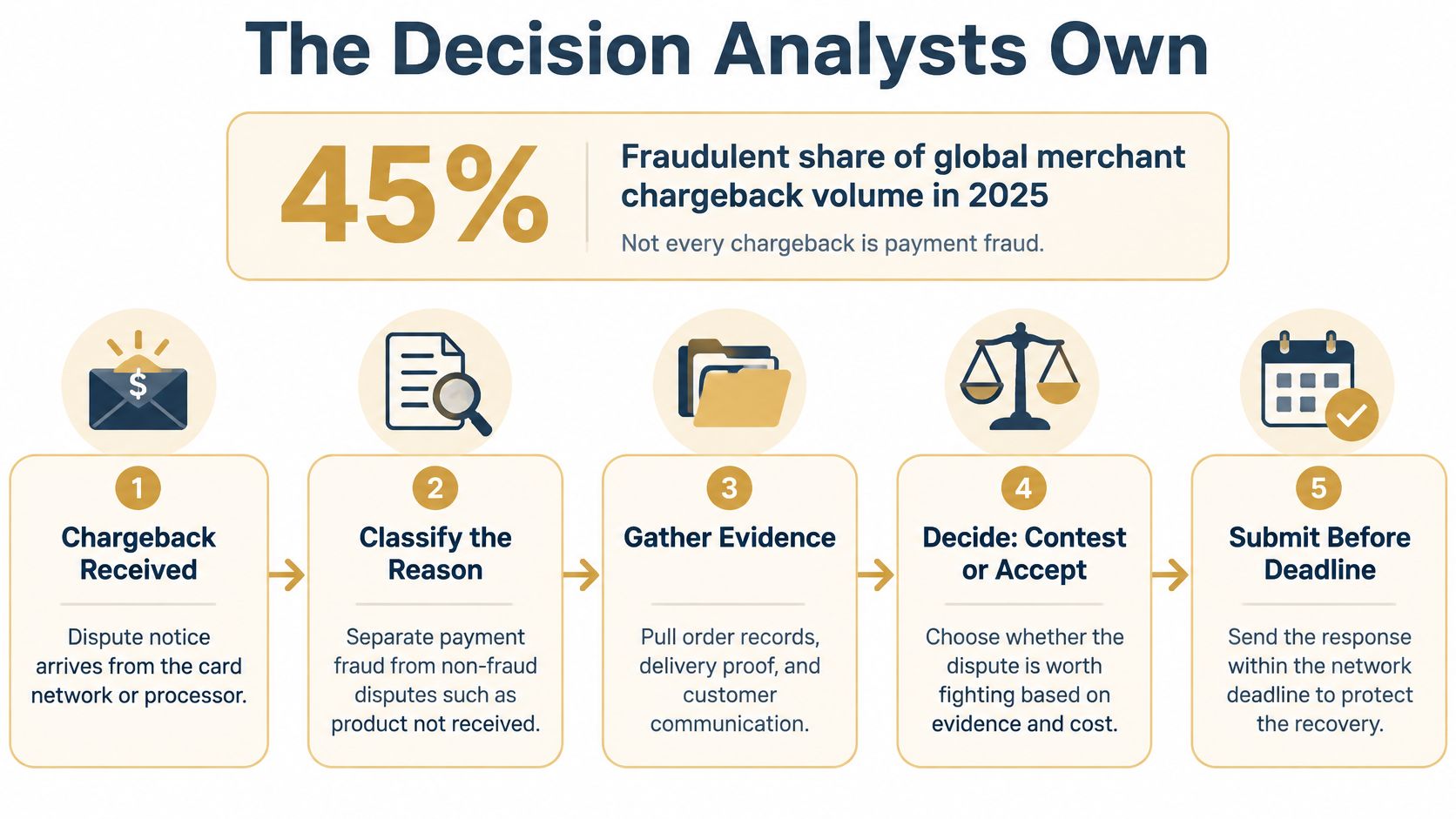
Merchants need analysts who distinguish third-party fraud, first-party misuse and genuine dissatisfaction. Mastercard's chargeback-cost analysis indicates that fraudulent chargebacks represented about 45% of global merchant chargeback volume in 2025. Treating every customer claim as payment fraud leads to poor decisions.
The workflow below shows where classification and evidence inform the decision.
Make the economics explicit
Start with expected recovery: recoverable amount multiplied by the probability of successful representment. Subtract incremental labor, processor fees and foreseeable escalation costs, then consider customer lifetime value and the risk of unnecessary refunds. Don't count costs already incurred as savings from contesting.
| Scenario | Preferred action | Reason |
|---|---|---|
| Low-value alert, item never received, refund costs less than representment | Refund before filing | Labor and fees exceed expected recovery |
| High-value order with signed delivery proof | Contest when the proof addresses the claim | Expected recovery outweighs cost |
| Repeated disputes from one account pattern | Contest supported cases and flag the account | Possible friendly fraud or misuse warrants investigation |
| Subscription disputed after a logged cancellation request | Contest with consent and cancellation evidence only if the charge remained valid | Records must establish that billing complied with the agreement |
| Confirmed product defect | Refund and escalate to Product | The root cause sits outside payments |
| Duplicate charge from billing error | Refund promptly and fix billing | Remove the error before it generates another dispute |
A cancellation log isn't automatically evidence for the merchant. If it shows billing continued after an effective cancellation, accept responsibility rather than arguing that historical consent overrides the request.
At Disputely, when we detect a chargeback threat, we automatically process a refund to prevent the chargeback. That makes merchant-authorized rules consequential: automatic refunds can be economical for weak, low-value cases but create leakage on defensible orders.
Hiring requirement: Own pre-dispute workflows, refund thresholds, alert triage and root-cause fixes, not only post-chargeback submissions.
Skills, Tools and Data Access Every Analyst Needs
Each day-one competency should support a specific dispute stage. Require operational access and reasoning, not familiarity with a long list of software logos.
The Visa merchant dispute-management guidelines provide the evidence standard: establish what was purchased, show delivery, availability or use as agreed, and link the transaction to the cardholder's participation or benefit.
Test the work directly
These are suggested hiring exercises, not industry benchmarks.
| Competency or tool | Day-one level | How to verify |
|---|---|---|
| Visa and Mastercard reason codes | Working knowledge | Map three sample codes to required evidence |
| SQL or spreadsheet reconciliation | Intermediate | Match 50 sample disputes to a settlement report |
| Processor dashboards including Stripe, PayPal, Shopify Payments, Authorize.net and Square | Operational in the merchant's stack | File a sample response in a sandbox or demo |
| Order-management and fulfillment systems | Query by order ID and tracking number | Retrieve delivery proof for a sample order |
| CRM and support history | Read and summarize | Condense a customer thread into three lines |
| Authentication data including 3-D Secure, AVS and CVV | Interpret results | Explain what an AVS mismatch does and doesn't establish |
| Representment writing | Concise, evidence-linked narrative | Write a 200-word response in a proposed 30-minute exercise |
| Privacy and payment-data handling | Required | Resolve an access-and-retention scenario |
For subscriptions, include billing consent, cancellation logs and recurring-billing communications. Preserve timestamps and immutable source records; don't overwrite originals while preparing a response.
HiredBySkill's guide to skills for no-degree data analyst roles is useful when designing skills-based screening rather than making a degree the default filter. For merchants evaluating Shopify chargeback protection, test whether candidates can connect order events to payment and dispute records.
Define the data boundary
Require least-privilege access, PCI-conscious handling and approved retention practices. Candidates shouldn't export unnecessary payment data to personal spreadsheets.
At Disputely, we share order and customer data with processors, card networks and banks for dispute responses, representations or fraud investigations as merchants authorize. We initiate refunds and related processor or alert-network communications only on the merchant's authorization; document that boundary in the analyst's operating procedures.
KPIs Chargeback Analysts Are Measured On
Merchant dispute-response deadlines typically fall 20 to 45 days after notification, according to the Mastercard chargeback guide. That range isn't permission to use a generic countdown. The analyst must follow the actual processor cutoff and applicable case rules.
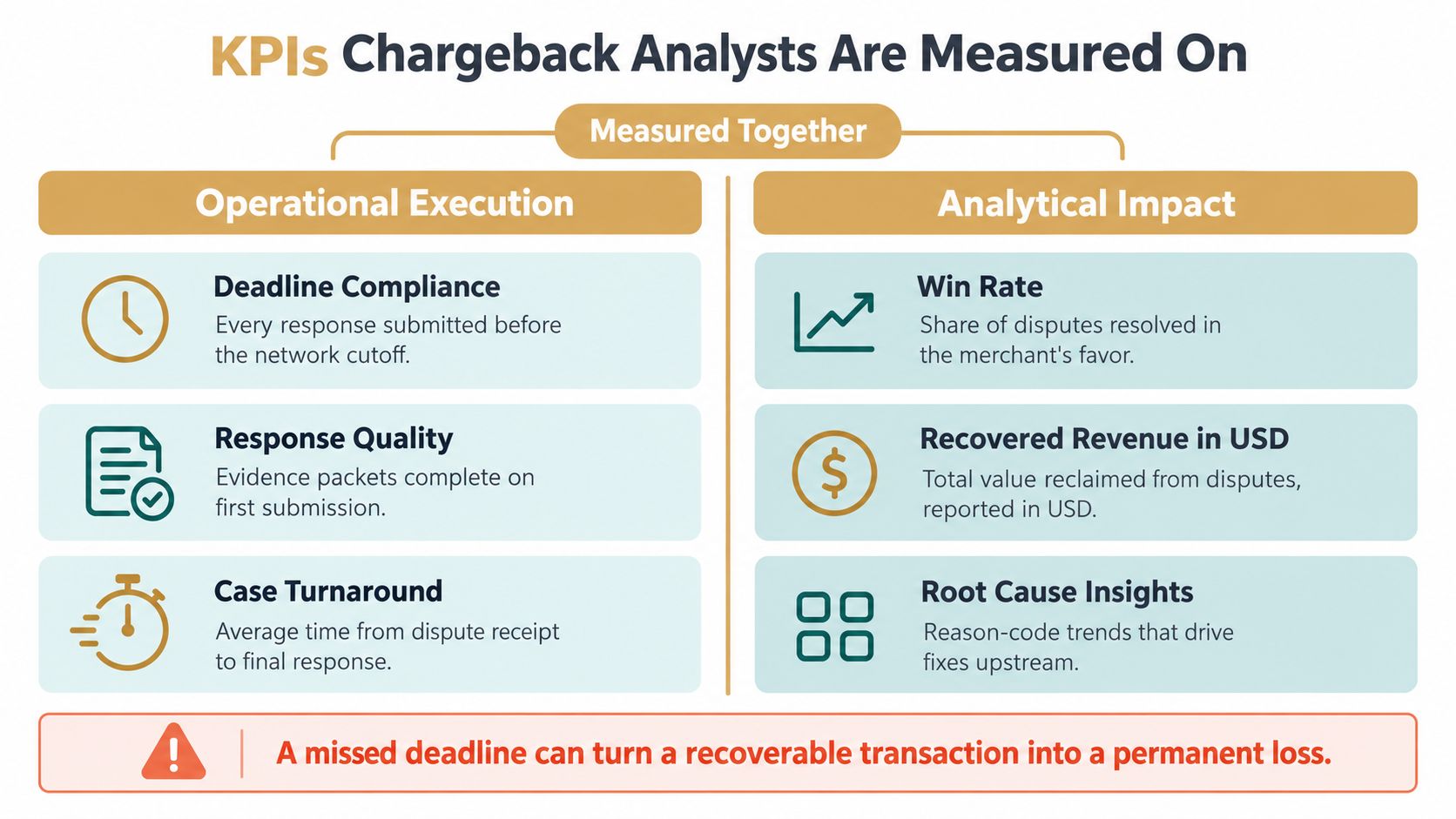
Measure operational execution and analytical impact together. A missed deadline can turn a recoverable transaction into a permanent loss, while a timely but uneconomic submission can still waste money.
This dashboard separates execution measures from business outcomes.
Define the denominator before setting targets
The chargeback analyst job description should name the metrics, but the operating manual must define their populations and reporting periods. Otherwise, Finance and Payments can produce different answers from the same case records.
| KPI | Formula | Why it matters |
|---|---|---|
| Response timeliness | Responses submitted before deadline ÷ responses due | Exposes preventable deadline losses |
| Representment rate | Cases contested ÷ cases received | Shows contesting selectivity |
| Win rate by reason code | Cases won ÷ cases contested, per code | Identifies where evidence works |
| Recovered amount | Sum of won amounts | Measures gross recovery |
| Net recovery | Recovered amount minus labor and processor fees | Measures economic value |
| Prevented disputes | Alerts resolved before filing | Tracks pre-dispute work |
| False-refund rate | Refunds on disputes assessed as winnable ÷ total refunds | Estimates avoidable revenue leakage |
| Repeat-dispute rate | Customers with more than one dispute ÷ customers who disputed | Highlights recurring account patterns |
| Dispute rate by cohort | Disputes ÷ transactions, segmented by product, cohort, merchant and billing model | Locates dispute pressure |
Calculate outcome metrics on mature cases or clearly label pending decisions. Comparing newly submitted cases with fully resolved cases creates misleading performance differences between analysts.
For recovered amount, distinguish a favorable decision from cash that has been credited. Reconciliation should support the amount reported to Finance, and reversals should flow back into the reporting period under an agreed accounting convention.
Don't reward the wrong behavior
Win rate alone can reward cherry-picking easy disputes. A target centered on total wins can push analysts toward contesting everything, including cases with little economic merit.
Pair win rate with representment rate and net recovery. An analyst who accepts weak cases and produces stronger economic results may be doing better work than someone with impressive submission volume.
False-refund rate requires particular care because the outcome of an unsubmitted case is unknowable. Treat it as an audited estimate based on documented eligibility and evidence review, not a directly observed fact.
A refund decision can be reasonable when made and still look unfavorable later. Evaluate the information available at the decision time, not just the eventual customer behavior.
Prevented disputes need similar discipline. An alert resolved before filing is an operational count, not proof that every resolved alert would otherwise have become a chargeback.
For a high chargeback rate, separate merchant-wide exposure from individual analyst performance. Analysts can identify a broken cancellation flow, but Product or Engineering may control the fix.
Give each report an owner and an action
A useful queue report identifies approaching cutoffs, missing evidence and cases awaiting approval. The calendar should distinguish representment, pre-arbitration, arbitration and compliance paths so no one treats every escalation as another routine upload.
A management report should connect outcomes to decisions:
- Payments: Processing errors, duplicate-charge patterns and processor reconciliation issues.
- Support: Unanswered refund requests, unclear resolutions and recurring communication failures.
- Product and fulfillment: Defects, delivery failures and cancellation problems with identifiable owners.
- Finance: Realized recovery, operating cost and changes to the loss forecast.
Use video training as supporting material, not as a substitute for a documented metric dictionary and case-review procedure.
Ask candidates which two KPIs they'd report weekly and which they'd report monthly, and why. Strong answers distinguish urgent queue control from outcomes that need time to mature, and explain what management should do when a metric deteriorates.
Sample Job Postings for Junior and Senior Roles
Mastercard's global chargebacks outlook reports approximately $34 billion in debit- and credit-card transactions disputed and charged back during 2025, and projects 324 million chargebacks by 2028. The hiring implication is straightforward: this is a payment-control function, not a narrow accounts-receivable task.
Use the following as adaptable posting language. Set compensation, location and authority before publication rather than leaving candidates to infer them.
Junior analyst posting
Title: Chargeback Analyst
Summary: Investigate assigned disputes, prepare eligible responses and maintain accurate case and settlement records.
Responsibilities: Work an assigned queue through classification, evidence preparation, submission and reconciliation. Report weekly win rate and aging; coordinate with Customer Support and Payments.
Requirements: Demonstrated payments-operations, collections or fraud-review experience. Require network-rule knowledge, evidence standards, reason-code analysis, cohort and trend analysis, and the ability to support loss forecasting. Accept equivalent practical experience demonstrated through the hiring exercise.
Nice to have: Subscription billing, ecommerce fulfillment or digital-wallet dispute experience.
Tools: Relevant processor dashboards and spreadsheets.
Reporting line: Payments Operations lead or designated dispute manager.
Compensation: Hiring team to set and approve the pay range before publication.
Location: Hiring team to specify work location, time-zone coverage and attendance expectations.
Senior analyst posting
Title: Senior Chargeback Analyst, Disputes and Revenue Protection
Summary: Own dispute economics, pre-dispute policy and the root-cause program.
Responsibilities: Set refund thresholds within delegated authority, review escalation decisions and deliver monthly net recovery, loss forecasts and false-refund reviews. Coordinate corrective work with Finance, Legal, Product, Compliance and Trust.
Requirements: Hiring team to set experience expectations based on case complexity and decision authority. Require network-rule knowledge, evidence standards, cohort and trend analysis, reason-code analysis, loss forecasting and defensible economic prioritization.
Nice to have: Experience designing dispute controls, coaching reviewers and implementing cross-functional fixes.
Tools: SQL, BI dashboards and rule configuration.
Reporting line: Head of Payments, Risk or Finance, with a named escalation approver.
Compensation: Hiring team to establish the pay range.
Location: Hiring team to define jurisdiction, coverage and working arrangement.
Interview Questions and What a Strong Answer Covers
A candidate who always refunds or never refunds has a single-rule mindset. Neither approach is adequate when evidence quality, customer circumstances and recovery costs differ.
Interview for reasoning rather than vocabulary. Each question should test a competency the analyst will use, and the strongest candidates should identify missing information before choosing an action.
Use a consistent case-based interview
| Question | Strong answer covers | Red flag |
|---|---|---|
| Walk me through a dispute from alert to outcome | Intake, reason code, evidence, deadline tracking and reconciliation | Describes emailing the customer and waiting |
| A subscriber says they never cancelled. What do you pull? | Clarifies the claim; checks billing consent, cancellation logs, usage and communications | Refunds without checking records |
| When would you refund instead of contest? | Expected recovery, incremental costs and false-refund risk | Always refunds or never refunds |
| How do you write a representment narrative? | Short timeline, with evidence linked to each relevant claim | Long emotional story without evidence references |
| How do you handle a missed deadline? | Escalation, loss documentation, root-cause review and process correction | Blames the processor or another team without a fix |
| Reconcile a sample set of 200 disputes to a settlement report | Joins on reliable IDs, flags mismatches and documents control totals | Copies rows manually without a completeness check |
For the subscription question, listen for clarification. A customer saying they never cancelled might be disputing an unexpected termination, denying a cancellation record or describing the claim imprecisely.
A strong analyst doesn't rewrite the allegation to fit a familiar template. They confirm what the customer disputes, which billing event is involved and what resolution the customer requested.
Make the exercise realistic
Give every candidate the same synthetic case file. Include an order record, processor notification, support thread, refund history and a small number of irrelevant records so candidates must select evidence rather than merely assemble it.
For a proposed timed exercise, ask the candidate to:
- Classify the case: Identify the allegation, applicable evidence and any eligibility question.
- Choose an action: Explain the decision and what additional information could change it.
- Draft the response: Produce a neutral narrative with evidence references.
- Record the next step: State the owner, approval requirement and deadline source.
Don't use a live customer case or ask candidates to perform unpaid production work. Synthetic records also make comparisons fairer because each applicant faces the same gaps and contradictions.
In the reconciliation task, include duplicate identifiers, partial refunds and unmatched settlement entries. The important result isn't a tidy spreadsheet; it's whether the candidate can show that all records were accounted for and explain unresolved differences.
Score observable behavior
I would use a proposed one-to-four scoring scale against the strong-answer column:
- One, unsafe: Misses the central issue or proposes an unauthorized action.
- Two, incomplete: Understands the task but needs substantial prompting.
- Three, operationally sound: Reaches a defensible answer and documents the reasoning.
- Four, independently strong: Handles ambiguity, identifies control gaps and explains trade-offs.
Record evidence for the score immediately after each answer. Avoid replacing the assessment with impressions such as confident, polished or a good culture fit.
Weight the refund-versus-contest and reconciliation questions most heavily for senior candidates. Senior ownership requires both economic judgment and reliable financial controls; presentation skills can't compensate for weakness in either.
Interview signal: The strongest answer can be a conditional decision with a precise request for missing evidence. Unsupported certainty isn't expertise.
For junior candidates, distinguish a trainable knowledge gap from unsafe judgment. Someone who needs help locating a network rule but knows not to submit an unsupported claim may be a better hire than someone who confidently invents an answer.
Finally, have reviewers score independently before discussing candidates. That makes it easier to identify whether disagreement concerns an actual skill gap or a different interpretation of the role.
Onboarding and the First 90 Days
Consider a new analyst joining a subscription merchant with scattered support records and an established processor dashboard. Giving them a queue immediately would test their ability to work through undocumented systems, not their dispute judgment.
Use a staged ramp with explicit handovers. The timeline below is a proposed onboarding design, not a guarantee of when every hire will be ready.
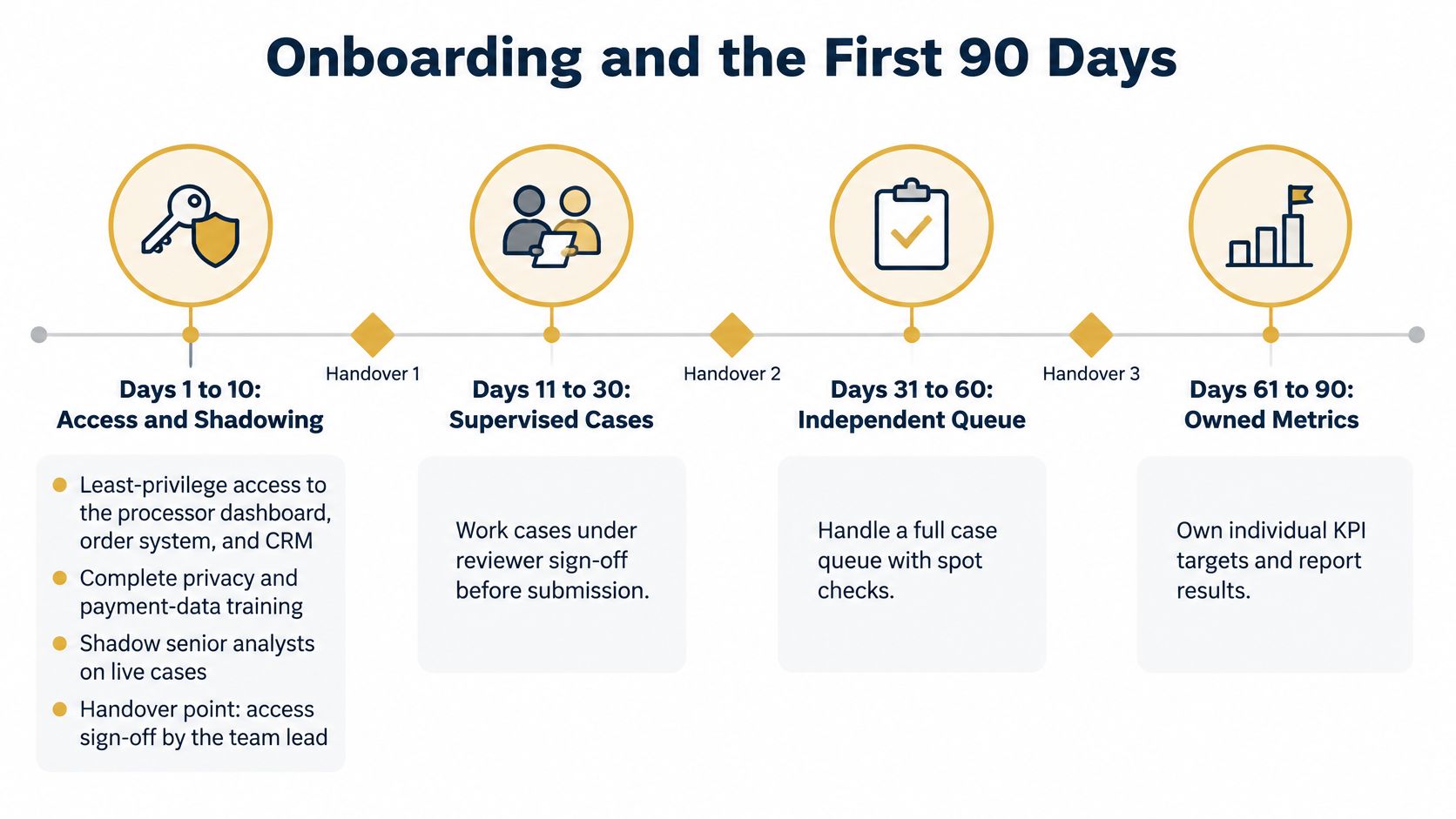
Days 1 to 10
Grant least-privilege access to the processor dashboard, order system and CRM. Complete privacy and payment-data training before the analyst exports records or handles submissions.
Have the new hire shadow closed-case reviews for the merchant's top three reason codes. Closed cases let the reviewer connect the original decision to the evidence, outcome and settlement entry.
- Access check: The team lead confirms permissions and approved storage locations.
- Case explanation: The analyst explains why a reviewed case was accepted or contested.
- Handover point: The lead signs off on access and readiness for supervised work.
The new hire should also know whom to contact when a system is unavailable. A documented fallback is more useful than assuming the analyst will find someone in a chat channel.
Days 11 to 30
Assign a low-value queue with reviewer approval before submission. The analyst checks the case calendar daily and records missing evidence early enough for the responsible team to respond.
The reviewer should evaluate decisions, not just grammar. If the case shouldn't be contested, polishing the narrative doesn't make the submission worthwhile.
Require the analyst to retain submission confirmations and record unresolved settlement questions. The handover occurs when the reviewer can trust the case record without rebuilding it from source systems.
Days 31 to 60
Transfer representment ownership for assigned reason codes, with spot checks rather than universal approval. Keep unfamiliar escalation paths outside that authority until the analyst demonstrates readiness.
Ask for the first root-cause report to Payments or Support. For the subscription merchant, that might identify customers who contacted Support before disputing and determine whether a cancellation workflow failed.
The report should contain:
- A defined pattern: The affected cases and the method used to group them.
- Supporting records: Evidence that separates a system problem from isolated complaints.
- An accountable owner: A team that can investigate or implement the change.
- A validation plan: How the analyst will check whether the intervention helped.
The handover point is independent queue ownership plus a usable analytical finding, not just the passage of time.
Days 61 to 90
Introduce pre-dispute alert ownership and refund-threshold recommendations within approved limits. Ask the analyst to propose a remediation to a cross-functional owner and explain its expected operational effect.
They should now present their assigned metrics and distinguish changes they control from changes requiring another team. Policy amendments still need the designated merchant approver.
MakeAutomation's guidance to streamline new hire onboarding is useful for coordinating access requests, training tasks and approvals. Automate those administrative handoffs without automatically granting financial authority.
Keep calibration running
Maintain a reason-code playbook with evidence checklists, decision examples and an owner responsible for updates. For a proposed weekly calibration, compare ten cases with a senior analyst's decisions and discuss disagreements.
Record every refund decision and its rationale from the start. That creates the review trail needed to estimate avoidable refunds without pretending the alternative outcome is known.
Readiness means the analyst knows when to act independently and when to stop for approval. Finishing training modules doesn't establish either.
Decide the Hiring Scope Before You Post
Start with the work you need done, not the title you want to advertise. Monthly dispute volume, the mix of fraud and misuse, and ownership of pre-dispute alerts determine whether you need queue capacity, policy leadership or both.
Use this sequence before approving headcount:
- Count the workload. Measure monthly disputes and the share attributable to each reason code. Separate routine cases from evidence-heavy investigations and escalations.
- Assign decision rights. Decide what the analyst owns and what automation may execute. Record the merchant's authorization for refunds, communications and rule changes.
- Select the level. Choose a junior queue owner or a senior policy-and-analysis owner based on unresolved work, not title inflation.
- Test the scope. Use case questions and a timed reconciliation exercise that reflect the actual systems and responsibilities.
Choose the operating model deliberately
A fully in-house analyst fits a merchant that needs direct control over investigations and can provide evidence access, backup coverage and cross-functional support. Don't assume a single hire eliminates the need for management oversight.
An analyst paired with refund automation can retain high-value evidence work, root-cause analysis and cost-model decisions internally. Size the role against the residual workload after alerts, including the work required to audit automated decisions.
A managed dispute service such as Disputely can handle the alert layer on the merchant's behalf while the internal owner concentrates on decisions and reporting. Compare that arrangement against the same workload count rather than assuming outsourcing removes accountability.
For distributed hiring, LatHire's Hire Latam talent resource can support the sourcing plan once language, coverage and access requirements are clear. Location doesn't replace a practical assessment or merchant-controlled authorization.
The final posting should tell candidates what they own, what they may approve and what success looks like. If those answers remain unsettled, resolve the operating model before publishing the job.
Disputely provides chargeback prevention, merchant-authorized refund initiation and dispute-management support. Use that support to define which alert and response tasks sit outside your analyst's queue, while keeping economic judgment and accountability explicit. Visit Disputely to assess how prevention and dispute handling could fit your hiring plan.


