
Chargeback and Dispute Guide: What Every Merchant Must Know
A customer started a subscription, used the service, and received the renewal charge on their card. Three weeks later, they don't recognize the billing descriptor, contact their bank, and dispute the payment. Your team finds out only after the funds have been reversed, leaving you to decide whether to refund, gather evidence, or contest the case.
That late notification is the part merchants often miss. A dispute starts with a customer's bank; a chargeback is a formal payment-network process with deadlines, evidence requirements, and a liability decision. The time between those events can offer a chance to resolve the problem before it becomes a chargeback. Managing that window takes more than blocking fraud. It takes a clear view of why the customer complained and whether the transaction can be supported with evidence.
The Moment a Customer Hits Charge Back
A subscription renewal posts to a customer's statement. The descriptor looks unfamiliar, the customer calls their bank, and the bank opens a dispute. By the time the acquirer forwards a chargeback notice, the funds may already be pulled from the merchant account, and the first real decision arrives: accept the loss or contest the case under network rules.
That decision is harder than it looks, because merchants and issuers read the same dispute differently. Merchants attribute roughly 70% of disputes to fraud, while issuers put the figure closer to 45%. The gap shapes everything downstream. Assume fraud and you build evidence for representment. Recognize a service complaint and a cheap, clean refund may end it.
A chargeback works like a referee ruling, with network rules replacing the merchant's discretion. Mastercard's dispute guidance notes that disputes can involve transaction validity, product quality, or data accuracy, and the reason code attached to the case signals which evidence will matter.
Practical rule: Speed preserves options. An early alert lets you fix a descriptor or issue a targeted refund before liability lands; a strong response filed late can still be rejected.
What a Chargeback Is
A dispute is a cardholder's complaint to their issuing bank about a transaction. A chargeback is the formal reversal process that may follow, moving the transaction amount back through the payment system while the merchant decides whether to accept the loss or challenge it. The terms often get used interchangeably, but distinguishing them tells you who is involved and when the merchant can still act.
The payment path works like a triangle. The cardholder contacts the issuer, the bank that issued their card. The issuer communicates through the card network to the acquirer, the merchant's payment-side bank or provider. The acquirer notifies the merchant and carries the case and its response back and forth. The merchant works through the acquirer rather than negotiating directly with the issuer or the customer.
Take a different case type: a customer places a one-time $340 electronics order, then disputes it as "not received." If the issuer proceeds with a chargeback, the merchant may lose the transaction amount while the case is reviewed, plus any applicable fees. A refund works differently. It is a merchant-initiated payment reversal, while a chargeback follows network rules and assigns liability through the dispute process.
The label on a case matters, too. The reason code acts like a routing instruction: it identifies the category of the complaint and points the merchant toward the evidence that could answer it. A claim about an unrecognized transaction calls for different records than a claim about an undelivered order or a service that didn't match its description. Merchants and issuers often read the same complaint differently, so the code is what forces both sides onto the same question.
For a plain-language explanation of the term, see this chargeback definition for DTC. The distinction is useful operationally: a customer complaint may still be resolved through direct support, while a formal chargeback demands a response that follows the applicable payment-network process.
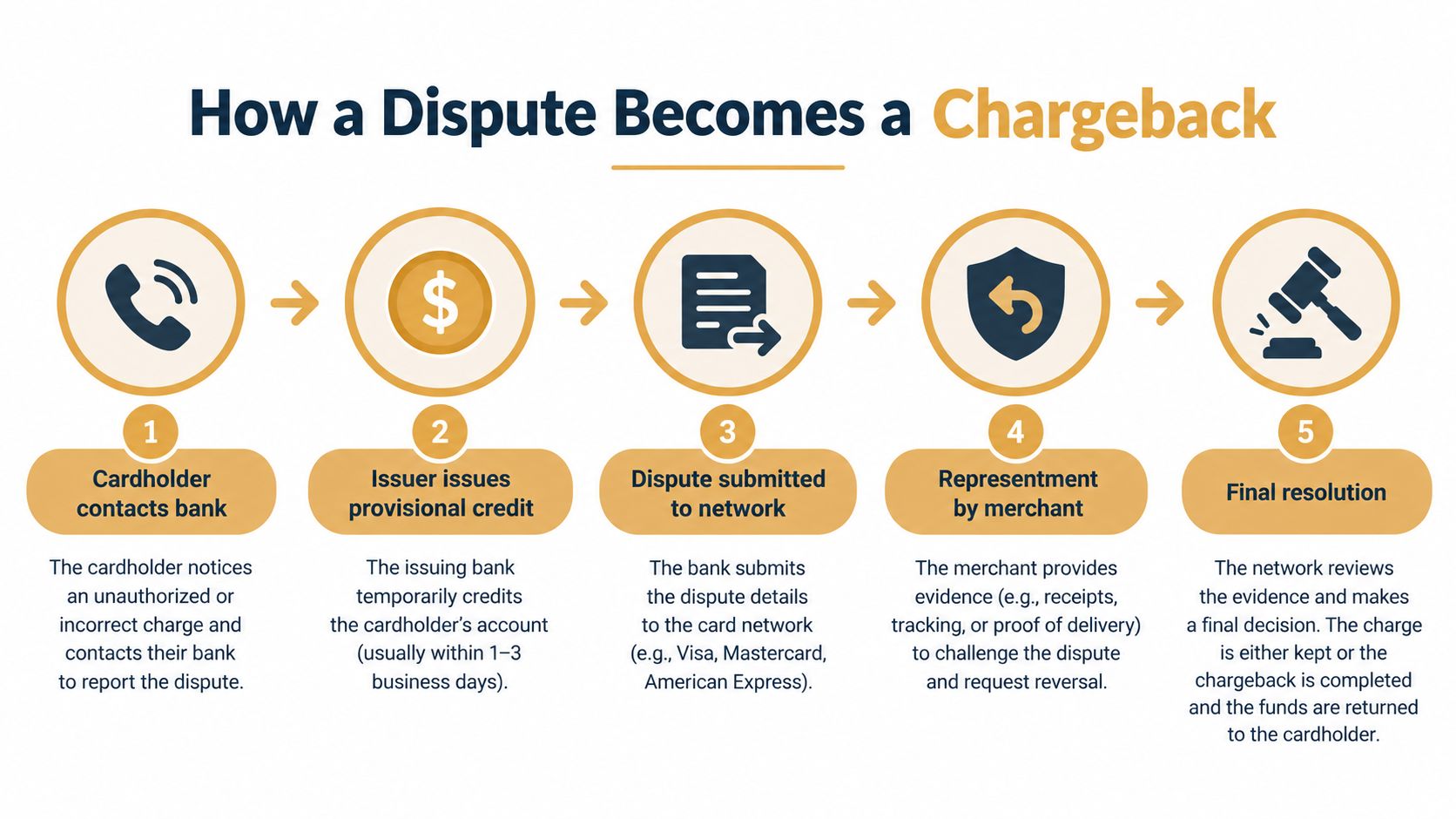
How a Dispute Becomes a Chargeback
A dispute can look small while it is still a customer-service ticket. The customer calls the issuer, describes the problem, and the issuer may place a provisional credit while it reviews the claim. The merchant often meets the case later, when the acquirer sends notice and the funds have already been pulled back or reserved.
The sequence works like a relay. The issuer takes the customer's statement, packages it under network rules, and hands it to the acquirer. The acquirer then delivers the case to the merchant with the fields that matter operationally: reason code, transaction identifiers, due date, and the evidence format the issuer will accept.
That handoff creates the alert window. Before formal notice, a refund or support fix may still close the complaint with less damage. After notice, the choice narrows to accepting the chargeback or submitting representment, which is the merchant's evidence package sent back through the acquirer. As noted earlier, the response window is measured in weeks, so the deadline should be logged the moment a case arrives.
The reason code still points to the question, but the deeper decision is interpretation. Say your review reads 70% of these cases as fraud while issuer coding reads about 45% that way. That gap changes the economics: a weak fraud case may be cheaper to refund or accept, while a well-documented delivery or authorization case may justify representment.
If the issuer rejects the response, the case can move toward pre-arbitration or arbitration where the network allows it. Each later stage adds work and fees, so the decision to continue should rest on evidence strength, transaction value, and the odds that the same records will persuade the next reviewer.
The operational habit is to build the file before the dispute exists. Order data, authentication results, delivery proof, customer messages, and refund history should be retrievable by transaction ID, not reconstructed during a deadline week.
The video walks through the issuer-to-acquirer handoff timeline in about two minutes.
Why Customers Dispute Charges They Authorized
A cardholder can approve a purchase and still dispute it weeks later.
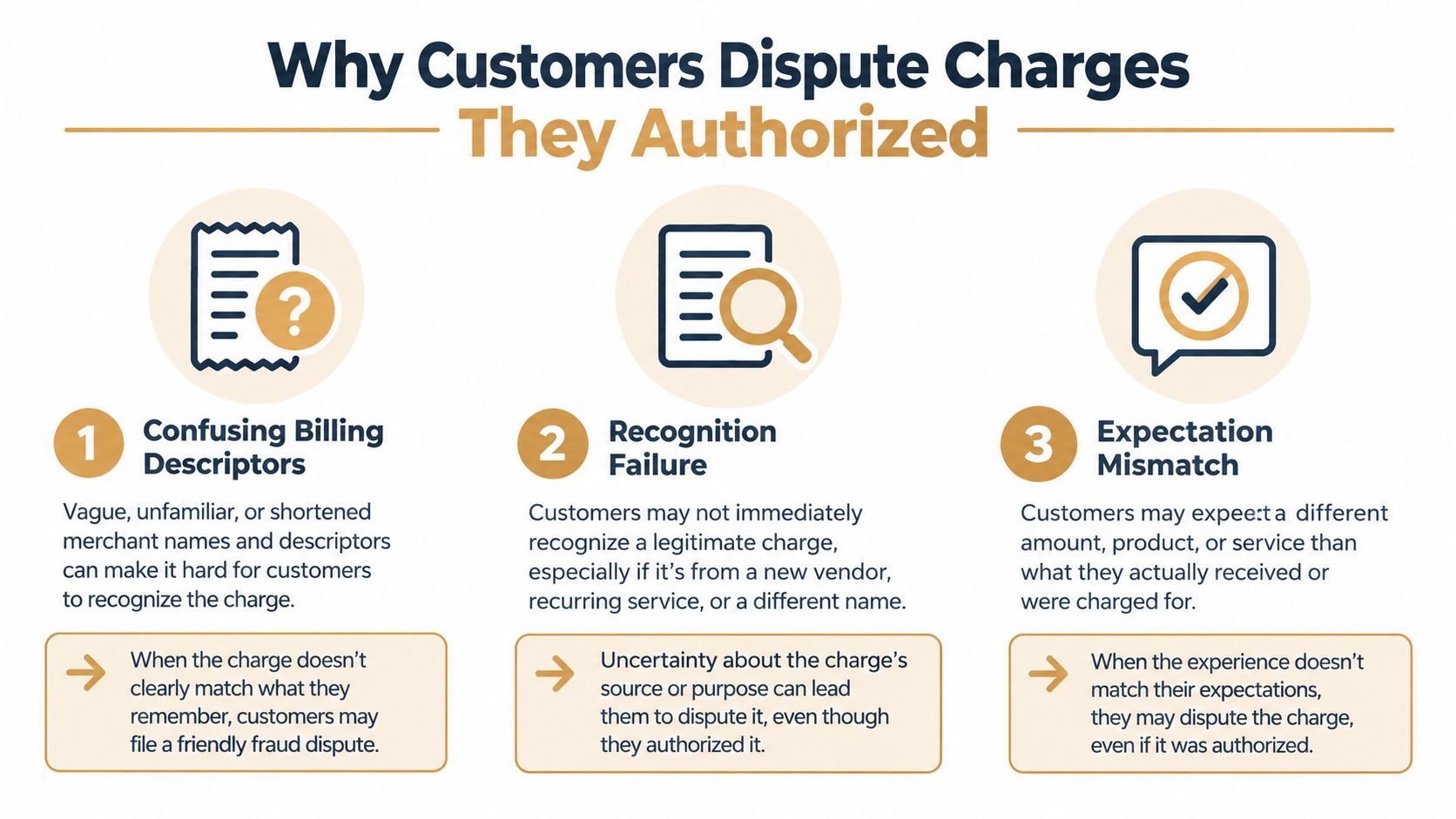
Authorization settles who could spend. It leaves open what the customer remembers, expects, or recognizes on a statement. A billing descriptor works like a return address: if the label shows a legal entity instead of the store name, the package looks suspicious even when the contents are fine. In one consumer survey, 40% of consumers often fail to recognize purchases because billing descriptors are confusing or incomplete (2025 Cardholder Dispute Index). A familiar descriptor plus visible support details gives the cardholder a faster route to you than the bank.
Renewals create the same recognition problem with a time delay. The customer may forget a recurring plan, miss a trial conversion, or believe a cancellation finished when it did not. Separate findings in the same 2025 Cardholder Dispute Index report that nearly half of consumers pay for subscriptions they forgot about. Renewal reminders, simple cancellation, and instant confirmation reduce the gap between “I approved this once” and “I never agreed to keep paying.”
Delivery and service problems add a third route. A shipment stalls, a digital login fails, or a refund sits pending without an update. The dispute then becomes a support escalation with fees attached, especially when the customer cannot see status or reach a person quickly.
These cases can fall under first-party misuse, often called friendly fraud, when a legitimate customer disputes a purchase they authorized or received. The Federal Reserve Bank of Atlanta identifies customer account or login ID, delivery address, device ID or fingerprint, IP address, and matching data from at least two undisputed transactions at least 120 days old as minimum evidence elements in the scenario it describes (Atlanta Fed guidance on first-party fraud). A merchant may read order history as consent while an issuer reads a vague descriptor as unauthorized use; that interpretation gap later decides whether refund, acceptance, or representment is proportionate.
The True Cost of a Chargeback
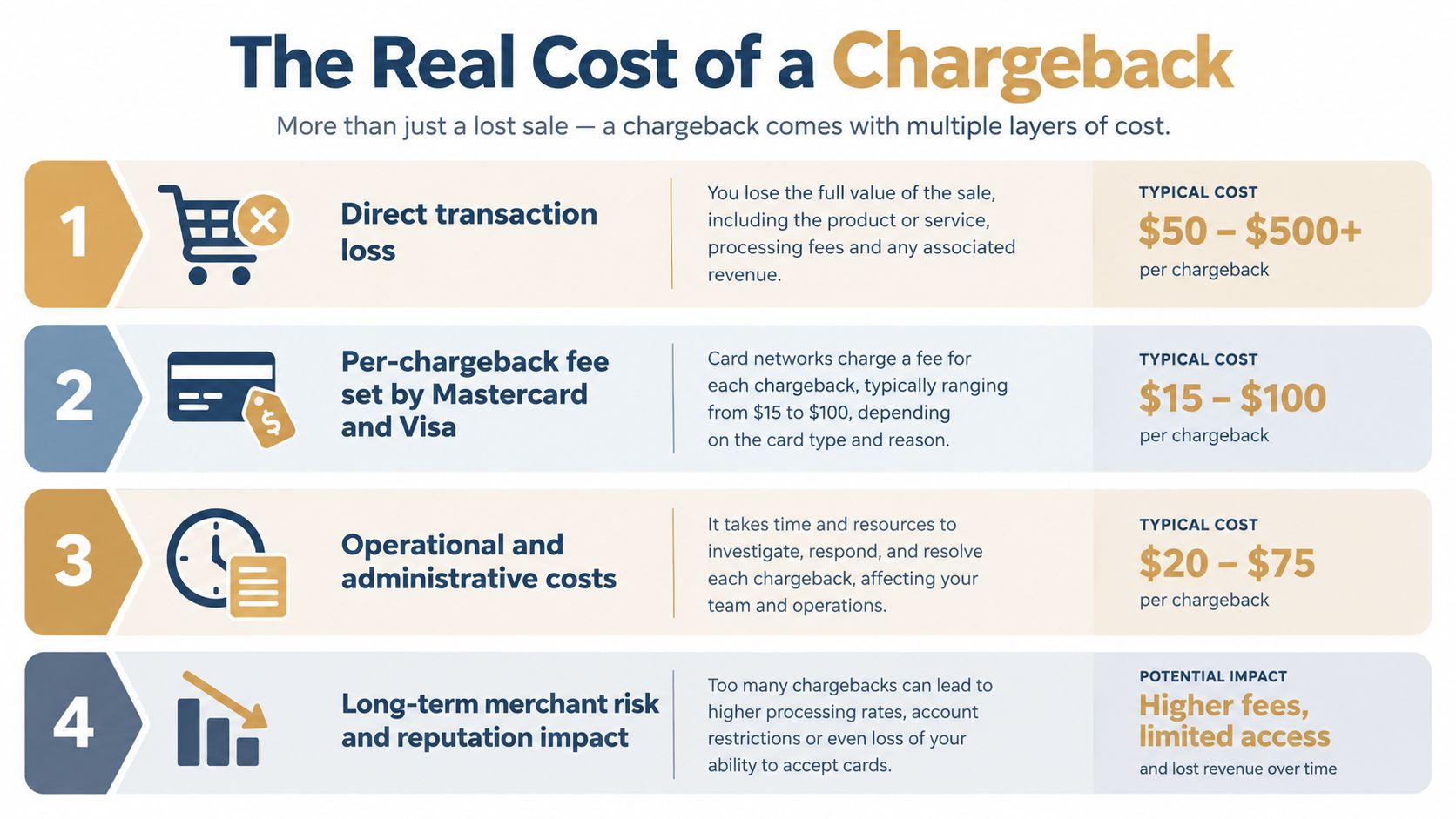
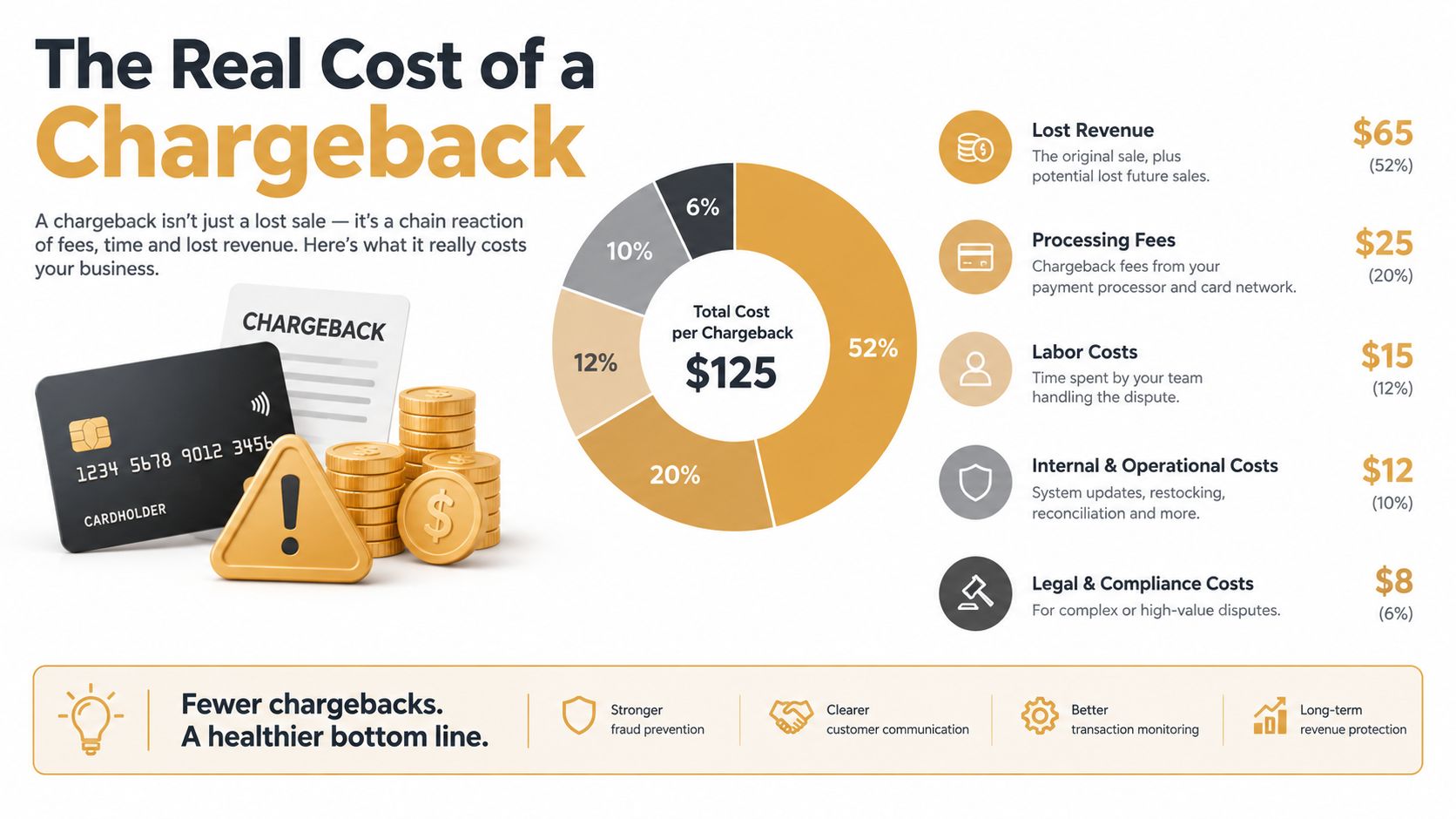
A $40 chargeback rarely costs $40. The reversed amount is the part you see first; the fee, the staff hours, and the effect on your processing account sit underneath it. Industry estimates put the all-in cost of an average chargeback at roughly $125 once those hidden layers are counted, which is why a "small" dispute deserves more than a shrug.
Before you decide whether to refund, accept, or fight a case, break the cost into four layers:
| Cost layer | What it covers | Typical range |
|---|---|---|
| Direct transaction loss | The disputed sale amount if you accept the chargeback or lose the case | Varies by transaction |
| Chargeback fee | A fee assessed under your processor and account terms | Check your provider's terms |
| Dispute-management labor | Staff time spent reviewing the case, gathering records, preparing evidence, and tracking deadlines | Datos Insights reports an average of $9.08 to $10.32 to manage a single dispute |
| Broader account impact | Potential consequences of persistent dispute issues, depending on your situation and provider | Varies by provider and account |
The same Datos Insights report puts merchant spend on chargeback-management technology at roughly $100,000 to $500,000 annually. Treat that as a scale figure rather than a quote for your business; it shows how quickly dispute operations grow into a line item of their own.
Case counts can also hide where the money goes. A foundational Federal Reserve study of selected U.S. merchant acquirers found that chargebacks averaged 1.6 basis points of sales volume (0.016%) but 6.5 basis points of sales value (0.065%). The same study found that about 70% to 80% were ultimately resolved as merchant liability, while fraud accounted for roughly 50% of chargebacks (Federal Reserve Bank of Kansas City payments working papers). Fewer high-value disputes can carry more dollar exposure than a long list of small ones.
Those layers feed the decision you face on every case: refund early, or build a representment file. An issuer may read fraud into a transaction you read as a delivered order, and that interpretation gap decides whether the fee, labor, and lost sale become a cost you absorb or one you contest. If your disputes are trending upward, the patterns and account consequences in this guide to high chargeback rates are worth reviewing before the next billing cycle.
The Alert Window That Stops Chargebacks
An early alert creates a decision point before a formal chargeback reaches the merchant account. The merchant can investigate the transaction, contact the customer, and decide whether to resolve the complaint with a refund or prepare to contest it. That's a different choice from responding after the chargeback has already been filed.
The choice shouldn't be automatic. Financial institutions attribute 70% of chargebacks to fraud, while merchants attribute 45% to fraud, according to Datos Insights (report summary). That gap shows how differently the same transaction may be interpreted. A bank may see a fraud claim; a merchant may see a delivered order, an active subscription, or a customer who has used the service.
So, when an alert arrives, ask what the available evidence says. Does the customer have a consistent history with your business? Was the product delivered or the service used? Did the customer contact support about a billing or fulfillment problem? Is the transaction value worth the effort of a representment case? Those answers help distinguish a legitimate complaint that warrants a refund from a claim the merchant has a sound basis to contest.
Some alerts can provide a short window to resolve the issue before formal filing, but timing and eligibility depend on the alert program and case. Where a merchant can act in time, a targeted refund may prevent the chargeback workflow and the work associated with it. Filtering alerts by evidence and customer context is more disciplined than refunding every alert or fighting every case.
The alert is a decision prompt, not a verdict. Use it to check the facts, then choose the response that fits the case.
Practical Prevention Moves You Can Ship
Most chargebacks begin as confusion: a statement line the customer doesn't recognize, a renewal they forgot about, a refund they think never arrived. Prevention is mostly the work of removing that confusion before a bank gets involved, and none of it requires rebuilding your payment stack.
Before purchase: Use a billing descriptor that customers can connect to your storefront or service. Keep subscription terms visible during checkout, including when a free trial becomes paid and how a customer can cancel. Clear branding reduces the odds that a valid purchase looks unfamiliar on a statement.
After purchase: Send a confirmation that identifies the product, price, and merchant. For subscriptions, send renewal reminders and make cancellation confirmation easy to find. For physical orders, share delivery updates; for digital services, explain how to access the account and where to get help. A refund-status message can also keep uncertainty from turning into a bank complaint.
When an alert arrives: Route it to someone who can pull transaction, support, and fulfillment records in one place, and apply the refund rules your team set in advance. Whatever you decide, preserve the records behind it, since a representment case stands on the minimum evidence elements described earlier from the Atlanta Fed's first-party-fraud guidance, such as customer-account and delivery information.
Keep payment failures in a separate lane from disputes. A declined renewal follows a different workflow than a chargeback, yet it can still interrupt a subscription and frustrate the customer. Teams reviewing failed payments may find this guide to fixing decline code 51 errors useful.
For Shopify merchants, compare your current tools and processes with this overview of Shopify chargeback protection. Then prioritize changes that make billing clearer, resolve customer issues faster, and help your team retrieve evidence without searching across disconnected systems.
What to Do With Everything You Just Learned
Treat chargeback management as an operating discipline, not a last-minute paperwork task. A customer complaint, an early alert, and a formal chargeback are different moments, each with different options. Your team should know who reviews alerts, who can authorize refunds, where transaction evidence lives, and who owns each response deadline.
Start by mapping the path from payment processor to support inbox to dispute queue. If alerts arrive in one system and order records live in another, document how staff will connect them. Next, write refund rules that reflect the evidence you have. A clear service failure may warrant a quick refund; a strong record of authorization and fulfillment may justify representment. Escalate uncertain cases rather than letting an automatic rule make every decision.
Track outcomes that reveal whether the process is working: how many alerts become formal chargebacks, how often your evidence supports a contest, and where customers report confusion. Don't judge success by alert volume alone. A high alert count might signal a billing-clarity problem, while a low number of formal chargebacks could mean your early resolution process is working.
If you're comparing ways to improve the workflow, Disputely's dispute-resolution platform is one option for handling alerts and organizing responses. Keep the decision framework yours: the right response depends on the customer's issue, the transaction record, and the evidence available.
The cheapest chargeback is the one that never files. Build a process that catches the customer's concern early, resolves genuine problems fairly, and preserves strong cases for a timely response.
Disputely connects merchants with dispute alerts from Visa RDR, Mastercard CDRN, and Ethoca, helping teams review eligible cases before they become formal chargebacks. If you want to see how alert handling could fit your payment workflow, visit Disputely.


