
Chargeback Automation: How It Works, Key Tools, and ROI
Mastercard says its Ethoca Alerts network has prevented more than 110 million chargebacks since 2011, including more than 39 million in 2025 alone. Mastercard's Ethoca overview makes the larger point clear: chargeback automation is no longer a back-office convenience. It's a transaction decision system that can act before a dispute becomes a formal chargeback.
For an ecommerce operator, the hard question isn't whether to automate. It's which cases to refund, which to defend, and which network signals deserve priority. That answer depends on your card mix, reason codes, customer history, order evidence, and the cost of letting a case move downstream.
What Chargeback Automation Actually Does
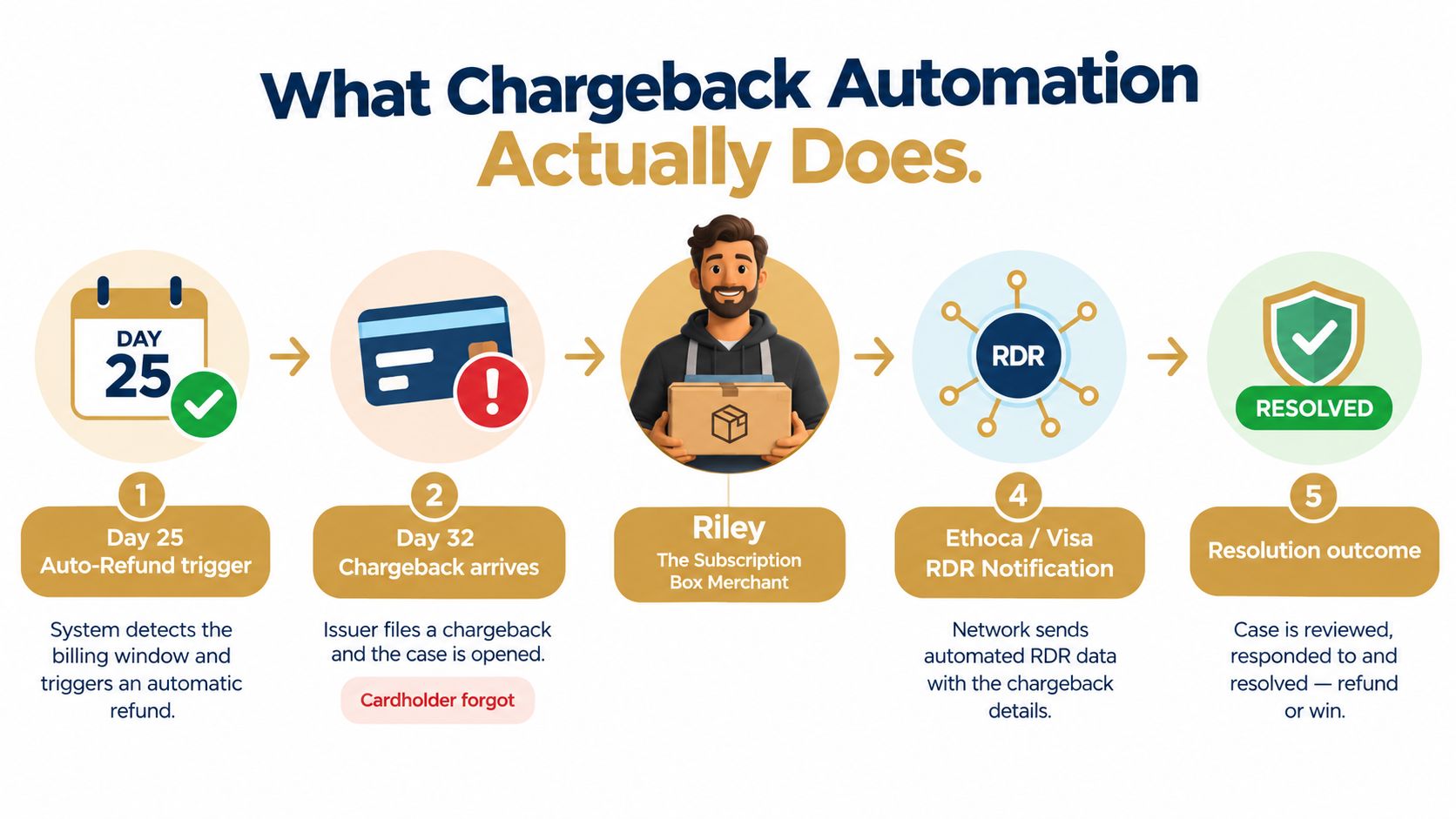
Riley runs a subscription box store. On day 25, a customer asks for a refund, so Riley issues it through Shopify. On day 32, the same customer files a chargeback because they forgot the credit had already posted. Riley now has a refund, a disputed transaction, and a support team trying to explain two events that should have been connected automatically.
Chargeback automation is the software layer that connects those events. It receives an alert while the dispute is still eligible for intervention, matches the alert to the original order, evaluates preset rules, and chooses an action. That action might be an automatic refund, a queue for human review, or a representment workflow if the evidence supports a defense.
Think in workflow stages
A useful implementation usually connects several functions:
- Alert ingestion: Pulls notifications from Visa RDR, Mastercard CDRN, Ethoca, or a processor feed.
- Case matching: Links the alert to the Shopify order, payment ID, customer record, and subscription event.
- Reason-code logic: Applies different treatment to an unrecognized transaction, cancelled recurring payment, non-delivery claim, or possible fraud.
- Evidence enrichment: Collects order history, delivery records, AVS results, 3DS data, IP information, and customer-service notes.
- Resolution execution: Issues a refund, escalates the case, or assembles a representment packet.
Manual handling often starts too late. The merchant first sees the case after funds have been debited and the formal chargeback process has begun. Automation moves the first decision earlier, while the merchant still has a chance to resolve the issue without treating every case as a legal defense exercise.
Operational rule: Don't buy a dashboard before you map the decisions you want it to make.
The right evaluation question is therefore not, “Which chargeback tool has the most features?” Ask instead, “Can this workflow receive the signals I need, enrich them with my order data, and apply rules that match my economics?” Teams comparing the surrounding workflow can also review Refact automation services for broader automation patterns beyond dispute operations.
The Modern Dispute Lifecycle and Where Automation Fits
A payment dispute begins as an ordinary transaction. The customer pays, the issuer authorizes the card, the merchant fulfills the order, and the payment settles. A problem appears later when the cardholder contacts the issuer, selects a dispute reason, and starts a process that routes through the card network to the acquirer and merchant.
Automation can intervene at several points, but the earliest useful point is usually before the formal chargeback is logged.
Where the signals enter
Alert networks act like an early warning channel. Visa RDR, Mastercard CDRN, and Ethoca can surface a cardholder's dispute intent while the merchant still has an opportunity to refund or clarify the transaction. The alert contains enough transaction information for a connected system to locate the order and apply a policy.
Once the merchant receives a formal notification, the workflow changes. The system can pull the case into a queue, pre-fill the dispute record, identify the reason code, and gather supporting material. Instead of asking an analyst to search across Shopify, a shipping portal, a subscription platform, and a support inbox, the automation layer creates one working record.

The air-traffic-controller model
Think of the system as an air traffic controller. Some cases can land safely with an immediate refund. Others need to be rerouted to an analyst because the amount is high, the customer is valuable, or the evidence is incomplete. A smaller group should proceed to representment because the merchant has clear proof and the economics justify a defense.
The lifecycle typically contains these decision points:
- Transaction context: Store the order, payment, customer, fulfillment, and subscription details together.
- Dispute intent: Receive a network alert before escalation where coverage allows.
- Triage: Classify by reason code, amount, customer history, product type, and evidence quality.
- Resolution: Refund, request human review, accept, or defend.
- Feedback: Record the outcome so future rules reflect what worked.
The shift matters because pre-dispute action can prevent a case from entering the merchant's formal dispute workflow. Visa states that RDR can resolve eligible disputes in about one second, compared with a 24-day resolution timeframe. Visa's RDR documentation shows why speed is a systems problem, not just a staffing problem.
Visa RDR, Mastercard CDRN, and Ethoca Alerts Compared
Alert coverage shapes the decisions your automation can make. A Shopify store serving mainly Visa customers needs reliable RDR handling. A store with significant Mastercard volume may need CDRN or Ethoca coverage as well. Treat each source as one input in a stage-by-stage decision system, not as a universal solution.
Visa Rapid Dispute Resolution, or RDR, handles eligible Visa disputes before they become formal chargebacks. Your connected system checks the request against rules such as order value, customer history, and fulfillment status, then can issue a refund when the case fits those rules. Verifi's explanation of RDR also explains the ratio benefit: an RDR resolution does not count toward the merchant's dispute or chargeback ratio.
Mastercard Ethoca Alerts sends early notifications for participating transactions. These alerts give your team a chance to refund a questionable order, contact the customer, or route the case for review before escalation. Mastercard's network description presents the service as a pre-chargeback prevention layer, not a replacement for every representment process.
CDRN provides another alert-to-action path for eligible Mastercard-related disputes. This CDRN guide describes an opportunity to issue a refund before escalation. Eligibility, timing, and routing vary by acquirer, processor, network, and dispute type, so configure rules around your live terms instead of assuming every alert follows the same clock.
| Feature | Visa RDR | Mastercard CDRN | Ethoca Alerts |
|---|---|---|---|
| Primary role | Automated pre-dispute resolution | Alert and pre-dispute action workflow | Early dispute notification |
| Network focus | Visa | Mastercard-related dispute flows | Broad merchant alert coverage |
| Merchant action | Apply rules and issue an eligible refund | Review or automate an eligible resolution | Refund or route the case before escalation |
| Ratio impact | Eligible cases can avoid formal chargeback counting | Depends on the resolution path and network rules | Designed to prevent escalation when acted on |
| Best operational use | Fast rules-based Visa decisions | Mastercard case interception | Coverage expansion and early warning |
The right priority comes from your own dispute mix. If “item not received” cases dominate, fulfillment data may matter most. If friendly-fraud claims dominate, preserve customer and delivery evidence for review or representment. Select the network signals your store receives, then connect them to the order data that determines whether to refund, fight, or request human judgment.
Real Business Benefits for Merchants and Payment Teams
Chargeback automation creates value at four separate points: dispute-ratio protection, lower manual workload, revenue recovery, and reduced reserve pressure. These outcomes connect, but they require different rules and measurements. A merchant should decide stage by stage whether to refund, fight, or send a case to an analyst.
Early intervention can stop eligible alerts from becoming formal chargebacks. That protects the merchant's ratio and reduces the cases that require evidence, deadlines, and network responses. Visa's explanation of RDR describes automated refunds and notes that eligible pre-dispute resolutions do not count toward the merchant's dispute ratio.
Automation also removes repetitive preparation. When a workflow attaches the Shopify order, delivery evidence, payment details, and customer correspondence, an analyst receives a reviewable case instead of a blank form. The saving comes from less searching and copying. Human judgment still matters for unusual orders, incomplete evidence, and customers whose history changes the decision.
A practical workflow turns each benefit into an operating measure:
- Ratio protection: Compare formal disputes avoided through alerts with total settled transactions.
- Revenue recovery: Separate refunds accepted as a deliberate loss from representments that return transaction value.
- Labor control: Track analyst minutes by reason code before and after automation.
- Reserve visibility: Ask the acquirer whether sustained ratio improvement changes reserve or hold conditions.
Mastercard reports that Visa's CDRN and RDR tools have addressed $695 million in potential disputes before escalation. Its Ethoca materials place that result in the wider context of pre-chargeback intervention. The financial case therefore includes avoided downstream exposure, not only orders recovered through representment.
| Metric | Before Automation | After Automation |
|---|---|---|
| Alert handling | Staff monitor portals and inboxes | Alerts enter a central workflow |
| Refund decisions | Inconsistent and manually reviewed | Governed by reason-code and value rules |
| Evidence gathering | Analysts search across systems | Order and fulfillment data is attached automatically |
| Formal dispute exposure | Preventable cases can escalate | Eligible cases can be resolved earlier |
| Finance reporting | Case counts are reconciled manually | Outcomes are grouped by network and rule |
Use the store's own baseline to test the business case. Pull settled transactions, formal disputes, refunds issued after alerts, representment recoveries, staff time, and reserve changes. Then compare margin by decision path. A low-value item-not-received alert may justify a refund, while a repeat customer with confirmed delivery may deserve evidence review and representment. The goal is not to refund every alert. It is to apply the right network signal and decision rule to each dispute type.
How a Chargeback Automation Workflow Runs Day to Day
A typical morning begins with an Ethoca or Visa RDR alert. The automation platform matches the network reference to a Shopify order, identifies the payment processor, retrieves fulfillment history, and assigns the relevant reason code. For a Mastercard case coded as 4837, no cardholder authorization, the workflow may check delivery confirmation, device information, previous orders, and customer-service contacts.
The operator should not decide each case from scratch. Configure rules around the store's risk tolerance, dispute mix, and unit economics. The workflow becomes a series of decisions: refund an alert, send it for review, or prepare evidence for representment.

Build rules that express a policy
Configure rules to express a clear policy:
- Refund automatically: If the alert amount is below the store's low-value threshold and the customer has limited purchase history.
- Escalate for review: If the order is high value, the customer is a repeat buyer, or delivery evidence is missing.
- Prepare representment: If earlier deliveries are confirmed and the current order has matching billing and fulfillment data.
- Accept without defense: If the customer already received a merchant refund and the dispute appears to duplicate that credit.
The exception path determines whether the system is safe to run at volume. Rules should identify incomplete evidence, unusual customer behavior, mismatched amounts, and duplicate refunds before an automated action creates another problem. A delivery alert with no scan may require review, while a duplicated credit can close without further defense.
After resolution, the platform writes the outcome to the case record and sends a summary to finance. The report should show alerts received, refunds issued, cases escalated, cases defended, unresolved exceptions, and the rule responsible for each result.
For a visual example of how automated payment actions can be connected to support workflows, see the Stripe actions guide for support agents.
The daily rhythm stays clear: the engine handles routine cases, analysts inspect exceptions, and finance reviews the combined result. Humans focus on ambiguous decisions instead of copying order numbers between systems. Over time, the team can adjust rules to match which network signals produce useful outcomes for its own dispute mix.
When to Auto-Refund and When to Fight a Dispute
The decision matrix has two primary axes: reason-code clarity and customer value. A low-value, ambiguous case can be cheaper to refund, while a high-value case with strong evidence may justify representment. A high customer lifetime value can also change the decision because preserving the relationship may matter more than recovering one transaction.
Start with reason code. Subscription renewal disputes often need a billing and customer-history check. Product-not-received disputes need delivery evidence. Unrecognized-transaction claims need statement descriptors, customer communications, authentication records, and order context.
Then apply customer value. A first-time buyer with one low-value claim may belong in an automatic refund policy. A repeat customer with confirmed delivery and a high-value purchase may belong in a defense queue.
Use economics, not instinct
A refund is a controlled cost. A formal dispute adds operational work, network exposure, and the possibility of losing the product and the payment. That doesn't mean refund every alert. It means comparing the expected recovery from representment with the value of staff time, fees, evidence quality, and customer retention.
A practical rule can look like this:
Refund low-value, weak-evidence cases automatically. Escalate high-value or repeat-customer cases when evidence is incomplete. Represent cases where delivery, authorization, and customer history create a credible defense.
For merchants that need a dedicated representment path, chargeback fighting workflows can sit alongside the alert decision process. The key is to connect the two. An alert engine should know when a case belongs in defense, and the defense workflow should receive the evidence already collected.
Implementing Chargeback Automation in Your Stack
Implementation works best as a staged decision system, not a single switch applied to every transaction. Start by mapping the path from alert receipt to refund, acceptance, or representment. Record which processor owns each step and where order, delivery, authentication, subscription, and support data can be found.
Phase one, connect the signals
Enroll in the network programs available through your acquirer or processor. Connect Visa RDR and Mastercard CDRN where eligible, then add Ethoca or Verifi if those feeds match your card mix. Create one case identifier linking network references with Shopify orders, payment intents, subscriptions, and refunds. Without that link, an alert is like a parcel without an address. The team may receive the signal but still fail to act on the right order.
Review historical disputes before writing rules. Group cases by reason code, amount, product type, customer history, evidence availability, and outcome. The pattern should show whether your priority is earlier interception, stronger evidence, clearer billing, or more consistent refund handling.
Phase two, tune conservatively
Start with narrow rules for low-value alerts that are easy to classify. Route high-value disputes to named analysts, while ambiguous cases go to a queue with a clear service-level owner. Log every automated decision, including the rule version, available evidence, and action taken.
During the first operating cycle, review false refunds and missed interventions each week. Change one rule at a time, so finance can identify whether the adjustment improved the intended result.
Phase three, establish ownership
Assign a chargeback champion, define finance and support handoffs, and review the dispute mix and reserve conditions regularly. Support should see when an alert already triggered a refund. Finance should distinguish prevention costs from revenue recovered through representment.
Teams connecting payment actions with support workflows can review how to enable Stripe actions in support agents. Shopify merchants comparing protection workflows can also review Shopify chargeback protection. The operating model should decide which network signals receive priority, when automation can refund, and when a case deserves human defense.
Measuring ROI and the Metrics That Matter
ROI starts with the merchant's overall dispute-to-transaction ratio, not with an isolated count of refunds. A system can process alerts quickly while still underperforming if it refunds winnable disputes, misses a large network segment, or fails to reduce formal chargebacks.
Track six measures together:
- Chargeback win rate: The share of representments that recover the disputed transaction.
- Alert-to-dispute conversion: How often an alert still becomes a formal chargeback.
- Time to resolution: The elapsed time from alert receipt to refund, acceptance, or defense.
- Recovered revenue: Funds returned through successful representment.
- Avoided fees and labor: Costs not incurred because a case was resolved earlier or handled automatically.
- Reserve and hold movement: Changes reported by the acquirer after the dispute profile stabilizes.
Use a 30, 60, and 90-day review rhythm
During the first 30 days, validate alert delivery, order matching, duplicate detection, refund execution, and rule accuracy. At 60 days, examine representment outcomes, recovery by reason code, and the cases analysts override. At 90 days, compare the formal dispute ratio and financial result with the pre-automation baseline.
Use this formula:
ROI = net recovered revenue + avoided fees + reserve release - tool cost - labor cost
Don't treat every refund as a failure. A deliberate refund can be a successful ratio-protection decision if it prevents a more expensive downstream case. The test is whether the rules direct each dispute to the lowest-cost resolution that protects revenue, customer relationships, and processor access.
| Metric | Definition | Target Benchmark |
|---|---|---|
| Alert coverage | Share of relevant dispute signals received by the workflow | Broad coverage across your actual card and processor mix |
| Alert-to-chargeback conversion | Alerts that become formal chargebacks | Declining after rule tuning |
| Automatic resolution rate | Eligible cases resolved without manual handling | Increasing without a rise in refund errors |
| Representment win rate | Defended cases recovered | Improving by reason code and evidence type |
| Average resolution time | Time from alert to final action | Short enough to meet each network window |
| Net recovery | Recovered value minus refunds, fees, labor, and tool cost | Positive and improving over the review cycle |
Before selecting a platform, compare the pricing model with your alert volume, processor coverage, and required analyst involvement. Disputely pricing can be used as one reference when modeling the tool-cost line in the formula.
Disputely connects chargeback alerts from Visa RDR, Mastercard CDRN, and Ethoca with automated refund rules, so ecommerce and subscription teams can act before eligible disputes become formal chargebacks. Review your network mix, map your first refund and representment rules, and visit Disputely to evaluate the workflow against your own dispute economics.


