
Chargeback Dispute Management: A Practical Guide
A dispute hits the queue while the team is already handling refunds, fulfillment exceptions, and payment failures. The clock starts immediately. An alert may give you only a short response window, and once it becomes a chargeback, the merchant must choose between accepting the loss and building evidence before the network deadline.
That makes chargeback dispute management a triage discipline, not a policy of fighting everything. The strongest operation separates cases that should be prevented, refunded, contested, or analyzed for a process change.
Why Chargeback Dispute Management Is Now a Core Ops Function
A small disputed order can consume more operating capacity than its ticket value suggests. Mastercard's 2025 research puts the average merchant cost at about $128 per chargeback, including third-party fees and internal costs, while U.S. financial institutions spend about $9 to $10 processing each dispute. Its analysis of chargeback costs also projects global chargeback volume rising 37% from 2025 to 2029 to 359 million transactions annually, with global chargeback value forecast at $46.1 billion by 2029. Those economics put dispute work on the operations agenda, alongside payment performance and fulfillment.
The loss is rarely limited to the reversed transaction. Processor fees, staff time, evidence preparation, customer-service work, and the merchant's dispute ratio all affect the decision. Rising volume increases pressure on queue ownership, integrations, documentation, and payment relationships.
Intake, triage, refund-or-contest, and feedback
Four operating decisions determine whether a dispute becomes a recoverable case or an avoidable cost:
Set the intake path. Pre-dispute alerts, processor notifications, and network cases need one monitored queue with an owner. An email notification without a tracked deadline is an unassigned exception. Use the guide to exception management in operations to define ownership, escalation, and closure rules.
Apply triage rules. Reason code, transaction value, authentication data, delivery evidence, customer history, issuer, and region should determine the route. A genuine fulfillment error may merit a fast refund, while a well-documented friendly-fraud case may justify a contest. The queue needs rules that distinguish those records.
Choose refund or contest. Refund when evidence is weak, the claim is credible, or handling cost exceeds recoverable value. Contest when the transaction record directly answers the cardholder's allegation and the expected recovery justifies the work. Fighting every case creates cost without improving the ratio.
Feed results back into controls. A lost dispute can reveal a fulfillment gap, unclear descriptor, weak authentication, or missing documentation. Record the cause, assign a process owner, and change the relevant rule. Case closure means the control has been updated, not merely that the money has moved.
Operational rule: Treat every dispute as both a financial decision and a control signal.
Network monitoring makes this discipline measurable. Industry coverage of Visa's Acquirer Monitoring Program describes a combined fraud-and-dispute threshold of 2.2% in several regions, with a planned reduction to 1.5% on April 1, 2026. Mastercard monitoring programs can trigger at 100 or more chargebacks and a 1.5% or higher ratio, according to industry coverage of chargeback alerts and monitoring programs.
The operating target is therefore clear: resolve preventable cases early, contest only defensible ones, and keep the measured ratios below the applicable Visa and Mastercard thresholds.
Alert Ingestion and the Network Response Window
The first failure usually happens before anyone evaluates evidence. An issuer submits a pre-chargeback alert, but the notification lands in a disconnected dashboard, a failed webhook, or an inbox nobody owns. By the time an operator sees it, the short response window has closed.
Visa RDR and Verifi alerts, Mastercard CDRN, and Ethoca alerts can give merchants an opportunity to resolve a cardholder complaint before it becomes a filed chargeback. The alert record should carry enough context to identify the transaction, including a masked PAN, amount, reason, and expiry time. In practice, response windows are often 24 to 72 hours, so the system should timestamp receipt and calculate the internal cutoff rather than relying on manual calendar checks.
Build one intake path
Route every alert into a queue that can be searched by order ID, transaction ID, customer, amount, and reason code. The payment and support stack may include:
- Stripe Radar and the Stripe dispute object, where fraud signals and formal disputes need to connect with order and fulfillment records.
- PayPal's Resolution Center and webhooks, which require event monitoring so a notification isn't lost between the platform and the case-management queue.
- Authorize.net's Customer Information Manager, where stored customer and transaction context should be available to the operator handling the alert.
- Third-party hubs such as Disputely or Kount, which can consolidate network alerts and processor events into an operating queue.
The architecture matters less than the control. Every integration needs webhook health checks, retry logic, duplicate-event handling, and a fallback queue for events that fail validation. Store the raw alert payload, receipt time, response deadline, action taken, and processor confirmation.
Use a two-stage response
The first stage is fast identification. Match the alert to the order, confirm the amount, classify the reason, and check whether a refund is permitted under the merchant's rules. The second stage is the decision, either resolve the alert or leave it open for a formal response.
A missed alert usually removes the cheapest intervention. Once the dispute is filed, the merchant must work through representment, and the case may be harder to win because the response process is more formal and the available evidence may still be incomplete. Assign a named operator for every unresolved event, even when automation performs the initial matching.
Triage Rules by Reason Code, Issuer, and Region
A fraud-coded case without 3DS evidence should not enter the same workflow as a product-not-received claim supported by verified delivery. Triage starts with the reason code, then weighs transaction value, authentication, fulfillment, customer history, issuer, and region. The evidence must answer the stated claim, not merely show that the payment was authorized.
Accertify reports a median win rate of 36.5% for fraud-coded chargebacks and 56.6% for non-fraud chargebacks, with market-level outcomes reaching roughly 54% in the U.S., 49.1% in the U.K., and 36.9% in Brazil, as reported in merchant chargeback outcome and representment research. Treat these figures as directional benchmarks. They support closer review of resolvable operational disputes, not a rule to contest every case.
Score the case before assigning work
Use a scorecard that forces a decision before an operator spends time assembling evidence:
- Reason code: Does the record directly refute the claim?
- Authentication: Do 3DS, AVS, CVV, authorization, and device records support the transaction?
- Fulfillment: Is there delivery confirmation, usage activity, or a signed receipt?
- Customer history: Has the customer previously received refunds, contacted support, or used the product?
- Issuer and region: Do local rules or observed outcomes justify a more conservative route?
- Value and labor: Is the expected recovery worth the handling time?
| Segment | Typical Win Rate | Recommended Action |
|---|---|---|
| Fraud-coded chargebacks | 36.5% median | Contest only with strong authentication and transaction evidence |
| Non-fraud chargebacks | 56.6% median | Review delivery, duplicate billing, or service records |
| U.S. merchant outcomes | Roughly 54% | Use complete evidence packs and measure issuer-level variance |
| U.K. merchant outcomes | Roughly 49.1% | Apply careful policy and fulfillment review |
| Brazil merchant outcomes | Roughly 36.9% | Raise the evidence bar and evaluate refund economics |
Market results should change prioritization, not replace case review. An issuer or regional pattern may justify a higher evidence threshold, but the reason code still controls the response.
Field reporting also suggests that merchants leave a large share of cases undisputed, which points to a queue problem before an evidence problem. Automate intake and prioritization, then reserve representment for cases where the records clearly support the merchant's position. A strong queue resolves valid claims quickly and directs limited operator time toward disputes with defensible evidence.
Automated Refunds Versus Contest Decisions
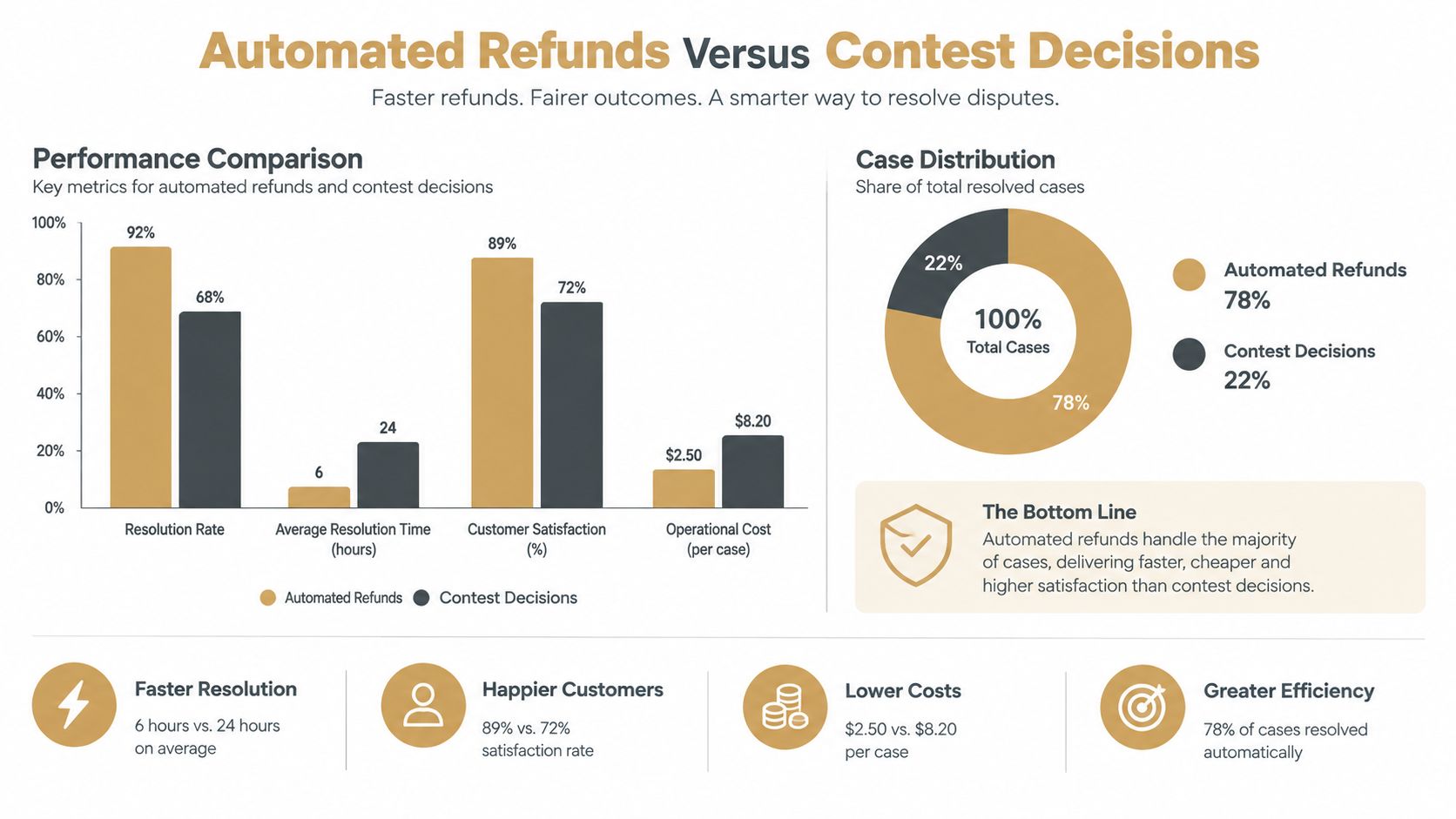
Refunding isn't failure, and contesting isn't automatically good management. The decision should compare the refund amount, chargeback exposure, handling labor, evidence quality, customer impact, and likelihood of recovery.
Refund when the merchant caused the problem, the evidence can't answer the reason code, or the case value is too low to justify manual handling. Contest when the transaction record, fulfillment record, and customer behavior point in the same direction. Avoid sending a generic evidence bundle. Issuers need a concise response tied to the claim.
Apply a case-level decision tree
Ask these questions in order:
- Is the claim valid? If the order was duplicated, never delivered, or materially misrepresented, accept or refund it.
- Can the evidence refute the claim? Look for delivery, usage, authentication, authorization, and communication records.
- Does the recovery justify the work? Include staff time, processor handling, and the chance of escalation.
- Will the outcome improve a rule? A case may be worth reviewing even when it isn't worth contesting, especially if it reveals a recurring billing or fulfillment issue.
For example, consider a $48 merchandise-not-received dispute where carrier tracking shows delivery, AVS matched, and usage logs show the customer used the product three times. The sensible route is to contest with the carrier signature, delivery record, AVS result, transaction receipt, and usage logs. Don't bury the decisive evidence inside a long narrative.
Your must-have packet should include:
- Transaction receipt: Amount, date, timestamp, item, and authorization result.
- Delivery proof: Tracking, delivery confirmation, and signature where available.
- Authentication data: 3DS results, AVS, CVV, IP, and device information.
- Customer and order history: Relevant usage, prior contacts, and account activity.
Useful supporting material includes customer communications and acknowledgment of refund or service policies. Visa response periods can be 30 days, while Mastercard response periods can be 45 days from notification, subject to the applicable case rules and processor workflow. Check the specific notification because an internal cutoff must come before the network deadline.
For merchants that want processor-specific automation and alert handling, Shopify chargeback protection is one example of a workflow to evaluate. The important test is whether the tool exposes the rule, evidence, deadline, and final outcome for each case.
Staying Below Visa and Mastercard Monitoring Thresholds
A merchant can have acceptable case outcomes and still enter monitoring because its dispute ratio is measured across a defined period. Treat the ratio as an operating control, not a month-end report. Visa's VAMP combines fraud and disputes into a monitored ratio in relevant regions. The current threshold is described as 2.2%, with a planned reduction to 1.5% on April 1, 2026, according to PayPal's explanation of dispute management and chargeback prevention.
The same PayPal explanation describes the VAMP Excessive threshold as requiring a minimum monthly volume of 1,500 disputes. Mastercard monitoring can apply at 100 or more chargebacks and a ratio of 1.5% or higher. Confirm the current program terms with your acquirer, since network rules and regional application can change.
Turn external thresholds into internal signals
Set an internal review point below each network limit. Track successful sales and disputes in rolling 30-day, 60-day, and 90-day views, then review the trend before a ratio reaches a program threshold. An internal trigger at 1.0% can prompt examination of reason codes, alert interception, fulfillment, and issuer concentration. It is a management buffer, not a network rule.
| Metric | Visa VAMP | Mastercard ECM | Internal Alert |
|---|---|---|---|
| Ratio threshold | 2.2%, planned at 1.5% from April 1, 2026 | 1.5% | 1.0% review trigger |
| Volume condition | 1,500 monthly disputes for the described Excessive threshold | 100 or more chargebacks | Review volume and trend |
| Measurement view | Monthly dispute and fraud ratio | Program ratio and chargeback count | 30-day, 60-day, and 90-day trend |
| Primary response | Reduce disputes before filing | Control chargeback count and ratio | Assign owner and corrective action |
Prevent the filing, not only the loss
Use pre-dispute signals from Ethoca and Verifi where they fit your processor setup. Review billing descriptors, delivery status, recurring-billing notices, address mismatches, and customer-service history before choosing a refund. A selective refund can protect the ratio when the expected chargeback cost, handling time, and payment-account risk exceed the margin at stake. Fighting every alert creates avoidable workload and can leave a merchant exposed to the same network thresholds.
Run a weekly control cycle:
- Monday: Pull new alerts, reconcile them against successful sales, and identify aging cases.
- During the week: Assign each case to a named operator and record the internal cutoff.
- Before expiry: Set the Visa RDR response cutoff at least 24 hours before expiration, leaving room for an integration failure or missing approval.
- Friday: Review open alerts, filed disputes, refunds, contested cases, and ratio movement.
The queue owner should compare prevention spend with avoided chargeback cost and labor. Refund early when the economics support it. Contest when the evidence is strong and the case value justifies the work. That discipline keeps internal signals ahead of the Visa and Mastercard thresholds.
KPIs and Continuous Tuning of Your Dispute Stack
A queue can look busy while producing poor financial results. Measure speed, selection quality, recovery, and root-cause reduction together.
Weekly reporting should show alert-to-action latency, auto-refund rate by reason code, contested win rate, evidence gaps in lost cases, and the number of alerts that became filed disputes. Monthly reporting should add the total dispute ratio against applicable network thresholds, pre-chargeback alerts resolved, revenue recovered per contested case, and operational cost per case.
The benchmarks supplied for this workflow include a 60% win rate on fraud reason codes, 35% pre-chargeback interception, and alert latency below four hours during business days. These are operating targets, not universal industry standards. Treat them as hypotheses to test against your economics and case mix.
Tag outcomes so rules can improve
Every closed case should carry structured fields for:
- Reason code and region
- Issuer or issuer group
- Customer segment
- Evidence submitted
- Refund, representment, or acceptance outcome
- Operational cause
- Time from alert to action
Review the queue in a four-week cycle. In week one, collect and clean the data. In week two, identify changes by reason code, issuer, region, and product. In week three, update routing and evidence rules. In week four, measure whether the changes improved recovery or reduced unnecessary refunds.
Measurement principle: A win rate without cost per case can reward expensive work that should have been refunded. A low refund rate without customer or ratio data can reward stubbornness.
Operators who need a governance model for metric definitions, ownership, and review cadence can use this practical KPI guide for operators. For merchants monitoring exposure across processors and alert sources, chargeback rate management can also serve as a reference point when designing the dashboard.
The most useful loss review asks why the evidence was absent, late, or irrelevant. If delivery records exist but never enter the case packet, fix the integration. If the same subscription descriptor causes repeated confusion, fix billing communication. If one issuer produces weak outcomes for a specific reason code, change the triage threshold rather than applying a blanket rule to every issuer.
A 30-Day Rollout Plan for Your Dispute Workflow
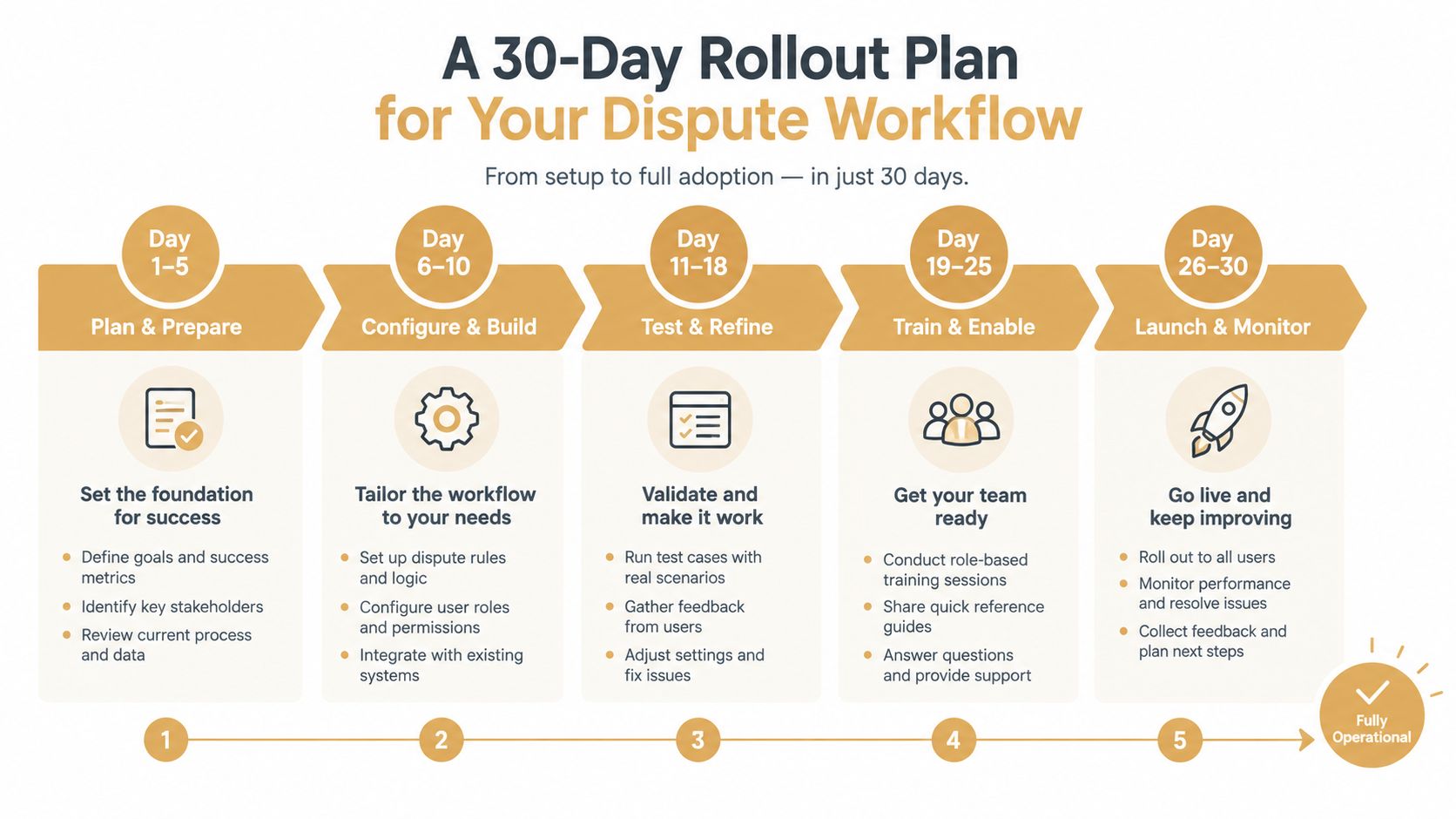
You can establish a disciplined workflow without adding headcount if the first month focuses on instrumentation and decision rules rather than elaborate tooling.
Week one creates visibility
Connect Visa RDR, Ethoca, and Verifi alerts to one monitored inbox or queue. Then export the previous 90 days of chargebacks from Stripe, PayPal, and Authorize.net to establish a baseline for dispute ratio, reason-code mix, response latency, win rate, and evidence availability.
Don't optimize a number you can't reconcile. Match processor records to orders, refunds, fulfillment events, and customer accounts before writing automation.
Week two turns judgment into rules
Create routing by reason code, issuer country, transaction value, authentication, and fulfillment status. Add auto-refund logic for selected fraud and product-not-received cases under a $30 threshold, but keep exceptions visible for manual review. The exact threshold should reflect your costs and evidence quality, not a vendor default.
Week three standardizes evidence
Build reason-code templates with transaction details, authorization data, AVS and CVV results, 3DS records, delivery confirmation, customer communications, and relevant usage history. Assign owners for CE 3.0 and Order Insight responses, and set internal cutoffs before the network deadlines.
Week four measures exposure
Launch a dashboard with chargeback ratio, alert-to-refund latency, win rate by reason code, pre-dispute resolution, operational cost, and VAMP exposure. Hold a 30-minute weekly review to retire rules that over-refund, strengthen rules that miss winnable cases, and route recurring operational causes to the responsible team.
Use Disputely's dispute resolution workflow as one option when evaluating alert intake, automated resolution, and processor connectivity. Delay chargeback insurance and generic AI response tools until the baseline is stable. If you don't know which cases you should refund, contest, or prevent, adding another layer of automation will only hide the decision problem.
Disputely connects Visa RDR, Mastercard CDRN, and Ethoca alerts with payment processors so teams can review or automate time-sensitive dispute decisions before alerts become filed chargebacks. Visit Disputely to evaluate a real-time alert workflow, configurable refund rules, and dispute analytics for your payment stack.


