
Chargeback Process Shopify: A Complete Merchant Guide
A chargeback notification rarely arrives at a convenient time. You're in the middle of a product launch, checking payouts, or dealing with a fulfillment problem when Shopify flags an order and tells you that the customer has disputed the payment. The money may already be gone, the evidence window is moving, and the facts are scattered across Shopify, your help desk, warehouse system, and shipping account.
The difficult part of the chargeback process on Shopify isn't understanding that a customer has challenged a transaction. It's making the right decision quickly, before a short response window closes. You need to separate preventable disputes from legitimate losses, map evidence to the reason code, and protect your overall dispute rate rather than treating every case as an isolated battle.
Understanding the Shopify Chargeback Rate
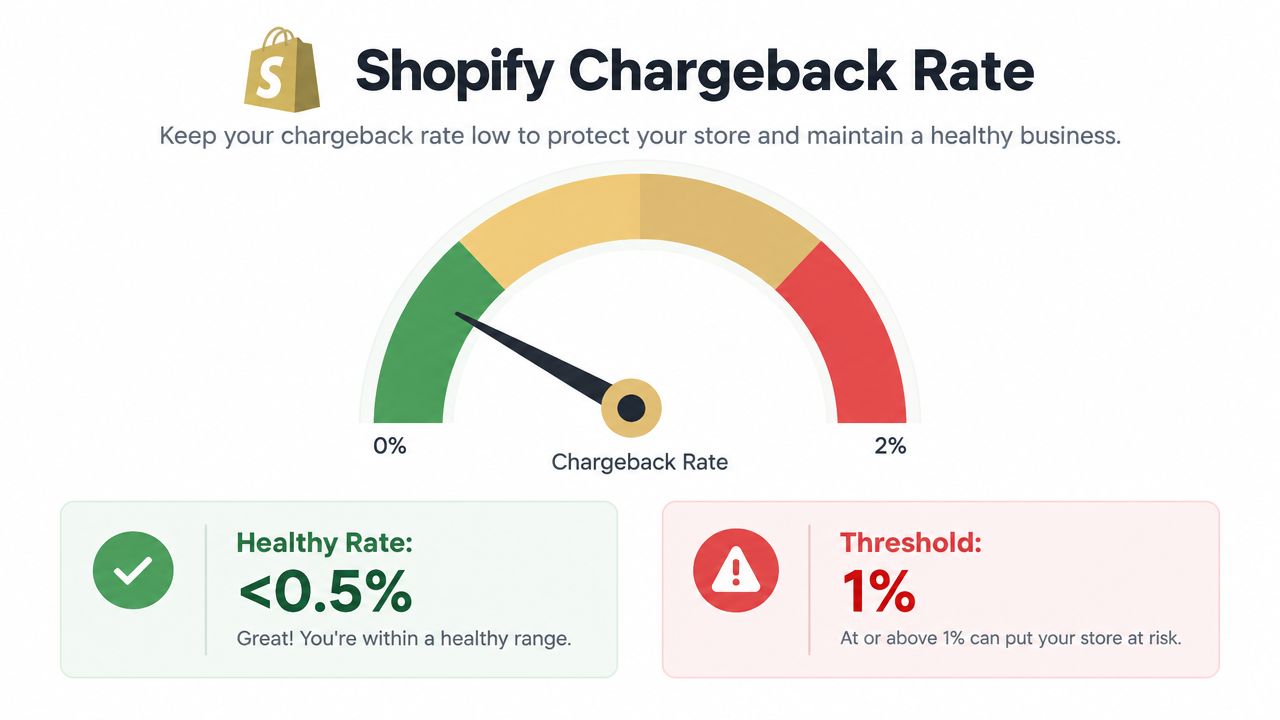
Shopify calculates the chargeback rate using a straightforward monthly formula: the number of chargebacks in a given month divided by the total number of chargeback-eligible transactions in that same month. Shopify treats every customer dispute as part of the merchant's rate, and the disputed amount is taken from the merchant immediately when the cardholder's bank initiates the chargeback. The calculation and cash-flow impact are described in Shopify's chargeback guidance.
That creates an uncomfortable distinction between case outcome and account health. You may submit convincing evidence and win the dispute, but Shopify says the chargeback still remains in the rate. A successful representment can recover the disputed funds without repairing the underlying ratio.
Why individual wins can mislead
Suppose your team wins several fraud disputes after submitting strong authentication and delivery records. Those wins matter financially, but they don't erase the disputes from the monitoring calculation. If new disputes continue arriving, the rate can remain high even while your representment team appears effective.
That's why a merchant needs two separate operating goals:
- Recover funds: Contest cases where the transaction is valid and the evidence supports your position.
- Reduce dispute volume: Fix the customer, billing, fulfillment, and fraud problems that create new disputes.
The second goal is the one that protects your payment relationship. A store can be technically right on many individual cases and still face scrutiny if the monthly dispute volume remains high. Merchants reviewing how to respond to a high chargeback rate should therefore treat representment as containment, not as the complete solution.
The practical benchmark
Shopify's 2025 merchant guidance cites a practical benchmark of keeping chargebacks under 0.65%, which is approximately 6 disputes per 1,000 transactions, as a risk-control sweet spot for major ecommerce operations. The same Shopify chargeback prevention article cites Mastercard's forecast that global chargeback costs to store owners are projected to rise from $33.79 billion in 2025 to $41.69 billion by 2028, an increase of nearly 23%.
Those figures are a warning against complacency. The right question after a dispute isn't only, “Can we win this case?” It's also, “What caused it, and what will stop the next one?”
The Operational Timeline of Chargebacks
The Shopify Payments timeline starts with the cardholder, not the merchant. The customer disputes the transaction with their bank, the bank initiates the chargeback, Shopify notifies you, and the disputed funds are removed while the case is reviewed.
The response window is usually 7 to 21 days, depending on the dispute and issuer requirements. That deadline is the operational center of the process. Once it closes, your evidence can no longer be edited, so waiting for a perfect packet is riskier than building a complete, well-organized response quickly. Shopify explains the sequence and timing in its Shopify Payments chargeback process documentation.
What happens at each stage
The customer disputes the charge. The cardholder contacts the issuing bank, often because the transaction is unrecognized, the order wasn't received, or the customer believes the merchant didn't resolve a problem.
Shopify notifies the merchant. The dispute appears in Shopify Payments, with the reason and response deadline. The notification should become an operations ticket immediately, not something left for the weekly finance review.
The merchant submits evidence. Your packet should answer the specific reason code. Shipping records help with a non-delivery claim, while authentication and customer communication may be more relevant to an authorization dispute.
The issuer decides. Shopify states that the issuer can take up to 75 days after submission to decide the case. During that period, the funds may remain unavailable and your team has limited control over the bank's review.
This timeline creates two separate clocks. The first is short and actionable, the period before evidence submission. The second can continue for months, during which your cash-flow forecast and dispute tracking need to account for unresolved cases.
Operational rule: Treat the deadline shown in Shopify as the real deadline. General guidance never overrides the date attached to the specific dispute.
A won case still counts toward the overall dispute rate, so a fast and accurate response protects recoverable revenue but doesn't remove exposure to monitoring thresholds, reserve reviews, or processor scrutiny. Your process should identify the reason code first, gather matching proof second, submit before the deadline, and address prevention separately.
This short video provides a visual overview of the sequence before you build your internal workflow.
Immediate Actions When a Chargeback Arrives
The first response should be controlled, not emotional. A chargeback notification tells you that money has already been pulled and that your team has limited time to respond. It doesn't tell you that every case deserves the same effort.
Start by opening the dispute in Shopify and recording the reason code, transaction details, response deadline, order status, customer history, and payout impact. Assign one owner who can coordinate finance, support, fulfillment, and fraud data. Shared responsibility sounds sensible, but it often produces the worst result, with everyone assuming someone else is preparing the response.
The first triage pass
Use this order of operations:
- Identify the reason: Read the dispute label before collecting documents. A “product not received” claim needs delivery evidence, while an unrecognized-payment claim may require billing descriptors, authentication records, and customer contact history.
- Check the commercial reality: Confirm whether the order shipped, arrived, was refunded, duplicated, canceled, or affected by a service failure.
- Review customer communications: Search email, chat, and support tickets for promises, cancellation requests, delivery complaints, or an agreed refund.
- Assess the economics: If the evidence is weak and the customer's claim is valid, accepting the chargeback may be more rational than spending scarce staff time on an unlikely representment.
- Freeze the packet: Once the response is complete, review it for contradictions, missing dates, and irrelevant material before submission.
A merchant shouldn't contest a case just because the team dislikes losing. Representment works best when the transaction records directly answer the bank's question. It works poorly when the response is a long narrative supported by generic invoices that don't address delivery, authorization, cancellation, or refund status.
Build evidence around the claim
Create a compact case file rather than uploading every record you can find. Put the conclusion first, then provide the supporting evidence in the order an unfamiliar reviewer can follow.
For a fulfillment dispute, that may mean the order record, shipping address, carrier events, delivery confirmation, and customer messages. For a recurring-billing complaint, include the accepted subscription terms, cancellation record, billing history, and any messages showing continued use after the alleged cancellation. For an unrecognized transaction, make the store descriptor and customer relationship clear, then add relevant authentication and account activity.
Shopify's guidance notes that evidence can be edited only until the response deadline, while resolution can take up to 75 days or even 120 days in some flows. The operational gap is significant: merchants need a triage system that works immediately, not a generic instruction to “submit evidence.” Shopify also states that the disputed amount and fee are withdrawn immediately, which makes cash-flow planning part of the response.
Practical rule: Don't wait for every department to produce a perfect file. Set an internal cutoff before Shopify's deadline, submit a coherent packet, and log what you learned for prevention.
Preventing Chargebacks Before They Reach Your Account
Representment begins after the merchant has already absorbed the disruption. A proactive alert system changes the decision point by notifying you while the transaction may still be resolved through a refund or customer-service intervention.
Traditional representment is appropriate when the order is valid and your evidence is strong. It gives you a formal route to recover funds, but it requires manual review, accurate records, and timely submission. It also leaves the dispute in your account, even if you eventually win.
Alert-based prevention takes a different route. Integrations connected to Visa's Rapid Dispute Resolution, Mastercard's CDRN, and Ethoca alerts can notify a merchant before a pending complaint becomes a formal chargeback. The merchant can then review the order, contact the customer, or issue a refund when that's the appropriate resolution.
Two operating models
| Approach | Where it starts | Main strength | Main limitation |
|---|---|---|---|
| Traditional representment | After the chargeback is filed | Recovers funds when the evidence directly supports the transaction | Requires rapid evidence work and doesn't remove the dispute from the rate |
| Alert-based prevention | Before formal chargeback filing | Can resolve eligible complaints before they become chargebacks | Requires compatible alert coverage, rules, and refund decisions |
| Customer-service intervention | When a complaint or alert appears | Preserves the relationship when the issue is confusion or fulfillment | Depends on a reachable customer and a team that responds quickly |
The choice isn't always either-or. A strong operation uses alerts to prevent avoidable disputes, representment to defend valid transactions that still become disputes, and product or fulfillment changes to reduce the underlying causes.
Shopify's merchant guidance cites Mastercard's projection that global chargeback costs could rise from $33.79 billion in 2025 to $41.69 billion by 2028, nearly 23%, and identifies under 0.65%, about 6 disputes per 1,000 transactions, as a practical risk-control benchmark. Those figures make prevention more than a support preference. It becomes a payment-operations decision.
Payment costs also affect the economics of intervention. Merchants comparing processing setups can use Sambapay transparent pricing as a resource when evaluating fees, transaction controls, and the total cost of accepting card payments.
For Shopify merchants that need automated alert handling and evidence workflows, Shopify chargeback protection is one option to evaluate alongside processor-native tools and internal support processes. Compare the tool's alert coverage, refund rules, integrations, reporting, and treatment of disputes you would likely win before committing to any prevention system.
Building a Long-Term Chargeback Defense Strategy
A sustainable defense has three layers: reduce avoidable disputes, respond consistently to formal cases, and monitor the rate as a business-health signal. Adding a tool without fixing unclear billing or weak fulfillment records only moves the bottleneck. Improving customer communication without tracking dispute reasons leaves you unable to see whether the changes work.
Start with the causes, not the dashboard
Review disputes by reason, product, fulfillment route, subscription status, country, and customer-contact history. Look for patterns that point to a specific operational defect:
- Unrecognized billing: Make the statement descriptor recognizable and put clear contact information on order confirmations.
- Delivery complaints: Surface tracking information, confirm the shipping address before dispatch, and investigate carrier exceptions quickly.
- Recurring-billing friction: State renewal terms plainly, make cancellation accessible, and document cancellation requests.
- Product dissatisfaction: Align product descriptions, images, expectations, and return instructions so support can resolve complaints before the customer goes to the bank.
- Duplicate or incorrect charges: Audit automated billing and fulfillment events so a checkout or retry error doesn't create competing transactions.
The point isn't to create a larger spreadsheet. It's to assign each recurring cause to a person who can change the process. A support manager may own billing-descriptor complaints, while operations owns delivery evidence and finance owns duplicate-transaction controls.
Make response quality repeatable
A response template should give the reviewer a clear chronology, but it shouldn't become a copy-and-paste excuse. Keep a structured record for every case:
- The original claim and reason code.
- The merchant's position, stated in plain language.
- Evidence that directly supports that position.
- The submission date and final outcome.
- The operational change, if one is needed.
This record helps you distinguish a weak case from a strong case lost for reasons outside your control. It also prevents the team from measuring success only by wins. A rising win rate alongside a rising dispute count still indicates a prevention problem.
Combine automation with judgment
Automation is useful for collecting order data, routing alerts, flagging deadlines, and applying pre-approved refund rules. It shouldn't automatically refund every complaint without considering order value, customer history, fulfillment status, or whether the dispute is likely to be resolved through support.
The strongest systems automate the clock and the paperwork, while people retain control over exceptions and customer relationships.
Set a regular review with finance, support, fraud, and fulfillment. Discuss new disputes, unresolved cases, recurring reason codes, cash held in review, and changes made since the previous review. That cadence turns chargebacks into operational feedback instead of a recurring emergency.
Protecting Your Payment Processing Relationship
Payment processors don't evaluate your store one dispute at a time. They look at the pattern: how frequently customers challenge transactions, whether your team responds on time, whether fraud and fulfillment problems persist, and whether the business appears capable of controlling its exposure.
That's why a merchant can feel successful after winning difficult cases and still receive uncomfortable questions from a processor. The wins may recover funds, but Shopify's calculation still includes the disputes. Processor scrutiny follows volume and pattern, not just the arguments submitted in individual cases.
Keep communication factual and early
If your dispute activity rises, don't wait for a restriction or reserve review before contacting your payment provider. Prepare a short operating summary that explains the reason mix, the immediate controls you've applied, the evidence workflow, and the prevention work underway. Avoid promising that the problem is solved if you're still testing the fix.
A processor is more likely to understand a temporary spike when the merchant can show ownership and a credible control plan. That plan should identify who monitors alerts, who handles formal evidence, how deadlines are tracked, and which customer or fulfillment changes are reducing new disputes.
Merchants reviewing broader payment architecture can also consult this ecommerce payment solutions guide when assessing processor fit, payment methods, and operational requirements. The cheapest transaction setup isn't necessarily the safest choice if it provides weak dispute visibility or poor support during a cash-flow crisis.
Build resilience before a hold
A reserve or payout hold becomes dangerous when the business has no liquidity buffer and no view of unresolved disputes. Track disputed funds separately from ordinary revenue, update cash-flow projections when a case begins, and avoid relying on eventual wins to fund immediate obligations.
Keep the following controls visible to leadership:
- Dispute rate: Monitor the monthly Shopify Payments population used for the calculation.
- Open exposure: Record funds already withdrawn and cases awaiting issuer decisions.
- Deadline ownership: Assign every formal case to a named operator.
- Root-cause trend: Compare reason codes with support, delivery, billing, and product data.
- Processor communication: Keep a dated record of questions, responses, and corrective actions.
If your account is already under pressure, review Shopify hold protection as part of a wider contingency plan, alongside processor communication and internal controls.
The healthiest payment relationship comes from fewer disputes reaching the processor, not from winning an impressive number of cases after they arrive. Start today by exporting your recent dispute reasons, assigning ownership for every open deadline, and fixing the clearest preventable cause before the next notification lands.
Disputely helps Shopify merchants intercept eligible dispute alerts, apply refund rules, and organize chargeback responses before a small complaint becomes a larger processing problem. Visit Disputely to review the alert and automation options for your store, then connect the workflow to the deadlines and dispute patterns you're managing now.


