
Chargeback Reason Code 13: A Practical Merchant Guide
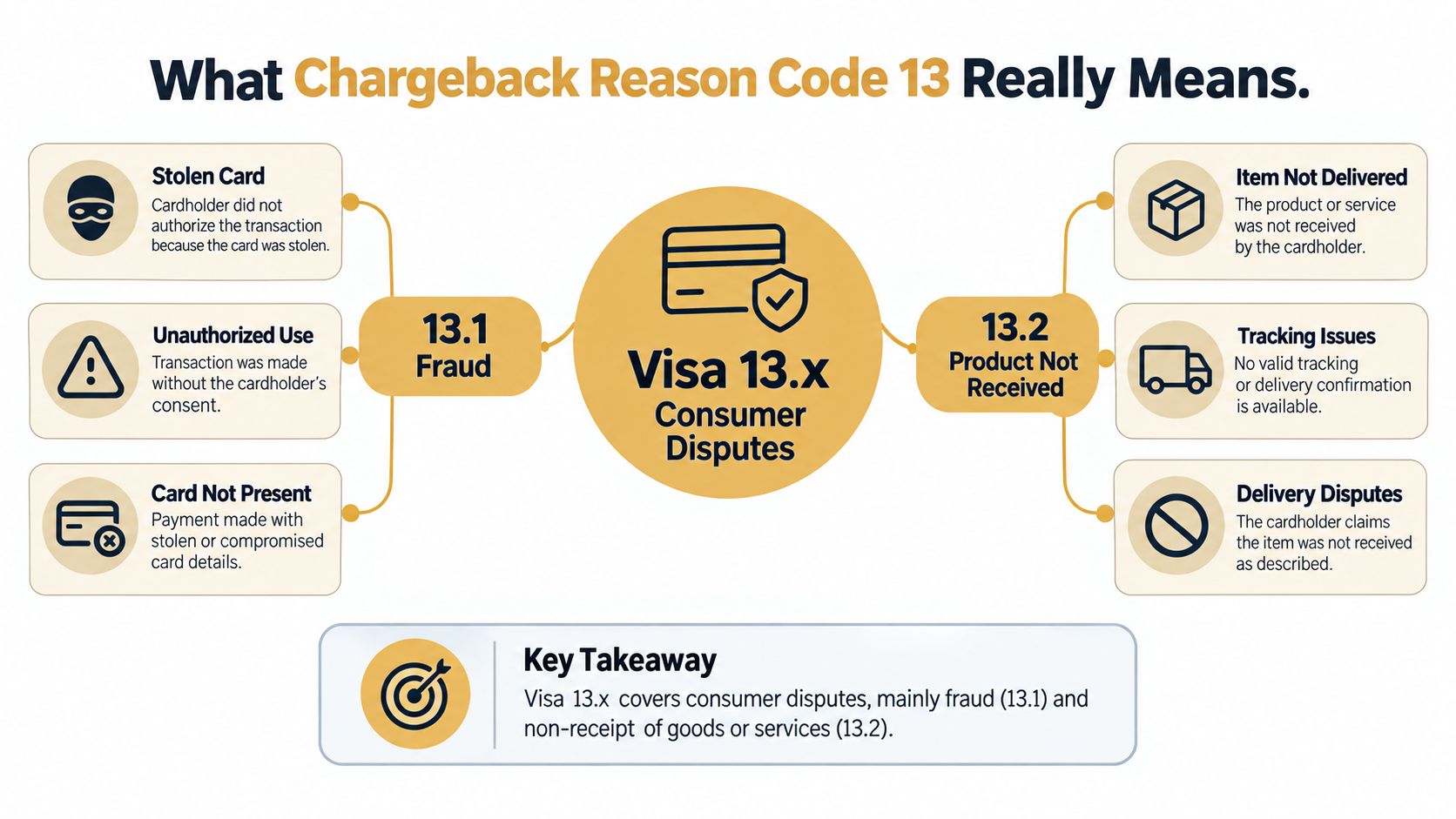
Visa reason code 13 is the Consumer Disputes family, covering subcodes 13.1 through 13.9 rather than one single dispute type. The subcode identifies the customer's complaint and determines whether you should refund, fix the underlying issue, or build a targeted representment case.
A familiar situation unfolds in many payment operations teams. A customer emails support about an order that has already shipped, the support queue misses the message, and an issuer later files a dispute that appears on the merchant statement as a 13.x case. The team sees “code 13,” pulls a generic delivery receipt, and submits it, even though the allegation may concern a cancellation, a defective item, or an unprocessed credit.
That approach fails because the parent code is only a family label. Visa's merchant materials classify 13.1 through 13.9 as different consumer complaints, each with its own evidence requirements and operational remedy. A 13.1 case usually turns on delivery or service-performance records, while a 13.2 case depends on cancellation and recurring-billing evidence. A 13.6 case is about whether a promised credit was submitted and processed. Visa's merchant dispute guidance reinforces why merchants need to distinguish the underlying condition rather than treat every consumer dispute alike.
What Chargeback Reason Code 13 Really Means
Visa's reason code 13 is a consumer-dispute category, not a universal fraud finding. The issuer is generally communicating that the cardholder disputes the goods, services, cancellation, refund, or transaction outcome. That doesn't tell you whether the customer is right, whether the transaction was authorized, or what evidence will persuade the issuer.
The subcode supplies that missing operational detail. Visa identifies 13.1 as merchandise or services not received, 13.2 as a cancelled recurring transaction, 13.3 as merchandise or services not as described or defective, 13.4 as counterfeit merchandise, 13.5 as misrepresentation, 13.6 as credit not processed, 13.7 as cancelled merchandise or services, 13.8 as an original credit transaction not accepted, and 13.9 as non-receipt of cash at an ATM. Those classifications appear in Visa-aligned merchant reason-code guidance.
The subcode changes the decision
A 13.1 notification should send the operations team to the order-management system, carrier records, and service-delivery logs. A 13.2 notification should send the billing team to cancellation timestamps, renewal notices, authorization records, and customer communications. A 13.6 notification requires a search for the refund submission, credit reference, amount, and processing date.
The same customer-service conversation can also lead to different actions. If a customer says an item never arrived, the merchant may still have a strong case if delivery records match the order. If the customer says a subscription was cancelled before renewal, a refund may be the sensible response even when the original payment was properly authorized.
Practical rule: Identify the network, message system, primary reason code, and subcode before choosing evidence or an outcome.
The operating principle is simple: read the subcode first, then choose the response. Prevention controls, alert-stage refunds, and representment packets all work better when the team starts with the allegation rather than the generic label.
The Subcodes Behind Code 13 and What Each One Signals
Each 13.x condition points to a different failure in the merchant's operation. The fastest review starts by searching for the trigger event in the OMS, CRM, billing platform, or payment processor.
| Subcode | Customer complaint | Operational signal |
|---|---|---|
| 13.1 | Merchandise or services not received | Delivery exception, missing tracking event, or absent service-completion record |
| 13.2 | Cancelled recurring transaction | Renewal after cancellation, account closure, or withdrawn billing authorization |
| 13.3 | Merchandise or services not as described or defective | Product mismatch, defect report, access failure, or unresolved support case |
| 13.4 | Counterfeit merchandise | Authenticity challenge or weak sourcing documentation |
| 13.5 | Misrepresentation | Product page, advertisement, or sales promise doesn't match the customer's experience |
| 13.6 | Credit not processed | Refund promised or expected, but no settled credit can be matched to the transaction |
| 13.7 | Cancelled merchandise or services | Cancellation or return recorded without the corresponding credit |
| 13.8 | Original credit transaction not accepted | Credit transaction rejected or not handled under the applicable rules |
| 13.9 | Non-receipt of cash at an ATM | Dispense discrepancy or missing cash-load confirmation |
13.1 is a fulfillment investigation. Search the shipment record, delivery status, delivery location, signature, and customer communications. For digital services, look for access, download, or service-completion logs. A generic order receipt won't answer a non-receipt claim.
13.2 is a recurring-billing investigation. Compare the cancellation timestamp with the disputed billing date. Check whether the customer cancelled through the supported channel, whether the cancellation was acknowledged, and whether the billing authorization remained valid.
13.3, 13.4, and 13.5 are catalog and quality investigations. Preserve the product-page version, SKU details, images, specifications, advertising copy, sourcing records, and support correspondence. A shipping record proves movement, not that the delivered product matched its description or was authentic.
13.6 and 13.7 are credit-control investigations. Search for refund requests, approval notes, credit submissions, processor responses, and customer notifications. A merchant's internal note saying “refund approved” is weaker than a processor record showing the credit was submitted and matched to the original transaction.
13.8 and 13.9 require specialist payment records. For 13.8, retain the original credit transaction details and regional processing records. For 13.9, reconcile ATM dispense logs, terminal records, cash counts, or load confirmations.
The important distinction is that these are decision keys, not merely reporting labels. The right search query and the right remedy depend on the subcode.
Why Code 13 Is a Visa Shorthand, Not a Universal Label
A delivery confirmation can look like the right answer until the network file shows a product-quality allegation. A merchant processing across card networks must identify the network and message system before choosing evidence or deciding whether to refund during the alert window.
Visa groups these disputes under the 13.x Consumer Disputes family. Mastercard uses different numbering and separates its Dual Message System from its Single Message System. Its documentation identifies 2713 as “Invalid Chargeback” and uses code 13 for “Representment” in certain debit Mastercard transactions processed through the Single Message System. Mastercard's chargeback documentation shows why the number alone cannot determine the workflow.
The same customer description can therefore produce different network requirements. For a Visa 13.1 delivery allegation, confirm fulfillment and delivery evidence in the alert window. For a cancellation or credit issue, verify the timing and submit the refund when the records show the customer is right. For a Mastercard product dispute, preserve the listing, configuration, and specifications instead of sending tracking data that answers a different question.
A merchant selling configurable goods may see a delivery event and attach the shipping record immediately. If the allegation concerns a missing feature, that packet proves receipt but not conformity. The practical decision matrix is simple: match the network and subcode, then either assemble the evidence that addresses that allegation or refund when the evidence will not support a defensible representment.
Normalize every case with fields for card network, message system, primary reason code, subcode, transaction date, and dispute stage. Never place every “13” in one queue or map a Mastercard record to a Visa rule because the customer's wording sounds similar.
How Code 13 Disputes Hit Your Merchant Account
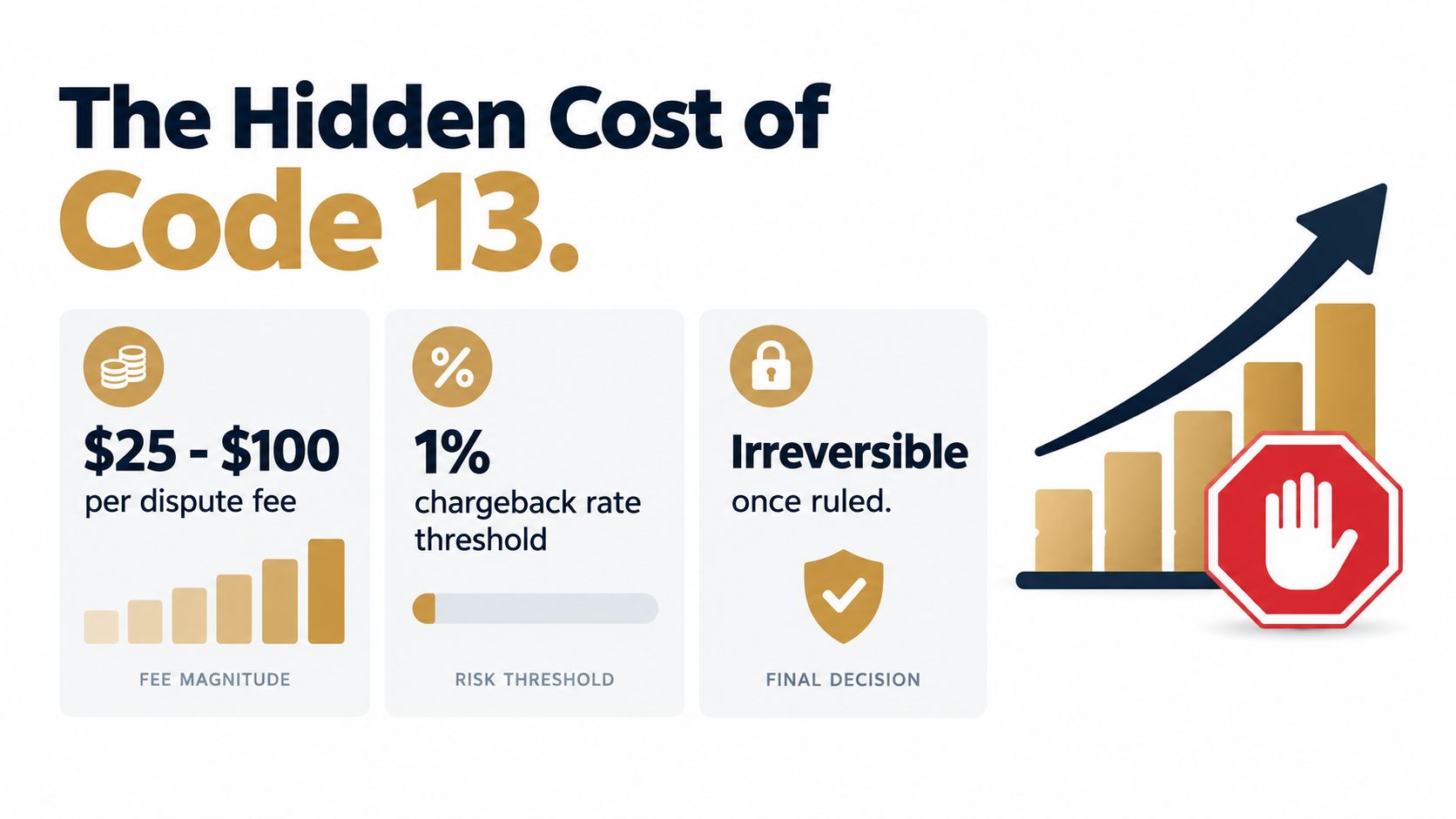
A code 13 case affects more than the disputed sale. The merchant may face a dispute fee set by its processor, lose the transaction amount if the case is decided against it, and spend staff time reconstructing an event that should have been documented at checkout, fulfillment, cancellation, or refund.
A representment win doesn't erase the operational cost of the case. The team still had to identify the allegation, retrieve records, format the response, meet the acquirer's deadline, and retain the submission history. Repeated consumer disputes can also change how an acquirer assesses the account, including scrutiny of reserves, processing limits, and underwriting risk.
Ratios reveal process failures
Aggregate reporting is useful for detecting pressure, but it's poor at finding the cause. A dashboard that reports only “reason code 13” can't tell whether the merchant has a delivery problem, a cancellation defect, inaccurate product claims, or delayed credits. Subcode-level reporting shows which team owns the fix.
Visa's monitoring environment makes that distinction operationally important. The Visa public rules describe dispute procedures and category requirements, while merchant risk teams use their own processor reporting to watch dispute ratios and account exposure. A cluster of 13.1 cases calls for fulfillment remediation. A cluster of 13.2 or 13.7 cases points to recurring billing and cancellation controls.
Subscription businesses and high-value merchants usually feel this pressure quickly because one unresolved customer complaint can represent a meaningful commercial loss and expose a broader process gap. Review high chargeback rate risks by subcode, not just by total case count.
How to Respond and Dispute a Code 13 Chargeback
When a notification arrives, preserve the original allegation before anyone edits the order, account, or support record. Then work through the case in this order:
- Confirm the network and subcode. Don't rely on an internal label that says only “consumer dispute.”
- Read the cardholder's claim. The narrative may narrow the issue beyond the formal code.
- Check the acquirer deadline. Your processor may require submission earlier than the network's outer deadline.
- Choose refund, remediation, or representment. Don't fight a valid cancellation or missing credit just because the transaction was authorized.
- Build a focused evidence packet. Include documents that answer the allegation, not every record in the account.
- Submit and retain confirmation. Store the response, attachments, timestamps, and outcome with the transaction.
| Subcode | Cardholder claim | Required evidence | Common win factor |
|---|---|---|---|
| 13.1 | Goods or services weren't received | Delivery, tracking, signature, service-completion, or access records | Evidence ties fulfillment to the disputed order |
| 13.2 | Recurring charge continued after cancellation | Subscription terms, cancellation timeline, renewal notice, authorization record | Billing date follows a valid authorization and no timely cancellation |
| 13.3 | Goods or services were defective or not as described | Product-page snapshot, SKU, fulfillment record, communications, usage or access logs | Delivered item or service matches the accepted description |
| 13.4 | Merchandise was counterfeit | Sourcing and authenticity records | Merchant demonstrates legitimate provenance |
| 13.5 | Merchant misrepresented the offer | Archived advertising, checkout copy, terms, and order details | Sales promise matches what the customer received |
| 13.6 | Promised credit wasn't processed | Credit amount, processing date, reference, and processor confirmation | Issued credit can be matched to the original transaction |
| 13.7 | Cancellation or return didn't produce a credit | Cancellation or return record, policy, refund submission | Merchant shows the required credit was processed |
| 13.8 | Original credit transaction wasn't accepted | Credit transaction and regional processing records | Transaction followed the applicable network rules |
| 13.9 | ATM cash or load value wasn't received | Dispense log, terminal record, reconciliation, or load confirmation | System record confirms cash or value was delivered |
A strong packet is chronological and legible. For a digital-service 13.3 case, access logs can help establish that the customer received and used the service, but they don't replace the product description or terms accepted at checkout. For a 13.6 case, a CRM transcript can explain the promise, while the processor credit record proves execution.
More evidence isn't automatically better. Evidence is useful only when it answers the allegation clearly.
Before escalating to pre-arbitration, compare the amount at stake, documentation quality, customer history, remediation cost, and the likelihood that the issuer will accept the explanation. The chargeback-fighting workflow should end with a deliberate decision, not an automatic escalation.
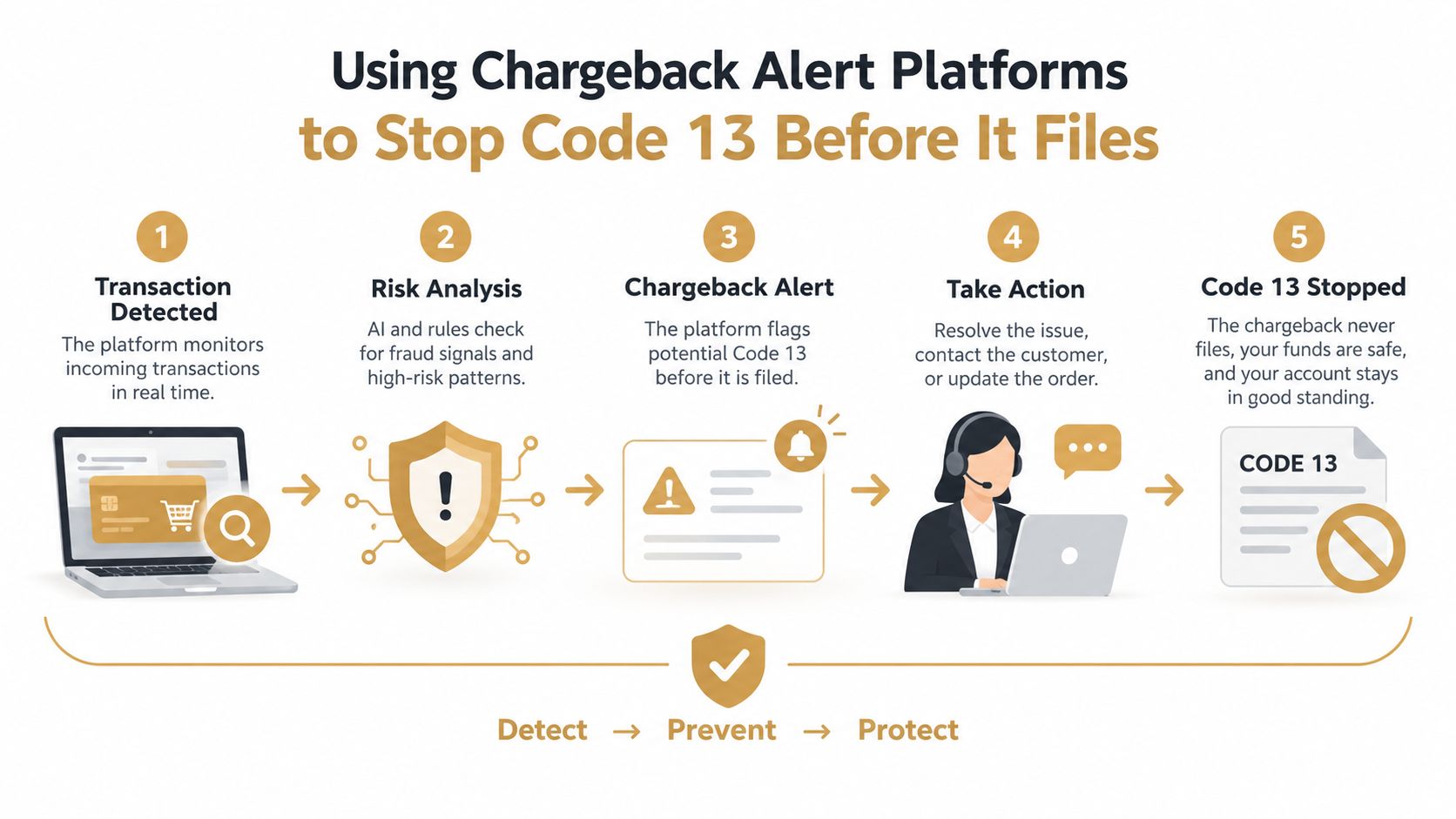
Using Chargeback Alert Platforms to Stop Code 13 Before It Files
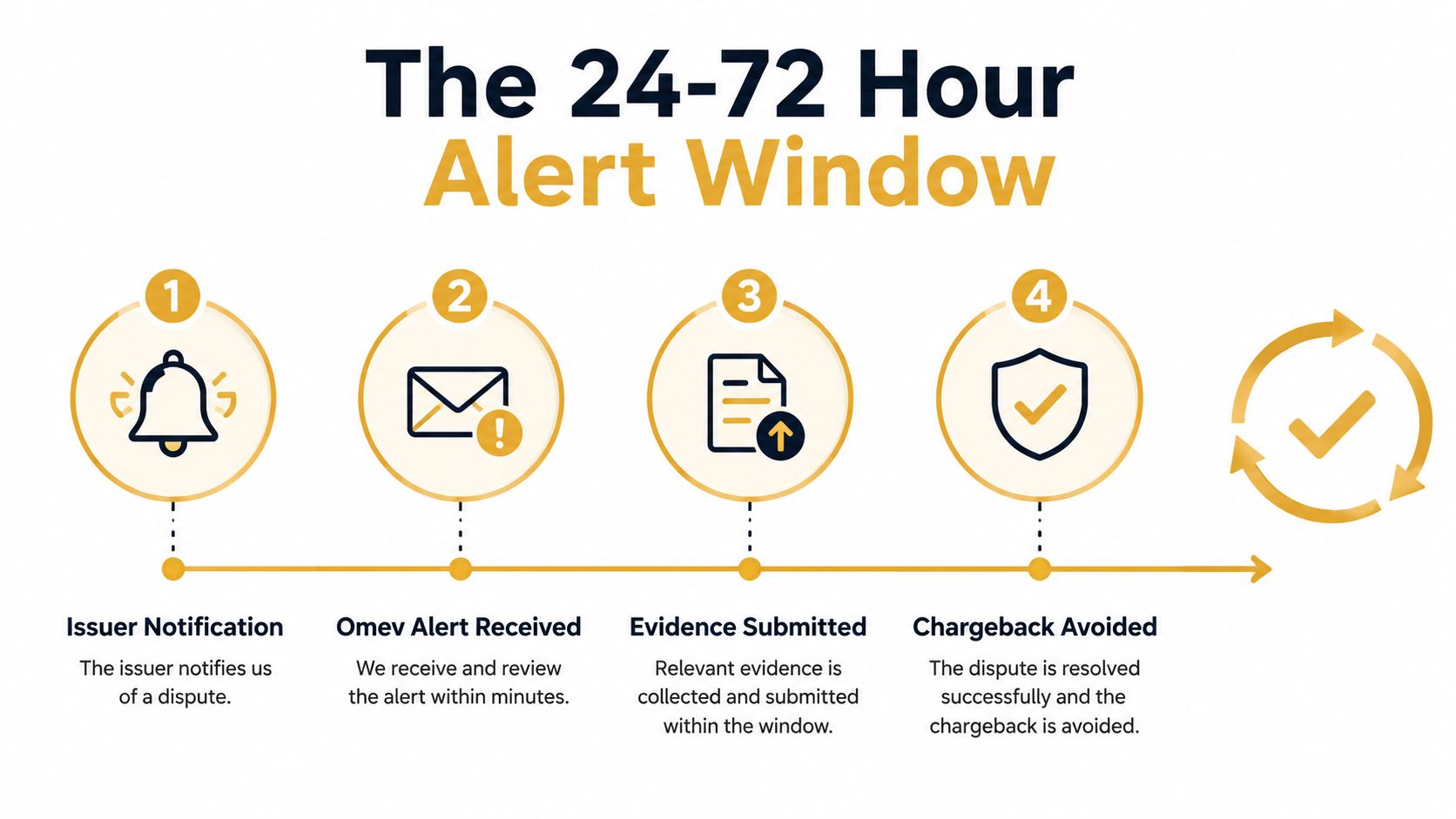
An alert arrives after the issuer receives the customer's complaint but before the network posts a formal chargeback. That interval is a triage opportunity. It isn't a guaranteed save, because the merchant still needs to verify the order, decide whether the complaint is valid, and act before the alert expires.
The best workflow translates the alert into the subcode-level action immediately. A 13.1 alert for a shipped order with weak delivery evidence may justify a refund or replacement. A 13.3 alert for a bespoke product may justify a focused representment if the catalog snapshot, specifications, and fulfillment records are strong. A 13.7 alert for a recurring charge may call for refunding the disputed billing period, confirming cancellation, and preventing another renewal.
What the platform should do
A useful alert system should:
- Normalize network data: Preserve the network, reason code, subcode, transaction, and customer reference.
- Route the case: Send the alert to billing, fulfillment, support, or risk based on the allegation.
- Expose the transaction record: Connect the alert to the OMS, CRM, subscription system, and payment processor.
- Support a decision rule: Allow refund, remediation, or evidence collection without forcing every case into the same path.
- Record the outcome: Store the action, timestamp, refund reference, and case status for later reconciliation.
Disputely is one example of an alert platform that connects issuer notifications with refund and dispute workflows, including Visa RDR, Mastercard CDRN, and Ethoca alerts. A merchant should also test the integration path, webhook or equivalent delivery, duplicate handling, refund confirmation, and escalation process before relying on it for live triage.
Ask providers how quickly they deliver alerts, how they handle missing subcodes, whether they distinguish networks and message systems, and how they expose failed refunds. A platform that delivers notifications but doesn't connect them to the transaction and action record moves the manual work to another inbox.
Prevention Strategies That Reduce Code 13 Disputes
Prevention starts before authorization, but the controls must follow the complaint type. A fraud control won't solve a delayed refund, and better tracking won't correct a misleading product page.
Fulfillment and catalog controls
For 13.1, provide shipment visibility, record delivery outcomes, and preserve proof that a service was performed. For digital goods, retain access, download, activation, or usage records that identify the account and transaction.
For 13.3, 13.4, and 13.5, archive the exact product description, images, specifications, selected options, terms, and advertising shown at checkout. Photograph or otherwise record packing for products where condition, configuration, or authenticity may later be questioned. Keep sourcing documents available for branded goods.
Recurring billing and credits
For 13.2, make cancellation easy to locate, confirm the request, stop future renewals promptly, and retain the cancellation timestamp. Display the billing cadence and renewal terms clearly. Don't make support search through several systems to determine whether authorization was withdrawn.
For 13.6 and 13.7, connect the refund request to the processor result. A weekly unfulfilled-cancellation review can identify cases where support promised a credit but billing never submitted it. Show a recognizable merchant descriptor so customers can connect the transaction to the business before contacting the issuer.
Specialist transaction records
For 13.8, preserve original credit transaction records and verify that the transaction followed the rules applicable to the region and payment flow. For 13.9, reconcile ATM dispense records, terminal logs, cash counts, and load confirmations after exceptions are reported.
| Subcode | Primary prevention action | Evidence to archive |
|---|---|---|
| 13.1 | Improve delivery and service-completion tracking | Tracking, delivery confirmation, signature, access, or completion logs |
| 13.2 | Confirm cancellation and suppress future renewal | Cancellation timestamp, terms, renewal notice, authorization history |
| 13.3 | Keep catalog content aligned with fulfillment | Product snapshot, SKU, specifications, photos, support records |
| 13.4 | Verify product provenance | Supplier invoices, authenticity records, sourcing details |
| 13.5 | Review advertising and checkout claims | Archived copy, images, terms, selected offer |
| 13.6 | Reconcile promised credits with processor output | Refund request, submission date, amount, reference, processor result |
| 13.7 | Link returns and cancellations to credits | Return record, policy acceptance, cancellation confirmation, credit |
| 13.8 | Validate original credit processing | Credit transaction record and applicable rule documentation |
| 13.9 | Reconcile cash and load delivery | ATM logs, terminal records, cash count, load confirmation |
For Shopify merchants, these controls should connect order, fulfillment, customer-service, and refund records rather than leave each team with a partial history. A Shopify chargeback protection workflow can support that coordination, but the underlying records still need to be accurate and retained at transaction level.
Choosing the Right Response for Each Code 13 Subcode
Use three response paths: prevent, refund during the alert window, or represent.
Refund when the customer's claim is supported by your own records, the evidence is thin, or remediation costs less than prolonged handling. Represent when the amount or customer history justifies it and the evidence directly answers the allegation. Flag recurring subcodes for process review, especially when cancellations, credits, or delivery exceptions repeat.
The subcode should drive the default. A 13.1 case may be winnable with clear fulfillment records. A 13.6 or 13.7 case often deserves rapid credit remediation when the merchant's own system shows a missed refund. Whatever the choice, record the reason, evidence strength, customer outcome, and upstream process owner so the next case becomes easier to prevent.
Disputely connects Visa, Mastercard, and Ethoca dispute alerts to transaction-level refund and representment workflows, helping teams act on code 13 complaints before they become filed chargebacks. Review the available alert and prevention workflows at Disputely and set rules around the subcodes your operation sees most often.


