
Clothing Store Shopify Setup: The 2026 Playbook
Most advice about launching a clothing store on Shopify starts with themes, product photography, and social media traffic. Those things matter, but they won't protect a weak apparel operation. A beautiful storefront can still lose margin through avoidable fit returns, multi-size ordering, inaccurate inventory, unclear shipping costs, and refunds that arrive after a customer has already contacted their bank.
A profitable clothing store treats the customer journey as one connected system. Product-page information influences returns, return handling influences disputes, and dispute volume can affect the payment relationships that keep the store operating. The practical question isn't only how to get more orders. It's how to acquire orders that your fulfillment, support, refund, and payment processes can handle safely.
The Hidden Costs of Selling Apparel Online
A generous return policy isn't automatically customer-friendly. It can increase confidence before purchase, but if the product page leaves shoppers uncertain about fit, the policy may also subsidize avoidable shipping, inspection, restocking, and refund work. In fashion, customers often solve uncertainty by ordering multiple sizes or colors and returning most of them.
Independent fashion-return data attributes 34.63% of fashion returns to garments not fitting, while another 21% is linked to bracketing, where shoppers order several sizes to choose at home. Those figures are reported in Shopify's ecommerce returns analysis. The commercial consequence is larger than the outbound postage. Your team also pays for reverse logistics, warehouse handling, inventory delay, payment processing work, customer support, and the risk that returned stock can't be resold at full value.
Practical rule: Treat fit uncertainty as a product and merchandising problem before treating it as a returns problem.
The operational chain starts before a product reaches Shopify. A garment with inconsistent grading, vague measurements, or poor quality control creates customer confusion that no return-policy paragraph can fully repair. Reviewing your design-to-manufacturing workflow can help connect product specifications, sampling, production checks, and the information eventually shown on the product page.
Why refunds become payment problems
A fit return is usually manageable when the customer can request it easily, receive clear instructions, and see the refund progress. Friction appears when the store confirms the return but delays the refund, sends inconsistent messages, or fails to explain whether the parcel has been received. The customer may then open a dispute for an order they already tried to resolve directly.
That creates a costly mismatch. The merchant may view the case as a normal return, while the issuer sees a cardholder claiming that money is still owed. The more often this happens, the more time your team spends reconciling Shopify orders, carrier scans, refund records, and processor deadlines.
Build the payment-risk workflow into the store architecture from the beginning. Define who reviews a return, who authorizes a refund, where tracking evidence is stored, and how support knows that a refund has already been issued. Your dispute-prevention budget should be based on the value of avoided operational failures, not only on the price of an app. Review potential payment costs and coverage before launch through the Disputely pricing page, then compare that with the labor and processor exposure created by unmanaged alerts.
Broad sizing needs governance
Offering many sizes can improve accessibility and conversion, but it also increases variant complexity. Inventory must be accurate at the size and color level, product photography must represent relevant fits, and customer service needs a consistent language for measurements and recommendations.
Don't respond to bracketing with blanket restrictions. A shopper ordering two adjacent sizes because the fit information is unclear isn't equivalent to a pattern of unusually large, high-value multi-size orders followed by repeated claims that shipments were incomplete. Segment the policy, document the evidence, and preserve a straightforward path for legitimate fit needs.
The best return policy is therefore not the most generous one. It's the policy your store can explain, execute, and document quickly.
Designing Product Pages for Fit and Conversion
Apparel product pages sell confidence before they sell fabric. The shopper needs a clear answer to how will this garment fit my body? A polished Shopify theme cannot provide that answer by itself. Build the content model so fit information appears before the shopper selects a size, chooses a variant, and adds the item to the cart. Every unresolved fit question can become a return, a refund delay, or a payment dispute.
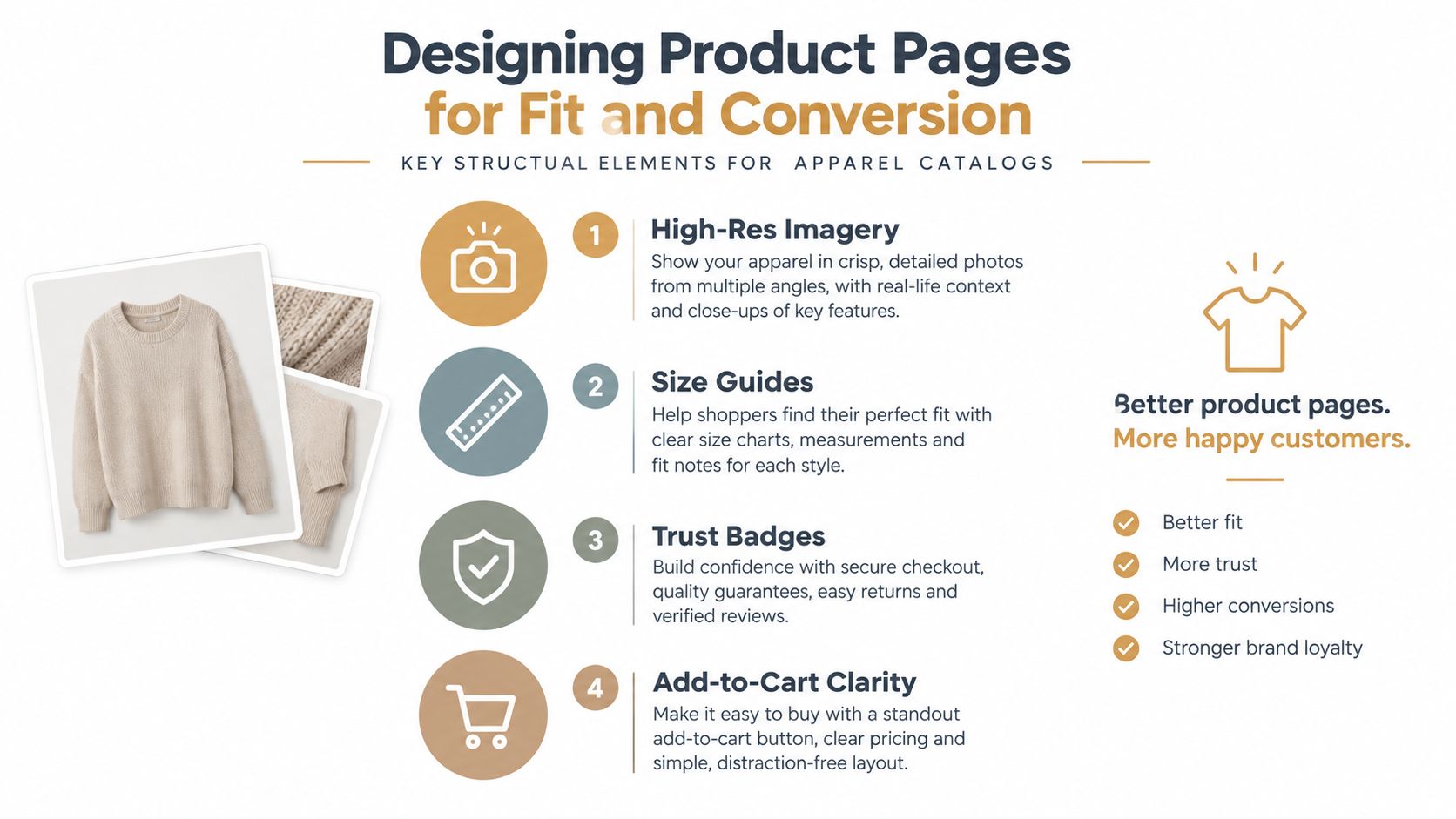
Start with the variant structure. Keep size, color, inseam, and other purchase-critical options distinct. Mark unavailable combinations clearly, rather than letting a shopper select a variant that cannot ship. Update stock promptly when inventory changes during a campaign. A customer who orders an available size and receives a substitute, cancellation, or delayed fulfillment has a stronger basis for dissatisfaction than one who sees an accurate out-of-stock message.
Build fit guidance into the buying decision
A generic small-to-large chart leaves too much interpretation to the customer. Use garment-specific measurements such as chest, waist, hip, rise, inseam, length, or sleeve length where relevant. State whether each measurement describes the garment or the body. Add a short fit label, such as fitted, relaxed, oversized, or true to size, only when it matches a documented internal standard. A fit note is a commitment, so review it against sample measurements and approved product data before publication.
Model information adds useful context. Show the model's height, worn size, and relevant body measurements when consent and brand practice allow it. Multiple model perspectives can clarify proportion across different bodies. They still cannot represent every customer, so pair those images with measurements and garment dimensions.
Put the size guide beside the selector on mobile. A chart hidden inside a long accordion or placed in the footer arrives after the buying decision has already stalled. If the theme needs custom product templates, compare implementation considerations with Presidio's Shopify template expertise before adding one-off components that your team cannot maintain. A maintainable template matters when measurements, model details, or variant rules change across a large catalog.
Make visual quality serve clarity
Use a consistent image sequence: clean front view, back view, detail view, scale or proportion view, and fit-on-model view. Show fabric texture, closures, transparency, stretch, and any feature that could affect the purchase decision. Alt text should describe the item and relevant visual context without keyword stuffing.
Performance affects both conversion and fit decisions. Apparel pages often load large images alongside variant logic, reviews, recommendations, and tracking scripts. Compress images, serve suitable dimensions, and reserve image space so the page does not shift while a shopper selects a size. Shopify's website benchmarking guidance describes LCP below 2.5 seconds, INP below 200 milliseconds, and CLS below 0.1 as field-performance thresholds at the 75th percentile, and reports that an additional 100 milliseconds of page-load delay can reduce conversions by as much as 3.5%. Treat app governance as a margin decision. Remove duplicate functionality, defer noncritical scripts, and test product pages on mobile networks after major changes.
Fit content also supports payment access. Clear measurements, accurate stock, and consistent product evidence reduce avoidable dissatisfaction before it becomes a refund request or chargeback. Add those checks to the product-page acceptance process beside photography, price, variant availability, and mobile performance.
Optimizing the Checkout Flow for Fashion Buyers
A clothing store can improve its checkout conversion rate and still lose money if the flow hides fit uncertainty, encourages bracketing, or delays refunds. Those failures create support work, chargebacks, and pressure on payment processing access. Treat checkout as an operational control, not only a sales page.
A practical fashion ecommerce benchmark is approximately 1.9% to 3.3% conversion, while average cart abandonment is about 70%, according to Shopify's fashion conversion-rate guidance. The same research identifies unexpected shipping, tax, and other checkout costs as common abandonment drivers. These figures provide context, but event data shows where a specific store is losing buyers.
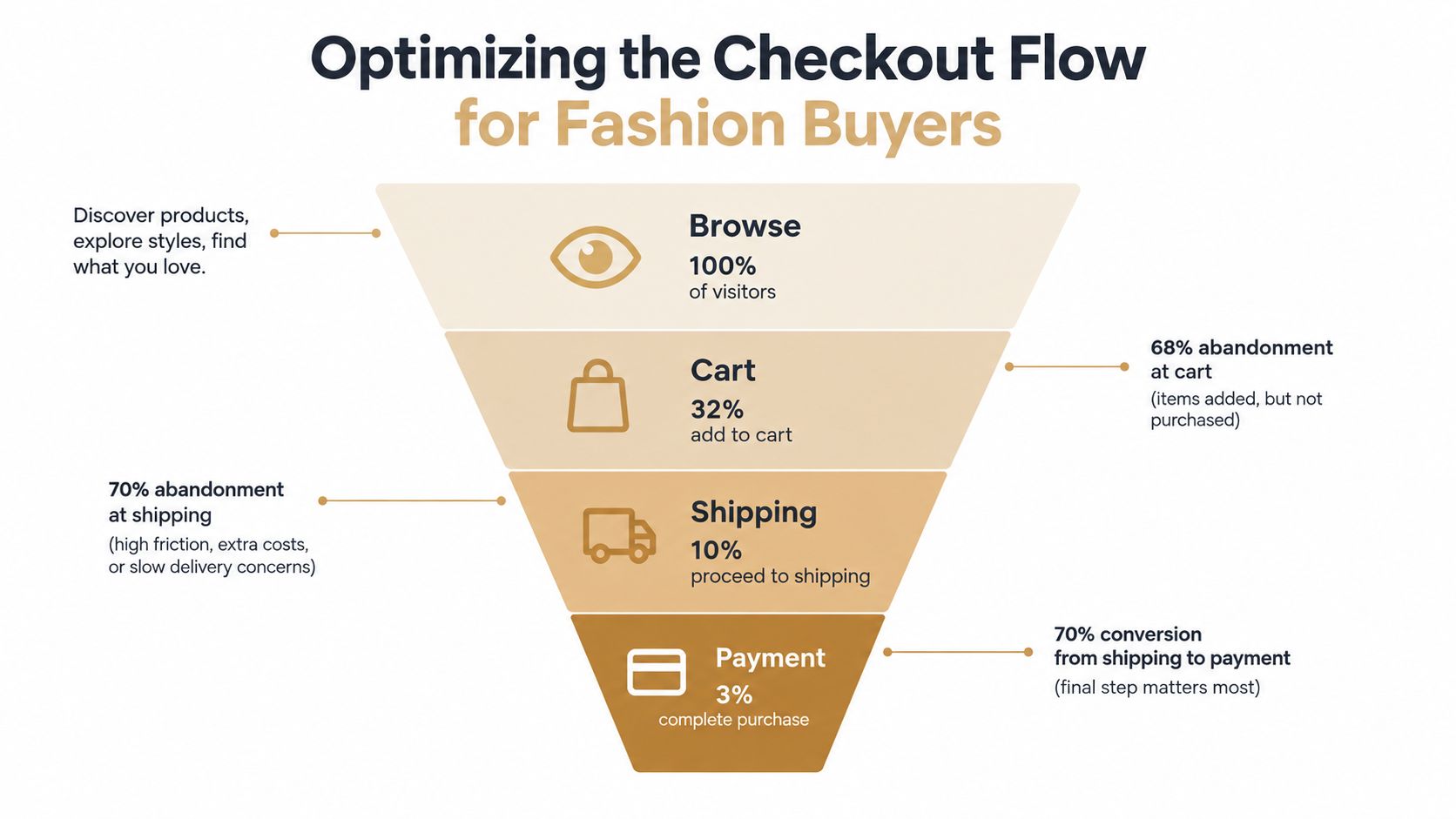
Instrument the path from product interest to completed order. Track product views, size-selector interactions, add-to-cart events, checkout starts, payment errors, purchases, refunds, and returns. Segment those events by device, country, traffic source, product category, size availability, and new versus returning customer.
Find the largest stage-level leak
Create a baseline before changing the checkout. If mobile shoppers select sizes but rarely add products, review the fit answer and variant controls. If shoppers add products but do not start checkout, inspect cart messaging, delivery estimates, and promotional conditions. If checkout starts are healthy but purchases drop after shipping appears, investigate landed costs and delivery promises before changing acquisition campaigns.
Show the estimated delivered cost as early as the market and platform setup allow. Include duties and taxes where applicable, and avoid advertising a low product price that becomes materially different at the final step. For apparel, also surface the return window, refund method, and any return fee before payment. A buyer who cannot predict the financial outcome may abandon the order, place several sizes to compare at home, or dispute a charge when the refund takes too long.
Run one controlled change at a time. Test clearer shipping language against the current version, or test an earlier delivery estimate, rather than changing the cart, theme, offer, and payment options together. Record the segment, hypothesis, starting condition, and decision rule. Judge the result against completed purchases, refunds, and returns, not clicks alone.
Test payment paths, not just page design
Review the order of payment choices on mobile and desktop. Test Shop Pay and other wallet buttons above the payment form against placement below it, then compare completed orders, payment errors, and refund requests by device. Express checkout can reduce typing, but prominent buttons may cause shoppers to skip a final review of size, quantity, delivery address, or return terms.
Check the full error path. Use failed payments, expired cards, duplicate submissions, cancellations, refunds, and partial refunds in testing. The customer should receive a clear recovery message, while support staff should be able to match order, payment, fulfillment, and refund status without guessing.
Use the supplied walkthrough as a discussion aid for your team:
Review checkout cohorts after launches and promotions. A small conversion gain is not a win if it produces more bracketing, delayed refunds, disputes, or avoidable strain on payment operations. Protect the complete order lifecycle.
Configuring Payments, Shipping, and Cross-Border Taxes
Payment, tax, and shipping settings determine whether the promise made on the product page survives checkout. Configure them with real apparel orders, not only with a low-value test item. A lightweight top, a multi-item basket, and a bulky winter garment can produce very different shipping economics.
Shopify serves merchants in more than 175 countries, and its FY2025 reporting indicates that 56% of merchants were located outside the United States, according to Shopify merchant reach data. An international clothing store needs a deliberate approach to currencies, languages, delivery destinations, duties, and refunds instead of treating cross-border sales as a simple extension of domestic checkout.
Set up payments for operational control
Activate the payment methods your target customers use, then test successful payments, declined payments, duplicate submissions, refunds, partial refunds, and cancellations. Confirm that order status, payment status, fulfillment status, and refund status remain understandable to support staff. A customer shouldn't receive a shipping message that contradicts the payment record.
Review fraud and payment settings alongside your fulfillment process. Excessive friction can block legitimate purchases, while weak review procedures can leave the team with little evidence when a transaction becomes contested. Use clear internal ownership for payment errors so support doesn't promise a refund before finance confirms the transaction state.
Merchants comparing processor options can review the Shopify payment signup process as part of a broader payment-operations checklist. The important point is not choosing a processor from a feature list. It's confirming that the selected setup supports your markets, refund flow, evidence requirements, and expected order patterns.
Map taxes and shipping by destination
Document where you collect tax, which products qualify for local treatment, and who owns tax updates. Apparel rules can vary by jurisdiction and product type, so don't assume that one global setting handles exemptions or thresholds correctly. Use professional tax advice for markets where your obligations are unclear.
Create shipping zones around actual fulfillment routes. Use shipping profiles that reflect product weight, package dimensions, warehouse location, and multi-item orders. A rate that works for one shirt may lose money on a heavy outer layer or a basket with several garments.
Before launch, place test orders to every important zone. Check the displayed currency, tax treatment, delivery estimate, duties messaging, shipping price, confirmation email, tracking link, and refund language. If a carrier cannot deliver to a destination, block the destination clearly rather than allowing the customer to discover the limitation after payment.
Cross-border localization also includes measurement conventions and returns. Explain whether measurements use centimeters or inches, show the relevant currency consistently, and state who pays return shipping. Clear terms reduce support volume because customers can make an informed decision before committing to an international order.
Managing Returns and Preventing Payment Disputes
Apparel returns should be managed as a financial and payment-control process, not as a separate customer-service queue. Online apparel return rates have been reported at 24.4% in the United States, materially above the 19.3% online-retail benchmark, according to fashion-return data from Reveni. That makes every fit-related decision relevant to inventory, margin, cash flow, and dispute exposure.
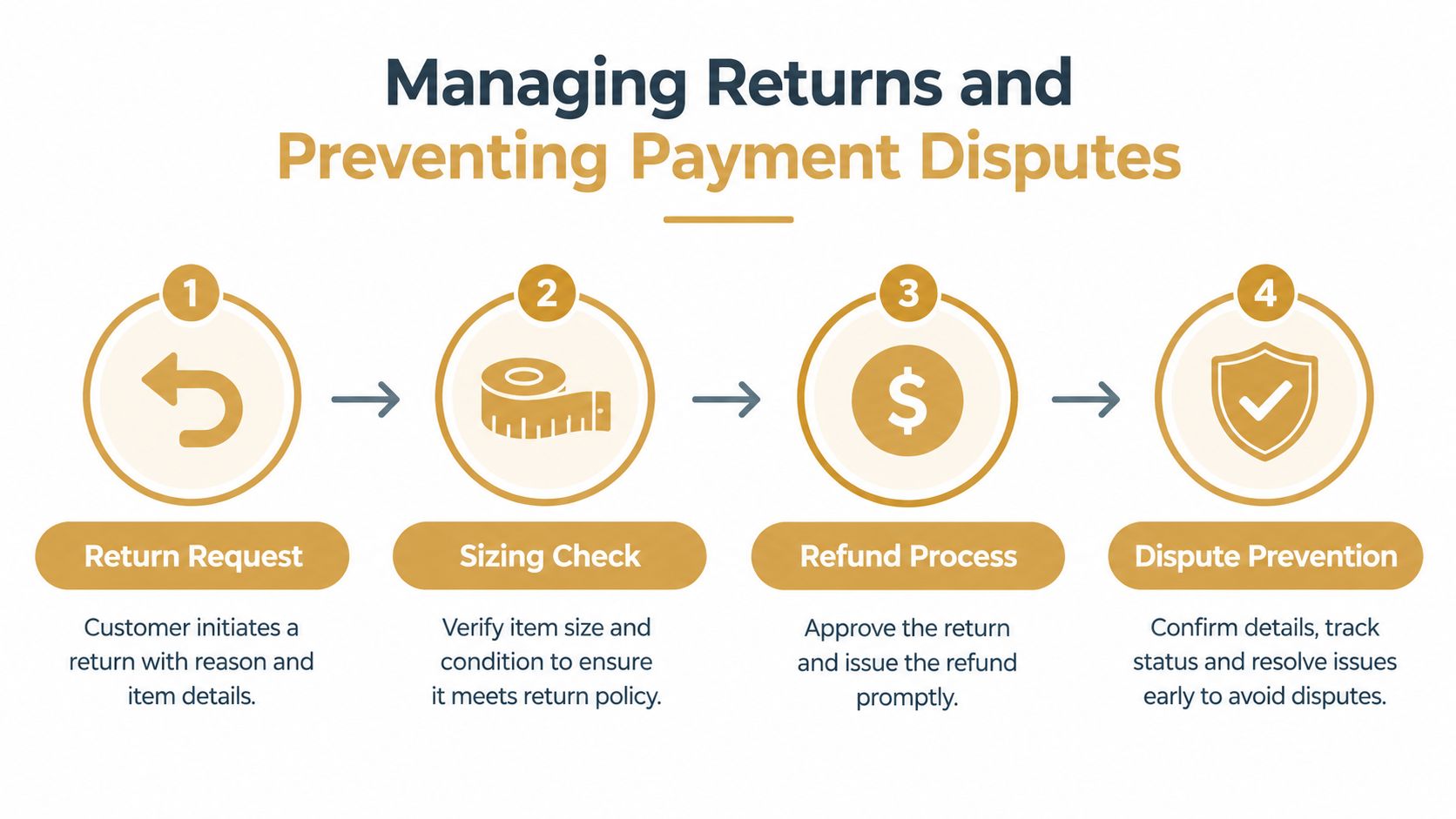
Start with the reason code. Require a structured choice such as too small, too large, color mismatch, damaged, late delivery, changed mind, or item not as described, then allow an optional note. This gives merchandising and product teams evidence they can act on, while support still receives the context needed to resolve the individual case.
Separate fit support from suspicious patterns
A customer returning one garment because the sleeve is too short needs a different workflow from a pattern of large multi-size orders, repeated missing-delivery claims, and refund requests after carrier proof of delivery. Don't punish legitimate sizing needs with a blanket restriction. Instead, use review thresholds based on order value, frequency, evidence, and behavior across the account.
Useful controls include:
- Fit education: Show measurements, model details, and fit language before purchase, then link the same information in post-purchase support.
- Return triage: Route ordinary fit returns through a quick path while sending damaged, incomplete, or disputed orders for evidence review.
- Refund visibility: Tell the customer when the return is approved, when the parcel is scanned, when the warehouse receives it, and when the refund is submitted.
- Inventory reconciliation: Match the returned variant to the original order and record whether it can return to sellable stock.
- Pattern review: Examine repeated bracketing, unusually high-value wardrobes, and recurring “not received” or “not as described” claims without assuming every pattern is abuse.
Merchants evaluating sizing tools can compare apps to reduce returns on Shopify, but an app won't repair inconsistent measurements or slow warehouse handling. Technology should support a documented process, not replace one.
Connect Shopify to the processor
The handoff after a return request matters. Shopify contains the order and refund record, the carrier contains movement evidence, the warehouse confirms receipt and condition, and the payment processor sets the dispute context and deadlines. Store those records where support and finance can retrieve them without reconstructing the timeline from separate inboxes.
When a cardholder alert arrives, decide quickly whether the merchant has a legitimate refund obligation or evidence that supports a response. If the customer is owed money, issuing the refund promptly may prevent a formal chargeback. If the merchant has fulfilled the order and the claim conflicts with delivery or product evidence, preserve the relevant records rather than refunding automatically.
A chargeback alert platform can connect processor alerts with Shopify order information, apply refund rules, and help teams act before an alert becomes a filed dispute. The Shopify chargeback protection workflow is one option to assess alongside processor-native controls and internal review.
The right objective isn't to win every dispute. It's to reduce the number of disputes created by poor communication, slow refunds, weak fit information, and missing evidence, while avoiding automatic refunds on cases the merchant could reasonably defend.
Launch Checklist and Post-Launch Monitoring Routine
A Shopify clothing store isn't finished when the theme is published. Launch is the point at which real customers test the product data, payment settings, fulfillment promises, return instructions, and support capacity at the same time.
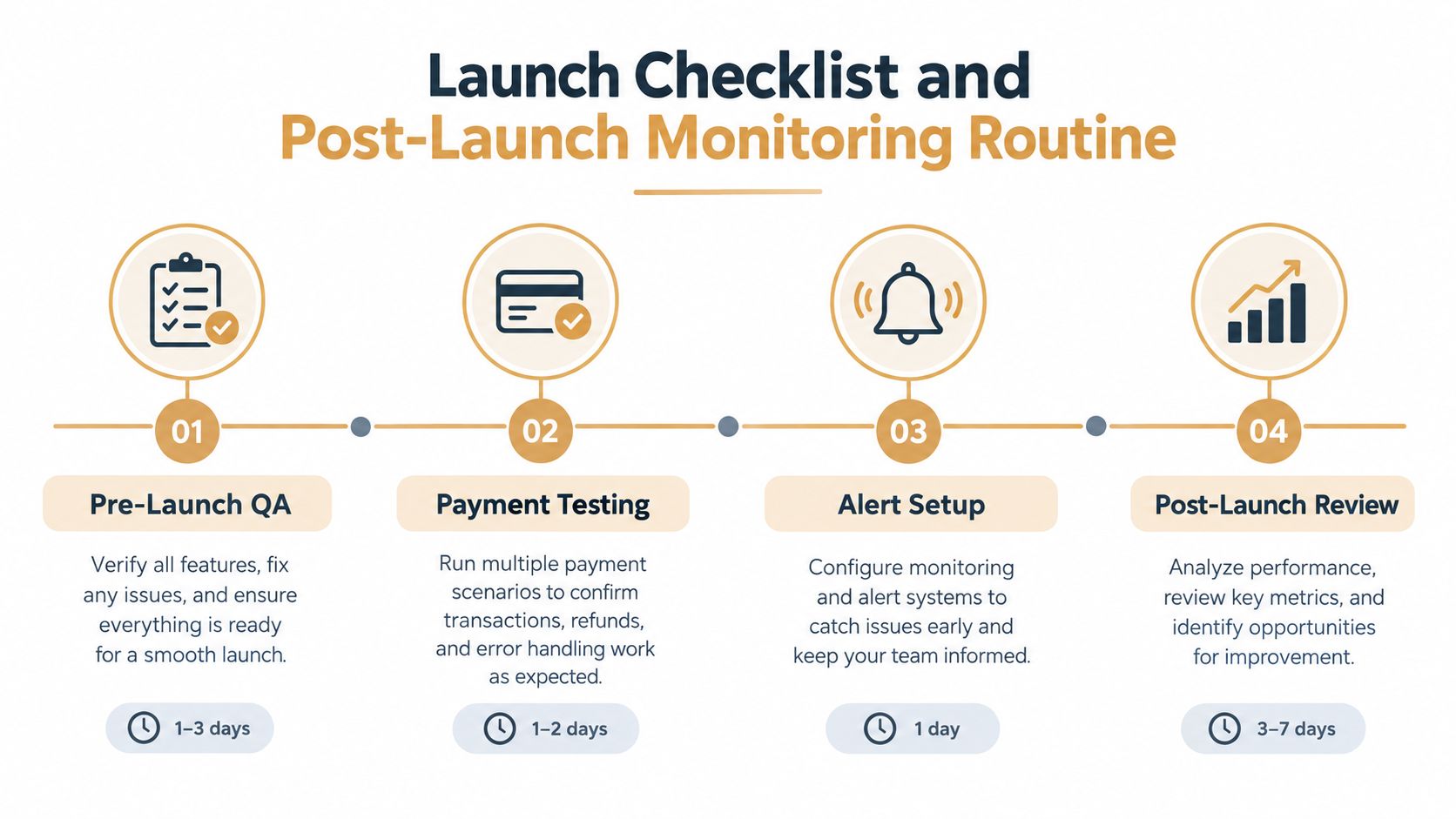
Complete pre-launch quality assurance
Use a written test order matrix. Test every important size and color path, unavailable variants, discount combinations, gift options if offered, shipping zones, tax display, mobile navigation, account creation, guest checkout, confirmation emails, tracking links, cancellations, partial refunds, and full refunds.
Check the content that protects you after purchase:
- Product accuracy: Confirm fabric composition, measurements, fit notes, care instructions, photography, and inventory for each launch product.
- Checkout clarity: Verify that delivery estimates, shipping fees, taxes, duties, currencies, and refund terms appear before payment.
- Mobile interaction: Tap every size selector, accordion, image control, cart button, and payment option on a real mobile device.
- Evidence capture: Confirm that order, fulfillment, tracking, customer communication, and refund records are accessible to the people handling disputes.
- Alert testing: Send a controlled payment alert or use the available processor test process to verify that notifications reach the correct owner.
Don't rely on a single successful test order. Test failure paths because customers experience declined cards, abandoned carts, address errors, and delayed shipments more often than your happy-path script suggests.
Review the store after launch
Set a weekly operating review with a short, stable scorecard. Monitor mobile conversion, product-page engagement, add-to-cart progression, checkout starts, payment errors, delivery exceptions, refund age, return reasons, and dispute alerts. Segment by product and variant so a strong store average doesn't hide one poorly fitting style.
Compare performance before and after meaningful changes, including new apps, campaign landing pages, shipping rules, theme releases, and promotional offers. A discount can lift orders while increasing low-margin returns. A frictionless return promise can help conversion while creating warehouse congestion. Review net contribution after returns, refunds, shipping, support, and payment costs.
Shopify reported approximately $378.4 billion in gross merchandise volume in fiscal 2025, up 29% from about $292.3 billion in 2024, as documented in its FY2025 annual reporting. That platform scale reinforces the need for disciplined monitoring, but your store still needs its own operational thresholds and escalation rules.
Assign an owner to every alert. When a product produces repeated fit complaints, pause the campaign long enough to inspect measurements and imagery. When refunds age, investigate the warehouse or payment handoff. When disputes rise, review the customer journey that preceded them instead of treating the ratio as a finance-only problem.
Disputely helps Shopify merchants monitor payment alerts, connect processor activity with order data, and automate eligible refunds before disputes become formal chargebacks. Visit Disputely to evaluate a chargeback-prevention workflow that fits your apparel store's return and payment operations.


