
Credit Card Dispute Resolution Process in 2026
The most popular advice about credit card disputes is to collect your evidence and fight back. That's often the wrong first move. Before anyone downloads a delivery receipt, the merchant needs to know which clock is running, whether the chargeback has been filed, and whether a refund would produce a better outcome than representment.
The credit card dispute resolution process isn't a single countdown. A cardholder's statutory billing-error rights and a merchant's contractual evidence deadlines start from different events. Meanwhile, delivery failures, cancellation problems, and refund confusion need operational fixes, not just stronger fraud screening.
Deadlines for Every Party in a Dispute
The split most explanations flatten is between consumer notice rights and merchant response obligations. U.S. Regulation Z governs how a consumer notifies an issuer about a billing error and how the issuer investigates it. Card-network rules and processor instructions govern how a merchant responds to a chargeback.
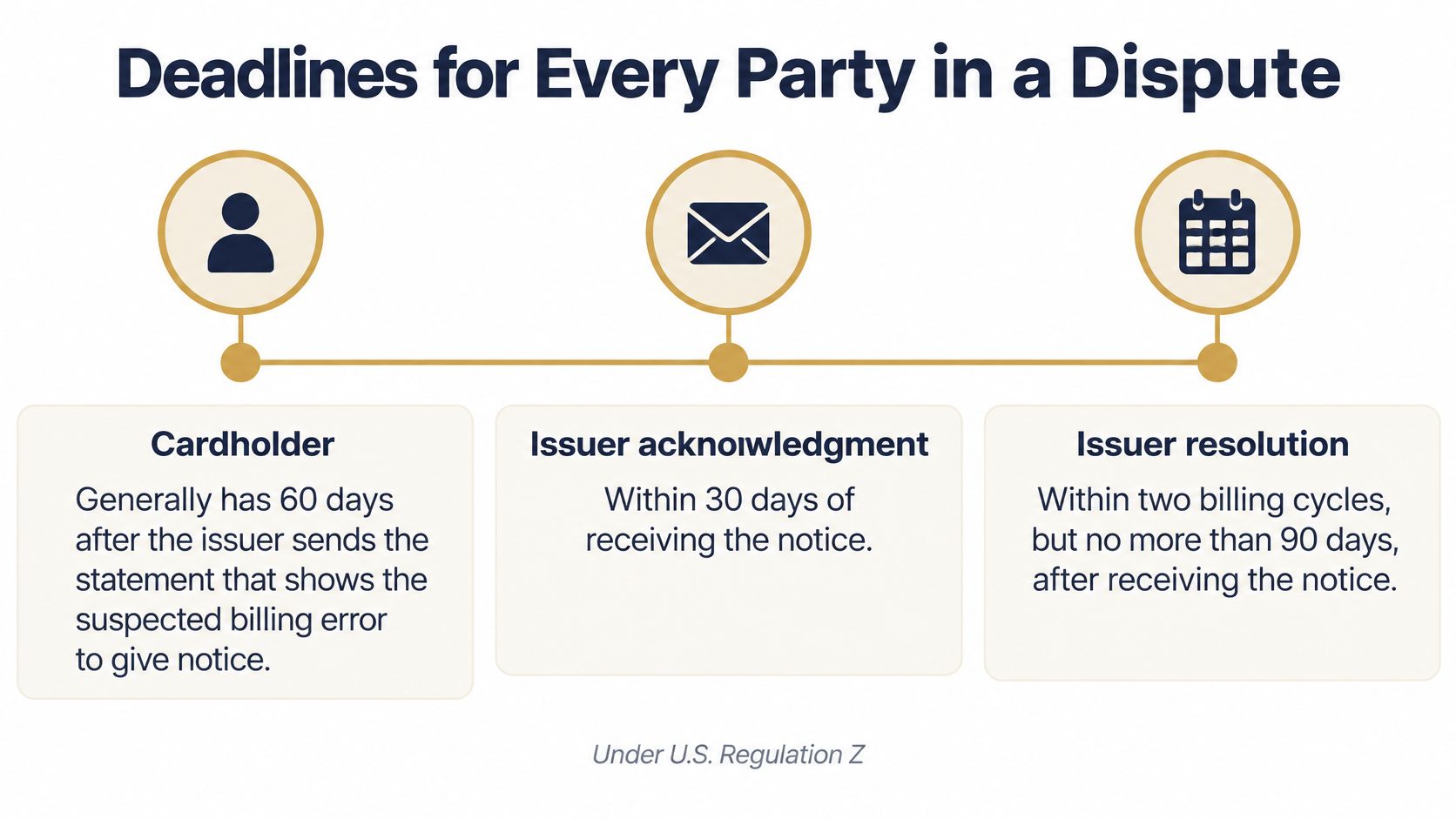
Under the CFPB's Regulation Z billing-error procedures, a cardholder generally has 60 days after the issuer sends the first statement showing the suspected error to submit written notice; the issuer generally must acknowledge a valid notice within 30 days, unless resolved sooner, and resolve it within two complete billing cycles, never later than 90 days.
The notice must identify the consumer and account, describe the suspected error, and state the amount involved. An informal complaint and a valid written billing-error notice aren't necessarily interchangeable, so merchants shouldn't assume the date of a support conversation establishes the issuer's legal deadline.
Dispute deadlines by actor
| Actor | Clock starts | Deadline | If the window is missed |
|---|---|---|---|
| Cardholder written notice under U.S. Regulation Z | Statement showing the error is sent | Statutory notice period described above | Billing-error protections can be lost |
| Issuer acknowledgment | Valid written notice received | Statutory acknowledgment period described above, unless resolved sooner | Regulatory and operational exposure |
| Issuer final resolution | Valid written notice received | Statutory resolution period described above | Regulatory exposure; a temporary credit doesn't replace the final determination |
| Acquirer or processor response | Merchant is notified | Submission deadline on the processor's notice | Generally an automatic loss, even with strong evidence |
| Card network stage | Merchant notification and applicable procedural stage | Applicable network response deadline | The case can be lost on timing alone |
| Cardholder during the investigation | Dispute is open | Until the issuer's final determination | Disputed amounts may be withheld; undisputed balances remain due |
These are separate obligations, not a shared allowance that each participant can spend. The processor's submission date is the merchant's working deadline, even when a broader network rule appears to allow more time.
The consumer-side checkpoints are shown below.
The statement date isn't the sale date
Say a merchant ships an order in June and the issuer sends the statement containing that transaction in July. The consumer's billing-error notice clock begins with the statement transmission, not the shipment. Deleting delivery records when the order leaves the warehouse creates an avoidable evidence gap.
During the investigation, the consumer may withhold the disputed amount and related interest or charges while continuing to pay undisputed balances. A temporary correction doesn't remove the issuer's obligation to investigate and provide a final determination.
Operational rule: Preserve the order history, but stamp the dispute notification time separately. The sale date tells you what happened; the notification timestamp tells your team when it must act.
Store the actual notice, including its stated deadline and time zone. Assign an owner immediately, and keep submission acknowledgment with the case rather than assuming an uploaded document reached the processor.
How a Credit Card Dispute Moves
A merchant may first hear about a complaint from a payment provider rather than its customer. In Mastercard-reported cardholder research, 75% of cardholders who had a dispute went directly to the issuer, while only 25% contacted the merchant first. Your workflow can't rely on receiving a support ticket before a bank gets involved.
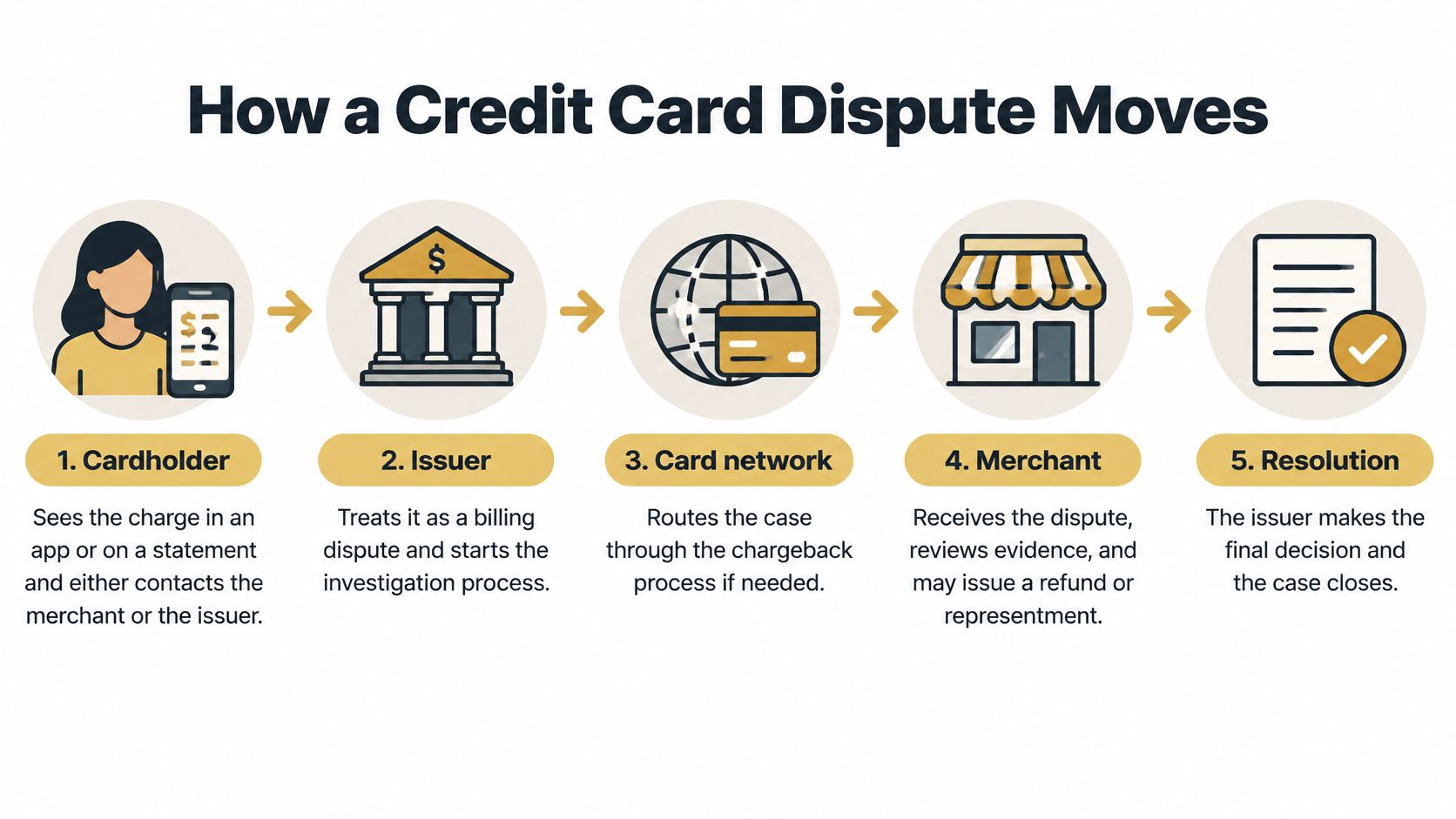
The main handoffs follow this path.
Follow the notices and the money
The cardholder questions the charge. They contact the seller or their issuer about an unfamiliar transaction, an unauthorized payment, or a purchase problem. The allegation matters because it determines what the merchant must eventually answer.
The issuer opens its review. It classifies the complaint and may apply a provisional credit. That credit is temporary treatment during the investigation, not proof that the merchant has lost.
An eligible pre-dispute alert reaches the merchant. Depending on enrollment and transaction coverage, the complaint may enter Visa Rapid Dispute Resolution, Verifi CDRN, or Ethoca. Not every transaction passes through an alert service.
The merchant resolves an eligible alert. A refund or automated decision completed under the program's rules can prevent progression to a chargeback. At this point, execution matters more than assembling a rebuttal.
An unresolved case enters the chargeback path. The issuer routes it through the network to the acquirer, which notifies the merchant. The disputed amount is generally debited according to the acquiring arrangement.
The merchant accepts or represents. Representment means submitting the transaction again with evidence answering the dispute. The processor routes that response for issuer review.
The issuer reviews the response. It may accept the evidence or maintain the dispute. Further escalation can introduce additional cost and requires an actual answer to the outstanding allegation, not another copy of the same packet.
The merchant reconciles the outcome. Record the financial result, any remaining fees, and the applicable dispute reporting treatment. Recovering funds and preventing account-risk consequences aren't the same objective.
Keep refund tracing separate from case closure
If the customer says an issued refund never arrived, trace the credit rather than sending a screenshot of a support promise. Sambapay's guide to resolve payment disputes with ARN explains the acquirer reference number's role in investigating payment movements. A refund reference helps establish what was processed, but it doesn't itself prove a network case has closed.
For a Shopify store, connect the payment record to fulfillment and support activity before choosing Shopify chargeback protection. Otherwise, staff may act on different versions of the same order.
This video provides another view of the investigation flow.
Consider a hypothetical subscription that renews at the start of a month, receives a cancellation request shortly afterward, and is disputed later. The alert is a fresh decision point: inspect the cancellation and billing records, then resolve or defend the charge. Don't treat the original checkout consent as the entire case.
Keep these fields visible in every case log:
- Notification time: When the actionable notice arrived.
- Reason code: The allegation the issuer assigned.
- Refund-or-fight decision: The action, owner, and rationale.
- Submission acknowledgment: Confirmation that the receiving system accepted the response.
Match Evidence to the Reason Code
Start with the reason code, not a compressed folder containing everything attached to the order. The reviewer needs evidence that answers the allegation, not proof that your business maintains a busy customer database.
Evidence that answers the claim
| Claim | Evidence that answers it | Weak substitute |
|---|---|---|
| Product or service not received | Carrier scan, signature, delivery photo, or timestamped access log | Order confirmation email alone |
| Cancelled subscription or recurring charge | Cancellation time compared with renewal disclosure and billing timestamp | Signup checkbox with no later cancellation log |
| Not as described | Product or plan details linked to the order, plus relevant usage or customer messages | Marketing screenshots with no order link |
| Credit not processed | Refund amount, date, and processor reference | A promise to refund later |
| Unauthorized use | AVS, CVV, 3-D Secure, and device or IP signals attached to the order | A generic risk score |
| Duplicate or paid by other means | Both transaction IDs reconciled against the fulfilled order and any alternative payment | Invoices that don't establish whether the payments concern the same sale |
Timing is part of evidence quality. Mastercard's merchant chargeback guidance describes acquirer response windows commonly averaging 10 to 35 days and network deadlines typically ranging from 20 to 45 days after merchant notification, with missed processor deadlines generally causing an automatic loss regardless of evidence strength.
Treat those ranges as context, not permission to choose your own submission date. The deadline on the merchant's notice governs the work queue.
Build a rebuttal a reviewer can follow
Use a concise sequence: the customer's allegation, the reason code, a short chronology, the relevant exhibit, and why it answers the applicable condition. Lead with the disputed transaction, not a description of your company or a complaint about customer behavior.
Label each exhibit with its purpose. A delivery record should identify the relevant shipment and destination; a cancellation log should show the request, its effective time, and the associated subscription. Normalize timestamps when support, billing, and fulfillment systems use different time zones.
A document belongs in the packet only if you can finish this sentence: This record answers the allegation because...
Authorization evidence needs particular care. Address verification, security-code results, and device signals can support an unauthorized-use response, but they don't establish that goods arrived or that a cancellation was honored. Don't attach authentication records as a substitute for fulfillment evidence.
Digital goods require transaction-linked usage records. An account creation event is weaker than access or download activity associated with the disputed purchase, and a login alone doesn't automatically prove the cardholder authorized payment.
Partial shipments need a line-item reconciliation. Identify what arrived, what remains outstanding, and what was credited; a delivery scan for one parcel shouldn't be presented as proof that the entire order was fulfilled.
Finish with a case-level checklist showing notification, evidence collection, submission, and acknowledgment. Save the exact packet submitted, not merely editable files that might change afterward. If escalation follows, the next reviewer should be able to identify what was already considered and what new evidence addresses the remaining issue.
Use RDR CDRN and Ethoca Windows
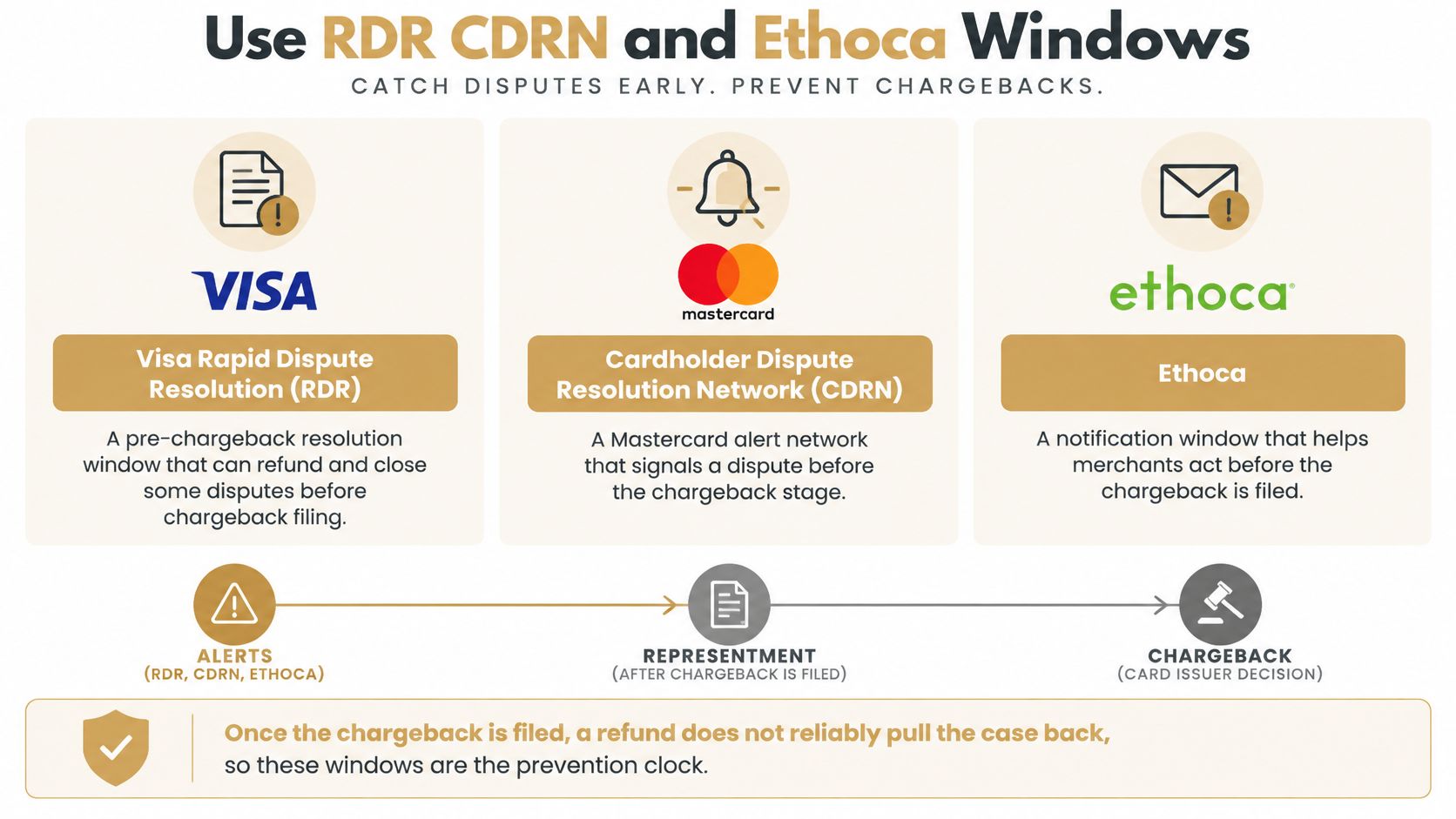
Alerts and representment solve different problems. Alerts give merchants an opportunity to resolve eligible complaints before chargeback filing. Representment is the response after the chargeback has entered the formal process.
Pre-dispute alert windows
| Alert | When it fires | Time to refund and stop the chargeback | If you miss it |
|---|---|---|---|
| Visa RDR | Pre-dispute, rules-based on Visa | Automated decision before chargeback filing when a rule matches | An unmatched case can continue through the issuer path |
| Verifi CDRN | Direct issuer alert after the cardholder disputes | The actionable period specified by the alert program | The chargeback can proceed |
| Ethoca Alerts | Participating issuer alert, commonly associated with Mastercard transactions | The response deadline attached to the alert | A chargeback can still be filed |
| No alert on the transaction | Chargeback already in the network path | Representment opportunity only, subject to the case notice | A refund no longer prevents the original chargeback filing |
Our Verifi Network CDRN coverage provides direct issuer alerts and 72 hours to refund and stop chargebacks. That is an operational service window, not an extension of a cardholder's Regulation Z rights or a universal deadline for every alert network.
The prevention-stage distinction is illustrated below.
Test the setup against an unattended queue
RDR uses merchant-configured decision rules for eligible Visa disputes. CDRN, operated through Verifi, provides an issuer-alert route; it shouldn't be confused with Mastercard's Ethoca service. These paths differ in coverage and handling, so a merchant shouldn't build one generic timer for all incoming notices.
Start with the identifiers that make matching possible. Enroll the relevant merchant descriptors, connect the alert to the correct transaction, and establish whether another system has already refunded it. A fast response against the wrong order creates a second reconciliation problem.
Next, define the automatic-refund ceiling and the exceptions requiring review. Record whether the rule evaluates the disputed amount or original order amount, and specify how it handles partial credits. Those details matter when a complaint concerns only part of a subscription period or a split shipment.
A Friday-night notice is a useful operational test. If nobody checks it until the next working week, can your team still meet its actual expiry time? Route alerts to a named owner and a backup rather than assuming a shared inbox provides coverage.
For support teams coordinating across tools, Convot's help desk integrations are a useful reference when planning how customer conversations reach the people handling payment complaints. Whatever tools you use, keep the alert status and refund result attached to the payment case.
Before issuing a credit: Check the case stage, prior refund status, and alert instructions. Once a chargeback is filed, an ordinary refund doesn't reliably withdraw it.
Finally, reconcile outcomes. An attempted refund, a successful refund, and a resolved alert are separate statuses. Capture the confirmation that matters to the program, and investigate exceptions instead of marking every attempted action complete.
Choose a Refund or a Representment
Treating every complaint as fraud sends teams toward the wrong fix. In worldwide benchmark reporting on contested chargebacks, the Justt chargeback benchmark report described in its published announcement found product-not-received and cancelled-recurring-payment claims rose from 13.0% to 24.1% in a year, while fraud claims declined from 74.6% to 60.4%.
That doesn't mean service complaints outnumber fraud claims. It means fulfillment and cancellation failures deserve their own prevention work, because stronger authentication won't repair them.
When a fast refund is the win
Authorize a refund within an eligible prevention window when the facts support it:
- Confirmed cancellation failure: The customer cancelled before the renewal, but billing continued.
- Unprovable fulfillment: The delivery exception remains unresolved and you can't establish receipt.
- Clear merchant error: The wrong item, duplicate payment, or missing credit is evident.
- Low-value ambiguity: The claim falls below your approved ceiling, and investigation would cost more than a defensible recovery is worth.
Don't use the ceiling as a reason to ignore repeated abuse. It's a decision rule for individual cases, not permission to stop investigating patterns.
Refund the service failure inside the prevention window. Spend representment effort on claims your evidence can actually disprove.
When to defend or review manually
A contested case deserves a closer look when the records contradict the allegation:
- Delivery or usage evidence: A signature, delivery record, or transaction-linked service activity answers the specific complaint.
- Documented renewal timing: Cancellation arrived after a clearly disclosed renewal, and the billing record supports the charge.
- Relevant liability protection: Authentication results may support an unauthorized-use defense under the applicable rules.
- Repeated contradictory claims: Prior cases justify investigation, while the current transaction still has its own evidence.
Partial fulfillment calls for a split decision rather than an all-or-nothing response. Credit the unsupported portion through the appropriate process and defend only the amount the records justify.
Where a merchant-of-record arrangement is involved, establish who controls the credit and who answers the issuer. SellerAI on merchant of record refunds is useful context for separating those responsibilities before staff promise an action they can't execute.
For cases that merit a defense, evaluate chargeback representment against the recoverable amount, evidence quality, and remaining procedural cost. Being right about the sale isn't enough if the packet can't establish why the disputed charge should stand.
Make the prevention review concrete: test the billing descriptor, verify cancellation confirmations, and route delivery exceptions to support. Fix the workflow that produced the complaint, not just the disputed transaction.
Set Rules Before the Next Dispute
In 2024, cardholders disputed $9.8 billion in credit-card charges, resulting in $5.9 billion in chargebacks, according to the CFPB's Consumer Credit Card Market Report. This is payment-account risk, not merely a back-office documentation task.
Turn individual decisions into a standing workflow. A team that improvises each response will spend time rediscovering rules while actionable notices wait.
Put ownership into the operating rules
Configure the decision before the queue arrives. Enter the refund ceiling, service-failure conditions, and manual-review exceptions. Require a recorded reason when someone overrides the rule, so finance can distinguish a deliberate decision from a missed case.
Keep evidence with the order. Preserve delivery scans, cancellation events, refund references, and authentication results under a documented retention policy. Don't let support-ticket deletion remove the only record needed to explain a disputed payment.
Name the alert owner and backup. Whether payments run through Shopify Payments, Stripe, PayPal, Authorize.net, or subscription billing, responsibility belongs to a person. Test coverage during absences and weekends, including access to issue authorized credits.
Disputely is notified within seconds after a customer creates a dispute and then offers a resolution. Fast notification helps only when the merchant has authorized a clear action and someone owns exceptions.
Review your chargeback rate regularly alongside alert coverage, missed deadlines, refund failures, and recurring complaint causes. Don't wait for a processor monitoring notice to investigate deterioration.
Issuers, processors, merchant practices, and card-network rules still affect each outcome. The practical objective is to make every response timely, every refund intentional, and every defense supported by evidence.
Disputely offers dispute prevention, real-time alerts, and chargeback recovery to support the decision from early resolution through evidence submission. Visit Disputely to put your refund rules and escalation process into an actionable workflow before the next dispute arrives.


