
Dispute Management Software: A Practical Buyer's Guide
Prevention platforms cost $20–$40 per alert, while post-chargeback tools focus on representment. Choose prevention when your problem is alert coverage, and choose representment when your problem is winning chargebacks that have already posted.
That distinction matters more than any feature checklist. A merchant can buy advanced case management, collect excellent evidence, and still lose money if disputes could have been stopped before filing. Another merchant can refund every alert and give away revenue that a strong representment process would have recovered.
The market reflects this broader scope. Dispute management software has been estimated at $4.2 billion in 2025 and projected to reach $9.1 billion by 2034, with a 9.8% compound annual growth rate forecast for 2026 through 2034, according to MarketIntelo's dispute management software market analysis. The category is no longer just a digital filing cabinet. It's becoming the operating layer for prevention, monitoring, analytics, refunds, evidence, and processor workflows.
| Buying situation | Primary problem | Best starting point | Main KPI |
|---|---|---|---|
| Alerts arrive but aren't acted on quickly | Low alert coverage or slow response | Prevention-first platform | Alerts resolved before chargeback |
| Chargebacks are already posting | Weak evidence or inconsistent filing | Representment tool | Representment win rate |
| Both problems exist | Fragmented operations | Integrated platform | Net recovered value after fees |
| Team uses spreadsheets and processor portals | Poor visibility and manual routing | Workflow-centered software | Analyst workload and response time |
A practical buyer should start with the prevent-versus-fight decision, not the vendor demo. First identify where money is leaking. Then price the cost of a refund against the expected value of contesting the dispute. That calculation tells you which category deserves your budget.
What Dispute Management Software Actually Does in 2026
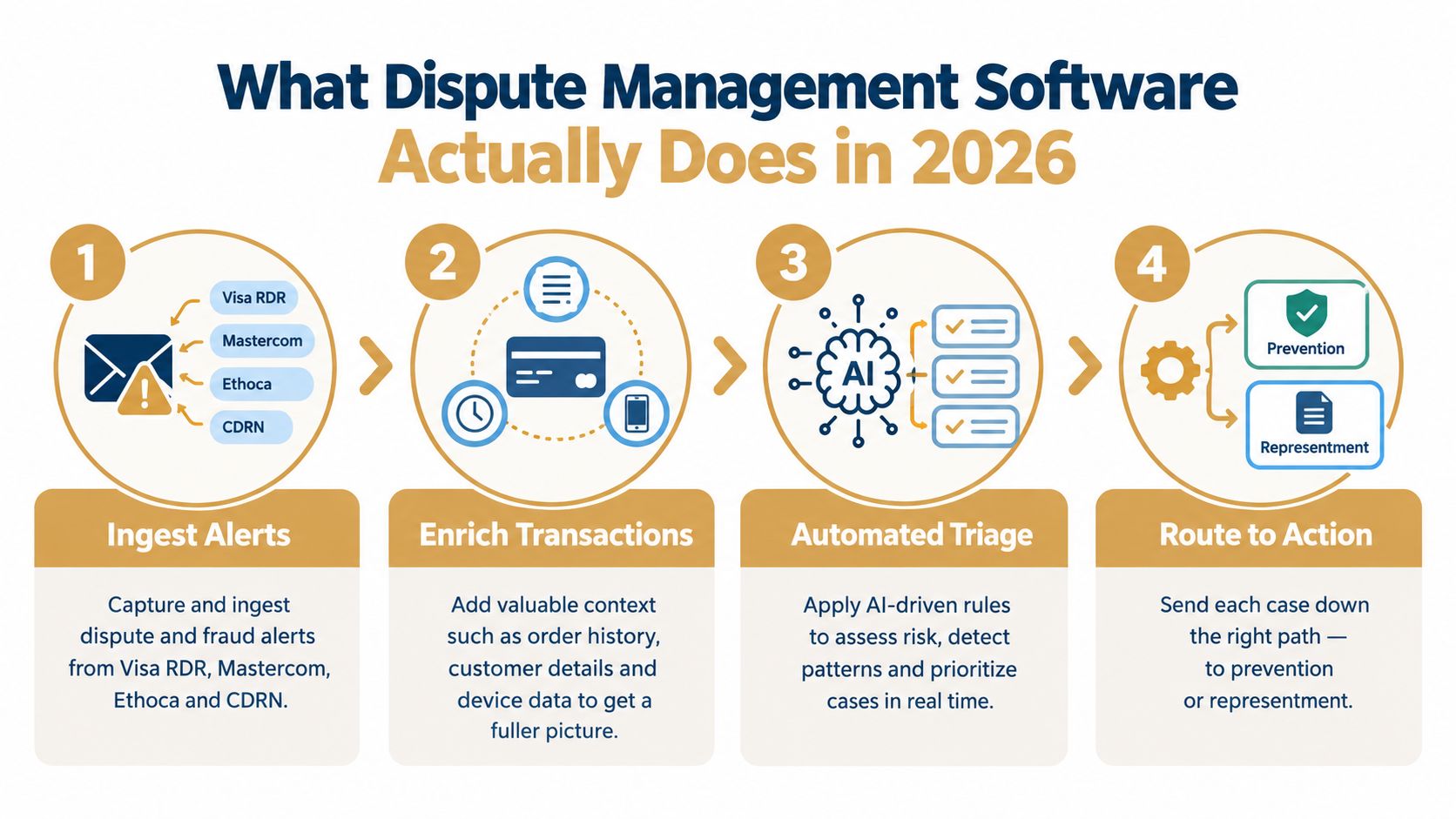
Modern dispute management software connects the event that starts a dispute to the action that protects revenue. It receives issuer alerts, finds the matching transaction, adds relevant order and customer context, applies rules, and either initiates a refund or prepares a case for representment.
The workflow usually looks like this:
- Ingest the alert. The platform receives events from Visa Rapid Dispute Resolution, Mastercard CDRN, Ethoca, or related network channels.
- Enrich the transaction. It matches the alert to payment, order, subscription, fulfillment, customer, and device records.
- Triage the outcome. Rules or predictive scoring determine whether a refund, analyst review, or representment path makes financial sense.
- Complete the action. The system writes the refund back to the processor or compiles evidence for the acquirer and network.
The operational shift
Card-network alert systems created the foundation for this model. Visa's Cardholder Dispute Resolution Network and Mastercard's Ethoca alerts gave merchants a way to intervene before some disputes became chargebacks. Visa's Rapid Dispute Resolution added automated, rules-based resolution. Industry explanations describe a 72-hour response window for CDRN, while issuer-side alert networks generally provide merchants with a 24- to 72-hour action window, as outlined by Chargeback.io's explanation of chargeback alerts and ChargebackHelp's KPI guidance.
That window changes the decision. A merchant can refund an order before a formal chargeback is filed, avoiding the representment process and the associated operational work. But an automatic refund isn't automatically profitable. If the customer would have lost a well-supported dispute, refunding without filtering converts recoverable revenue into a preventable cost.
Practical rule: Treat every alert as a financial routing decision, not as an instruction to refund.
Suppose a subscription merchant receives an alert for a customer who claims a recurring payment wasn't authorized. The platform should check cancellation history, prior successful renewals, login activity, delivery or usage records, and earlier disputes. A clear cancellation record may justify a refund. A long-standing active subscription with consistent usage may deserve review or a fight instead.
Teams also need to separate payment disputes from other credit and attribution problems. For example, fixing marketing channel credit fights can help marketing and finance teams resolve disagreements about which channel deserves revenue credit, but that workflow isn't the same as handling issuer alerts or chargebacks. Keep those processes connected through shared transaction identifiers, while maintaining distinct ownership and controls.
When the workflow is properly integrated, chargeback fighting becomes one possible route inside a broader system. The platform's job is to decide whether fighting is economically sensible before the team spends time building the case.
The Two Categories Most Buyers Confuse
Prevention-first platforms and representment tools solve different problems. Treating them as interchangeable is one of the fastest ways to overbuy.
Prevention platforms act before the chargeback posts. They compete on network coverage, alert speed, refund automation, filtering, and the ability to resolve eligible alerts within the issuer window. Market guidance commonly places prevention pricing at $20–$40 per alert, according to Chargeflow's overview of chargeback management tools.
Representment tools act after the chargeback exists. They collect transaction evidence, format responses, submit cases through processor or acquirer workflows, and report outcomes. Their pricing may use platform fees, per-case charges, or success-related fees, depending on the provider and contract.
| Dimension | Prevention Platforms | Representment Tools |
|---|---|---|
| Pricing unit | Usually per alert | Platform fee, per case, or outcome-related fee |
| Primary KPI | Alert coverage and pre-chargeback resolution | Representment win rate and recovered value |
| Best fit | Merchants with early-warning access and preventable disputes | Merchants with recurring posted chargebacks |
| Main action | Refund or resolve before filing | Submit evidence after filing |
| Main risk | Refunds that should have been contested | Paying to fight disputes with weak evidence |
A SaaS merchant with recurring billing confusion may need alert coverage and precise refund rules more than a large evidence library. If the merchant's primary issue is that alerts aren't reaching the team, buying representment infrastructure first adds cost without fixing the leak.
The opposite is true for a high-risk merchant whose disputes post quickly or whose network coverage is incomplete. Alerts alone won't recover a chargeback that has already entered the case queue. That merchant needs processor connectivity, reason-code expertise, evidence assembly, and outcome reporting.
Buying test: If you can't state whether your main failure is missed alerts or lost cases, don't sign a software contract yet. Pull the data first.
Look at three operating measures: alert coverage rate, average alert response time, and the share of alerts resolved before formal chargebacks. For existing cases, measure dispute-to-transaction ratios by card network, reason-code concentration, representment win rate, and distance from monitoring thresholds. A blended portfolio number can hide whether fraud, friendly fraud, or slow alert handling is the actual issue.
Core Features That Separate Real Platforms From Notification Tools
A notification tool tells an analyst that something happened. A real platform connects the alert to a decision and then confirms that the decision reached the processor.
The first dividing line is multi-network ingestion. Visa RDR, Ethoca, Verifi CDRN, and Mastercard channels don't create identical events or workflows. A platform that listens to only one source leaves blind spots, especially when the merchant's processors and acquiring relationships vary by region or payment method.
What belongs on the baseline checklist
| Feature | Real Platform | Notification Tool |
|---|---|---|
| Multi-network alert ingestion | Pulls and normalizes events across supported networks | May forward alerts from one or two sources |
| Intelligent filtering | Scores refund cost, evidence strength, and likely outcome | Sends alerts for manual review |
| Automated refunds | Executes rules by amount, reason, and customer history | Requires analyst action |
| Evidence compilation | Pulls records from OMS, CRM, PSP, and shipping systems | Leaves analysts to gather documents |
| Processor synchronization | Reads and writes case and refund status | Often read-only |
| Reason-code analytics | Shows root causes and trends | Provides basic event logs |
| Outcome reporting | Tracks results by network, cohort, and route | Shows notification counts |
Intelligent filtering deserves special attention. The platform should estimate whether a refund is cheaper than a likely successful fight, not merely label an alert as high or low risk. Give operations teams controls for order value, reason code, customer history, fulfillment proof, subscription status, and prior outcomes.
Bidirectional processor synchronization is the other major differentiator. Read-only access creates a dangerous illusion of automation. The system may display an alert, but an analyst still has to switch to Stripe, Adyen, Braintree, Checkout.com, or another processor to issue the refund or update the case. Write-back automation closes that gap and creates an auditable outcome.
Evidence workflows also need depth. A credible representment packet may require payment metadata, customer communications, order details, delivery confirmation, usage records, cancellation terms, and prior account activity. The platform should pull those records from the systems where they already live, instead of asking analysts to download and rename files.
Finally, insist on cohort reporting. A single win-rate figure isn't enough. Break outcomes down by card brand, reason code, alert source, product, subscription status, country, processor, and analyst override. Those slices reveal whether the model improves routing or merely moves difficult cases into a different queue.
How Pricing Models Change the ROI Calculation
Pricing determines what the vendor is rewarded to optimize. Per-alert pricing favors prevention volume. Per-case pricing attaches cost to representment activity. Flat platform fees spread the cost across the portfolio, but contracts can hide additional charges for alerts, refunds, cases, or integrations.
A worked example makes the trade-off visible. A merchant receiving 200 alerts per month at $25 per alert spends $60,000 per year. If the merchant refunds 60% of those alerts at an average order value of $120, the modeled gross chargeback cost avoidance is $86,400, based on the supplied scenario. That produces a positive gross result, but only if the refund decisions are accurate enough to avoid giving away orders that could have been won through representment.
The example's stated break-even condition is refund accuracy above approximately 55%. Treat that as a decision-model assumption, not a universal benchmark. Your own model should replace it with observed outcomes by reason code, order value, customer segment, and alert source.
| Pricing Model | Annual Cost | Recovered from Refunds | Net ROI |
|---|---|---|---|
| Per-alert at $25 | $60,000 | $86,400 in modeled avoidance | $26,400 gross net |
| Per-chargeback | Depends on cases fought | Depends on won cases | Sensitive to dispute volume |
| Platform plus per-case | Depends on contract | Depends on alerts and cases | Requires full fee reconciliation |
Per-chargeback pricing can work for low-volume merchants with sporadic cases. It becomes less attractive when a high-volume merchant pays for every dispute while also funding internal review, evidence preparation, and processor operations.
Blended contracts need closer scrutiny. Ask whether an alert that becomes a refund is billed once, whether the same event triggers a case fee, and whether failed or duplicate notifications count. The Disputely pricing page is a useful reference point for evaluating a transparent pay-per-alert structure, but every vendor contract still needs a transaction-level fee example.
Finance rule: Calculate net recovered value after software fees, refunded principal, internal labor, processor charges, and any cost associated with a failed route.
Don't use gross avoided chargebacks as the final ROI number. Compare the outcome against a baseline period, then isolate the effect of prevention from normal changes in payment volume, product mix, and customer behavior.
Fit by Merchant Type and Volume
Merchant profile should determine the first workflow you buy. A subscription company, a large DTC brand, and a high-risk travel merchant can all report “chargebacks,” yet their operating constraints are different.
| Merchant Type | Monthly Volume | Best-Fit Network | Priority Feature |
|---|---|---|---|
| SaaS or subscription | High renewal activity | Ethoca and Verifi coverage | Automated refund rules |
| High-volume DTC | High order and dispute activity | Processor-native coverage across Shopify, Stripe, and Adyen | Intelligent filtering |
| High-risk vertical | Complex acquiring setup | Processor and acquirer coverage suited to the business | Representment depth |
Subscription and SaaS
Recurring billing creates a strong case for prevention-first automation. The system should recognize cancellation timing, renewal history, plan changes, trial conversion, account usage, and prior customer contacts. A blanket refund rule is risky because it ignores the difference between a legitimate cancellation failure and a customer who continued using the service.
Ethoca and Verifi coverage can help when issuer alerts arrive early, but coverage isn't enough. Require automated routing by reason code and customer history, plus a clear exception queue for high-value or ambiguous accounts.
High-volume DTC
Large DTC brands need deep integrations more than attractive dashboards. Shopify, Stripe, and Adyen data should connect to the same decision record as fulfillment, delivery, customer service, and refund events. Manual triage becomes difficult to sustain as dispute queues grow, so filtering should reduce analyst touches without concealing the reasons behind each decision.
The merchant should also monitor concentration by product, fulfillment location, campaign, and reason code. A spike in “product not received” disputes points to a different operational fix than recurring-billing confusion.
High-risk verticals
Supplements, nutraceuticals, adult products, and travel businesses often require more than issuer-alert handling. Their acquiring setup, evidence requirements, product claims, fulfillment patterns, and customer expectations can create disputes that need a strong representment process.
Use high-chargeback-rate guidance when assessing monitoring exposure and processor risk, but don't treat a single portfolio ratio as the complete diagnosis. Segment by network, reason code, payment method, product, and customer cohort before selecting the workflow.
The Prevent Versus Fight Decision Framework
The right routing rule compares two expected outcomes:
Expected fight value = probability of winning × recoverable order value, minus fight costs
Expected prevention value = order value avoided through the alert route, minus refund and alert costs
Refund when expected prevention value exceeds expected fight value. Fight when the evidence and historical outcome justify the additional work. Escalate when the data is incomplete or the order value makes an automatic decision unsafe.
Step one, classify the alert
Visa RDR and Ethoca alerts generally give merchants a 24- to 72-hour action window, according to the previously cited industry guidance. Use that window deliberately. Confirm the source, reason code, processor, response deadline, and whether the event supports an automated resolution path.
Don't treat every alert as equivalent. Some routes can resolve the issue before a formal chargeback, while others only notify the merchant that a case may be coming.
Step two, assess transaction context
Check order value, fulfillment status, delivery evidence, customer contact history, subscription state, prior refunds, and previous dispute outcomes. A high-value transaction should usually receive human review unless the evidence and rule set are exceptionally clear.
Step three, use historical performance
Measure win rate by card network and reason code. If a segment consistently produces weak representment outcomes, refunding eligible alerts may be rational. If the segment has strong evidence and favorable outcomes, an automatic refund could destroy recoverable revenue.
Include operational costs in the model. The supplied decision framework identifies roughly $20–$30 in operational labor and approximately $0.10–$0.25 in program fees as costs to consider for a won chargeback, based on the referenced industry assumptions. Validate those figures against your processor agreements and internal labor rates before embedding them in production rules.
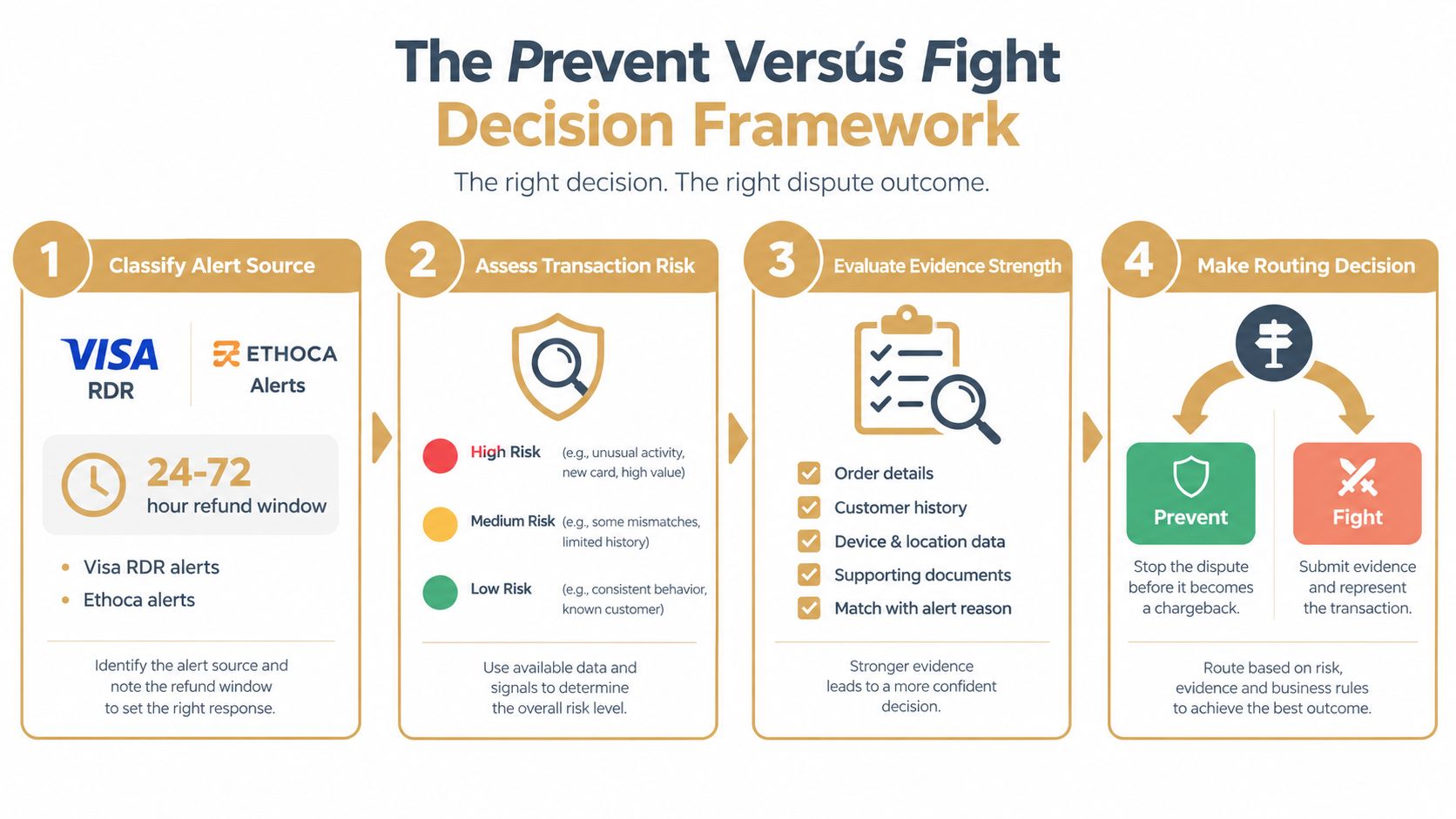
Step four, route with an explicit threshold
A practical rule engine can use:
Route to refund when (alert resolution value - refund cost - alert fee) > (win probability × recoverable value - representment labor - processor cost)
Route to fight when the reverse is true. Send the case to review when either probability or cost is unknown.
Automation should reduce team friction, not hide judgment. The broader automation strategies for team friction perspective is useful here because dispute operations involve finance, support, fraud, fulfillment, and payments teams. Give each team clear ownership, a reason for the routing decision, and an override path with an audit trail.
Red Flags, Integrations, and Implementation Checks
Vendor demos usually show the clean path. Production disputes arrive through missing webhooks, mismatched order IDs, delayed processor updates, unsupported reason codes, and refunds that appear successful in one system but fail in another.
Start with the network and processor map. Ask whether the vendor connects directly to Visa RDR and Mastercard EVD, supports Mastercard alert channels such as Ethoca and CDRN, and receives events from every processor in your portfolio. Confirm webhook coverage for Stripe, Adyen, Braintree, Worldpay, and any regional processor you use.
Demand write-back, not just visibility
A read-only integration can show a dispute while leaving the analyst responsible for the actual action. Require proof that the platform can initiate or confirm refunds, update case status, receive processor outcomes, and reconcile duplicates.
Run these checks before signing:
- Event completeness: Test alert, refund, reversal, representment, and outcome events.
- Identifier matching: Confirm that payment, order, subscription, customer, and processor IDs reconcile reliably.
- Reason-code coverage: Review every code relevant to your products, billing model, and networks.
- Evidence access: Verify that OMS, CRM, shipping, support, and usage records can be retrieved without manual downloads.
- Sandbox behavior: Test duplicate alerts, expired windows, failed refunds, partial refunds, and manual overrides.
- Data portability: Confirm that event history, evidence, decisions, and outcomes can be exported.
A pilot should expose workload, not just successful API calls. Use a defined test period, compare alert coverage and response latency with the baseline, and count analyst touches per event. Track the ratio of alerts refunded versus fought, prevented chargebacks, representment win rate, refund overrides, unresolved alerts, and net recovered value.
Be cautious with long contracts that lack service-level commitments. Also reject alert-only vendors that won't share source-level outcomes. If the tool can't tell you which alerts became refunds, which became chargebacks, and which were never actioned, it can't prove that its automation works.
Selecting a Vendor With Confidence
The common assumption is that the vendor with the longest feature list is the safest choice. It isn't. The safer choice is the platform that matches your dispute stage, network coverage, processor stack, and economic decision rule.
Start by mapping disputes by source, reason code, card network, processor, order value, and outcome. Decide whether prevention or representment is the primary objective. Then shortlist two or three vendors whose integrations match your actual payment architecture, not the architecture you hope to build later.
Run a paid pilot with written success criteria. Negotiate transparent alert and case pricing, data portability, an exit clause, service levels for alert-to-refund latency, and responsibility for failed write-back actions. During reference calls, ask merchants with similar volume and risk profile how often analysts override automation, how outcomes are reconciled, and what the implementation team didn't show during the demo.
Use a 90-day rollout:
- First phase: Establish alert coverage, response latency, dispute mix, and baseline recovered value.
- Second phase: Activate rules by reason code, order value, customer history, and evidence strength.
- Third phase: Compare prevention outcomes with representment outcomes and remove rules that create unnecessary refunds.
Don't approve the purchase because the dashboard looks polished. Approve it when the platform proves that it routes each dispute to the cheaper, more defensible outcome.
Disputely provides a chargeback alert platform that connects with payment processors and automates real-time alert handling, including rule-based refunds before eligible disputes become formal chargebacks. Visit Disputely to compare prevention-first automation with your current representment workflow and model the economics before you commit.


