
Dispute Prevention and Resolution Guide for Merchants
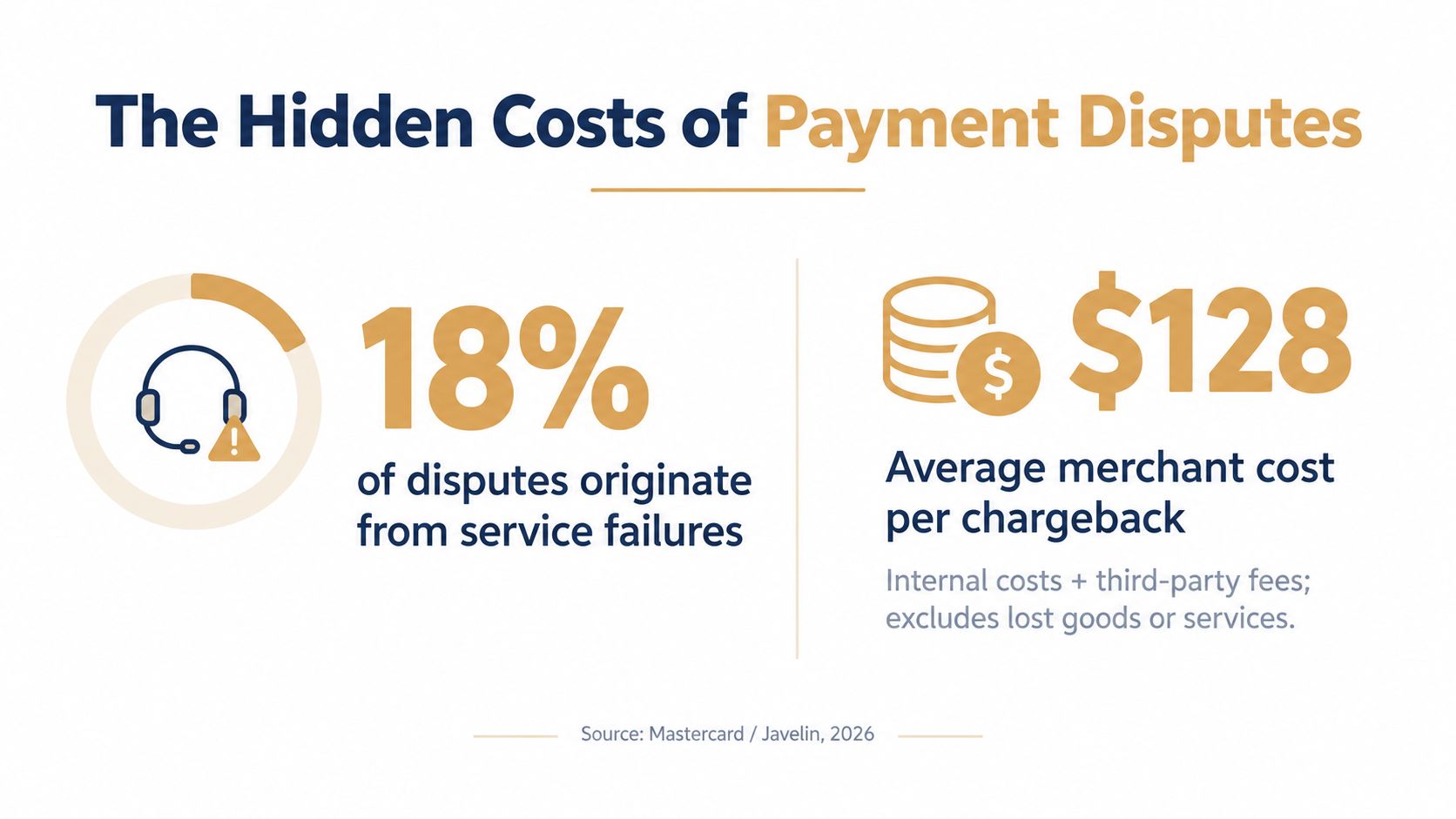
18% of disputes stem from delayed refunds and 17% from missing or late deliveries. That makes dispute prevention and resolution an operational discipline, not just a legal fight or a fraud problem.
The merchants that stay out of trouble treat every dispute as a signal that something in the post-purchase journey broke. Refund timing, delivery communication, descriptor clarity, and escalation handling matter long before anyone starts drafting evidence.
The Hidden Costs of Payment Disputes
18% of disputes come from delayed refunds and 17% from missing or late deliveries, which points to where a lot of pain starts. When merchants read disputes as pure fraud, they miss the obvious operational leak behind the chargeback. Recent global data also shows that only 25% of consumers contact the merchant before going to their issuer, while merchants resolve 44% of those pre-dispute contacts through clarification and another 31% through a refund or replacement, which is why the first response often decides whether the issue stays small or escalates. Dispute prevention and resolution data
Why the real cost is bigger than the claim
The amount under dispute is only the start. The World Bank's commercial-dispute methodology shows an average of 402 days to enforce a contract, with about 14 days for filing and service, 328 days for trial and judgment, and 60 days for enforcement, plus an average cost of 23.2% of the claim value and attorney fees of 18.5%. World Bank dispute enforcement data
Practical rule: if a disputed order can be resolved before it becomes a formal claim, you protect cash flow, reduce admin load, and avoid turning a small service failure into a long recovery cycle.
That matters most for subscription, ecommerce, and other high-volume merchants, where even a small dispute spike can distort account health. Once a case reaches formal processes, you're no longer managing just a customer complaint. You're also managing legal cost, staff time, reserve pressure, and the risk that recovery takes far longer than the original transaction was worth.
For merchants under pressure, the first question shouldn't be how to write a better rebuttal. It should be how to stop a refund delay, delivery failure, or recognition problem from becoming an issuer dispute in the first place. A useful starting point is a review of account risk patterns like the ones described in high chargeback rate guidance.
Understanding the Dispute Lifecycle
A dispute rarely begins when the chargeback notice lands. It usually starts much earlier, with confusion, a missed delivery update, a refund that feels stuck, or a support request that didn't get a useful answer. By the time the issuer gets involved, the customer has often already decided the merchant isn't responding.
The critical windows
A workable lifecycle has four stages. First comes the customer signal, which may be a complaint, a chat message, or a canceled order. Next comes the merchant response window, where a fast clarification or refund can still settle the problem without formal escalation. After that, the issuer filing turns the matter into a network-level dispute, and only then does representment or acceptance become the operational choice.
This is why early intervention beats late evidence in many real cases. Once the issuer process starts, you can still defend a claim, but you've already lost the cheapest moment to fix it. That's the point where preventing and fighting chargebacks becomes a useful framework, because it separates the customer-service phase from the formal evidence phase.
If a customer is still asking questions, you still have a chance to resolve the case without paying the full cost of escalation.
The best teams map each dispute type to a stage in that lifecycle. Delivery issues need a faster logistics response. Refund complaints need a clear status path. Recognition problems need descriptor and account-history context. The important part is matching the intervention to the stage, not treating every case as if it were already a filed chargeback.
Proactive Alert Systems and Real-Time Intervention
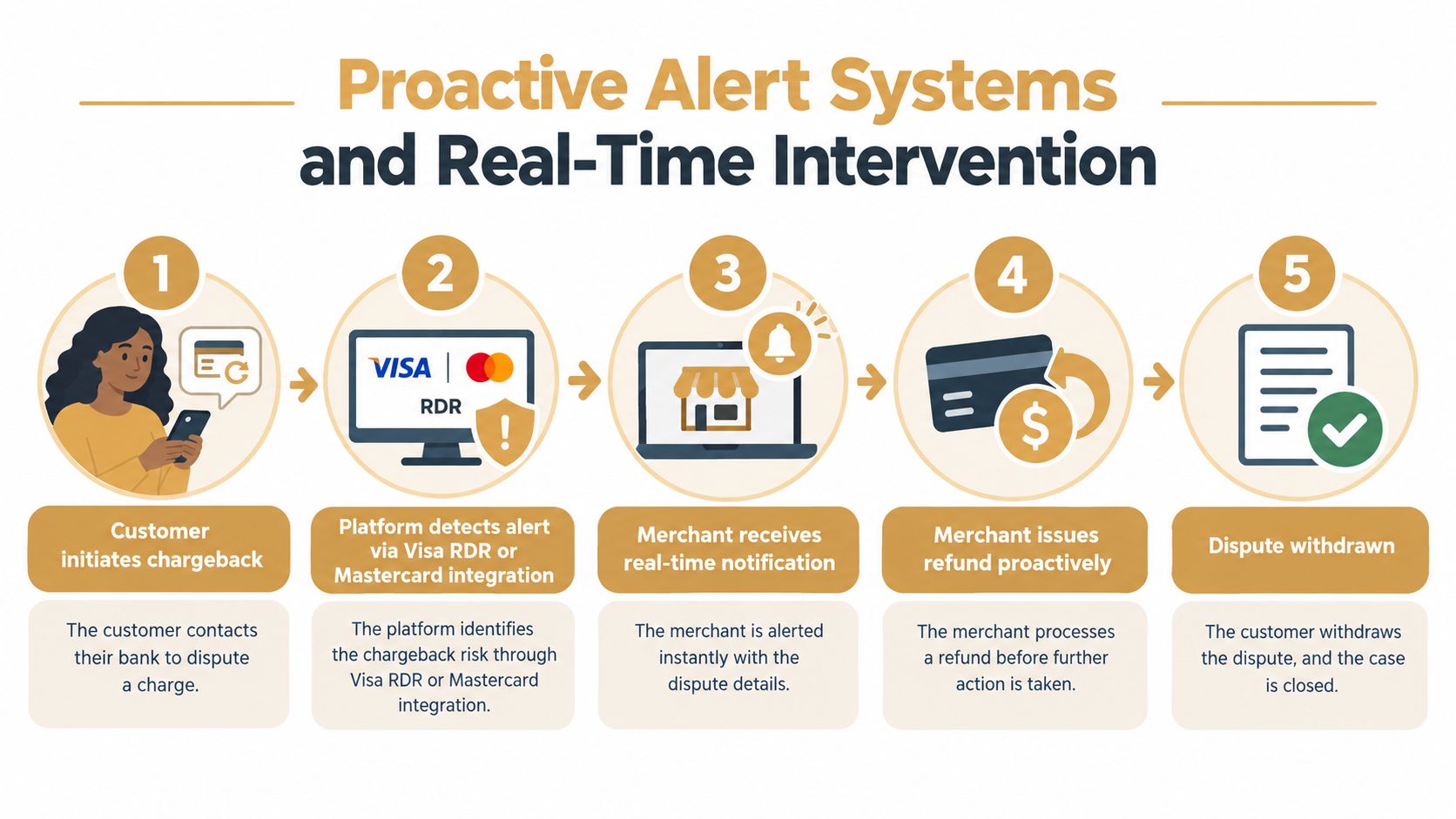
A dispute that gets caught early is usually cheaper to resolve than one that reaches representment. Real-time alerts matter because they arrive while the customer still wants a fix, not after the case has hardened into a chargeback.
What speed actually buys you
Visa Rapid Dispute Resolution, Mastercard CDRN, and Ethoca-style alerts all serve the same operational purpose. They surface a dispute fast enough for the merchant to refund, replace, or correct the issue before the network process moves too far. That is a different job from representment, where the merchant is already defending a filed dispute with evidence.
For high-volume merchants, the ratio impact is real, not theoretical. Removing 100 disputes from 100,000 monthly settled transactions lowers the ratio by 10 basis points, from 0.50% to 0.40%. Visa monitoring guidance
Why the alert window matters more than perfect evidence
The former Visa Dispute Monitoring Program used thresholds tied to dispute count and dispute-to-sales ratio, and merchants generally had to stay below the applicable levels for three consecutive months to exit. That structure pushes prevention first. Every avoided dispute improves the numerator and the account's direction at the same time.
The practical value shows up in operations. Alert platforms work best when they feed directly into refund rules and support workflows, so a genuine service failure can be closed quickly instead of drifting into a long dispute cycle. A fast refund often costs less than a formal fight, but only if the team acts within minutes and not after the issue has sat in queue all day.
Building Effective Refund Policies and Workflows
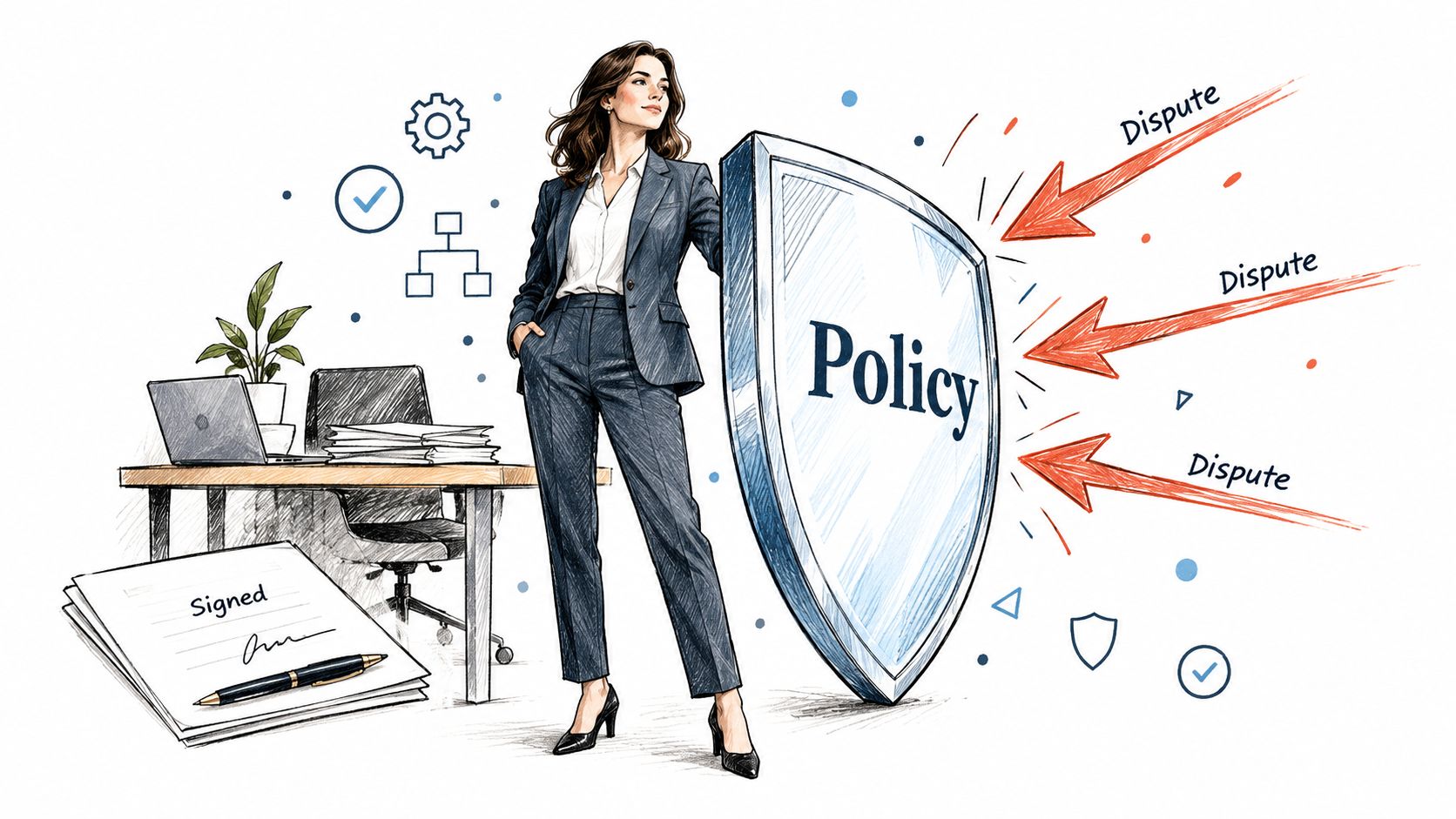
A good refund policy prevents confusion before it becomes chargeback language. That means clear terms, visible status updates, simple cancellation paths, and a support flow that tells customers what happens next without making them hunt for answers. When customers can't recognize a purchase, billing clarity becomes part of dispute prevention, not just customer experience.
Clarify first, refund when the facts fit
Recent Mastercard research found that 44% of consumers fail to recognize at least one purchase, 56% of those consumers classify the unfamiliar transaction as fraudulent, and nearly 48% have disputed a charge they later realized was legitimate. Mastercard purchase recognition research
That makes descriptor clarity and purchase-context messaging practical tools, not polish. If your billing name is hard to recognize, your cancellation flow is buried, or your refund status messages are vague, you're inviting avoidable disputes. A support team that can answer the question fast often prevents the filing entirely.
Use separate rules for confusion, failure, and abuse
Not every alert deserves the same response. Some cases should auto-refund because the service clearly failed. Some should go to manual review because the facts are ambiguous. Some should be defended because the merchant has evidence of fulfillment, usage, or legitimate renewal behavior.
A helpful comparison is simple. Traditional representment starts after the chargeback hits and asks, “Can we win this file?” Modern prevention asks, “Should this ever become a chargeback at all?” That shift matters because faster operational decisions usually cost less than after-the-fact defense.
For merchants who need to harden the front end against abuse as well as confusion, a guide to blocking bot traffic can help support cleaner account activity and fewer false signals.
Evidence Collection for Representment Success
When prevention fails, evidence has to do more than show a receipt. The Federal Reserve Bank of Atlanta's updated compelling-evidence requirements focus on proving participation, receipt, or benefit, which means merchants need identity, access, delivery, and usage data that fits the dispute type. Atlanta Fed first-party fraud guidance
What to capture early
The strongest evidence bundles begin at authorization and fulfillment, not after the dispute is filed. That means normalizing account IDs, keeping device and network signals, storing delivery confirmations, and preserving service-use logs where they exist. The key is making the evidence retrievable later without manual reconstruction.
A practical bundle should include:
- Account identifiers: normalized customer account or login ID, tied to the order.
- Device and network signals: device ID, device fingerprint, or IP address.
- Fulfillment proof: delivery address, shipping confirmation, or service access logs.
- History match: at least two undisputed older transactions that align with the disputed order, where the qualifying attributes support the claim.
- Reason-code mapping: a way to route the evidence to the right dispute reason without a scavenger hunt.
Operational lesson: if the evidence only exists in someone's inbox, it isn't really evidence. It's a future search problem.
For merchants using automated dispute tooling, the useful test is whether the platform can pull the right bundle fast enough to matter. If it can't, the team ends up spending more time assembling proof than the dispute is worth. That's why a disciplined evidence process is part of dispute prevention and resolution, not just courtroom-style defense.
See how chargeback fighting workflows are typically structured when a case does escalate.
Measuring ROI and Performance Metrics
Dispute work gets messy when no one agrees on what success looks like. The cleanest teams track monthly dispute ratios, monitor their distance from network thresholds, and compare prevention costs against the amount of labor and loss they remove from the process. If the numbers aren't visible, prevention becomes a feeling instead of an operating decision.
What to measure
Start with the basics, then add decision quality. Track dispute count, settlement volume, alert response time, refund turnaround, and the share of cases resolved before filing. If you use representment at all, separate those results from the cases you prevented, because a win after filing is not the same thing as avoiding a filed dispute.
A practical readout for leadership should answer three questions. Are disputes falling? Are response times fast enough to intercept cases before they harden? Are refunds being issued only when the operational facts justify them?
Why prevention usually wins the budget conversation
Automated alert platforms are easier to justify when you compare them with the hidden cost of manual handling. Every case avoided means less support load, less evidence assembly, and less account pressure. For merchants with steady dispute volume, the operational savings often show up before finance can fully model the downstream benefit.
That's also why per-alert pricing can make sense. You're paying for the moment that prevents a larger workflow from starting. If the team can show faster resolution, lower review burden, and fewer escalations, the investment becomes easier to defend internally.
Choosing the Right Prevention Platform
The right platform depends on your volume, risk profile, and internal process maturity. A subscription merchant with recurring billing has different needs from a lower-volume brand with occasional friendly-fraud issues. The central question is whether the platform fits your dispute patterns without adding more manual work than it removes.
Fit matters more than feature count
Some merchants need deep alert routing and automatic refund logic. Others need strong analytics, processor integrations, and a simple way to filter out cases they'd probably win. A platform that looks impressive in a demo can still be wrong if your team can't operationalize it in the first week.
Disputely is one option in this category, and it focuses on real-time chargeback alerts, processor integrations, filtering, and automated dispute handling for merchants that need to stop disputes before they hit the merchant account.
What to evaluate before you sign
Look at integration effort first. Then look at routing logic, support responsiveness, and reporting quality. If your payment stack includes Shopify, PayPal, Stripe, Authorize.net, or Square, the main question is whether the platform fits the way your team already works.
A simple decision table helps keep this grounded:
| Merchant need | What to favor |
|---|---|
| Fast response to incoming alerts | Real-time notifications and simple refund rules |
| Complex transaction patterns | Strong filtering and dispute analytics |
| Subscription or recurring billing | Descriptor clarity and renewal-aware workflows |
| High monitoring pressure | Ratio tracking and escalation controls |
For merchants comparing options specifically around Shopify, Shopify chargeback protection is a useful lens because it forces the discussion back to process fit instead of generic promises.
If dispute volume is eating support time, pressuring ratios, or creating avoidable refunds, tighten the process at the alert stage instead of waiting for more chargebacks to land. Visit Disputely to review how real-time alerts, automated handling, and dispute analytics can fit your merchant account workflow.


