
Dispute Resolution Methods That Protect Ecommerce Revenue
A Tuesday morning dispute spike can turn a normal payment operation into a cash-flow emergency. A fulfillment partner misses shipment targets, customers contact their banks instead of support, and your dashboard fills with alerts while finance asks why reserves are rising and your team searches for order records one case at a time.
That pressure makes dispute resolution methods feel like legal terminology. For ecommerce operators, they're operational decisions. Each incoming dispute should move quickly into one of four paths: resolve directly with the customer, defend the transaction through chargeback representment, bring in a neutral third party, or escalate to formal legal action. The right choice depends on the reason for the dispute, the evidence available, the transaction value, and the customer's future value.
The broader ecosystem is established but still relatively small in everyday justice outcomes. The American Bar Foundation's review of alternative dispute resolution describes ADR as including mediation, arbitration, conciliation, and negotiation, while noting that about 1.6% of justice problems conclude through mediation or arbitration, compared with 3.1% through a court or other formal authority. For merchants, that reinforces a practical rule: build fast operational resolution first, then reserve formal escalation for disputes that justify it.
The Moment a Dispute Lands on Your Dashboard
Consider a mid-size direct-to-consumer apparel merchant opening Stripe after a fulfillment partner delayed a major batch of orders. The dashboard shows 47 new disputes in 24 hours. Finance sees funds moving into reserve, customer support sees a growing queue of “Where is my order?” tickets, and operations knows the team lacks a clean answer for every shipment.
The first mistake would be treating all 47 cases alike. Some customers may accept a refund immediately. Others may have received the goods and filed a friendly-fraud claim. A smaller group may have a legitimate delivery failure that the merchant can correct with tracking data, a replacement, or a refund before the case becomes more expensive.
Operational rule: A dispute is not a single problem. It's a routing decision.
Start by assigning every case to one of four pathways:
- Direct customer resolution: Refund the payment, replace the order, or offer an appropriate credit when the customer's complaint is valid or the relationship matters more than recovery.
- Chargeback representment: Submit compelling evidence when the merchant fulfilled the order and can document the cardholder's participation, delivery, or use of the service.
- Third-party mediation: Use a neutral platform or intermediary when both sides have a credible position and agreement is still possible.
- Formal legal action: Escalate only when the value, contract, fraud pattern, or cross-border issues justify legal expense.
The merchant also needs to recognize when the dispute problem is becoming a broader processing risk. A high chargeback rate can affect payment operations through reserves, monitoring exposure, and strained processor relationships, not just individual transaction losses.
Card-network alert programs change the sequence. Visa Rapid Dispute Resolution, Mastercard CDRN, Ethoca, and Verifi can notify a merchant after a cardholder contacts the issuer, before the chargeback is formally filed. That gives the merchant another chance to refund or resolve the transaction early, often eliminating the need to choose among the four formal pathways at all.
The Four Core Methods Every Merchant Should Know
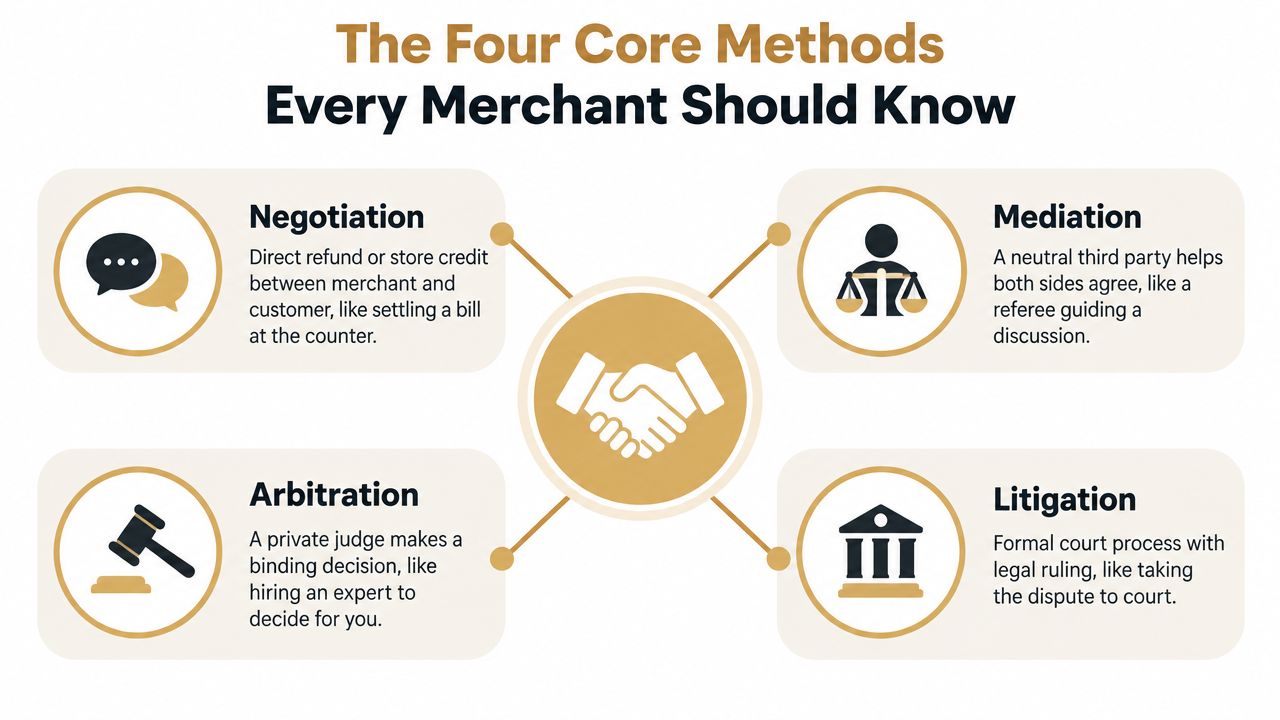
The four primary methods differ in who controls the result, how much operational effort they require, and whether the merchant can preserve the customer relationship. Don't confuse a customer-service resolution with a bank decision. They may address the same complaint, but they create very different costs and evidence requirements.
Negotiation keeps the merchant in control
In ecommerce, negotiation usually means a direct refund, replacement, partial refund, or store credit agreed with the cardholder. It's like settling a tab before the manager walks over. The merchant controls the offer, the customer controls whether to accept it, and the result is generally the quickest path.
The direct financial cost is usually the refund or concession itself, plus support time. The most common triggers are late delivery, a product that differs from its description, accidental duplicate billing, or a customer who forgot about a subscription renewal. Negotiation works best when the merchant can reach the customer before they contact the bank.
Mediation gives both sides a structured conversation
Mediation adds a neutral participant, such as a platform, issuer process, or independent facilitator. Think of it as a referee who guides the discussion and suggests a resolution without imposing the final result. Control is shared, and the outcome depends on agreement.
This method fits a mid-value order where the merchant wants to avoid a hard loss but the evidence isn't decisive. It can also protect a valuable relationship, especially when a customer or wholesale partner has a history of legitimate purchases. Costs range from platform or facilitator charges to internal coordination, and the timeline is usually longer than a direct refund.
Arbitration produces a binding decision
Arbitration puts the dispute before an adjudicator operating under agreed rules. The analogy is a private judge whose decision both parties must accept. The merchant loses control over the final outcome, but arbitration can resolve a serious claim without the full structure of court litigation.
The cost can include filing, administrative, and professional fees. It makes sense when the disputed amount or commercial relationship is substantial enough to justify that process and when the contract or applicable rules support arbitration. Appeal options are limited, so the evidence must be organized before submission.
Litigation belongs at the far end of the ladder
Litigation is a formal court process with pleadings, procedural rules, legal representation, and an enforceable ruling. It's the move from a league review to a courtroom. The merchant has almost no control over the final judgment and takes on the highest likely cost and longest timeline.
Use it for high-value or repeat disputes, serious contract breaches, or cross-border conflicts that other routes can't resolve. A routine low-value apparel claim doesn't belong in court. A supplier dispute involving substantial obligations, disputed jurisdiction, and material business damage might.
Comparing Methods on Cost Speed and Control
The fastest method isn't automatically the cheapest. A refund can look expensive on the transaction ledger, but it may be preferable to months of evidence work, support handling, and processor risk. Conversely, defending a high-value transaction can be sensible when the merchant has strong records and the customer relationship isn't the deciding factor.
| Method | Cost | Speed | Merchant Control | Relationship Impact |
|---|---|---|---|---|
| Negotiation | Refund, replacement, credit, and support time | Usually fastest | High, because the merchant sets the offer | Usually preserves goodwill |
| Mediation | Platform or facilitator cost plus coordination | Moderate | Shared with the customer and neutral party | Generally neutral to positive |
| Arbitration | Filing, administration, and professional fees | Slower than direct resolution | Limited, with a binding decision | Depends on the process and relationship |
| Litigation | Legal fees, court costs, and internal management | Slowest | Low, with the court controlling the ruling | Often damages the relationship |
The merchant recommendation by dimension
- Cost: Use negotiation for valid low-value service complaints. Defend when the evidence is strong and the transaction matters.
- Speed: Route urgent, clear cases to automation or customer support. Don't make a customer wait for a legal-style review.
- Control: Negotiate when you need a custom outcome. Choose arbitration only when a binding decision is worth giving up control.
- Relationship: Preserve repeat customers through fast, respectful resolution. Litigation is a poor retention tool.
Negotiation wins on speed and customer experience but gives up recoverability. Once the merchant refunds, that revenue is gone. Arbitration can protect a larger claim with a binding outcome, but the merchant pays for process and usually has little room to appeal. Litigation is the final escalation, not a default response to a chargeback.
For international commercial activity, formal arbitration is not marginal. ICC dispute-resolution statistics report 881 new cases filed under its Arbitration Rules in 2025, with parties from 147 jurisdictions. Those cases show how arbitration can serve commercial disputes at scale, but they don't make it appropriate for ordinary cardholder complaints.
The Alert Layer Most Merchants Overlook
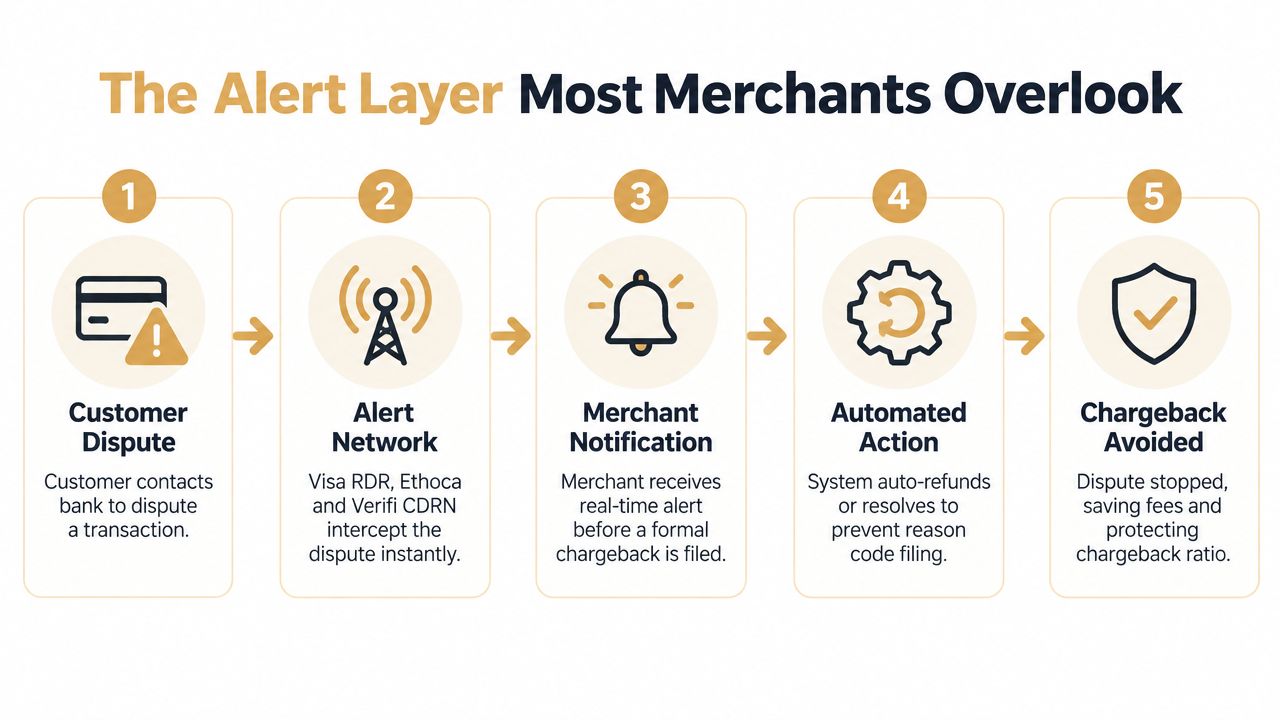
A card-network alert arrives before the formal chargeback workflow reaches its most expensive stage. Visa RDR, Mastercard CDRN, Ethoca, and Verifi programs can pass issuer-side dispute signals to a merchant or its payment provider, allowing the merchant to decide whether a refund or other action makes sense before a reason code is filed.
The alert layer sits before negotiation, mediation, arbitration, and litigation. It doesn't replace those methods. It changes how often merchants need them.
What the workflow looks like
A practical alert workflow has five stages:
- The cardholder contacts the issuer about a transaction.
- The alert network transmits the signal to the merchant, processor, or alert provider.
- The merchant receives transaction details before the formal chargeback is filed.
- Rules determine whether to refund, replace, investigate, or allow the case to proceed.
- The merchant records the action and updates the order and dispute ledger.
Visa's merchant guidance stresses that the strongest evidence should be submitted at the initial notification stage. The Visa evidence guidance available through the referenced merchant dispute material emphasizes records showing cardholder participation, receipt of goods or services, or benefit from the transaction. That makes automated evidence retrieval important, but it doesn't make every alert worth fighting.
Do not confuse an alert with an order-insight feed. An alert indicates that a cardholder has raised a dispute signal. An order or customer data feed supplies context such as fulfillment, identity, delivery, refund, and communication records. A reliable operation needs both: the signal to start the clock and the records to make the decision.
Where integration belongs
Merchants typically connect these programs through a specialized provider, a processor, or a payment service provider such as Stripe, Adyen, or Braintree. The integration should capture order status, tracking, customer history, refund state, billing descriptor, and the merchant's decision rules.
A platform such as Disputely's Klaviyo connection can help connect customer and order context to dispute operations. The important design question isn't whether the system can receive alerts. It's whether the system can make a defensible decision quickly and write that decision back to the merchant record.
Choosing the Right Path for Each Dispute Type
A merchant should never begin with “Should we fight this?” Begin with “What happened, and what can we prove?” That question separates legitimate recovery from expensive representment theater.
Start with the dispute signal
First classify the complaint as likely fraud, service failure, processing error, or customer confusion. Review the transaction, device and identity signals available to your team, authorization records, fulfillment state, delivery confirmation, refund history, and all customer correspondence.
For suspected fraud, don't rely on hope. If the merchant can't establish meaningful cardholder participation or authorization, a quick refund may be more rational than building a weak representment case. Block or review the associated payment instrument according to the merchant's fraud policy, and investigate whether the same pattern appears across other orders.
For service disputes, retrieve the actual operational evidence before choosing a path. A missing-delivery case needs tracking and delivery confirmation. A “not as described” complaint needs the product page, order details, customer messages, and any return or replacement record. A duplicate-charge claim needs payment identifiers and the merchant's ledger.
Use the method that matches the evidence
- Clear service failure: Refund or replace through the alert workflow. Negotiation is usually better than defending a mistake.
- Strong fulfillment evidence: Submit representment with a complete evidence package, especially when the order was delivered and the complaint conflicts with the records.
- Credible disagreement with a valuable business customer: Consider mediation before escalating.
- Material commercial or contract dispute: Review arbitration or litigation with qualified counsel and the governing agreement.
A merchant should also treat card-network thresholds and rules as operating constraints, not casual benchmarks. For example, arbitration may become more rational for a substantial claim under the applicable network process, while a routine consumer transaction rarely justifies it. The exact rule depends on the network, contract, jurisdiction, and dispute type.
| Reason Code | Best Method | Evidence Required | Expected Outcome |
|---|---|---|---|
| Visa 13.1, merchandise or service not received | Negotiation or representment | Tracking, delivery confirmation, customer communication, refund records | Refund or replacement if delivery failed, representment if delivery is documented |
| Visa 11.30, authorization-related dispute | Representment or direct resolution | Authorization data, transaction records, authentication details, order history | Defense when authorization and participation are documented |
| Visa 10.4, fraud or card-absent environment claim | Early refund or representment | Identity, authentication, device, address, delivery, and customer-use records | Refund when evidence is weak, defense when the record is compelling |
The key is timing. Visa guidance says compelling evidence should be provided at the initial notification stage, so your workflow should retrieve it before an agent starts writing a response. A polished argument cannot repair missing records.
Real Merchant Scenarios Across Business Models
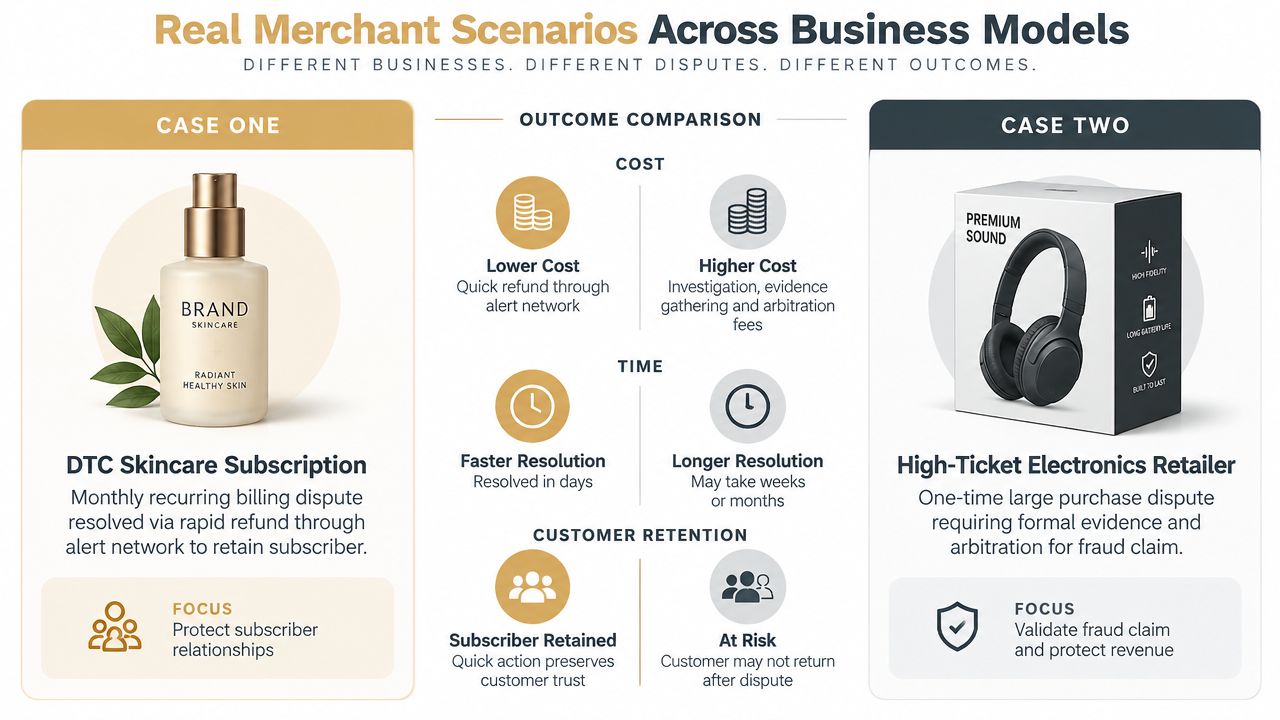
A subscription skincare merchant and a travel seller can receive similar customer complaints but should make opposite resolution decisions. Transaction value, repeat-purchase economics, fulfillment complexity, and monitoring exposure all change the answer.
Subscription skincare
The skincare brand bills customers on a recurring schedule. Customers sometimes miss cancellation reminders because messages land in spam, then contact their banks after seeing a renewal they don't recognize. The brand's practical response is not to defend every case. It improves cancellation visibility, uses recognizable billing descriptors, updates stored payment credentials through an appropriate card-updater process, and routes early alerts into a refund decision.
For a customer who has already asked to cancel, a fast refund can preserve the relationship and prevent support escalation. For a customer who received and used the product, the brand can review the subscription terms, account activity, and customer communications before deciding whether representment is defensible.
High-risk travel
Travel disputes behave differently because cancellations, schedule changes, supplier failures, and weather events can affect the underlying service. A high-value flight or hotel package may justify detailed evidence collection and arbitration when the merchant has a contractual basis and strong records.
The same merchant may use mediation for a travel-agent partner because preserving the commercial relationship matters. Litigation belongs only in a narrow group of cross-border supplier conflicts where contractual obligations and financial exposure justify the process.
The right method follows the economics of the order, not the merchant's industry label alone.
The operational lesson is simple. A low-value recurring billing complaint can be more expensive to fight than to resolve, especially when the customer might continue buying. A high-value travel claim may deserve formal escalation, but only after the merchant has assembled booking records, cancellation terms, supplier communications, and proof of the service offered.
Preventing Disputes Before They Become Chargebacks
Post-filing resolution is necessary, but prevention creates more advantage. A merchant that waits for a chargeback has already lost time, customer trust, and control over the first conversation.
The Mastercard and Javelin chargeback research reports that consumers bypass merchants and contact issuers in fraud-related disputes up to 76% of the time, merchants bear two-thirds of total chargeback costs, and 60% of merchant chargeback costs come from management overhead. The same source estimates that every $1 disputed creates about $1.50 in combined additional costs for merchants and issuers. That is why prevention is a margin decision, not merely a support preference.
Build the merchant-side safety net
- Clarify the offer: Make product descriptions, renewal terms, cancellation rules, delivery windows, and refund policies easy to find before purchase.
- Explain fulfillment: Send shipping, delay, and delivery notifications with the order number and a recognizable business name.
- Fix billing confusion: Use a billing descriptor customers will recognize on their statement.
- Resolve small complaints early: A reasonable refund or replacement can cost less than a bank-led dispute process.
- Train support agents: Teach agents to identify cancellation requests, duplicate billing, delivery failures, and friendly-fraud signals.
- Automate alerts: Send every network alert through rules that refund clear failures and preserve strong cases for evidence review.
Delivery proof deserves special attention. Merchants that need a practical recordkeeping workflow can use Routelink's receipt for delivery guide to strengthen how they document receipt and fulfillment.
The consumer behavior gap matters here. Payments Association coverage of the 2025 Cardholder Dispute Index says 76% of surveyed consumers prefer resolving disputes through their bank, nearly half bypass the merchant, and 89% trust their bank to resolve disputes. Your support channel must therefore reach customers before the issuer becomes their default help desk.
Building a Dispute Operating Model That Scales
A scalable dispute operation doesn't need a larger queue of agents. It needs a repeatable decision tree, reliable records, and clear ownership for every branch.
Start by instrumenting the funnel. Tag orders with signals such as recurring billing, delayed fulfillment, address mismatch, refund request, delivery confirmation, customer contact, and prior dispute activity. These tags let the team distinguish a fulfillment problem from a fraud pattern before choosing a resolution method.
Roll out the workflow in four phases
- Create the risk record: Connect payment, order, fulfillment, identity, refund, and support data to a shared transaction view.
- Automate obvious decisions: Refund clear service failures and weak fraud cases through alert rules. Route potentially defensible transactions to review.
- Centralize evidence: Store tracking, authentication, invoices, customer messages, product information, and refund records in a shared merchant vault.
- Review reason-code performance: Examine outcomes by dispute type and identify which prevention habit needs investment, such as better descriptors, delivery notices, cancellation controls, or fraud screening.
Your operating dashboard should show alert volume, refund decisions, representment submissions, evidence completeness, unresolved cases, and outcomes by reason code. It should also flag sudden changes in fulfillment delays, subscription cancellations, customer contact volume, and issuer dispute activity.
A centralized dispute resolution workflow should make the same decision consistently whether the case arrives during business hours or overnight. The objective isn't to win every dispute. It's to refund the right cases early, defend the cases supported by evidence, and escalate only when the economics and facts justify it.
Disputely connects merchants with Visa RDR, Mastercard CDRN, and Ethoca alerts, then applies rules to incoming disputes so teams can decide quickly between an early refund and evidence-based representment. Visit Disputely to connect your processor, define your refund rules, and build a dispute workflow that protects revenue without adding another manual queue.


