
Dispute Resolution Procedure for Merchants That Wins
Most merchants treat a dispute resolution procedure as something that begins after a chargeback arrives. That's backwards. In card payments, Visa cardholders generally have up to 120 days to dispute a transaction, while merchants often have about 30 days to submit representment evidence, and escalation can extend the process to roughly 110 to 160 days or more depending on the case, according to industry chargeback timeline guidance. The most valuable moment is earlier, when an alert gives your team a short opportunity to resolve the complaint before it becomes a chargeback.
A merchant that waits for the formal case is already operating at a disadvantage. A merchant that intercepts the alert, applies a disciplined refund rule, and reserves evidence-heavy fights for the right cases can protect margin, customer relationships, and payment processing continuity. The procedure below is built around that principle.
Why a Dispute Resolution Procedure Exists and What It Must Do
A dispute resolution procedure exists to intercept disputes before they become chargebacks, not merely to organize a queue of cases that have already landed. Alert providers such as Visa's Rapid Dispute Resolution, Mastercard's CDRN, and Ethoca can give merchants an earlier signal. That signal creates the chance to refund quickly, clarify the transaction, or hold the case for an evidence-based decision.
The economics are straightforward. A timely refund may prevent representment work, escalation, and a lengthy evidence review. It can also preserve a legitimate customer relationship when the problem is confusion, a delayed delivery, or an unrecognized recurring charge. Fighting every alert is not discipline. It's expensive reflex.
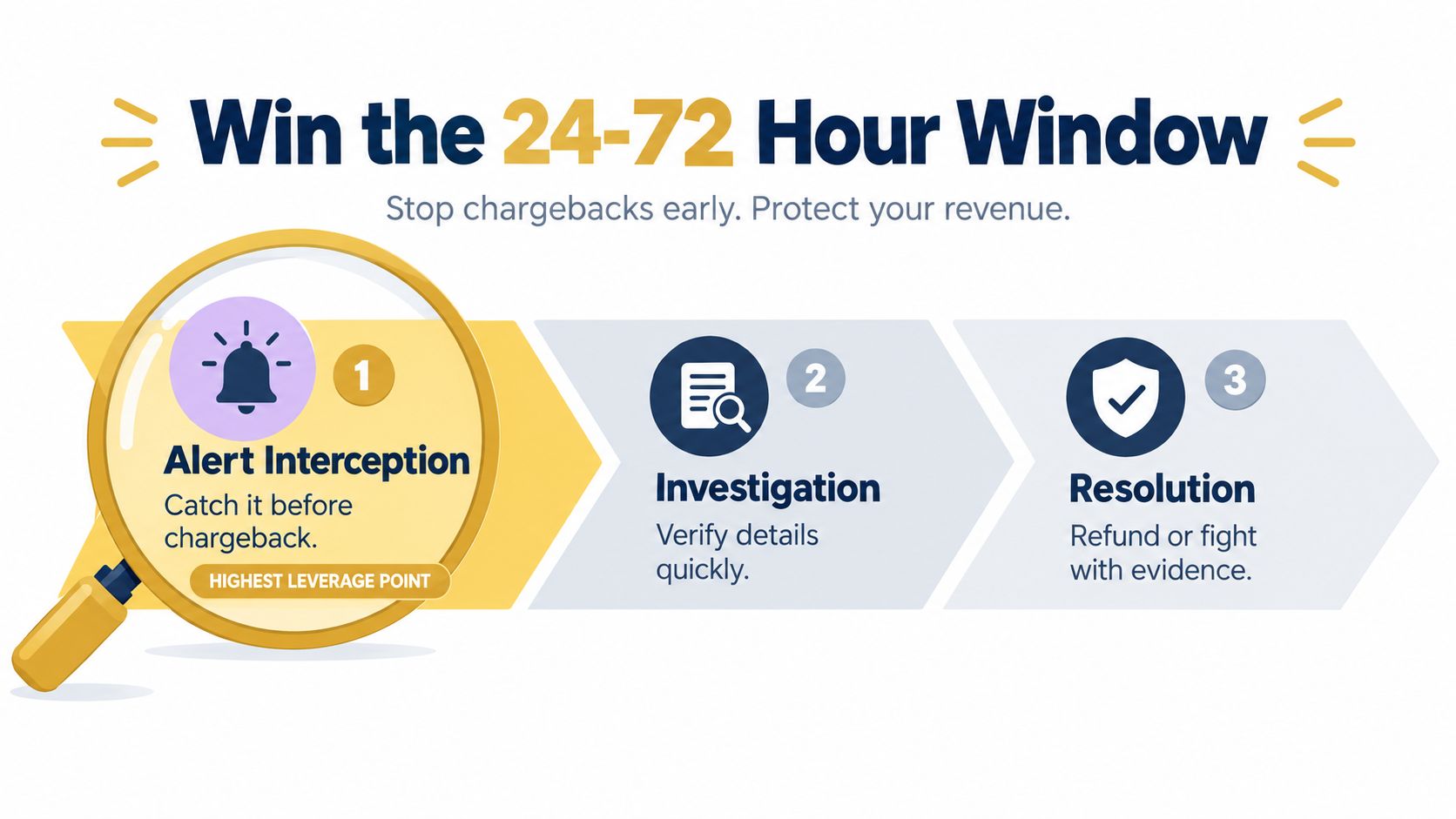
The three jobs your procedure must perform
Capture every signal quickly. Build a single intake for RDR, CDRN, and Ethoca alerts. Use webhooks where available, polling where necessary, and monitoring that flags missing or delayed events. An alert nobody receives is not an operational asset.
Route each alert to a clear decision. The case record should expose the reason code, transaction value, customer history, evidence strength, and alert source. Your team should know whether to refund, investigate, or preserve the transaction for a formal defence without debating the basics from scratch.
Learn from every outcome. A refund, an accepted alert, a successful representment, and an abandoned case should all update your rules and reporting. If outcomes don't change future routing, the process is only recording activity.
Practical rule: An alert workflow without coverage is a reaction queue. A reaction queue without decision rules is just busyness.
The right objective is interception speed and decision quality, not a lower count of open disputes. FINRA's dispute resolution system handled 2,469 cases filed and 3,108 cases closed in 2024, compared with 3,382 filed and 3,027 closed in 2023, demonstrating how formal resolution can remain high-volume even when filing and closure patterns shift. FINRA's published dispute resolution statistics also show that arbitrators resolved 499 of 569 decided cases in favor of claimants in one summary category in 2024, or 87% of that segment, a reminder that outcomes can be highly sensitive to the forum and case type. Merchants should avoid pushing preventable disputes into that stage.
Setting Up the People, Tools, and Integrations
A procedure fails before the first alert if nobody owns the decision. Assign one dispute owner with authority to approve refunds, one payments analyst who understands reason codes and network rules, one customer support liaison for goodwill or service-recovery cases, and one escalation contact at the acquirer or processor. The dispute owner controls the queue. The analyst controls interpretation. Support supplies customer context. The acquirer contact resolves coverage and settlement questions.
The technology stack should be equally explicit. Use a centralized case-management record, a rules engine connected to the payment gateway, and a reporting layer that sends urgent events to Slack or email. Your team shouldn't copy details between a processor portal, a spreadsheet, and a support ticket. That manual chain creates missed deadlines and inconsistent decisions.
Integrations to establish first
For Visa, connect Verifi RDR and Ethoca where supported. For Mastercard, connect CDRN and relevant Chargeback Alerts services. Add direct processor feeds when they expose alert or dispute events that network tools don't provide.
Before launch, verify three things:
- Coverage by reason code: Confirm which reason codes each provider can signal and identify gaps that require processor monitoring.
- Credential and event integrity: Test API credentials, webhook signing, event retries, duplicate handling, and timestamp conversion.
- Historical replay: Run a parallel comparison against historical chargebacks to see which cases would have generated alerts and what information the payloads contain.
A Shopify merchant may also need a payment-specific workflow alongside its store operations. This Shopify chargeback protection guide is useful for mapping store, processor, and alert responsibilities before the team configures automation.
| Network | Alert Source | Signal Type | Action Window |
|---|---|---|---|
| Visa | Verifi RDR | Issuer or network alert with an opportunity for early resolution | Short pre-chargeback response window |
| Visa | Ethoca | Issuer-side consumer dispute signal | Rapid review, refund, or hold decision |
| Mastercard | CDRN | Network-connected dispute notification | Early intervention before formal processing |
| Mastercard | Chargeback Alerts | Issuer or processor alert | Fast triage and documented action |
| Any supported network | Direct processor feed | Gateway or acquirer event | Governed by processor and network rules |
On day one, deliberately trigger test events, inspect the normalized case record, confirm the responsible person receives the alert, and verify that a test refund reaches the order and payment records. “Connected” is not the same as operational.
Designing the Alert-to-Resolution Workflow
The workflow should be simple enough for an analyst to run without interpretation and structured enough for automation to handle routine cases. Every stage needs an owner, a service-level clock, and a defined handoff.
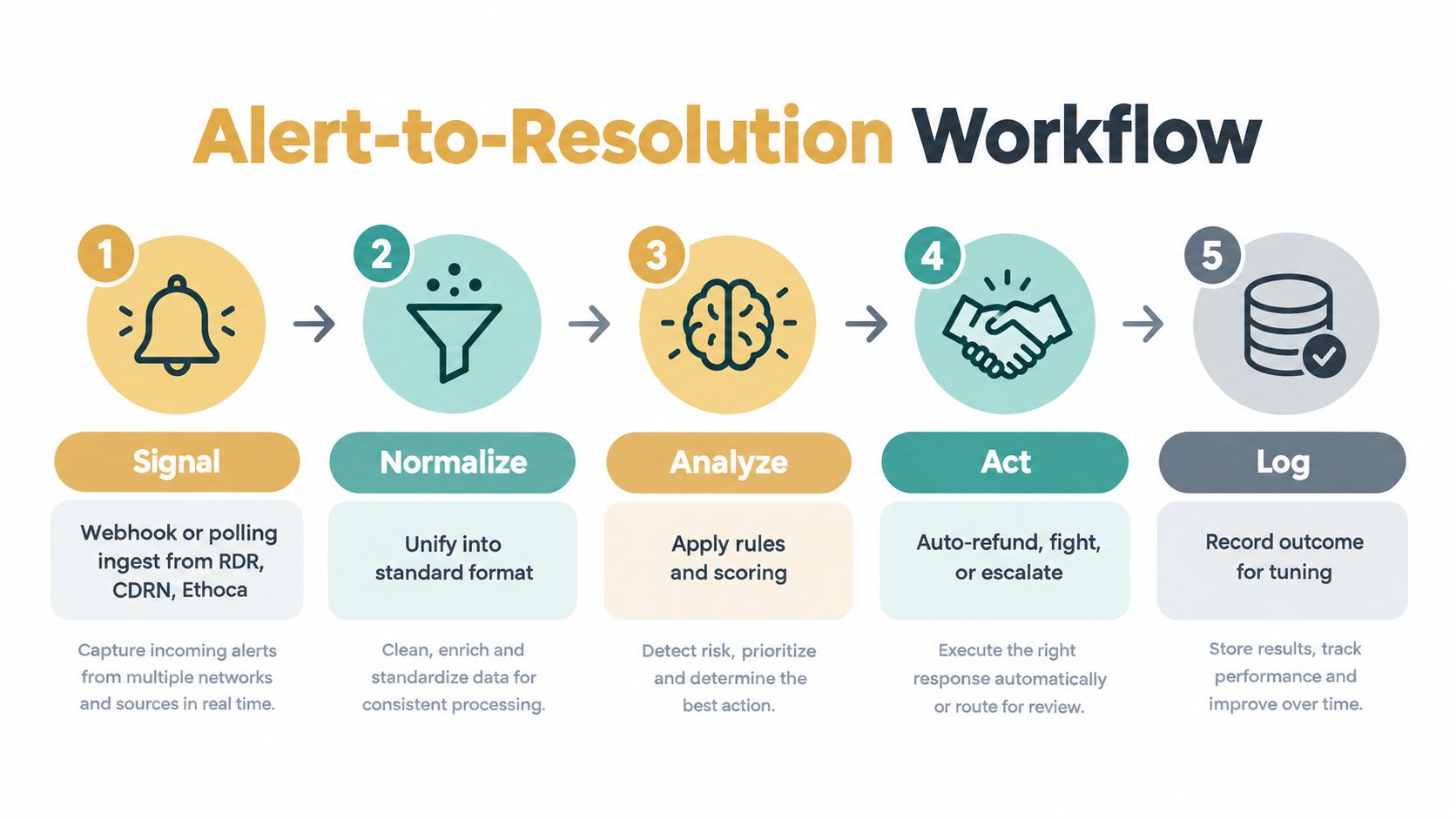
Five stages from signal to decision
1. Ingest the signal. Receive a webhook or poll RDR, CDRN, or Ethoca. Store the alert provider, transaction identifier, reason code, amount, and event timestamp. The dispute owner monitors ingestion health, while the platform handles retries and duplicate events.
2. Normalize the record. Convert different payload structures into one case format. The minimum record should include transaction ID, order ID, payment method, reason code, alert source, amount, timestamps, customer identifier, and current status. Don't let one provider's field names become your operating model.
3. Enrich the case. Pull customer history, lifetime value, prior disputes, device fingerprint, billing details, order contents, delivery status, subscription activity, and support conversations. The analyst needs context before deciding whether the alert reflects fraud, dissatisfaction, confusion, or a processing error.
4. Apply routing rules. Send standard low-risk cases to auto-refund, ambiguous cases to analyst review, and defendable cases to an evidence hold. Route by reason code and amount, but don't rely on amount alone. A small recurring-billing complaint may deserve a different treatment from a small confirmed fraud signal.
5. Act and log. Execute the refund or preserve the transaction for defence. Record the rule that fired, the human override if one occurred, the documents used, and the final outcome. Feed those outcomes into a weekly rules review.
For routine cases, set an internal target of under 30 minutes for the decision. That target is an operating standard for your team, not a network guarantee. Complex cases should take longer when the evidence requires verification, but they shouldn't sit untouched because ownership is unclear.
The fastest workflow isn't the one with the most automation. It's the one where every exception has a named owner.
A normalized handoff also makes broader workflow optimisation for SMBs easier. The same principles apply to payment disputes: consistent intake, explicit routing, and a recorded outcome.
Use the following video as a practical visual reference for the workflow:
Refund Versus Fight Decision Matrix
The refund-versus-fight decision should take minutes, not a committee meeting. Start with the reason code, then evaluate transaction value, customer history, evidence quality, and alert source. A fraud claim with authenticated 3DS, a matching AVS result, delivery confirmation, and a cardholder-address match is materially different from a “product not received” complaint with no delivery record.
Friendly fraud also deserves separate treatment. A customer who says an order never arrived may be mistaken, frustrated, or testing the process. A duplicate-charge claim may result from a genuine processing error. A confirmed unauthorized transaction needs a fraud-specific evidence path. Treating every reason code as an invitation to fight creates poor customer outcomes and weak evidence.
| Reason Code | Amount < $50 | Amount $50-$200 | Amount $200+ | Customer History | Alert Source | Default Action |
|---|---|---|---|---|---|---|
| Product not received | Refund if delivery proof is absent | Review delivery, carrier, and support records | Human review with full fulfilment evidence | Favor established customers with clean history | RDR, CDRN, or Ethoca | Refund unless delivery proof is strong |
| Duplicate charge | Verify ledger and payment captures | Reconcile authorizations and captures | Escalate accounting review | Check whether one transaction was already reversed | Any alert source | Refund or correct the duplicate |
| Fraudulent transaction | Review authentication and AVS | Fight when evidence is complete | Human review before representment | One-off customers may still be defendable | Weight issuer-issued alerts carefully | Fight when fraud evidence is strong |
| Subscription or recurring billing | Refund when cancellation or notice is unclear | Review consent, renewal, and cancellation records | Escalate if customer value is high | Check prior usage and support history | RDR, CDRN, or Ethoca | Review, then refund or defend |
| Unknown or incomplete code | Do not automate | Analyst review | Senior reviewer approval | Consider repeat disputes from the same card | Any source | Hold pending evidence |
The matrix should escalate amounts between $100 and $500, repeat disputes from the same card, incomplete evidence, and cases involving a high-value customer. Those thresholds are operational controls, not universal network rules.
Weight duplicate signals carefully. If RDR and Ethoca refer to the same transaction, deduplicate the case and preserve both source fields. Don't issue two refunds because two providers reported one complaint. For merchants that need a formal evidence workflow, chargeback fighting support can help organize representment preparation, but the decision still belongs to the merchant's rules and risk policy.
Automating Refund Rules Without Losing Control
Automation should remove repetitive handling, not remove judgment from consequential cases. Start by mapping every RDR, CDRN, and Ethoca payload into a shared schema. Store fields such as transaction_id, reason_code, amount, alert_source, three_ds_status, avs_result, delivery_status, customer_value, and evidence_complete.
A platform such as Chargeback.io, Midigator, Kount, or a gateway-native rules engine can then route the normalized case. Disputely is another option for merchants that want a real-time alert layer connected to Visa RDR, Mastercard CDRN, and Ethoca, with configurable refund rules and processor integrations.
Rules that deserve automation
Use automatic refunds for low-risk friendly-fraud alerts under $75 when delivery confirmation is already stored. Use automatic defence preparation for confirmed fraud when the transaction has authenticated 3DS, a matched AVS result, and delivery to the cardholder address. Don't confuse evidence collection with automatic submission. The second step still needs a policy check.
Require human review for amounts above $250, alerts involving flagged high-value customers, and any event with incomplete evidence fields. Add daily refund caps, reviewer approval thresholds, duplicate-event protection, and a kill switch that pauses a rule without disabling alert ingestion.
A normalized event might look like this:
transaction_id: "..."reason_code: "product_not_received"amount: 42alert_source: "RDR"three_ds_status: "authenticated"avs_result: "match"delivery_status: "delivered"evidence_complete: true
A practical rule can be expressed in plain language:
- Refund automatically: If the reason is product not received, the amount is under $75, delivery is confirmed, and the customer isn't flagged, issue the refund and log the rule.
- Send to review: If the amount exceeds the review threshold, evidence is incomplete, or the customer is high value, hold the case.
- Prepare to fight: If the alert indicates fraud and 3DS, AVS, delivery, and order evidence align, assemble the evidence bundle for representment.
Connect the automation layer to the CRM, order-management system, and payment service provider. The refund should update the order, ledger, customer record, and case status in seconds. Evidence documents should attach to the correct transaction ID automatically. Test failure paths, not only successful ones. A missing order ID or delayed PSP response must produce an explicit exception, never a silent success.
KPIs, Monitoring, and Continuous Tuning
A dispute resolution procedure needs a dashboard that exposes delay, poor routing, and missing coverage. The four most useful operating measures are alert-to-action time, refund rate on alerted transactions, win rate on fought cases, and chargeback rate as a share of transactions.
Track alert-to-action time by source, reason code, queue, and shift. Set an internal target of under four hours for RDR alerts. Measure the refund rate on alerted transactions against a target of above 60%, but interpret it with margin and customer-history data. A high refund rate may indicate effective interception, or it may indicate rules that refund cases the team could defend.
For fought cases, monitor separate benchmarks for fraud and services. The operating targets are above 40% for fraud and above 25% for services. Track the chargeback rate against a control threshold of below 0.05% of transactions when assessing exposure to monitoring programs. These benchmarks come from the operating framework for this procedure, while network and program eligibility should always be checked with the relevant processor and scheme.
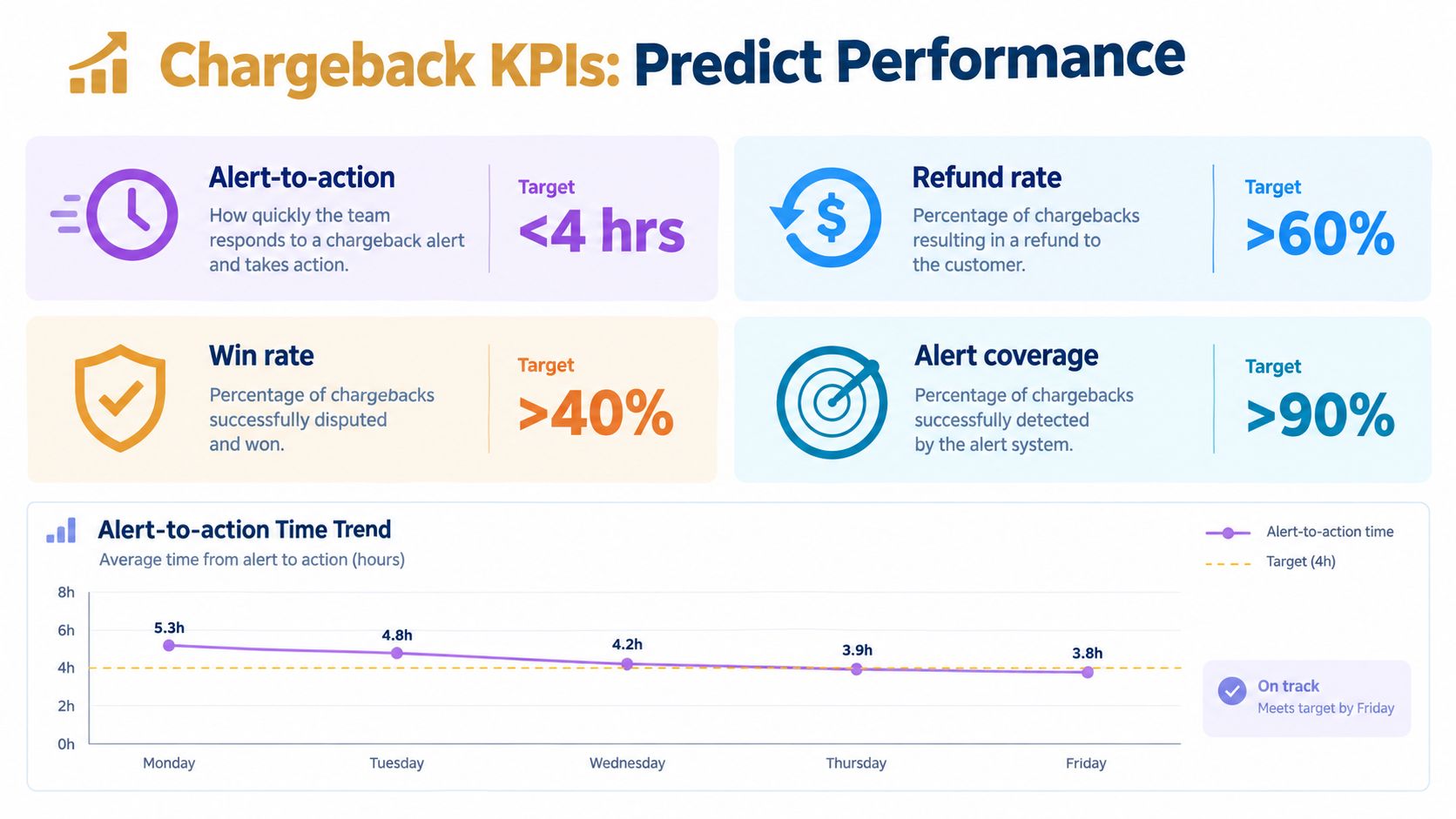
What the Monday dashboard should show
- Alert response: Median and worst alert-to-action time, split by provider and queue.
- Rule activity: Rules fired, manual overrides, duplicate alerts, and cases with missing fields.
- Refund quality: Refund rate, false-positive refunds, average order value, and customer retention signals.
- Defence quality: Win rate by reason code, evidence type, analyst, and processor.
- Exposure: Chargeback rate, alert coverage, unresolved cases, and monitoring-program proximity.
- Pattern changes: Monthly reason-code mix, repeat cards, product lines, geographies, and subscription cohorts.
Review the dashboard weekly and conduct a deeper monthly review. Compare recovered revenue, preventable refunds, rule hit rate, and false positives. If the win rate drops 10% week over week, pause automatic defence and route affected cases to reviewers until the reason is understood.
Don't change a live rule based on one bad case. A/B test a new threshold against a control group, document the intended effect, and compare outcomes over a consistent review period. For merchants already dealing with raised exposure, this guide to a high chargeback rate provides useful context for structuring the response.
30-Day Rollout Plan and Common Failure Modes
Roll out the procedure in stages. Trying to automate every reason code on the first day is how merchants create refund leakage and lose trust in the data.
| Stage or Failure Mode | Symptom or Deliverable | Action |
|---|---|---|
| Week 1, integrations | RDR, CDRN, and Ethoca connections are configured, with named owners | Test credentials, event delivery, deduplication, and notification routing. Go forward only when each alert has an accountable queue owner |
| Week 2, decision matrix | Reason-code, amount, evidence, and customer rules are documented | Approve refund, review, and defence paths. Block ambiguous cases from automatic action |
| Week 3, controlled automation | Automation runs behind a human review queue | Compare system decisions with analyst decisions before expanding rule scope |
| Week 4, operating baseline | KPI dashboard and response SLAs are live | Establish alert-to-action, refund, win, coverage, and chargeback baselines. Set review cadence |
| No owner | Alerts arrive, but response times rise | Assign a primary and backup owner for every source and shift |
| Loose refund rules | Refund volume grows without clear customer or evidence logic | Add reason-code, evidence, customer, and daily-cap controls |
| Tight rules | Alerts close without action or formal disputes increase | Review missed interceptions and widen only the rules supported by outcomes |
| Broken evidence mapping | Evidence packs lack transaction IDs or attach to the wrong order | Validate identifiers across the PSP, OMS, CRM, and case system |
| KPI theatre | Dashboards exist, but nobody changes rules | Schedule a weekly operating review and require an owner for every corrective action |
The most common failure is not a bad tool. It's the loss of operating discipline after the launch. Teams stop checking alert coverage, let exceptions accumulate, and return to reacting only after the processor opens a formal case.
Keep one person accountable for the queue, one review ritual on the calendar, and one change log for every rule adjustment. That discipline keeps interception at the centre of the dispute resolution procedure instead of allowing the business to drift back into late-stage firefighting.
Disputely gives merchants a real-time alert layer for Visa RDR, Mastercard CDRN, and Ethoca, with configurable refund rules and integrations for supported processors. Visit Disputely to connect your payment workflow, test alert coverage, and replace reactive chargeback handling with controlled early intervention.


