
Ecommerce Chargeback Management: A Practical Guide
Chargebacks become merchant liability in approximately 70% to 80% of cases, and fraud represents about 50% of total chargebacks. That makes proactive ecommerce chargeback management more valuable than relying on representment after the money and the dispute record are already at risk.
A high-volume merchant can have strong fraud screening, accurate fulfillment, and responsive support, yet still lose margin when customers dispute legitimate transactions. The operational mistake is treating every dispute as an isolated ticket. Chargebacks are a payment-system risk that needs early detection, classification, controlled intervention, and network-level measurement.
The most effective strategy is simple: intercept eligible disputes before they become filed chargebacks, then reserve refunds, manual review, and representment for the cases where each response makes economic sense.
Why Chargebacks Exist and Why They Hurt
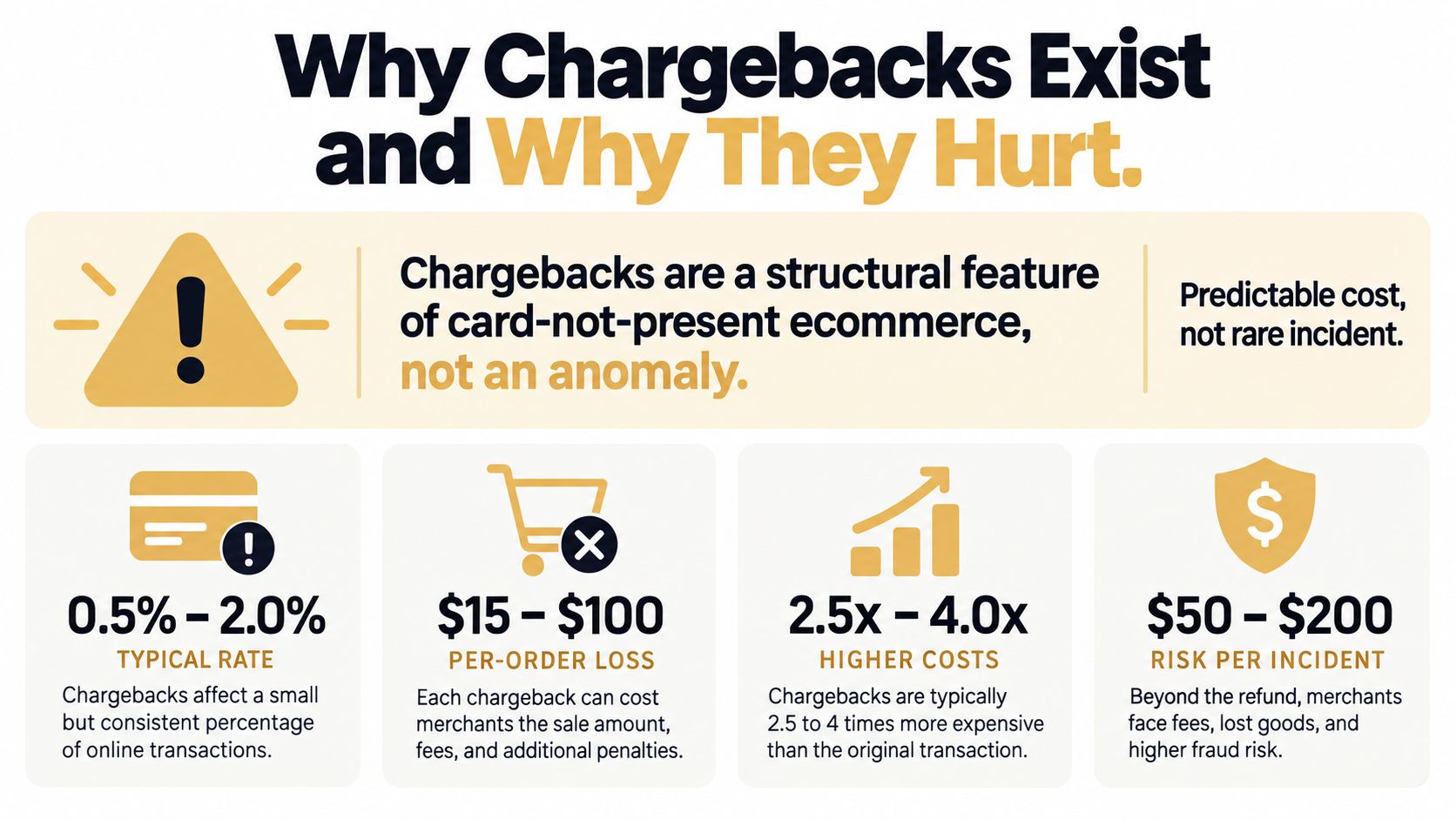
The Federal Reserve Bank of Kansas City found that merchants received chargebacks equal to an average of 1.6 basis points of sales volume and 6.5 basis points of sales value across Visa and Mastercard transactions. Approximately 70% to 80% were ultimately resolved as merchant liability, while fraud represented about 50% of total chargebacks, according to the Federal Reserve's payments research.
That average can look harmless in a dashboard. It isn't harmless in a business with substantial transaction volume. A merchant may ship an order, pay fulfillment and payment costs, absorb customer-service time, and then lose the original sale when the issuer reverses the payment. If the business responds only after the chargeback arrives, the team is already dealing with a financial loss and an operational deadline.
The card-not-present problem
The Federal Reserve analysis found that both total and fraud-related chargeback rates were significantly higher for card-not-present transactions than for card-present payments. That distinction matters for Shopify stores, WooCommerce merchants, subscription companies, SaaS providers, and direct-to-consumer brands because online transactions lack the physical card and in-person verification signals available at a point of sale.
A merchant that reviews only its internal dispute percentage also misses the broader cost structure. The same research measured a merchant fraud-loss rate of 0.7 basis points by transaction count and 2.6 basis points by transaction value. Those losses don't capture the full effort required to investigate alerts, collect evidence, answer customers, reconcile processor records, and protect the account's processing relationship.
Operational rule: Treat every chargeback as a cost event with financial, fulfillment, support, and processor consequences.
The right response isn't to fight every case. It's to prevent avoidable filings, identify genuine abuse, and create a consistent path for cases that deserve representment. Once merchants view chargebacks as a predictable operating cost rather than an occasional anomaly, investment in alerts and workflow becomes easier to justify.
Understanding the Two Types of Disputes
The first classification question is whether the payment appears to involve true unauthorized fraud or first-party misuse. True fraud generally involves a third party using payment credentials or an account without the legitimate cardholder's authorization. First-party misuse occurs when the customer made or benefited from the purchase, then disputes the transaction or requests a refund while often retaining the goods.
The distinction changes the evidence and the response. A stolen-card case calls for authorization, authentication, and account-risk signals. A first-party case may depend on delivery confirmation, customer communications, cancellation history, recognizable billing details, and prior undisputed transactions.
The Federal Reserve Bank of Atlanta analysis identified first-party misuse as 34% of reported fraud and reported that merchants had experienced a 62% increase in first-party disputes since 2021. The same analysis cited Visa's estimate that friendly fraud may account for as much as 75% of all chargebacks.
Why checkout controls aren't enough
Fraud screening still matters, but it can't solve a dispute that begins with an authorized purchase. A customer may pass authentication, receive the product, and later claim that the transaction was unauthorized, the product never arrived, or a subscription should have been canceled. That dispute enters the merchant's operation through customer service, an alert provider, or the issuer, not necessarily through the checkout risk engine.
This creates two common failures:
- Misclassification: The team labels every dispute as fraud and misses evidence that points to confusion, merchant error, or first-party misuse.
- Uniform treatment: The team automatically refunds every alert or automatically contests every case, regardless of order value, customer history, or evidence quality.
A dispute queue should classify behavior, not just record reason codes.
For subscription merchants, the customer's cancellation request, renewal notice, account activity, and prior successful payments can be more useful than a generic fraud score. For physical goods, delivery records and customer contact history may determine whether manual review is justified. For digital products, access logs and terms acceptance can carry more weight.
The operational shift is clear. Merchants need a classification layer between fraud prevention and representment. Without it, the business either gives away valid revenue or spends staff time contesting cases it should have resolved earlier.
How Alert Programs Prevent Filed Chargebacks
Representment is a recovery mechanism. Alert-based prevention is a control mechanism. That distinction should shape the payment team's priorities.
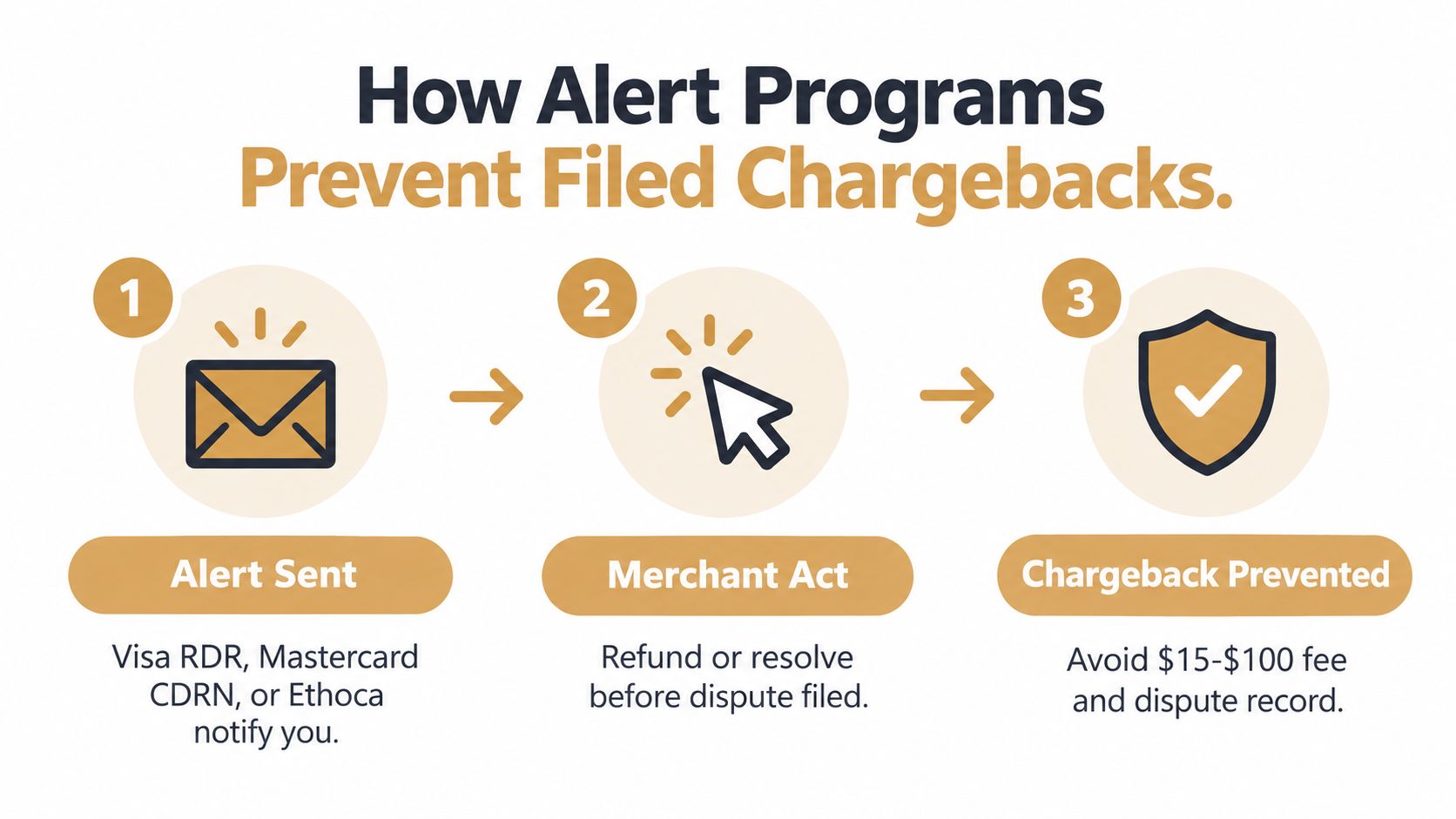
Visa RDR, Mastercard CDRN, and Ethoca can notify a merchant after a cardholder initiates a dispute but before the chargeback is formally filed. The merchant can then apply a defined action, often a refund or another resolution, while the transaction is still eligible for pre-dispute intervention. The exact timing and treatment depend on the network, provider, acquirer, and dispute type, so the merchant must confirm operational rules with its payment partners.
Put the alert path in production
Start with the payment processor and acquirer. Confirm which alert products are available, which transaction identifiers they return, how refunds must be issued, and whether a resolved alert is excluded from relevant monitoring calculations. Then connect those alerts to one operational queue instead of leaving them scattered across processor dashboards and email inboxes.
A practical setup looks like this:
- Receive the alert: Capture the transaction ID, order ID, dispute reason, customer, amount, processor, and deadline.
- Match the order: Pull the order, delivery, refund, subscription, and support records automatically where possible.
- Apply a rule: Route the alert to an automatic refund, manual review, or no-action path.
- Record the result: Store the action, timestamp, refund status, exception reason, and subsequent dispute outcome.
- Reconcile monthly: Compare alert outcomes with processor, acquirer, and network records.
The decision should be fast, but speed without rules creates unnecessary refunds. A merchant might automatically resolve a low-value delivery complaint when the order record is incomplete, while sending a high-value order with clear delivery evidence to manual review. The same framework can flag repeat first-party behavior for investigation rather than rewarding it with an automatic refund.
Prevention beats late recovery
A filed chargeback creates a formal dispute record and forces the merchant into a response process. An eligible alert gives the merchant more control over the outcome and reduces the need to assemble a representment package under time pressure. It also lets the team protect customer relationships in legitimate cases without pretending that every customer claim is valid.
The goal isn't to refund more. The goal is to resolve the right alerts before they become expensive, recorded disputes.
Building a Chargeback Management Workflow
Alerts create value only when the team knows what happens next. The workflow should assign ownership from intake through reconciliation, with no ambiguity about who can refund, who can approve exceptions, and who reviews repeated customer behavior.

A workable operating sequence
Intake starts the clock. Log each alert or filed dispute in a central queue. Capture the processor, payment identifier, order identifier, reason, amount, status, deadline, and assigned owner. If the team can't see the full case record in one place, missed deadlines and duplicate actions become likely.
Triage determines the path. Check whether the customer has already received a refund, whether the order shipped, whether delivery evidence exists, and whether support received a cancellation or complaint. Compare the dispute with the customer's transaction history, particularly for subscriptions and recurring billing.
Resolution follows the evidence. Refund when the customer is likely right or when the cost of intervention exceeds the recoverable value. Send ambiguous cases to manual review. Prepare representment when the transaction appears valid and the evidence directly addresses the dispute reason.
Reconciliation closes the loop. Match the action to processor records, confirm whether funds moved, and record the final outcome. A case shouldn't disappear when someone clicks “refund” or submits evidence.
Subscription teams need a dedicated cancellation checkpoint. Record the cancellation request, effective date, renewal date, customer communications, access status, and refund decision. A recurring charge often becomes difficult to defend because the merchant can't prove what the customer requested and when.
For a broader view of recurring-payment controls, teams can also review RecurX payment recovery tools, particularly when failed payments, customer retention, and refund handling intersect.
Documentation standard: Every decision needs a reason that another operator can understand without contacting the original reviewer.
A mature workflow also feeds root causes back into the business. Repeated “unrecognized transaction” disputes may point to a billing descriptor problem. Repeated cancellation disputes may expose a subscription flow that hides renewal terms. Repeated delivery claims may require better carrier data or customer notifications.
Deciding When to Refund and When to Fight
The assumption that every dispute should be fought is wrong. Representment makes sense when the merchant has relevant evidence and the expected recovery justifies the operational and relationship cost. A refund makes sense when the customer is right, the evidence is weak, or early resolution protects the account more effectively than a formal contest.
The classification gap is substantial. Financial institutions estimate that 70% of chargebacks are fraud-related, while merchants attribute only 45% to fraud, according to the global chargeback perspective report. The same source estimates first-party fraud at $3.9 billion globally in 2025, projects $4.8 billion by 2028, and attributes 21% of merchants' chargebacks to that category.
Those figures point to a practical conclusion: merchants need a decision framework, not a universal refund policy.
Use three response lanes
Automatic refund fits a case where the amount is modest, the customer's complaint appears credible, the order record is incomplete, or the merchant made an operational error. The rule should include safeguards for repeat abuse. Automatic resolution must never become an unlimited refund channel.
Manual review fits a high-value, ambiguous, or strategically important case. The reviewer should examine order value, customer lifetime value, prior undisputed transactions, delivery evidence, support history, subscription activity, and the likely cost of representment. A loyal customer with a legitimate service failure deserves a different response from a pattern of repeated disputes after successful delivery.
Representment fits a case where the merchant has direct evidence tied to the reason code. Delivery confirmation can support a non-receipt response. Cancellation records can address recurring billing claims. Customer communications can challenge a claim that the merchant ignored a resolution request. Evidence should answer the issuer's question, not merely provide a large document bundle.
For merchants refining customer-facing policies, this returns and refunds guide for Shopify provides useful context for making refunds clear before customers resort to their banks. Teams that need a formal evidence process can also review chargeback fighting guidance.
Track more than the chargeback count. Measure false refunds, recovered revenue, repeat abuse, manual-review volume, and downstream processor exposure. A lower dispute count can hide a policy that refunds too aggressively and gives repeat abusers a predictable path to free goods.
Monitoring Your Chargeback Health Metrics
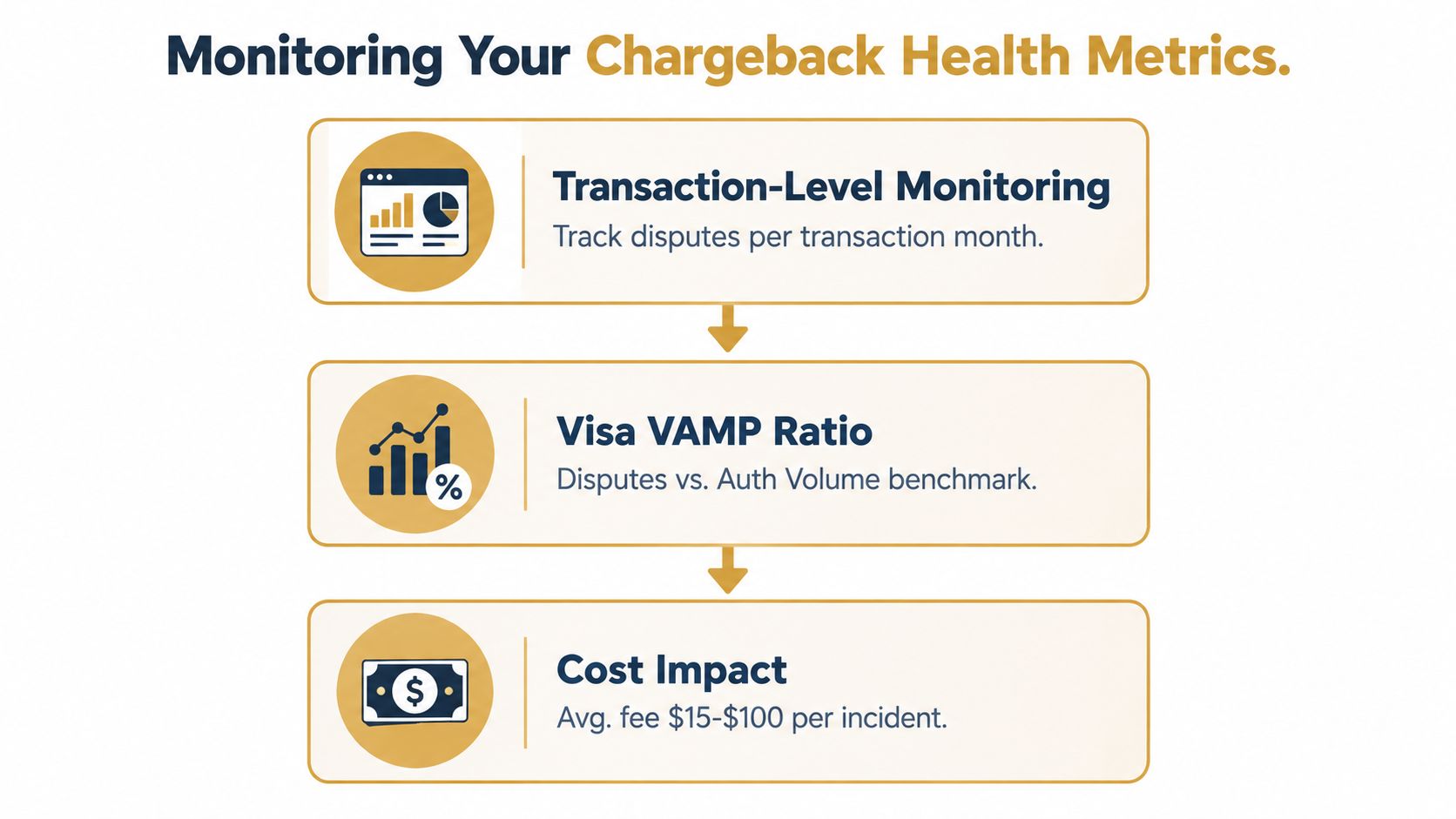
A simple internal dispute percentage isn't enough. Visa's methodology combines TC40 fraud reports and TC15 disputes, then divides the combined count by settled transactions for the same data month. Certain prevention or resolution mechanisms may be excluded, which means the merchant's internal dashboard must reflect network treatment rather than rely on a locally defined ratio.
The Visa monitoring program guidance describes a threshold structure that has used a 2.2% VAMP ratio in several major regions, with a planned reduction to 1.5% globally outside specified regional exceptions from April 2026. Eligibility can also depend on monthly count thresholds, including 1,500 combined fraud and dispute records in many regions.
Compare internal reporting with network exposure
| Measurement view | What it tells the team | What it can miss |
|---|---|---|
| Internal dispute percentage | How many recorded disputes the merchant sees | Fraud reports and network exclusions |
| TC15 and TC40 by transaction month | How disputes and fraud reports contribute to monitoring | Processor mapping errors |
| Settled transactions | The denominator used in network calculations | Timing differences between systems |
| Alert resolutions and exceptions | Which cases may avoid formal dispute treatment | Whether the network accepts the treatment |
| Cost per outcome | Financial effect of refunds, losses, fees, and labor | Account-level monitoring consequences |
Maintain separate fields for TC15, TC40, settled transactions, alert resolutions, exceptions, processor references, and network month. Reconcile those fields monthly against the acquirer and processor. Don't assume the dashboard's reporting month matches the network's data month.
Rapid alert handling matters because a prevented dispute can affect both the numerator and the applicable exception treatment. The merchant still needs confirmation from its acquirer because definitions and effective dates vary by region.
Teams that need to understand escalation risk can use this high-chargeback-rate resource as a reference point, then validate thresholds against their own processor and network documentation.
Implementing Automated Chargeback Management
Manual processing works until the queue becomes unpredictable. Then the business starts making inconsistent decisions, missing evidence, overlooking alerts, and measuring only the number of cases that reached the dispute dashboard. Automation should remove repetitive handling while leaving economic judgment with the merchant.
A sound implementation connects four layers:
- Alert intake: Pull RDR, CDRN, Ethoca, processor, and acquirer events into one queue.
- Decision rules: Route cases by reason, order value, customer history, evidence quality, and business model.
- Evidence operations: Gather order, fulfillment, delivery, subscription, refund, and communication records for cases that need review.
- Measurement: Report prevention, refunds, representment, recoveries, repeat abuse, and network exposure separately.
Disputely is one example of this model. It connects with payment processors such as Stripe, PayPal, and Shopify Payments, receives pre-dispute alerts from Visa RDR, Mastercard CDRN, and Ethoca, and applies automated refund or review rules before eligible alerts become formal chargebacks. Merchants evaluating broader operational automation can also explore finance automation with AI for adjacent reconciliation and workflow use cases.
Build the rollout in controlled stages
First, document the current path from alert to final outcome. Identify every manual handoff, spreadsheet, inbox, and processor dashboard. Then define the three response lanes and create an exception process for high-value orders, recurring billing, repeat disputes, and unclear evidence.
Next, test automation against historical cases without allowing it to issue refunds. Compare the proposed decision with the actual outcome, then adjust rules for false refunds, missed intervention opportunities, and cases the team would have won through representment. After that, activate automatic handling for narrow, well-understood categories before expanding coverage.
Automation won't rescue poor policy. It will apply poor policy faster. Keep human approval for ambiguous cases and review rules whenever products, fulfillment methods, subscription terms, processors, or customer-support policies change.
For Shopify merchants, the implementation should also account for platform-specific order, refund, and customer records. A focused Shopify chargeback protection workflow can help teams think through that integration without reducing the broader operation to a single plugin.
Measure the system by avoided filed disputes, appropriate refunds, net recovered revenue, repeat-abuse detection, response consistency, and monitoring exposure. The right result isn't the highest representment rate or the lowest refund count. It's a payment operation that resolves legitimate problems quickly, challenges unsupported claims with evidence, and gives the processor fewer reasons to question the account.
Disputely helps merchants intercept payment disputes through Visa RDR, Mastercard CDRN, and Ethoca alerts, then apply refund or review rules before eligible chargebacks are filed. If your team is managing high transaction volume, recurring billing, or growing dispute pressure, visit Disputely to evaluate a more controlled prevention workflow.


