
Escalation Procedures for Chargeback Alerts
At 2 a.m., an Ethoca alert lands for a $280 order. The issuer has given your team a narrow window to refund the customer before the transaction becomes a formal chargeback. The analyst on call has two bad options: refund immediately and sacrifice margin, or wait for more evidence and risk letting the dispute enter the account.
That moment exposes the weakness in most escalation procedures. A shared inbox, a generic priority label, and a “send to payments” rule don't tell anyone whether to refund, investigate, or fight. The right system treats every alert as a time-bound decision, shaped by the alert network, reason code, transaction value, customer history, and evidence available before the clock expires.
Without that structure, staff spend hours rechecking the same orders, customer-facing teams make inconsistent promises, and valuable representment opportunities disappear. A rising dispute burden can also create the conditions described in this guide to high chargeback rate management. The practical answer isn't more manual review. It's a refund-or-fight engine with clear triggers, named owners, processor actions, and measurable response standards.
Why Chargeback Alerts Need an Escalation Playbook
The 2 a.m. alert is rarely difficult because the team lacks intelligence. It's difficult because the team lacks a decision rule. The order may have a delivery scan, a device match, prior successful purchases, and a customer message claiming the card wasn't used. Each fact points in a different direction, while the alert clock keeps moving.
An ad-hoc workflow usually produces one of two outcomes. The cautious analyst refunds almost everything, including disputes the business could have defended. The overloaded analyst leaves alerts in a queue until the pre-dispute opportunity disappears. Both behaviors are understandable, and both are expensive. One bleeds gross margin through unnecessary refunds. The other turns preventable alerts into chargebacks that affect dispute operations and customer-service workload.
Practical rule: An alert should never enter a queue without a deadline, an owner, and a prescribed next action.
A useful escalation playbook turns the alert into a controlled sequence:
- Identify the source. Visa RDR, Mastercard CDRN, Ethoca, Verifi, and internal risk signals don't represent the same operational event.
- Start the clock. The remaining issuer or network window determines urgency more reliably than a subjective label such as “high priority.”
- Enrich the case. Pull order fulfillment, customer history, authentication records, device information, and prior dispute outcomes.
- Choose the action. Refund, request evidence, escalate for approval, or prepare a formal chargeback response.
- Record the reason. Every decision should create a usable audit trail for later analysis.
The distinction matters especially in payments because the objective isn't merely to route work to a senior employee. The objective is to prevent a chargeback when a refund is economically and operationally sensible, while preserving representment for cases where the evidence justifies a fight.
Mastercard notes that dispute deadlines are typically 20 to 45 days after merchant notification, while pre-dispute alerts may arrive only 24 to 72 hours before a formal chargeback. Those windows make escalation procedures a timing discipline, not just a ticket-management practice. A team that measures only final chargebacks learns about failure after the decision opportunity has already closed.
Building Blocks of a Dispute Escalation System
A durable system has four building blocks: triggers, severity, ownership, and SLAs. The important design choice is to connect each block to a real alert source and a processor action. Abstract policies sound orderly, but analysts need to know exactly what opens a case, who acts next, and what happens if nobody responds.
Triggers must create complete cases
A trigger should include more than an alert ID. It should capture the source, network, reason code, transaction details, deadline, customer identity, fulfillment status, and available authentication evidence.
Relevant triggers include:
- Visa RDR alerts: Treat the incoming event as a pre-dispute refund opportunity and preserve the network deadline in the case.
- Mastercard CDRN alerts: Capture the issuer-provided dispute context and map it to the merchant's transaction record.
- Ethoca alerts: Record the alert type, receipt time, and remaining response window before deciding whether an automated refund is appropriate.
- Verifi alerts: Separate the alert from a formal chargeback and route it through the merchant's prevention policy.
- Internal risk flags: Open an escalation when velocity, device reuse, customer behavior, or fulfillment anomalies increase the likelihood of a later dispute.
Severity should follow the clock
A P1 case is one with little time left or unusually high financial or ratio exposure. A P2 case has enough time for ordinary evidence review. A P3 case can wait for the next business-day queue because the value or risk doesn't justify immediate intervention.
The exact tier definitions should be configured against the alert network's stated window. For example, a team might set P1 to a 30-minute review SLA, P2 to four hours, and P3 to the next business day, provided those targets fit the actual source deadline. The key is consistency. A low-dollar case can become critical if it sits untouched close to expiry.
Ownership needs a human name
The on-call rotation owns first acknowledgment. A payments lead or designated approver handles refunds above the team's internal threshold. A dispute analyst owns the evidence pack, and a support owner handles customer communication. Avoid labels such as “operations” or “finance” without a person or rotation behind them.
| Building Block | Definition | Alert Source Example | Output |
|---|---|---|---|
| Trigger | Event that opens a case | Ethoca alert received by webhook | Case with source, order, reason, and deadline |
| Severity | Priority based on remaining time and exposure | Visa RDR nearing expiry | P1, P2, or P3 assignment |
| Ownership | Named person or rotation responsible for action | CDRN assigned to dispute analyst | Acknowledgment and decision owner |
| SLA | Maximum time before the next action | P1 review target | Refund, evidence escalation, or response task |
Use the SLA as a control, not a suggestion. Incident.io's discussion of escalation metrics also highlights TTFA, escalation frequency, false escalation rate, and team satisfaction as useful process measures, with a practical benchmark of TTFA under 5 minutes for most production services and a false escalation rate under 5%. Those measures translate well to payment operations because they reveal whether the workflow is fast, precise, and usable.
Designing Refund vs Fight Decision Trees
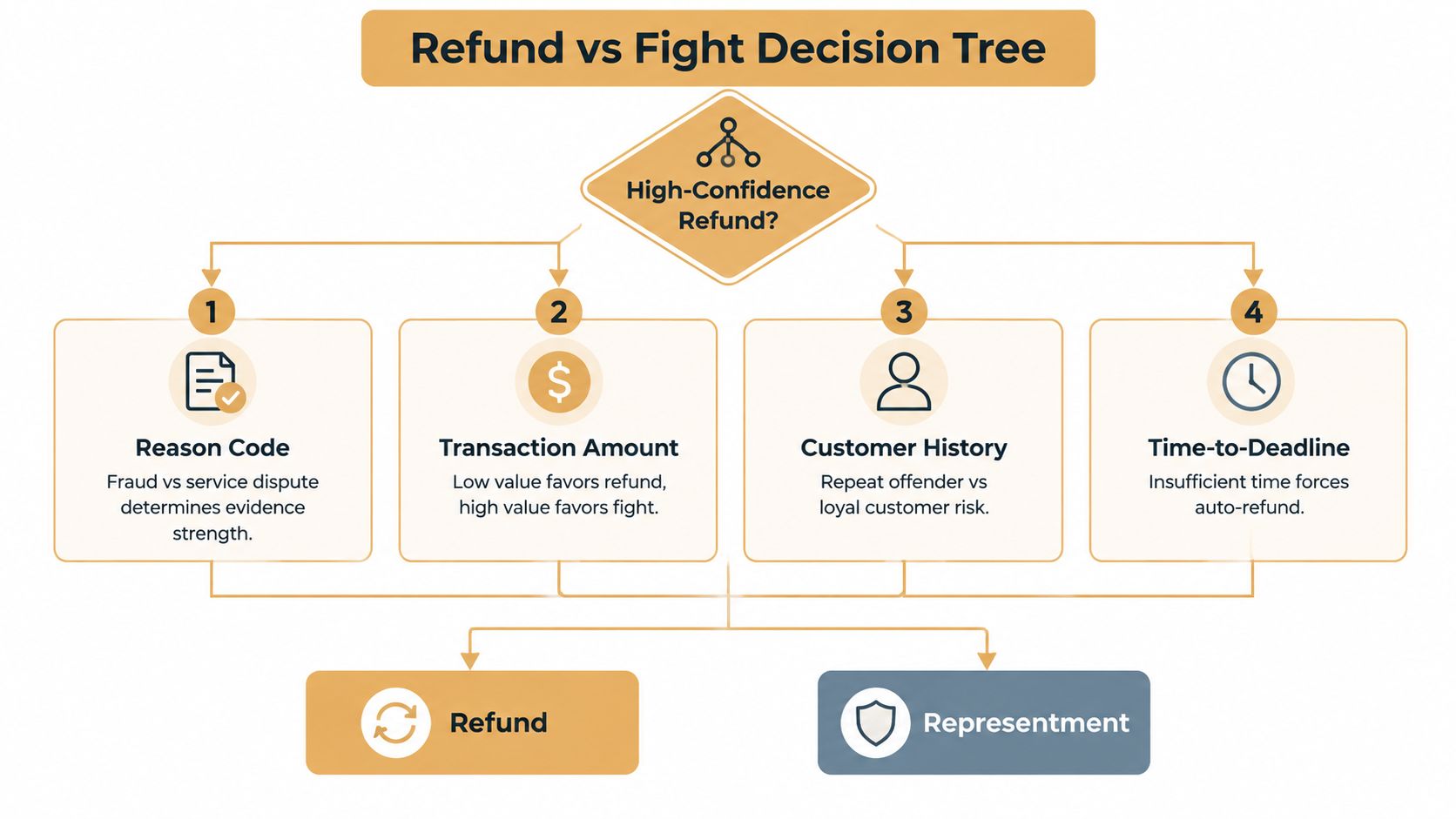
A refund-versus-fight tree should make the first decision quickly, then add evidence only where it can change the outcome. Don't ask an analyst to review every field before deciding whether the case is an obvious refund or an obvious representment candidate.
Start with the confidence branch:
- Is the dispute a high-confidence refund? If the reason code indicates no cardholder authorization, the cardholder doesn't recognize the transaction, or the digital-goods order is being challenged by the actual issuer-side customer, route to immediate refund review.
- Has the formal chargeback already been filed? If yes, stop treating the case as a pre-dispute refund opportunity and route it to the chargeback-response workflow.
- Is the transaction a confirmed fraud event, duplicate charge, or already-refunded order? Route those dead ends to fraud operations, billing correction, or formal response handling rather than issuing another prevention refund.
- How much time remains? If the alert is close to expiry, the remaining clock can override a marginal evidence advantage.
The reason-code branch deserves special care. Codes such as 4837, no cardholder authorization, and 4863, cardholder does not recognize, often require a conservative posture when the merchant can't produce strong transaction and customer evidence. For digital goods, a mismatch between the purchaser and the issuer-side customer can make the refund decision more compelling because delivery proof may not answer the authorization question.
Use value and history as controls
Transaction value shouldn't operate alone. Combine it with customer history and fulfillment status:
- Under $25: Default to refund when the alert is eligible for pre-dispute resolution and no fraud or duplicate-charge exception applies.
- $25 to $100: Refund when the customer is a single-purchase account or the order hasn't shipped. Escalate when fulfillment and identity evidence are strong.
- Above $100: Require evidence review. Fight when the case has at least three independent confirmations, such as successful authentication, delivery confirmation, and a consistent device or customer history.
These are operating rules, not network mandates. They need periodic review against false-refund results, customer experience, and representment outcomes. Before publishing customer-facing language, teams should also check the refunds section so internal refund decisions align with the merchant's stated policy.
Time can flip the branch. With under 12 hours left, an automated or approved refund may be preferable even when the evidence is promising, because the team may no longer have enough time to preserve the alert-network benefit. When the alert has already crossed into a formal dispute, use the evidence tree for representment instead. A practical review of Q4 representment workflows can help teams separate prevention decisions from post-chargeback response.
Connecting Alert Networks to Your Processor Stack
The cleanest architecture has three layers: alert intake, case enrichment, and processor action. Alert networks send events through their own channels and payload structures. Your internal system should normalize those differences before an analyst or automation rule makes a decision.
The intake layer receives Visa RDR, Mastercard CDRN, Ethoca, and other network alerts. Store the raw payload, receipt timestamp, network deadline, alert category, and transaction identifier. Never rely on a human to copy the deadline from an email into a ticket. That small manual step creates avoidable timing errors.
The enrichment layer resolves the transaction against the processor and commerce platform. Pull the order total, customer history, fulfillment events, delivery evidence, authentication results, billing descriptors, device signals, and previous refund or dispute records. The case should present one evidence view, not force the analyst to switch between Stripe, PayPal, Shopify, an acquiring dashboard, and a support system.
Map the action back to the processor
The action layer sends the selected outcome to the right processor endpoint. A pre-dispute refund API can close the opportunity without waiting for a formal chargeback, while a representment route must preserve evidence and follow the processor's dispute-submission process. Shopify Payments and Stripe require different event handling, and Authorize.net often requires transaction-level lookup and action confirmation rather than a single standardized dispute object.
| Alert Source | Stripe | PayPal | Shopify Payments | Authorize.net |
|---|---|---|---|---|
| Visa RDR | Match alert to payment intent, then issue approved refund action | Match to merchant transaction and refund through the relevant account workflow | Resolve against Shopify Payments order and refund record | Retrieve transaction details, verify eligibility, and record the action |
| Mastercard CDRN | Normalize alert data against charge or payment intent | Match notification to the PayPal transaction | Match order, payment, and customer context | Match notification to transaction detail |
| Ethoca | Enrich with order and dispute history before refund decision | Enrich merchant-side transaction record | Enrich order, fulfillment, and customer history | Enrich transaction and fulfillment evidence |
Stripe's dispute.created event belongs in the formal-dispute branch, not the pre-dispute alert branch. PayPal's cm.notifications, Shopify Payments webhooks, and Authorize.net transaction details should likewise be mapped to distinct states so the same transaction can't receive conflicting refund instructions.
An orchestration layer can normalize payloads, apply the decision tree, request approval where required, and write the processor response back to the case. That architecture is closer to the responsibilities described in a payment systems engineer job than to a simple support integration. The integration should also preserve idempotency, so a retried webhook doesn't create a second refund attempt.
For Shopify merchants, the practical objective is to connect alert handling to order status, fulfillment, and customer records rather than treating chargebacks as isolated payment objects. A focused Shopify chargeback protection workflow can be useful when documenting those dependencies.
Templates, Filters, and Runbooks You Can Steal
A good escalation procedure should be executable from a ticket. The analyst shouldn't need to invent a customer email, search for an evidence checklist, or decide from scratch whether a device pattern deserves a block.
Refund confirmation email
Use language that confirms the action without admitting facts your team hasn't established:
Subject: Your payment has been refunded
Hi [Customer name],
We've processed a refund for order [order number] in response to your payment concern. The refund was submitted to the original payment method. Please keep this message for your records, and reply to this email if you still need help with the order.
Regards, [Merchant support team]
The message should be sent only after the processor confirms the refund request. If the order is still in fulfillment, the runbook should separately tell operations whether to stop shipment or cancel access.
Representment evidence request
Ask for evidence by reason code, not by copying the same request into every case:
Case: [Alert or dispute ID]
Reason code: [Code and description]
Deadline: [Network or processor deadline]
Required evidence: [Authentication, delivery, usage, customer communication, refund history]
Transaction context: [Order value, product, customer history, fulfillment state]
Owner: [Analyst]
Decision requested: Refund, fight, or senior approval
Submission status: [Not started, drafting, submitted, accepted, rejected]
Filter rules need a safe middle
A blacklist should reject patterns that are already strongly associated with confirmed fraud or refund abuse, while sending ambiguous high-value cases to review. Useful dimensions include:
- Velocity: Flag repeated payment attempts, rapid account creation, or repeated disputes tied to the same identity signals.
- BIN: Review unusual concentration by issuing range or geography, but don't block a BIN solely because one customer disputed.
- Device: Escalate device reuse across unrelated accounts, especially when fulfillment and identity signals conflict.
- Email domain: Review disposable or repeatedly disputed domains, but avoid broad blocks that catch legitimate corporate or shared addresses.
Three runbook entries
Visa RDR fraud alert on a first-time buyer
- Trigger: Visa RDR fraud alert.
- Owner: Payments on-call analyst.
- SLA: Immediate review under the P1 policy.
- Decision: Refund when authorization evidence is weak or the customer cannot be verified before expiry. Escalate when strong authentication and fulfillment evidence support a fight.
- Processor action: Submit the approved refund through the connected processor, then close the alert only after confirmation.
Ethoca service-not-received alert on a repeat customer
- Trigger: Ethoca service-not-received alert.
- Owner: Customer operations with payments oversight.
- SLA: Review against the alert deadline.
- Decision: Check fulfillment, delivery, prior support contacts, and customer history. Refund when the service failed or delivery is unresolved. Fight when delivery or service-use evidence is complete.
- Processor action: Refund eligible cases, or attach the evidence request to the formal response path.
CDRN friendly-fraud alert on a high-AOV order
- Trigger: Mastercard CDRN friendly-fraud alert.
- Owner: Senior dispute analyst.
- SLA: High-priority evidence review.
- Decision: Require independent confirmations before fighting. Escalate edge cases for approval rather than applying an automatic refund.
- Processor action: Preserve the evidence pack, then submit representment if the case moves into formal dispute handling.
The same fields work in Zendesk, Freshdesk, or Notion. Keep the runbook versioned, and record why an analyst overrode automation. That override data is what improves the next decision tree.
KPIs That Predict Ratio Health
Raw chargeback count is a lagging measure. By the time the count rises, the underlying workflow may already be missing alerts, refunding the wrong cases, or losing evidence quality. A better dashboard connects response speed and decision accuracy to monitoring-program exposure.
The first measure is time-to-first-action, or TTFA. Track the interval from alert receipt to acknowledgment, then separately track the interval from acknowledgment to refund, evidence request, or escalation. The escalation-metrics guidance from incident.io recommends TTFA under 5 minutes for most production services and a false escalation rate under 5%. Payment teams should adapt the metric to their own alert windows rather than treating the benchmark as a network rule.
For urgent payment alerts, the operating target may be stricter. A high-value alert with under 12 hours remaining should receive action quickly enough to leave room for approval and processor confirmation. That is a workflow choice based on the deadline branch, not a universal network requirement.
Four measures worth reviewing
- TTFA by alert source: Calculate receipt timestamp to first human or automated action for Visa RDR, CDRN, Ethoca, and other sources.
- False-refund rate by reason code: Divide refunds later judged unnecessary by total prevention refunds in the same reason-code group. The practical benchmark for false escalation is under 5%, as described by incident.io.
- Representment win rate by network: Divide won representments by submitted representments, then segment by network, reason code, product category, and evidence type.
- Monitoring-program exposure: Track current ratio position and a 90-day projected ratio against the relevant Visa and Mastercard monitoring thresholds. Keep the projection tied to actual case data, not a generic industry estimate.
Customer-support escalation guidance recommends keeping routine escalations below 10% of total case volume, while rates above 15% indicate a need for process intervention. It also recommends reviewing resolution time by escalation level, CSAT, SLA breach rate, and root-cause resolution. Those measures help identify whether frontline teams lack authority or whether knowledge routing is failing.
| KPI | What It Measures | Target Benchmark |
|---|---|---|
| TTFA | Speed from alert receipt to first action | Under 5 minutes for most production-service escalation contexts, per incident.io's escalation metrics guidance |
| False escalation or false-refund rate | Precision of routing and refund decisions | Under 5%, where the benchmark is applied |
| Routine escalation rate | Volume sent beyond frontline handling | Below 10% of cases, with intervention above 15%, per customer escalation guidance |
| Monitoring exposure | Current and projected ratio risk | Stay below applicable program thresholds |
Review these metrics by source. A healthy blended rate can conceal a failing Ethoca queue or a slow CDRN handoff.
Rolling Out Your Playbook in 90 Days
A rollout should produce working controls, not just a policy document. Organize the work around instrumentation, controlled automation, and measured routing.
Days 1 to 30
Instrument every alert source and preserve the original receipt time. Baseline TTFA, refund rate, escalation rate, formal-dispute volume, and the reason codes driving decisions. Draft the refund-versus-fight tree in a shared document, then assign an owner and backup for each alert type.
Don't automate before the team can explain the current process. During this phase, review a representative set of closed alerts manually and identify where analysts lack order, fulfillment, customer, or processor data.
Days 31 to 60
Connect the relevant Stripe, PayPal, Shopify Payments, or Authorize.net events to the runbook. Normalize alert payloads, test duplicate-event handling, and require processor confirmation before closing a case. Enable automated refunds only for rules the team has already validated, such as clearly defined low-value or high-confidence branches.
Run controlled tests for RDR and CDRN receipt latency. Test the failure path too. If a webhook fails, the on-call rotation needs a visible fallback queue and a deadline-based escalation.
Days 61 to 90
Turn on full decision-tree routing, then monitor false-refund rate by reason code and alert source. Run a chargeback simulation using old cases, including one where the evidence is strong but the remaining window is short. Retire ad-hoc tickets only after the new system creates an auditable decision and a confirmed processor action.
Common rollout failures include:
- Over-refunding low-velocity products: A broad rule may protect ratios while consuming margin.
- Ignoring reason-code evidence needs: A delivery record won't answer every authorization question.
- Letting alerts sit in a shared inbox: A team can miss the 24-to-72-hour pre-dispute window described by Mastercard's dispute guidance even when everyone believes the queue is monitored.
- Using stale evidence packs: Old fulfillment and customer records produce weak decisions.
- Skipping post-decision review: Without feedback, automation repeats the same false positives.
Treat the playbook as a living operational control. Mastercard describes Ethoca Alerts as a way for merchants and issuers to share dispute data and deflect chargebacks before formal creation. That makes the decision layer especially important. The winning design isn't “refund every alert.” It's “act before expiry, refund where the economics and evidence support it, and preserve strong cases for representment.”
Disputely connects Visa RDR, Mastercard CDRN, and Ethoca alerts to your Stripe, PayPal, Shopify Payments, or Authorize.net workflow, then applies refund rules before preventable disputes become formal chargebacks. Visit Disputely to see how a deadline-aware escalation procedure can centralize alert intake, automate approved actions, and keep your payments team focused on the cases that need judgment.


