
Ethoca Alerts Explained How to Stop Chargebacks Fast

A customer emails support at 9:12 a.m. saying they don't recognize a charge. By lunch, your team still hasn't matched the order. By tomorrow, the issuer may turn that confusion into a formal chargeback.
That's the moment Ethoca Alerts matters.
For merchants with steady order volume, disputes rarely arrive at a convenient time. They show up during fulfillment peaks, after support handoffs, or when your payments team is already watching processor risk and rising dispute pressure. Once a chargeback is filed, your options narrow fast. Before it's filed, you still have room to make a decision.
Introduction Why Ethoca Alerts Matter Right Now
If you're running ecommerce, subscriptions, or any business with repeat card billing, you've probably felt this squeeze already. A customer disputes before your team can correct a billing issue. A fraud claim lands before you can stop shipment. A processor starts asking questions because too many disputes are reaching the formal chargeback stage.
Ethoca Alerts gives merchants a short, valuable head start. Mastercard describes it as a near real-time system that shares issuer-confirmed fraud and dispute information before a formal chargeback is filed, so merchants can act first. Mastercard says the network has helped prevent more than 110 million chargebacks since 2011, including more than 39 million in 2025 alone, and prevented $1 billion in fraud in 2025 on the Mastercard Ethoca Alerts overview.
That scale matters, but the more practical question is simpler. What do you do when an alert arrives?
Many merchants treat alerts like an automatic refund trigger. That sounds safe, but it can get expensive. If your team is good at representment, or if certain disputes are weak and likely winnable, refunding everything can protect your chargeback ratio while draining margin.
Practical rule: An alert is not the same as a loss. It's a chance to choose the least costly path before the dispute hardens into a chargeback.
The merchants who get the most value from Ethoca Alerts usually aren't the ones who refund blindly. They're the ones who use alerts as a decision layer. They decide which transactions should be refunded immediately, which ones should be stopped before settlement, and which ones are strong enough to let proceed to a fight.
That's especially important for high-volume teams. When alert volume rises, the job isn't reacting fast alone. It's reacting fast and correctly.
What Ethoca Alerts Are and How They Prevent Chargebacks
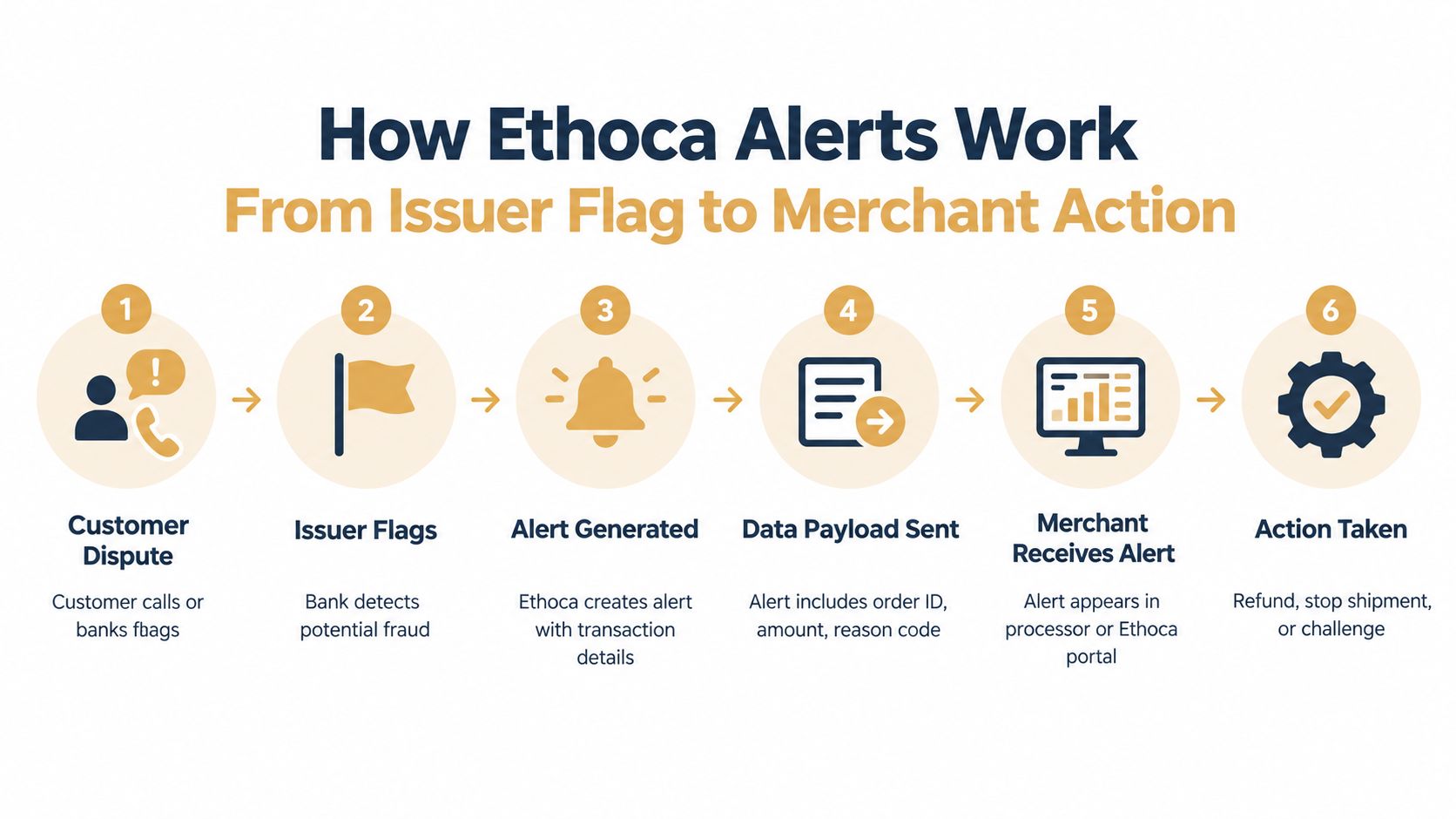
Think of Ethoca Alerts as an early-warning radar between the issuing bank and the merchant. The customer raises a problem with their bank. Before that issue becomes a formal chargeback, the network sends a signal so the merchant can act.
Mastercard's developer and product materials describe Ethoca Alerts as a near real-time pre-chargeback alert network that shares issuer-confirmed fraud and dispute information before filing. The point isn't to help after the damage is done. The point is to create a short window where the merchant can still change the outcome.
Alert first, chargeback second
Many teams get confused. An alert is not a chargeback notice. It's a warning that a dispute has reached the issuer side and may become a chargeback if you don't respond in time.
That timing changes your options:
- Refund early: You may be able to stop the dispute before it posts as a formal chargeback.
- Stop settlement or fulfillment: If the transaction or shipment is still in motion, operations may have time to intervene.
- Prepare to fight: Some cases still make sense to defend through chargeback fighting workflows, especially if your evidence is strong and the dispute looks weak.
Why the timing matters
Once a chargeback is filed, you're in a reactive process. Fees, ratio impact, processor scrutiny, and evidence deadlines start stacking up. Before filing, you still control the first move.
Ethoca's own merchant-facing materials also show the network's scale in a historical period. From April 1, 2020 to March 31, 2021, participating merchants collectively stopped more than $326 million in fraud and prevented more than 10.6 million chargebacks worldwide. In that same period, Ethoca reported that merchants stopped 7.1 million fraud incidents, equal to roughly 591,600 cases per month, according to the Mastercard Europe Ethoca Alerts page.
That doesn't mean every alert deserves the same response. It means the network can move information quickly enough for merchants to make a prevention decision instead of waiting for a dispute to become formal.
The best mental model is simple. Chargebacks are the fire. Ethoca Alerts is the smoke alarm.
How Ethoca Alerts Work From Issuer Flag to Merchant Action
The workflow matters because speed alone won't save you if your operations can't connect the alert to the right order, payment, or customer record.
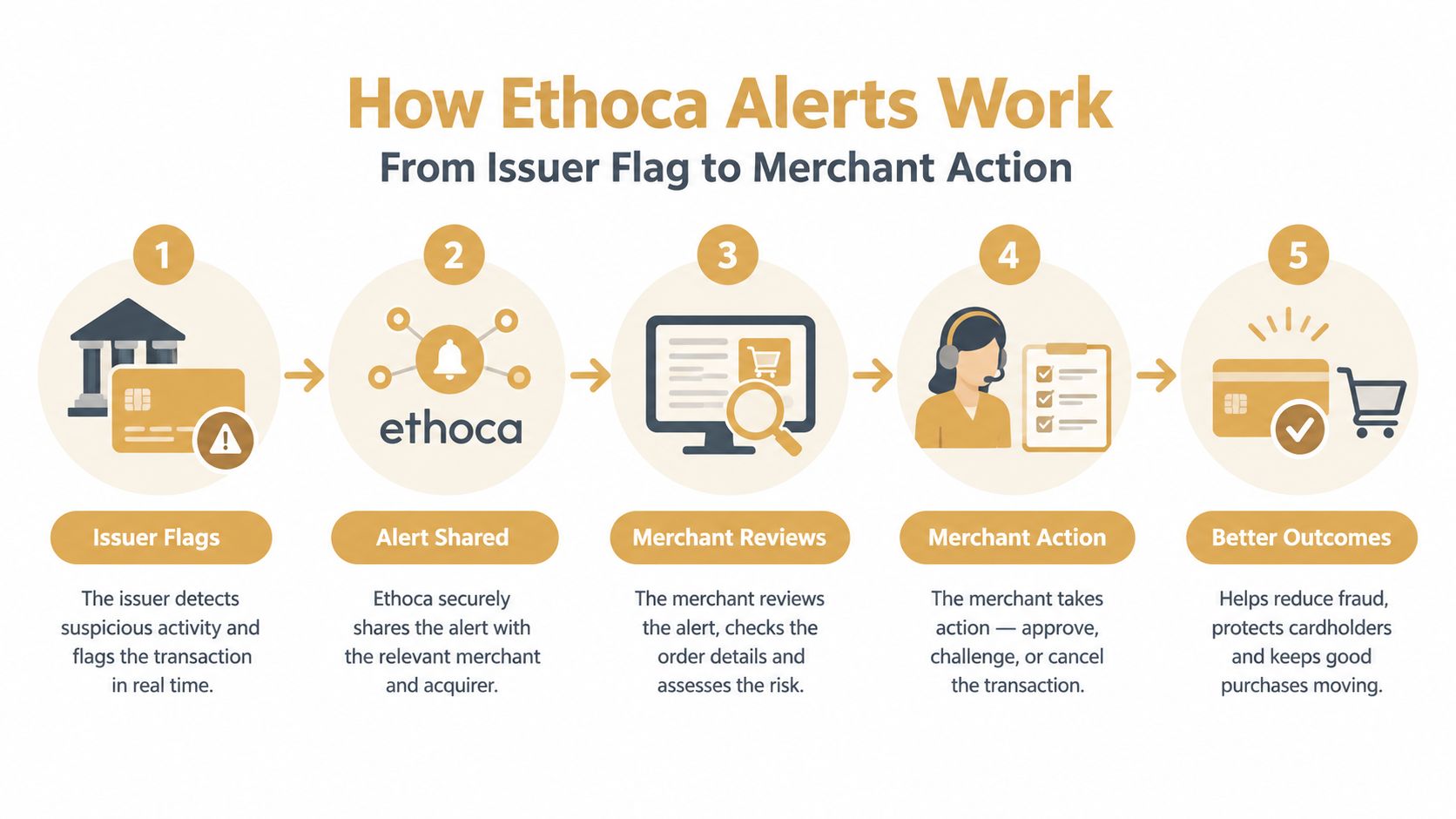
At a high level, the lifecycle starts when an issuer identifies a disputed or suspicious transaction and sends that information into the network. Ethoca then passes the alert to the merchant or the merchant's provider. From there, the merchant has to decide what happened and report back.
What arrives in the alert
The useful part of an alert is the transaction detail. Your team needs enough information to match the alert to the original sale, then decide whether to refund, stop settlement, or take no pre-chargeback action.
That matching step is where operations often break. If your order system, processor data, and subscription records don't line up cleanly, your team wastes the response window just trying to identify the transaction.
The three integration surfaces
Mastercard's merchant documentation describes Push, Pull, and Outcome as the three main integration surfaces in Ethoca Alerts, and says merchants can submit outcomes back to the network with up to 25 outcomes in a single POST request in the Ethoca Alerts for Merchants developer documentation.
Here's what that means in plain language:
- Push means Ethoca sends alert data to you.
- Pull means your system retrieves alerts from the network.
- Outcome means you send back what you did with the alert.
Those outcomes matter operationally. The merchant has to map each alert to the original transaction and return a status such as REFUNDED or NOT_SETTLED quickly enough to influence whether the issuer proceeds with a chargeback.
A short explainer helps if your team wants to see the flow visually:
Where merchants lose time
Most delays happen in three places:
- Transaction matching: The alert arrives, but the order ID or processor reference isn't easy to locate.
- Decision ownership: Support, fraud, finance, and fulfillment each assume someone else will act.
- Outcome submission: The refund may be issued, but the network isn't updated fast enough.
If you can't tie the alert to a single transaction owner within minutes, your response window will feel much shorter than it really is.
The technical takeaway is straightforward. Ethoca Alerts doesn't just require alert receipt. It requires a usable workflow from incoming issuer signal to merchant decision to confirmed outcome.
Ethoca Alerts vs Visa RDR and Mastercard CDRN Compared
Merchants often ask the wrong question. They ask, “Should I use Ethoca?” when the better question is, “Which rail covers which disputes, and where are the gaps?”
Ethoca is one prevention rail. It is not the whole map.
Industry and vendor documentation consistently indicate that Ethoca coverage is materially stronger for Mastercard than for Visa. One documented benchmark says Ethoca covers roughly 95% of Mastercard-related disputes and about 40% of Visa-related disputes, as noted in the ChargebackStop Ethoca Alerts coverage guide. That asymmetry is the practical reason merchants pair Ethoca with other rails instead of treating it as a universal answer.
Chargeback Prevention Rails at a Glance
| Prevention Rail | Primary Network | How It Prevents Chargebacks |
|---|---|---|
| Ethoca Alerts | Mastercard-led network | Sends a near real-time alert before formal filing so the merchant can refund, stop settlement, or take another action |
| Visa RDR | Visa | Resolves eligible disputes through rule-based automation on the Visa side |
| Mastercard CDRN | Mastercard | Provides pre-dispute visibility and lets merchants act before some disputes become formal chargebacks |
How they differ in practice
Ethoca Alerts works well when you need speed and you have meaningful Mastercard exposure. It's especially useful when your team wants a fast refund-or-review layer rather than a fully hands-off process.
Visa RDR is a different model. Instead of waiting for a human to inspect every case, merchants define rule logic in advance. That makes it useful when you want automation on the Visa side.
Mastercard CDRN belongs in the broader pre-dispute stack for merchants trying to reduce incoming Mastercard disputes through additional network coverage and workflow options.
Why one rail isn't enough
Another market-coverage question often gets buried in product FAQs: how much of your total alert opportunity comes from one network versus another? A recent dataset-focused analysis referenced by Mastercard reported that Ethoca generated 42.1% of alerts versus 57.9% for Visa-side alerts, which is a strong reminder that merchants usually need multi-network coverage rather than assuming Ethoca alone is enough, as discussed in Mastercard's analysis of how Ethoca helps prevent first-party fraud and reduce chargebacks.
That doesn't weaken the case for Ethoca. It sharpens it. Use Ethoca where it's strongest, especially for Mastercard-heavy volume, and don't expect it to catch disputes that live outside its practical coverage.
Connecting Your Processor and Mapping Alerts to Refund Rules
The operational goal isn't just “receive alerts.” It's “receive alerts and turn them into consistent actions.”
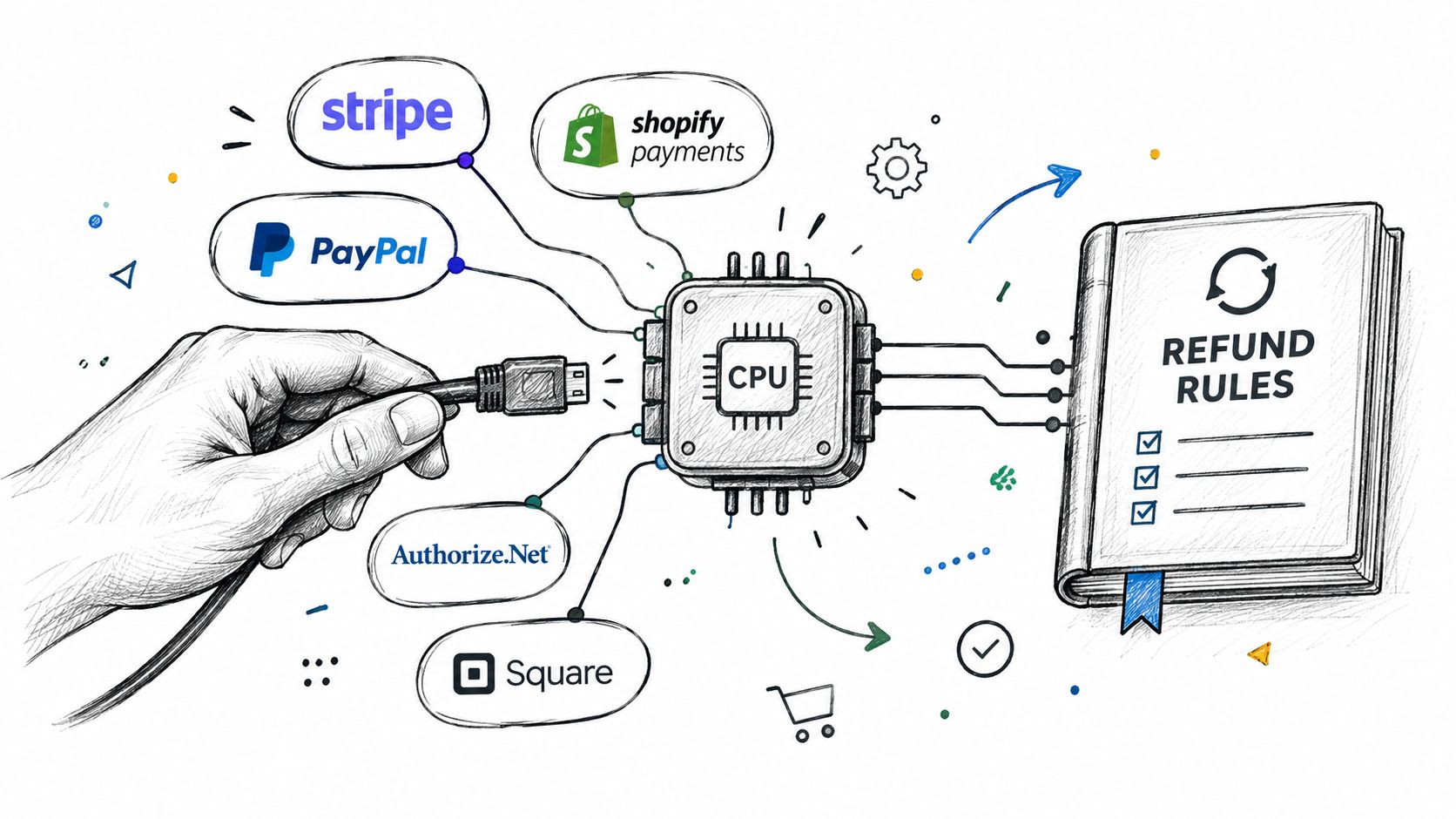
That usually starts with the processor. Merchants commonly need alert handling tied directly to payment and commerce systems such as Stripe, PayPal, Shopify Payments, Authorize.net, or Square. When that connection is in place, your team can match alerts to transactions, issue refunds, and update outcomes without bouncing across several dashboards.
Build rules around business logic
A good setup doesn't refund everything. It applies rules.
For example, a subscription merchant might auto-refund first-billing disputes from recent signups, but route renewal disputes from long-term customers to review. A physical-goods seller might refund an unshipped order immediately, but escalate a delivered high-ticket order with clear proof of receipt.
Useful rule categories often include:
- Order state: Unfulfilled, partially fulfilled, shipped, or delivered
- Customer history: First-time buyer, repeat buyer, recent canceller, prior disputes
- Product type: Subscription, digital access, physical goods, pre-order
- Internal evidence strength: Clear login data, shipment confirmation, cancellation logs, support history
Filtering matters more than merchants expect
Public discussion around alerts often treats them like automatic wins. The harder question is whether they save money for merchants that already have strong representment processes.
Ethoca's own FAQ says merchants should refund or stop settlement within about 24 hours, and neutral coverage also notes that alerts can be costly on a per-alert basis and shouldn't be used on disputes you'd likely win anyway. That gap is why selective filtering matters so much, especially for subscription, DTC, and high-volume merchants, as explained in this analysis of Ethoca alert ROI and filtering decisions.
One platform that focuses on this workflow is Shopify chargeback protection through Disputely, which connects alerts to payment and commerce workflows, applies refund rules, and supports exception review instead of treating every alert the same way.
Best Practices for Responding Within the 24 to 72 Hour Window
The response window sounds generous until you lose half of it to internal confusion.
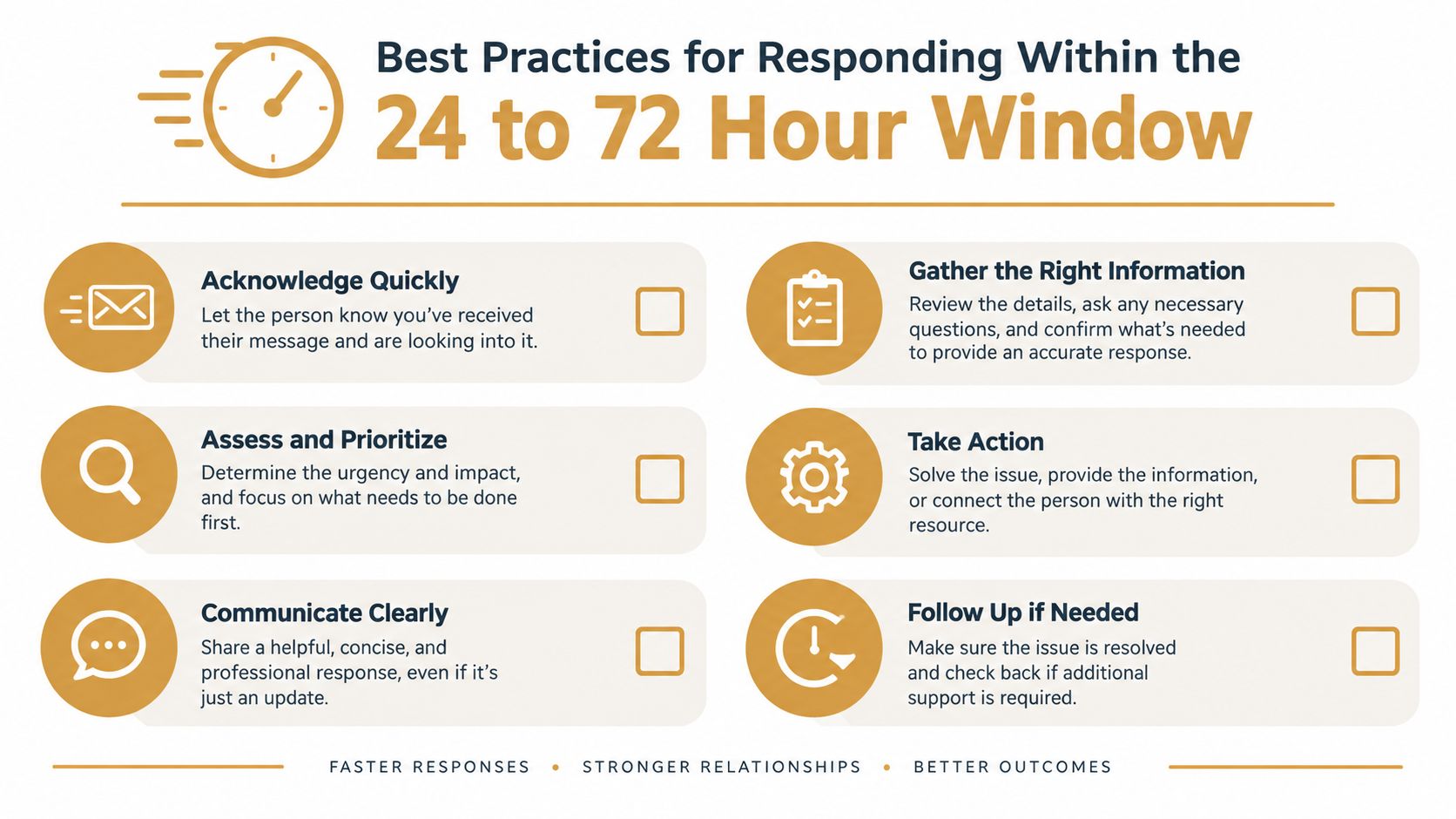
In practice, merchants need a fast triage model. Some alerts should trigger immediate refunds. Others deserve a short review because the underlying dispute looks weak, the customer has a known pattern, or your evidence is unusually strong.
Start with triage, not panic
A useful first pass is to sort alerts into three buckets:
- Refund now: Cases where the order is clearly unresolved, the customer is likely entitled to a credit, or shipment can still be stopped.
- Review quickly: Cases where evidence may support representment, but the ticket size and account risk still matter.
- Let proceed if justified: Cases where refunding would train abuse, erase a likely win, or create more loss than the chargeback risk itself.
That's the decision layer. You're not deciding whether alerts work. You're deciding when an alert should override your normal dispute defense posture.
Questions that improve decisions
Ask these before refunding:
- What kind of dispute is this? Fraud, service dissatisfaction, renewal confusion, duplicate billing, or something else.
- Can operations still intervene? If fulfillment or settlement can still be stopped, speed has extra value.
- How strong is our evidence? Clear records change the economics.
- What customer segment is involved? A long-term subscriber and a first-day trial user don't carry the same risk.
- What happens if we refund? You may protect ratio health but lose revenue you could have defended.
Don't confuse speed with strategy. Fast refunds are useful only when they're attached to a reasoned rule.
A practical merchant checklist
Use a short operating checklist so the team doesn't improvise under pressure:
- Match the alert immediately: Confirm the exact order, subscription, or invoice.
- Check order status: See whether shipment, access, or settlement can still be stopped.
- Review customer context: Look at support history, cancellation attempts, and prior disputes.
- Score the case internally: Decide whether it looks weak, mixed, or strong for representment.
- Return the outcome promptly: Once you act, make sure the network is updated through your workflow.
The merchants who handle alerts well usually do one thing consistently. They separate ratio management from revenue recovery. Some disputes are worth sacrificing to keep formal chargebacks down. Others are worth fighting because auto-refunding them would create an avoidable loss.
Measuring ROI and Putting Ethoca Alerts to Work for Your Business
The cleanest way to measure Ethoca Alerts isn't by asking whether it stops chargebacks. It does. The more useful question is whether it stops the right chargebacks at the right cost.
Track outcomes in business terms:
- Alert-to-refund rate: How often do you refund after receiving an alert?
- Alert-to-chargeback leakage: Which alerts still become formal disputes?
- Refund quality: Which refunded alerts were likely unwinnable anyway, and which ones might have been defendable?
- Coverage by card mix: Are your prevented disputes concentrated in Mastercard volume while Visa exposure remains elsewhere?
- Operational speed: How quickly does your team match, decide, and confirm outcomes?
For many merchants, the biggest ROI benefit is indirect. Fewer formal disputes can mean less pressure from acquirers and processors, fewer difficult conversations about reserves, and more room to fix root causes before monitoring pressure gets worse. If your dispute rate is already above average, this broader high chargeback rate guide helps frame the processor-risk side of the problem.
Where Ethoca fits best
Ethoca Alerts tends to make the most sense when you have one or more of these conditions:
- Mastercard-heavy transaction mix
- High-volume order flow where manual review creates delays
- Subscription or recurring billing, where confusion disputes can escalate quickly
- A strong representment team that needs filtering, not blanket refunds
The practical model is simple. Use Ethoca as a selective decision layer, not an autopilot. Pair it with other pre-dispute rails where coverage requires it. Then review the alerts you refund versus the disputes you would have preferred to fight.
That's how merchants turn Ethoca from a reactive safety tool into a disciplined part of payments operations.
Disputely helps merchants connect Ethoca Alerts, Visa RDR, and Mastercard CDRN into one workflow so incoming disputes can be matched, filtered, and handled before they become chargebacks. If you want a practical way to apply refund rules without over-refunding winnable cases, visit Disputely.


