
Friendly Fraud Prevention: A Merchant Playbook
Nearly half of merchants in a 2024 survey believed friendly fraud made up 50% or more of their chargebacks, and that lines up with the reality payments teams see every day, disputes are no longer just a checkout problem. They're a post-purchase governance problem, where the merchant's ability to recognize a legitimate customer, prove fulfillment, and respond before the network files the chargeback decides whether revenue survives. Visa's own industry framing says friendly fraud represents around 20% of all fraudulent disputes globally and as much as 30% for high-volume online merchants (Visa friendly fraud overview).
Many merchants still fight friendly fraud in the wrong place. They try to solve it with more friction at checkout, but the decisive moment usually comes later, when the customer has already contacted the issuer and the clock is running. That's why the useful playbook is built around billing clarity, delivery proof, refund speed, and real-time alert interception, not just fraud scoring.
What Friendly Fraud Costs Merchants in 2026
Friendly fraud affects more than recovered revenue. Industry reporting cited by Fiserv estimates the annual global cost at roughly $130 billion, while another 2024 consumer and merchant study estimated retailer losses near $100 billion and found that 35% of U.S. adults admitted to first-party fraud in that survey (Fiserv friendly fraud article). For payments teams, the expense also appears in support time, evidence preparation, processor scrutiny, and pressure on account stability.
A dispute can therefore cost more than the original ticket. The merchant may lose the sale, absorb operational labor, pay chargeback fees or fines, and move closer to monitoring thresholds. Exact exposure depends on the processor and network, but weak responses make later disputes more expensive.
Why representment alone doesn't scale
Representment remains useful for disputes that reach the issuer. It is still a recovery process, though, not a prevention system. By the time the formal chargeback exists, the merchant has already lost time, incurred handling costs, and possibly refunded a customer who could have been resolved through support.
The higher-value control point is the 24-to-72-hour window after a customer contacts the issuer and before the chargeback is filed. Real-time programs such as RDR, CDRN, and Ethoca can send an alert during that window, allowing the merchant to verify the order, issue an appropriate refund, and prevent the dispute from becoming a chargeback. That changes friendly fraud from a checkout fraud problem into a post-purchase governance problem.
Practical rule: resolve an eligible complaint before the chargeback file is created. The merchant usually preserves more value than it would by fighting the same case through representment.
| Friendly Fraud Cost Breakdown Per Dispute | Typical Range |
|---|---|
| Reversed sale value | Transaction dependent |
| Operational labor | Varies by team and workflow |
| Chargeback fees or fines | Varies by processor and network |
| Ratio and monitoring risk | Increases with dispute volume |
Track whether each case is being handled as a billing-event problem or a documentation problem. A billing-event problem can often be intercepted through an alert, refund, or account-level resolution. A documentation problem requires fulfillment records, customer communications, and payment evidence.
Waiting for month-end reporting hides the intervention window. Merchants assessing high chargeback rate guidance should treat the ratio as an operational risk indicator, not only a finance metric. The useful question is how many disputes were prevented before filing, not just how many were won afterward.
Stopping Disputes Before They Start
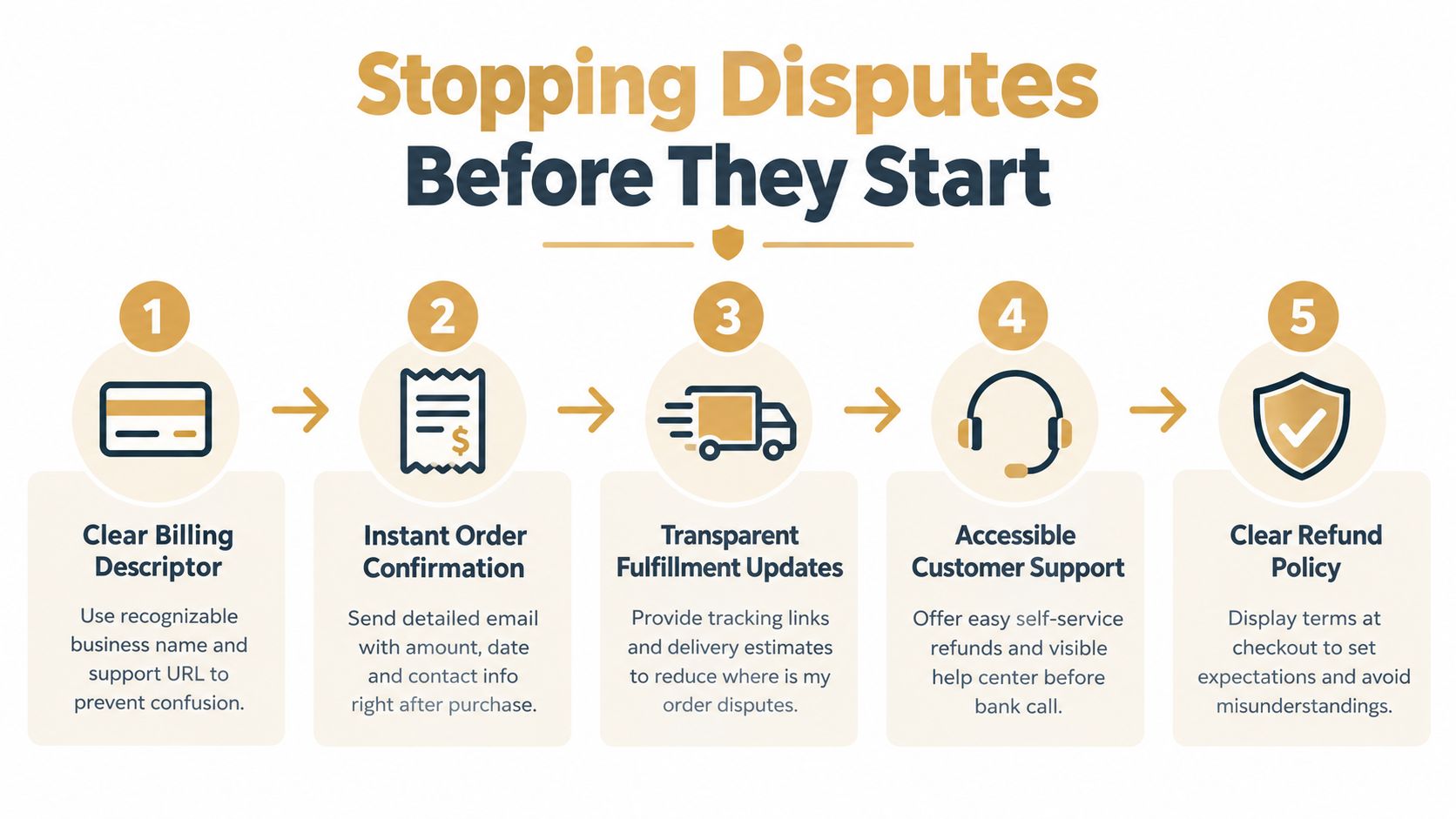
The cheapest friendly fraud dispute is the one that never reaches the bank. Most of the root causes are boring and fixable, customers don't recognize the charge, don't see the shipment coming, or can't get a fast answer from support. That's why the front-end work is really a merchant recognition project.
Make the charge recognizable
The billing descriptor should read like something a customer expects to see, not like an internal processor label. It needs a clear merchant name, a support phone number, and a URL that resolves to help, not a dead end. If a customer can match the charge to the order in a few seconds, the chance of an issuer call drops sharply in practice.
Shipment visibility matters just as much for physical goods. A label created without a tracking link is a missed opportunity, because “I never received it” complaints often start before the package even reaches the porch. Send the tracking reference as soon as the carrier accepts the parcel, then follow with delivery confirmation so the customer never has to wonder where the order is.
A support team that answers fast will beat a chargeback team that answers perfectly but too late.
Give customers a clean off-ramp
Refund speed is underrated. If a buyer can solve a duplicate charge, missing item, or cancellation issue inside an account page or order email in under two minutes, they're less likely to go straight to the issuer. The merchant doesn't need to make refunds easy for abuse, it needs to make legitimate resolution easier than escalation.
For merchants on Shopify, Shopify hold guidance is useful context because held funds and dispute pressure often show up together. A clean support path reduces the chance that a billing annoyance turns into a reserve problem.
3-D Secure still has a place, but not as a universal cure. Use it on higher-risk orders where authentication evidence is worth more than the friction cost, because the point isn't just fraud screening. It's creating a record that helps defeat the claim of non-authorization when a cardholder later disputes the transaction.
A practical checklist helps here:
- Descriptor clarity: Use a recognizable merchant name and keep the support route visible.
- Delivery proof: Push tracking as soon as fulfillment starts.
- Refund access: Put self-service refunds where customers can find them without opening a ticket.
- Authentication control: Apply 3-D Secure selectively to orders where the liability trade-off makes sense.
For teams that want a broader operational checklist, WooCommerce fraud protection tips is a useful companion resource because it pushes the same idea, reduce confusion first, then add controls where they change outcomes.
How Real-Time Alert Networks Work
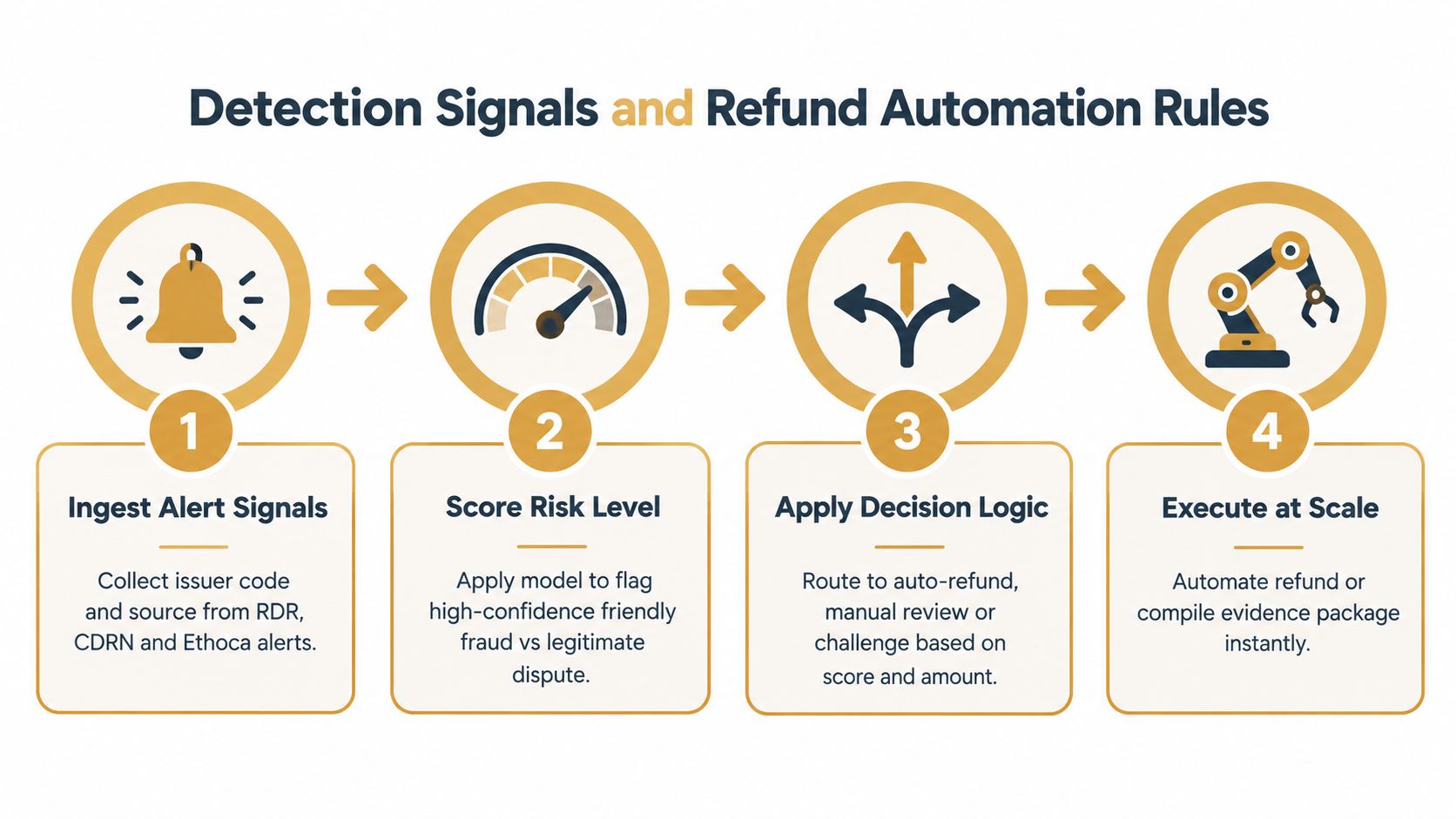
Real-time dispute alerts form the operating layer between a customer complaint and a filed chargeback. Visa's RDR uses its dispute alert infrastructure, Mastercard provides CDRN through the broader MDRI feed, and Ethoca connects issuers with merchants for pre-dispute notifications. The merchant receives an alert, matches it to the original sale, and decides whether to refund before the complaint becomes a formal chargeback.
The data that matters
An alert payload usually provides enough information to locate the transaction quickly: a masked card reference, amount, merchant descriptor, and reason context. Depending on the network and processor configuration, it may also include a customer note or short issue summary. That information supports a decision while the case remains a complaint rather than a settled network event.
The response window is short, generally 24 to 72 hours, depending on the network and processor workflow. Merchants that respond inside that window can prevent the dispute from entering standard chargeback handling. Once the deadline passes, the case follows the normal representment or liability process.
How integration usually lands in the stack
Most merchants do not need a separate infrastructure layer. Their processor or dispute platform can deliver alerts through a webhook, queue, or existing chargeback dashboard. The harder work sits in the decisioning layer: defining which alerts receive an automatic refund, which require analyst review, and which should be defended.
Practical rule: a live alert feed without written refund logic creates visibility, not control.
Design the workflow around the team that owns disputes. If alerts arrive where analysts already review cases, they can act within the response window. If they arrive in an unassigned inbox, ownership becomes unclear and the deadline can pass unnoticed.
The integration also needs clear failure handling. Log unmatched alerts, duplicate notifications, and delivery errors, then route them to an accountable operations queue. A simple audit trail should show when the alert arrived, which transaction it matched, who made the decision, and whether the refund was completed. That record helps managers measure prevention separately from ordinary chargeback handling.
Detection Signals and Refund Automation Rules
Alert data only becomes useful when the merchant turns it into rules. The goal isn't to auto-refund everything, it's to separate likely friendly fraud from disputes you can still win. That means looking at the alert source, the transaction history, and the customer pattern, then deciding how much risk to absorb.
Build rules in tiers
Start with hard signals. An alert from RDR, CDRN, or Ethoca tied to an order that already has a clean AVS/CVV match and falls inside a known subscription or fulfillment window usually deserves fast action. A customer with repeat refund history, a dispute on a digital good, or a rebill after a long dormant period deserves more scrutiny.
Then add soft signals. Repeated claims from the same BIN, odd timing relative to shipment, and customer email patterns that mirror prior disputes all matter, especially when they line up with the same merchant descriptor. That's where a good anomaly layer helps, and Halo AI anomaly detection is relevant because the merchant problem is rarely one signal, it's pattern recognition across weak signals.
A workable automation structure looks like this:
- Tier 1, auto-refund: Low-value disputes with strong friendly-fraud signals, especially when the cost of fighting exceeds the likely recovery.
- Tier 2, manual review: Mid-range disputes where the analyst can still change the outcome with one-click evidence review.
- Tier 3, fight: Higher-value cases with authentication, delivery proof, and clean customer history.
Put guardrails around automation
Automation without controls creates refund leakage. Use allowlists for VIP customers, but keep them narrow and versioned so they don't become a loophole. Keep an exception list for products that win often in representment, because refunding those cases hands back revenue you could have kept.
A daily cap matters too. If auto-refund volume spikes, something changed in the upstream flow, maybe a descriptor issue, a shipping delay, or a bad alert mapping. A kill switch protects the merchant from overcorrecting before the team understands the cause.
The Metrics That Tell You Prevention Is Working
Most dashboards drown teams in activity counts. What matters is whether the program is reducing processor risk, preserving revenue, and keeping the review queue sane. The key is to watch a small set of ratios that connect directly to network pressure and refund quality.
The four numbers worth reviewing weekly
Chargeback ratio is the first one. Visa and Mastercard monitoring pressure is tied to ratio behavior, and independent reporting says merchants should track daily against the 1.5% threshold rather than waiting for month-end reports (chargeback statistics and thresholds). A merchant that sees the ratio drift for a full billing cycle is usually reacting too late.
Alert-to-refund conversion is the second. This shows how many alerts turn into an actual refund rather than a manual fight. If conversion is low, the feed may be noisy or the rules may be too strict. If it's too high, the merchant may be refunding cases it could have won.
The third number is recovery cost per dispute. That includes analyst time, evidence gathering, and processor handling overhead. The fourth is refund leakage, the share of refunded alerts that likely would have dropped in representment anyway. That's the metric that stops finance and operations from arguing in circles.
Add the leading indicators
Weekly scorecards should also show:
- Decline velocity: Whether the same cardholder or product line is producing repeated problem transactions.
- Repeat-alert rate by BIN: Whether one issuing pattern is showing up more than it should.
- Alert-to-refund lag: How long the team takes to convert a live alert into a decision.
If the team can't answer where the lag comes from, the process is already too slow.
A simple cadence works best. Review one page every week, compare each metric to the trailing 90-day baseline, and flag anything that moves by more than two standard deviations from normal. That's a much cleaner operating habit than waiting for a quarterly postmortem.
| Friendly Fraud Prevention Scorecard | Healthy Band | Watch | Take Action |
|---|---|---|---|
| Chargeback ratio | Stable below monitoring pressure | Trending upward | Rising toward network concern |
| Alert-to-refund conversion | High enough to reduce filed disputes | Inconsistent | Falling or noisy |
| Recovery cost per dispute | Predictable | Rising slowly | Spiking |
| Refund leakage | Low and contained | Creeping up | Clearly wasting refunds |
A Merchant Playbook for Each Incoming Dispute
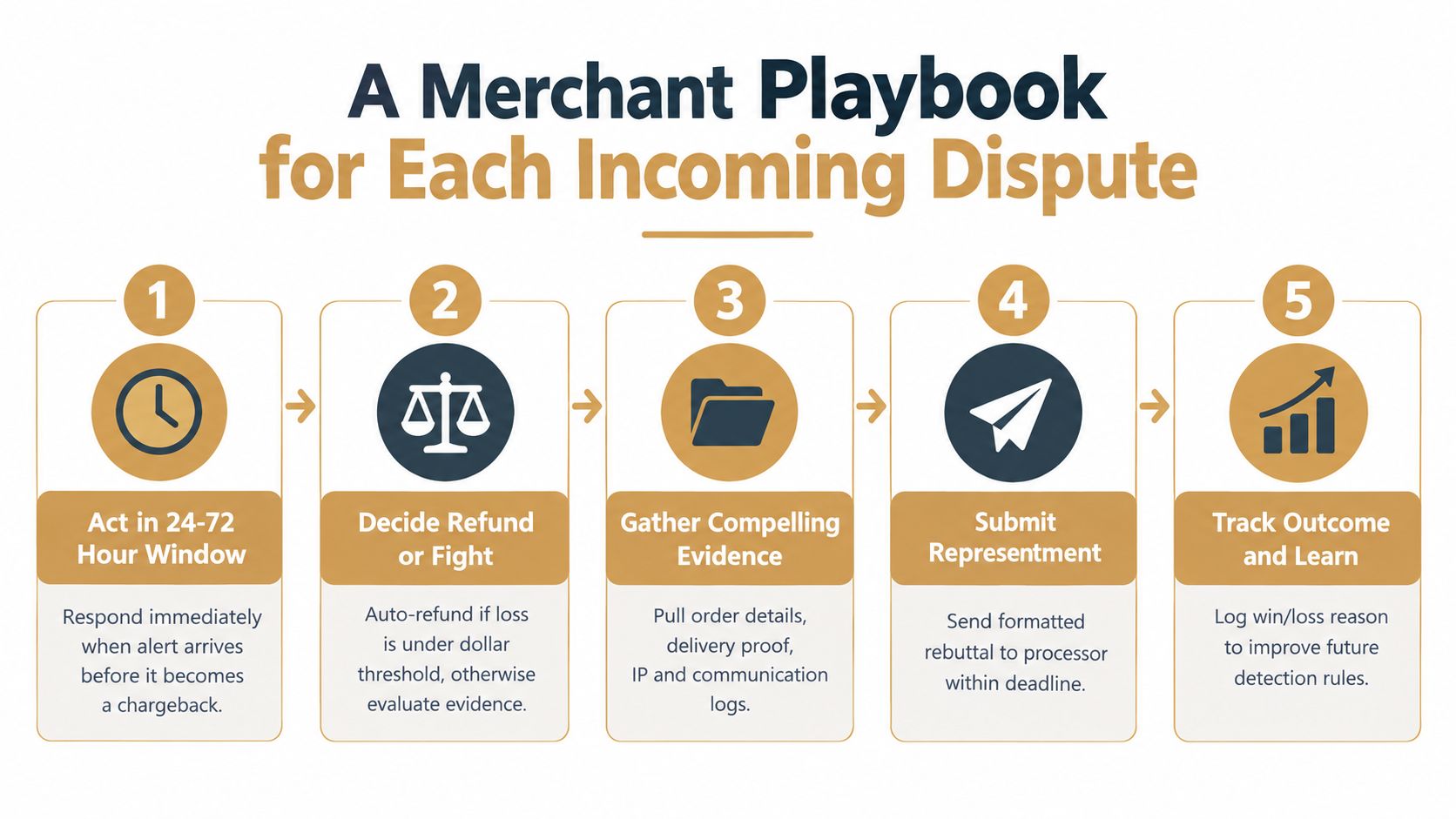
An incoming alert creates a short operating window. The merchant must decide whether to refund, investigate, or contest before the alert becomes a filed chargeback. Apply consistent rules based on transaction value, evidence quality, customer history, and the likelihood that the claim reflects friendly fraud rather than a genuine billing issue.
Decide first, then document
Refund low-value cases when the signals point to a legitimate customer complaint and the cost of investigation exceeds the recoverable amount. Contest cases with strong evidence, such as 3-D Secure authentication, signed delivery, a recognizable billing descriptor, and prior successful transactions from the same card. Set these rules before alerts arrive so analysts are not making subjective decisions under time pressure.
Use a single case record for every decision. Attach the order receipt and descriptor, available IP and device data, shipping confirmation, signed delivery proof, and relevant prior transactions. Record the decision, reason, and deadline in the same workflow. The alert exists to stop the chargeback from being filed, so evidence gathered after the window closes has less operational value.
For a refund, use the tokenized reference supplied by the alert or processor workflow so the transaction is marked resolved and is not selected for another action. For a contest, submit the evidence package through the network or processor process before its deadline. Use a dedicated workflow to resolve disputes before chargeback filing and log the outcome for the next alert.
Use each outcome to improve the next one
Store the issuer, product line, reason, customer history, and final outcome in a shared record. Analysts can then identify recurring descriptions, products, or card patterns instead of reviewing every alert from scratch. A refund is still useful operational data when the reason is recorded accurately.
For merchants that need this workflow in one system, Disputely connects Visa RDR, Mastercard CDRN, and Ethoca alerts. Teams can use it to manage refund rules, act during the 24-to-72-hour period before filing, and track dispute outcomes without building a separate internal system.
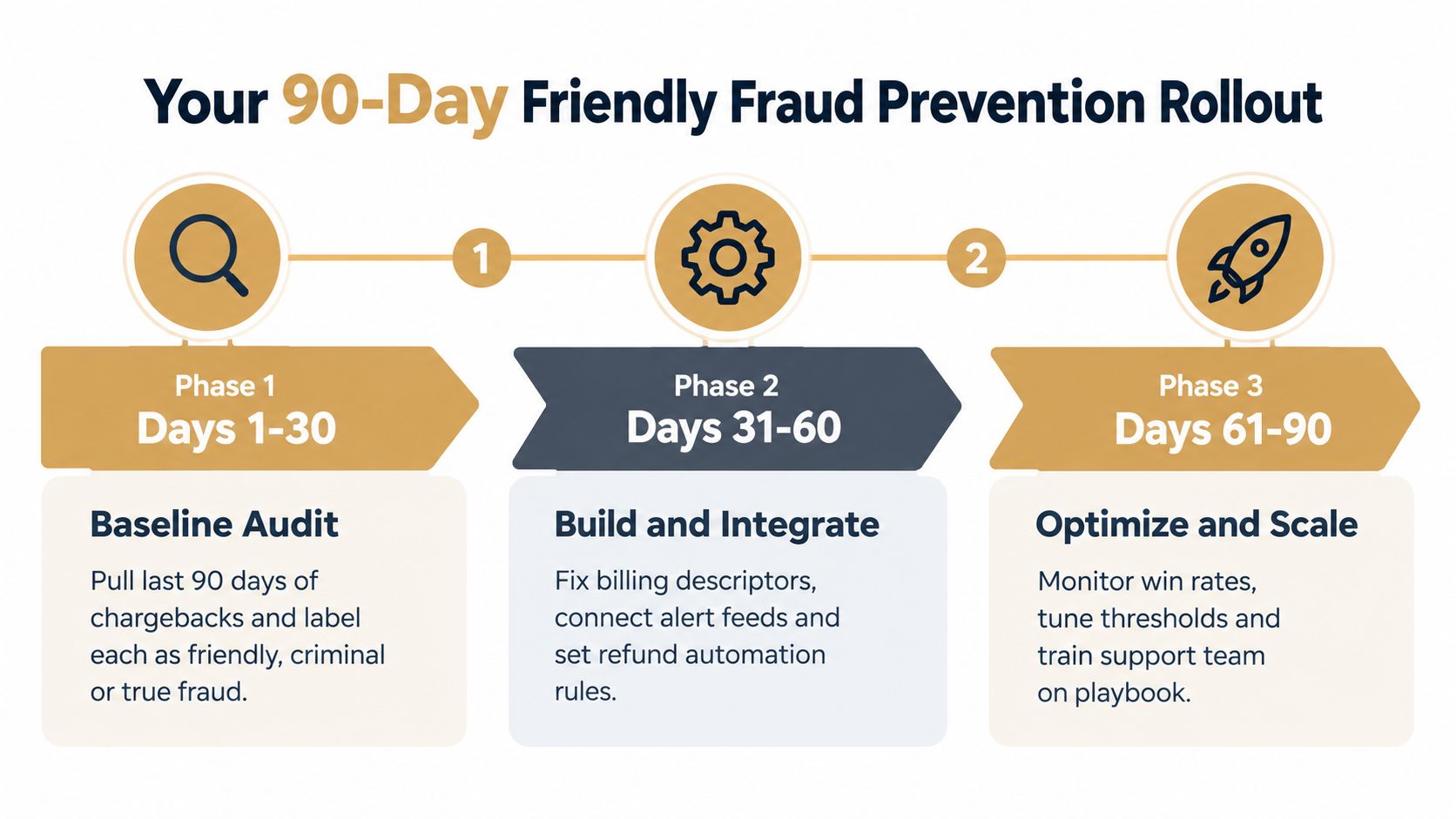
Your 90-Day Friendly Fraud Prevention Rollout
The cleanest rollouts start with the boring groundwork. In the first 30 days, pull the last 90 days of chargebacks, label each case as friendly, criminal, or operational error, and map them to issuer, descriptor, and product line. That gives the team a baseline it can trust.
Days 1 to 30, fix the obvious breakpoints
Rebuild the billing descriptor if customers can't recognize it. Set 3-D Secure thresholds for the orders that justify the friction. Require shipment tracking on physical goods and define a 48-hour refund SLA for avoidable service issues and duplicate charges.
Days 31 to 60, connect the alert layer
Enroll in the relevant alert networks and wire them into the dispute workflow. Build the refund rules, manual review queue, and logging discipline at the same time, not afterward. By the end of this phase, the merchant should be able to see whether the upstream fixes are reducing dispute volume.
Days 61 to 90, tune and pause if needed
By the third month, the dashboard should show whether the program is creating usable outcomes, not just more activity. The rollout should pause if the ratio moves the wrong way, if alerts are triggering too many unnecessary refunds, or if the support team can't keep up with the new process. The point is to reduce dispute pressure without handing back revenue blindly.
If you're building a dispute program that needs to act before a chargeback lands, Disputely gives you the alert window, the routing rules, and the tracking layer in one place. Visit Disputely to see how pre-dispute alerts can fit into your payment operations and reduce the cases that ever reach your merchant account.


