
How Long Does Visa Chargeback Take? Timeline Breakdown
A fully contested Visa chargeback commonly takes 60 to 70 or more days, while an eligible dispute can resolve in approximately 1 second through Rapid Dispute Resolution before a formal chargeback appears. The timeline depends on which clock you're measuring, because filing eligibility, merchant response, issuer review, and arbitration operate separately.
The popular advice to “allow 120 days” points merchants toward the wrong deadline. That figure usually describes how long a cardholder may have to initiate a claim, not how long you have to respond and not how long your funds will remain unsettled.
Operationally, the most important moment is often the alert that arrives before formal filing. If you act during that short prevention window, you may resolve the issue before a chargeback record exists. If you wait until the case reaches your processor dashboard, your usable response period may be measured in days, not months.
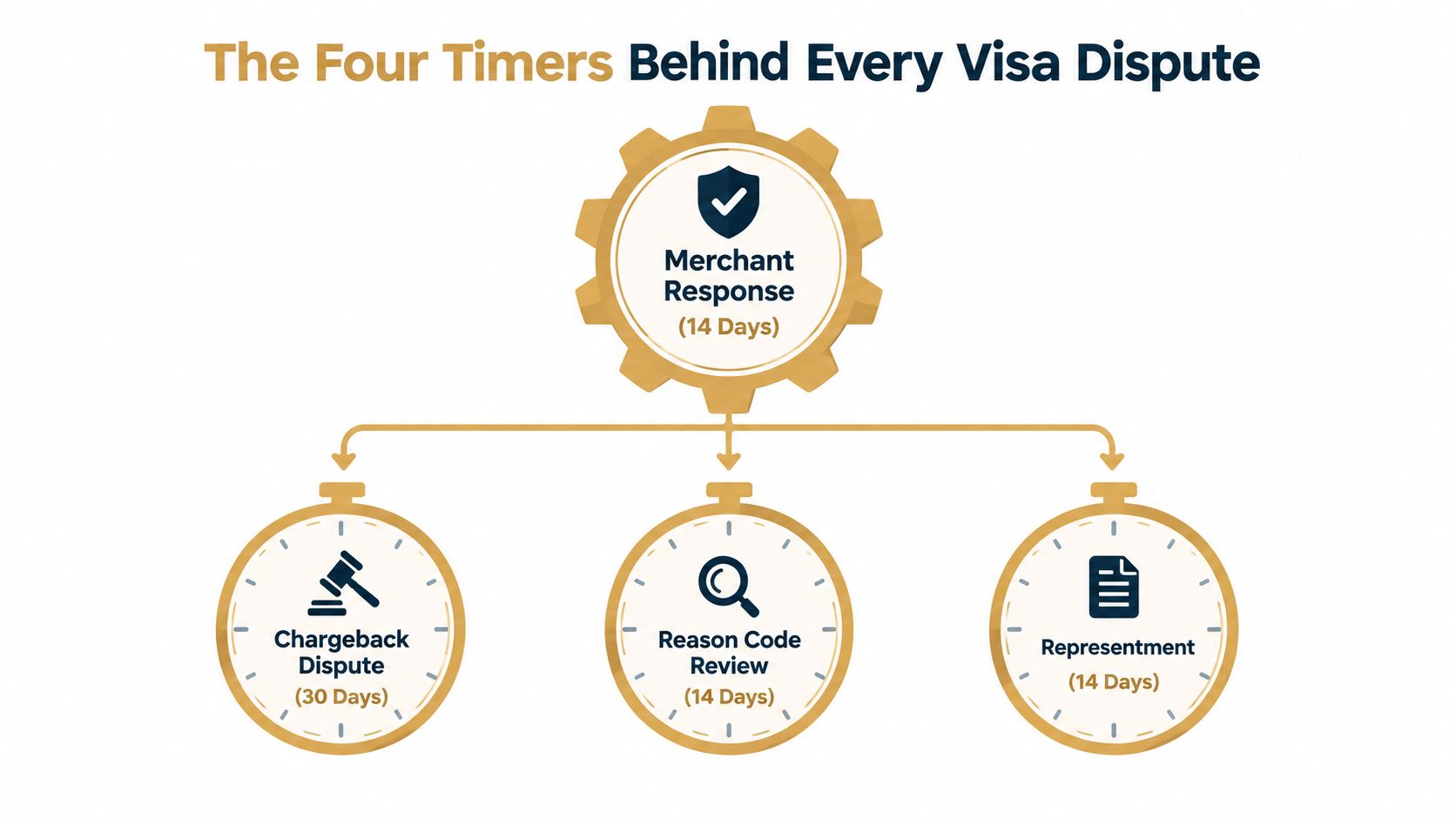
The Four Timers Behind Every Visa Dispute
“How long does a Visa chargeback take?” depends on which clock you are measuring. The operational mistake is treating the cardholder's filing window as the timeline your team can use. The first hours after a processor alert often matter more because they may still allow prevention before a formal case reaches your workflow.
Four timers operate independently:
Cardholder filing window. A cardholder may initiate a dispute long after the transaction, depending on the transaction or expected delivery and service dates. The filing window explains when exposure can appear, not when your response is due.
Merchant response window. Once your acquirer or processor sends a notification, a case-specific deadline controls your work. Geography, dispute stage, processor rules, and acquirer procedures can all affect that cutoff. Record it immediately and work to the earlier internal deadline.
Issuer review period. After evidence is submitted, the issuer assesses the claim and response. Review may continue for weeks, particularly if the dispute progresses beyond initial representment.
Escalation window. Pre-arbitration and arbitration create further response periods when the issuer does not accept the outcome. A case can therefore remain active after the first evidence submission.
Operational rule: Track the shortest active deadline, and use the pre-filing alert window before the network clock starts ticking.
The filing clock governs when a cardholder may act. The processor deadline governs when your team must act. Confusing them leaves usable prevention time untouched and can forfeit a defensible dispute.
Understanding Visa Chargeback Stages and Typical Durations
Visa chargeback timing is controlled by several clocks, and the merchant response deadline is usually the one that creates immediate risk. The cardholder may have a broad period to file, but your usable prevention window ends when the processor's case deadline arrives.
The process begins with the issuer reviewing the cardholder's claim. If the issuer advances it, the acquirer or processor sends the merchant the reason code, amount, transaction details, evidence requirements, and response cutoff. At that point, accepting the loss and challenging it are the two available paths. A challenge must address the stated dispute reason with relevant records, not a general claim that the customer received good service.
The formal lifecycle
For common Visa Category 12 processing error and Category 13 consumer dispute cases, the acquirer generally has 30 calendar days from the dispute-processing date to submit the merchant response and supporting evidence, according to this chargeback timeline reference. A processor may set an earlier internal cutoff, so treat the dashboard deadline as the operational limit.
The sequence usually runs as follows:
- Issuer review: The issuer evaluates the cardholder's claim and decides whether the dispute should proceed.
- Acquirer notification: The acquirer passes the case to the merchant with the reason, amount, transaction data, and deadline.
- Representment: The merchant submits delivery records, cancellation terms, usage logs, customer communications, authorization data, or other evidence through the acquirer.
- Issuer decision: The issuer reviews the response and either upholds the refund or reverses the chargeback.
- Pre-arbitration: If the issuer continues the case, the parties receive another response opportunity.
- Arbitration: Visa makes the network-level determination if the matter escalates.
A pre-arbitration attempt and the following response can each add another 30-day period. Visa arbitration provides an additional 10-day window for the relevant party. A contested case can therefore extend beyond 70 days after the first formal dispute stage, before accounting for issuer review, processor handling delays, weekends or holidays outside defined windows, and any appeal.
Why the merchant experience feels longer
For a $120 subscription renewal, the processor may hold the amount from notification until the issuer decision, typically 3-5 weeks, while the team retrieves Stripe logs, delivery confirmation, cancellation timestamps, and account activity.
Visa's published chargeback process describes the possible outcome as upholding the refund or reversing it after both sides' information has been reviewed. Build the evidence packet during the notification window, then submit it before the processor cutoff. The filing window may still be open, but it does not extend your response deadline.
How Rapid Dispute Resolution Changes Visa Chargeback Timing
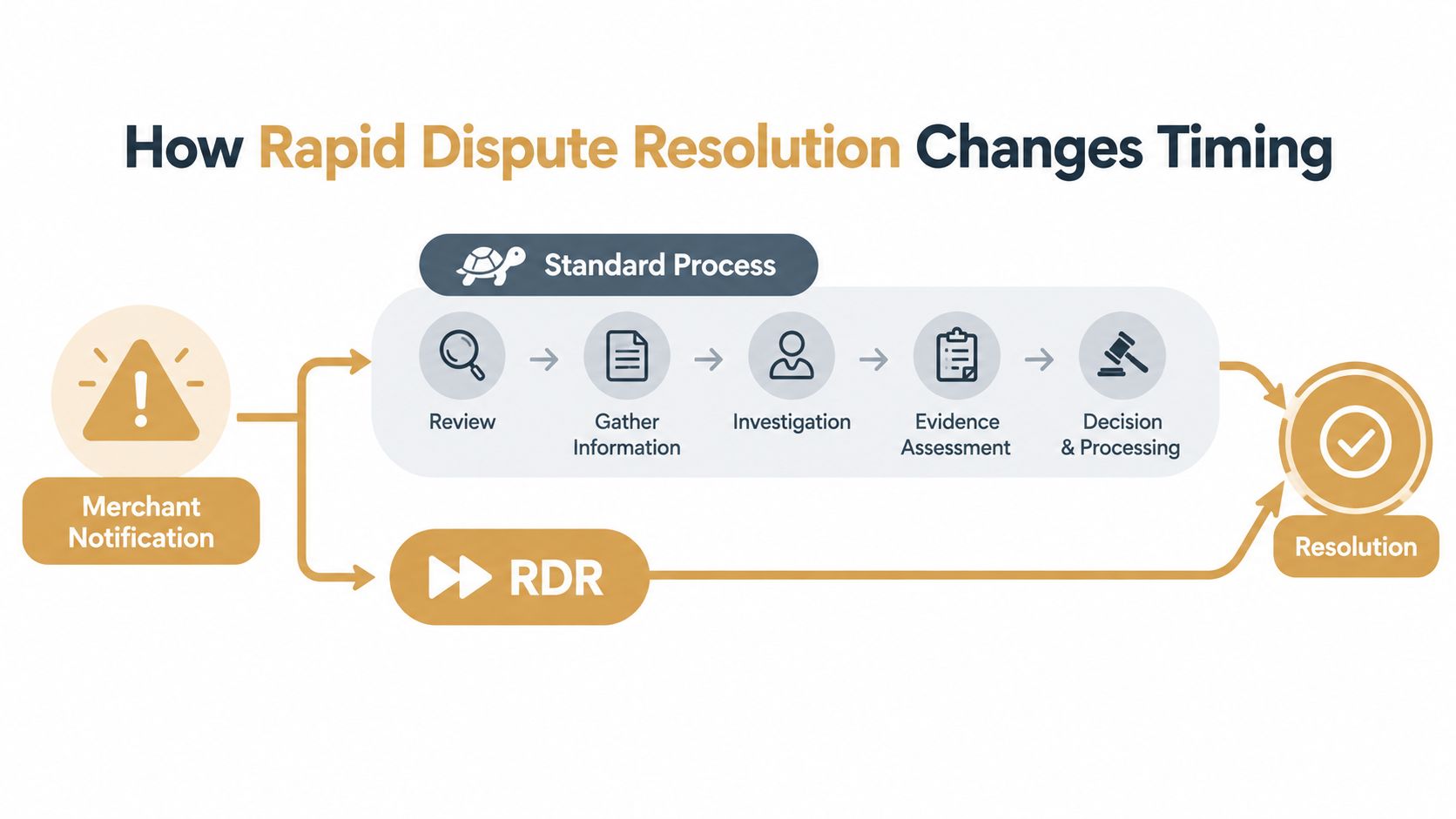
Traditional chargeback defense begins after filing. Rapid Dispute Resolution, or RDR, works before the conventional chargeback workflow starts. Visa describes RDR as an automated, real-time mechanism that can apply a refund or another configured resolution rule when an eligible dispute reaches the participating system.
Visa states that RDR can reduce the resolution timeframe from 24 days to approximately 1 second when an automated refund or resolution rule is triggered, as explained in its Visa dispute-management materials. That isn't a promise that every dispute resolves instantly. Eligibility, issuer, acquirer, processor, reason code, and merchant configuration all matter.
Prevention versus defense
The distinction is operationally significant:
| Pre-dispute alert | Formal chargeback |
|---|---|
| A merchant may apply an eligible refund or rule before filing | The merchant generally needs to submit evidence through the acquirer |
| Resolution can occur in approximately 1 second when RDR triggers | Issuer review and later stages can take weeks |
| The chargeback record may never be created | The case consumes funds, staff time, and tracking capacity |
| The response window may be measured in hours | The processor deadline may be measured in days |
The usable prevention window often lasts hours rather than weeks. Alert programs and processor integrations determine the precise period, so your team shouldn't assume that every alert provides the same amount of time.
A refund completed during that pre-dispute window can prevent the chargeback record from being created. Once the dispute is formally filed, collecting evidence and submitting representment generally starts the longer evidence-and-decision process. That makes alert handling a different discipline from chargeback defense.
For Shopify merchants assessing this workflow, Shopify chargeback protection options can be compared with the controls already available through the payment processor. The right setup should distinguish disputes worth refunding from disputes where strong evidence justifies defense.
This video provides a visual explanation of the timing difference:
Merchant Response Deadlines by Region and Processor
Once a Visa dispute is open, don't calculate your deadline from a generic network number. The notification in your processor or acquirer dashboard governs the work your team must complete.
Current processor documentation identifies a 9-day defense window for Visa disputes opened on payments processed locally in the United States and Canada from July 21, 2025, while disputes in other regions generally receive 18 days, according to Adyen's Visa chargeback guidelines. Missing the applicable cutoff can prevent the merchant from challenging the case.
| Case context | Published response period |
|---|---|
| Payments processed locally in the United States and Canada, for disputes opened from July 21, 2025 | 9 days |
| Other regions in the processor documentation | 18 days |
| Allocation disputes in one acquirer implementation | 18 days |
| Collaboration disputes in one acquirer implementation | 24 days |
The last two examples show why processor documentation matters. In one acquirer implementation, Allocation disputes require a response by day 18 and Collaboration disputes by day 24, with automatic acceptance if the merchant misses the stated cutoff. Those figures don't replace your own dashboard deadline. They demonstrate that the applicable period depends on routing model, case type, geography, and service configuration.
What to record when a case arrives
Capture the notification timestamp in UTC, the case identifier, the dispute reason, the transaction identifier, the amount, and the exact received deadline. Save a copy of the original notification and the final submission confirmation.
Don't treat a displayed “received” date as proof that you still have the full network period. A processor may have started its internal clock before your team saw the alert, or it may require evidence earlier than the broad network stage permits.
The practical comparison is clear. A long cardholder eligibility period gives you no protection against a short defense cutoff. Your queue should prioritize the case with the nearest processor deadline, even if another dispute appears older.
Setting Up Real-Time Alerts and Evidence Workflows
A reliable timeline starts before the first dispute. Merchants should connect each payment channel to an alert source, define ownership for incoming cases, and preserve the records that answer the dispute reason without manual searching.
Build the intake path
Use the notification and dispute tools available in your processor account for platforms such as Stripe, PayPal, Shopify Payments, and Authorize.net. The exact integration differs, but the operating pattern is consistent:
- Route alerts immediately: Send processor notifications to a monitored queue, not a shared inbox that nobody owns.
- Record UTC timestamps: Store when the alert arrived, when the case deadline was displayed, and when your team submitted its response.
- Assign a decision owner: One person or queue should decide whether to refund, accept, or defend.
- Preserve submission proof: Keep the case status, uploaded files, confirmation identifier, and final transmission time.
- Escalate exceptions: Flag missing order data, duplicate alerts, unclear reason codes, and deadlines that conflict across systems.
Evidence collection should begin when the transaction is created. Store delivery confirmation, tracking information, cancellation records, refund attempts, customer-contact history, product or service usage, login activity, and the policy version shown at checkout where relevant.
Automate collection, not judgment
Automation is useful when it retrieves records quickly and presents them in a case-specific package. It becomes risky when it refunds every alert without considering whether the merchant has strong evidence or whether the customer already received a refund.
A practical ruleset can separate low-value operational refunds from cases that require review. For example, a configured rule might refund an eligible alert where delivery failed and the customer has already contacted support, while routing a verified delivery dispute to an evidence queue. The rule should be tested against real transaction states, not just written as a blanket instruction.
Merchants under sustained pressure should also monitor their chargeback rate exposure alongside individual case deadlines. A single response workflow protects one transaction. A complete alert and evidence workflow protects the consistency of the payment account.
Evidence standard: If an employee would need to search three systems to prove delivery or cancellation, the evidence isn't operationally ready.
Review the workflow regularly. Check that alerts reach the right team, timestamps use one time standard, evidence links remain accessible, and the processor records the submission as complete.
Why the 120-Day Filing Window Is Not Your Response Deadline
The 120-day figure is frequently presented as though it answers the entire question. It doesn't. Visa's UK consumer guidance says a cardholder generally has up to 120 days to initiate a claim, but that period doesn't tell the merchant how long it has to respond or the bank how long it will take to decide, as explained in Visa's consumer chargeback guidance.

A customer may initiate a claim long after the sale, especially where the relevant date relates to expected delivery or service. That delayed arrival affects forecasting and record retention, but it doesn't create a matching response period for the merchant.
Published guidance identifies merchant-side examples ranging from 9 to 18 days, depending on the processor and case context. The difference between those figures and the cardholder's filing eligibility is the central operational trap. One clock determines when a dispute may enter the system. Another determines whether your defense can enter the system.
The control that actually works
Use the case deadline displayed by your processor or acquirer. Don't replace it with a date calculated from the transaction date, the customer's filing window, or a generic Visa estimate.
Your case record should show:
- the transaction date and relevant delivery or service date
- the alert or chargeback notification timestamp
- the processor's received deadline
- the evidence owner and review status
- the submission timestamp and confirmation
That record lets you investigate a missed deadline as a process failure instead of guessing afterward. It also helps distinguish a late cardholder claim from a late merchant response, which require different operational questions.
A Real Merchant Timeline From Alert to Final Decision
Consider a subscription merchant that receives a pre-chargeback alert for a renewal transaction. The alert arrives before formal filing, so the team checks the customer's cancellation request, account activity, renewal terms, and support history.
The merchant has two practical paths:
- Refund during the alert window: If the record shows a credible cancellation issue and the alert is eligible for automated resolution, the merchant refunds before the formal chargeback record is created.
- Defend the transaction: If the account shows continued usage after renewal and the billing terms were properly presented, the merchant preserves the records and prepares for the processor's case deadline if the dispute becomes formal.
If the merchant takes no action, the case can enter the conventional Visa workflow. The acquirer then supplies a processor deadline, which may be much shorter than the cardholder's filing eligibility period. The team submits evidence, waits for issuer review, and tracks whether the case is upheld, reversed, or escalated.
A fully contested path can extend beyond 70 days after the first formal dispute stage when the relevant pre-arbitration and arbitration windows are added. The merchant therefore tracks two different outcomes: whether the funds are ultimately recovered and how much staff capacity remains tied to the case.
The alert-stage decision is the strategic pivot. A timely refund may close the customer issue before filing. A defensible case may justify representment. Neither decision should be made by looking only at the transaction age.
Next Steps to Protect Your Visa Processing Timeline
Treat every Visa dispute as four clocks: cardholder filing eligibility, merchant response, issuer review, and escalation. In daily operations, the shortest processor deadline usually matters most.
Set up real-time alerts, record every deadline in UTC, collect delivery and cancellation evidence automatically, and configure refund rules for eligible pre-dispute cases. Preserve submission confirmations, and use the processor dashboard as the source of truth rather than a generic Visa estimate.
For merchants that need a structured workflow, chargeback fighting tools can help organize evidence and response work before deadlines expire.
Disputely connects merchants with Visa RDR and other dispute-alert workflows, then supports real-time notification and configurable refund handling before an eligible issue becomes a formal chargeback. Visit Disputely to review how its alert and evidence workflow could fit your processor operation.


