
If I Dispute a Transaction What Happens: Steps and Outcomes
If you dispute a transaction, it becomes a timed review in which the card issuer decides the outcome, the merchant can answer with evidence, and a U.S. credit-card dispute must be resolved within 90 days, while the disputed money is often on hold in the meantime.
You open a statement and see a charge you don't recognize, or a renewal you thought you'd canceled. The impulse is to call the bank and make the line disappear. That call puts two people on the same clock. You wait to learn whether the charge comes off. The merchant decides whether to give the money back or defend the sale.
People search a plain question when they're stuck: if I dispute a transaction, what happens next. The answer depends on the payment method, the reason you give, and whether anyone responds before the deadline. It isn't a refund button. It's a review with paperwork, and the money can move before either side has finished arguing.
What Happens After You Dispute a Transaction
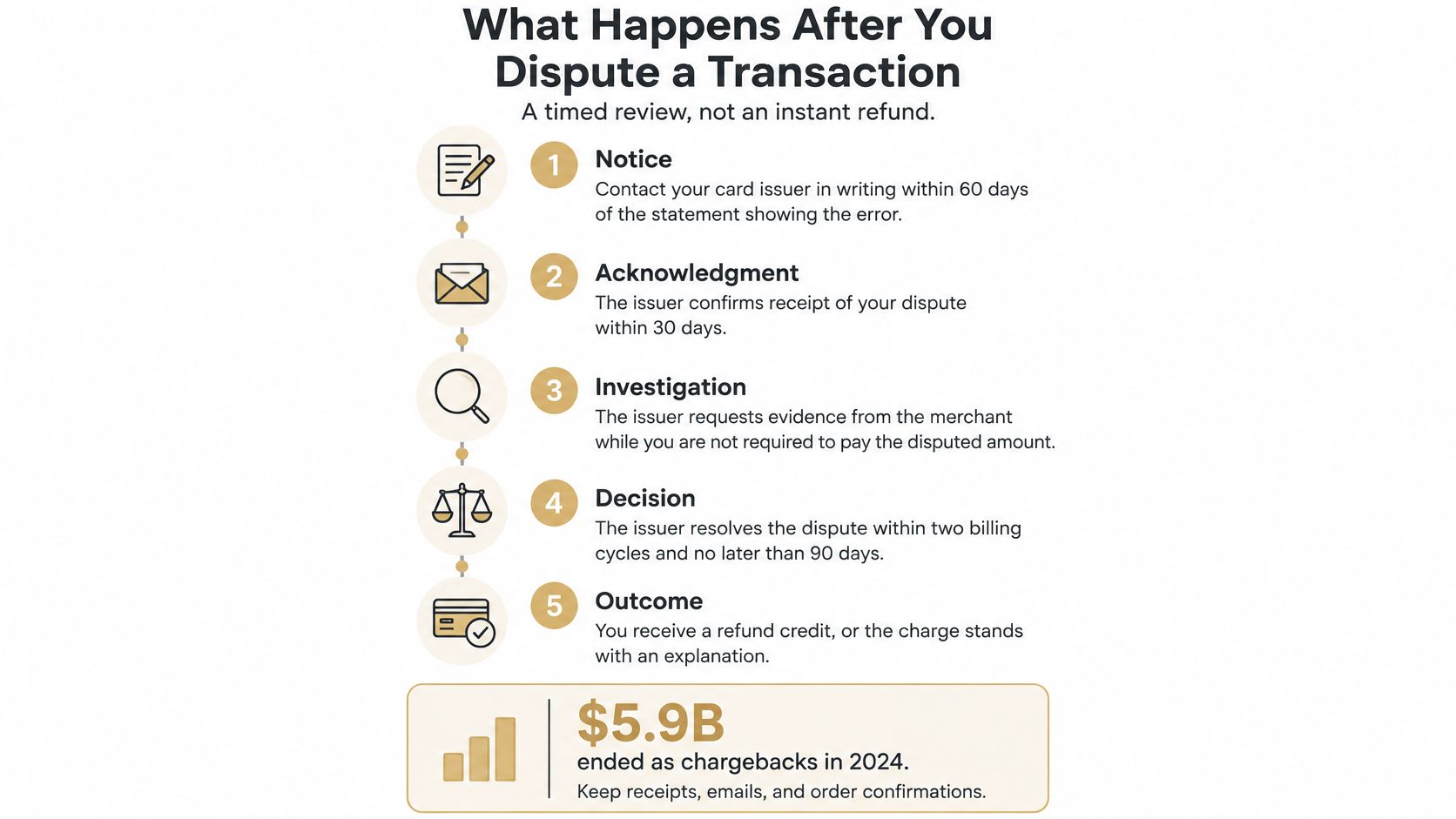
A dispute is not an instant refund. Your card issuer runs a timed review and decides, using records the merchant can send back.
On a U.S. credit card, that review sits under the Fair Credit Billing Act and Regulation Z. The FTC's guide to using credit cards and disputing charges sets the frame. You generally send written notice within 60 days after the statement that shows the suspected error. Name the account, the transaction date, the amount, and why you think the charge is wrong.
Once the issuer has a valid notice, it normally has 30 days to acknowledge it in writing, unless it fixes the problem sooner. It must then correct the account or explain a rejection in writing within two complete billing cycles, and no later than 90 days. While the review is open, you may withhold payment of the disputed amount. The issuer generally may not treat that amount as delinquent or run ordinary collection on it.
From your notice to a decision
| Stage | What happens | Typical timing | Who acts |
|---|---|---|---|
| Dispute filed | Cardholder sends written notice or uses the issuer's dispute channel | Within 60 days of the statement showing the error | Cardholder |
| Acknowledgment | Issuer confirms it received a valid notice | Usually within 30 days | Issuer |
| Hold on disputed amount | Disputed amount is not treated as delinquent while the review is open | Until the investigation closes | Issuer |
| Chargeback sent | Transaction returns through the network; funds move from acquirer to issuer | Network rules; can extend to 120 days from processing in some scenarios | Issuer, network, acquirer |
| Merchant response | Merchant accepts liability or submits second presentment with evidence | Processor deadline, commonly 20 to 45 days after notice | Merchant |
| Final decision | Issuer corrects the account or gives a written reason for rejecting the claim | Two billing cycles, no later than 90 days | Issuer |
Walk that table in order.
- You file, in writing or through the issuer's dispute channel, inside the 60-day window.
- The issuer confirms it got a valid notice, usually within 30 days.
- The disputed amount stays off the late pile until the investigation closes.
- If the issuer sends a chargeback, the sale goes back through the card network to the merchant's bank, the acquirer. Mastercard's chargeback guide describes the network moving the money first, a credit to the issuer and a matching debit to the acquirer. Picture a referee holding the ball while both sides still argue the call. Your bank has the funds. The case later decides who keeps them.
- The merchant accepts the loss or files a second presentment, evidence that the sale was valid. Acquirer deadlines commonly fall within 20 to 45 days of notice. Miss that window and the merchant usually loses by default, no matter how strong the file is.
- The issuer corrects your account or writes why it rejects the claim, inside two billing cycles and no later than 90 days.
In some network scenarios the wider path can run up to 120 days, including windows counted from the transaction's central processing date. The merchant's useful file is the sale record, delivery proof, refund history, your messages, and authentication data. A clear map of how a dispute gets resolved is really just those milestones, with both of you answering on time.
Outcomes Cardholders Can Expect and What to Do
This isn't a rare exception. In 2024, U.S. cardholders disputed $9.8 billion in credit-card charges, and $5.9 billion of that ended as chargebacks, according to the CFPB's consumer credit card market report.

A dispute can end before anyone rules on it. Say your package arrives after a refund has already been sent, or the merchant cancels a renewal you contested. The file closes because the problem got fixed before a bank ruling was needed. The same idea sits on the merchant side: refunding every alert by default can pay for claims that were really delivery confusion, while fighting a clear unauthorized charge can burn time and goodwill. The claim type should choose the response.
Five endings show up again and again. They don't all look like a win.
The merchant refunds you first. You email about a late package. They refund the same day, before any chargeback is filed. The dispute closes, and your issuer never has to rule.
The issuer agrees with you. The temporary credit, or a correction on the next statement, becomes permanent. The charge is removed or fixed.
The issuer rejects the claim. You get a written explanation, and the charge goes back on the account. If you'd held the payment, that amount can come due again, sometimes with finance charges for the period it was in review.
The merchant wins the second presentment. Their evidence persuades the issuer. The chargeback reverses, and the sale stands.
You withdraw. The merchant reships the order or fixes the service problem, and you tell the issuer to drop it.
A dispute is a request for review, not a verdict you control.
What to do inside the 60-day window
- Try the merchant first when the problem is delivery, service, or a renewal you can document. A same-day refund can end the matter before a dispute exists.
- Send written notice within 60 days of the statement that first showed the billing error. If the charge was unauthorized, call the issuer to lock the card, then send the written dispute as well; treat the call as an alarm bell rather than a substitute for the letter or portal notice.
- Keep the paper trail: receipts, cancellation confirmations, screenshots of the listing, the renewal email, and tracking history.
- Track two clocks: your 60-day notice window and every response date printed on the issuer's acknowledgment or document request. Reply before the issuer's stated cutoff so silence cannot be read as dropping the claim.
How Dispute Rules Change by Payment Method
A credit-card dispute is about money the bank lent you, so you can hold that slice of the bill while someone checks it. A debit-card dispute is about your own money, already gone from the account, so the bank may have to put it back temporarily while it looks.
That difference is easy to miss. Explainers often say "the bank will investigate and might reverse it." They skip the fact that a billing-error claim, a debit claim, and an account transfer are not the same process, and the claim type decides which clock starts running. Bank dispute deadlines and cardholder rights are where people get that wrong, especially on subscriptions, where you recognize the merchant and still believe the renewal was canceled or never agreed.
| Payment method | Governing rule | Deadline to dispute | Resolution timing | Provisional credit |
|---|---|---|---|---|
| US credit card | Fair Credit Billing Act and Regulation Z | Written notice within 60 days of the statement | Acknowledge within 30 days; resolve within two billing cycles, no later than 90 days | Not required; disputed amount can be withheld |
| US debit card | Electronic Fund Transfer Act and Regulation E | Generally within 60 days of the statement | 10 business days to investigate; up to 45 days if provisional credit is issued; up to 90 days for certain transfers | Generally required if the review runs past 10 business days |
| Bank transfer (authorized payment) | Bank policy; Regulation E covers unauthorized transfers | No universal chargeback clock; ask the bank immediately | The bank's own review, if it offers one | Often none for a payment you authorized |
| Bank transfer (unauthorized) | Regulation E | Report as soon as you notice the transfer | The bank's stated fraud timeline | May be available; confirm what the bank promises |
| Payments outside the US | Local card-scheme and consumer-protection rules | Set by the local scheme or your bank | Varies by country and network | Depends on local rules |
The trap in a temporary credit
Under Regulation E, the bank generally has 10 business days to investigate a reported debit error. If it needs more time, it can take up to 45 days, but only if it puts provisional credit in your account within those first 10 business days. Certain cases stretch further: point-of-sale transactions, foreign-initiated transfers, and errors on accounts less than 30 days old can run to 90 days. If the bank doesn't finish inside its window, the provisional credit stands. If it finishes and rules against you, it can pull the credit back once it explains the decision in writing.
A credit on your app is not a final win. Treat it as a placeholder. For an ordinary late shipment, contact the merchant first and keep the cancellation email. For a charge you never made, notify the bank the day you see it.
An authorized bank transfer is the sharp edge. You told the bank to send the money, so there often isn't a card-style chargeback waiting in the background. Contact the recipient, then the bank's fraud team. Don't assume a reversal is already on the way.
The same claim-type logic works on the merchant's side. A clear unauthorized charge is usually cheaper to refund, while a delivery or service complaint may be worth answering with evidence. The claim type, not the dollar amount, makes that call.
How Alerts Stop a Dispute Before It Becomes a Chargeback
Take an $80 order as a working example, not a fee schedule. The customer tells the bank on Tuesday that the charge was unauthorized. An alert hits the merchant that afternoon. The merchant refunds the same day, and the case closes with no chargeback filed and nothing new on the dispute record.
Leave that same order alone and the path splits. The $80 is debited, a processor fee can stack on top, evidence has to be filed before the stated deadline, and the outcome counts toward the dispute ratio whether the merchant wins or not.
An alert works like a smoke detector, where the filed chargeback is the fire. One warns while there is still time to act; the other is the event itself. Visa's merchant dispute management guidelines set strict deadlines at each stage of a dispute, and a missed response window can decide the case against the merchant even when the evidence is strong. Alert programs such as Visa RDR, Ethoca, and Mastercard CDRN exist to reach the merchant before that process starts. How long the merchant has to respond, and whether the alert carries a fee, depends on the specific program and processor, so the notice itself is the document that matters.
Alert versus a filed chargeback
| Feature | Pre-dispute alert (RDR, Ethoca, CDRN) | Formal chargeback |
|---|---|---|
| Trigger | Issuer shares the dispute with the merchant before filing | Issuer files the chargeback through the network |
| Merchant window | Set by the alert program and processor; read the deadline on the notice | The processor deadline printed on the notice |
| Money movement | A refund can close the case before any debit | Funds are debited first, then recoverable if the merchant wins |
| Counts toward dispute ratio | Depends on the program and processor | Yes |
| Merchant action | Refund or decline and let the dispute proceed; no evidence package | Accept liability or submit a second presentment |
| Typical fee | Varies by program and processor | Set in the merchant agreement |
The reflex is to refund every alert. That is not always the right call, because the claim type decides whether to refund or fight. If the charge looks like genuine fraud, refunding inside the alert window ends the case cleanly. If the alert is a repeat buyer claiming non-delivery on a tracked order, declining means the dispute continues as a chargeback, and the tracking evidence becomes the response at that stage. Declining never makes the problem disappear. It moves the argument to the formal clock.
Stores that sell on Shopify feel this first as a cash and ratio problem, which is why chargeback protection for Shopify stores centers on acting inside that window, before the network debit exists. After the chargeback is filed, the job changes from choosing a refund to assembling evidence in the format the processor requires.
What a Dispute Costs Merchants and Cardholders
When a chargeback is filed, the network typically moves the disputed funds before anyone has decided who is right. The merchant's available cash drops even if they later win and the money comes back. That's the part that surprises finance teams. The argument is still open, and the balance is already smaller.
Missing the response window can close the case against the merchant even when the file is strong. A chargeback, a second presentment, and sometimes a further issuer review are separate stages, each with its own clock. The operational hit is that order data has to stay retrievable long after settlement, tied to the payment, the invoice, the delivery event, and the customer messages.
What the merchant pays
- The sale itself: the refunded or reversed amount leaves the account up front.
- A per-dispute processor fee: the amount is set in the merchant agreement, not by a single national rate.
- Staff time: someone has to match the charge, pull tracking, and write the response.
- Reserves and holds: if dispute volume climbs, the processor can hold a slice of settlements.
- Network monitoring: a rising ratio can put the account into a review program. The trigger differs by network and merchant category, which is why a high chargeback rate is an account risk, not only a lost order.
What the cardholder pays
- Usually no fee just for filing a dispute with the issuer.
- Finance charges can return if the issuer upholds the charge and you'd withheld that part of the bill.
- A pending line can still sit on the statement while the review is open, which feels like the money is gone even when it isn't a final loss.
The cheapest dispute is the one that never becomes a chargeback.
A win still costs time on both sides. You waited through billing cycles. The merchant rebuilt a file and may never see the processor fee refunded. Resolving the problem before a chargeback exists is cheaper than winning one later.
Classify the Claim and Act Within 72 Hours
A merchant gets two alerts in the same morning. One is a cardholder whose number was skimmed at a fuel pump. The other is a subscriber who forgot a renewal, did not recognize the charge, and went straight to the bank instead of the cancel button. Refunding both treats them as identical. They are not.
Refunding every alert is not automatically the smart move. An unnecessary refund can reward friendly fraud, meaning a dispute filed on a purchase the customer made, and it gives up a sale you could have defended. The claim type decides the move.
Reported consumer fraud losses in the United States reached $12.5 billion in 2024, a 25% increase over the prior year, according to a Richmond Fed review of consumer fraud losses. A number that size covers a lot of different problems: stolen cards, manipulated buyers, sloppy recurring billing, and ordinary confusion about what a charge even was.
Classifying the claim works like triage in an emergency room. The symptom is always the same, an unhappy cardholder, but the treatment depends on the cause. Here is how the common causes sort.
Match the claim to the evidence
| Claim type | What it looks like | Evidence to gather | Usual move |
|---|---|---|---|
| True fraud | Customer says a stolen card was used; no order recognized | 3-D Secure authentication, AVS and CVV match, IP and device data | Contest if authentication is strong; refund if it is weak |
| Duplicate or wrong amount | Charged twice, or at the wrong price | Order log and processor transaction IDs | Refund the duplicate; contest the valid charge |
| Non-receipt | Customer says the item never arrived | Carrier tracking, proof of delivery, signature | Contest with delivery proof; refund if tracking failed |
| Cancellation or recurring billing | Customer says they canceled, or never agreed to renew | Checkout consent, cancellation log, renewal emails | Contest with consent proof; refund if the cancellation was never recorded |
| Not as described | Product differs from the listing | Listing screenshots, product photos, return policy | Refund credible claims; contest only with a clear listing match |
| Friendly fraud | Customer recognizes the purchase and disputes it anyway | Full order record, customer messages, delivery and usage logs | Contest; refunding rewards the behaviour |
Read the table row by row and a pattern appears. A stolen-card claim lives or dies on authentication. A duplicate lives or dies on two transaction IDs. A "never arrived" claim lives or dies on the carrier scan. A renewal dispute lives or dies on the consent checkbox and the cancellation log. Treating all six as "the customer is unhappy, just refund" erases sales you can prove and trains people to skip your support inbox.
How long do you have to do this sorting? Alert programs differ, and the windows are short, so treat roughly 72 hours as a working assumption rather than a guaranteed deadline. The date your processor shows is the one that counts. Once a formal chargeback is filed, you respond inside the processor's evidence format, and a missed date usually loses the case regardless of what you could have shown.
A 72-hour playbook
- Write down the deadline your processor shows. That date controls the work.
- Match the disputed charge to one order by amount, date, and transaction ID. If you can't link them, you don't have a defense yet.
- Classify the claim with the table above before anyone clicks refund.
- Check delivery or usage, cancellation history, and prior refunds. A second refund on an order you already credited is a self-inflicted loss.
- Refund when the claim is credible and the alert program allows it. Tell the customer what happens next, including when the credit should appear.
- If you contest, build the bundle for that reason code and submit it before the deadline. Authorization records, fulfillment, messages, cancellation terms, and recurring-billing consent only help if they match the complaint.
- Record the outcome and fix the cause. A muddy billing descriptor, a hidden renewal, or a slow refund policy will send you the same dispute next month.
Refund or fight: Refund when the claim is credible. Fight when your evidence is stronger than the complaint.
Cardholder and merchant are on one timeline here. You want the charge explained or reversed. They want a refund only when the claim holds up. Sorting the claim while the alert is still open is how both sides skip a months-long argument over something a tracking number could have settled in an afternoon.
Disputely watches Visa RDR, Mastercard CDRN, and Ethoca alerts and matches them to the original sale, so you can refund a credible claim or keep a defensible one before a chargeback is filed. That is the same split this article walks through: classify the reason, act inside the short window, and stop a timed review from starting. See how the alerts fit your processor at Disputely.


