
Mastercard Chargeback Monitoring Program: Avoid Fines
The Mastercard Excessive Chargeback Merchant (ECM) tier historically begins when a merchant reaches 100 chargebacks and a 1.5% chargeback-to-transaction ratio in the same calendar month. Escalation to High Excessive Chargeback Merchant (HECM) occurs at 300 chargebacks and a 3.0% ratio, with both count and ratio tested together.
A dispute dashboard can look ordinary until the denominator changes. A subscription business may receive roughly the same number of complaints as the previous month, then cross a monitoring line because captured payments fell, a seasonal promotion ended, or a sales channel shifted. That's why the Mastercard chargeback monitoring program demands more than a static threshold table. You need to understand which month supplies the chargebacks, which month supplies the transaction base, and what your early-warning systems can prevent before a dispute becomes a chargeback.
What Triggers Mastercard Chargeback Monitoring
A DTC brand can have a routine operational problem on Monday and a network-compliance problem by the end of the month. A billing descriptor confuses customers, a product shipment runs late, and a short-lived fraud attack adds more unauthorized transactions. The team sees the spike in its processor dashboard, but Mastercard sees the resulting chargebacks against a defined monthly ratio.
Mastercard's Excessive Chargeback Program is designed to identify merchants whose dispute activity threatens cardholder experience and network integrity. The program isn't a judgment on one unhappy customer. It's a structured monitoring mechanism that helps acquirers identify an escalating pattern early, investigate its causes, and require remediation where necessary. The practical consequences can still be serious, because an acquirer may respond with additional scrutiny, operating restrictions, or commercial pressure.

Normal variation versus formal exposure
A few disputes don't automatically indicate a monitoring event. The important question is whether the merchant reaches both the relevant absolute count and ratio threshold during the applicable calendar month. A business can therefore be exposed in two different ways:
- Count pressure: Chargebacks accumulate quickly, even while sales volume appears healthy.
- Ratio pressure: Captured payment volume contracts, making the same dispute count represent a larger share of transactions.
- Operational pressure: Refund delays, unclear descriptors, recurring-billing confusion, and fulfillment failures create disputes that prevention systems could have intercepted.
Merchants often start looking for answers too late, after the acquirer sends a compliance notice. A better starting point is a daily view of Mastercard chargebacks, captured payments, transaction channels, billing cycles, and alert outcomes. The high chargeback rate guidance is useful for framing that operational review, but your own processor and acquirer reports remain the source of truth for your account.
Practical rule: Treat a rising chargeback trend as an operating problem before it becomes a network problem.
The strongest response isn't to dispute every case reflexively. It's to separate avoidable service disputes from confirmed fraud, then fix the customer, payment, and fulfillment causes producing each category.
Understanding ECM and HECM Thresholds
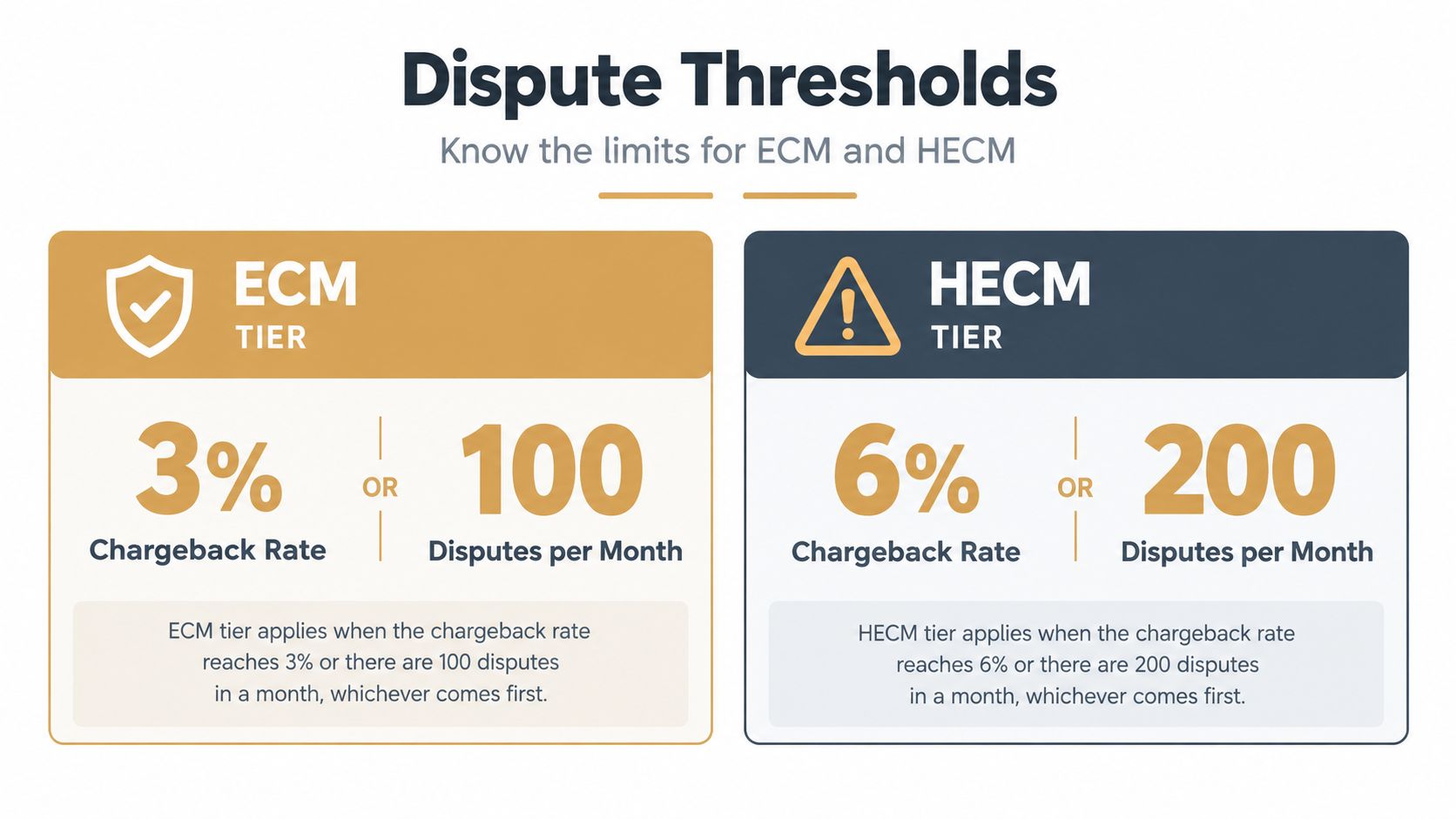
The core mechanic is a dual-threshold test. Mastercard's ECM tier historically applies when a merchant reaches at least 100 chargebacks and a 1.5% chargeback-to-transaction ratio. HECM applies at 300 or more chargebacks and a 3.0% ratio. Both conditions must be met in the same calendar month, rather than allowing a merchant to qualify through count or ratio alone (Mastercard program guidance).
The tiers can be read as follows:
| Tier | Chargeback count | Chargeback-to-transaction ratio |
|---|---|---|
| ECM | 100 to 299 | 1.5% to 2.99% |
| HECM | 300 or more | 3.0% or higher |
The ratio uses chargebacks raised in the current month against the total number of captured payments from the preceding month, rather than just dividing current disputes by current sales. That timing matters for businesses with uneven volume. A merchant can have moderate transaction activity and still face exposure if disputes rise quickly or the preceding month's captured-payment base was weak (Mastercard ECP FAQ).
Why one metric isn't enough
A merchant may have 100 chargebacks but remain below the ECM ratio if the prior-month captured-payment base is sufficiently large. Another merchant may have a high ratio but fewer than 100 chargebacks. In either case, one condition is present while the dual test is incomplete.
That design prevents simplistic fixes. Cutting dispute count without addressing the ratio may leave exposure intact. Increasing sales volume without reducing the underlying dispute causes may also leave the merchant vulnerable when volume later falls. Teams should monitor both figures together, by card brand and merchant account, rather than relying on an overall blended rate.
The following video can supplement that threshold review, but it shouldn't replace your acquirer's current program documentation:
Forecasting Your Chargeback Exposure Risk
Forecasting starts with the denominator, not the headline dispute count. Because Mastercard compares current-month chargebacks with the preceding month's captured payments, a sales forecast that ignores timing can give your team false comfort.
Use a rolling internal model with separate fields for:
- Current-month Mastercard chargebacks. Track posted chargebacks by calendar month, merchant ID, product line, and reason category.
- Prior-month captured payments. Pull captured-payment totals from the relevant Mastercard reporting period, not gross orders, authorizations, or shipment counts.
- Projected ratio. Divide the current chargeback count by the preceding month's captured-payment base, then compare the result with both the count and ratio gates.
- Scenario volume. Model what happens if the next sales period contracts, grows, or shifts toward a channel with different dispute behavior.
A simple internal table is often more useful than a polished dashboard:
| View | Question to answer |
|---|---|
| Base case | What ratio does the current chargeback count produce against the prior-month captured payments? |
| Seasonal dip | Would the same count become more severe if captured payments decline? |
| Channel shift | Are subscriptions, marketplaces, or international sales changing dispute composition? |
| Refund timing | Which customer contacts could still be resolved before a formal chargeback? |
Account for business distortions
Refunds and chargebacks aren't interchangeable. A refund may resolve customer dissatisfaction before an issuer dispute, while a chargeback enters the monitored count. Keep refunds visible as an operational signal, but don't silently subtract them from the Mastercard chargeback calculation unless your reporting rules explicitly support that treatment.
Subscription merchants should also isolate renewal transactions from initial purchases. A customer who doesn't recognize a recurring descriptor may create a dispute even when the underlying service works as intended. DTC teams should compare fulfillment delays, support queues, billing-descriptor changes, and acquisition-channel shifts against the month in which disputes appear.
Forecast the next ratio before the network calculates the current one.
The most useful output is an exposure flag with an owner. Finance owns the denominator, payments owns network reporting, support owns avoidable service disputes, and risk owns fraud and alert workflows. Without that division, teams notice the threshold but miss the cause.
How Mastercard Monitoring Has Evolved
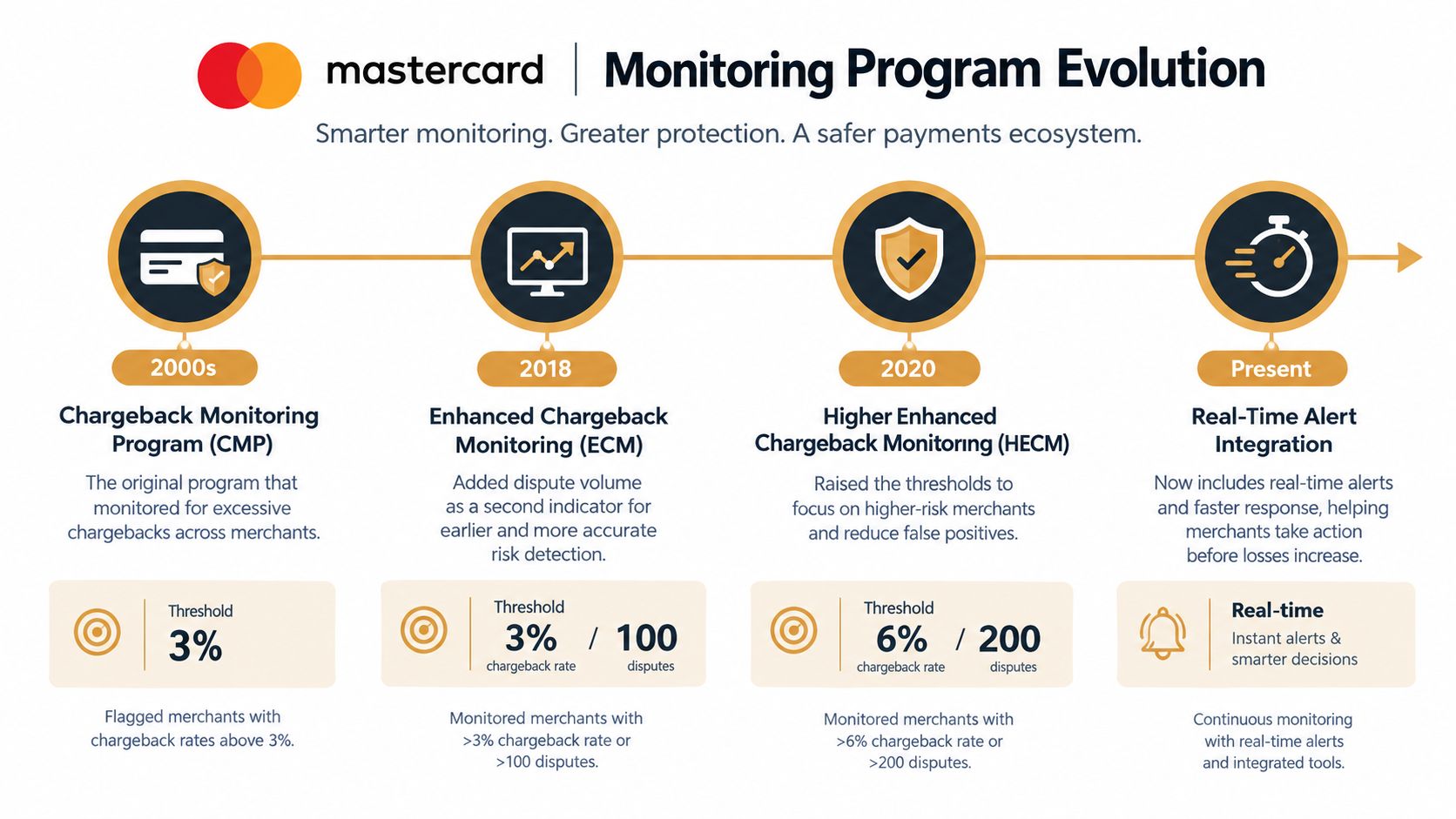
Mastercard's framework has changed, so older blog posts can mislead merchants. The former Chargeback Monitored Merchant, or CMM, structure used a threshold of 100 chargebacks and a 1.0% ratio, but Mastercard removed it effective April 2020. Before that removal, a policy change in October 2019 required merchants to meet both the chargeback count and ratio before being flagged (Braintree's Mastercard program overview).
That progression matters because it shows a move away from a simple warning-style threshold and toward a more selective, ratio-based framework. The current ECM and HECM structure evaluates the interaction between dispute volume and payment volume. A high-volume merchant can't assume that its scale makes the ratio irrelevant, and a smaller merchant can't assume that a moderate count makes monitoring impossible.
What the change means operationally
The older CMM approach encouraged merchants to watch a single minimum ratio and count combination. The modern approach rewards more disciplined forecasting because both inputs can move independently:
- A stable dispute count can become more concerning when captured payments fall.
- A growing transaction base doesn't solve service or fraud causes permanently.
- A sudden dispute increase can push a merchant toward the ratio gate before internal reports show a full-month trend.
That's why threshold history isn't just background reading. It tells you not to build a compliance process around a copied table. Confirm current requirements with your acquirer, preserve the applicable reporting definitions, and recalculate exposure when Mastercard or your processor changes its reporting logic.
A merchant that treats the program as static will usually react to a notice. A merchant that treats it as an evolving control environment can adjust reporting, alert handling, and customer operations before the next review cycle.
Using Real-Time Alerts to Prevent Chargebacks
Pre-dispute alerts change the decision point. Instead of waiting for a formal chargeback and then assembling evidence, the merchant receives an issuer-originated signal while a refund or resolution may still prevent the dispute from entering the network record.
The relevant ecosystem includes Mastercard's Cardholder Dispute Resolution Network, Ethoca alerts, and Visa's Rapid Dispute Resolution. Coverage depends on the issuer, merchant, processor, and network connections, so no single feed should be assumed to capture every event. The operating principle is consistent: match the alert to the original transaction, apply a defined refund rule, and complete the response inside the available window.
Where alerts work and where they fail
A real-time alert is valuable only when your team can act. A queue that notifies support but provides no transaction match, refund authority, or escalation path creates another unresolved inbox. The Shopify chargeback protection workflow illustrates the kind of processor-level connection merchants need to consider when designing prevention operations.
For each alert, decide whether to:
- Refund immediately: Appropriate when the transaction is confirmed fraudulent, duplicated, or tied to a clear service failure.
- Resolve without refund: Appropriate when customer support can quickly correct a misunderstanding and the issuer process allows that outcome.
- Review selectively: Appropriate when the transaction has compelling fulfillment or authentication evidence and a refund would create an avoidable loss.
The trade-off is real. Refunding every alert may reduce chargeback exposure but can sacrifice valid revenue. Refunding nothing may preserve revenue on paper while allowing preventable disputes to accumulate. The right policy uses transaction value, fraud confidence, customer history, product delivery status, and the likelihood of successful resolution.
Build the response around time
Alert workflows need an on-call owner, automatic transaction matching, clear refund permissions, and a reconciliation report. Subscription businesses should include cancellation and renewal rules, because a customer's request may arrive close to the next billing event. High-volume merchants should also test duplicate alerts and partial refunds before turning on automation.
The best defensive strategy combines prevention with cause analysis. If alerts cluster around one billing descriptor, acquisition source, product, or renewal stage, fix that source rather than treating refunds as the entire solution.
The 2026 Monitoring Overhaul and What Changes
Reducing formal chargebacks may not be the complete future strategy. Mastercard materials describe a broader Global Merchant Audit Program that is intended to unify acquirer and merchant monitoring, bring fraud and non-fraud dispute performance into one view, and retire the legacy ACMP framework. The initial standards are not expected to take effect until April 2027, with first billing described for May 2027, so merchants should treat this as a projected change rather than a current ECM replacement (Mastercard dispute management materials).
The important shift is conceptual. A narrow chargeback dashboard asks, “How many disputes became chargebacks?” A broader governance process asks, “What fraud and dispute signals are accumulating across the payment journey, including events that haven't yet become chargebacks?”
Why pre-dispute prevention still matters
Pre-dispute tools remain useful because they can stop an avoidable event before it reaches formal network reporting. They aren't a license to ignore fraud that never becomes a chargeback. A transaction can still indicate weak authentication, account compromise, or an operational pattern that deserves investigation even when the customer hasn't filed a dispute.
Merchants should therefore join these data streams:
- Dispute outcomes: Chargebacks, representments, refunds, and alert resolutions.
- Fraud indicators: Declines, suspicious behavior, authentication results, and issuer signals.
- Merchant operations: Fulfillment, support contacts, cancellation requests, and recurring-billing changes.
- Acquirer reporting: Program notices, account-level requirements, and current definitions.
This broader view also changes how leadership evaluates prevention costs. A refund rule isn't merely a way to reduce a monthly count. It's one control inside a payment-health program that must balance revenue preservation, cardholder experience, fraud loss, and acquiring stability.
Building a Long-Term Monitoring Defense Strategy
A durable defense has three connected layers. First, forecast exposure using the prior-month captured-payment base. Second, intercept eligible disputes before formal filing. Third, prepare reporting that can accommodate a broader fraud-and-dispute view as Mastercard's projected framework develops.
Start with ownership rather than software. Payments should produce the monthly count and denominator. Finance should reconcile captured payments and refunds. Support should classify avoidable complaints. Risk should review fraud patterns and alert decisions. Leadership should receive exceptions, not a raw export that nobody can interpret.
A practical operating model
Every day, route alerts to an accountable queue and reconcile refunds with the original transaction. Record why the team refunded, declined, or escalated each alert.
Every week, review dispute causes by product, billing cycle, channel, processor, and merchant account. Look for operational changes that precede disputes, such as a descriptor update, fulfillment delay, or subscription renewal issue.
Every month, calculate the projected Mastercard ratio using the correct preceding-month captured-payment base. Compare the count and ratio separately, then model the effect of lower sales volume and channel changes.
Ahead of program changes, ask your acquirer which data it will provide for fraud and non-fraud dispute monitoring. Don't wait for a new notice to discover that your reporting systems can't join customer, transaction, alert, and chargeback records.
You can also evaluate a managed prevention option when internal teams can't respond reliably. Disputely is one example of a platform that connects to Mastercard dispute alerts and can automate refund workflows during the pre-chargeback response window. Merchants considering any provider should test matching accuracy, processor coverage, refund controls, reconciliation, and escalation handling before routing live alerts through it.
The chargeback-fighting process still has a place for disputes that become formal cases, but representment shouldn't be the only defense. The strongest programs reduce avoidable disputes upstream, preserve evidence for the cases worth challenging, and use the same reporting system to measure both outcomes.
Don't manage the threshold as a monthly surprise. Manage the causes, timing, and data that create it.
If Mastercard chargebacks are consuming payment-team time, visit Disputely to review a pre-dispute alert workflow for CDRN, Ethoca, and related integrations. Set refund rules, connect your processor, and use the resulting alert and dispute data to act before preventable chargebacks distort your monitoring exposure.


