
Mastercard Ethoca Explained: Alerts That Stop Chargebacks
You usually learn a customer is unhappy long after the money is gone. The order shipped, the support inbox stayed quiet, then a chargeback lands weeks later and the dispute ratio moves in the wrong direction before anyone has time to react. Mastercard Ethoca exists to shrink that delay, so the merchant sees issuer-confirmed fraud or a dispute while there's still a chance to refund, stop fulfillment, or protect the account relationship.
That timing changes the game for ecommerce and subscription teams. A traditional chargeback cycle can arrive after the product is out the door and the billing team is already buried in other tickets, which is why many merchants end up paying for mistakes they never had a chance to fix. If your ratio is already under pressure, the operational patterns behind that pressure are worth reviewing alongside your alert strategy, especially if you're dealing with a high chargeback rate like the teams described in this chargeback risk overview.
Why Chargebacks Arrive Too Late to Fix
A common failure starts with silence. The customer contacts the issuer, the issuer confirms a dispute or fraud concern, and the merchant hears nothing until the card network's formal process is already moving. By the time the chargeback reaches the merchant, the order is often fulfilled, the digital service has been used, and the business is reacting instead of deciding.
That delay is the core problem. Mastercard's acquisition announcement framed Ethoca as a way to close the information gap between issuers and merchants, because the issuer learns about the problem first and the merchant normally learns last. In practice, that means a merchant cannot stop shipment, pause access, or correct a customer issue while the transaction is still salvageable. Mastercard said the network connected more than 5,000 merchants with 4,000 financial institutions worldwide at the time of the acquisition, which shows how many parties were already trying to solve the same timing problem through a shared network. Mastercard's Ethoca acquisition announcement
The operational cost of being late
Once a formal chargeback lands, the merchant is no longer choosing between refunding and not refunding, it is choosing between absorbing the loss or fighting a process that already started. For ecommerce and subscription businesses, that delay is especially expensive because fulfillment often happens quickly and support work happens later.
Practical rule: if the merchant only hears about the dispute after the issuer has already committed to the case path, the business has lost the cheapest moment to intervene.
A chargeback-risk review can help spot the patterns that lead to that outcome, especially if the business is already seeing pressure on its ratio. chargeback risk overview
Ethoca matters because it moves the signal earlier. Instead of a weeks-later cleanup exercise, the merchant gets a chance to act while the order is still open, which is the only point where a refund or cancellation can prevent the dispute from hardening into a chargeback. That timing problem matters more than the dispute itself.
How Mastercard Ethoca Alerts Work
A customer contacts the issuer, or the issuer otherwise confirms the cardholder's dispute. Ethoca turns that issuer-confirmed signal into an alert the merchant can act on before the case becomes a chargeback. That matters because the merchant is still working with an open order, not a closed dispute file. Mastercard's developer documentation describes this as an issuer-to-merchant pipeline, not a passive notification feed. Ethoca Alerts for merchants documentation
The alert itself does not decide the outcome.
The merchant still has to make a call. In practice, that usually means stopping fulfillment, suspending service, refunding the transaction, marking the order as not found, or confirming that it was already cancelled. Mastercard's guide makes the point plainly, the alert is a signal for review, not an automatic refund order. Ethoca Alerts tutorial and guide
The part many teams miss is the closeout. After the merchant acts, it reports an outcome such as REFUNDED or NOT_SETTLED back to Ethoca, and Ethoca passes that result to the issuer. Without that feedback loop, the alert can stay unresolved even if the merchant already fixed the order. In my experience, that is where refund leakage starts, the refund happens but the outcome never makes it back, so the merchant looks responsive internally while the external dispute path keeps moving.
Timing is the key advantage. Traditional chargeback notification can take roughly three to six weeks, while Ethoca documentation says alerts can arrive in days, hours, or minutes. That gives the merchant a window to stop delivery, revoke digital access, or reverse the charge before the dispute hardens into a formal chargeback. The value comes from acting while there is still something left to save, not from reacting after the case is already locked in. Ethoca Alerts for merchants documentation
A simple ecommerce example
A subscription renewal is flagged. The merchant checks whether the customer already cancelled, whether there is a real service issue, and whether the renewal should be reversed. If the claim is clean and the service has not been used, the merchant refunds quickly. If the alert is ambiguous, the merchant can hold the account, review evidence, and decide whether to fight the dispute later.
The decision framework matters more than the alert volume. Some alerts should be auto-refunded because the cost of delivery, support, and dispute handling is already too high. Others should be paused while the merchant verifies fraud signals or fulfillment status. A smaller set should be fought when the transaction is legitimate and the evidence is strong. Ethoca shortens the time between issuer discovery and merchant action, but the merchant still owns the response.
What Ethoca Alerts Delivers at Scale
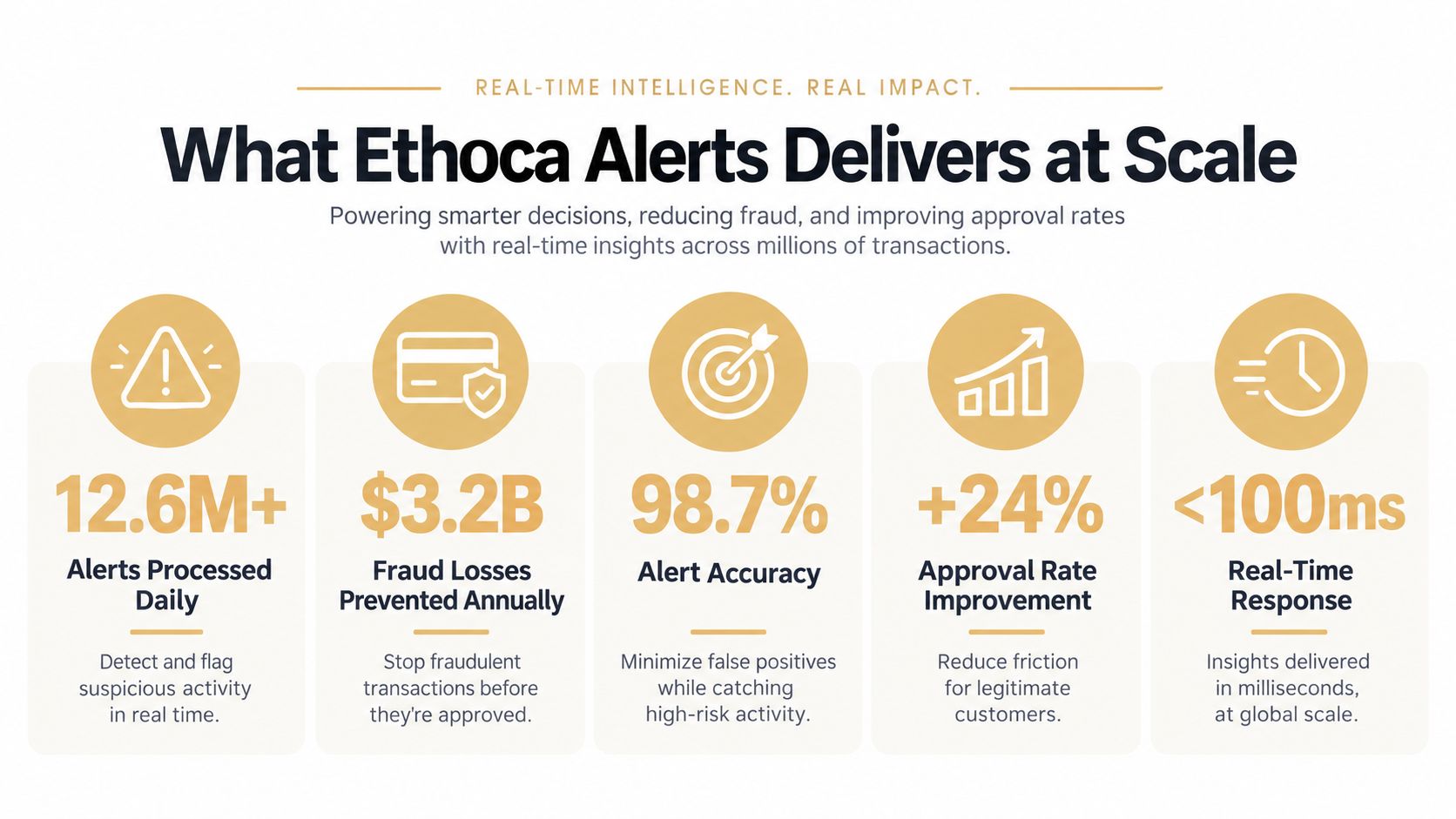
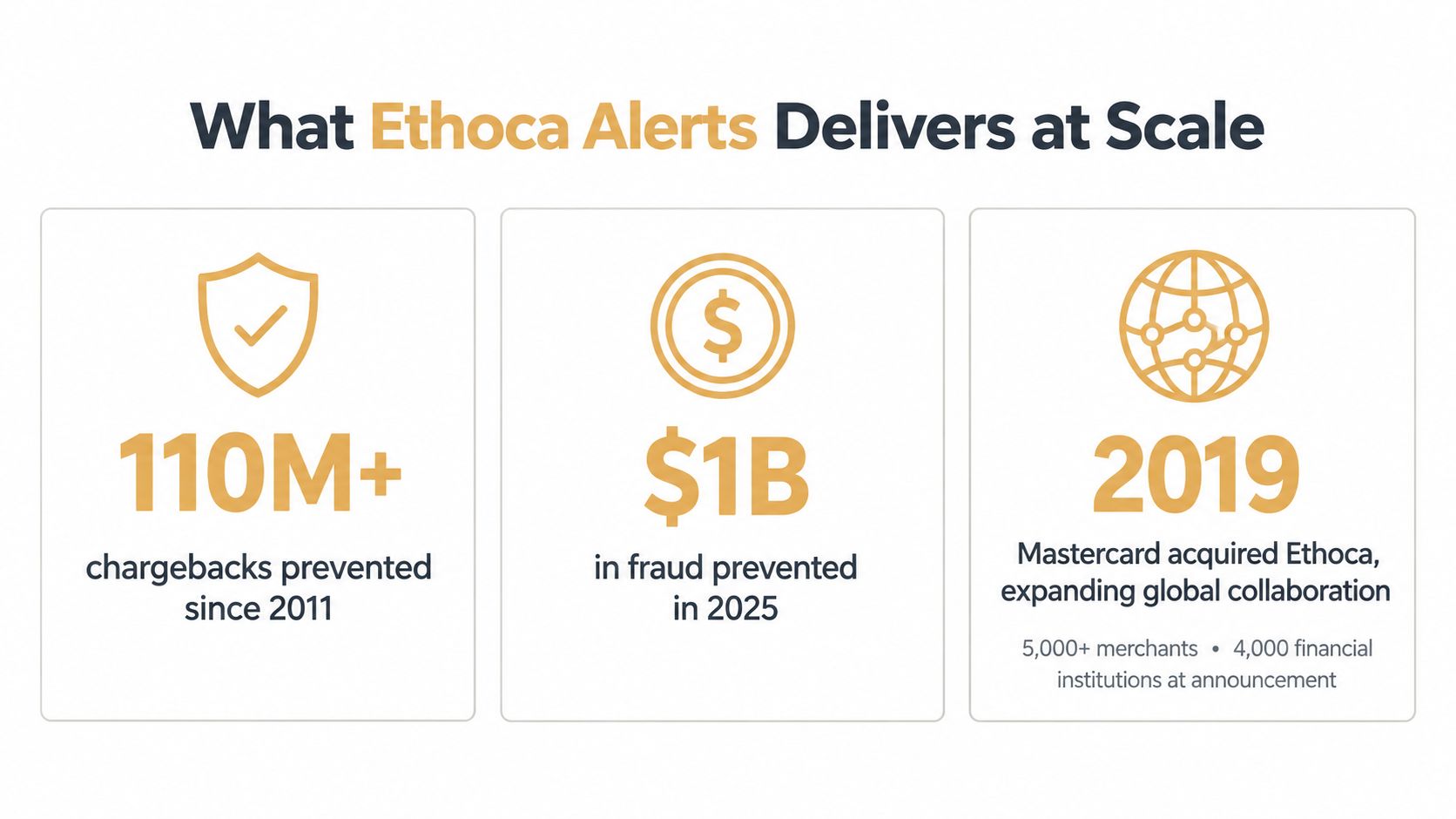
At scale, Ethoca is less about brand familiarity and more about operational load. Mastercard reported that Ethoca Alerts helped prevent more than 39 million chargebacks during 2025 and more than 110 million chargebacks cumulatively since 2011, while also preventing approximately $1 billion in fraud during 2025. Mastercard and Worldpay also described the network as processing millions of daily alerts, which matters because merchants do not win on alerts alone, they win on how quickly they can turn an alert into the right action. Mastercard and Worldpay fraud-fighting announcement
That scale changes the merchant's decision tree.
Some alerts should be auto-refunded because the transaction is already lost once support time, shipping cost, and dispute handling are added up. Others should be paused while the team checks fraud signals, fulfillment status, or whether the customer has already cancelled. A smaller group should be fought when the sale is legitimate and the evidence is strong. The point is not to treat every alert the same, because that is how merchants create refund leakage or keep bad transactions alive long enough to become chargebacks.
The footprint behind Ethoca explains why that workflow can hold up across regions. Mastercard said the acquisition would expand its digital-commerce fraud and dispute capabilities, and that Ethoca already served more than 5,400 merchants across 40+ countries and more than 4,000 card issuers in 20+ countries at the time. That kind of reach matters for merchants selling across borders, where issuer-to-merchant routing has to happen quickly and cleanly. Mastercard's Ethoca acquisition announcement
A scale story only matters if the workflow holds together. If alerts are not acknowledged, if outcome reporting is incomplete, or if refund and reconciliation records do not match what really happened, the merchant still ends up with chargebacks on the books and manual cleanup in the queue. Ethoca pays off when the alert response is disciplined, not when the dashboard looks busy.
How Ethoca Compares to Visa RDR and CDRN
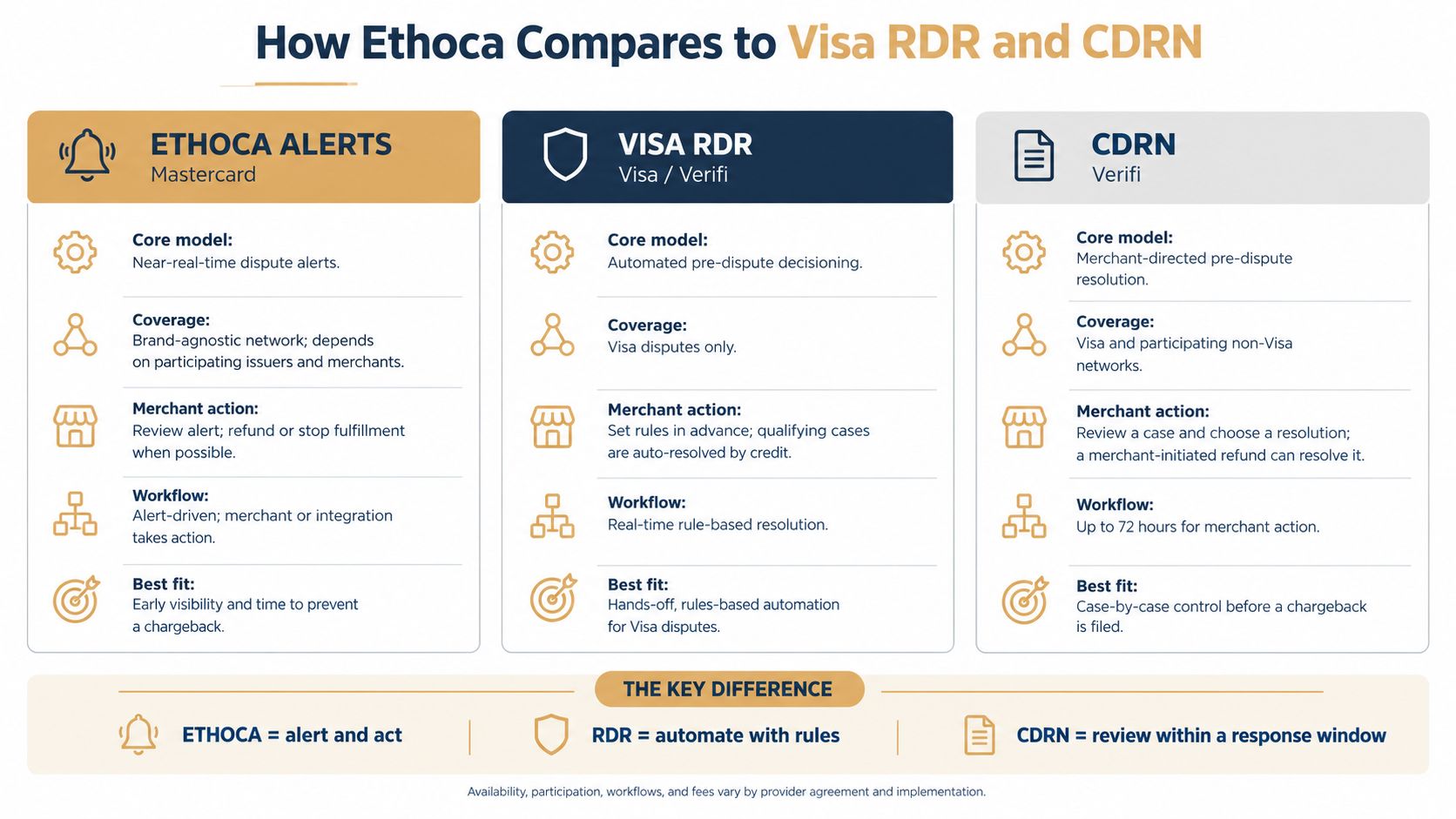
Most merchants don't sell into one card brand, so network choice matters. Ethoca Alerts covers the Mastercard side of the house, Mastercard CDRN is the other Mastercard dispute-routing path, and Visa Rapid Dispute Resolution covers Visa volume. A merchant that only buys one network leaves gaps, even if that one network performs well.
| Network | Card Brand | How Alerts Trigger | Merchant Action |
|---|---|---|---|
| Ethoca Alerts | Mastercard | Issuer-confirmed fraud or dispute is forwarded to the merchant | Review, refund, stop fulfillment, or escalate |
| Mastercard CDRN | Mastercard | Dispute is routed through Mastercard's network process | Review and respond within the network workflow |
| Visa RDR | Visa | Disputes are resolved through Visa's rapid dispute process | Follow automated resolution rules and refund when appropriate |
What the table hides if you don't read carefully
Ethoca and CDRN both matter to Mastercard merchants, but they are not the same thing in practice. Ethoca is the issuer-to-merchant alert path, while CDRN operates through Mastercard's dispute-routing flow. Visa RDR solves the Visa side of the portfolio, which is why mixed-brand merchants usually need more than one tool.
The practical takeaway is coverage, not brand loyalty. If half your disputes are on Visa and you only monitor Mastercard alerts, your resolution coverage is incomplete. If you're running subscriptions or recurring billing, that gap shows up fast because card-brand mix rarely stays static.
A good alert stack follows the merchant's payment mix, not the vendor's favorite product line. That's why many teams use an alert platform that can aggregate multiple networks instead of forcing operations to swivel between separate dashboards and separate response rules.
Building a Smart Alert Response Strategy

Ethoca is not an automatic refund mandate. That's the mistake many merchants make when they first turn it on, and it's a costly one. A blanket auto-refund rule can turn a winnable dispute into pure revenue loss, especially when the customer is known, the service was delivered, or the merchant has strong representment evidence.
Classify first, then decide
The best response framework starts with transaction status. If the order is unfulfilled, a refund or cancellation is usually straightforward because the merchant still controls the shipment or access. If the order is already fulfilled, the decision changes because the merchant may have a real argument to keep the charge.
Then look at margin and history. Low-margin items are easier to refund quickly because the cost of fighting may exceed the value of the order, while high-value or high-confidence accounts may justify manual review. Repeated fraud flags, subscription renewals, and digital goods each need their own treatment, because the commercial harm from an unnecessary refund is different in each case.
Here's the useful rule set in plain terms:
- Auto-refund fast: unfulfilled orders, low-margin baskets, obvious fraud patterns, or cases where stopping shipment prevents more loss.
- Pause and investigate: known customers, digital goods, subscription renewals, and orders with messy fulfillment status.
- Fight when evidence is strong: clean delivery proof, prior cancellation records, customer history that contradicts the claim, or cases where refunding would create more loss than the expected dispute cost.
The right goal is prevented chargeback cost after refund leakage, not the vanity metric of how many alerts got refunded. A merchant that refunds everything can make the alert dashboard look clean while slipping margin on disputes that were defensible.
If you need a useful operational companion for staffing and workflow design, the discussion of how ecommerce teams staff support is a good reminder that dispute handling is still a service function, not just a payment switch.
The support side also matters because alert triage often sits between payments and customer care. A service team that can't reach the right evidence quickly will either refund too much or sit on alerts too long.
The strongest teams build rules around transaction state, customer context, and evidence strength, then let humans handle the edge cases. That's the part most merchants miss when they ask for “automation” without defining what should be automated.
For teams that already handle disputes across multiple channels, the same logic applies whether the alert came from Mastercard Ethoca, a processor dispute feed, or a broader chargeback-fighting workflow. The alert is just the trigger. The decision rule is the asset.
Integration and Operational Reliability
An alert that lands in the wrong inbox is close to no alert at all. Mastercard documents three integration surfaces, Push webhooks, Pull polling, and an Outcome API, and each one creates a different operational load. The integration choice matters less than whether the merchant can reliably acknowledge, match, act, and report back before the window closes.
The plumbing that decides success
Webhooks are fast, but they fail when delivery breaks or downstream systems miss the payload. Polling is more forgiving, but it can lag if the job schedule slips or the queue gets noisy. The Outcome API closes the loop, which means the merchant must decide what to do and then tell Ethoca what happened after the investigation.
Mastercard's support guidance recommends a final outcome within 24 hours to maximize the chance of stopping the chargeback. That makes internal SLA design critical, because a fast network alert still loses value if the merchant waits on a refund queue, a warehouse stop-ship exception, or a manual reconciliation step that takes too long. Ethoca Alerts support guidance
A reliable setup needs a few controls.
- Acknowledgment versus resolution: confirm receipt immediately, then finish the operational action separately.
- Retry and idempotency rules: prevent duplicate refunds when the same alert lands more than once.
- Reconciliation checks: compare alert outcomes to processor refund status so pending refunds do not look like completed work.
- Partial-match handling: define what happens when an alert maps to only part of an order or to an ambiguous record.
Operational rule: if support, payments, and fulfillment do not share the same truth source, the merchant will either miss alerts or refund twice.
That is why teams often layer the alert feed into a broader payment operations stack. If your business runs on Shopify, a platform like Disputely provides dedicated Shopify chargeback protection that sits between the alert and the refund action. For teams that manage uptime and incident response with the same discipline, the logic in infrastructure monitoring for fintech applies here too, because the system only helps when it is still moving money at the right moment.
The right metrics are the ones that expose failure modes. Track missed-alert rate, median response time, and prevented-chargeback rate separately. If you collapse them into one dashboard number, you will not know whether the problem is bad routing, slow humans, or weak refund logic.
Your Ethoca Readiness Checklist
Before turning on Mastercard Ethoca, map your card mix and confirm which networks you still need beyond Mastercard coverage. Check whether your processor or alert platform supports Ethoca directly, then decide which alerts should auto-refund, which should pause for review, and which should go to manual escalation. Make sure someone owns alerts outside business hours, because the network doesn't care when your team clocks in.
Track the weekly numbers that tell the truth, not the ones that only make the dashboard look busy. You want to see whether alerts are preventing chargebacks, whether refunds are leaking on winnable cases, and whether the workflow is helping protect your payment relationship instead of stressing it. The objective is staying below dispute thresholds while preserving as much revenue as you can.
Disputely connects merchants to Ethoca, Visa RDR, and Mastercard CDRN, then applies configurable refund rules so alerts can be handled consistently before they become chargebacks. If you're building a response workflow around Mastercard Ethoca, visit Disputely to see how the alert plumbing, automation, and reporting fit together.


