
Merchant Category Code Explained: Fees, Risk and Fixes
A merchant category code is a four-digit number describing a merchant's primary business, assigned by the acquirer during account setup rather than chosen by the customer for each purchase.
You might be investigating declined payments, an unexpected expense category, or customers who don't recognize a subscription charge. Before changing checkout settings or blaming fraud filters, check whether your payment partners have an accurate picture of what your business sells.
Why One Four-Digit Code Shapes Every Card Payment
A customer scrolls through their card statement, spots an unfamiliar business name, and calls the bank before contacting your support team. They bought from your storefront, but the information surrounding the charge doesn't match what they remember.
That's a useful starting point for understanding payment data. The statement descriptor and merchant category code, usually shortened to MCC, aren't interchangeable. When investigating customer confusion, treat the displayed name and business classification as separate questions rather than assuming a category correction will fix everything.
Recognition and classification are different problems
Consider a hypothetical subscription business selling professional services under a consumer-facing brand. A customer remembers the brand, while the payment account reflects information established when the business first launched. Your operations team needs to check both whether customers recognize the charge and whether the account still represents the business accurately.
The MCC isn't a customer-service message. It's structured classification data used across payment processing, reporting, compliance, and risk processes, as described in Visa's merchant data standards manual. That makes it relevant even when customers never see the underlying code.
For ecommerce teams, the practical distinction is between improving the buying experience and maintaining accurate payment-account information. Resources that help you optimize your store's checkout process address the customer-facing side. Account classification deserves a separate conversation with your payment provider.
Practical rule: Investigate what the customer saw and what the payment system received. Don't assume they're the same thing.
A useful investigation keeps several questions separate:
- Recognition: Does the customer understand which business charged them?
- Classification: Does the payment account describe the business accurately?
- Transaction outcome: What explanation does the processor provide for the payment or dispute?
Keeping those questions distinct helps your team avoid changing the wrong setting. It also creates a clearer support request than telling the processor that payments look wrong.
How Merchant Category Codes Are Assigned and Travel With Every Transaction
Think of an MCC as a shipping label attached to payment data. The label identifies the kind of business sending the transaction, not everything inside the customer's shopping basket.
A parcel can contain different items without changing the sender's identity. Likewise, a merchant can sell different offerings without assigning a fresh business category to each purchase.
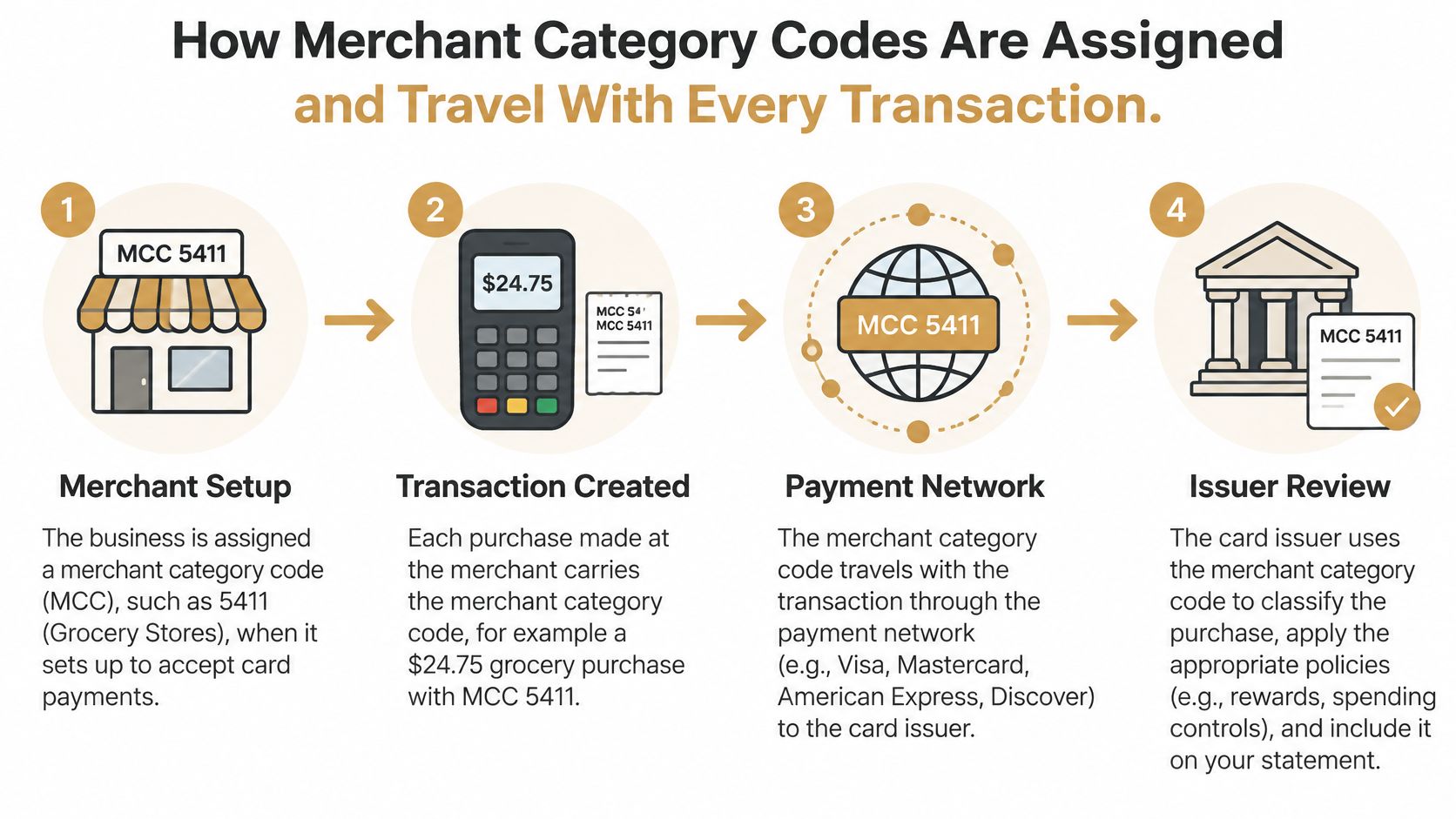
The following diagram shows the classification moving from account setup through issuer review.
Assignment starts with the business
Your acquirer, the institution responsible for the acquiring relationship, governs classification under the applicable network rules. Depending on your payment arrangement, a payment facilitator or processing system handles the setup workflow.
The classification should reflect the merchant's primary activity. Visa's definition considers annual sales volume in local currency, so the commercial substance of the business matters more than a convenient website label.
For a hypothetical business that sells both products and consulting, the useful onboarding question is which activity represents its primary business. Picking whichever category sounds closest to the brand name isn't a reliable method.
The network documentation also matters. Visa's manual lists codes numerically, defines them, and explains that its descriptions were derived from Standard Industrial Classification codes. A processor's abbreviated dashboard label shouldn't replace the underlying category definition.
Following the payment data
The workflow is easier to understand when you separate the participants:
- Merchant setup: The provider establishes the classification for the relevant merchant account or outlet.
- Transaction creation: The payment carries the configured category, rather than a category selected by the shopper.
- Network processing: Participants use the classification as part of transaction processing.
- Issuer review: The card issuer interprets the category alongside other transaction information.
The same classification can support authorization, settlement, reporting, compliance, and risk work. Those uses explain why an onboarding decision deserves attention long after the account goes live.
Settlement is the later stage of completing the payment financially. It isn't a new opportunity for the customer to choose how the purchase should be categorized.
The label describes the merchant's activity. It isn't an itemized receipt.
That distinction answers a common question: buying an unusual item from a merchant doesn't automatically change the merchant's category. If your business itself has changed, however, the account configuration may need review. That's a governance issue for your provider, not a checkout preference.
How Codes Influence Fees, Risk and Chargebacks
An accurate category doesn't guarantee an approval. An inaccurate category can nevertheless create a problem before the customer has any chance to explain the purchase.
This diagram provides a visual reference for the payment and monitoring stages.
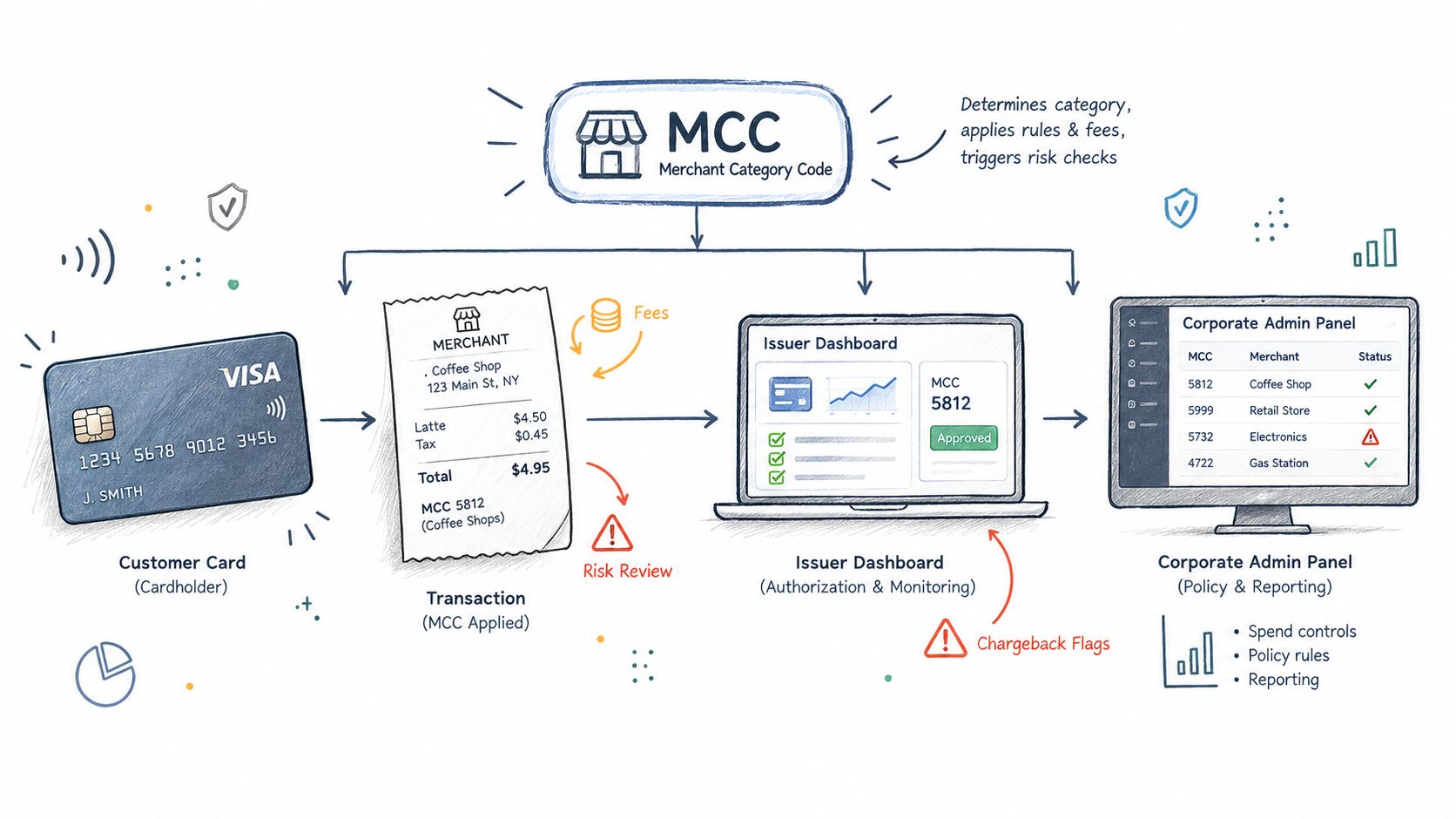
Category controls can affect legitimate purchases
The international framework is ISO 18245, originally published in 2003 and revised in 2023; it supports merchant classifications that issuers and corporate-card administrators can use for category-based controls during authorization, as outlined in the ISO 18245 overview.
Consider an employer that permits spending at certain business-service merchants but restricts unrelated categories. If a legitimate supplier is misclassified, an employee's purchase could encounter the category restriction despite being allowed under the employer's written policy.
That's an illustrative scenario, not proof that a particular decline came from the MCC. Your processor still needs to investigate the transaction.
| Question | Sensible operational response |
|---|---|
| Was a category restriction involved? | Ask the provider to investigate the authorization outcome. |
| Does the category match the business? | Compare the account configuration with actual activity. |
| Does the issue affect pricing or reserves? | Request the applicable agreement and a written explanation. |
| Will a correction resolve a dispute? | Assess the dispute's evidence separately. |
Don't infer a fixed fee or dispute outcome
Classification belongs in a risk review, but an MCC alone doesn't establish your total processing cost, reserve requirements, or chargeback outcome. Don't treat a category lookup as a pricing quote, and don't promise that changing a code will remove an account restriction.
The same discipline applies to other risk signals. Guidance on spotting suspicious affiliate conversions concerns another part of the commercial journey. An affiliate concern, an issuer decline, and a classification mismatch require different evidence, even when they occur around the same sale.
The embedded video provides an additional reference alongside the transaction diagram.
If you're investigating a high chargeback rate, include classification in the account review without making it the default explanation. Ask which complaints concern recognition, delivery, cancellation, or authorization, then match each problem to the evidence you can verify.
Mixed Business Models and Subscription Edge Cases
A subscription business introduces one-time add-ons. A direct-to-consumer brand starts selling services. A reseller launches a marketplace alongside its existing store.
These are hypothetical examples, but they illustrate a practical difficulty: the business described during onboarding may no longer match what the merchant operates today.
Recurring billing doesn't answer the classification question
For the subscription company, start with what customers receive, not merely how often they pay. Ask whether the add-ons support the existing activity or represent a materially different line of business.
For the direct-to-consumer brand, compare the established product business with the new service offering. A small experiment and a substantial shift in revenue deserve different discussions with the acquirer. Don't assume the original category remains suitable because the legal entity hasn't changed.
Use this checklist to frame the review.
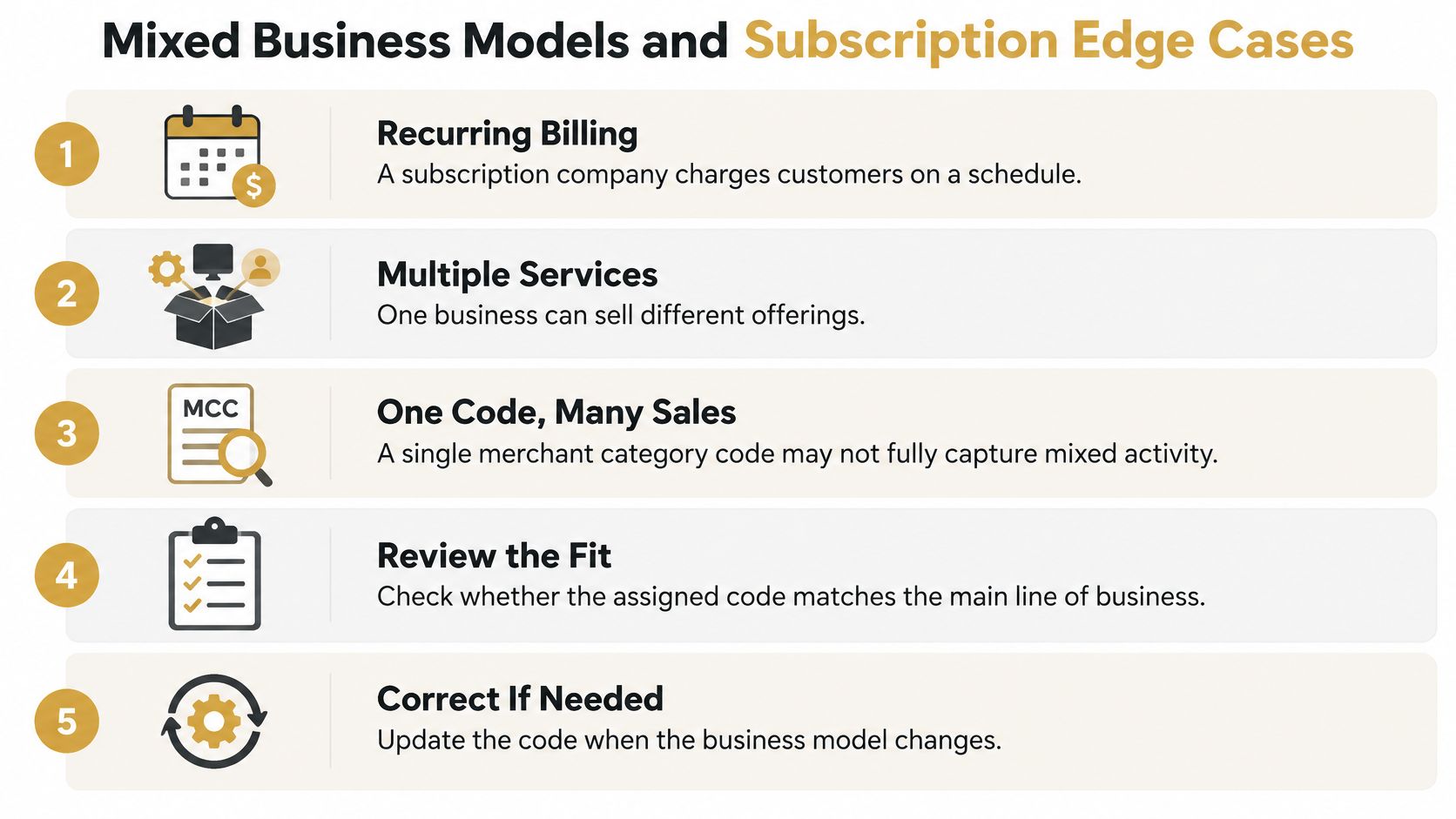
Separate operations need a documented decision
Visa's public rules require the acquirer to assign the code that most accurately describes the merchant outlet. They also require multiple MCCs in specified circumstances, including separate business lines with separate merchant agreements, distinct merchant names, designated high-integrity-risk activity, and qualifying linked ecommerce websites.
That means neither “one company, one category” nor “one website, one category” is a safe universal rule.
Prepare the relevant facts before asking the acquirer to decide:
- Multiple websites: Document what each site sells, the names customers encounter, and the merchant agreements involved.
- Reseller activity: Explain the offering and commercial arrangement rather than relying on the reseller label alone.
- Marketplace structure: Show how sellers, offerings, websites, and payment accounts relate to each other.
- Mixed revenue: Provide the revenue mix and identify whether the activities are operationally separate.
A practical decision path starts with the dominant activity, then checks whether distinct operations trigger separate treatment under network and acquirer rules. The merchant supplies the business facts; the acquirer determines the appropriate classification.
Review triggers should include a meaningful product launch, a shift in revenue mix, a new website, a changed merchant name, or a revised marketplace arrangement. Record the trigger and the provider's response so the next operations lead doesn't have to reconstruct why the account was configured that way.
Finding and Correcting Your Merchant Category Code
Start with a specific account, not a search-engine list of possible categories. You need to establish what your provider configured before deciding whether it's wrong.
Check your processor dashboard and transaction records. If the category isn't visible, ask processor support for the assigned MCC and review your account-setup documentation for any recorded classification.
Build a useful correction request
Visa's operational guidance recommends identifying the primary business activity, configuring the corresponding category, validating it through test transactions, and reviewing the assignment when the business model changes. For merchants using multiple processors, it also supports comparing the category across accounts and escalating discrepancies.
Use a short evidence-led workflow:
- Locate the assignment: Record the processor, merchant account, relevant website, and category returned in the dashboard or transaction data.
- Explain the business: Describe what customers buy and how the dominant revenue activity supports that description.
- Compare accounts: Flag differences across processors without assuming they're automatically errors.
- Request review: Send the business explanation and the reason you believe the current assignment needs examination.
The correction process should run through the provider responsible for the account.
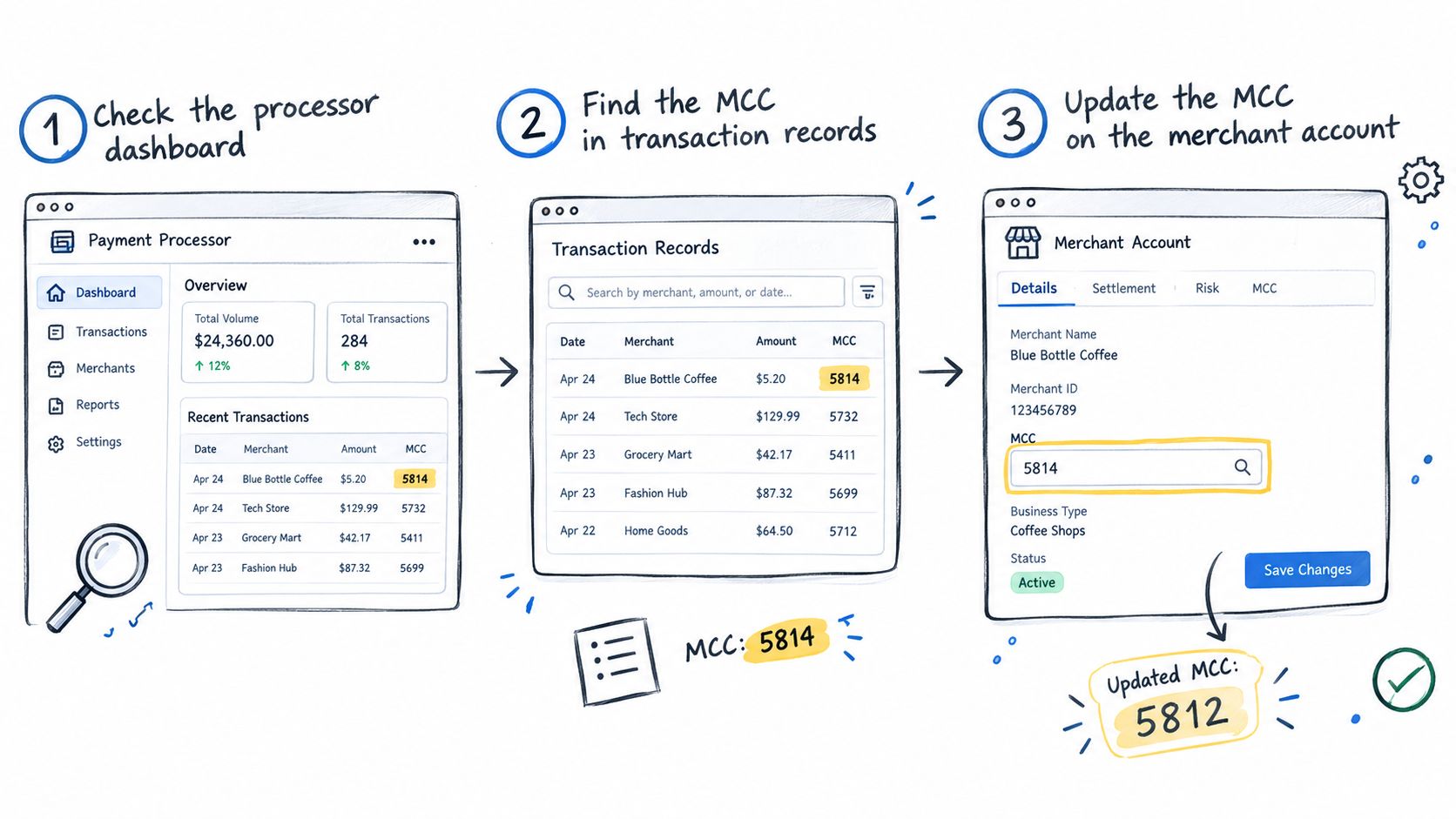
Test the transaction, not just the dashboard
Ask the processor how to validate the configuration through an appropriate test transaction or live authorization. Preserve the transaction reference so support can investigate the data associated with that specific attempt.
If a customer's banking app presents an unexpected category, don't assume its wording proves the transmitted MCC is wrong. Ask your provider to distinguish the underlying code from the issuer's displayed interpretation.
A focused escalation might explain that the account now primarily sells a different service, identify when the activity changed, and request confirmation of the correct classification. Attach relevant transaction references rather than sending a general complaint about declines.
Escalation note: Ask what was configured, what was transmitted, and what was interpreted before deciding which participant needs to correct something.
After an approved change, obtain confirmation and validate the result again. Keep that record with your merchant-account documentation, including the business rationale and the provider's response.
Best Practices for Disputes and Processor Relationships
Seeking a more favorable code is the wrong starting point. Your objective is an accurate account, not a category that appears more attractive for rewards, pricing, or scrutiny.
An incorrect MCC can cause declined transactions, reporting inaccuracies, and compliance problems, according to Visa Acceptance's MCC guidance. The same merchant-level classification also helps explain why an apparently eligible product might not earn a category-based card benefit.
Accuracy is different from optimization
If a customer complains about a missing benefit, don't promise to recategorize the sale. Establish whether the merchant classification is accurate, then direct questions about benefit eligibility to the issuer's program terms.
For processor relationships, maintain a straightforward record of what you sell and tell the provider when that changes. Treat a mismatch as a support and governance request, not a workaround to apply.
Keep these responsibilities separate:
- Payment-account accuracy: Describe the business consistently and request review when the operation changes.
- Customer communication: Make invoices, receipts, renewal notices, and support responses understandable.
- Dispute evidence: Preserve records relevant to the actual complaint rather than relying on classification alone.
A tutoring business provides a useful illustration. A guide on how to automate tutoring invoices addresses billing administration and customer-facing records. That work can support clearer communication, but invoice automation doesn't determine the acquirer's classification decision.
Handle the complaint on its own merits
An unexpected category may add to a customer's uncertainty, especially when other payment details are unfamiliar. Investigate the full presentation of the charge rather than asserting that the category caused the complaint.
For a delivery complaint, establish what was ordered and provided. For a recurring-payment complaint, review the subscription and cancellation records. For an unrecognized charge, examine recognition and authorization evidence.
Use chargeback fighting processes when the evidence supports contesting the dispute. Don't treat a correct MCC as proof that every transaction was authorized, or a corrected MCC as a substitute for answering the customer's allegation.
The strongest operational habit is simple: keep the account description accurate and the transaction records useful. Those are complementary jobs, not interchangeable fixes.
Choosing Dispute Tools and Taking Your Next Step
Manual handling, helpdesk workflows, and alert-based tools solve different parts of the dispute problem. Choose based on when your team needs to act and what evidence it can retrieve, not on a promise that software will repair merchant classification.
Reactive dispute handling starts after a chargeback reaches the business. The team investigates the complaint, decides whether to accept or contest it, and assembles relevant documentation.
Alert-based prevention focuses on an earlier opportunity to review an eligible dispute and take action. It's a separate workflow from correcting the merchant account.
Compare the operational work
| Approach | What your team needs |
|---|---|
| Reactive handling | Evidence collection, case ownership, and response procedures |
| Alert-based prevention | Clear refund rules, transaction matching, and exception review |
| Classification governance | Accurate business records and an acquirer escalation path |
For a Shopify store, evaluating Shopify chargeback protection should include practical questions about how alerts match orders and how staff review exceptions. A subscription business should also ask how the workflow handles cancellation records and recurring charges.
When assessing a platform, request current details about processor connections, alert coverage, refund controls, reporting, and commercial terms. Ask how it avoids unnecessary refunds and what happens when an alert can't be matched confidently. Treat the answers as purchasing criteria, not assumptions.
Give the review an owner
Assign payment operations responsibility for the merchant-category check, and give support or finance a named owner for dispute handling. If those teams are separate, agree on how they'll share transaction references and account changes.
This week, locate your assigned category in the processor dashboard or request it from support. If your business model has changed, send the acquirer a written description of the change and ask whether the classification still fits.
Disputely offers chargeback alerts as an option alongside manual dispute handling, helping merchants act on incoming dispute notifications. Accurate classification still belongs with your acquirer, while alert handling needs its own workflow. Visit Disputely to discuss processor compatibility and how alerts could fit your refund and dispute procedures.


