
Merchant High Risk Status Explained and How to Fix It
Your inbox starts with a subject line that makes finance stop mid-day. The acquiring bank wants a call, the reserve is going up, and someone in operations is suddenly being asked for refund logs, fulfillment proof, and the last three months of dispute data. If that sounds familiar, you're not dealing with a theory problem. You're dealing with merchant high risk status, and the only useful response is to treat it like an operational fire, not a branding label.
A lot of merchants waste days arguing about whether they belong in the category. That's the wrong fight. Processors care about exposure, dispute behavior, and whether your account looks controllable. If your business sells remotely, uses recurring billing, ships internationally, or keeps getting customer non-recognition claims, you're already in the zone where underwriting gets stricter and cash gets locked down.
The Email That Changes Everything
He'd seen the warnings before, but they always felt abstract. Then the email landed from the acquiring bank for a subscription merchant clearing about 8,000 monthly transactions. The language was cold and specific, rolling reserve review, account monitoring, possible remediation, updated dispute documentation requested. That's when the math stops being theoretical and starts touching payroll.
What the merchant sees first
The first reaction is usually denial, then panic, then a bad instinct to send a long emotional reply. Don't. The bank is looking for whether the account can be stabilized quickly, not whether the merchant feels misunderstood. The right response is to gather the facts the processor is already worried about, dispute volume, refund handling, billing descriptor clarity, and any recent change in fulfillment or acquisition.
The next 72 hours matter because that's when the merchant either looks organized or unprepared. Pull the monthly transaction file, identify the dispute mix, and separate customer confusion from true fraud. If there's a spike tied to a new SKU, a new offer, or a new geography, say so plainly.
Practical rule: respond to the bank with evidence, not explanations. A short, factual packet beats a long apology every time.
What tends to trigger the review isn't one dramatic event. It's usually a pattern the bank can defend internally, rising disputes, refund noise, cross-border exposure, or a product that doesn't fit neatly into standard underwriting. If your business has reached that stage, the question isn't whether you're high risk. The question is whether you can keep the relationship from tightening further.
What Actually Makes a Merchant High Risk
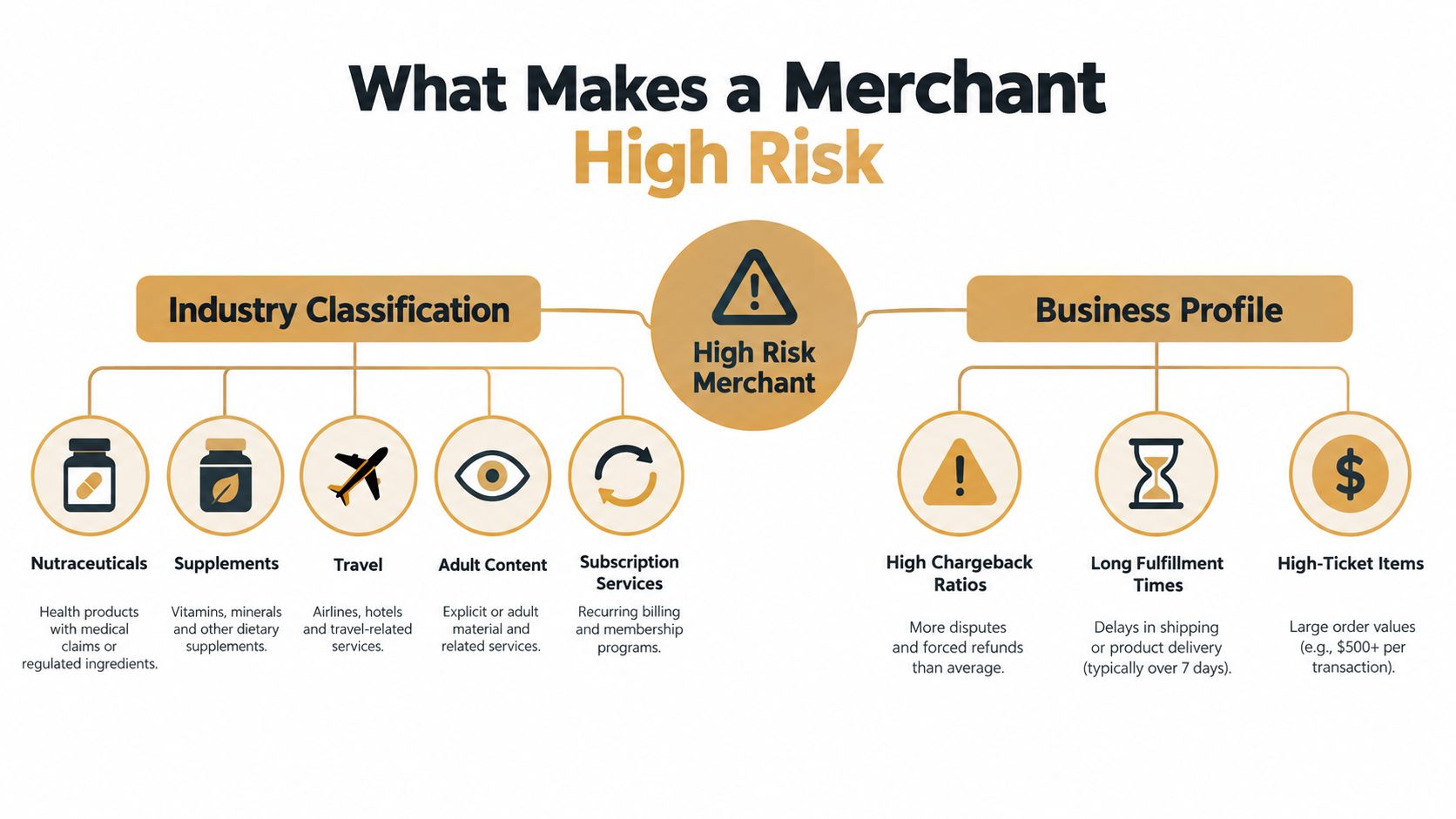
A merchant becomes high risk through two different lenses, and most guides blur them together. The first is industry classification, where certain categories get treated cautiously from day one. The second is behavioral risk, where any merchant can be pushed into tighter review because of how it processes payments.
Industry is only half the story
Some businesses start with a higher baseline because processors know the category carries more dispute, fraud, or compliance exposure. That doesn't mean the business is bad, it means the processor has seen enough bad outcomes in the category to price it differently. A merchant can be fully legal and still get flagged because the vertical itself looks messy to underwriters.
That's why ecommerce subscriptions, DTC brands, and international sellers can land in the same bucket as legacy high-risk categories even when the product is ordinary. The processor isn't only judging what you sell. It's judging how often the transaction pattern creates claims, reversals, and review work.
The scale of payment fraud makes that caution understandable. A joint report by the European Central Bank and European Banking Authority found €4.3 billion in fraudulent payment activity across the EEA in 2022 and €2.0 billion in the first half of 2023, with 7.31 million fraudulent card transactions recorded in H1 2023 ECB and EBA report.
Behavioral signals can override a clean product
Even a perfectly legal merchant can move into high-risk territory if the processing pattern looks unstable. High refund activity, abrupt volume changes, recurring billing confusion, cross-border sales, and weak authentication all signal trouble. The commercial issue isn't fraud rate alone, it's the blend of fraud, customer non-recognition, unauthorized-payment claims, and downstream dispute cost.
If you want a blunt rule, this is it. A legal product doesn't save you if the transaction profile keeps tripping bank alarms.
- High refund noise: refunds that pile up fast make the account look operationally fragile.
- Recurring billing confusion: subscriptions and trial conversions often produce “I didn't authorize this” claims.
- Cross-border sales: international shipping and foreign descriptors make recognition harder.
- Weak authentication: poor transaction verification invites both fraud and disputes.
For a tighter breakdown of those warning signs, the high chargeback rate guide is worth reading once, then using as a checklist against your own data.
How Processors Measure Risk in 2026
Visa and Mastercard do not care how steady your business feels from the inside. They watch ratios, event counts, and whether your account lands in a monitoring program. If you do not know the math, you are negotiating blind.
Visa VAMP and Mastercard ECMP use different logic
Visa's 2025 Visa Acquirer Monitoring Program combines fraud and disputes into one VAMP ratio. In AP, Canada, the EU, the US, and LAC, the excessive-merchant threshold is 2.20%, with a 1,500-event monthly eligibility requirement. In CEMEA, the trigger is 150 events plus USD 75,000 in associated amount Visa VAMP fact sheet.
Mastercard's Excessive Chargeback Merchant Program uses a different test. It looks at both absolute count and ratio, with 100 chargebacks at 1.50% CTR or 300 chargebacks at 3.00% CTR Mastercard program guide. A merchant can get flagged on volume alone even when the percentage looks harmless.
| Network | Ratio Threshold | Volume Trigger | Practical Implication |
|---|---|---|---|
| Visa VAMP | 2.20% combined fraud-and-dispute ratio | 1,500 monthly fraud-and-dispute events in the cited regions, or CEMEA's separate trigger | Track fraud and disputes together, not separately |
| Mastercard ECMP | 1.50% CTR or 3.00% CTR | 100 chargebacks or 300 chargebacks | Absolute dispute count matters as much as the rate |
A merchant with 5,000 transactions per month can do the math quickly. At that volume, 2.20% works out to about 110 combined fraud and dispute events. The exact eligibility rules depend on the network's reporting population, so confirm your numbers with your acquirer. The point is simple. If your team only watches chargebacks and ignores alerts, you are reading half the scoreboard.
If you want a plain-English view of how processors and agents talk about this relationship, the payment processing guide for independent agents is useful. It does not replace network rules, but it shows how underwriting language shows up in real account conversations.
Hard truth: a merchant can be profitable and still be too noisy for a processor. The bank does not need you to be losing money for the account to become expensive.
Reserves, Holds, and Termination Triggers
The reserve conversation is where the processor stops being polite. Once your profile looks unstable, the bank starts protecting itself with cash controls that hit your working capital immediately.
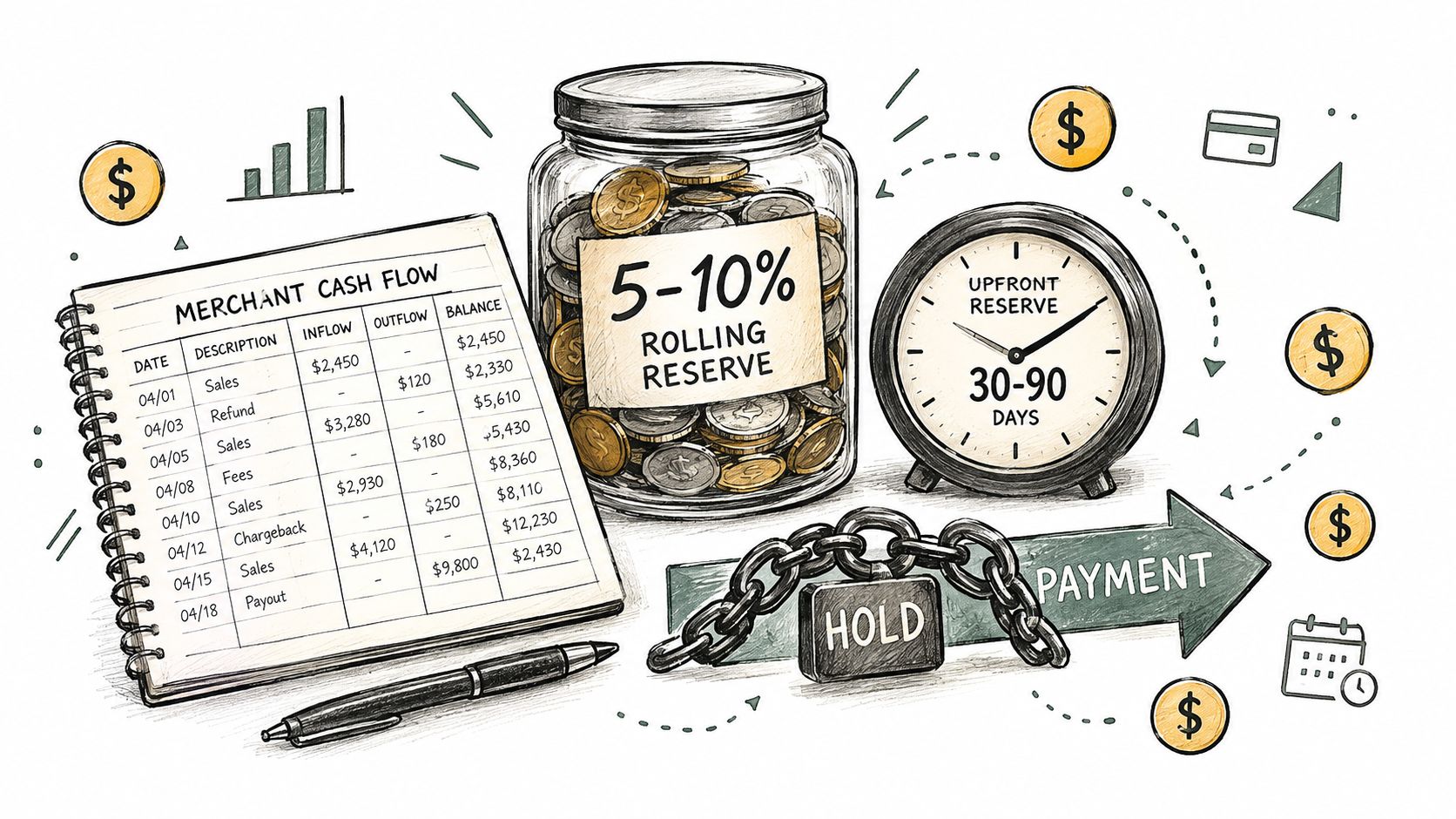
A rolling reserve keeps back a slice of settlement instead of paying it all out at once. Upfront reserves are harsher, because they force you to float cash before you've even seen normal payout behavior. Transaction-level holds are worse still, because they stall specific payouts when the processor wants to slow exposure fast.
What usually gets tightened first
The first move is often a rolling reserve, especially if the bank thinks the business can stabilize. If the profile looks messier, the processor may add holds, fee increases, or tougher contract terms. The termination clause is always there in the background, and once a bank loses confidence, the path to closure gets short.
A merchant on thin cash flow should model the reserve as a real operating expense, not a line-item annoyance. A reserve doesn't just reduce today's payout, it changes how much cash you can use for inventory, payroll, and ads. If the business depends on daily settlement, reserve pressure can turn a manageable month into a liquidity problem.
A reserve is not a penalty in the emotional sense. It's the processor deciding your cash belongs partly to their risk buffer until you prove the account is stable.
If your business is already in a hold situation, the most useful outside reading is this crisis management resource for Israeli bank closures. It's not about cards specifically, but the response discipline is the same, document fast, preserve cash, and stop making the situation louder.
For Shopify merchants dealing with payout friction, the Shopify hold guide is a practical reference point. Shopify isn't the only platform that creates payout stress, but it's one of the clearest examples of how processor scrutiny turns into cash-flow pain.
Separating Fraud From Friendly Fraud From Service Failure
Most merchants say they want to reduce chargebacks. That's too blunt. A stolen card, a regretted purchase, a refund abuser, and a late shipment are not the same problem, and they don't deserve the same response.
The Merchant Risk Council's 2025 report surveyed 1,082 ecommerce payment and fraud professionals and found 47% identified refund abuse as the top fraud attack, while 57% reported refund-abuse concerns. A separate 2025 retrospective found six in ten merchants saw first-party misuse or friendly fraud increase year over year Merchant Risk Council report. That is the core issue. Merchants keep treating every dispute like one thing.
Match the response to the transaction problem
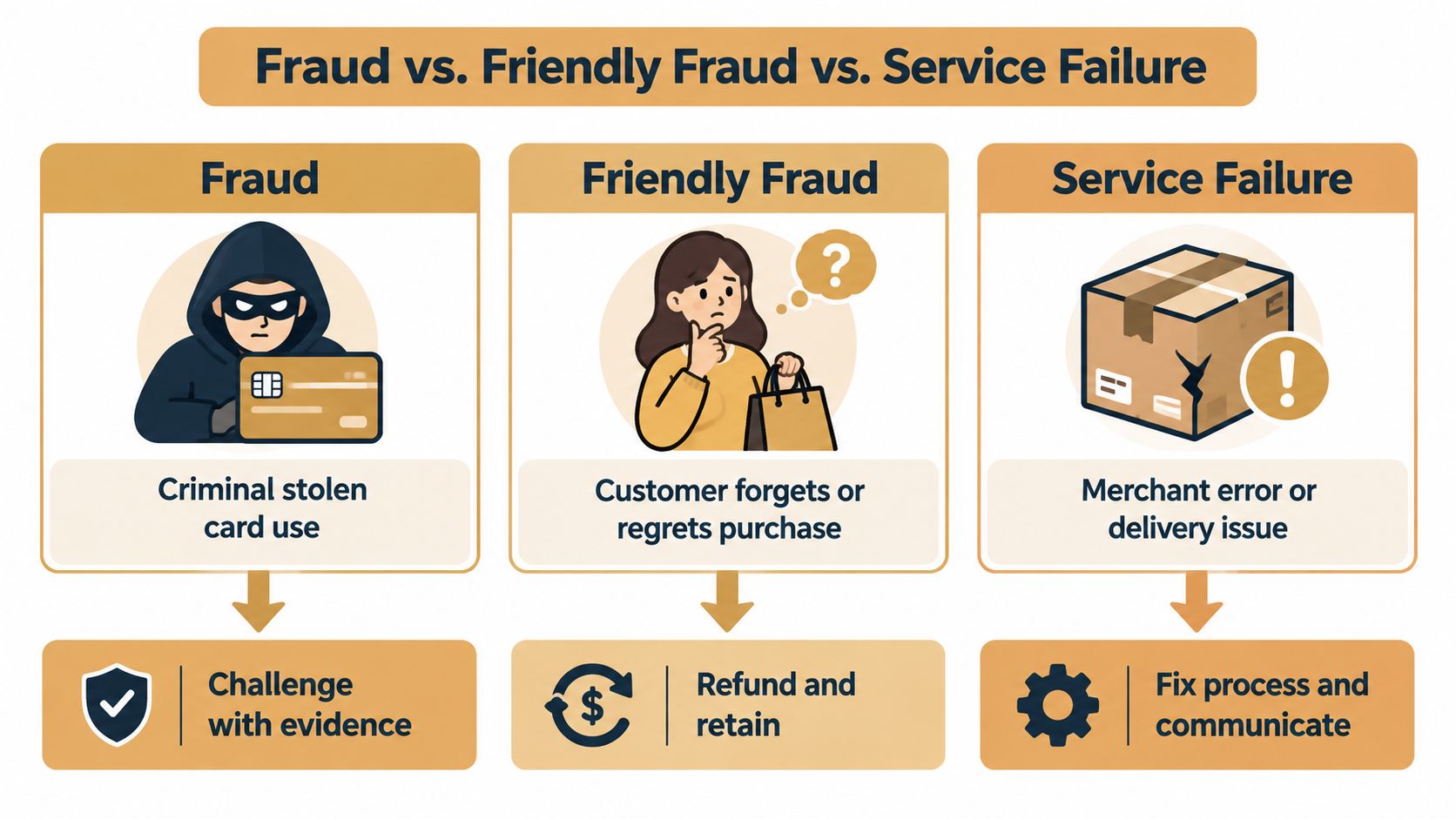
Third-party fraud is the cleanest case. The card was stolen, the merchant didn't know, and the right fix is stronger screening plus better evidence handling. Friendly fraud is different. The customer bought, then disputed instead of resolving the issue through support or a refund path.
Refund abuse sits in a separate bucket. These are customers who game policy loopholes, repeat claims, or push the merchant into paying for avoidable reversals. The right response is a tighter policy, better customer history tracking, and a decision rule that doesn't auto-refund every complaint.
Service failure is the easiest to ignore and the most expensive to repeat. If you shipped late, sent the wrong item, or let the order disappear in transit, the fix is process, not more fraud tooling.
- Third-party fraud: challenge with evidence and harden the fraud rules.
- Friendly fraud: refund only when the economics make sense, then tighten the descriptor or support flow.
- Refund abuse: block repeat abusers and stop rewarding policy exploitation.
- Service failure: fix the operational failure before it turns into recurring dispute loss.
That's the decision framework most high-risk guides miss. The right move is controlled loss allocation, not blanket auto-refunds and not automatic fight-everything representment.
The Pre-Dispute Window Most Merchants Miss
The smartest money in disputes is made before the chargeback exists. Visa Rapid Dispute Resolution, Mastercard CDRN, and Ethoca give merchants a short window to act while the customer complaint is still only an alert. Used properly, that window keeps the dispute off your processor record.
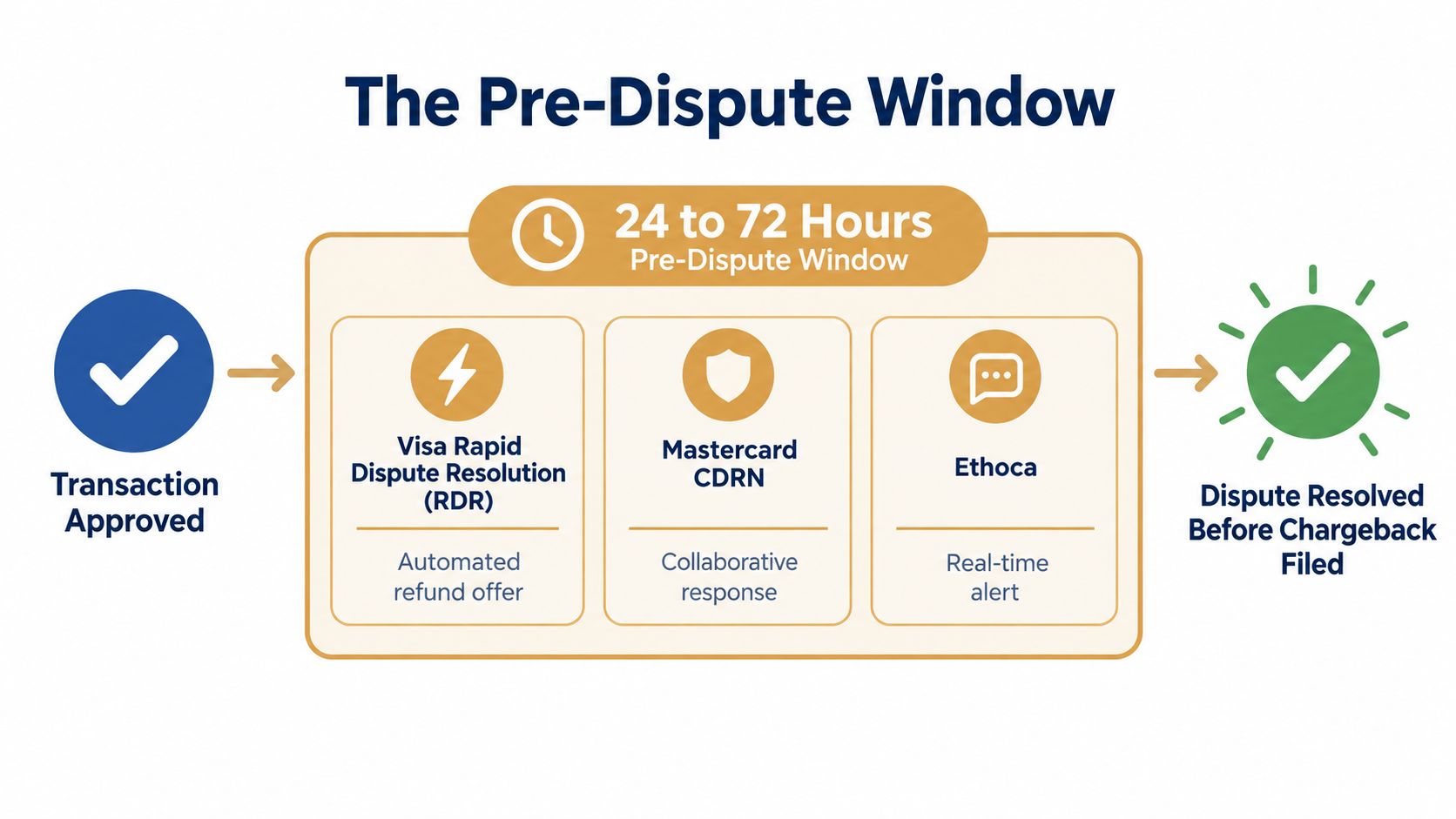
The operational value is straightforward. When an alert arrives, the merchant has to decide fast whether the case calls for a refund, a challenge, or a process fix. That decision should reflect transaction amount, customer tenure, fulfillment status, and whether the same customer has complained before.
What a useful alert rule looks like
A new customer, an unfulfilled order, and a reason that looks like honest non-recognition call for a quick refund. A delivered order with a clear attempt to reverse a completed purchase calls for evidence preservation and escalation. If the dispute traces back to shipping mistakes or descriptor confusion, fix the process that caused it.
Visa's VAMP framework counts fraud and dispute signals together, as noted earlier, so speed matters. Mastercard's excessive chargeback program still puts weight on the absolute count, which means a merchant can get into trouble even when the ratio looks manageable. Those thresholds reward fast triage, not slow debate.
Use alerts to make the cheap decision while it is still available. If the economics favor refunding, refund. If the case is defendable, hold the evidence and push back. If the complaint points to an operational failure, fix the failure before it turns into another dispute.
If you want a practical workflow for that process, the Disputely chargeback fighting guide shows how to turn dispute handling into a repeatable rule set instead of a manual scramble.
Practical rule: score alerts in minutes, not hours. Once the chargeback is filed, you have already lost the cheapest chance to intervene.
False Declines Are a Hidden Margin Leak
Tightening fraud controls feels responsible until it starts rejecting good customers. That tradeoff is the part most merchants underestimate, especially in subscriptions, travel, and DTC businesses where legitimate activity can look suspicious on the surface.
A 2025 survey of more than 130 ecommerce professionals representing roughly $1 trillion in annual transaction volume found 85% cite reducing friction for legitimate customers without raising fraud risk as their biggest challenge, and 47% estimate that up to 5% of legitimate orders are falsely declined Riskified survey. That's not a minor tuning problem. That's margin leakage.
Stop measuring only the fraud side
A merchant that blocks good orders is paying for fraud prevention twice, once in the tooling and again in lost revenue. A subscription brand with recurring billing can lose more through false declines than it saves by being overly aggressive with rules. The key task is to separate pre-authorization prevention from post-transaction dispute intervention.
Pre-auth tools help stop obvious bad actors before approval. Post-transaction controls help manage disputes after the sale, which is where alerting, refund rules, and evidence handling belong. If you use one to solve the other, you'll either miss fraud or reject too many customers.
- Track false declines: don't let approval rate hide the value of lost good orders.
- Measure repeat-customer loss: a declined loyal buyer is more expensive than a one-time loss.
- Watch refund leakage: overly generous refunding can become its own abuse channel.
- Tie rules to margin: a blocked order is only “safe” if the avoided loss beats the lost revenue.
The blunt takeaway is that chargeback prevention is a profitability problem, not just a compliance problem. If your fraud stack can't tell the difference between a bad buyer and a good customer with a weird transaction pattern, it's costing you more than it's saving.
Your 30-60-90 Day Plan to Get Back in the Safe Zone
The fastest way out of processor trouble is disciplined execution, not a flashy vendor pitch. Start by measuring where you are, then change the parts of the account the network and the bank can see.
Days 1 to 30
Pull the last three months of data and calculate your current VAMP exposure and your Mastercard chargeback position. Separate refund abuse, friendly fraud, service failure, and third-party fraud in your reporting, do not jam them into one bucket. Make sure alert integrations are live and routing correctly.
Your KPI here is simple, current dispute ratio visibility with a clean event breakdown. If you cannot explain your dispute mix in one page, you are not ready for an acquirer review.
Days 31 to 60
Deploy rule-based alert responses and stop handling every case manually. If the alert is an obvious refund, issue it quickly. If it is evidence-backed, prepare the representment file instead of surrendering the revenue. Use a chargeback management workflow that forces that decision fast.
Tighten fraud settings against the false-decline problem. Do not keep loading more friction into checkout because you are nervous. Use the data to remove noise, not customers.
Days 61 to 90
Measure again against the 2.20% VAMP and 1.50% ECMP thresholds from the network breakdown above, and compare current event counts to the applicable trigger. Build reserve cushion if your payout timing is still fragile. Document the changes so the bank sees a merchant that knows its own controls.
The KPI by day 90 is board-level clarity, fewer avoidable disputes, less refund abuse, and a cleaner story for the acquirer. That is what changes the account conversation at renewal.


