
Miscellaneous and Specialty Retail Stores Risk

Specialty retail shops saw a 106% increase in chargeback transactions from 2021 to 2023, according to industry chargeback reporting. That figure changes how operators should think about miscellaneous and specialty retail stores. The central risk isn't only whether a product sells. It's whether a fragmented assortment, inconsistent fulfillment process, and unclear customer communication create enough uncertainty for a buyer to dispute the payment.
A florist, pet-supply store, craft retailer, hobby shop, gallery, gift store, or specialty food merchant may look small beside a national chain, but payment operations can be more complicated. Each product category can have different handling requirements, delivery promises, return rules, and customer expectations. A store that treats every order as a standard retail transaction can end up paying for the gaps through refunds, manual reviews, lost merchandise, and processor scrutiny.
The Hidden Payment Risk in Specialty Retail
Chargebacks in specialty retail rose sharply between 2021 and 2023, while family clothing stores also saw a meaningful increase in chargeback rates, according to the industry metrics report. The pattern points to an operational problem, not just a merchandising one. A mixed basket can pass through different fulfillment, return, and support processes before the customer sees one payment on a statement.
That mismatch creates payment friction. A florist may promise a delivery window, a hobby shop may ship fragile components, and a specialty food retailer may handle items with limited return options. Each transaction needs customer communication that matches the product. Generic service rules leave gaps that customers may resolve through their card issuer.
Why the category behaves differently
Big-box retailers usually rely on standardized SKUs, consistent shipping rules, recognizable billing descriptors, and repeatable refund workflows. A miscellaneous retailer may combine stocked goods, custom items, seasonal products, perishables, used merchandise, and vendor-supplied inventory. The operational burden sits behind a single checkout, even when each item follows a different path.
Common dispute triggers appear before the customer files a claim:
- A vague product page: Terms such as “handmade,” “vintage,” or “assorted” can mean different things to the buyer and the merchant.
- A split shipment: One basket generates several tracking events while the card statement shows one charge.
- A delayed special order: Without reminders, a buyer may contact the issuer before contacting the store.
- A confusing descriptor: The customer may recognize the product category but not the legal business name shown on the statement.
- An inconsistent refund: Staff may approve part of a return without recording the item, amount, or timing clearly.
Practical rule: Every source of customer uncertainty needs an owner, a record, and a defined response.
The cost extends beyond the disputed item. Staff must investigate the order, gather delivery or refund evidence, prepare a response, and reconcile the funds. A dispute can also delay access to revenue and prompt closer processor review. For a merchant operating on narrow margins, clear expectations and timely intervention generally cost less than defending a preventable claim.
Risk starts with the operating model
Fragmented inventory does not automatically create excessive risk. A documented store can manage varied products well. Risk rises when product complexity outpaces the discipline of checkout, fulfillment, refunds, and customer support.
Treat payment risk as an operational design issue. Mark products that need special handling, identify orders likely to split, define restricted-return items, and flag transactions that require proactive contact. Store those details with the order record, then give support staff a consistent script and escalation path. The result is a control system built around the actual basket, rather than one generic policy applied to every sale.
Defining the Miscellaneous and Specialty Sector
The miscellaneous and specialty sector covers far more than a general merchandise storefront. Under NAICS classification guidance, miscellaneous store retailers fall within NAICS 453 and sell specialized merchandise from fixed point-of-sale locations. The category includes florists, used merchandise stores, pet and pet-supply stores, and other specialty operators.
That range creates different payment and fulfillment profiles within the same broad classification. A florist managing same-day arrangements, a hobby shop shipping fragile kits, and a used-goods retailer recording product condition need different order evidence, refund controls, and customer communications. The category name alone gives a processor little insight into how a transaction will be fulfilled or disputed.
The U.S. subsector was reported to include 329,541 business entities, including 203,907 in the 4539 subgroup and 158,426 in the 453998 subgroup, according to the NAICS reference above. The figures point to a long-tail market with many small-format operators, each managing its own product data, suppliers, fulfillment promises, and return practices.
Scale doesn't remove fragmentation
The wider specialty retail market is substantial. One global specialty retailers market report places it at roughly $799.21 billion in 2025, projecting $1.045 trillion by 2030 at a 5.6% CAGR. Asia-Pacific was identified as the largest region in 2025.
Market size does not make an individual merchant's operations uniform. A large sector can still contain businesses with different inventory records, supplier dependencies, return rules, delivery methods, and payment setups. Those differences determine what evidence exists if a customer challenges a charge.
The processor sees a transaction. The merchant has to manage the story behind it.
In the U.S., miscellaneous store retailers generated $187.8 billion in revenue in 2024, after growing at an annual rate of 6.2% over the prior three years, and averaged $1.7 million in sales per location that year, according to the specialty retail market dataset. The same dataset reported 80,871 companies in the category and projected 2024 ecommerce sales growth of 14.5%.
Online ordering, pickup, shipping, and marketplace sales increase the need for connected records. Merchants need a consistent way to link the product sold, the promised timing, the delivery event, any refund, and the customer conversation to the original payment. Without that chain, a mixed or delayed fulfillment path becomes difficult to explain during a dispute.
Classify products by payment risk behavior, not only by department. “Custom,” “perishable,” “fragile,” “used,” “split-ship,” and “vendor-direct” are more useful control labels than “gifts,” “pets,” or “hobbies.” Each label can determine the required evidence, fulfillment communication, and refund handling before the transaction reaches the processor.
Why Fragmented Assortments Drive Chargebacks
Chargebacks rise when a specialty retailer's internal order logic becomes invisible to the customer. Fragmented inventory creates several promises inside one payment, and each promise needs its own status, evidence, and follow-up.
A mixed basket might include an in-stock item, a vendor-direct product, and a personalized item. The first ships immediately, the second waits for supplier confirmation, and the third requires customer approval. The retailer may see normal progress in its systems. The buyer sees one posted charge, incomplete delivery, and messages that do not explain which item is delayed.
That gap can lead to a legitimate “merchandise not received” claim. It can also create friendly fraud when the buyer forgets the purchase, sees several deliveries against one charge, or assumes a partial shipment means the full order failed.
Turn exception points into controls
Lower SKU standardization increases the number of payment exceptions because products do not share the same promise. A repeatable item can use a standard description, dispatch target, tracking rule, and return path. Specialty products require controls that follow the item's actual risk.
- Control description risk by locking the product title, measurements, materials, condition, variation details, and included accessories into the checkout record. Preserve the same copy in the confirmation email.
- Control fulfillment risk by recording supplier confirmation, promised dispatch timing, and any customer approval before the order is marked ready. Do not let a general availability label stand in for item-level status.
- Control basket risk by assigning shipment status, delivery estimates, and return eligibility to each line item. Send tracking updates per shipment rather than relying on one order-level message.
- Control refund risk by showing which line item, quantity, tax, shipping amount, and payment method each refund covers. Store the calculation with the original transaction.
- Control support risk by giving store and customer service staff access to the same order, shipment, payment, and conversation history. A handoff should not require the customer to repeat the case.
These controls address confusion before it becomes an issuer case. They also give the merchant a clearer basis for deciding whether a service failure requires a refund or whether the available evidence supports a representment.
Make the transaction an operational record
For every order, preserve the checkout description, accepted policy version, promised fulfillment date, line-item tracking, delivery confirmation, customer approvals, and exact refund calculation. The record should let a reviewer follow the order without asking staff to reconstruct events from separate systems.
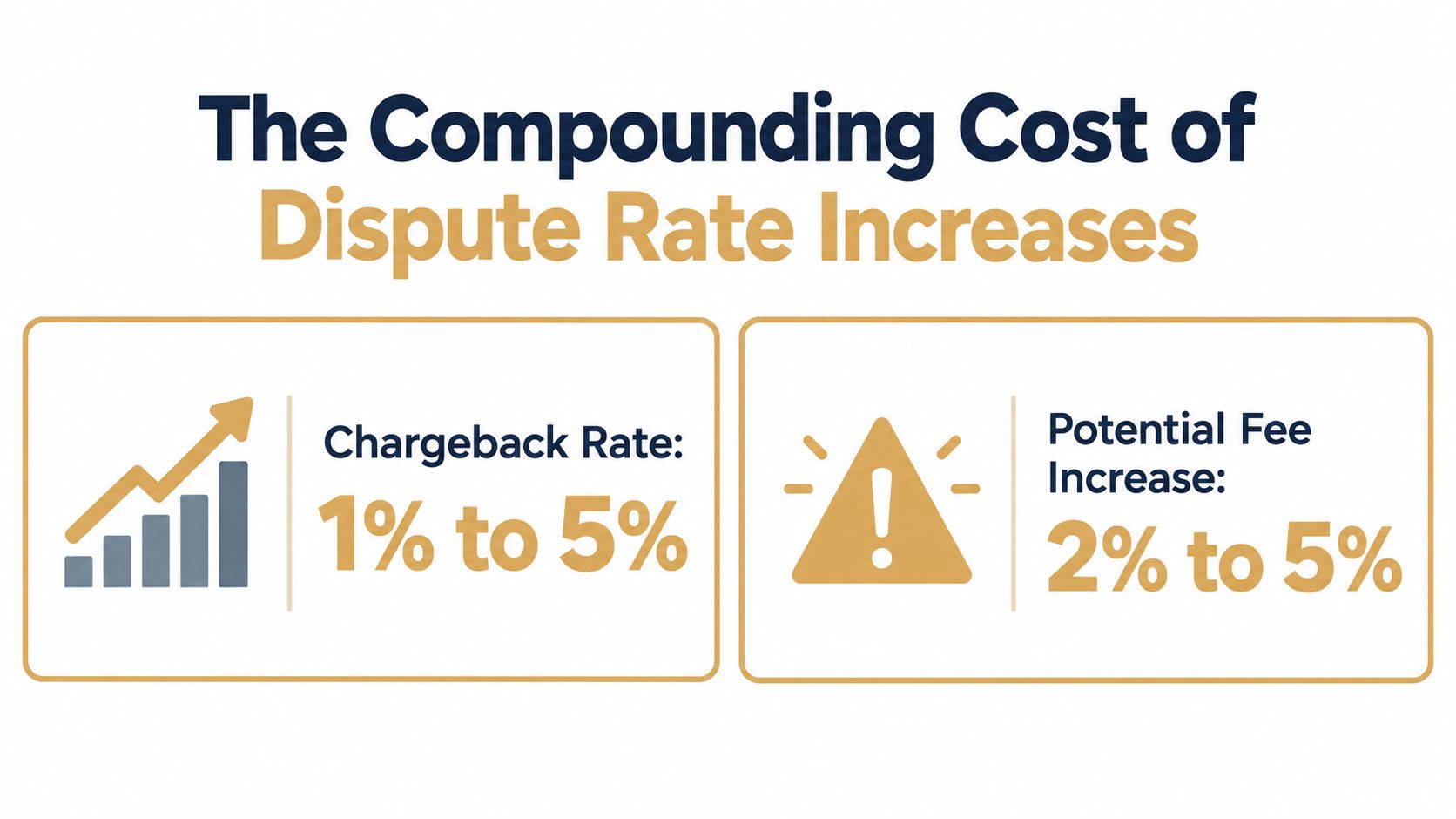
As noted earlier, a 0.5% absolute increase across 10,000 monthly card transactions equals roughly 50 additional disputes per month. That workload can overwhelm a small team before fees, reserves, and lost inventory are counted.
Mixed baskets need mixed controls. One order number is not enough when each item carries a different promise.
Keep niche products. Make their differences visible at checkout, in confirmation messages, and in support records. Customers can accept longer lead times or restricted returns when the retailer states those terms clearly, tracks each obligation, and applies the promised process consistently.
The Compounding Cost of Dispute Rate Increases
A dispute rate is a ratio, but merchants experience it as a queue of cases, withheld funds, and decisions that staff must make under time pressure. A small movement can become operationally serious when order volume is steady and every case requires research.
Start with a clean baseline. Pull payment data by channel, product type, fulfillment status, and reason code. Don't rely on a blended figure that combines in-store transactions, ecommerce orders, subscriptions, marketplace sales, and manual invoices. Each channel creates different evidence and different customer expectations.
Build controls around the preventable cases
Separate disputes into three groups:
- Preventable confusion, such as unclear descriptors, missing delivery updates, or incomplete refund confirmations.
- Service failures, such as an unfulfilled special order, damaged goods, or a refund that staff promised but never completed.
- Likely abuse or fraud, where the merchant has delivery evidence, clear product records, and no corresponding service failure.
The first group should trigger process changes. The second needs escalation and fast resolution. The third requires evidence collection and a measured decision about whether to refund or fight.
Refund rules should reflect the economics of each case, but they shouldn't be improvised by individual staff members. Define who can approve a full refund, when a partial refund is appropriate, which evidence must be attached, and when a case goes to a senior reviewer.
- Create a daily exception queue: Review orders with delivery delays, failed handoffs, duplicate authorizations, or unresolved support contacts.
- Set a communication trigger: Contact customers before the promised date changes, not after the customer asks where the order is.
- Record the decision: Store the reason for each refund, the affected line item, the amount, and the customer notification.
- Review trends monthly: Identify whether disputes cluster around one supplier, product description, carrier, or sales channel.
Merchants should also understand the consequences of crossing their processor's monitoring thresholds. A sustained increase can affect reserves, manual scrutiny, and account stability. The high chargeback rate guidance is useful as a supplementary reference, but operators should confirm applicable thresholds and program rules with their acquirer and payment processor.
Protect loyalty without accepting ambiguity
Specialty merchants often depend on loyal customers and word-of-mouth sales. A rigid policy that surprises buyers can create more complaints, not fewer. A precise policy paired with responsive service is stronger than a broad promise that staff can't administer.
Use a short decision matrix:
| Situation | Preferred response |
|---|---|
| Item hasn't shipped by the stated date | Offer a clear update, revised date, or cancellation path |
| One line in a mixed basket is delayed | Explain the split and confirm whether the customer wants the available items first |
| Product differs from its documented description | Resolve the mismatch before treating the case as a standard return |
| Customer disputes a charge after delivery | Gather order, delivery, and support evidence, then decide whether the case is contestable |
The aim isn't to refund every complaint. It's to resolve genuine failures quickly and keep avoidable confusion from becoming a formal dispute.
Targeted Best Practices for Refund Policies
A generic “returns accepted within the standard period” policy is poorly suited to miscellaneous and specialty retail stores. A florist may handle perishable arrangements, a craft retailer may sell opened materials, and a specialty shop may carry custom or used goods that can't be resold in the same condition.
The policy must match the product's actual risk. If it doesn't, customers and staff will interpret it differently, creating the exact ambiguity that produces disputes.
Write rules customers can use
Put the important conditions beside the purchase decision. Don't hide them in a long legal page that customers won't connect to a particular product.
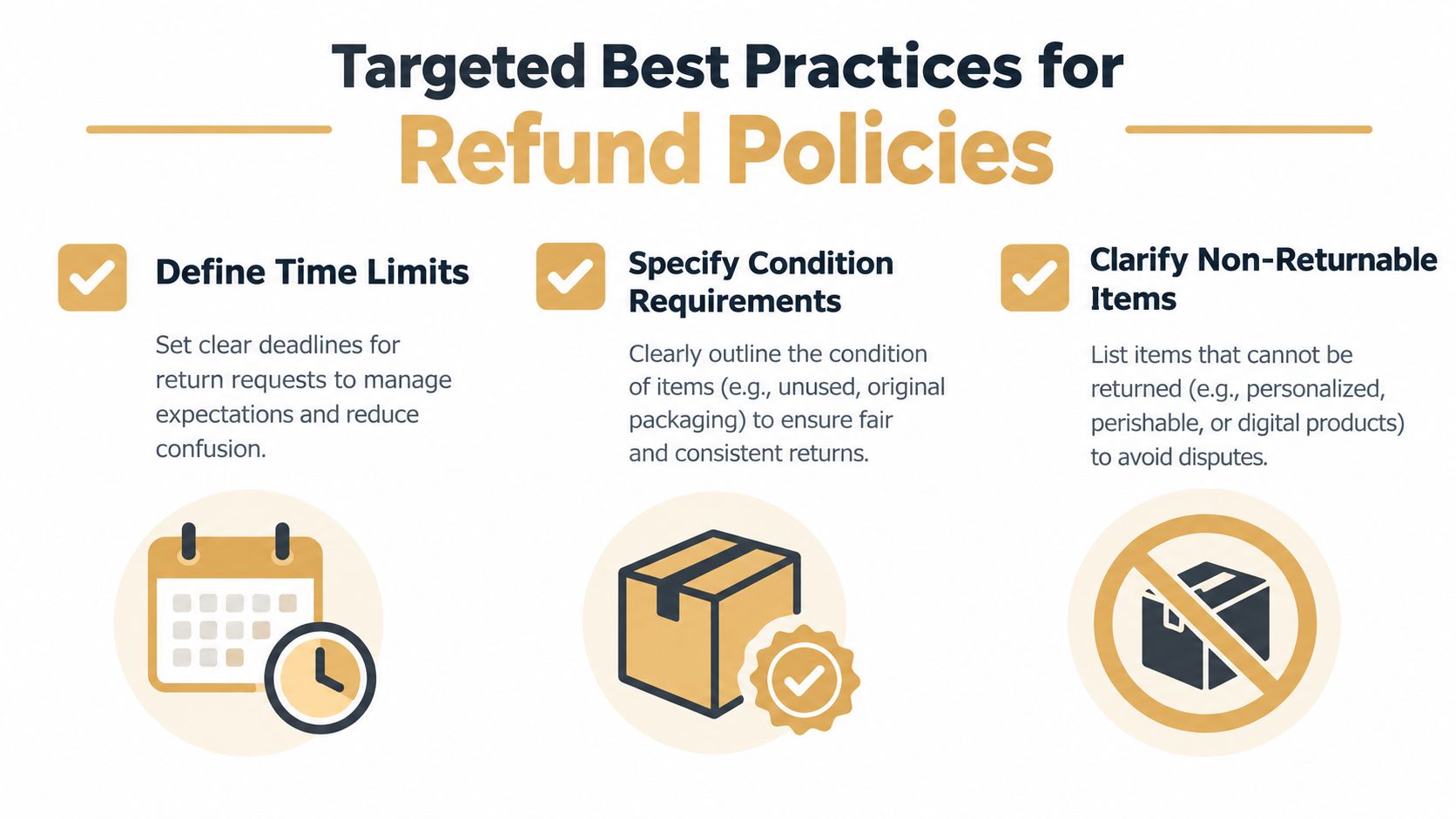
Define time limits by event. State whether the period begins at purchase, dispatch, delivery, pickup, or another clearly recorded event. For split shipments, explain whether each item has its own return window.
Specify condition requirements. Describe packaging, seals, tags, personalization, hygiene requirements, and proof of purchase in plain language. If inspection is required, tell the customer what happens after the item arrives.
Clarify non-returnable items. Identify custom, perishable, opened, used, or final-sale goods before payment. Don't use “all sales final” as a substitute for explaining the product-specific reason.
Make partial refunds legible
Mixed baskets need line-level refund records. The confirmation should identify the item refunded, the amount, the original payment method, and the expected posting process. If shipping is being retained or refunded proportionally, state the calculation rather than leaving the customer to infer it.
Billing descriptors deserve the same attention. The name on the card statement should be recognizable, and confirmation emails should connect that descriptor to the store, order number, and support route. A customer who can match the statement to a recent purchase is less likely to treat the charge as unauthorized.
Post-purchase communication should follow the order's actual state:
- Immediately after payment: Confirm the products, total, descriptor, and return conditions.
- At dispatch: Identify which items shipped and provide the relevant tracking details.
- Before a delay: Explain the cause, revised expectation, and available options.
- After a refund: Confirm the exact item and amount processed.
For teams reviewing support tooling, a practical 2026 help desk buyer's guide can help compare features such as order visibility, automation, and conversation history. The tool matters less than whether staff can see the payment and fulfillment facts in one place.
Alert networks add another layer, but they can't compensate for a policy that customers can't understand. Automated refunds should follow documented rules, and exceptions should go to a trained reviewer rather than being handled through inconsistent goodwill.
Automating Dispute Prevention with Alert Networks
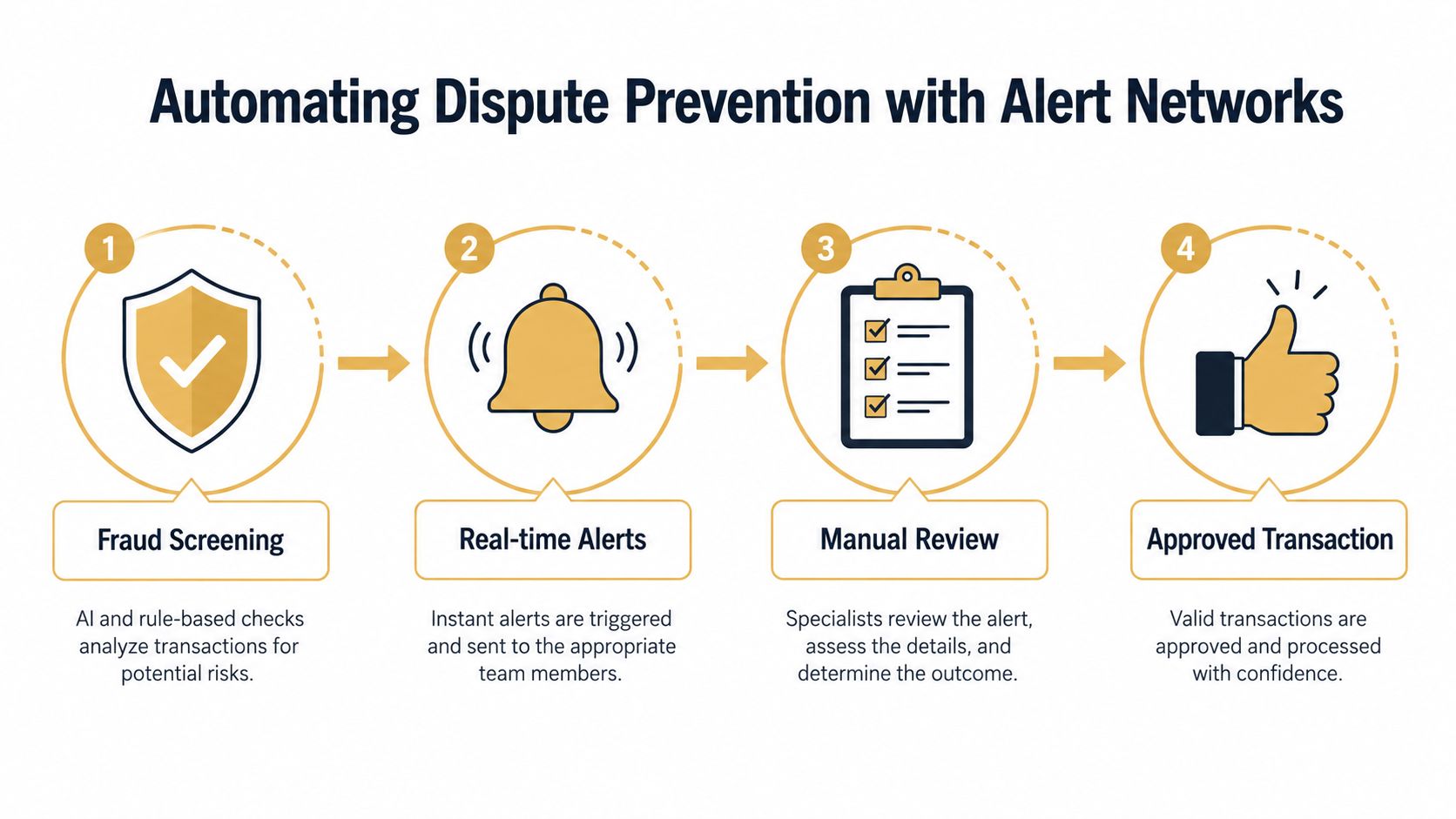
A specialty merchant can have a sound product page, a fair return policy, and a reliable support team, yet still miss a dispute because the customer contacts the card issuer first. Alert networks address that timing problem by notifying the merchant while there may still be an opportunity to resolve the transaction directly.
The workflow is straightforward. A payment processor or network sends an alert, the merchant matches it to the order, and the system applies a rule. If the case meets the merchant's refund criteria, the transaction is refunded before it becomes a formal chargeback. If the merchant has strong evidence and the case falls outside those criteria, the team can review it rather than refunding automatically.
A realistic specialty retail workflow
A pet-supply store receives an alert tied to an online order containing food and a durable accessory. The food shipment was delivered, but the accessory is still with the supplier. The customer has contacted the issuer, likely because the single charge doesn't reflect the split fulfillment.
An automated rule should not blindly refund the full basket. It should identify the affected line, check shipment status, and route the case according to the merchant's policy. The store may refund the delayed item, send a clear update, or request a manual review if the customer has already received the complete order.
Intelligent filtering matters here. A blanket rule can reduce disputes while giving away valid revenue. A rule that uses order value, fulfillment state, product category, delivery evidence, and prior support activity can distinguish a service failure from a contestable claim.
Connect the alert to the payment record
A workable setup needs more than an email notification. Connect the alert source to the payment gateway, order platform, refund function, and internal case record. For online specialty stores, platforms such as Stripe, PayPal, Shopify Payments, Authorize.net, and Square may sit across different parts of the payment stack, so ownership and permissions should be documented before automation is enabled.
Disputely is one option that connects payment processors and sales tools, applies merchant-defined refund rules, and uses real-time alerts to manage incoming disputes. Merchants evaluating the broader process can also review chargeback fighting workflows to compare automated resolution with manual evidence handling.
A sensible rollout starts in observation mode. Measure which alerts would have qualified for a refund, which would have required review, and which lacked enough order data. Then activate limited rules, audit outcomes, and expand only after staff can explain every automated decision.
Automation should make a merchant's policy faster and more consistent. It shouldn't replace judgment where the order record is incomplete.
Securing Your Processing Relationship Long Term
Payment stability requires operational control. Specialty retailers depend on uninterrupted authorization, settlement, refunds, and access to funds. A preventable dispute can pressure all four when a processor requests more evidence, adds a reserve, delays settlement, or places the merchant in a monitoring program.
The strongest operators build dispute controls into omnichannel operations. Store staff, ecommerce teams, warehouse personnel, and customer support should use the same definitions for order status, return eligibility, refund completion, and customer identity. Mixed baskets and variable fulfillment make this harder. A customer may buy items with different delivery times, return rules, or suppliers, so the payment record must preserve those distinctions.
Audit the full payment journey
Start with the transaction and trace each handoff:
- Statement recognition: Can the customer identify the merchant from the billing descriptor?
- Product accuracy: Does the order record preserve the description, variant, and condition shown at purchase?
- Fulfillment proof: Can staff match every shipped or collected item to the original order?
- Refund clarity: Does the customer receive an itemized confirmation showing what was refunded?
- Dispute response: Can the team retrieve relevant evidence without searching disconnected systems?
Review successful and disputed orders together. Successful orders show which controls work repeatedly. Disputed orders expose gaps in customer communication, fulfillment records, product data, or payment configuration. Assign each preventable cause to an owner, with a deadline for correction.
With ecommerce continuing to take a larger role in specialty retail, the audit points above matter most when orders cross channels or contain products fulfilled in different ways. A processor relationship is easier to defend when the merchant can show consistent records rather than isolated screenshots and informal explanations.
Choose infrastructure that matches the exposure
Review gateway features, alert coverage, refund controls, reporting, and integration depth before changing processors. A comparison of best checkout payment gateways can help assess the checkout layer. It will not correct incomplete product data or weak fulfillment communication.
For Shopify stores, a Shopify chargeback protection workflow can be assessed alongside existing refund and support procedures. The practical test is whether the workflow gives staff timely order information and controlled actions, rather than another dashboard to monitor.
Set a recurring review cadence. Track dispute reasons, unresolved refunds, delayed orders, descriptor-related contacts, and alert outcomes. Reconcile those findings with processor requirements and document changes to policies, integrations, and staff responsibilities.
Disputely connects specialty retailers with Visa Rapid Dispute Resolution, Mastercard CDRN, and Ethoca alerts, then applies configurable refund rules before disputes reach the merchant account. Review payment channels, connect relevant processors, and visit Disputely to assess how real-time alerts could reduce preventable dispute work.


