
Original Credit Transaction: How Push Payments Really Work
You're in the middle of a payout flow, a refund queue, or a reconciliation file, and one row keeps behaving differently from the rest. The card network says the money was pushed, the customer says they never asked for a refund, and your processor report doesn't line up cleanly with your order system. That's usually where the confusion around an original credit transaction starts.
What Is an Original Credit Transaction
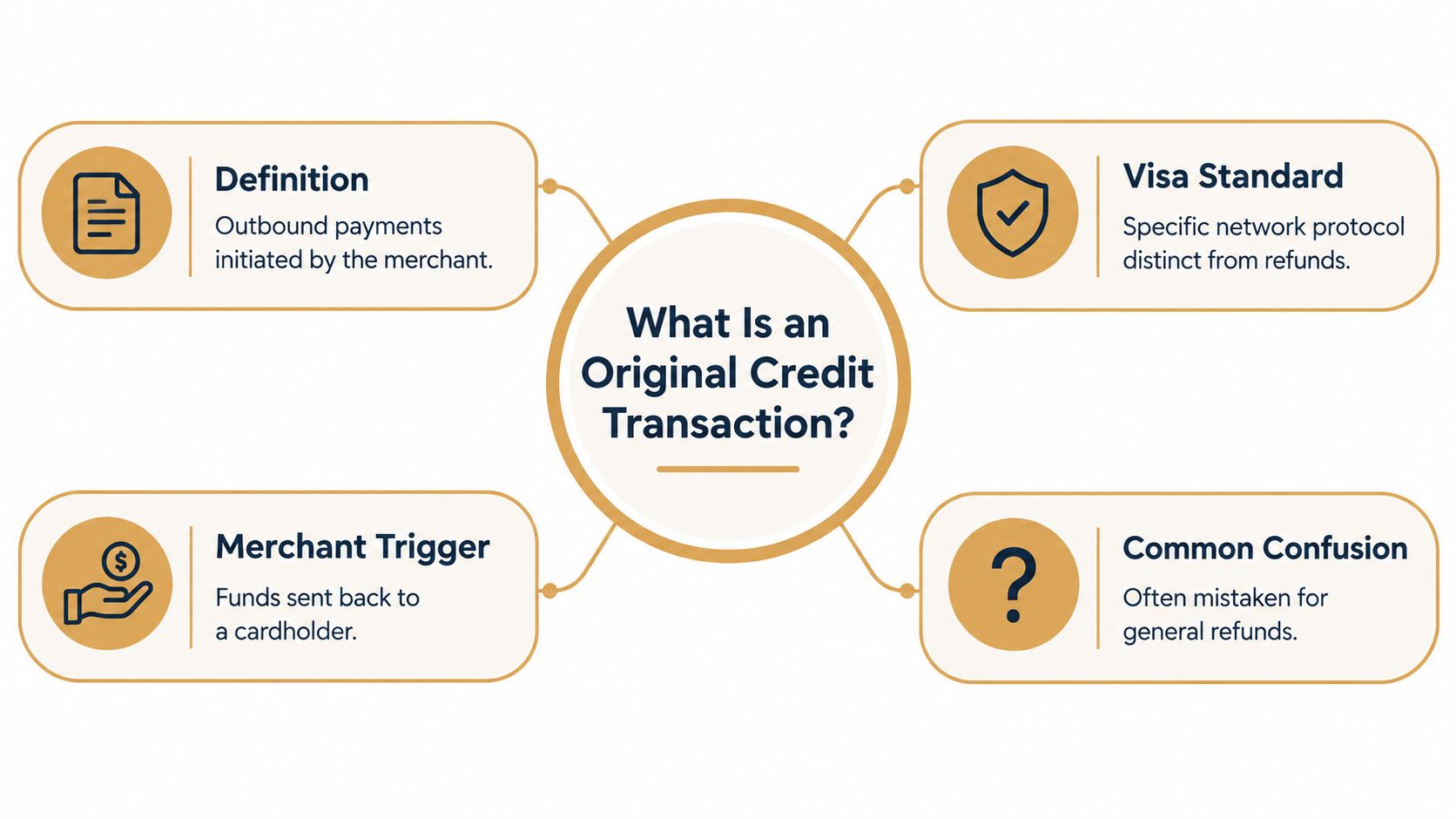
A common mistake is to call every outbound card credit a refund. In production, that shortcut causes trouble because an original credit transaction, or OCT, is a specific card-network credit that pushes funds directly to an eligible card account rather than reversing a purchase.
Visa describes OCT as a VisaNet transaction that credits an eligible U.S. debit or reloadable prepaid cardholder account, and it says an OCT can't generally be used by itself to buy goods or services, nor does it function as an ordinary merchandise-return refund except under specified network exceptions. That makes the transaction a push-payment credit, not a reversed sale, and the operational consequences are very different. Visa's documentation also reports that 98% of U.S. consumer debit payment volume was OCT-enabled, which represents access to about 490 million U.S. Visa debit cards. It also identifies a VisaNet system limit of US$50,000 per disbursement transaction. Visa's OCT and online lending guidance
Why the distinction matters in real operations
If your team treats an OCT like a refund, you'll usually map it to the wrong ledger path, the wrong dispute path, or both. A refund keeps a direct relationship to the original sale. An OCT stands on its own, with its own recipient, its own acceptance state, and its own settlement result.
Practical rule: if there's no original purchase being reversed, don't force the transaction into your refund workflow.
That matters in marketplaces, gig payouts, insurance disbursements, and loan proceeds, where the credit is the primary event. It also matters when support teams promise “we refunded you,” because that wording can be inaccurate if the network transaction was a push credit to a card account. The payment stack needs to know which rail it's using before it can reconcile, report, or dispute that payment correctly.
The wrong mental model causes hidden risk
Refund logic usually expects a sale record, a return reason, and a direct link to a prior authorization. OCT logic expects a beneficiary, an outbound amount, eligibility checks, and acceptance controls. If you blur those together, retries become dangerous, duplicate credits become easier to create, and settlement breaks are harder to spot.
How OCTs Work Step by Step
An OCT doesn't behave like a purchase reversal. It behaves like an independent payout with its own lifecycle, so each stage needs its own control point.
The four stages that matter
- Outbound credit request. Your system creates the instruction to push funds, usually after a business event like a payout approval, claim decision, or return refund decision.
- Recipient eligibility validation. The card has to be eligible for OCT receipt in that issuer and jurisdiction. If you skip this, the request may fail even when the customer data is correct.
- Network delivery. The payment moves through the card network rails to the issuer and toward the recipient account.
- Settlement confirmation. Your API may show success before the final state is settled, so your operations team still needs a post-submission confirmation path.
That separation is the reason OCTs work well for cases where there's no prior purchase to unwind. The transaction is independent, so it can support a marketplace seller payout, a gig-worker disbursement, or an insurance claim payment without pretending to be a merchandise refund.
What usually breaks in production
The failure point is often not the credit itself, but the assumptions around it. Teams send an outbound credit, get a processor response that looks positive, and then stop watching the transaction. Later, they discover that the card wasn't eligible, the issuer didn't accept the credit, or the transaction was reversed downstream.
A successful API call is not the same thing as final money movement.
That's why every OCT should be tracked with its own transaction identifier, recipient credential, network response, and settlement state. If your operations tools only track “submitted” and “failed,” you're missing the middle ground where most reconciliation headaches begin. In practice, the safest systems treat OCTs as a status chain, not a one-time event.
OCT vs Refund vs Payout Differences
The easiest way to remove confusion is to stop using one label for three different things. Refunds, OCTs, and payouts may all result in money going to a customer or recipient, but they do not behave the same way at the network layer.
The distinction also helps when you compare customer-facing concepts like returns and refunds. ECORN's guide to return vs refund is useful if your team wants a clean merchant-language distinction before it maps into payment operations: ECORN's guide to return vs refund.
| Dimension | Refund | Original Credit Transaction | Payout |
|---|---|---|---|
| Transaction direction | Reverses money from a prior sale | Pushes money directly to an eligible card account | Business category for sending money out |
| Network treatment | Tied to the original purchase record | Independent outbound card credit | Can be executed through an OCT or another rail |
| Dispute handling | Usually anchored to the original transaction | Can face a specific “Original Credit Transaction Not Accepted” challenge | Depends on the rail used |
| Evidence needed | Sale, return, and refund linkage | Recipient, purpose, amount, eligibility, and settlement trail | Business justification plus rail-specific proof |
| Accounting view | Negative adjustment to the original sale | Separate outbound payment | Depends on whether it's a refund, salary, rebate, or disbursement |
| Duplicate-credit risk | Usually lower if linked to the return workflow | Higher if retries aren't idempotent | Depends on the implementation path |
Why payout is not the same as OCT
A payout is the business reason for sending money. OCT is one way to send it. That sounds minor, but in operations it changes everything from metadata capture to reconciliation logic. A payout can be a seller settlement, a worker payment, or a rebate. The network still needs to know what kind of transaction it is, and your records need to show whether it was a refund, a credit, or a separate disbursement.
What happens when teams collapse the categories
When finance, support, and engineering all call the same outbound credit a refund, the accounting file becomes noisy and the dispute file becomes weak. You lose the thread between the original purchase, the outgoing credit, and the recipient acceptance state. That's how duplicate credits slip through and why a clean workflow needs separate paths for refunds and OCTs.
When to Use OCT for Disbursements
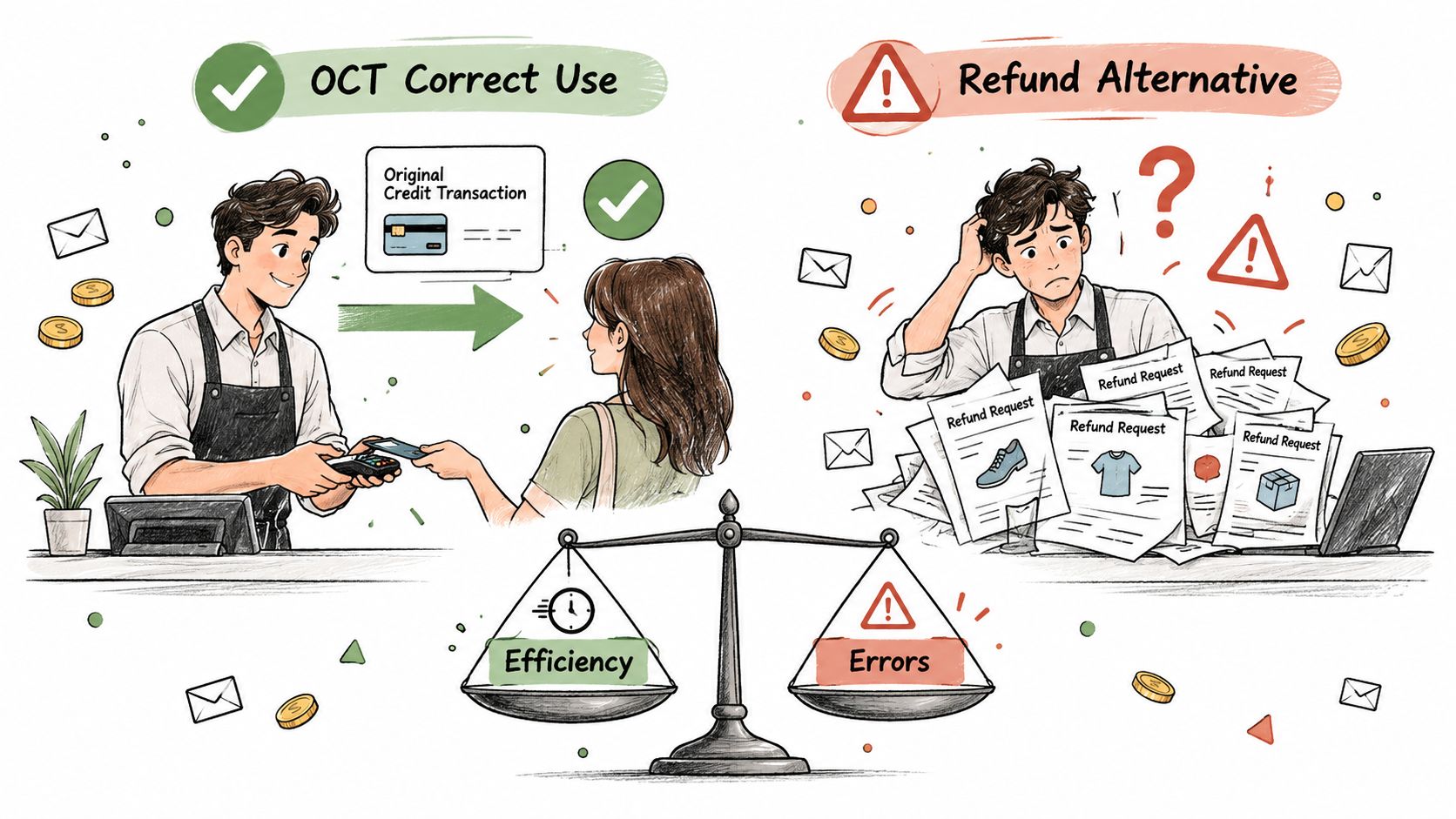
Use an OCT when the business event is a direct payment to a cardholder, not a reversal of a card purchase. That sounds simple, but in practice the boundary matters because some teams try to route every outgoing payment through a refund process just because it feels familiar.
Good fit cases
- Marketplace earnings: A platform pays a seller or creator to the card they already use for receiving funds.
- Gig-worker payments: A driver, courier, or freelancer gets paid without waiting for a bank transfer.
- Insurance claims: A policyholder receives a claim settlement directly to an eligible card account.
- Loan proceeds: A lender sends approved funds to a cardholder account when the product design supports that path.
In each of those cases, there may be no original card purchase to reverse. The payment is the event, not the undoing of a sale. That's why OCT is a better fit than forcing the transaction into a refund template.
Boundary cases that need judgment
Subscription credits can go either way depending on what triggered the payment. If you're reversing a prior charge, that's a refund path. If you're issuing a separate goodwill credit, reward, or incentive, the network treatment may be different. Loyalty rewards and prepaid loads also need careful review because the business purpose is not the same as a return against a sale.
A simple routing rule
If the credit exists to unwind a prior card sale, keep it in the refund workflow. If the credit exists to send funds independently to an eligible cardholder, route it as an OCT. If you can't tell which one it is from the order record alone, the process isn't ready for scale.
Chargeback and Dispute Risks
A credit can still turn into a dispute. Visa classifies a cardholder challenge to an unaccepted OCT under dispute condition 13.8, “Original Credit Transaction Not Accepted.” That can happen when the cardholder does not accept the credit, the issuer does not permit OCTs for that card or jurisdiction, or the OCT was reversed. Visa's dispute management guidelines
What operators need to track
Track more than the API response. You need the OCT request, the network response, the recipient credential, the eligibility result, reversal status, settlement confirmation, and the customer communication. If the issuer accepts the instruction in one step but settlement fails later, that difference matters when finance, support, and dispute teams compare records.
Visa also expects merchants to send a credit to the same payment credential used for the original transaction where possible, and it prohibits duplicate recovery when a cardholder has already received both a merchant credit and a dispute credit. In practice, that means one resolved credit path should close the file. A second workflow should not fire just because another team or system noticed the same complaint.
If dispute pressure is already hitting your account, Disputely's guide to fighting chargebacks covers how to respond before a dispute is filed.
Mastercard and evidence design
Mastercard's transaction-processing rules, including the MoneySend framework, classify independent credits separately from purchase-linked refunds and gaming payments. That distinction shapes evidence design because an OCT needs its own beneficiary, purpose, amount, currency, and acceptance-state controls. Mastercard's transaction-processing rules
If the credit is not accepted, do not bury it in the refund queue. Route it to an exception path and preserve the original network outcome.
Retries need the same discipline. A timeout does not tell you whether the issuer accepted the credit. If retry logic treats that uncertainty as a fresh failure, duplicate credits are easy to create, and settlement cleanup gets messy fast.
Implementing OCT with Stripe and PayPal
Processor implementation usually fails at the metadata layer, not the money-moving layer. The network may support the credit, but your platform still has to send the right transaction type, the right funding data, and the right idempotency controls.
What has to be true in the stack
The first requirement is to distinguish an OCT from a standard refund in your processor configuration. Those are not interchangeable labels, and the wrong mapping sends the transaction down the wrong path. The second requirement is to populate the Source of Funds field where the network expects it. Visa's developer documentation says that effective October 17, 2025, Visa can decline OCTs when the Source of Funds field is not populated. Visa developer documentation on OCT data requirements
That deadline matters because this isn't just a documentation preference. It's a decline risk. If your implementation leaves the field blank, a valid disbursement can still fail.
How teams keep the flow stable
- Use idempotency keys: Prevent duplicate credits when a timeout or retry happens.
- Map transaction types carefully: Make sure your refund path and OCT path are separate in code and reporting.
- Test decline handling: Confirm that missing metadata, eligibility failure, and reversals land in different exception buckets.
- Reconcile separately: OCTs should not disappear into a generic refund total.
Processor-specific discipline
Stripe, PayPal, Shopify Payments, and Authorize.net all sit behind different operational assumptions, even if the business intent is the same. Your team needs to know which fields the processor exposes, which ones it forwards, and which ones it normalizes away. For implementation patterns and onboarding checkpoints, the practical signup path matters, especially if you're wiring a new payout flow into existing checkout logic: Stripe signup implementation notes.
Best Practices and Common Mistakes
The fastest way to break an OCT flow is to treat it like a minor refund variant. In production, that usually shows up as weak reconciliation, support notes that do not explain the payment path, and duplicate credits that only surface after volume builds.
What works in production
- Reconcile daily: Match OCT requests against network responses and final settlement states instead of waiting for month-end review.
- Keep one immutable audit trail: Store the request, response, eligibility result, reversal status, settlement confirmation, and customer communication together.
- Separate refund and OCT reporting: Keep outbound credits out of a single bucket, because refund handling and push-payment handling create different liabilities and dispute records.
- Check the 2025 Source of Funds requirement: Missing data can turn a valid payout into a decline.
- Treat retries carefully: A timeout is uncertainty, not a failed payout.
What does not work
- Assuming “200 OK” means the recipient got paid
- Retrying without idempotency
- Using refund logic for a direct disbursement
- Ignoring card eligibility and jurisdiction rules
- Letting support manually reissue credits without checking settlement
These failures are hard to unwind later. If duplicate credits and disputes have already pushed your ratio up, see how to reduce a high chargeback rate before monitoring programs start paying attention.
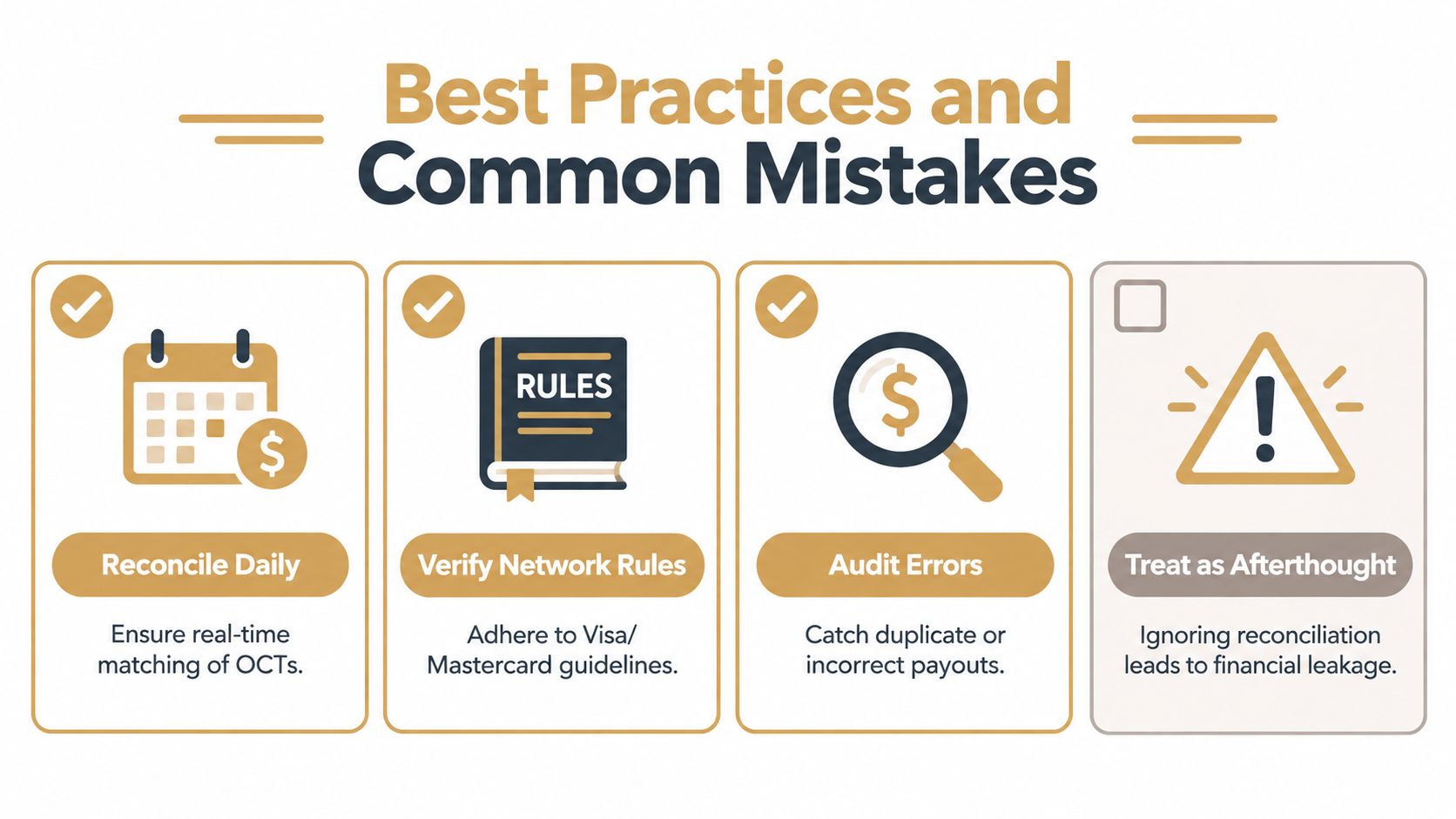
Operational takeaway: once OCT volume grows, reconciliation becomes a control system, not a bookkeeping task.
Disputely plugs into Visa RDR, Mastercard CDRN, and Ethoca alerts so a disputed OCT or refund path can be handled before the chargeback file is opened. Set it up quickly, keep refund and OCT workflows separate, and use Disputely to track dispute signals in the same operating rhythm your payments team already uses.


