
Paddle vs Stripe: Which Payment Platform Fits Your Business
A SaaS founder comparing Paddle and Stripe often starts with a spreadsheet: one platform appears to charge more per transaction, while the other seems to offer a lower processing rate. But the spreadsheet gets harder to trust when customers live in different countries, billing rules get complicated, or a customer disputes a payment. The choice isn't just about what a transaction costs. It's also about who owns the tax work, dispute process, and operational burden behind it.
| Decision factor | Paddle | Stripe |
|---|---|---|
| Core model | Merchant of record, with tax and compliance services bundled into its offering | Payment infrastructure, with the merchant retaining more operational responsibility |
| Published pricing detail | 5% + $0.50 per checkout transaction, including billing and tax compliance | Billing is priced separately at 0.7% of Billing volume on the pay-as-you-go plan |
| Billing approach | More bundled and streamlined | More composable, with support for varied billing models |
| Best-fit consideration | Global digital sellers seeking to offload more commercial administration | Businesses prioritizing billing flexibility and control |
| Dispute consideration | The platform takes on more of the commercial burden, but merchants still need sound records and policies | Merchants retain more responsibility for their payment-risk operations |
The decision comes down to your risk profile, sales geography, billing complexity, and capacity to manage compliance. A bundled fee can be expensive for a straightforward domestic sale, but a lower processing rate may not be cheaper after you account for the work and exposure that remain with your company.
Two Payment Platforms, Two Different Philosophies
Consider a software company with a growing subscription base. Its founder wants to launch in additional markets, but the finance team is already spending time reconciling payments and the engineering team is building custom billing rules. The founder compares the fee on each checkout and sees a clear apparent winner. Then a customer disputes a payment, and the actual comparison begins: who handles the customer's tax, gathers the records, manages the dispute, and keeps the billing system aligned with the product?
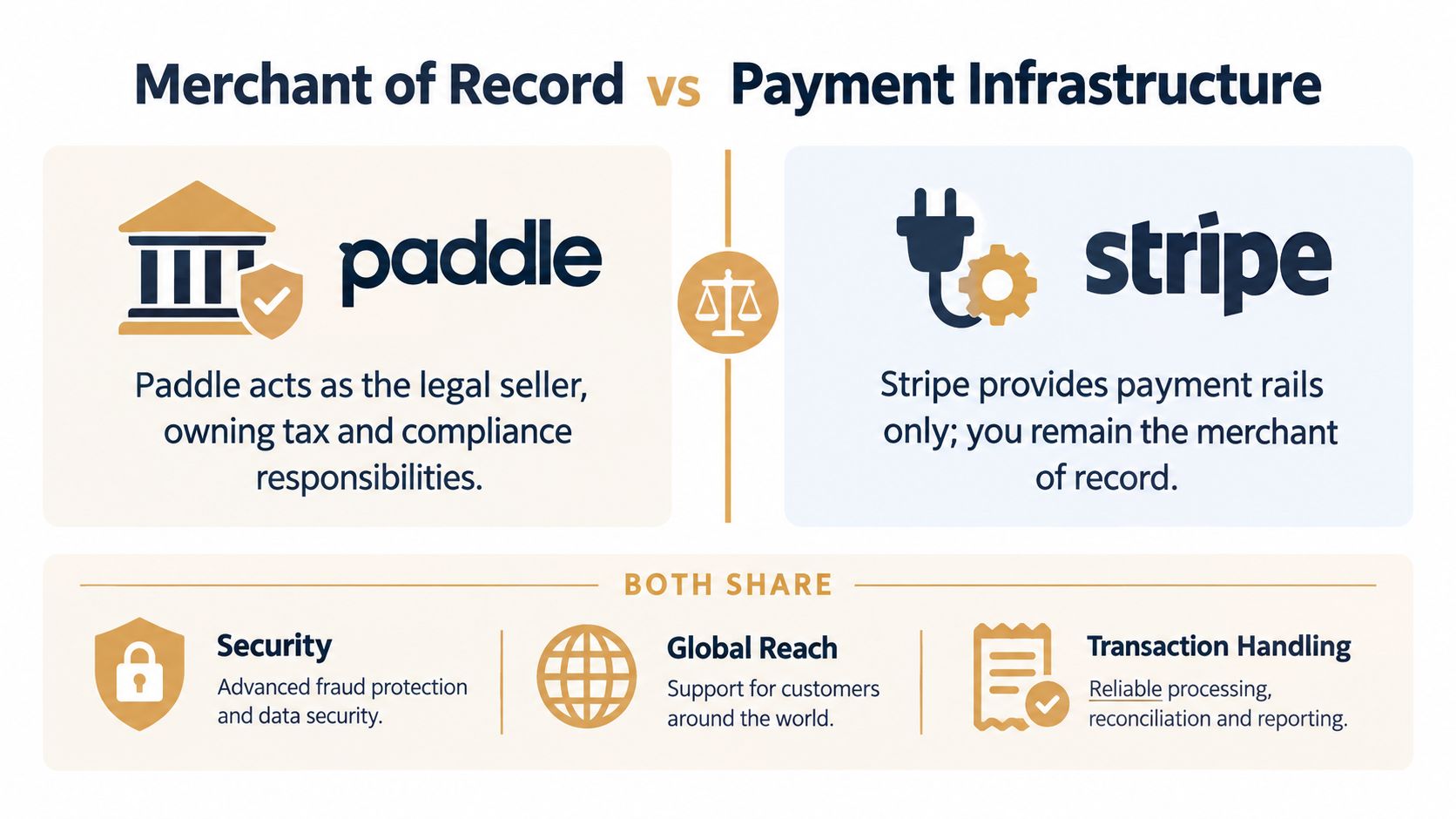
Paddle and Stripe take different approaches to that problem. Paddle is built around a merchant-of-record model, where the platform presents itself as the legal seller and bundles more of the commercial and compliance work. Stripe provides payment infrastructure, giving businesses tools to accept payments and build billing systems while leaving them responsible for more of their own operations.
That distinction changes what a headline rate means. With Paddle, the advertised fee covers a broader service arrangement. With Stripe, the processing charge is only one part of the cost. A merchant may also need to account for billing features, tax compliance, internal staff time, and the systems used to manage payment risk. The correct comparison isn't “Which percentage is smaller?” It's “What does my business still have to do, and what consequences does it still own?”
The decision depends on what your team can carry
A business selling digital products across borders may value the simplicity of handing off more tax administration. A company with specialized pricing rules may instead favor the freedom to build a billing stack around its own product. Neither preference is better. It depends on whether the business is more constrained by compliance work or by the limits of a more bundled system.
The dispute question belongs in the same calculation. When a customer challenges a payment, direct costs aren't the only concern. Staff time, customer communications, recordkeeping, and the risk of losing the payment all matter. The platform that appears cheaper before a dispute may be less attractive once you factor in who manages the process and what your team must do to support it.
Practical rule: Compare the total work and risk that remain with your company, not only the fee taken from each checkout.
Merchant of Record vs Payment Infrastructure
A merchant of record (MoR) is the entity that sells to the customer. For a software merchant, the practical difference is who takes responsibility for parts of the commercial relationship, including tax compliance and payment-related administration. Paddle describes itself as a merchant of record and says its model includes tax registration, filing, and remittance. Stripe's core model is payment infrastructure: the business uses Stripe to process and manage payments, but remains responsible for its own merchant operations.
That distinction doesn't mean a business using Stripe has no tools for tax or billing. It means the merchant must decide how to configure those tools and how to handle the responsibilities that sit outside payment processing. A Stripe merchant can assemble a flexible system, but flexibility comes with ownership of the integration and its edge cases. Paddle's bundled approach can reduce the number of separate processes a digital seller must coordinate.
Different measures of scale reflect different jobs
The companies' reported figures show why their scale shouldn't be compared as if both were selling the same service. Stripe reported more than $1 trillion in annual total payment volume in 2023, up 25% from approximately $817 billion in 2022, and said more than 100 businesses processed at least $1 billion annually through its platform. The milestone describes the reach of a broad payments infrastructure provider, not the size of a specialized subscription-billing product. Stripe's 2023 payment-volume milestone
Paddle emphasizes a different set of measures: it says it has processed 180 million transactions, remitted $6 billion in sales taxes in the previous year, and serves more than 10,000 digital-product businesses. Stripe, by contrast, reported $1.4 trillion in total payment volume in 2024, up 38% year over year. Those figures speak to different operating models. Paddle highlights the transaction and tax-compliance work associated with its MoR approach; Stripe's reported volume captures broad payment throughput. Paddle's comparison of its model with Stripe
The operational takeaway is simple. With Paddle, a business buys more than payment acceptance. With Stripe, it gets infrastructure that can be shaped around its own systems, but it must decide which responsibilities to keep and how to manage them.
Pricing Models and Effective Rates Compared
On a $10 sale, Paddle's published checkout fee takes a full dollar. Stripe's commonly cited domestic card rate of 2.9% plus $0.30 takes $0.59 on the same transaction, before optional services and other costs. That gap shrinks as order value climbs, and how quickly it shrinks is the first thing a merchant should model.
The published figures describe two different products. Paddle charges 5% plus $0.50 per checkout transaction on its core subscription offering, and Paddle's published pricing states that payment processing, billing, tax compliance, and sales-tax or VAT filing and remittance are included, with no monthly, migration, or hidden fees. Stripe's Billing product is priced at 0.7% of Billing volume on the pay-as-you-go plan, excluding one-off invoices, and it sits alongside card processing rather than replacing it, per Stripe's published pricing. A like-for-like read is impossible: one number buys a bundled merchant-of-record service, the other buys components of a stack the merchant assembles itself.
| Effective Fee Comparison by Transaction Value | Paddle Fee (5% + $0.50) | Stripe Base Fee (2.9% + $0.30) | Stripe with Billing + Tax Add-ons |
|---|---|---|---|
| $10 | $1.00, 10% | $0.59, 5.9% | Base fee + 0.7% of Billing volume; tax cost varies |
| $50 | $3.00, 6% | $1.75, 3.5% | Base fee + 0.7% of Billing volume; tax cost varies |
| $100 | $5.50, 5.5% | $3.20, 3.2% | Base fee + 0.7% of Billing volume; tax cost varies |
| $500 | $25.50, 5.1% | $14.80, 2.96% | Base fee + 0.7% of Billing volume; tax cost varies |
The last column stays untotaled on purpose. Billing is charged on volume rather than per transaction, and the published figures do not define a single universal tax add-on.
Compare the fee with the work it replaces
The table isolates transaction fees, so it cannot settle the decision on its own. A Stripe merchant still needs to model billing costs where recurring charges apply, tax administration across the jurisdictions it sells into, and the headcount or tooling required to run its own dispute process. A Paddle merchant should test the bundled fee against its average order value and decide how much that outsourced work is worth. The table also leaves out where losses land when a transaction is disputed; merchants pricing that exposure separately can review Disputely's pricing.
The break-even point shifts with more than transaction size. A higher average order value dilutes the fixed $0.50 component as a share of each sale. A business selling across borders may assign more value to bundled tax handling than a domestic-only seller. And a subscription company should count recurring Billing volume charges in its Stripe model rather than treating card processing as the full cost.
A lower sticker rate is only one input. The useful number is the cost after the team accounts for the service stack it needs and the operational exposure it chooses to keep.
Subscription Billing and Monetization Flexibility
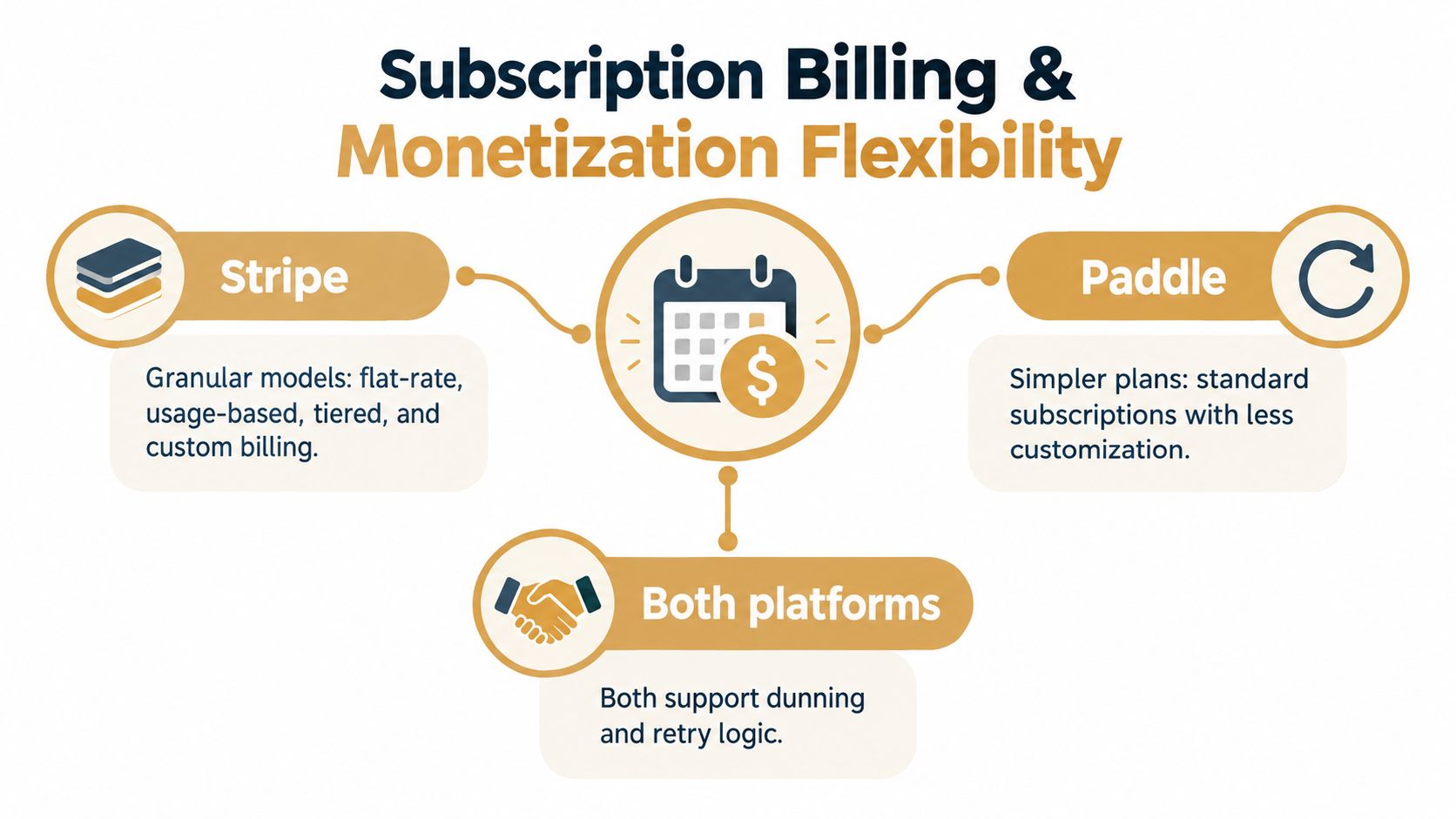
A merchant charging a base fee per seat, metering API calls, and billing overages each month needs a billing engine, not only a card processor. Stripe Billing covers that range directly, supporting flat-rate, per-seat, tiered, good-better-best, usage-based, metered, hybrid, and credit-based models. Its usage-based workflow records consumption and calculates charges in arrears at the end of a billing period, and basic metering through the Meters API carries a published monthly event allowance. For heavier requirements, such as real-time metering, multidimensional rates, prepaid credits, enterprise contracts, and automated invoice generation, Stripe points merchants to Metronome.
That breadth matters when the commercial model is part of the product itself. A configurable billing layer gives engineers fine control over pricing rules, and it hands the same team responsibility for designing, testing, and maintaining the integrations that keep those rules correct.
More flexibility means more decisions
The flexibility premium shows up in two places. The first is direct: the 0.7% pay-as-you-go Billing charge on billed volume described in the pricing comparison, excluding one-off invoices, with annual volume-based plans as the alternative.
The second is operational and easy to undercount. Retries, dunning, failed-payment recovery, and tax configuration all sit with the merchant, and every failed renewal is revenue leakage the platform does not absorb.
Paddle takes the opposite trade.
Its consolidated model suits software sellers whose subscriptions are conventional and who prefer a managed operating model to detailed control of each billing rule. More of the machinery behind renewals and collection runs inside the bundle rather than inside the merchant's own stack. The cost surfaces when pricing logic gets unusual, since a business with nonstandard billing rules has fewer places to express them.
On a risk-adjusted view, the choice comes down to who owns the downside of a failed renewal. A merchant that can model its own recovery rates and staff the work converts that exposure into engineering time and may extract more value per billing dollar on Stripe. A merchant treating involuntary churn and billing operations as unpriced liabilities pays for them either way, in Paddle's bundled fee or in internal headcount.
A practical test comes before the platform decision: write the pricing model in plain language. If the description needs exceptions, usage thresholds, credits, and contract rules, Stripe's flexibility earns its maintenance cost. If it describes a conventional recurring offer and the pain is operational exposure, the bundled model prices that exposure directly.
Global Tax Compliance and Cross-Border Selling
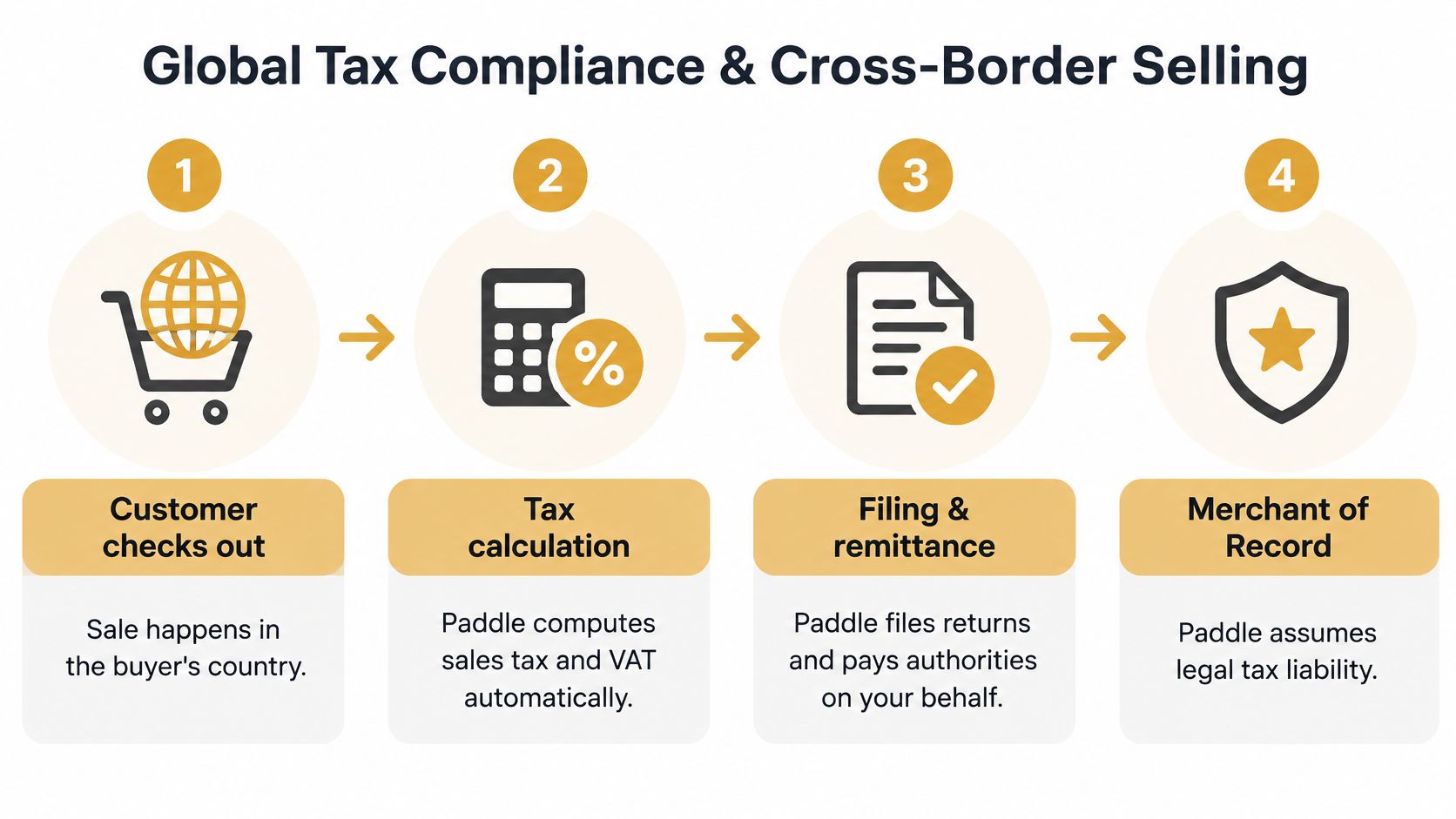
Tax compliance changes the fee calculation because the work doesn't stop when the customer pays. A business selling digital products across borders may need to consider tax registration, rate calculation, filing schedules, and remittance in the relevant jurisdictions. Under Paddle's MoR model, its published offering includes tax registration, filing, and remittance as part of the bundled service. A Stripe merchant, by contrast, retains responsibility for its merchant operations and has to decide how to configure tax tools and handle the related obligations.
Put administration into the model
A business comparing platforms should list the tax tasks it expects to manage, then identify which are covered by its chosen provider and which remain internal. A lower processing fee isn't a complete saving if the company must pay for additional services or assign staff to coordinate registration, filings, and payments. Conversely, a merchant with a limited compliance footprint may not benefit enough from a broad bundle to justify its higher transaction fee.
This is why cross-border revenue changes the meaning of the price gap. Paddle's fee is easier to evaluate as a package, while Stripe's economics depend on the merchant's own set of billing and compliance choices. The comparison is not between a fee and no fee; it's between a bundled operating model and a collection of responsibilities the merchant manages.
The right model also depends on internal capacity. A finance team that already has a reliable tax process may prefer to retain more control. A lean software business that doesn't want to build its own compliance workflow may see value in moving that work into the platform relationship. In either case, the merchant should verify what its current contract and configuration cover rather than assume that payment processing automatically takes care of tax obligations.
Chargeback Risk and Who Owns the Downside
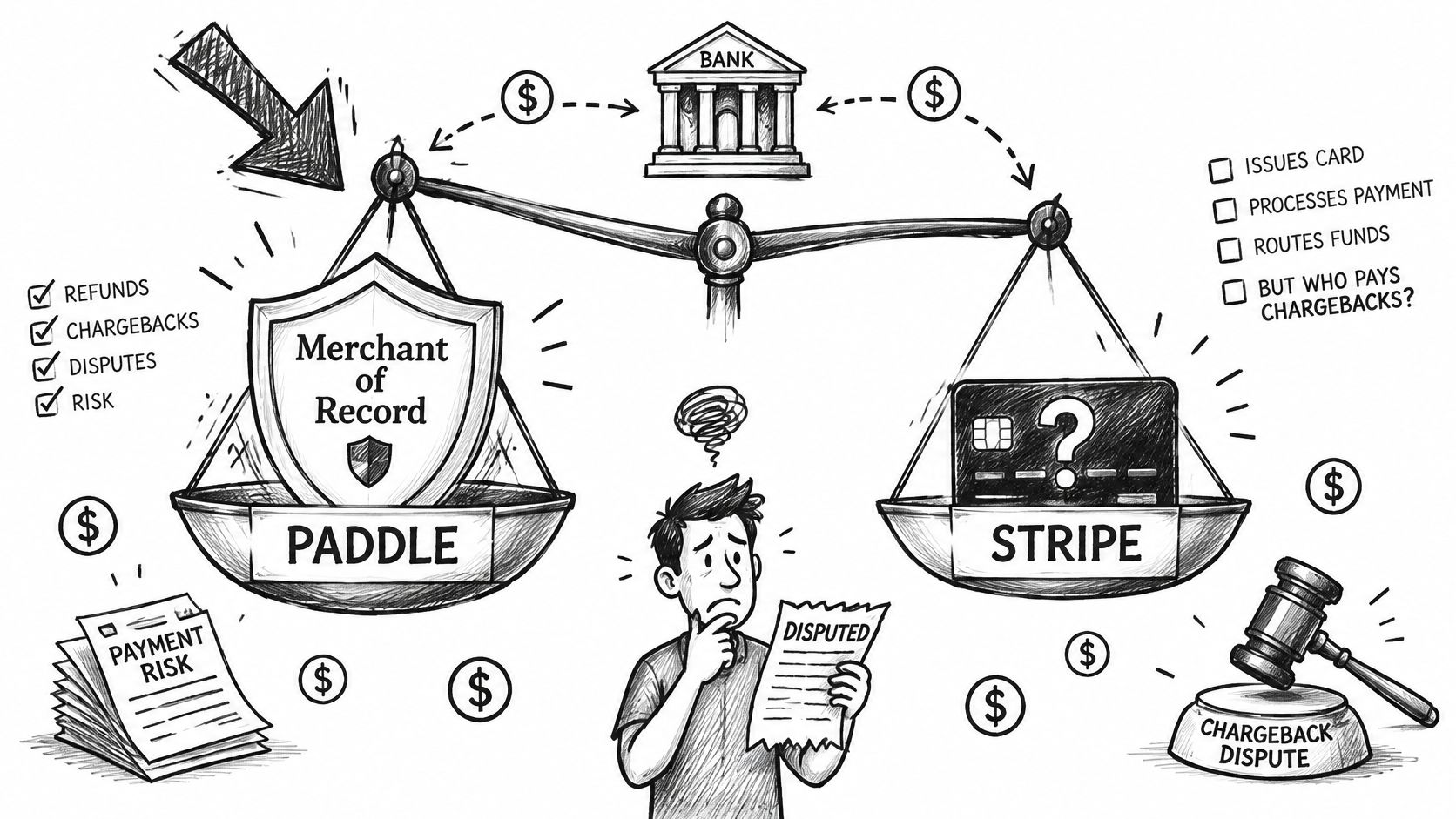
The hardest question in Paddle vs Stripe isn't only who processes a payment. It's who bears the downside when a customer disputes one. Under Paddle's merchant-of-record model, the platform is the legal seller and generally assumes responsibility for payment-related tax compliance, refunds, and chargebacks. Under conventional Stripe Payments, the merchant retains more responsibility for its merchant entity, tax configuration, payment risk, and dispute workflow. Paddle's explanation of managed payments and the MoR model
That difference can change the economic case for a platform. A global software company with meaningful dispute exposure may find a bundled fee more rational if it reduces the amount of compliance and dispute administration the team must own. A low-dispute merchant selling domestic, higher-value transactions may place more weight on a lower processing cost and the control of handling its own payment operations. There isn't a universal break-even point because the calculation depends on the merchant's own sales and dispute experience.
Transferring responsibility doesn't erase the work
An MoR model doesn't make good merchant records unnecessary. Businesses still need accurate product descriptions, clear cancellation policies, and a reliable process for distinguishing a legitimate refund request from a dispute they may be able to contest. The platform's role in the legal and administrative process can change, but the merchant's ability to explain what was sold and what the customer agreed to remains valuable.
That's the difference between transferring liability and preventing problems. Merchants should ask what evidence they'll need to supply, how customer complaints reach their team, and which decisions stay under their control. For businesses handling disputes themselves, a defined chargeback response process helps make sure records and policies are ready when a case needs attention.
A risk-adjusted comparison therefore includes the expected workload around refunds and disputes, not just the payment fee. Paddle may suit a seller that wants to move more of that burden to its MoR. Stripe may suit a merchant that prefers to keep control and has the people and systems to manage the consequences.
Choosing the Right Platform for Your Merchant Profile
Choose based on the pressure your team needs to relieve. Paddle is a stronger fit for digital-product sellers that want more tax and compliance work handled within a merchant-of-record arrangement, particularly when their sales footprint is international. Stripe is a stronger fit for businesses that need highly customized billing, want a composable payment system, or have the internal capacity to manage more of their own compliance and payment operations.
Before deciding, answer these questions:
- Average order value: How does Paddle's fixed per-transaction component affect your actual checkout mix?
- Sales geography: How much do you value having tax registration, filing, and remittance included?
- Billing complexity: Can your pricing fit a standard subscription model, or does it depend on detailed usage and contract logic?
- Dispute exposure: How much staff time goes into refunds, payment disputes, and record collection today?
- Internal capacity: Who will own tax administration, payment configuration, and ongoing billing changes?
If your business also sells through creator or course platforms, researching broader platform comparisons can help frame the selling model alongside the payment decision. For example, this resource can help you compare and Kajabi when assessing how platform choices fit a digital-product business.
Don't treat a rising dispute burden as just another processing cost. Review your high chargeback rate and identify whether the platform model, your customer policies, or your dispute-prevention process needs attention. The best choice is the one that fits your team's actual capacity and leaves responsibility for each important task clearly assigned.
Disputely helps merchants monitor dispute alerts and refund requests so they can act before a chargeback is filed, and it integrates with payment processors including Stripe. If you're weighing Stripe's retained dispute responsibilities against Paddle's bundled model, visit Disputely to see whether its alert-based workflow fits your payment operations.


