
Payment Gateway Integration for Website: A Practical Guide
A customer submits an order, sees a green “payment successful” message, and closes the tab. A few minutes later, the order is still marked pending in your database. The gateway authorized the payment, the browser callback fired, but the webhook arrived late, failed signature validation, or never reached your application. Your warehouse doesn't know whether to ship, your customer sees no confirmation, and your support team starts investigating a transaction that looked finished.
That scenario is why payment gateway integration for a website isn't just a matter of adding a card form. The difficult work begins after the first successful checkout, when your system must keep authorization, capture, settlement, refunds, recurring billing, and disputes aligned across several services. A stable integration treats payment state as an operational system, not a button.
Why Payment Gateway Integration Is More Than Checkout Setup
The checkout screen is the visible tip of the payment system. Underneath it sit browser SDKs, tokenization services, gateway APIs, fraud checks, authentication challenges, webhooks, order management, accounting, and customer support workflows. A failure in any one of those layers can leave two systems holding different versions of the truth.
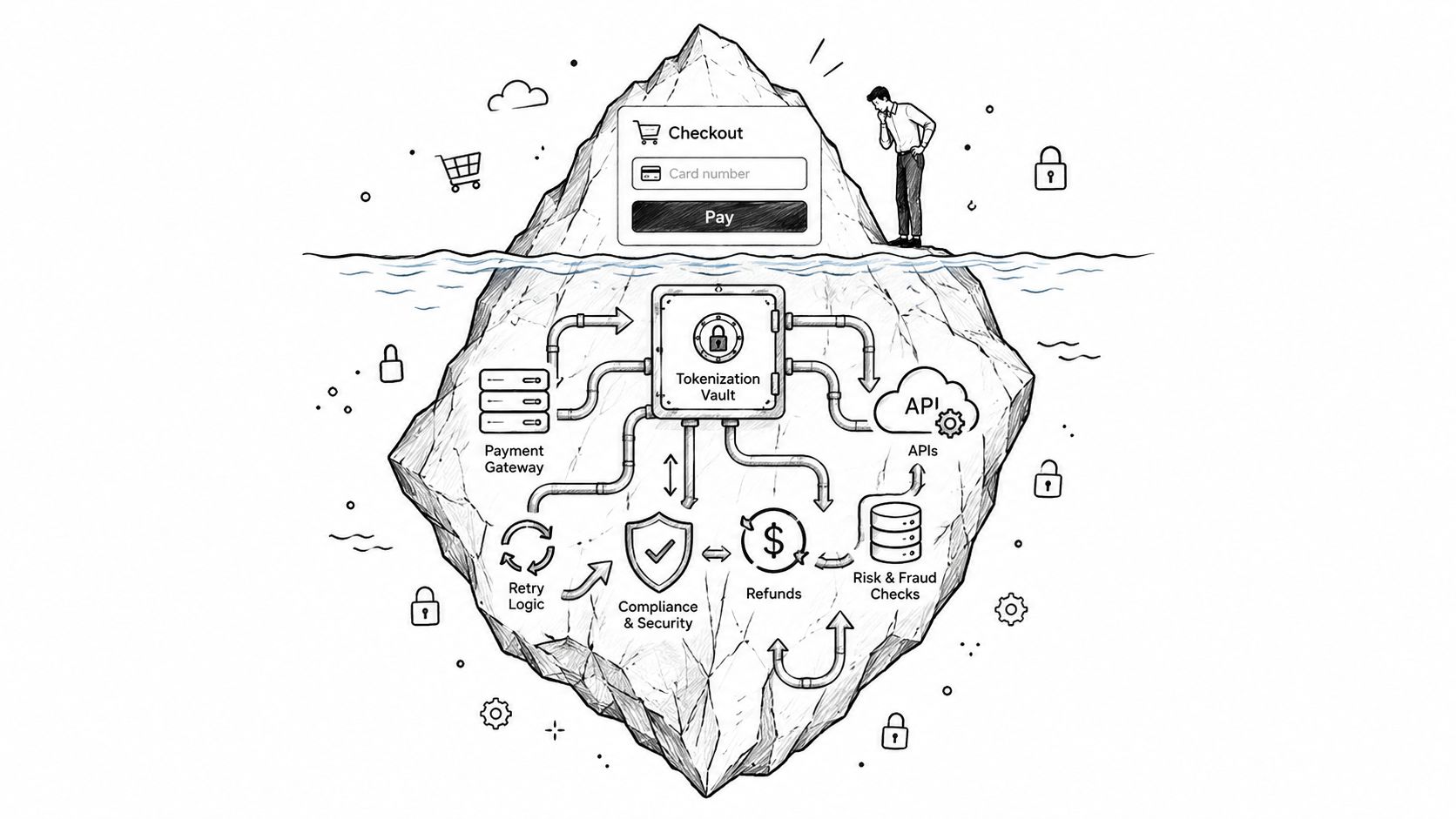
A common mistake is to treat the frontend response as the final result. The browser can report that a customer completed a payment step, while the backend still needs to receive an authorization event, handle a 3DS challenge, wait for asynchronous confirmation, or record a later capture. If fulfillment depends on the browser alone, customers can receive goods without a confirmed payment, or legitimate orders can remain stuck because the callback was interrupted.
The business impact extends beyond a single order. Refund status affects customer communication, recurring payment failures affect retention, and incorrect transaction records make reconciliation harder. Disputes add another layer because the merchant needs accurate order, delivery, and payment evidence when a customer challenges a transaction.
Payment infrastructure is becoming strategic
The market context explains why these failures deserve engineering attention. The global payment gateway market was valued at USD 26.7 billion in 2024 and is projected to reach USD 48.4 billion by 2029, with a projected 12.6% compound annual growth rate during that forecast period, according to Grand View Research's payment gateway market analysis. The same report says hosted gateways captured 56.66% of 2025 revenue, while online web channels represented 98.38% of activity, making browser-based payment flows a central part of digital commerce infrastructure.
A separate forecast values the market at USD 30.58 billion in 2025 and projects USD 90.28 billion by 2034, while another estimates growth from USD 29.0 billion in 2025 to about USD 115.3 billion by 2035. Those are projections, not guarantees, but they point to sustained demand for payment integrations across ecommerce, subscriptions, and digital services, as described in Fortune Business Insights' payment gateway forecast. The same source places North America at roughly 30% to 36% of recent global revenue estimates, which helps explain why gateway standards and integration practices often emerge from highly mature payment markets.
For implementation context, merchants comparing checkout architecture and processor responsibilities may also find WebinOne payment solutions useful alongside their provider documentation. Your own system still needs explicit ownership of payment state, retries, reconciliation, and support escalation. A payment gateway can authorize money, but it can't decide whether your order database is safe to fulfill.
The practical lesson is simple. A website payment integration is complete only when it handles the normal path, the delayed path, the failed path, and the disputed path without requiring someone to repair records manually.
For ongoing monitoring and transaction operations, teams can also keep their payment workflows connected to Disputely's payment operations resources.
Choosing the Right Integration Pattern for Your Store
The right architecture depends on how much control your team needs and how much payment responsibility it can safely operate. A small store selling occasional one-time orders shouldn't automatically build a full payment stack. A subscription business with custom billing logic may outgrow a basic redirect flow quickly.
Hosted checkout
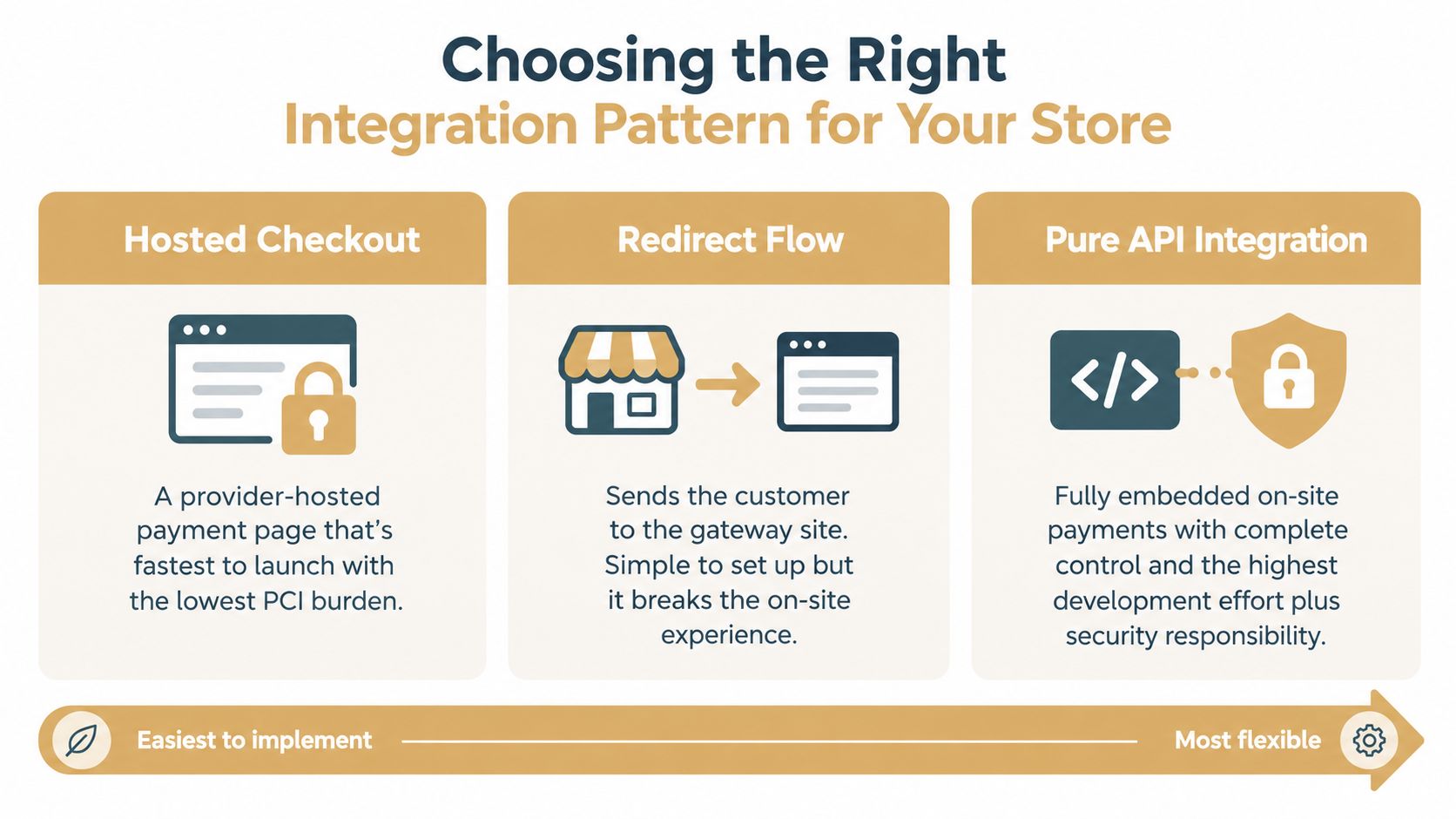
A hosted checkout keeps payment fields in the provider's environment, often through an embedded component or provider-controlled page. The gateway handles sensitive input collection, and your application receives a token or payment reference rather than raw card data.
This is usually the most practical starting point for a small engineering team. It reduces the amount of payment data your server touches, shortens the security review, and lets the provider manage parts of the browser experience. The trade-off is reduced control over layout, validation, and some edge-case behavior. You also need to understand how the hosted component reports asynchronous events, because “the form submitted” still isn't the same as “the order settled.”
Redirect flow
A redirect sends the customer to a gateway or wallet page and returns them to your website afterward. It can be straightforward to launch and may suit merchants that prioritize a lower implementation burden over a continuous on-site checkout.
The weakness is continuity. Customers may not return to the merchant site, close the payment window, or arrive back before the backend receives the definitive event. Your return URL can help restore context, but it shouldn't be the system of record. Fulfillment should still depend on verified server-side state.
For businesses evaluating alternative rails, including bank-based payment methods, it can help to read from Jumpstart Partners about processor considerations beyond card checkout. The same principle applies: select a flow that your team can reconcile, not merely one that looks simple in a demo.
Pure API integration
A pure API approach gives you the greatest control over the checkout experience, payment orchestration, and custom billing logic. It also creates the greatest security and maintenance responsibility. Your team must manage tokenization correctly, protect credentials, support gateway-specific statuses, and keep behavior consistent across browsers, retries, refunds, and webhooks.
This pattern makes sense when the store has a dedicated engineering function, a distinctive checkout requirement, or complex recurring and marketplace logic. It doesn't make sense when a standard hosted component already covers the customer journey and the team lacks capacity for continuous payment maintenance.
A useful decision rule is:
- Choose hosted components when reducing PCI exposure and launch effort matters most.
- Choose redirects when a simple provider-controlled journey is acceptable and return handling is dependable.
- Choose API integration when custom experience and orchestration justify the security and support burden.
Before committing, verify how the provider handles recurring billing, saved payment methods, refunds, partial captures, 3DS, failed webhooks, and test environments. For Stripe-specific setup considerations, keep the provider account and integration workflow aligned with your Stripe signup process, rather than treating account creation as a separate operational concern.
Building a Secure Tokenized Payment Flow
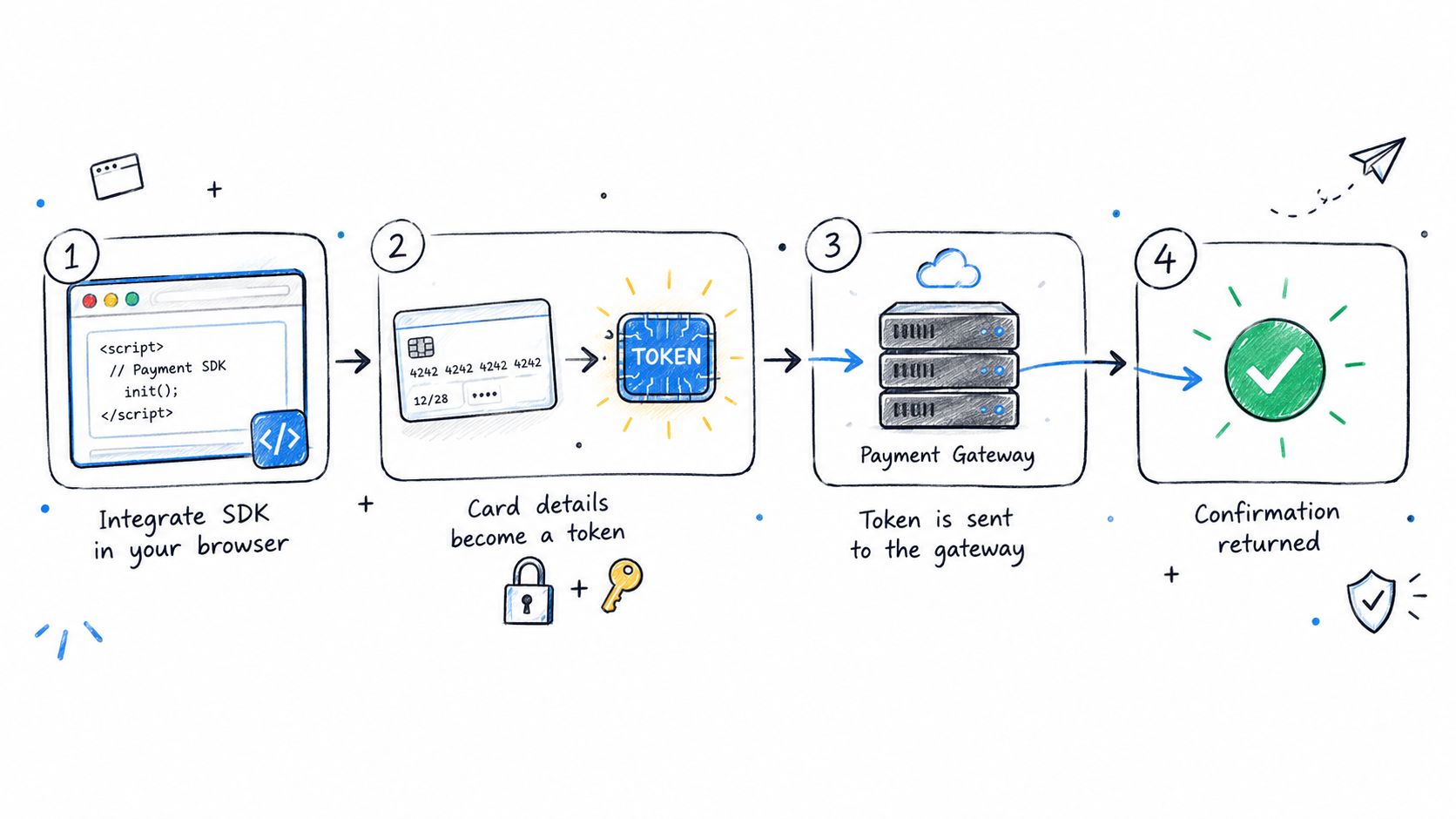
A secure payment flow keeps raw card data away from your application server. The browser collects payment details through the gateway's hosted fields or JavaScript SDK, the provider converts those details into a token or payment method reference, and your backend works with that reference.
The request sequence
Start by retrieving the provider's publishable and secret credentials. Keep the publishable key available to the browser only where the provider permits it, and store the secret key in your backend's protected configuration. Never place a secret credential in frontend JavaScript, a mobile bundle, a public repository, or an order record.
Load the provider's browser SDK and render its secure payment fields. When the customer submits the form, the SDK sends the payment details to the gateway and returns a token. Your server should receive that token through a signed HTTPS request together with the amount, currency, internal order reference, and an idempotency key.
The backend then creates or confirms the payment through the provider API. It should store your internal payment identifier, the provider's transaction reference, the requested amount, and the current state. Keep the raw request and response data limited to what you need for debugging and reconciliation, and never log card numbers or security codes.
What tokenization changes
Tokenization reduces the amount of sensitive payment data that your application directly handles. The payment gateway integration guidance from Reform recommends gateway-hosted inputs or browser-side tokenization, followed by a backend request containing the token and transaction details. The same guidance emphasizes testing authorization, capture, refunds, webhook retries, and 3DS challenge handling as one complete loop.
Tokenization also supports later actions without retaining raw card details. Mastercard and PayPal guidance describes token reuse for recurring payments, refunds, and future merchant-initiated transactions. Your system still has to record customer consent, billing terms, and the relationship between the stored payment reference and the subscription or order.
Use this implementation checklist:
- Separate credentials: Keep publishable and secret keys in their correct execution environments.
- Tokenize in the browser: Let the gateway collect the payment details.
- Submit from the backend: Send only the token, amount, currency, internal reference, and idempotency data over HTTPS.
- Model intermediate states: Support requires-action, authorized, captured, failed, refunded, and disputed states as appropriate for the provider.
- Handle 3DS: Treat an authentication challenge as part of the payment flow, not as an exceptional browser error.
- Process webhooks: Update the authoritative payment record after validating and storing the provider event.
- Test recovery: Repeat authorization, capture, refund, retry, and delayed-event scenarios before launch.
A browser success callback can improve the customer experience by showing progress or a confirmation screen. It must not authorize fulfillment by itself.
The video below provides a visual overview of the payment process before you adapt the sequence to your own provider and order model.
Handling Webhooks and Keeping Payment State Accurate
The most reliable integration treats the gateway as an asynchronous system. A customer can finish a browser interaction while the provider is still processing authorization, waiting for authentication, or preparing a later settlement event. Your backend needs a state machine that can accept events in a safe order and recover when delivery is delayed.
Build an event-driven payment record
Store a payment record separate from the order record. The payment record should include the internal order ID, provider transaction ID, amount, currency, current status, timestamps, refund totals, and the last processed event identifier. This separation lets you investigate payment behavior without overwriting commercial order data.
Validate the webhook signature using the provider's documented method before accepting the payload. Then persist the event before applying the state transition. If your worker crashes after storage but before processing, a retry can resume safely. If the same event arrives again, the event identifier and idempotent update should prevent a second refund, duplicate fulfillment, or repeated email.
Practical rule: A return URL tells you where the customer went. A verified backend event tells you what the payment system recorded.
Your status model should distinguish authorization from capture and capture from settlement where the provider exposes those states. It should also represent action required, failed authorization, expired session, partial refund, full refund, and dispute activity. Avoid collapsing every non-final response into “failed,” because that can trigger an unnecessary retry or mislead support.
Reconcile instead of trusting notifications
Webhooks are essential, but they aren't a substitute for reconciliation. Run a scheduled comparison between your payment records and the provider's transaction data. Investigate records that exist at the gateway but not in your database, records marked paid internally without a matching provider result, and refunds whose gateway status differs from your accounting system.
Integration quality has a measurable operational effect. One technical review reports a 95.5% payment success rate during peak hours, 48-hour average refund processing, and a dispute ratio below 0.1% for properly configured payment gateway systems, as documented in the WJARR technical review. Another industry guide reports that integration errors can cause 15% to 20% of transactions to fail without user visibility because of API mismatches or network issues. Those figures are not promises for every store, but they show why webhook validation and scenario testing deserve production-level attention.
Use idempotency keys for payment creation and refund requests. Lock or atomically update the order when fulfillment begins. If a customer clicks twice, the second request should resolve to the original operation rather than create a second charge.
Testing Before Launch and Preventing Expensive Failures
A payment integration isn't ready because one sandbox card produced a successful response. It's ready when the team has tested the transitions that cause real support tickets: a challenge that expires, a webhook that arrives twice, a refund that fails after the customer has been told it was issued, or a payment that succeeds after the browser loses connectivity.
Test the complete transaction lifecycle
Create a test matrix that covers both customer behavior and provider events. At minimum, exercise:
- Successful authorization and capture: Confirm that the order, payment record, inventory, receipt, and accounting entry agree.
- 3DS and SCA challenges: Test success, failure, abandonment, and a challenge completed after the original page state has changed.
- Expired sessions: Verify that the customer receives a recoverable message and that an expired payment can't fulfill an order.
- Duplicate submissions: Click the pay button repeatedly, refresh during submission, and retry after a network timeout.
- Delayed and duplicate webhooks: Deliver events out of order, repeat the same event, and restart the worker during processing.
- Failed authorizations: Show a useful customer message without revealing sensitive gateway details or marking the order as paid.
- Partial captures and refunds: Confirm that totals, inventory, receipts, and accounting remain accurate after more than one payment action.
- Provider outages: Make sure the application fails safely and doesn't create an order state that implies payment completion.
Staging often behaves more cleanly than production. Live traffic introduces browser extensions, abandoned tabs, slow mobile connections, provider latency, fraud reviews, and customer retries. Run a controlled live transaction after launch, then compare the provider record with your own database and fulfillment system.
Turn maintenance into a routine
Assign an owner for credentials, webhook endpoints, gateway configuration, and plugin updates. Credential mapping becomes fragile when a store has separate test and production accounts, multiple brands, or several processors. Plugin version conflicts can also change payment behavior without changing your checkout code, especially when an ecommerce platform, theme, gateway extension, and fraud tool update independently.
Keep a reconciliation queue rather than hiding mismatches in logs. Give support a way to search by internal order ID, provider transaction ID, customer email, and refund reference. A payment team should be able to answer whether money was authorized, captured, refunded, or disputed without asking engineering to query production tables.
Chargeback prevention belongs in the same operating rhythm. Capture order confirmation, delivery, subscription consent, cancellation history, customer communication, and refund records while they're easy to retrieve. When an alert arrives, decide whether an early refund is appropriate or whether the transaction has evidence worth defending.
A launch checklist protects the first transaction. A reconciliation habit protects the thousandth.
Review gateway release notes, test meaningful changes in a sandbox, and monitor payment states after every deployment. If a status mapping changes, a small code release can otherwise create a large backlog of orders requiring manual repair.
From Integration to Ongoing Payment Operations
Many teams still measure a website payment gateway integration by its launch date. That measurement is too narrow. The actual test is whether the store continues to authorize, capture, refund, reconcile, and fulfill accurately when traffic rises, providers change behavior, and customers challenge transactions.
Modern gateways support cards alongside wallets, account-to-account payments, buy now, pay later products, and real-time rails. That broader coverage increases customer choice, but it also creates more status models and more operational paths to maintain. Recent coverage of ecommerce payment challenges highlights credential mapping, webhook reliability, plugin conflicts, asynchronous updates, and cross-provider reconciliation as continuing sources of support work after launch.
Resilience needs deliberate boundaries
A second gateway can provide regional coverage, redundancy, or cost flexibility. It also forces the team to maintain separate authentication rules, response codes, webhook formats, refund behavior, and reporting logic. Industry commentary on multi-gateway orchestration describes this trade-off clearly: more providers can improve resilience, but they require distinct mental models and stronger orchestration.
For a single-store operation, one well-understood gateway may be safer than several poorly reconciled integrations. For a high-volume or subscription business, controlled failover and provider diversification may justify the extra system design. In either case, payment operations need alerting for failed captures, unusual declines, webhook gaps, refund failures, and dispute notifications.
Dispute alerts can sit beside the payment processor rather than inside the checkout code. A service that receives alerts, applies refund rules, and preserves transaction context can help teams act before an issue becomes a formal chargeback. Merchants evaluating that workflow can review chargeback-fighting options as part of their broader payment operations design.
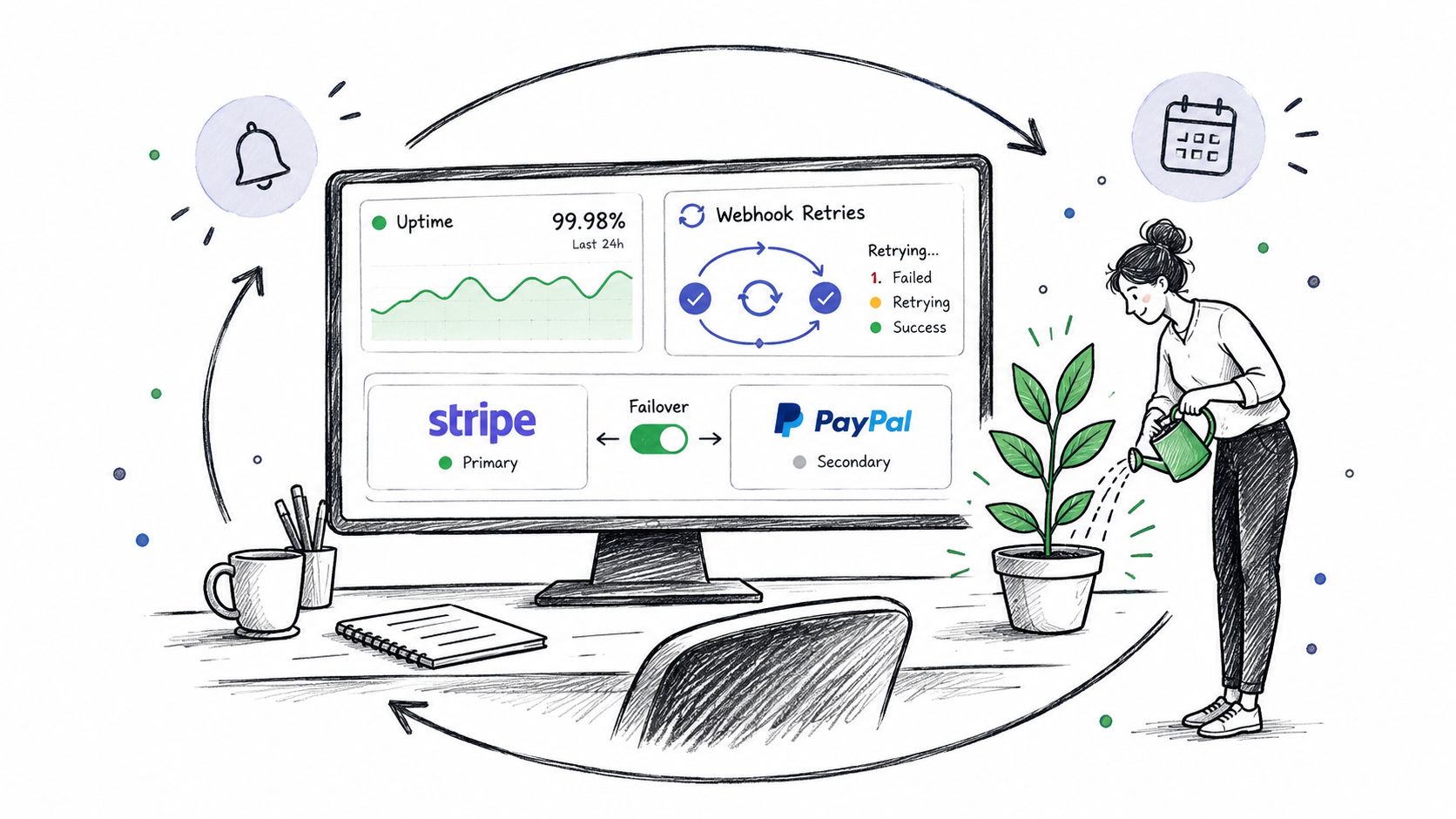
The mature view is that integration is maintained like any other revenue-critical backend service. Keep payment state explicit, reconcile it regularly, test provider changes, and give disputes a fast operational path. Stable processing protects more than conversion. It preserves customer trust, fulfillment accuracy, and the relationship with your payment processor.
Disputely connects with payment processors, receives dispute alerts, and helps automate refund decisions before disputes become chargebacks. Visit Disputely to see how its real-time workflow can fit alongside your website payment integration and reconciliation process.


