
Payment Gateway Integration in Ecommerce: A Complete Guide
Silent failures can affect 15-20% of transactions when API mismatches or network issues aren't caught before launch, while clear error handling can recover 20-25% of otherwise lost transactions. Payment gateway integration in ecommerce therefore needs to be engineered as an operational system, not treated as a checkout configuration task.
The failure usually appears at the worst possible time. A customer completes payment, the gateway approves it, and the order remains stuck in “pending” because a webhook never arrived. Another shopper refreshes the browser and creates a second authorization. A wallet works in one country, a bank transfer fails in another, and the support team discovers the problem only after customers start sending screenshots.
Global transaction growth has made these failures more expensive. Worldpay data shows global ecommerce spend rose from $1.2 trillion in 2014 to more than $6.8 trillion in 2024, while digital payment methods used in ecommerce and in-person shopping grew from $1.7 trillion to $18.7 trillion over the same period (payment statistics and gateway integration context). Your integration must now handle more volume, more payment rails, more markets, and more operational states than a basic card form was designed to support.
Why Payment Gateway Integration Keeps Breaking After Launch
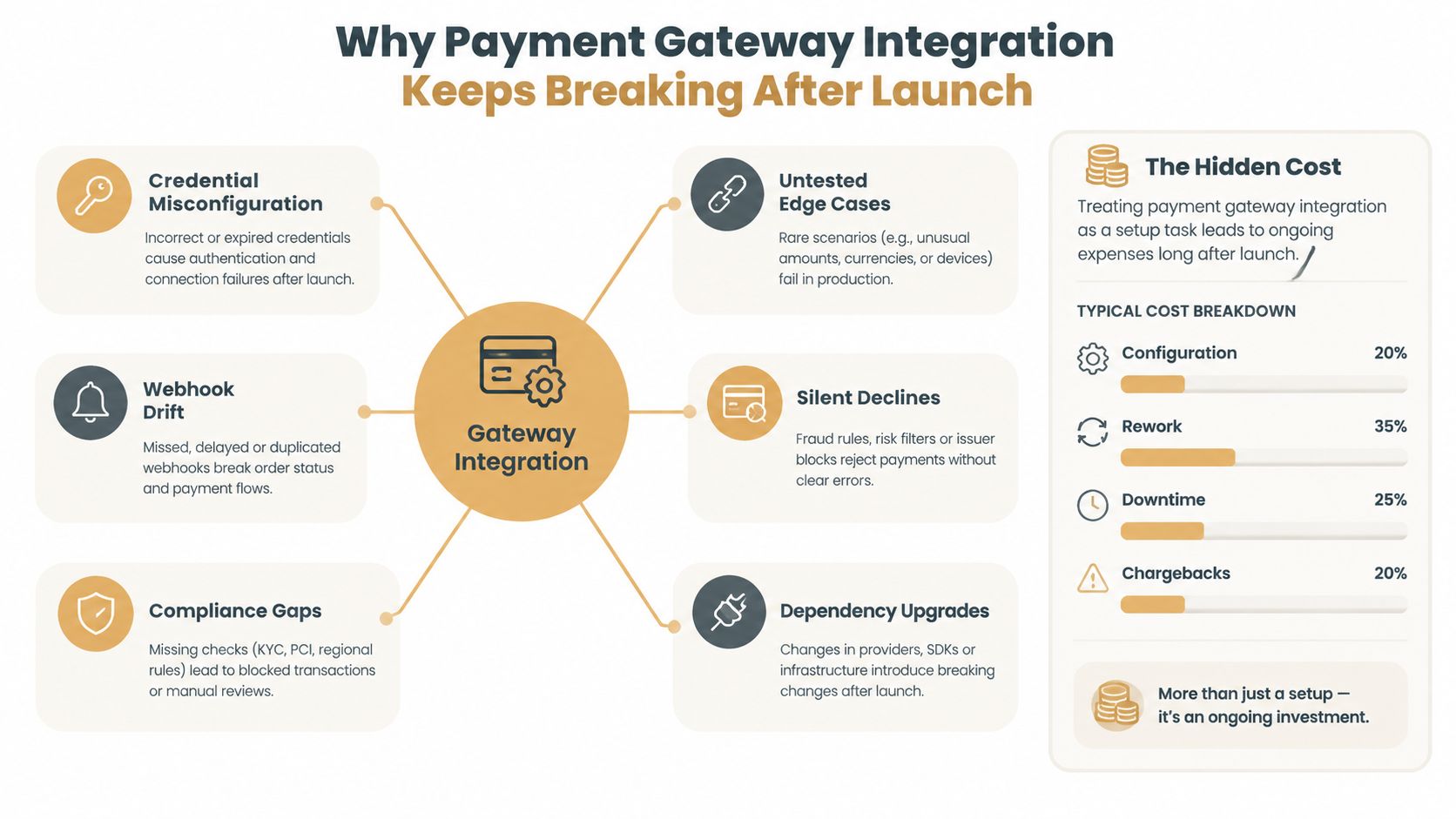
A checkout can pass every staging test and still fail during a weekend promotion. The page loads, the card form accepts input, the sandbox approves the payment, and the order confirmation appears. Production introduces the cases that scripted tests rarely cover: a customer loses connectivity after clicking Pay, a gateway retries a webhook, or a payment method returns its result minutes later.
That changes the definition of a working integration. The system must preserve payment state, expose an actionable error, and reconcile the gateway's transaction record with the merchant's order system. A green API response proves only that one request succeeded.
The single-gateway mental model is obsolete
A checkout built around one card processor and one synchronous request becomes difficult to operate after the business adds wallets, account-to-account payments, BNPL, subscriptions, local methods, or cross-border settlement. Each rail can apply different authentication rules, response fields, settlement timing, refund behavior, and dispute signals.
Analysts expect digital payments to represent 79% of ecommerce payments by 2028, compared with 34% in 2014, and project 5.4 billion digital wallet users, or 60% of the global population (global payment-method research). The same research reports wallets account for 84% of ecommerce payments in China and 64% in India, while account-to-account payments lead in the Netherlands at 67% and Poland at 70%. Regional behavior makes payment-method selection a routing decision, not a matter of adding buttons.
The payment layer should track each intent from authorization through authentication, asynchronous confirmation, capture, settlement, refund, and dispute. Idempotency keys prevent a retry or browser refresh from creating a second authorization. Webhook handlers must accept repeated events safely, verify their origin, process them in a controlled order, and expose failures for replay. Reconciliation then compares gateway records with orders, refunds, payouts, and fulfillment instead of assuming every callback arrived correctly.
Fraud and disputes belong in the same operational design. A payment that appears successful can still produce a chargeback, while a weak event trail makes it harder to explain delivery, authentication, or refund decisions. Store the transaction identifiers, event history, customer and order context, and fulfillment evidence needed for later review.
Practical rule: If the team cannot explain what happens after a timeout, redirect failure, duplicate callback, delayed webhook, refund, or partial fulfillment, the integration is unfinished.
Unpaid orders can reserve inventory, duplicate events can trigger duplicate fulfillment, and missing payment records can force manual reconciliation. Businesses expanding their digital operations should also account for the broader online selling benefits for enterprise growth, including payment infrastructure that supports expansion without multiplying manual work.
Choosing Between Hosted and API-Based Gateway Integration
The choice between hosted checkout and API-based integration is a decision about control, compliance scope, engineering ownership, and failure responsibility. Neither approach is universally superior. The right choice depends on whether the business needs a customized payment experience or a dependable path to accepting payments with limited operational overhead.
A hosted checkout redirects, or securely embeds, the payment experience managed by the gateway. The provider typically owns more of the payment-data handling, while the merchant configures branding, methods, redirects, and order behavior. This is often the sensible route for a small team using Shopify, WooCommerce, or another established ecommerce platform.
An API-based integration keeps more of the flow inside the merchant's application. It can support custom subscription logic, multi-currency routing, marketplace workflows, wallet orchestration, and tightly integrated inventory or customer experiences. The trade-off is substantial: your engineering team owns more state management, error handling, testing, monitoring, security controls, and gateway-change maintenance.
A practical comparison
| Dimension | Hosted Checkout | API-Based Integration |
|---|---|---|
| Checkout control | Limited to provider-supported branding and configuration | Deep control over layout, logic, and customer flow |
| Development effort | Lower, especially with a supported ecommerce plugin | Higher, with custom backend and frontend work |
| Payment-data exposure | Generally reduced because the provider handles more of the sensitive flow | Requires careful tokenization and stricter system boundaries |
| Payment-method expansion | Dependent on provider UI and supported configuration | More control over method selection and routing |
| Subscriptions and custom logic | Suitable for standard billing workflows | Better for complex recurring, marketplace, or entitlement logic |
| Operational ownership | Provider handles more infrastructure, merchant still owns callbacks and order state | Merchant owns nearly every integration layer |
| Best fit | Small teams, standard stores, fast launches | Dedicated engineering teams and differentiated checkout experiences |
A solo store owner usually benefits from hosted simplicity. The main risk isn't a lack of customization. It's adding custom code around a flow that already works, then creating callback or refund inconsistencies that the team can't monitor.
A high-volume DTC brand with dedicated engineers may justify API-based orchestration when checkout behavior, regional routing, or subscription control materially affects the business. The team should move only when it can staff the integration after launch, not just build it.
Hosted checkout reduces implementation burden. It doesn't eliminate the need to reconcile webhooks, refunds, order state, and customer-facing errors.
A migration from hosted to API-based payments should start with evidence. Review failed-payment reasons, unsupported methods, authentication friction, reconciliation workload, and the specific checkout behavior the hosted flow prevents. If those constraints are minor, staying hosted is often the better engineering decision. If they materially limit growth, build the API path beside the existing flow, run it through production-like testing, and migrate a controlled portion of traffic rather than replacing the working path in one release.
Technical Integration Patterns That Prevent Production Failures
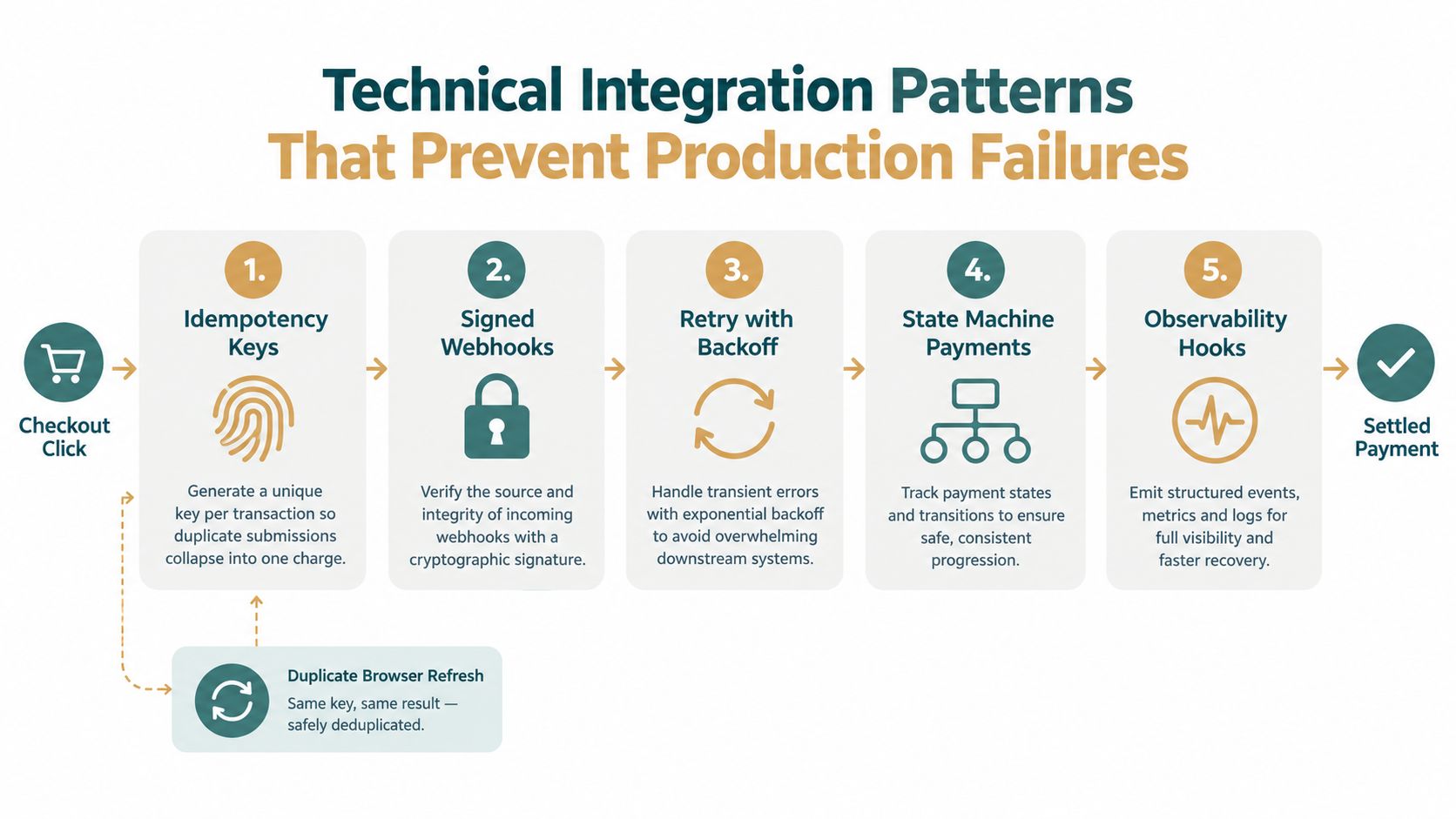
A customer can submit an order twice, refresh after payment, lose the connection before receiving a response, or trigger a gateway retry. The first control against duplicate charges and orders is idempotency. Without it, one payment attempt can create multiple charges, fulfillment events, or refund requests.
Treat payment creation and confirmation as operations with stable identities. Generate an idempotency key for each merchant payment attempt, store it with the order, and return the original result when the same request arrives again. A browser retry should reuse the existing key, not create a new one.
Build payment state instead of trusting one response
The browser redirect supports the customer experience, but it cannot be the payment record of truth. A shopper may close the tab, a redirect may be blocked, or authentication may still be processing when the browser returns. Webhooks must update the order independently, and duplicate deliveries should be treated as normal system behavior.
Use a state machine with states such as created, requires_action, authorized, captured, failed, refunded, and disputed. Names may differ, but every transition should be checked against the current state. A captured payment must not be captured again. A late failure event must not replace a confirmed settlement unless a defined reconciliation rule permits it.
Webhook handlers should verify signatures, persist each event before downstream work, acknowledge it only after safe acceptance, and tolerate retries. Recurring failure causes include unregistered endpoints, non-200 responses, processing only the first delivery, and SSL or TLS problems in staging, as described in this webhook and integration failure analysis.
Protect credentials and normalize gateway data
Store secret keys in a managed secret store. Keep them out of browser code, logs, tickets, and source control. Use tokenization where available, so the application handles a gateway token instead of raw card data. Normalize provider responses into an internal schema while retaining the original event ID and response for investigation.
A useful payment record connects the order ID, payment attempt ID, gateway name, provider transaction ID, idempotency key, currency, amount, status, authentication result, and timestamps. Teams connecting payment operations securely can use an OAuth authorization flow instead of passing long-lived credentials through custom application code.
Test authentication headers, signature verification, timeouts, duplicate events, and out-of-order delivery. The happy path is the smallest part of a production integration. Multi-rail routing also needs explicit fallback rules, because retrying through another provider without preserving payment identity can create a second charge.
Security and PCI Compliance Requirements for Merchants
Security decisions shape the amount of payment infrastructure your team must protect. A hosted redirect or hosted payment field can reduce the systems that touch card data. A custom API flow gives you more control, but it also requires disciplined tokenization, access control, secure transport, logging, and documented responsibility between your application and the gateway.
PCI DSS scope depends on the implementation. Merchants using a fully hosted payment experience generally have a different assessment burden from merchants embedding payment fields or sending payment data through their own systems. A merchant that collects raw card numbers on its server takes on a much more serious security responsibility than one that sends tokenized values from provider-controlled fields.
Reduce exposure with clear boundaries
Use hosted fields or gateway-hosted pages where they meet the product requirement. Tokenization replaces sensitive payment data with a gateway-managed token, allowing your order system to reference a payment method without storing the underlying card number. It doesn't make security irrelevant, but it narrows the places where a breach could expose payment data.
Keep production and test credentials separate. Restrict access by role, rotate secrets through a controlled process, and prevent payment payloads from appearing in application logs. Enforce encrypted transport, validate certificates in every environment, and review third-party plugins because an otherwise clean architecture can be undermined by an extension that captures or stores payment details.
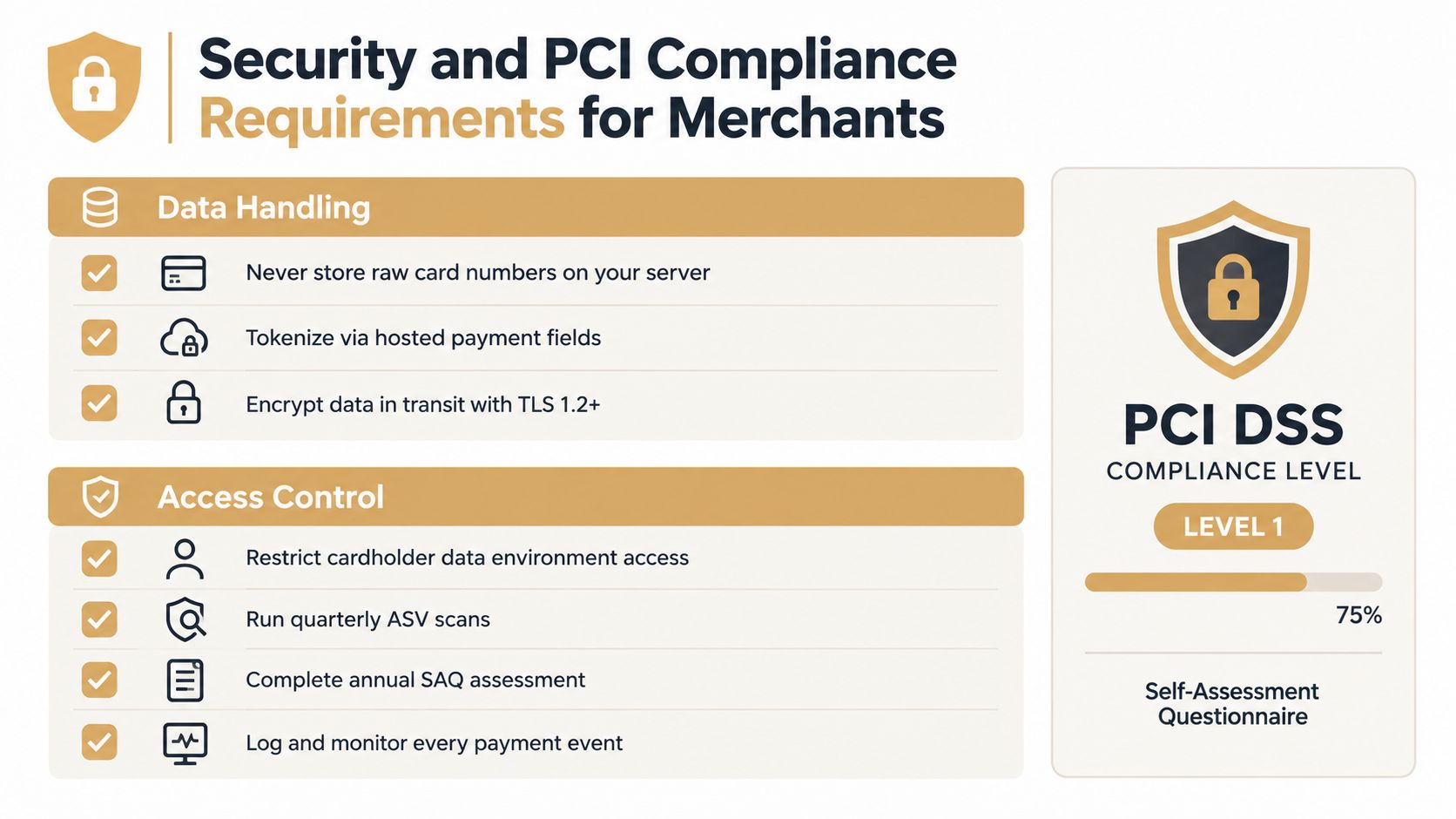
For a practical overview of the framework, use this guide to the 12 PCI DSS requirements explained. Treat it as a checklist for conversations with your acquiring bank, gateway, security team, and compliance assessor, not as a substitute for confirming your own implementation scope.
A pre-launch compliance check
- Map payment data: Document where payment information enters, travels, appears, and gets deleted.
- Confirm tokenization: Verify that application databases, logs, analytics tools, and support systems receive tokens rather than raw card numbers.
- Review access: Remove unnecessary production access and record administrative activity.
- Test transport security: Check certificates, webhook endpoints, redirects, and third-party scripts in every environment.
- Complete the right assessment: Confirm the applicable self-assessment and evidence requirements with your provider or assessor.
- Monitor events: Log payment decisions without logging sensitive payment values.
A merchant can also connect payment events to a dedicated workflow through secure Stripe account authorization, provided the permissions, data access, and retention behavior are reviewed before activation.
Testing Strategies That Catch Failures Before Customers Do
A payment test suite should be designed around failure, not reassurance. A successful card authorization proves that one request can complete. It doesn't prove that the order remains correct after a timeout, a delayed webhook, an expired token, a currency mismatch, or a gateway outage.
Start in the sandbox with production-like payloads. Use realistic order totals, currencies, customer metadata, subscription references, shipping information, and line items. Test the exact fields your fulfillment, tax, accounting, and customer-support systems depend on. Inconsistent field mapping between gateways is a common source of silent failure, especially when one provider calls a value customer_id and another returns a nested customer object.
Exercise the cases teams usually skip
Build tests for declined payments, authentication challenges, expired tokens, malformed responses, unavailable methods, and network timeouts. Then send the same payment request repeatedly with the same idempotency key. The expected result is one payment attempt and a consistent response, not multiple charges.
Webhook testing needs deliberate failure injection. Return an error from the endpoint, delay processing, deliver the same event again, and deliver related events out of order. Confirm that the handler retries safely, records the event, and moves the order only through valid state transitions.
For multi-gateway systems, route a test transaction to each provider and compare normalized output. Force the primary gateway to fail, then verify that fallback routing follows the business rule rather than creating a second authorization. A retailer integration guide reports that multi-gateway routing can increase successful transaction rates by up to 26%, reduce payment failures by up to 27%, and reduce processing fees by as much as 30%, when routing and fallback logic are implemented properly (multi-gateway integration findings and testing guidance). Those outcomes aren't automatic. Skipping sandbox testing, inconsistent field mapping, and incorrect API-key formatting can undermine the design.
Validate the release, then watch for drift
Use unit tests for mapping and state transitions, integration tests for gateway behavior, load tests for concurrency and latency, and a controlled production rollout for live verification. Monitor authorization outcomes, webhook lag, duplicate-event rates, unresolved orders, refund completion, and reconciliation differences.
A deployment isn't complete when the first payment succeeds. It's complete when the team can detect a broken callback, identify affected orders, replay a safe event, and explain the customer impact before support tickets become the monitoring system.
How Integration Quality Affects Disputes and Fraud Outcomes
Payment integration quality influences disputes long after the checkout button disappears. A missed webhook can leave an order marked unpaid even though the customer sees a bank approval. A failed refund event can leave a customer waiting, increasing the chance that they contact the issuer. A missing wallet or account-to-account option can push customers toward unfamiliar workarounds, while inconsistent payment records make later investigation harder.
Independent coverage identifies gateway misconfiguration, callback failures, outdated plugins, and inconsistent setup across touchpoints as causes of unpaid orders, missing payment options, manual fixes, and chargeback risk (payment gateway challenges affecting disputes and fraud operations). The important connection is operational: a technical defect can become a customer-service failure, then a dispute, then a processing-risk problem.
Treat dispute prevention as part of the payment lifecycle
A payment record should remain connected to authorization, capture, fulfillment, refund, and customer communication. If the gateway confirms a refund but the order system doesn't record it, an agent may issue another refund or tell the customer incorrectly that the money is still pending. If fraud signals aren't passed consistently across checkout touchpoints, the risk team loses context when reviewing a transaction.
Your monitoring should therefore join payment and post-payment data. Track whether approved orders were fulfilled, whether refunds reached the processor, whether customer descriptors are recognizable, and whether alerts arrive quickly enough for the support team to act. Reconciliation isn't just an accounting task. It helps identify the technical conditions that produce preventable disputes.
Use chargeback response workflows alongside gateway monitoring when the business needs to respond to issuer disputes, refunds, and evidence requests in one operational process. The tool choice matters less than the design principle: payment events must reach the people and systems responsible for resolving customer issues before those issues become formal chargebacks.
Evaluate the integration after launch
Review the system against four questions:
- Can the team explain every unresolved payment? A pending order should have a reason, an owner, and a next action.
- Can the system safely replay events? Recovery should not create duplicate charges, refunds, or fulfillment.
- Can support resolve customer confusion quickly? Agents need payment status, refund status, and order context.
- Can risk teams preserve evidence? Transaction, authentication, delivery, and communication records should remain connected.
The best gateway integration is not the one with the most endpoints. It's the one that keeps commercial state accurate when networks fail, customers retry, providers change behavior, and disputes arrive.
Disputely connects with payment processors and payment platforms, monitors incoming dispute alerts, and can automate refund rules before a dispute becomes a chargeback. Visit Disputely to evaluate whether its alert and dispute workflows fit your ecommerce payment operations.


