
Point of Sale Integrations: What Merchants Need to Know
A customer buys the last unit in your store on Saturday morning. Your Shopify store sells the same unit again that afternoon because inventory hasn't synced, your subscription platform bills a second customer against a cancelled plan, and a refund you approved in the POS never reaches your accounting tool. By Monday you've got an oversold order, an angry subscriber, and a dispute you can't match to any payment. None of that started with a broken connector. It started with systems that disagreed about what was true.
Why Point of Sale Integrations Matter More Than Ever
That's a normal weekend for a merchant selling in person, online, and on subscription at the same time. The POS takes the in-store payment, the ecommerce store holds the online order, the recurring platform rebills next month, and accounting expects all three to agree on price, tax, and refund state. When they don't, staff improvise. They cancel from the wrong screen, refund twice, or mark an order fulfilled while the payment is still only authorized.
Disagreement Is the Real Failure Mode
Fragmentation isn't rare. A 2025 retail survey found that 73% of retailers experienced data inconsistency because of fragmented integrations across finance, inventory, and POS, while only 27% had one system integrating all three functions, according to the Priority Software 2025 retail survey report. Most merchants don't have one system doing all three jobs, and they don't need one. They need clear rules for which system wins when records conflict.
Without those rules, small mismatches turn into money problems:
- Inventory conflicts: The POS decrements stock, the online store doesn't, and you oversell a SKU you can't ship.
- Refund conflicts: A refund issued at the counter doesn't update the online order, so support refunds it again.
- Customer conflicts: The same buyer exists as two records, so loyalty points, receipts, and dispute evidence split across profiles.
Practical rule: Ask which system is authoritative for each data object before you ask which connector to buy. The connector only moves the disagreement faster.
Point of sale integrations matter because they're the coordination layer for the whole business, not a checkout accessory. When that layer is weak, disputes become harder to trace and prevent, which is how merchants drift toward a high chargeback rate without a single dramatic failure. When it's strong, every sale, refund, and rebill carries the same order history wherever your team looks. That's the standard the rest of your stack has to meet, whether you run one store or several channels at volume.
What a Point of Sale Integration Actually Is
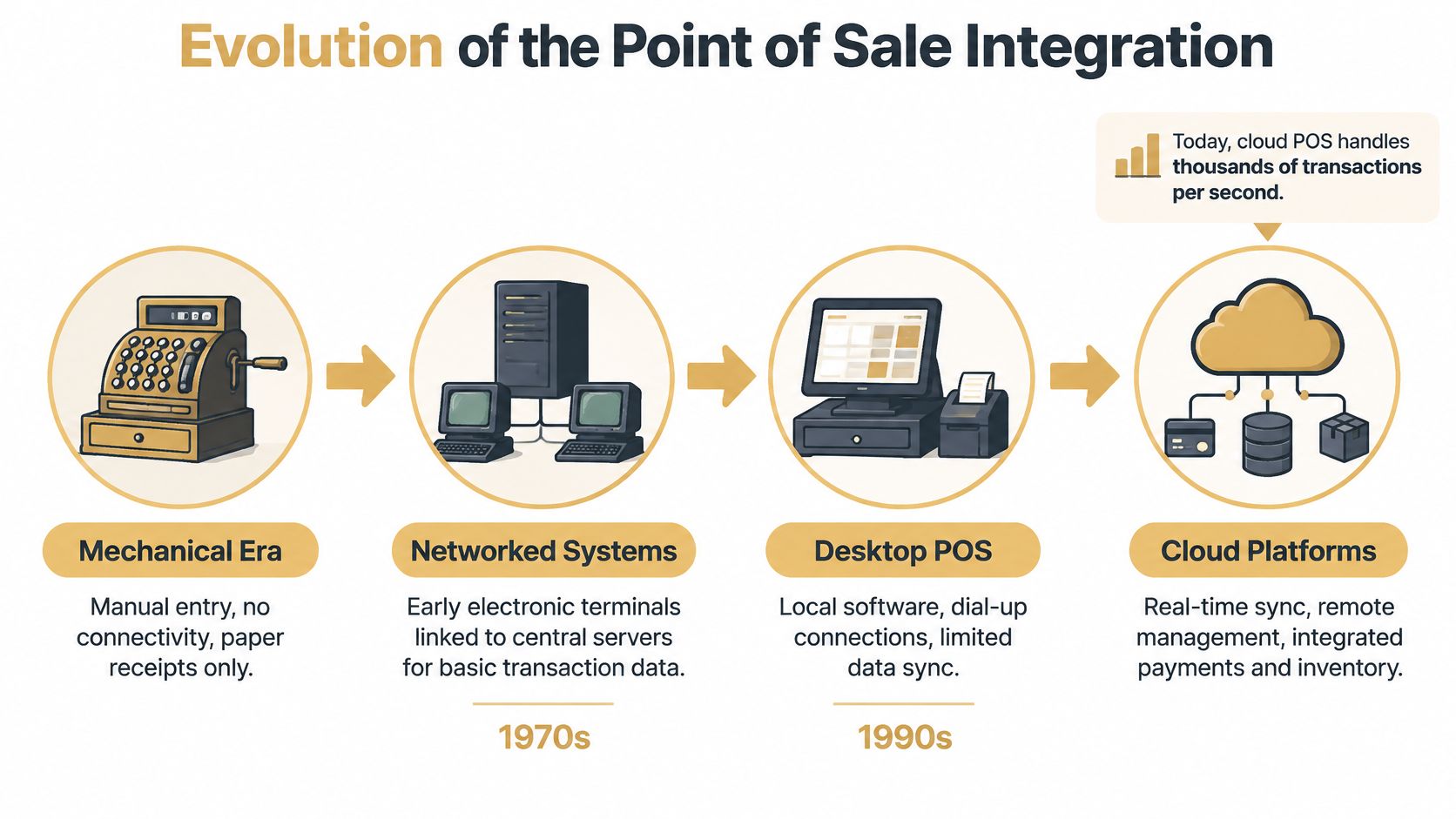
The history helps because the core idea hasn't changed as much as the hardware. In 1879, James Ritty patented an early mechanical cash register, and later IBM's 3650 and 3660 systems in the early 1970s used store controllers, networked registers, and centralized data management, a progression traced in Qualtrics' history of point of sale advancements. IBM also integrated the Universal Product Code, introduced commercially in 1973, so products could be identified electronically instead of keyed in by hand. By the 1990s, POS systems increasingly ran on personal computers with graphical interfaces, while OPOS and JavaPOS helped terminals talk to printers, scanners, and cash drawers.
The timeline below shows that progression from isolated registers to connected platforms.
A Coordination Layer, Not a Cable
Strip away the era and the architecture is consistent. A checkout device connects to product, inventory, pricing, and transaction records. Modern cloud POS platforms extend that same link to payment processors, ecommerce stores, accounting tools, loyalty programs, and customer databases. A bakery taking counter sales and preorders faces the same coordination problem at smaller scale, which is why practical resources like Ovenbell's bakery order guide treat order management as a flow across systems rather than a single register function.
So a POS integration isn't one connection. It's the set of agreements between systems about:
- Identity: Which SKU, customer, and order IDs every system shares.
- State: What paid, refunded, cancelled, and fulfilled mean in each tool.
- Timing: Whether updates are instant, batched, or confirmed by webhook.
That's why treating integration as an API project alone undersells it. APIs move data, but governance decides what the data means. If your POS, store, and accounting platform each define a refund differently, a technically successful sync still produces wrong books and confused customers. The register got faster over a century. The hard part, keeping every connected system in agreement, is the work that remains.
How POS Integrations Work with Payment Processors and Recurring Platforms
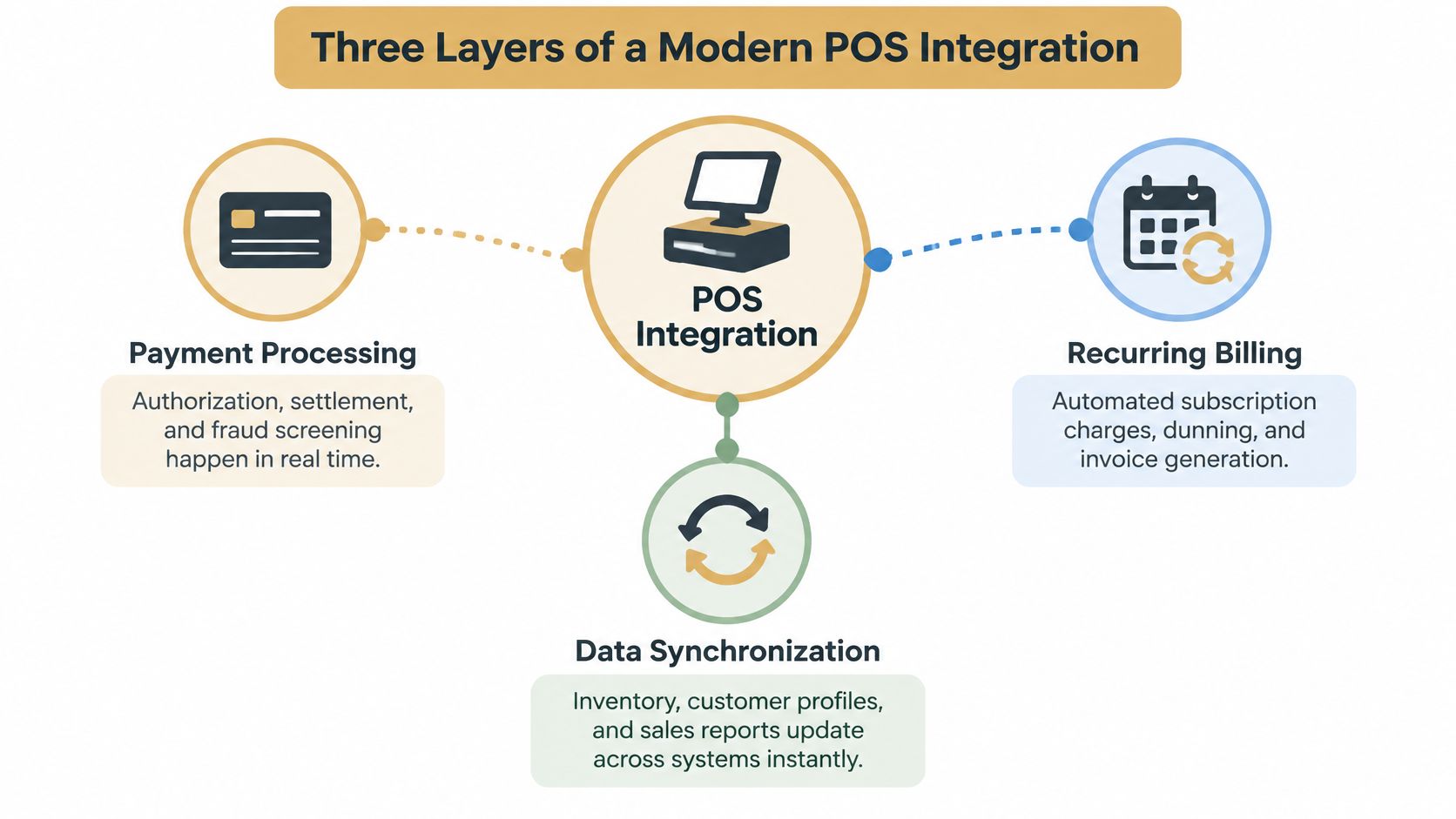
Most integrations break at the seams between three layers. Payment processing moves money, recurring billing repeats that movement on a schedule, and data synchronization keeps every other system aligned with what happened. Treat any one layer as an afterthought and the other two inherit the mess.
The diagram below maps those three layers around the POS.
Payment Processing and Tokenization
At checkout, the terminal or payment page sends a request to the processor, which routes it for issuer authorization before capture and settlement. EMVCo's payment tokenization framework replaces the primary account number with an EMV Payment Token that can travel from the point of purchase through the acquirer, payment network, and issuer, as described in EMVCo's payment tokenisation overview. In that flow, the consumer presents a token, the POS transmits it to the merchant, and the merchant sends a Token Payment Request and receives a Token Payment Response after authorization. Your order systems work with a surrogate credential while the actual card number stays outside your environment.
That design only works if you preserve token metadata and use processor supported token references for refunds and transaction linking. Don't assume every credential is a reusable card number, because wallet credentials and network tokens have their own lifecycle rules.
The walkthrough below shows how these events move through a connected checkout in practice.
Recurring Billing Needs Distinct Events
Subscription platforms add a second problem. A rebill isn't a new anonymous sale, it's a charge against a stored customer reference with a history. Your integration has to distinguish authorization, capture, refund, cancellation, and dispute as separate events, not collapse them into paid or unpaid. If a subscriber cancels after authorization but before capture, treating that as a completed sale creates exactly the kind of charge customers dispute.
Stable order to payment mappings and idempotency keys on retries keep a timed out rebill from becoming two charges. The same discipline helps downstream tools, such as when you connect Klaviyo to act on order and billing events for customer messaging. If the event names are sloppy, your emails, your ledger, and your dispute evidence all tell different stories about the same transaction.
Common Providers and How to Choose the Right One
Merchants usually shortlist providers by fees or brand familiarity. Both matter less than fit with your business model and the maturity of the provider's event system. A processor that's excellent for a single Shopify store can be painful for high volume subscriptions if its refund and dispute events are hard to reconcile.
Questions That Predict Pain
Before you compare names, answer four questions in writing:
- Business model fit: Do you need in person, online, subscriptions, or all three under one customer record?
- Event quality: Are webhooks for authorization, capture, refund, and dispute clearly separated and replayable?
- Token portability: Can you keep billing existing subscribers if you migrate later?
- Reconciliation: Can finance match settlements to orders without manual spreadsheet work?
The table below maps common choices against those practical concerns. It's a starting point for evaluation, not a ranking.
| Provider | Best For | Key Integration Strength | Watch Out For |
|---|---|---|---|
| Stripe | Custom carts and subscriptions | Deep APIs, webhooks, and token references | You own more of the integration logic |
| Shopify Payments | Shopify first merchants | Native order and payment alignment | Less flexibility outside the Shopify ecosystem |
| Square | In person first sellers adding online sales | Unified POS hardware and payments | Confirm subscription workflows fit your model |
| PayPal | Merchants whose buyers prefer wallet checkout | Broad consumer recognition and wallet flows | Reconcile PayPal records carefully against store orders |
| Authorize.net | Merchants needing gateway flexibility | Established gateway features and processor choice | More moving parts between gateway, processor, and cart |
The cheapest provider on rate can become the most expensive one if your team spends every month end untangling settlements by hand.
Test with your ugliest real scenarios before committing. Run a partial refund, a failed rebill retry, a cancelled subscription mid cycle, and an in person return of an online order. Watch what each connected system records. The provider that keeps those four cases clean is usually the right one, even if its feature list looks shorter on paper.
Integration Best Practices for Reliability and Security
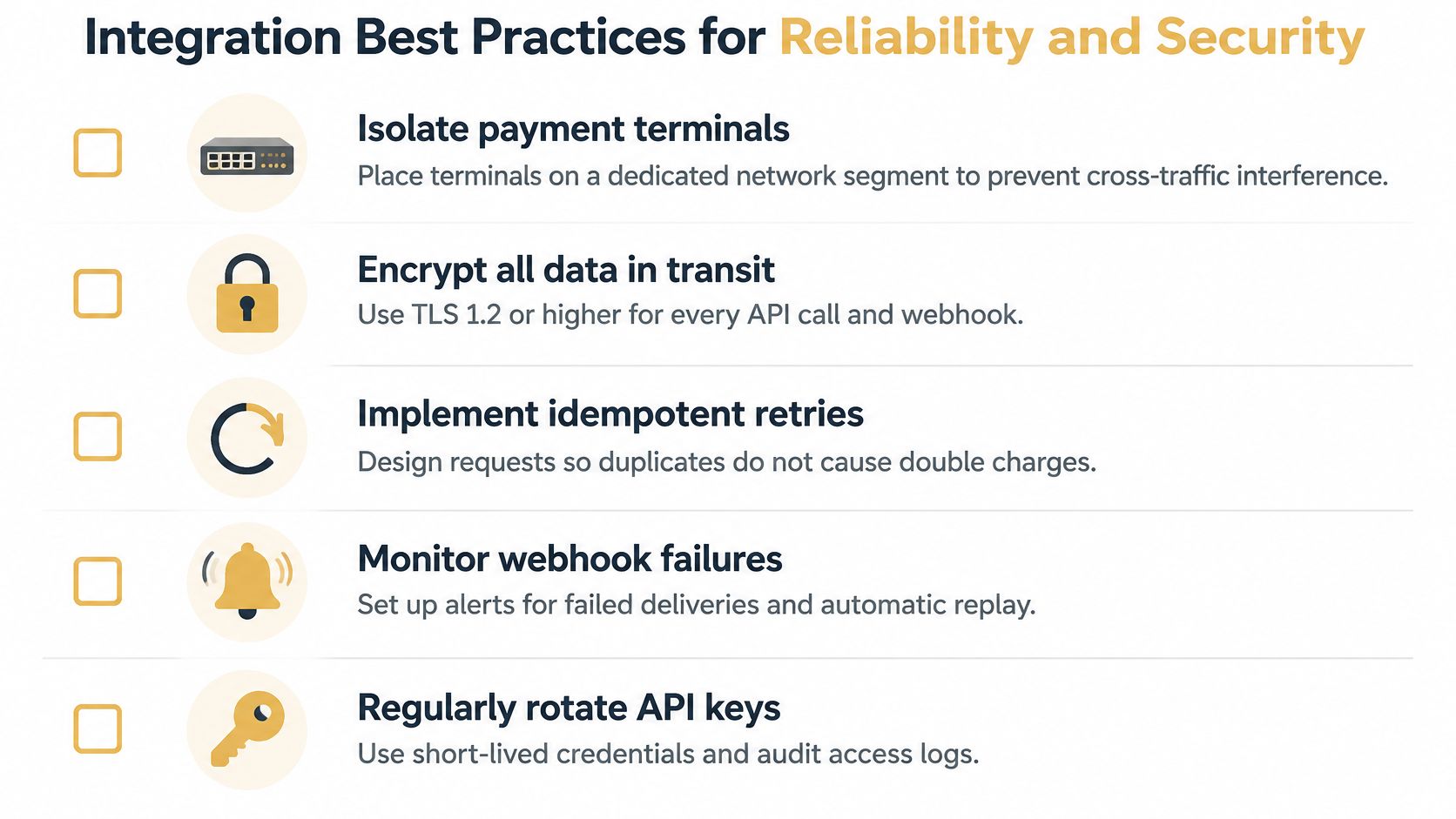
Good integrations are built from a small set of deliberate engineering decisions. None of them are exotic, but skipping any one of them creates a specific, predictable failure. Work through them as a checklist with whoever maintains your stack.
The checklist below summarizes the controls worth verifying first.
Isolate Terminals and Keep Card Data Out
Don't treat a payment terminal as an ordinary app endpoint. PCI DSS v4.0's SAQ B-IP applies to merchants using standalone, PCI listed PIN Transaction Security devices connected over IP, and those devices must not connect to other systems in the merchant environment, with segmentation enforcing that separation under the PCI DSS v4.0 SAQ B-IP requirements. In practice, put terminal traffic on a dedicated VLAN, restrict outbound destinations to the processor's approved endpoints, and never route raw cardholder data through your ecommerce application. Tokenization supports the same goal by giving your systems a reference instead of a card number.
Segmentation also pays off operationally. Fewer systems touch payment data, so PCI scope shrinks, troubleshooting gets faster, and containing an incident doesn't mean shutting down your whole store network.
Define Failure Behavior Before It Happens
Decide now what the POS does when it can't reach the processor. It should never fall back to storing card data locally. Instead:
- Queue metadata only: Store non sensitive transaction details needed to reconcile later.
- Show the error: Give the operator a visible failure state, not a spinner that invites a second attempt.
- Reconcile on reconnect: Match authorized transactions through processor webhooks or settlement reports.
- Use idempotency keys: Make retries safe so a repeated request can't create a double authorization.
Reconcile Daily, Not Monthly
Build reconciliation into the daily workflow, with timestamps and audit logs for every state change. A mismatch found tomorrow morning is a correction. The same mismatch found at month end is an investigation across hundreds of orders, and that's when teams start guessing.
How Integration Quality Affects Dispute Prevention
Dispute prevention fails when order data is dirty. An alert arrives, but nobody can tell which order it belongs to, whether a refund already went out, or whether the charge was a first purchase or a rebill. The window to act closes while staff search across systems, and a preventable refund becomes a filed chargeback.
Matching Is the Whole Game
Disputely integrates with Visa's Rapid Dispute Resolution, Mastercard's CDRN, and Ethoca alerts, and the 24 to 72 hour window to issue a refund before a chargeback is filed only helps if the alert maps cleanly to a payment, as outlined in its Shopify chargeback protection coverage. That mapping depends on work done long before any dispute, including stable order to payment references, accurate refund states, and one customer identity across POS and online checkout. Merchants using processors such as Stripe, PayPal, Shopify Payments, Authorize.net, and Square can connect quickly, but connection speed isn't the bottleneck. Data quality is.
The screenshot below shows the alert workflow that depends on that underlying matching.
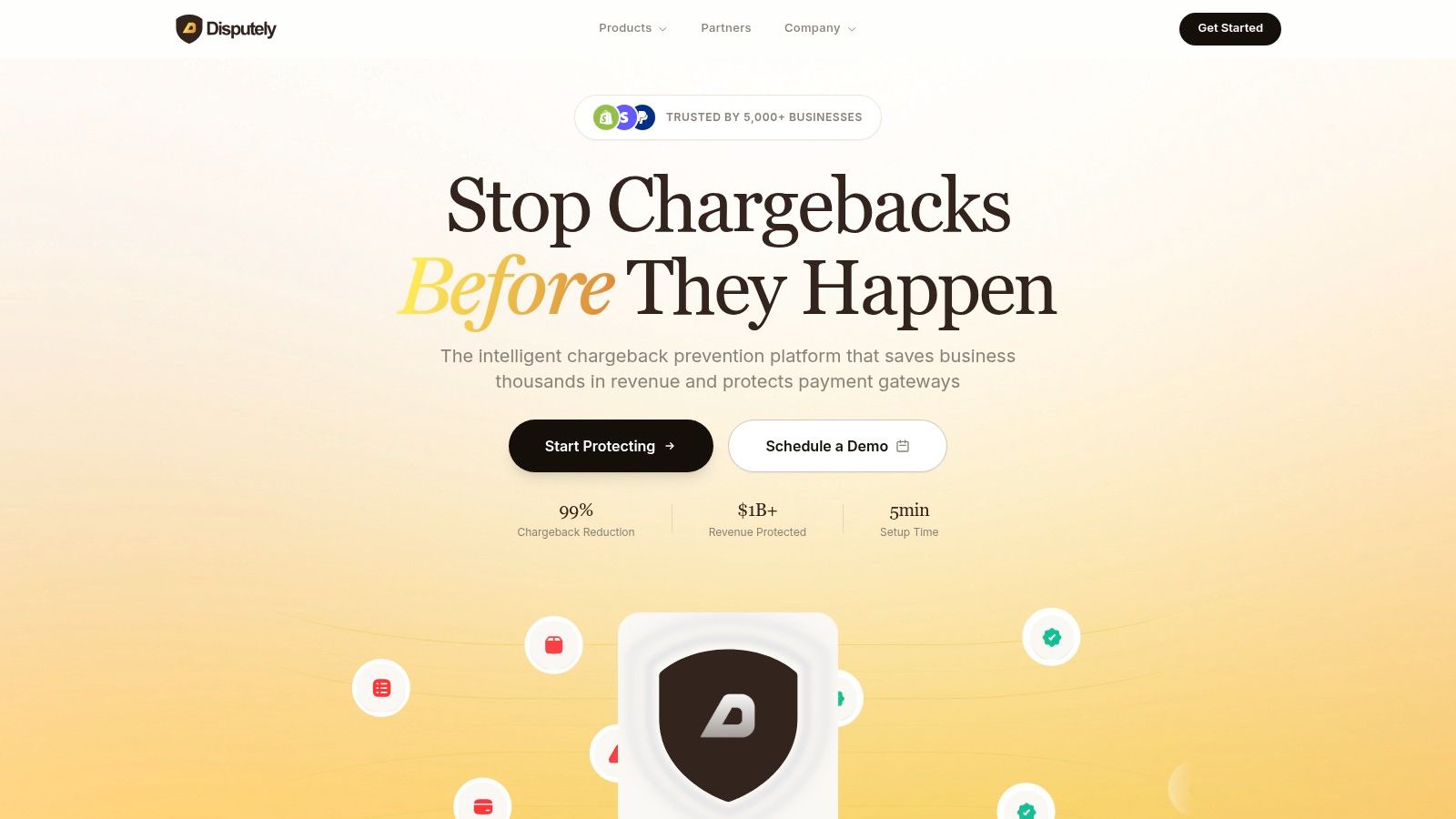
When matching works, automated refund rules can act in real time, and intelligent filtering can avoid refunding disputes you'd likely win anyway. Disputely reports customers seeing up to 99% chargeback reduction alongside avoidance of Visa and Mastercard monitoring programs, outcomes that only hold up when refund and order state stay accurate. If your POS marks an order refunded but the processor never received it, automation trusts the wrong record and skips an alert it should have caught.
Operating principle: A dispute tool can only act on the truth your integration gives it. Feed it conflicting states and it will make fast, confident, wrong decisions.
Audit this path directly. Pick recent disputed transactions and trace each one from processor record to order, customer, and refund state. Every hop that requires a human to search, guess, or check a second screen is a place where prevention will fail at volume.
Handling Outages, Migrations, and Peak Trading
Vendors love promising real time synchronization. The more useful question is what happens during the hours when sync isn't happening. A 2025 retail technology study reported that more than one third of organizations had persistent POS to inventory integration issues, naming legacy compatibility, connectivity, security, workflow redesign, and training as linked challenges in the 2025 retail research report from DecisionPoint and Zebra. The same research context notes that 78% of surveyed retail executives had moved to cloud native or cloud hosted POS, yet 45% of modern POS users still ranked integration complexity as a top challenge. Separate analysis cited there documented connectivity disruptions across 86.3% of observed retail locations, averaging 4.7 hours annually, though that study's methodology is less established and deserves caution.
A Runbook for the Offline Hours
Cloud hosting removes server maintenance, not dependency. Your store still depends on connectivity, webhooks, and the processor being reachable. Write the runbook before peak season:
- Local queuing: Capture non sensitive transaction metadata locally and sync in order on reconnect.
- Duplicate prevention: Reuse idempotency keys when replaying queued events so retries don't double charge.
- Webhook replay: Confirm you can request or simulate missed events instead of reconstructing state by hand.
- Refund pause rule: Stop automated refunds when order data is incomplete, since refunding against a partial record creates a second problem.
Migrations Deserve the Same Discipline
Treat a POS or processor migration like a planned outage. Freeze catalog changes during cutover, run old and new reconciliation in parallel, and verify that token references and open subscriptions survive the move. Most migration damage doesn't come from the switch itself. It comes from discovering, weeks later, that historical orders no longer match their payments.
Your Next Steps for a Stronger POS Integration
You don't need to rebuild your stack to fix its weakest points. You need three decisions made explicitly, then a short audit to confirm your systems follow them. Start with the questions, because tooling choices get easier once they're answered.
Three Decisions to Make First
- Source of truth: Name the authoritative system for SKU, price, inventory quantity, order status, customer identity, refund, and tax.
- Failure behavior: Define what the POS queues, shows, and reconciles when the processor is unreachable.
- Dispute matching: Confirm every payment maps to one order, one customer, and one current refund state.
A Short Audit You Can Run This Week
Pull a sample of recent transactions covering an in person sale, an online order, a rebill, a partial refund, and a cancellation. Trace each one through every connected system and note where states, totals, or timestamps disagree. Then verify the basics around them, including terminal network segmentation, token based storage instead of card numbers, idempotent retries, and daily reconciliation against settlement reports.
Fix conflicts in order of money impact. Inventory mismatches that cause overselling and refund mismatches that cause double refunds come before cosmetic reporting gaps. After that, evaluate whether a dedicated dispute prevention layer fits your volume, because alert handling at scale isn't a task your support team should run from an inbox.
Point of sale integrations aren't a project you finish. They're an operating discipline you maintain every time you add a channel, a tool, or a promotion.
Merchants who treat integration that way stop discovering problems through chargebacks and month end surprises. They find them in daily reconciliation, while the fix is still small. That's the difference between a stack that merely connects and one that protects revenue.
If alert matching is where your stack feels weakest, Disputely connects to your existing processor, receives Visa RDR, Mastercard CDRN, and Ethoca alerts, and applies your refund rules automatically so preventable disputes never become chargebacks. Visit Disputely to connect your processor, set your rules, and use the savings calculator to see what dispute prevention is worth for your volume before you commit.


