
Shopify vs Stripe: Choosing the Right Payment Stack
The most popular advice about Shopify versus Stripe is also the least useful: compare the headline card rate and pick the cheaper processor. That advice ignores the architecture around the payment, the platform surcharge applied to external gateways, the treatment of recurring contracts, and the operational consequences of disputes or account restrictions.
Shopify and Stripe aren't interchangeable payment gateways. Shopify is a bundled commerce operating system. Stripe is a programmable payments and financial infrastructure layer. A Shopify merchant routing payments through Stripe may gain control at the processor level while paying an additional platform fee and creating a second operational system to reconcile.
The right question is therefore not “Which processor is cheaper?” It's which payment architecture preserves margin, checkout control, subscription continuity, and account resilience as the business grows?
| Configuration | Best fit | Primary strength | Main economic or operational trade-off |
|---|---|---|---|
| Shopify Payments inside Shopify | Shopify-native merchants | Centralized storefront, checkout, orders, refunds, and payouts | Greater dependence on Shopify's platform rules |
| Stripe on a standalone or custom storefront | SaaS, marketplaces, custom commerce, and multi-channel businesses | Programmable payment APIs and financial tools | Requires engineering, reconciliation, and payment operations |
| Stripe inside Shopify | Merchants needing a specific external processor or integration | Processor-level controls within a Shopify storefront | Shopify's additional transaction fee applies to external gateway volume |
| Shopify Payments plus an external provider | Complex or transitional architectures | Keeps Shopify-native payment capability while adding another rail | More routing, reporting, and event-management complexity |
Understanding the Infrastructure Divide
The phrase “Shopify vs Stripe” suggests a head-to-head contest between two products that solve the same problem. That framing breaks down as soon as you examine what each company provides.
Shopify began in 2006 as an ecommerce software company and expanded from storefront tools into payments, shipping, lending, and merchant services, as described in Shopify's fiscal 2025 annual report. Its commerce model connects the storefront, catalog, checkout, customer data, order management, and payment acceptance inside one ecosystem. Shopify's scale is therefore commonly assessed through GMV, the value of orders facilitated through its platform.
Stripe sits at a different layer. It is principally a programmable payments and financial infrastructure platform that businesses embed into websites, applications, marketplaces, subscription systems, and other digital products. A company can use Stripe without adopting Shopify's storefront, themes, catalog model, or checkout environment.
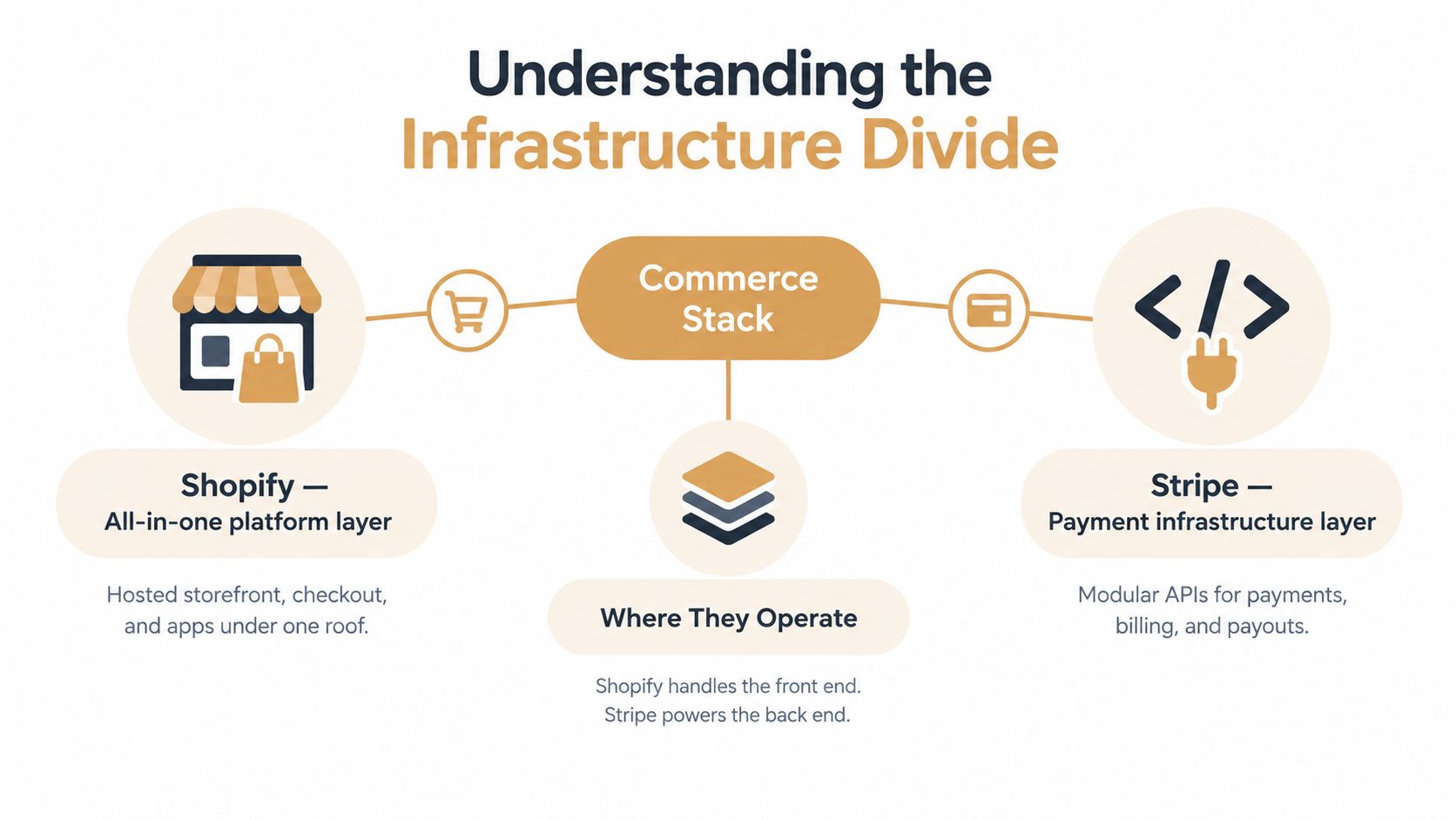
Different layers create different trade-offs
Shopify emphasizes a bundled commerce operating system. Stripe emphasizes modular payment APIs and financial tools. That distinction affects data flows, checkout control, billing logic, settlement reporting, and the amount of technical ownership your team must accept.
Shopify reported approximately $378.4 billion in GMV for fiscal 2025, compared with $292.3 billion in 2024, according to its annual report. It also reported roughly $11.6 billion in revenue, including $8.8 billion from merchant solutions and $2.8 billion from subscription solutions. Shopify Payments accounted for approximately 65.6% of GMV, which shows that payments are now central to Shopify's platform rather than an optional side feature. These figures describe Shopify's commerce ecosystem, not a payment processor.
Stripe reported $1.4 trillion in total payment volume for 2024, a figure it described as approximately 1.3% of global GDP, in its 2024 annual letter. That volume spans internet commerce, software, marketplaces, subscriptions, and other digital business models. It isn't directly equivalent to Shopify GMV. Stripe processes payments across many environments, while Shopify measures orders facilitated through its commerce platform.
Architectural rule: Choose the layer your business needs first. Compare processors only after you know where storefront, billing, customer, and payment responsibilities will live.
A Shopify-native merchant usually values launch speed and operational concentration. A SaaS platform, marketplace, or custom cart may value payment portability and programmable workflows more than a hosted store. Treating the two platforms as identical hides the decision that actually matters, which is who owns the surrounding commerce system.
Modeling the True Effective Processing Cost
Nominal rates look similar for a U.S. online card transaction. Shopify's published Basic-plan rate is 2.9% plus $0.30 per successful transaction, while Stripe's standard U.S. online-card rate is also 2.9% plus $0.30, according to Shopify's explanation of credit card processing fees.
The similarity ends when Stripe is routed through Shopify. Shopify lists a 2% third-party transaction fee on Basic, 1% on Shopify, 0.6% on Advanced, and 0.2% on Plus. Those fees apply on top of the external processor's charge. Shopify Payments doesn't add that separate third-party transaction fee when it is the sole payment provider.
The $100 order that changes the answer
For a $100 domestic order, Stripe's card fee is approximately $3.20. If the same order runs through Shopify Basic with Stripe as the external gateway, Shopify's additional 2% fee adds $2.00, producing an illustrative combined cost of approximately $5.20 before other applicable charges.
| Configuration | Processor Fee | Platform Surcharge | Total Cost |
|---|---|---|---|
| Shopify Payments on Basic | Approximately $3.20 | $0 | Approximately $3.20 |
| Stripe on a standalone storefront | Approximately $3.20 | $0 | Approximately $3.20 |
| Stripe inside Shopify Basic | Approximately $3.20 | $2.00 | Approximately $5.20 |
| Stripe inside Shopify plan | Approximately $3.20 | $1.00 | Approximately $4.20 |
| Stripe inside Shopify Advanced | Approximately $3.20 | $0.60 | Approximately $3.80 |
| Stripe inside Shopify Plus | Approximately $3.20 | $0.20 | Approximately $3.40 |
The table isn't a universal quote. It illustrates why the transaction route matters more than the processor name. Shopify Payments and standalone Stripe can have comparable headline processing costs, while external Stripe inside Shopify creates a second fee layer.
Build a routing-specific model
Your finance team should calculate effective cost using the actual path taken by each payment:
- Average order value: The fixed $0.30 component has a larger relative effect on lower-value orders, so a percentage-only comparison will misstate economics.
- Shopify plan: The external gateway surcharge changes by plan, which can alter the result as the store upgrades.
- Geography and card mix: Shopify reports a 1.5% currency-conversion fee for U.S.-based sellers and 2% for sellers in other regions. Stripe's published pricing adds 1.5% for international cards and may apply separate currency-conversion charges.
- Payment routing: A Shopify Payments order, an external Stripe order, and a payment processed through a custom storefront don't share the same fee stack.
- Recurring billing and disputes: Processor fees aren't the entire operating cost. Failed renewals, refunds, reconciliation, dispute administration, and migration work can affect the economics even when the initial card rate is unchanged.
For merchants evaluating monitoring and dispute operations alongside processor costs, Disputely's pricing page can be included in the broader cost model rather than treated as a separate afterthought.
The practical conclusion is uncomfortable for simplistic comparisons: Stripe can be technically superior and economically irrational when embedded in Shopify. Conversely, Shopify Payments can be cheaper and easier to administer without offering the same portability or processor-level flexibility as a standalone Stripe architecture.
Evaluating Checkout Control and Developer Flexibility
Checkout is where the architectural difference becomes visible to customers and developers. Shopify gives merchants a hosted, integrated path from product selection through payment, while Stripe gives technical teams building blocks for a custom payment experience.
Shopify Checkout is tightly connected to the Shopify catalog, cart, order, customer, and payment-provider stack. That connection reduces the amount of infrastructure a merchant must assemble. It also means the merchant works within Shopify's checkout model and platform rules, with customization shaped by the store's plan, extensions, themes, and supported apps.
Stripe is designed to be embedded into a wider system. Developers can use payment APIs and related financial tools inside a custom storefront, SaaS product, marketplace, subscription application, or mobile experience. That modularity supports bespoke billing logic, but it places responsibility for integration, testing, event handling, and reconciliation on the merchant's technical and finance teams.
Centralized execution versus programmable behavior
A DTC brand selling standard physical products may prefer Shopify's controlled checkout because the team can operate a connected store without building every payment workflow. Shopify Payments also supports Shop Pay and local payment methods through Shopify, which keeps payment-method administration close to the checkout and order record.
A SaaS business with usage-based charges, tiered plans, invoices, or multiple products may need payment behavior that doesn't fit a conventional storefront. Stripe's API model can support those requirements, but the merchant must define how billing events map to customer access, revenue records, refunds, and failed-payment recovery.
That distinction extends beyond visual design. Checkout control includes who can change payment state, how events are represented, and which system becomes authoritative when two platforms disagree.
Decide how much engineering ownership you want
Use Shopify when the business values:
- Fast deployment: A merchant can launch within a predefined commerce environment instead of assembling a storefront, cart, checkout, and payment layer separately.
- Central administration: Orders, refunds, and payment activity remain close together in Shopify's operating interface.
- Conventional commerce flows: Product catalogs, standard carts, and hosted checkout benefit from the platform's integrated structure.
Use Stripe when the business requires:
- Custom billing logic: The product can define subscription, invoice, usage, or payment behavior around its own commercial model.
- Multi-channel continuity: One payment layer can support websites, applications, marketplaces, and other business environments.
- Processor-level orchestration: Engineering teams can build event-driven workflows around payment, refund, recurring billing, and dispute events.
For teams extending Shopify without abandoning its native environment, enhance checkout with Shugert offers a focused resource on checkout extensibility. The strategic question remains whether the requested customization belongs in Shopify's extension model or requires a payment layer your team controls directly.
Managing Dispute Risk and Account Continuity
A processor change doesn't erase the merchant's underlying dispute exposure. The customer, transaction history, product promise, fulfillment record, and refund policy still exist, even if the payment rail changes.
Shopify's payment documentation explains that third-party gateways can be used alongside Shopify Payments, but transactions processed through third-party providers remain subject to Shopify's transaction fees, as described in Shopify's payment administration documentation. The same split creates a risk-management issue: payment events may live in the processor, while order, fulfillment, customer communication, and product records live in Shopify.
Ratios follow the merchant relationship
A chargeback ratio is not a magic property of Stripe or Shopify. It reflects the merchant account's transaction history and dispute activity. A merchant that moves from one processor to another without correcting the cause of disputes may carry the same operational weaknesses into the new account.
A processor can also apply restrictions, reserves, or holds when it identifies elevated risk. The exact response depends on the provider, account history, business model, transaction patterns, and supporting evidence. Changing gateways is not a dispute strategy. Better descriptors, clearer billing consent, faster customer support, reliable fulfillment records, and timely dispute responses are.
Risk principle: Treat processor migration as a continuity project, not a settings change. Preserve transaction identity, billing history, evidence, and customer communication before switching routing.
Shopify Payments centralizes checkout, payout, and payment-method administration within Shopify. A standalone Stripe stack generally gives the merchant cleaner processor-level event orchestration. A Shopify-plus-Stripe configuration can provide external processor controls, but it also requires reconciliation across Shopify orders, Stripe payment events, refunds, recurring charges, and disputes.
For a merchant designing a broader governance process, DevArmor threat modeling can help frame payment integrations as operational and security dependencies rather than isolated checkout components.
Put alerts ahead of formal disputes
A dispute alert gives the merchant an opportunity to resolve a customer complaint before it becomes a formal chargeback, depending on the applicable network and alert program. That window matters because a refund may be cheaper and operationally cleaner than allowing a dispute to proceed, but refunding every alert without review can also create unnecessary losses.
The payment team should connect:
- Transaction identity: Map Shopify order IDs, processor payment IDs, subscription references, and customer records.
- Evidence ownership: Decide who gathers delivery confirmation, refund records, billing terms, customer messages, and product access logs.
- Escalation rules: Define when to refund, when to respond with evidence, and when to involve finance, support, or risk operations.
- Ratio monitoring: Watch dispute activity by product, acquisition source, billing descriptor, geography, and recurring-payment cohort.
- Continuity controls: Maintain access to historical records even after a processor or payment method changes.
Merchants seeking a processor-aware workflow can review Shopify chargeback protection as one operational option. The important design decision is not the vendor name. It's whether the workflow sees the order and processor events together before the dispute reaches the account.
A high-volume merchant should test dispute handling in a controlled environment before changing live routing. Confirm that refunds update the order record, recurring events reach the correct system, evidence can be assembled from retained data, and account teams know which platform owns each escalation.
Matching the Payment Stack to Your Business Model
The best architecture depends on where revenue originates and how much variation exists in the payment lifecycle. A single storefront with standard physical goods has different needs from a marketplace that settles funds to multiple parties or a SaaS product that changes billing according to usage.
Small DTC brands
Choose Shopify with Shopify Payments when most sales come through one Shopify storefront, the catalog is conventional, and the team values a unified operating view. The model keeps storefront, checkout, orders, refunds, customer data, and payment acceptance within one commerce ecosystem.
This choice also avoids the additional Shopify transaction fee that applies when an external gateway processes the payment. It won't provide the same portability as a standalone Stripe stack, but portability may not justify additional integration and reconciliation work for a Shopify-native merchant.
Custom-built stores and SaaS
Choose Stripe as the primary payment layer when the product experience is custom, the business sells through multiple applications or channels, or billing logic is central to the product. Stripe's programmable infrastructure can support payment behavior that doesn't naturally fit a hosted retail checkout.
The trade-off is ownership. Your team must maintain payment integrations, handle webhooks and idempotency correctly, reconcile settlements, and preserve the relationship between payment state and customer access. Stripe offers flexibility, but flexibility creates obligations.
Marketplaces and multi-party businesses
A marketplace should evaluate Stripe first when it must coordinate payments, payouts, seller onboarding, and platform-level financial workflows. Shopify can support commerce operations for merchants, but a marketplace's core challenge is usually not storefront creation. It's the movement of funds and responsibilities among buyers, sellers, and the platform.
The architecture should document who owns refunds, seller reserves, dispute evidence, tax records, and customer support. If those responsibilities remain unclear, adding payment functionality won't solve the underlying operating model.
Subscription boxes and hybrid businesses
Subscription merchants need to separate new acquisition from recurring contract continuity. A Shopify-native subscription app may keep the customer experience close to the store, while Stripe may offer more independent control over recurring payment events and billing logic.
Hybrid businesses should map each revenue stream separately. Physical goods may belong in Shopify, while digital access, service invoices, or application subscriptions may belong in Stripe. A dual architecture can work, but only if the business defines one authoritative customer identity and reconciles refunds, recurring events, and disputes across systems.
Decision test: If moving to another storefront would require rebuilding your payment model, you have chosen a tightly integrated platform. If moving storefronts leaves your payment model intact, you have chosen a more portable infrastructure layer.
Navigating Processor Migration and Subscription Continuity
Processor migration becomes difficult when a merchant treats stored payment credentials as ordinary database fields. They aren't. Payment credentials are tokenized and controlled within payment-provider environments, so a new processor generally can't be activated just by copying the old customer table.
Shopify's subscription documentation lists Shopify Payments, PayPal Express, Authorize.net, Adyen, and Stripe as supported gateways for third-party subscription apps, while noting that Stripe availability is limited to select merchants. Shopify also documents that external gateways can be connected as a secondary subscription payment gateway for billing existing contracts. That detail changes the migration plan: existing recurring agreements may need a transition path rather than a single checkout switch.
A practical migration sequence
Start with an inventory of every payment object:
- New purchases: Identify which storefront and gateway will accept transactions after the cutover.
- Active subscriptions: Record plan, renewal date, payment method reference, retry state, cancellation status, and customer consent.
- Stored credentials: Confirm whether a supported token migration path exists, or whether customers must re-enter payment details.
- Recurring events: Map successful renewals, failures, retries, upgrades, downgrades, pauses, cancellations, refunds, and credits.
- Disputes and evidence: Retain transaction history, customer communications, fulfillment records, and previous responses.
- Accounting records: Reconcile open invoices, pending payouts, refunds, fees, and tax records across the old and new systems.
The most damaging migration failure is often silent. A customer sees a normal renewal email, but the new processor lacks a usable payment reference. The renewal fails, access is suspended, support receives the complaint, and the merchant loses a customer without realizing that the root cause was a tokenization boundary.
Protect customer trust during the cutover
Run new purchases and recurring contracts as distinct operational tracks. Decide whether existing subscriptions remain on the old gateway temporarily, move through a supported secondary gateway, or require explicit customer action. Communicate only what customers need to know, but give them a clear explanation if they must update payment details.
Don't retire the old processor until pending refunds, disputes, failed renewals, and settlement records have been reconciled. A migration that completes checkout testing but loses access to historical evidence has not completed successfully.
For high-volume merchants, the release checklist should include payment-state reconciliation, renewal simulations, webhook replay testing, refund verification, dispute-evidence retrieval, and customer-support procedures. The migration is finished only when finance can explain every payout and support can resolve every payment question across the transition boundary.
Securing Revenue Beyond the Initial Gateway Choice
Processor selection matters, but it doesn't protect revenue by itself. Shopify Payments can simplify operations, and Stripe can provide powerful payment controls, yet neither architecture automatically prevents avoidable disputes, failed renewals, unclear billing descriptors, or incomplete evidence.
The strongest payment operation treats the gateway as one layer in a broader control system. That system should connect customer communications, fraud review, fulfillment, refund policy, subscription state, dispute alerts, and processor reporting.
Build controls around the payment lifecycle
A durable program includes:
- Before authorization: Screen transactions against the business's risk rules and make billing terms clear.
- After purchase: Send recognizable receipts, fulfillment updates, and support paths that reduce confusion.
- Before a dispute: Monitor alerts and route each case toward a refund or evidence response according to defined rules.
- During recurring billing: Track failed renewals, retry outcomes, account access, and customer notices as one workflow.
- During reconciliation: Match orders, processor events, payouts, refunds, and disputes rather than relying on gross sales totals.
- During migration: Preserve historical IDs and evidence before changing payment routing.
The merchant's dispute ratio reflects the full customer journey. A payment processor may expose better controls, but the merchant still determines whether product descriptions are accurate, renewal notices are understandable, refunds are timely, and evidence is available.
A high-volume team can use chargeback-fighting workflows as part of its operating design, alongside processor dashboards, support procedures, refund rules, and ratio monitoring. The objective isn't to choose a fashionable gateway. It's to prevent payment incidents from becoming account-level interruptions.
The clearest conclusion from the Shopify versus Stripe decision is that economic efficiency and operational resilience can point in different directions. Shopify Payments may minimize friction and avoid an external-gateway surcharge for Shopify-native merchants. Stripe may provide the portability and programmable controls required by SaaS, marketplaces, subscriptions, and custom commerce. Neither choice removes the need to manage disputes, credentials, recurring contracts, and evidence as connected payment operations.
Disputely connects with Shopify Payments, Stripe, PayPal, Authorize.net, and other processors to monitor dispute alerts, apply refund rules, and support evidence workflows across the payment lifecycle. Visit Disputely to evaluate how automated dispute handling can fit your Shopify, Stripe, or hybrid payment stack before account holds and processor restrictions threaten continuity.


