
Software for Subscription Billing Explained and Compared
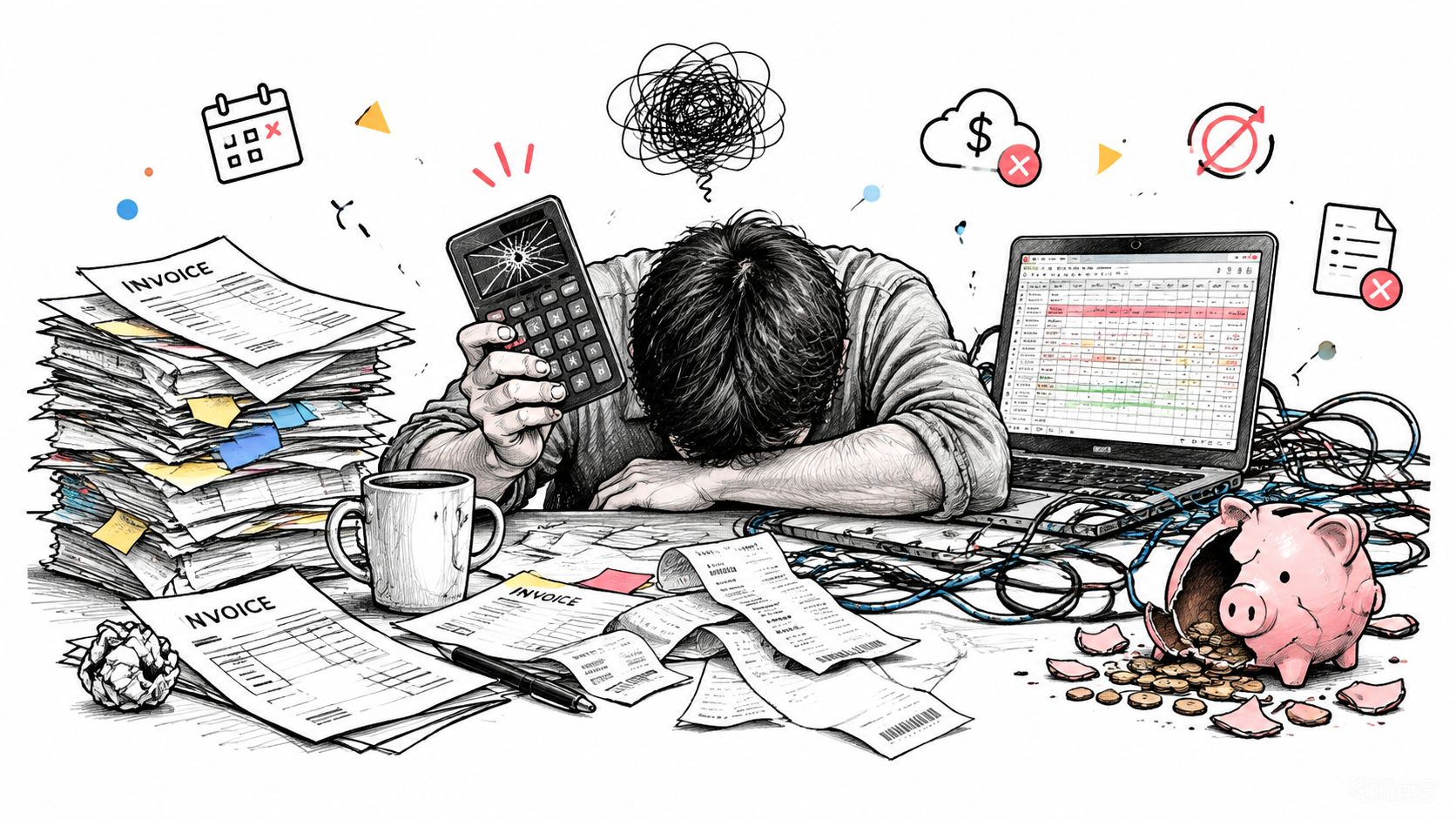
Your payment processor says a recurring charge failed. A customer upgrades halfway through the month, another downgrades before renewal, and a third asks why the invoice doesn't match the price shown at checkout. Meanwhile, finance is reconciling spreadsheets, support is explaining confusing prorations, and product access doesn't always match payment status.
Software for subscription billing earns its place. Recurring revenue depends on more than sending an invoice. The system must understand contracts, calculate what each customer owes, recover legitimate failed payments, update entitlements, and create a reliable record for finance and operations. The subscription billing software market reached an estimated USD 9.04 billion in 2025 and is projected to reach USD 19.66 billion by 2030, a trajectory that reflects how central billing infrastructure has become to recurring-revenue businesses (The Business Research Company).
Why Subscription Billing Breaks Without Dedicated Software
A small subscription business can often survive with a payment link, a spreadsheet, and a few calendar reminders. The trouble starts when customers stop behaving like identical rows in a table.
One customer pays monthly for a standard plan. Another has an annual contract with a discount. A third adds a seat halfway through the cycle, while a fourth pauses service before renewal. If a team calculates each adjustment manually, someone eventually bills the wrong amount, grants the wrong access, or forgets to collect a payment after a card expires.
One-time checkout is comparatively simple. The customer chooses an item, pays once, and receives the product. A subscription creates an ongoing relationship. The system must remember the plan, renewal date, price, tax treatment, payment method, trial status, cancellation terms, and product entitlements for every account.
The first break is usually operational
Suppose a customer upgrades on the fifteenth day of a monthly cycle. A sound billing system calculates the unused portion of the old plan, applies the remaining portion of the new plan, creates a clear invoice adjustment, and updates access immediately. A spreadsheet can record the change, but it won't reliably coordinate the calculation, payment, invoice, entitlement, and accounting entry.
The same problem appears with failed payments. A declined card isn't always a customer decision to leave. The issuer may reject the transaction temporarily, the card may have expired, or the customer may need to authenticate the payment. If the business cancels access after the first failure, it converts a recoverable payment problem into churn.
Practical rule: Treat billing as a live operational system, not as an invoice generator.
Why manual work becomes expensive
Manual billing creates several forms of leakage:
- Missed revenue: A plan change, add-on, or renewal can be omitted.
- Incorrect access: The product may grant premium features even though the account has not paid, or remove them from a valid customer.
- Customer friction: Confusing invoices create support tickets and weaken trust.
- Weak financial records: Finance spends time reconciling payment-provider data against internal spreadsheets.
- Poor recovery: Failed payments receive inconsistent reminders and retries, if anyone follows up at all.
The market evidence points in the same direction. Cloud delivery accounted for 75.35% of subscription billing management market share in 2025, while platform software represented 79.40% of revenue share, showing the category has moved toward centralized software rather than local, manual billing processes (Mordor Intelligence).
Dedicated software doesn't remove every billing decision. It gives those decisions a consistent place to live, so pricing, payment collection, customer access, and reporting don't drift apart.
What Software for Subscription Billing Actually Does
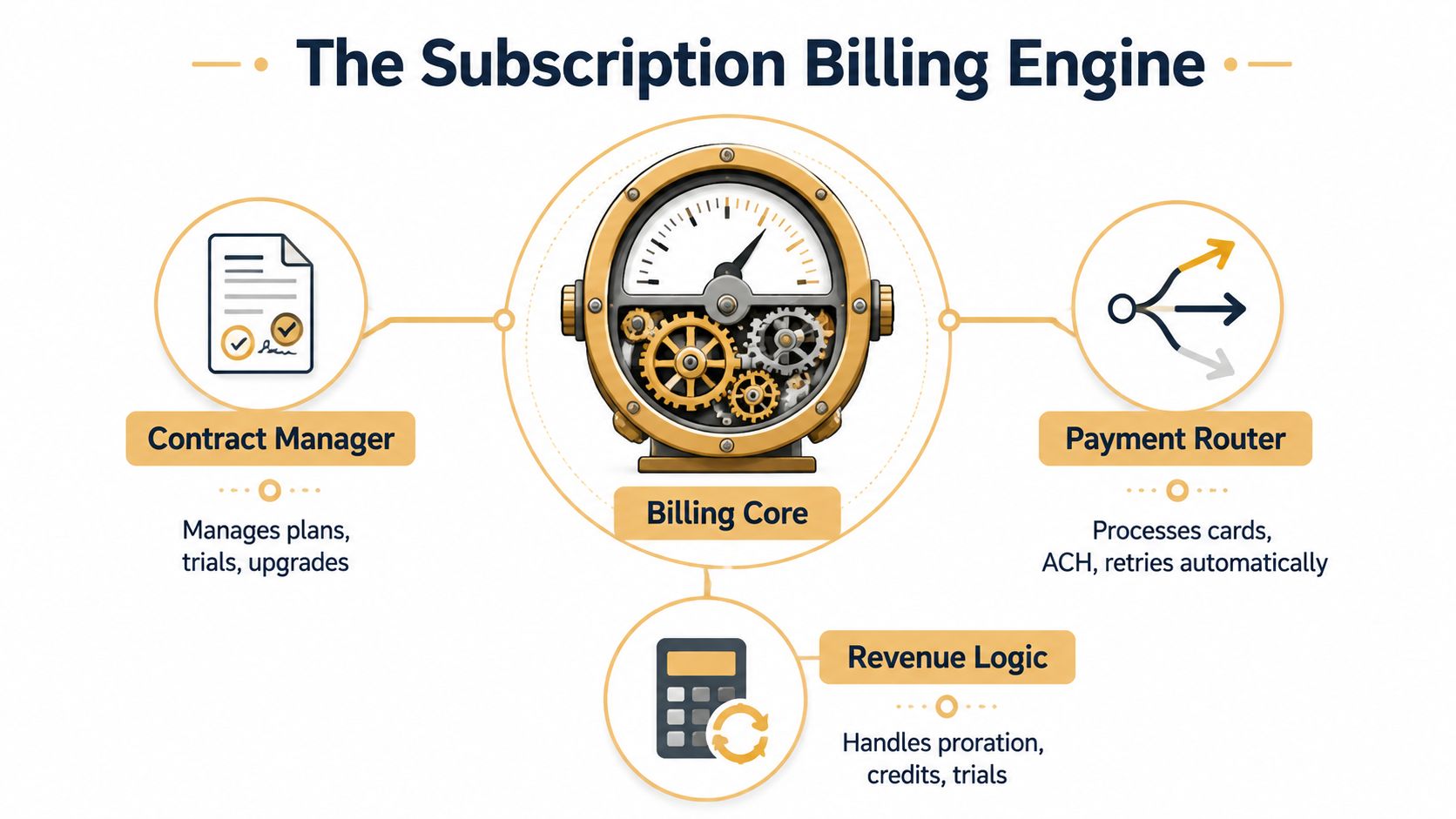
A useful analogy is a utility meter combined with a contract manager. The meter records what a customer is entitled to receive or has consumed. The contract manager knows the agreed price, billing schedule, discounts, and changes. The billing engine combines those facts and produces an invoice and a payment request.
A payment gateway performs a narrower job. It helps authorize or route a transaction. A billing engine decides when to charge, how much to charge, why that amount is correct, and what should happen after the payment succeeds or fails.
Start with the subscription record
The billing platform stores the customer's commercial relationship. That record normally includes the selected plan, quantity, billing frequency, start date, renewal behavior, discounts, payment method, and current status.
That status matters. “Trialing,” “active,” “past due,” “paused,” and “cancelled” shouldn't be informal labels scattered across several systems. They should represent defined states that the product, support team, finance team, and payment workflow can interpret consistently.
Add the invoice logic
The engine applies the rules attached to the subscription. For a straightforward recurring plan, it creates the same scheduled charge each cycle. For a mid-cycle change, it calculates a proration. For a coupon, it applies the discount according to its conditions. For a usage component, it receives measured consumption and rates it against the relevant pricing rule.
The output isn't only an invoice. It also includes the information needed to collect payment, update access, record revenue, and notify the customer.
Keep access aligned with billing
Entitlements are the bridge between a commercial decision and the product. If a customer pays for five seats, the application should know whether five seats are available. If the account enters a defined grace period after a failed payment, the product should follow that policy rather than making an independent guess.
This is why the billing platform should serve as the system of record for subscription state, while the product keeps a local entitlement view for fast access checks. A resilient architecture uses tenant-scoped records, webhook deduplication, unique database constraints, and reconciliation jobs to identify drift between systems (subscription billing architecture guidance).
The same principles apply outside SaaS. A service business evaluating tutoring billing software may need recurring invoices, customer records, payment collection, and schedule-aware account management. The exact features differ, but the underlying lesson is consistent: recurring billing needs a dependable record of what the customer bought and what the business owes them.
Core and Advanced Features That Drive Revenue Retention
A vendor's feature list can make billing platforms appear interchangeable. Evaluate each capability by the revenue problem it prevents, especially failed payments, involuntary churn, inaccurate charges, and avoidable disputes.
Core essentials
Recurring invoicing creates invoices on schedule, applies the correct plan and quantity, delivers the document, and records its status. Check support for monthly, annual, trial, pause, cancellation, and renewal flows. An invoice is only useful when it also leads to the right collection and account action.
Plan and price management lets teams create products, tiers, add-ons, coupons, and effective dates without rebuilding the billing process. A product-led SaaS company may need fast experimentation. A contract-led business may instead require approvals, version control, and a clear history of changes.
Proration handles a mid-cycle upgrade or downgrade. The software should show which days, seats, or quantities produced the adjustment. That explanation works like a receipt for the change. It reduces confusion, support requests, and disputes over charges that otherwise look arbitrary.
Dunning manages failed recurring payments through retries, reminders, payment-method updates, grace periods, and account-state changes. Its design directly affects retained revenue. Industry guidance places involuntary churn at 20–40% of subscription cancellations, and automated recovery workflows often recapture 40–70% of failed payments (dunning and subscription recovery guidance). Review retry timing, message controls, and the handoff from payment failure to restricted access. Poorly timed retries can frustrate customers, while no recovery sequence leaves valid accounts to churn.
Advanced differentiators
Usage-based billing records consumption events and converts them into charges. It suits API products, data services, communications platforms, and AI products where a flat subscription does not represent the value delivered. Accuracy depends on reliable event capture, clear units, and an understandable usage record.
Revenue recognition separates the date of billing from the period in which revenue should be recognized. Finance-led SaaS businesses may need this with contract amendments, deferred revenue schedules, and audit trails.
Entitlement management connects billing state to product access. It matters when plans include feature limits, seats, credits, or usage allowances. A failed payment should trigger the policy you chose, not an unrelated product decision.
Analytics should go beyond total recurring revenue. Reports should connect plan changes, failed payments, recovery outcomes, cancellations, and customer cohorts. That view helps an operations team identify whether leakage comes from pricing changes, payment failures, weak recovery, or customer behavior.
Match complexity to the business model
A consumer subscription may value retry orchestration, account updates, pause flows, and cancellation offers. A B2B SaaS company may prioritize contract amendments, multi-entity reporting, and revenue recognition. A hybrid company needs recurring charges and usage measurement.
Choose the capabilities that protect today's revenue model and support a pricing model you can reasonably adopt. A long feature page is not a substitute for accurate charges, effective recovery, clear customer communication, and controls that reduce chargeback exposure.
How Implementation Works From Integration to Daily Operations
Implementation is easiest to assess by tracing one subscription from signup to renewal, failure, and recovery.
A customer starts through the product or sales process. The CRM or application sends customer and plan data to the billing engine, which applies catalog rules, creates the invoice, calculates adjustments, and requests payment from the processor. Tax and compliance services may provide jurisdiction-specific calculations, while accounting and analytics systems receive the resulting records.
Begin with the source of truth
Assign ownership for each type of data before building integrations. The billing platform should own commercial subscription state. The product should own activity and usage events. The CRM may own sales context, while the accounting system owns the final financial ledger.
Conflicts arise when several systems can change the same subscription. A sales representative updates a plan in the CRM, the customer changes it in the application, and a finance user edits the invoice in the billing dashboard. Without explicit ownership and controlled transitions, records diverge, invoices become harder to explain, and access decisions can fall out of sync.
Build safe event handling
Payment providers and billing services may retry requests or resend webhooks, so the application must expect duplicate events.
Use the provider's event ID as a deduplication key. Add unique database constraints, record processing status, and make each state transition idempotent. Repeating an event should produce the same result, rather than creating a second invoice, sending a duplicate notification, or granting access twice.
A reconciliation job compares internal records with provider records and flags drift. It also provides a recovery path when a webhook fails, a deployment interrupts processing, or a provider temporarily reports inconsistent state. Schedule clear ownership for reviewing these exceptions, because an undetected mismatch can affect both retained revenue and dispute evidence.
Make proration and usage rules visible
Proration needs written rules. Decide whether a change takes effect immediately, at the next renewal, or on a defined date. Specify how credits, refunds, taxes, and discounts interact. Then test invoices for upgrades, downgrades, pauses, reactivations, and cancellations.
Usage billing needs the same level of definition. Document event names, timestamps, units, late-arriving data, duplicate events, and corrections. If a customer disputes an invoice, the team should trace the amount to the recorded usage and pricing rule. A clear trail can also support a response before a billing complaint becomes a chargeback.
Treat dunning as an operating workflow
A failed payment should enter a deliberate recovery sequence. A staged schedule can span roughly 14–30 days, include 4–6 attempts, and combine retries with reminder messages and payment-method updates. The right timing depends on decline reasons, customer type, payment method, and business policy. Dunning should protect access and retention without treating every failure as a reason to cancel immediately.
Daily operations should surface failed charges, customers in grace periods, upcoming renewals, unprocessed events, reconciliation exceptions, and accounts approaching cancellation. These alerts connect billing mechanics to action. They help the team update payment details, investigate a suspicious charge, or contact a customer before involuntary churn or a chargeback occurs.
If customer communications run through a marketing platform, document the connection and ownership clearly. Teams using lifecycle messaging can review Klaviyo connection guidance while deciding which system triggers payment-failure messages and which records delivery, response, and recovery outcomes.
Pricing Models Security and Compliance Essentials
Subscription billing vendors commonly charge in one of several ways. Some price by subscriber, invoice, transaction volume, or platform tier. Others combine a software fee with payment-processing charges or offer a merchant-of-record structure that bundles payment and compliance services.
The headline price rarely represents total cost. Add implementation work, tax tooling, accounting integrations, payment fees, support, data storage, and any recovery or analytics modules. Model the cost against your own billing volume and customer mix, not against a generic demo account.
| Evaluation Criteria | What to Ask the Vendor | Why It Matters |
|---|---|---|
| Platform pricing | Is the fee based on subscribers, invoices, billing volume, or a tier? | The cheapest starting tier may become expensive as usage grows. |
| Payment costs | Are processor fees separate? Can we use our existing processor? | Bundled and unbundled pricing can look similar while producing different total costs. |
| Failed-payment recovery | Are retries, card updates, reminders, and recovery reporting included? | Recovery controls affect retained revenue, not just operating convenience. |
| Tax and compliance | Is tax calculation native, integrated, or manual? Does the vendor support the jurisdictions you sell into? | A billing platform can create invoices without solving every tax obligation. |
| Security posture | Does the vendor provide PCI documentation, tokenization details, SOC 2 materials, and access controls? | Sensitive payment data and operational permissions need clear protection. |
| Auditability | Can we export an immutable history of plan changes, invoices, payments, refunds, and user actions? | Finance and support need to explain what happened without reconstructing it from email. |
Security without the jargon
Tokenization replaces sensitive payment credentials with a token, so your systems don't need to handle raw card data directly. Ask where payment details are stored and which systems can access the token.
PCI scope describes the payment-security responsibilities that remain with your business. A hosted checkout or tokenized integration may reduce exposure, but it doesn't eliminate the need to understand your obligations.
SOC 2 documentation can help you evaluate the vendor's controls around security, availability, confidentiality, and related processes. GDPR matters if you process personal data connected to customers in the European Union. Neither certification replaces your own access policies, retention rules, or incident procedures.
Before comparing quotes, request a complete fee schedule and security packet. You can also review the vendor's commercial structure through resources such as Disputely's pricing information, but compare every provider using the same assumptions.
Preventing Disputes and Chargebacks in Recurring Billing
A failed payment and a chargeback require different responses. A processor declines or cannot complete a failed payment. A chargeback starts after the cardholder disputes a completed transaction with their issuer. Treating both events as ordinary invoice problems leaves preventable revenue at risk.
Recurring charges create repeated opportunities for confusion. A customer may forget the original purchase, fail to recognize the billing descriptor, miss a renewal notice, or believe cancellation succeeded while the account stayed active. Clear invoices and timely messages reduce these misunderstandings, but they do not remove the exposure.
Subscription merchants can face 1–2% chargeback rates, compared with 0.5–0.7% in standard ecommerce. Recurring billing disputes represent 27.1% of chargebacks, and friendly fraud accounts for 70–79% of cases. Mastercard expects global chargebacks to rise 37% from 2025 to 2029, reaching 359 million annually, so dispute prevention affects both retained revenue and the merchant's processing relationship. These figures are summarized in this subscription billing and chargeback analysis.
The prevention workflow starts before the dispute
Your billing system should send a recognizable descriptor, renewal reminders, receipts, cancellation confirmations, and payment-failure messages. Each message should answer four practical questions: what was purchased, when it renews, what it costs, and how the customer can stop future charges.
Connect these messages to the account's actual state. After a payment fails, explain the next action and the retry plan. If access continues during a grace period, state that clearly. If cancellation is complete, confirm its effective date and whether a final invoice remains.
Dunning supports dispute prevention as well as payment recovery. Repeated retries without context can look like unexpected charges. A clear sequence gives the customer time to update the payment method, contact support, or cancel deliberately. Good dunning protects the relationship while recovering legitimate payments.
Where alerts fit
Chargeback alerts create an earlier intervention point. Services such as Visa Rapid Dispute Resolution, Mastercard CDRN, and Ethoca can notify a merchant that a customer has raised an issue, allowing the business a 24–72 hour window to refund an eligible transaction before it becomes a formal chargeback.
This work sits alongside subscription billing. Billing software manages the contract, invoice, payment, retry, and cancellation lifecycle. An alert service watches for dispute signals and applies refund rules before a chargeback is filed. Set clear rules for when to refund, when to submit a response, and when available evidence supports contesting the claim. For cases that require formal evidence, define an ownership path through chargeback fighting support.
A practical playbook combines recognizable descriptors, accessible cancellation, renewal communication, payment-failure messages, alert-based intervention, and reporting that connects disputes to plan, channel, geography, and payment method. The aim is retained revenue with fewer avoidable disputes, not a larger archive of representment evidence.
How to Choose the Right Vendor With Confidence
Start with your failure mode, not with the vendor's brand name. If your main problem is incorrect invoices, prioritize catalog flexibility, lifecycle management, proration, and accounting exports. If failed payments consume your attention, test dunning, recovery reporting, payment-method updates, and grace-period controls. If disputes are rising, inspect descriptors, customer communications, alert integrations, and refund automation.
Use a short evaluation checklist:
- Model fit: Can the platform represent your current plans, trials, discounts, usage, credits, and contract changes?
- Operational safety: Does it support idempotent webhooks, event deduplication, reconciliation, and clear audit history?
- Revenue recovery: Can you configure retry timing, customer reminders, payment updates, and account-state rules?
- Finance readiness: Does it provide tax integrations, revenue workflows, exports, and reporting your finance team can trust?
- Integration depth: Can your CRM, product, processor, accounting system, and analytics tools exchange the required data?
- Dispute prevention: Does the stack support recognizable billing communication and alert-based intervention?
- Ownership clarity: Can finance, product, engineering, and revenue operations work without overwriting one another?
Run a trial using realistic scenarios, not only a successful checkout. Test a mid-cycle upgrade, a downgrade, a failed renewal, a duplicate webhook, a late usage event, a cancellation, a refund, and a customer dispute. Ask the vendor to show the invoice, account state, entitlement result, webhook record, reconciliation output, and accounting export for each case.
Shortlist the platform that makes revenue more predictable without creating a new operational dependency your team can't support. Then document ownership, recovery rules, and escalation paths before the first production charge.
Disputely helps subscription businesses detect chargeback alerts early and automate refund rules before disputes become formal chargebacks. Visit Disputely to connect your payment processor, review alert-based prevention, and protect recurring revenue alongside your billing operations.


