
Value Payment Systems for Modern Merchants
Choosing the cheapest processor is popular advice. It's also incomplete. A low transaction fee won't compensate for delayed access to funds, expensive exception handling, or a dispute pattern that puts your processing relationship under pressure. Value payment systems should be evaluated as an economic operating system, not a shopping list of payment brands.
Why Value Payment Systems Deserve a Strategic Look
Consider a hypothetical ecommerce merchant whose order volume is growing. The finance team sees more revenue, but customer support is handling more refund requests, operations staff are investigating deliveries, and the payments manager is watching dispute exposure. The business looks healthier at checkout than it does after fulfillment.
A disputed purchase can become a business-continuity concern when the merchant considers its processing relationship, not just the sale. The right question isn't whether the business can afford to lose that transaction. It's whether the team can identify the cause, respond consistently, and prevent similar complaints from becoming a recurring operational problem.
Look beyond the checkout result
I recommend treating the payment system as the connected route through authorization, settlement, refunds, disputes, reporting, and risk controls. Each function needs an owner. A provider comparison that stops at acceptance rates leaves finance, customer service, and engineering to discover the gaps after launch.
Use this management lens:
- Revenue quality: Distinguish accepted sales from revenue the business ultimately retains.
- Cash accessibility: Establish when finance can use funds, not merely when a dashboard marks a payment successful.
- Exception workload: Include staff effort spent tracing transactions, correcting refunds, and preparing evidence.
- Processing continuity: Assess whether the arrangement supports stable operations when disputes or fulfillment problems increase.
Adviser's rule: Buy the payment arrangement your operations team can manage, not just the checkout your marketing team prefers.
The priorities won't be identical for every merchant. A subscription business needs reliable links between billing and cancellation records. A high-volume retailer needs efficient reconciliation. A merchant with heightened dispute exposure needs clear escalation procedures and careful oversight of account conditions.
Transaction value and business value aren't interchangeable. The amount of a purchase is visible immediately. The value of preserving customer trust, usable cash, and a workable processor relationship requires a broader scorecard.
How Value Payment Systems Move Money
In this guide, value payment systems means the arrangements used to transfer electronic payment value. It's a practical umbrella, not a claim that every provider belongs to a single standardized product category.
The scale of adoption makes that broader view useful. The World Bank reported that two-thirds of adults globally made or received a digital payment in 2021, while adoption in developing economies increased from 35% in 2014 to 57% in 2021, according to its Global Findex findings on digital payment adoption.
Follow the purchase through the chain
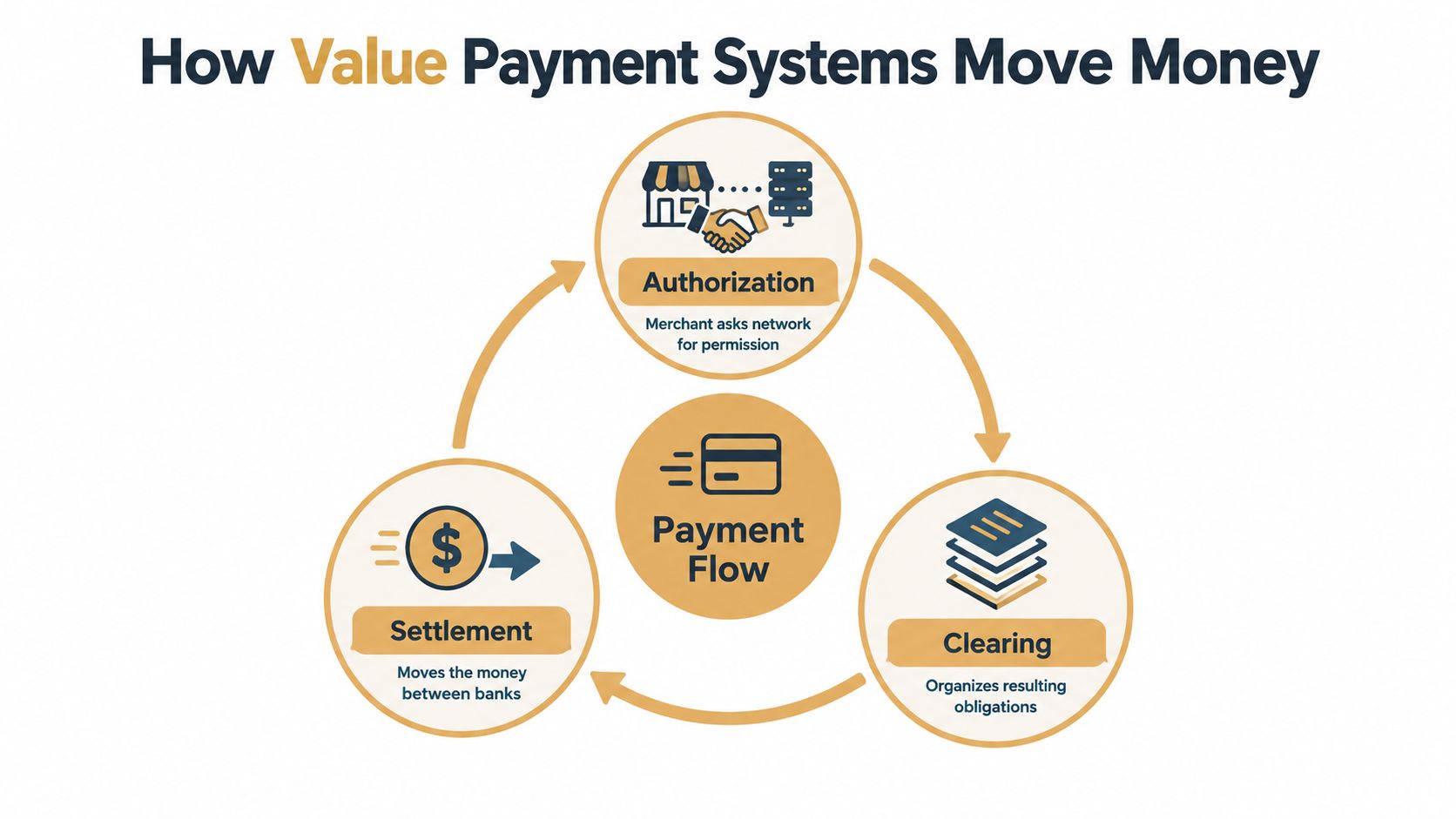
For a card purchase, think of authorization as asking permission, clearing as organizing obligations, and settlement as moving the resulting money between institutions. These are useful distinctions for investigating a payment, even when a provider presents them through a unified interface.
The diagram separates those functions.
When reviewing a proposed arrangement, ask the provider to map its responsibilities against these roles:
- Gateway: The connection through which your checkout submits payment information and receives responses.
- Processor: The service handling transaction messages and related payment operations.
- Acquiring bank: The institution supporting the merchant's acceptance relationship.
- Card network: The network connecting participating institutions under its payment rules.
- Settlement infrastructure: The mechanisms through which institutions discharge payment obligations.
Providers may combine roles. Don't assume a single commercial contract means a single operational dependency.
Keep the transaction identity intact
After purchase, a refund request or dispute introduces another event that must be associated with the original transaction. Your team needs to connect the order, payment, fulfillment record, customer communication, and financial adjustment without relying on manual searches.
Ask providers to demonstrate that traceability using a test purchase. Follow it from checkout into the payment record, then into reporting and a refund workflow.
The useful mental model is customer → checkout → payment services → financial institutions, with status information returning to the merchant. Evaluate who controls each connection, who can explain a failure, and which records your team can export. A familiar logo doesn't answer those questions.
Retail and Wholesale Payment Infrastructure
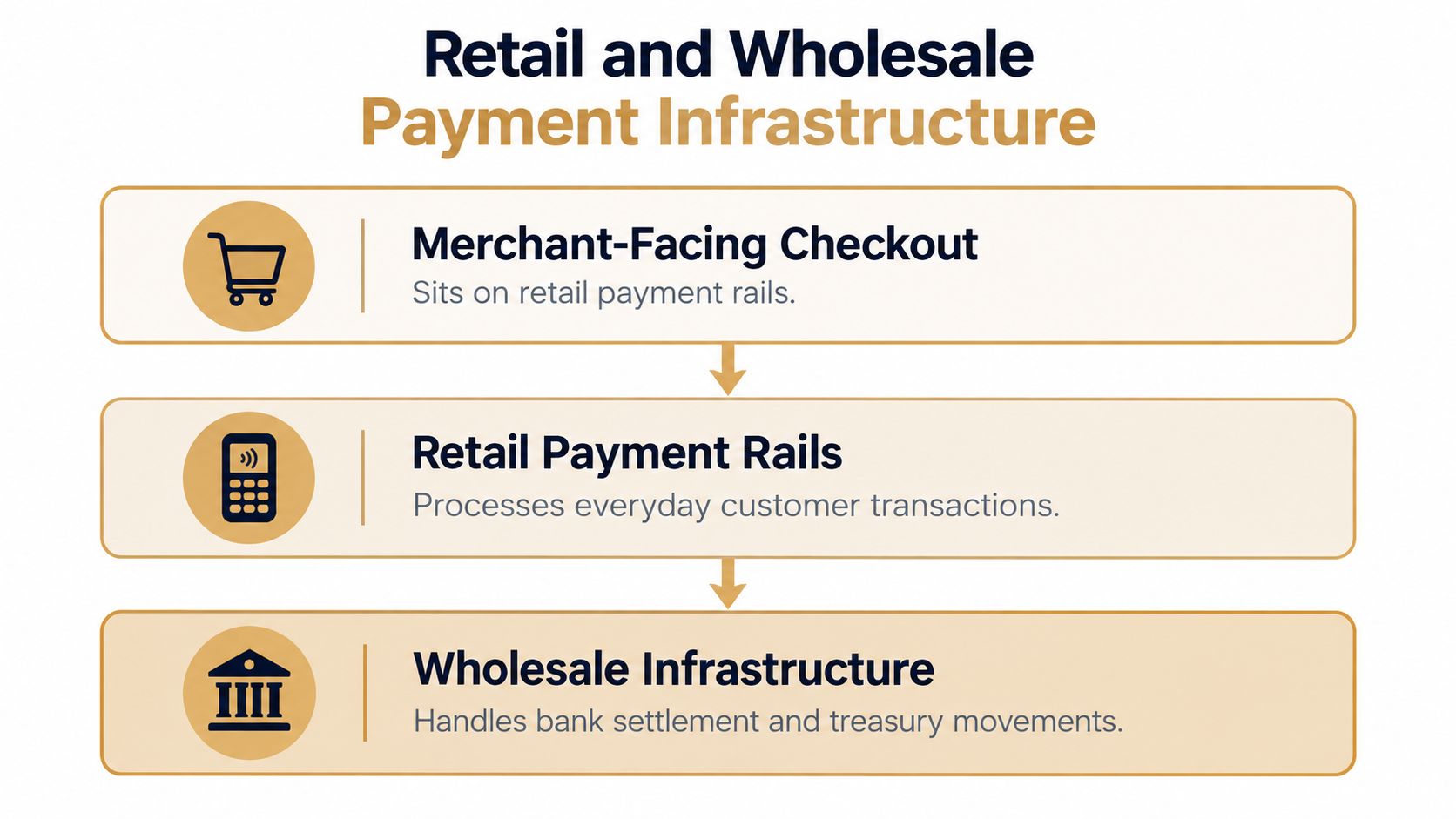
Your checkout interface isn't the whole payment infrastructure. Retail rails serve payments between end users, while wholesale infrastructure supports institutional transactions, including high-value or time-critical payments. The World Bank's digital financial services overview distinguishes these layers within the wider payment ecosystem.
For a merchant, that distinction separates direct integration responsibilities from institutional dependencies. You may control the checkout code without controlling the infrastructure behind bank settlement or treasury movements.
The hierarchy makes those dependencies easier to discuss with providers.
Speed needs an operating model
The World Bank identifies real-time or near-real-time messaging and final-funds availability, alongside service availability approaching 24/7, as defining characteristics of fast-payment infrastructure. Don't interpret a fast confirmation screen as proof that every downstream process is equally fast.
My recommendation is to match faster payments with continuous operational controls. Engineering should process repeated status events idempotently, meaning a repeated event doesn't trigger the same financial action again. Finance should reconcile against processor records, while support needs an escalation route that doesn't depend on an end-of-day batch.
Ask infrastructure questions in operational language:
- Availability: Which services are covered by uptime commitments, and what happens during maintenance?
- Finality: When are funds final, and when are they available for merchant use?
- Reconciliation: How quickly can your team identify a mismatch between internal and processor records?
- Failure handling: What happens after a timeout, delayed callback, rejected refund, or unavailable API?
- Incident ownership: Who coordinates a problem that crosses the provider, bank, and merchant systems?
Faster funds are useful only if your team can trust the status, reconcile the movement, and handle exceptions.
Don't choose a rail because it sounds newer. Choose it because its availability, funding behavior, and failure procedures fit your operating requirements. Ask for demonstrations and written responsibilities, not an assurance that the infrastructure is modern.
Compare Payment Models and Fee Structures
Compare commercial arrangements, not brand rankings. A platform-native service, independent gateway, processor-led package, and bank-led relationship are different starting points for allocating work and control. Use the following matrix as a procurement framework, then confirm every assumption in the proposal.
Value payment model comparison
| Payment model | Typical fee lens | Integration burden | Operational control | Best fit to evaluate |
|---|---|---|---|---|
| Platform-native processing | Bundled processing, platform-related charges, exception fees | Assess built-in checkout and reporting coverage | Check which settings and exports the platform exposes | Merchants prioritizing platform consistency |
| Independent gateway | Gateway charges plus underlying processing costs | Validate gateway and processor connections separately | Examine routing, reporting, and integration flexibility | Custom carts with engineering capacity |
| Processor-led arrangement | Processing schedule plus optional services | Determine what the provider manages | Confirm access to risk settings and support escalation | Merchants seeking coordinated payment support |
| Direct bank or network relationships | Negotiated terms and infrastructure obligations | Establish technical, compliance, and operational responsibilities | Test the scope of contractual control | Businesses equipped to manage a more involved arrangement |
These aren't fixed promises about each model. A supposedly flexible arrangement can still restrict data access. A bundled service can still meet demanding operational requirements. The contract and integration determine the result.
Normalize the quote before negotiating
Give every candidate the same transaction profile. Include payment methods, customer locations, currencies, order values, refund behavior, recurring billing needs, and dispute workload. Otherwise, providers may price different assumptions and leave you comparing totals that aren't comparable.
Request a complete schedule covering:
- Acceptance charges: Percentage pricing, per-transaction charges, gateway costs, and any minimum commitments.
- Account costs: Setup, monthly service, reporting, support, and integration charges.
- Cross-border activity: International processing and currency-related charges.
- Post-purchase work: Refund charges, dispute fees, and representment expenses.
Keep fees, cash constraints, and internal labor separate. A reserve isn't the same as a processing charge, but finance still needs to assess its effect on usable working capital. Likewise, a lower quoted fee isn't a saving if staff must manually repair exports or investigate routine status mismatches.
Ask each provider to walk through a normal purchase, a refunded purchase, and a disputed purchase using its proposed terms. Don't let a sales presentation substitute for that exercise.
Negotiate after you understand the operating burden. The strongest proposal is the one whose costs and responsibilities remain intelligible when a transaction doesn't go as planned.
Match Payment Systems to Merchant Risk
High volume and high risk describe different requirements. Don't let either label replace a detailed assessment of your business.
The distinction between transaction scale and operational needs also matters in institutional payments. The Federal Reserve has operated a wire payment system since 1915, and the average Fedwire transfer increased from approximately $500,000 in 1953 to $5.4 million in 2022, according to its history of Fedwire. That isn't a merchant-processing benchmark. It illustrates why payment arrangements must be judged against the values and responsibilities they support.
Test your actual exceptions
For a high-volume ecommerce operator, I'd prioritize centralized rules, usable analytics, reconciliation capacity, and support that can investigate patterns rather than isolated tickets. For a merchant facing higher risk, I'd put greater weight on evidence retention, account conditions, monitoring sensitivity, and continuity planning.
Business-model examples make the requirements concrete:
- Subscription business: Test whether cancellation status, renewal notices, and customer communications can be retrieved together.
- DTC retailer: Trace a delayed delivery from carrier information to the support conversation and refund decision.
- Custom-cart operator: Check whether engineering can diagnose payment failures without losing the connection to the order.
- Promotion-led merchant: Preserve the offer and terms the customer saw, not just the current landing page.
These are test scenarios, not claims about particular merchants. Their purpose is to expose missing records and unclear ownership before those gaps affect customers.
Use causes, not labels
When assessing a high chargeback rate, separate the reasons behind customer complaints. A delivery failure, an unclear renewal, and suspected unauthorized use shouldn't automatically receive the same response.
Build the provider evaluation around ticket size, transaction count, fulfillment promises, customer support coverage, and dispute reasons. Require the provider to explain how its services accommodate those conditions.
Don't accept “we support your industry” as sufficient evidence of fit. Ask who handles exceptions, what information they need, and how your team can challenge an incorrect decision.
Make Better Refund and Dispute Decisions
Treat disputes as a post-purchase operations problem, not exclusively a fraud-screening problem. In the 2025 Global eCommerce Payments and Fraud Report, 47% of merchants identified refund abuse as their leading fraud attack, 57% reported rising refund or policy abuse, and 62% reported increased first-party-misuse disputes, according to the Merchant Risk Council's report.
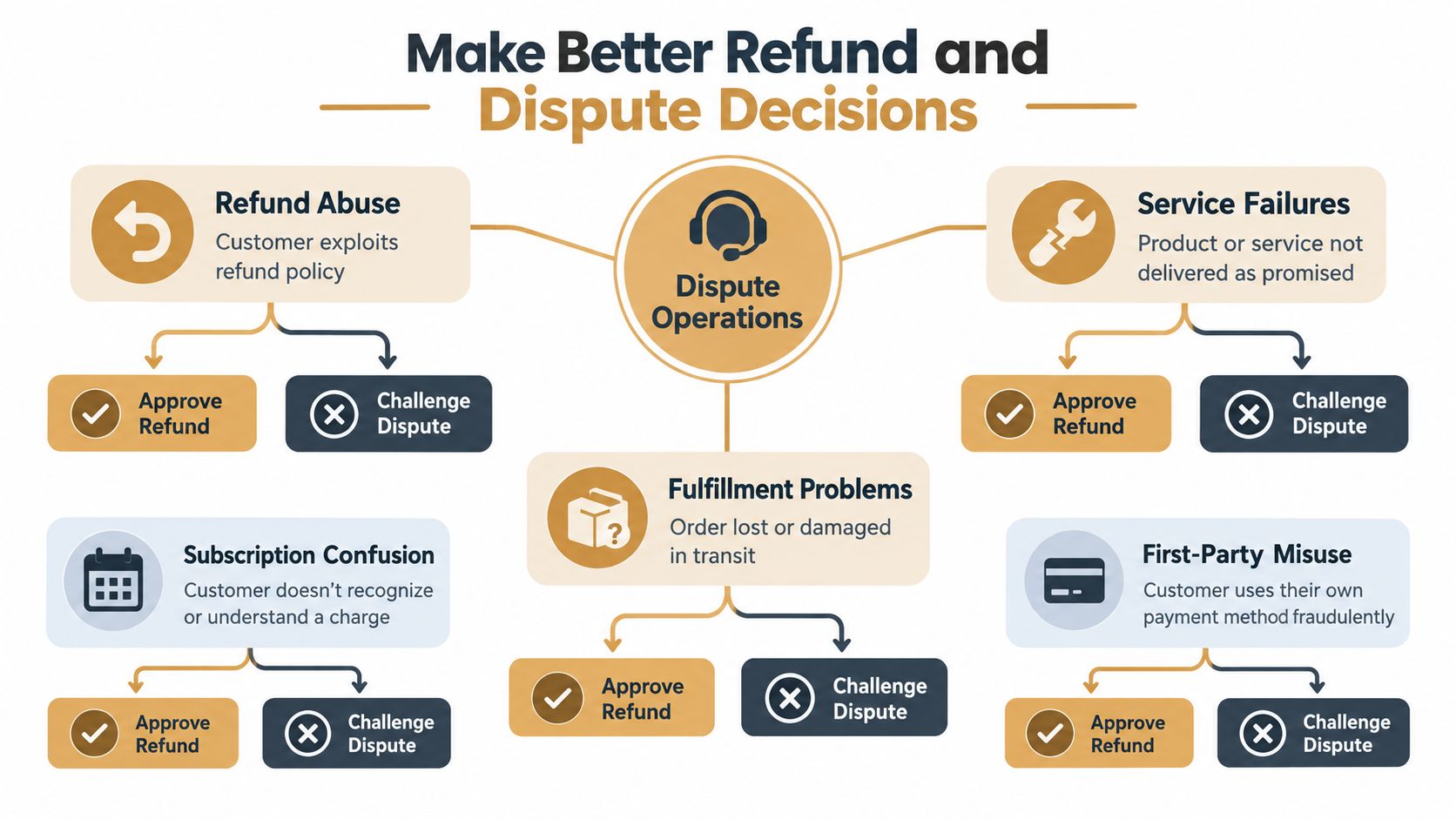
Those findings justify closer examination, not automatic suspicion of every customer. Your policy should distinguish a credible service failure from an ambiguous claim or a well-supported case for contesting a dispute.
Use the decision map as a prompt for investigation, not an automatic verdict.
Choose the response from the evidence
Refund promptly when the available records establish a service failure and the refund is appropriate. Examples to build into your policy include an unfulfilled order or a billing error confirmed by your own records. Check for an existing refund or dispute action before initiating another adjustment.
When the facts conflict, investigate. Bring transaction details, fulfillment records, customer identity signals, subscription status, previous refunds, and communications into a single case record. Assign an owner and a review deadline so investigation doesn't become indefinite delay.
Contest selectively when the dispute reason and available evidence support doing so. A consistent chargeback-fighting process should specify relevant evidence, approval authority, and circumstances in which the team should stop spending effort.
Compare the full economic exposure
Don't compare the refund amount only with the original sale. Evaluate the decision against:
- Direct exposure: Refunded revenue, goods or services already supplied, and applicable fees.
- Handling expense: Investigation, customer support, evidence preparation, and representment work.
- Account implications: Potential ratio effects, reserves, holds, and processor escalation.
- Customer outcome: Whether the response fairly resolves the problem and supports retention.
For another resource while documenting the workflow, AmaJova's page on how to resolve payment disputes can sit alongside your processor's current procedures. Your own policy should still define responsibilities and escalation authority.
A refund is a service decision. A contest is an evidence decision. Neither should be a reflex.
Report the outcome by reason and response path. Track retained customers, refunded revenue, handling effort, and false positives alongside dispute outcomes. Label prevented disputes carefully: an early resolution is observable, but what would have happened without it isn't always knowable.
Integrate Payments With Dispute Alerting Tools
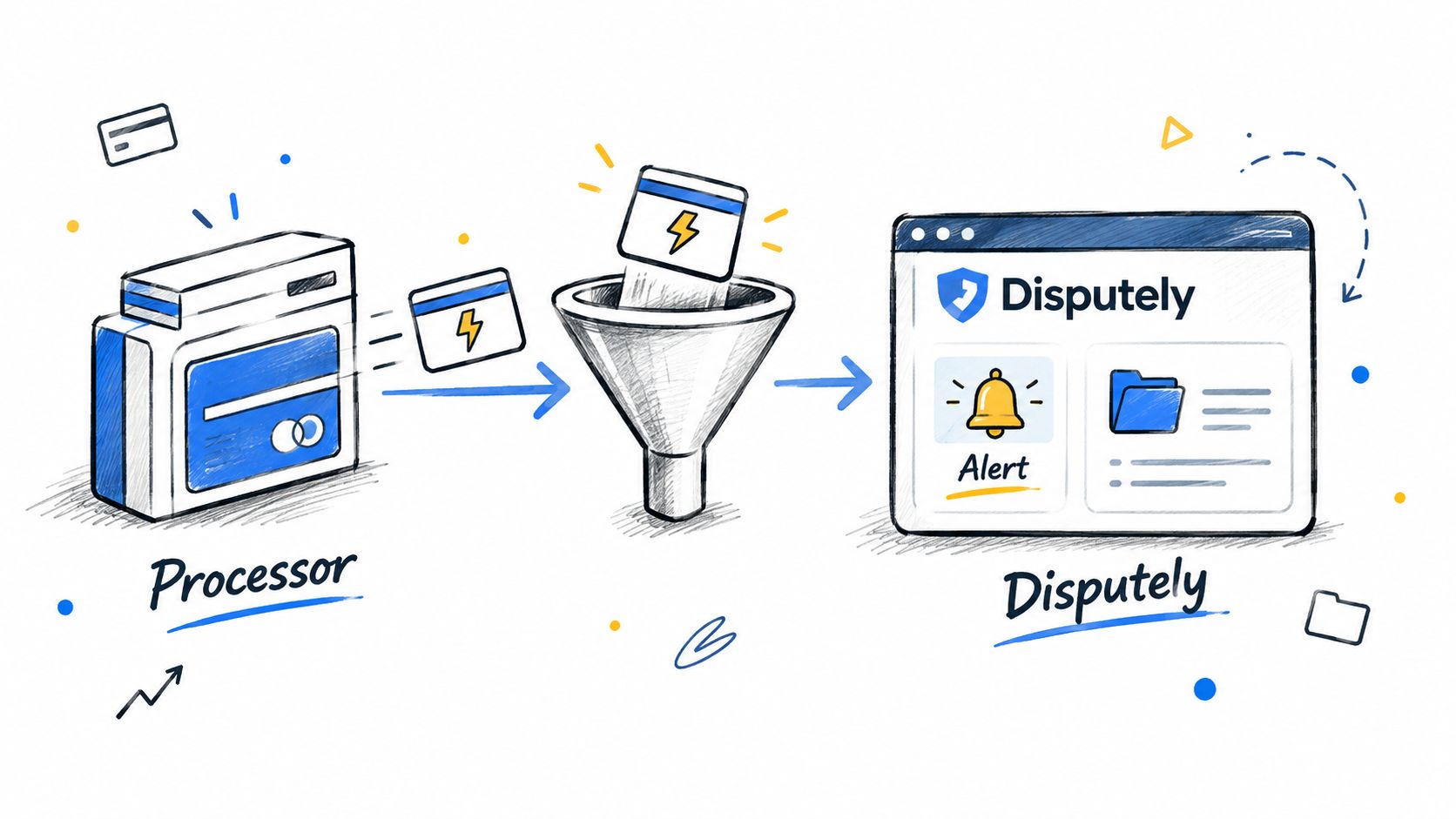
Connectivity is the starting point, not proof that an alerting workflow is ready. For processors such as Stripe, PayPal, Shopify Payments, Authorize.net, and Square, verify the exact account connection and available event coverage before authorizing automated action.
Use the interface review to identify what the team can configure and audit.
Validate the action behind the alert
Map processor event → matched transaction → policy decision → action → reconciliation. At each stage, specify the required fields, failure behavior, and human owner. A notification without a reliable transaction match isn't permission to issue a refund.
Before enabling a dispute-resolution workflow, test:
- Authentication and security: Access permissions, credential management, and audit visibility.
- Event handling: Required identifiers, duplicate-event protection, delayed delivery, and retry behavior.
- Refund accuracy: Existing refunds, partial adjustments, currency handling, and processor confirmation.
- Operational coverage: Applicable response windows, failed-action alerts, exports, and support escalation.
- Commercial terms: Which alerts are billable and how pay-per-alert charges appear in reporting.
Use a demonstration to compare the documented workflow with the actual interface.
Keep people responsible for exceptions
Ask vendors to demonstrate filtering against conflicting records and previously refunded transactions. Treat claims about automation quality as claims to validate, not independent evidence of performance.
Assign someone to review unmatched alerts, failed refunds, and inconsistent processor records. Start with rules your team can explain, then expand automation only after reviewing actual outcomes. Automate an approved policy, not an unresolved judgment call.
Choose and Test the Right System
Choose against a written operating specification. Define transaction profile, risk exposure, settlement needs, integration constraints, and dispute objectives before requesting proposals. Then score candidates against the same requirements rather than whichever feature a salesperson demonstrates first.
The broader exposure deserves attention. Worldwide chargeback volume is projected to rise from 261 million in 2025 to 324 million in 2028, while losses are projected to increase from $33.79 billion to $41.69 billion over that period, according to Sift's disputes reporting. Those projections aren't a forecast for your business, but they reinforce the case for disciplined post-purchase operations.
Validate before migrating
Run a limited test that includes successful purchases, failed payments, refunds, and exception handling. Finance should verify reports, engineering should inspect event behavior, and support should attempt to retrieve the records needed for a customer complaint.
Regional suitability belongs in that assessment. For merchants evaluating local requirements, Zaro's discussion of South African payment solutions for SMEs provides a regional comparison resource. Don't assume a recommendation transfers unchanged across markets.
Use this final decision checklist:
- Performance: Does the test meet your authorization and payout requirements?
- Economics: Can finance explain fees, cash constraints, and handling costs?
- Operations: Can staff reconcile records and complete refunds without workarounds?
- Disputes: Are alert coverage, evidence access, and escalation responsibilities clear?
- Control: Do you retain usable exports, documented exit procedures, and access to your records?
- Support: Has the provider demonstrated how it handles an unresolved incident?
Select the arrangement that passes the operational test, not the one with the most attractive headline rate. Payment continuity, manageable workload, and fair customer outcomes belong in the purchasing decision.
Disputely states that it connects merchants with Visa RDR, Mastercard CDRN, and Ethoca alerts, supports major processors, and offers pay-per-alert pricing without setup fees or contracts. Visit Disputely to check processor compatibility and evaluate how dispute alerting could fit your refund policy and payment operations.


