
Visa Chargeback Dispute Process and Timelines
The most popular advice about the Visa chargeback dispute process is also the least useful: collect every receipt, submit a rebuttal, and fight until the money comes back. That approach assumes every dispute follows the same path and that winning an individual case is always the right commercial decision.
Visa's current framework is more complicated. Some cases move through allocation, where liability can be assigned without a full evidence exchange. Others use collaboration, where the merchant and issuer review reason-code-specific evidence. Visa's modernization materials also describe seller-initiated refunds before a formal dispute, with different response windows and total timelines depending on the dispute type. The practical question is not just whether you can fight. It's whether you should refund, represent, or accept an outcome that's already effectively determined.
The Modern Reality of Visa Dispute Workflows
A chargeback isn't always a straight line from cardholder complaint to merchant evidence to bank decision. That model remains useful for understanding collaboration cases, but it misses an important operational distinction in Visa's newer rules.
Allocation and collaboration are different problems
In a collaboration workflow, the merchant receives a dispute and can submit a package built to match the reason code. The acquirer passes that material through for issuer review. Receipts, fulfillment records, customer communications, authentication data, and other transaction evidence can all matter, but only when they answer the specific allegation.
In an allocation workflow, the system may assign liability automatically in certain fraud or authorization scenarios. The merchant might not receive the same opportunity for a traditional representment exchange. Treating that case like a normal evidence battle wastes time and can create the wrong customer-service response.
Visa describes the broader process as a layered review. The cardholder raises the issue with the issuing bank, the acquirer notifies the merchant, and the merchant can seek recovery with a reason-code-specific evidence package. Visa's overview of the chargeback process makes the central operational point clear: evidence must match the dispute type.
Practical rule: Classify the workflow before deciding what action to take. A merchant can't optimize a process it hasn't identified correctly.
Why “fight everything” fails
Representment has a direct cost. Someone must retrieve order data, verify delivery or access, redact and format documents, write the response, monitor status, and handle follow-up. The merchant may also carry the original loss while the case remains open. For subscription businesses, an aggressive response can damage a relationship with a legitimate customer who did not recognize a billing descriptor.
A blanket refund strategy fails in the opposite direction. It converts preventable disputes into permanent losses and teaches abusive customers that a bank complaint is an easier refund channel than customer support. It also throws away useful identity and transaction data that could have exposed a pattern.
The better operating model separates three decisions:
- Prevent escalation when a pre-dispute alert gives the merchant a controlled refund option.
- Represent selectively when the reason code is defensible and the evidence connects the order to the cardholder.
- Accept or allow allocation when the rules or available facts make a fight commercially irrational.
That shift matters most for recurring billing, digital goods, and high-volume ecommerce. A team that measures only recovered transactions will miss refund leakage, staff time, customer friction, and the effect of dispute handling on its processing relationship.
Mapping the Chargeback Lifecycle and Timelines
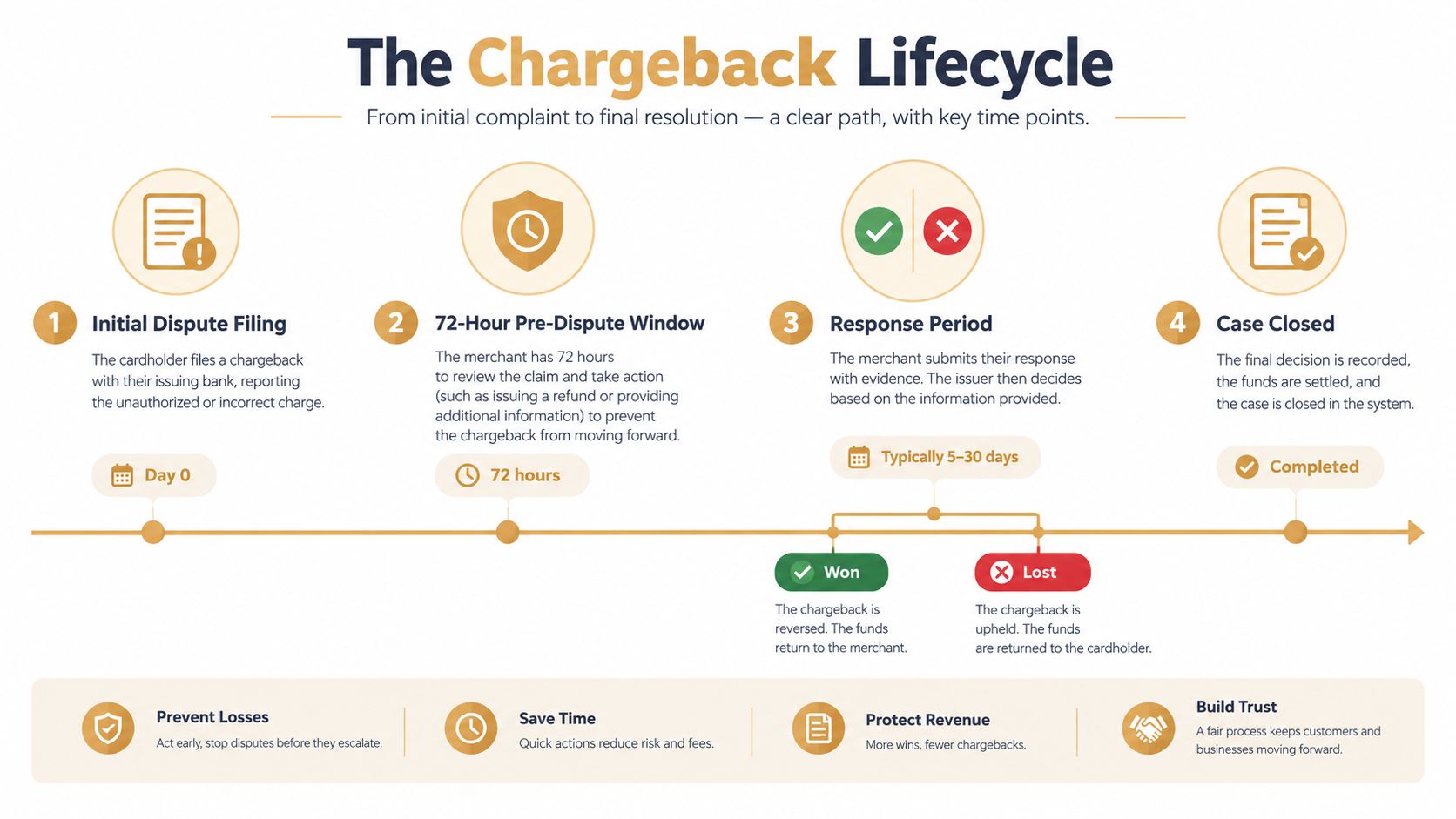
The lifecycle begins before a formal chargeback reaches the merchant account. A cardholder contacts the issuing bank, the issuer evaluates the complaint, and the case may enter a pre-dispute alert channel. If the merchant can resolve the issue during that early window, the formal dispute may never be filed.
Stage one is the pre-dispute decision
Visa's dispute modernization materials describe seller-initiated refunds within a 72-hour pre-dispute window. That window is operationally different from formal representment. The merchant isn't proving its case to an issuer yet. It's deciding whether a controlled refund is cheaper and safer than allowing the complaint to become a chargeback.
The decision should happen automatically where possible. Match the alert to the order, check whether the customer has already contacted support, confirm fulfillment status, and apply rules based on product type and risk. A digital subscription with no convincing access history may deserve a different response from a high-value physical order with verified delivery.
Customers also confuse unfamiliar descriptors and legitimate duplicate postings with fraud. A plain-language resource such as this guide to duplicate charges for shoppers can help support teams resolve those cases before a bank complaint becomes the default path.
Stage two is formal notification and classification
If the dispute proceeds, the acquirer notifies the merchant and identifies the relevant reason code. The merchant should treat that code as a requirements document, not as a label to copy into a generic response. It determines which facts the issuer needs to evaluate.
At this point, funds may be removed or placed into dispute status according to the processor's handling. The merchant should open a case record immediately, preserve the original transaction data, and assign ownership. Missed deadlines commonly result in a default outcome, even when the underlying order was legitimate.
Stage three is the response window
Visa's newer framework describes merchant response windows of around 30 days, depending on the workflow and dispute type. That isn't a comfortable project deadline. The clock includes internal review, data retrieval, quality control, acquirer submission, and any processor-specific cutoff.
A practical case file should contain:
- The reason code and workflow classification.
- A concise rebuttal that answers the allegation directly.
- Transaction, fulfillment, authentication, and customer-service records.
- A submission confirmation and a status owner.
The issuer then reviews the response. The result may resolve the case, continue the dispute, or move it into another stage. The total lifecycle can extend to up to 70 or 100 days, depending on the dispute type and path, as outlined in Visa's modernization materials.
The formal timeline can therefore outlast the customer interaction that caused it. Build alerts around every deadline, not just the initial notification. Store the evidence in a form that another operator can understand without reconstructing the order from several disconnected systems.
Use the following video as a visual walkthrough of the lifecycle and the operational handoffs involved.
Arbitration is a last-resort network review rather than a routine extension of representment. Before escalating, calculate the likely recovery against the cost of preparation, delay, and an unfavorable final decision. A strong process knows when the case is worth pursuing and when the merchant should close it.
Building a Winning Representment Evidence Package
A winning package isn't a document dump. It's a short, reason-code-specific explanation supported by records that connect the disputed transaction to the customer, the order, and the fulfillment event.
Visa's guidance calls for evidence such as receipts, shipping records, communications, and authentication data, but the right combination depends on the allegation. A shipping record can support a merchandise-not-received response, yet it won't by itself establish that a cardholder authorized a digital purchase. The issuer needs evidence that addresses the disputed fact.
Start with the reason code
For each case, write the disputed proposition in plain English. Is the customer denying authorization, claiming non-receipt, alleging a processing error, or disputing the quality or terms of the service? Then remove every document that doesn't help answer that proposition.
For a physical order, the package may include the order record, delivery confirmation, shipping address, customer communications, and relevant policy acceptance. For a service or subscription, include signup details, billing terms, cancellation history, account activity, and support interactions. For digital goods, preserve proof of download or access with timestamps and corroborating information.
The strongest packages create a clear chain:
- Who placed the order: Account identity, customer details, and consistent billing information.
- What the customer bought: Product, service, quantity, price, and terms presented at checkout.
- What happened afterward: Shipment, delivery, login, download, use, cancellation, or communication.
- Why the evidence answers the claim: A direct explanation tied to the reason code.
Visa's merchant chargeback guidance describes highly technical evidence standards for card-not-present fraud cases. In Compelling Evidence 3.0-style cases, aligned data such as IP address, device fingerprint, user ID, and shipping address across qualifying prior transactions can help connect the disputed order to an established cardholder behavior pattern.
Preserve telemetry before the case arrives
Telemetry only helps if it exists, is retained, and can be retrieved in a readable form. Payment teams should preserve the event history at order creation, authentication, checkout, fulfillment, account access, and customer-service contact. Don't rely on a fraud vendor's dashboard as the only copy of the underlying facts.
The package should explain the telemetry rather than paste raw logs into an appendix. State what the device or account relationship shows, how it aligns with prior qualifying activity, and why that relationship matters to the reason code. Avoid overstating certainty. A matching signal supports a conclusion, but it doesn't replace a complete explanation.
Evidence principle: More pages don't make a stronger case. Relevant, connected records do.
The chargeback-fighting workflow from Disputely can be used as a reference point when designing internal representment procedures. Whether a merchant uses a platform, an acquirer portal, or an in-house queue, the standard should remain the same: classify, preserve, explain, submit once, and monitor the result.
Stopping Disputes with Visa RDR and Alert Networks
The cheapest dispute to represent is the one that never becomes a formal chargeback. Visa Rapid Dispute Resolution, or RDR, and other alert networks give merchants an earlier intervention point, when the customer has raised an issue but the formal evidence exchange hasn't fully begun.
Visa's modernization materials describe a 72-hour pre-dispute period for seller-initiated refunds. The merchant can use that window to match the alert to the order and refund under defined rules. This isn't the same as admitting fault in every case. It's a controlled decision about whether preserving the transaction is worth the operational and account-level exposure created by escalation.
Alerts need rules, not just notifications
An alert that lands in an inbox and waits for manual review is only a faster way to create a backlog. The system should connect the network alert to the original order, customer account, fulfillment state, product category, and prior support history.
Set refund rules around commercial risk:
- Refund automatically: Low-margin orders, unclear fulfillment, inaccessible digital-use records, or complaints that customer support could have resolved.
- Route for review: High-value orders, active subscriptions, repeat customers, and cases with conflicting signals.
- Decline automatic refund: Orders with strong fulfillment and identity evidence where representment is likely to be worthwhile.
Ethoca alerts can serve a similar pre-dispute purpose for participating issuers and acquirers, but coverage, timing, and processor behavior vary. Confirm the actual alert types and response requirements with your acquiring partner instead of assuming every network provides the same intervention.
Ratio protection is a strategic benefit
A pre-dispute refund can prevent the case from becoming a formal chargeback. That distinction matters because monitoring programs evaluate dispute activity at the merchant level, and rising ratios can trigger reviews, reserves, restrictions, or account holds depending on the processor and network context.
Refunding every alert isn't a solution. It can increase unnecessary refunds, especially when customers report transactions they recognize after a quick support interaction. Intelligent filtering matters because the merchant must protect both cash flow and the health of the processing account.
Disputely is one example of an alert platform that connects with Visa RDR, Mastercard CDRN, and Ethoca alerts, then applies merchant-set refund rules to incoming cases. The important capability is the workflow, not the brand: receive the alert quickly, identify the order, decide consistently, record the outcome, and keep cases that require formal defense in a separate queue.
Operational test: If your team can't tell within minutes whether an alert maps to a fulfilled order, your data integration is part of the dispute problem.
When to Refund Versus When to Fight
The right response depends on four questions: what the customer alleges, what evidence exists, what the transaction is worth to the business, and how much work the case will require. Transaction value matters, but it isn't the only variable. A recurring customer relationship, a weak fulfillment trail, or a pattern of similar claims can change the decision.
Use the matrix below as a starting policy, then tune it using actual outcomes from your processor and acquirer.
| Dispute Scenario | Recommended Action | Primary Rationale |
|---|---|---|
| Pre-dispute alert with unclear fulfillment or weak access records | Refund within the alert window | A controlled refund may prevent formal escalation and closes an evidence-poor case quickly |
| Pre-dispute alert with clear fulfillment and strong identity signals | Review before refunding | The merchant may avoid unnecessary refund leakage when the transaction is defensible |
| Collaboration case with reason-code-specific records and aligned telemetry | Fight through representment | Connected evidence gives the issuer a basis to reverse the dispute |
| Collaboration case with missing logs, contradictory records, or an incorrect descriptor | Refund or accept the case | A weak package consumes resources and is unlikely to clarify the transaction |
| Allocation case with automatic liability assignment | Accept the assigned outcome unless the processor provides a valid challenge path | A conventional evidence package may not change the workflow |
| Case approaching arbitration with limited recovery value | Avoid escalation | Preparation, delay, and final-decision risk can outweigh the disputed amount |
Configure the policy around evidence quality
A merchant should not automate solely on order value. A small digital order with excellent account telemetry may be easier to defend than a larger physical order with an incomplete delivery trail. Likewise, an apparently unauthorized recurring charge may reflect a cancellation or descriptor failure rather than genuine payment fraud.
Retention is foundational. Teams reviewing their policy should consult a practical data retention guide from Sift AI and align retention with the evidence their acquirer and reason codes require. Keep records structured, searchable, and tied to a transaction identifier.
For Shopify merchants, a workflow such as Shopify chargeback protection from Disputely can be evaluated alongside processor-native tools and internal operations. The selection criteria should be concrete: alert coverage, rule controls, processor compatibility, audit history, and the ability to distinguish a likely win from a case that should be refunded.
The best policy also learns. Review accepted refunds, successful representments, lost cases, and automatic allocations separately. If one product or billing flow repeatedly produces weak evidence, fix that flow instead of asking the dispute team to compensate forever.
Proactive Prevention and Gateway Configuration
Dispute prevention starts before the payment is authorized. Customers file complaints when they don't recognize the merchant, can't get help, don't understand recurring terms, or see a transaction that doesn't match their memory of the purchase. Gateway controls then add another layer by reducing unauthorized use and preserving signals for later review.
Make legitimate transactions easy to recognize
Use a billing descriptor that customers can connect to the storefront or product name. Put a recognizable support route on the receipt and make cancellation instructions easy to find. Subscription merchants should display renewal terms clearly, send useful account notifications, and process cancellation requests without forcing a customer to call a bank.
Brand recognition helps, but it isn't enough. The order confirmation should state what was purchased, how the charge will appear, and how the customer can resolve a problem. Customer support needs access to order, fulfillment, and billing data so it can answer a question before the customer turns to the issuer.
Configure the gateway to collect useful signals
Enable 3D Secure where it fits the risk profile and customer journey. Configure address verification and card security code checks according to the processor's capabilities and your approved rules. These controls can reduce exposure, but strict settings can also decline legitimate customers, so monitor authorization quality and checkout friction together.
Fraud screening should use multiple signals rather than a single hard block. Device information, account age, velocity, shipping consistency, authentication results, and prior order behavior can support a decision. Store the resulting event data in a way that the dispute team can later explain to an issuer.
A prevention stack usually includes:
- Clear customer communications: Receipts, descriptors, renewal notices, and cancellation confirmations should agree with the transaction record.
- Layered authentication: Use 3D Secure and gateway checks where risk justifies the added step.
- Fulfillment discipline: Capture shipment, delivery, access, and usage events as they occur.
- Alert integration: Send RDR and other network alerts into the same case and order systems.
- Support visibility: Let agents see billing status and resolve recognizable disputes without making customers repeat themselves.
A merchant facing persistent pressure can also review how high chargeback rates develop, then map each recurring complaint to a checkout, fulfillment, billing, or support cause. The aim isn't to block every suspicious customer. It's to reduce preventable confusion while preserving the evidence needed when a genuine dispute reaches collaboration.
Protecting Your Processing Relationships Long Term
A merchant account can look healthy at the transaction level while becoming fragile at the portfolio level. Repeated disputes consume processor attention, weaken the case for continued access, and can lead to monitoring or tighter financial controls. The danger isn't limited to the amount lost on individual orders.
The Visa Dispute Monitoring Program, or VDMP, is one reason dispute operations belong in executive planning rather than only in customer support. A merchant that reacts after formal disputes arrive has already missed the cheapest intervention point. By then, the team is measuring damage instead of preventing escalation.
A sustainable operating model has four parts:
- Capture alerts early and apply consistent refund rules.
- Separate allocation from collaboration before assigning work.
- Preserve telemetry and fulfillment evidence as part of normal order processing.
- Review trends by product, descriptor, subscription flow, and processor, not only by individual case.
The strongest teams don't celebrate every representment win. They ask why the customer disputed, whether the alert could have prevented the case, whether the refund was commercially sensible, and whether the same failure will appear again next month. That mindset protects revenue and gives the acquirer evidence that the merchant manages disputes deliberately.
If you're rebuilding the process, start with one processor, one alert channel, and a written decision matrix. Connect alerts to orders, assign an owner for every formal case, and audit the evidence trail before the next deadline arrives.
Disputely connects merchants to Visa RDR, Mastercard CDRN, and Ethoca alerts, then applies configurable refund rules before eligible complaints become formal chargebacks. Visit Disputely to evaluate an alert-driven workflow for your ecommerce or subscription business and protect the processing relationship behind every sale.


