
What Does Credit Floor Mean? a Merchant's Guide
A credit floor is most commonly a transaction threshold, or floor limit, that determines when a merchant must get real-time authorization from the cardholder's bank. In lending, the same term means an interest-rate minimum that limits how far a floating rate can fall.
A merchant reviewing a processor statement may see “credit floor” beside an authorization rule and wonder whether it affects a customer's available credit, the merchant's pricing, or both. A business owner reading a loan agreement may encounter the same phrase and find that it describes something completely different.
The confusion comes from one word serving two separate financial systems. In card payments, a credit floor is an operational threshold for individual transactions. In lending, it's a contractual lower boundary for an interest rate. The first changes how a payment gets approved. The second changes how much interest a borrower may continue paying when market rates decline.
Introduction
Suppose an ecommerce merchant is checking processor documentation after a payment is declined. The document refers to a floor limit, but the merchant doesn't know whether the term means the customer has reached a credit ceiling or whether the processor has imposed a transaction rule. The answer depends on the context in which the term appears.
For card payments, a credit floor is a per-transaction authorization threshold. A floor limit determines when the merchant must seek real-time confirmation from the cardholder's bank. It doesn't describe the customer's overall borrowing capacity. For a loan or floating-rate credit agreement, an interest-rate floor is a contractual minimum benchmark rate. If the reference rate drops below that level, the agreement can keep the borrower's benchmark component at the floor.
That distinction matters for merchants because the two meanings create different questions. A payment floor concerns authorization records, fraud exposure, disputes, and the evidence available if a customer later challenges a transaction. A lending floor concerns interest expense, cash-flow planning, and who carries the risk when rates move downward.
The practical examples ahead use the classic $20 floor limit to show how authorization thresholds work. They also explain why online merchants commonly operate with a zero floor limit, how that reality affects liability and reserve risk, and what to check in processor and loan documents. Once you identify which system is using the word “floor,” the rest of the language becomes much easier to interpret.
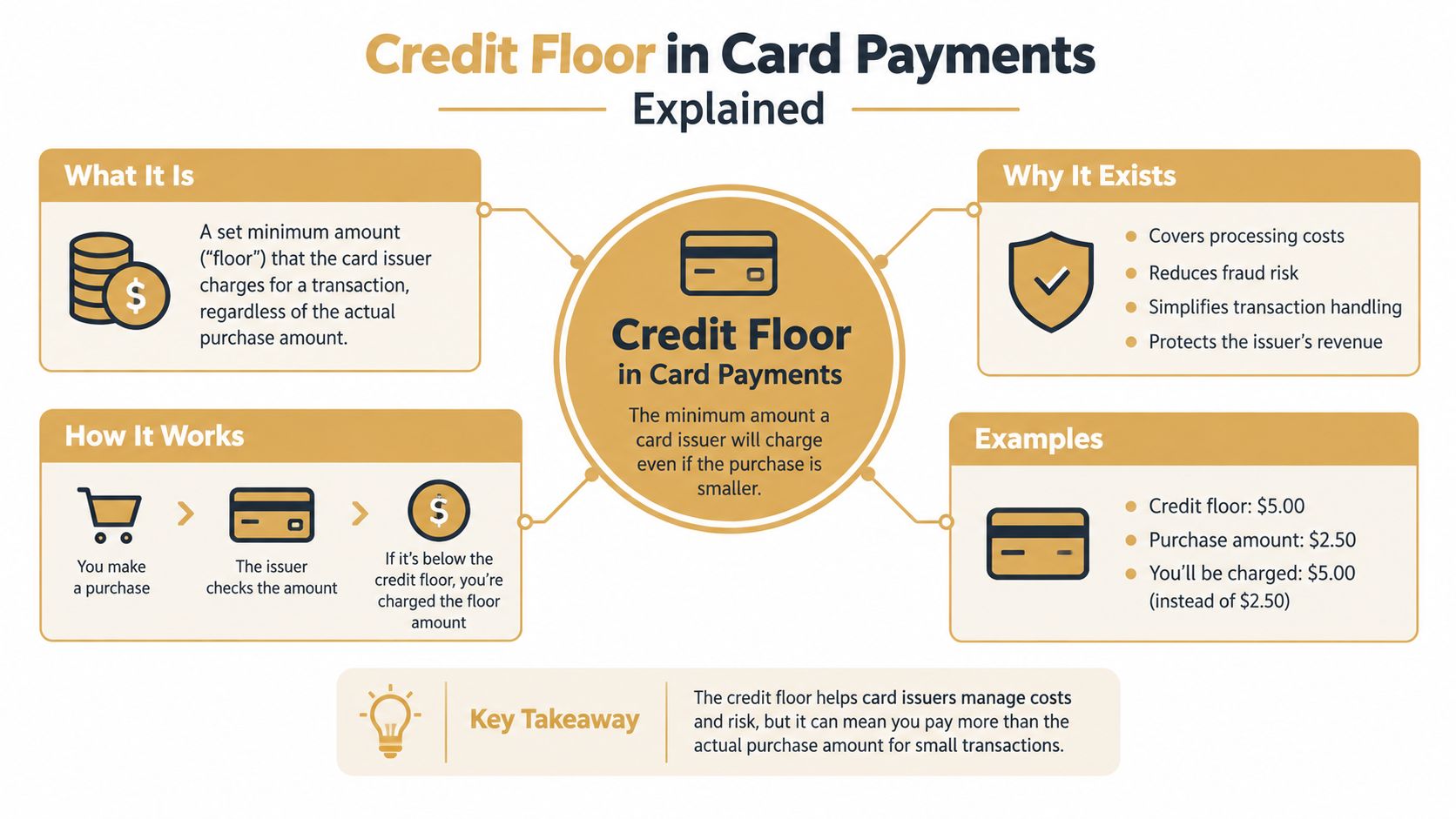
Credit Floor in Card Payments Explained
In card payments, the simplest definition is operational: a credit floor, also called a floor limit, is a transaction amount that determines whether the merchant must obtain immediate issuer authorization. The rule applies to the payment being attempted, not to the customer's entire card account.
A common example is a $20 floor limit. A $19.99 purchase can be processed without immediate authorization, while a $20.00 purchase requires the issuer to confirm card validity and available funds, as explained in this floor limit example from Orchestra Solutions.
Think of the floor as a security checkpoint at a venue. Small bags may pass through a simpler process, while bags at or above a stated size must be inspected. The checkpoint doesn't change how much the visitor owns or can buy. It changes the procedure applied to that particular bag. A payment floor works in the same way. It changes the approval workflow for a particular transaction, not the cardholder's borrowing capacity.
A credit floor is a per-transaction authorization threshold, not a cardholder credit limit.
That distinction prevents a frequent mistake. A cardholder credit limit is the maximum borrowing capacity assigned to the customer's account. A credit floor determines when the merchant needs issuer contact for an individual sale. One concerns the customer's account relationship with the issuer. The other concerns the merchant's payment-processing procedure.
Credit floor versus credit limit
| Attribute | Credit Floor (Floor Limit) | Cardholder Credit Limit |
|---|---|---|
| Applies to | An individual transaction | The customer's card account |
| Main purpose | Determines when authorization is required | Sets overall borrowing capacity |
| Controlled by | Payment-network and merchant-processing rules | The card issuer's account decision |
| Changes customer's available credit | No | Yes |
| Relevant question | Does this sale require issuer confirmation? | How much can the customer borrow? |
For a merchant, the floor matters because a transaction that appears successful may still require the correct authorization record under the account's rules. That's one reason payment teams should treat processor documentation as an operating document, not just administrative paperwork. Merchants handling high dispute exposure can also review their high chargeback rate guidance to understand why authorization evidence and transaction records matter when a customer challenges a sale.
The term may appear in older terminal documentation, network rules, or processor agreements. Modern systems often authorize transactions automatically, but understanding the underlying threshold explains why card-present and card-not-present transactions can follow different approval paths.
The Interest Rate Floor in Lending
A loan agreement may use “credit floor” to mean something unrelated to payment authorization. In lending, it can describe an interest-rate floor, a contractual minimum for the benchmark component of a floating-rate loan or credit agreement. If the reference rate falls below that floor, the borrower still pays the floor rate, as described in this definition of an interest-rate floor.
The calculation is easier if you separate the loan's pricing into two parts:
Effective rate = benchmark rate, subject to the floor, plus the contractual spread
Suppose a loan agreement says that the benchmark can't fall below its stated floor. If the benchmark remains above that boundary, the benchmark moves normally and the borrower pays the benchmark plus the spread. If the benchmark falls below the boundary, the lender substitutes the floor for the lower benchmark value, then adds the spread.
For example, if the benchmark drops below the contractual floor, the borrower's effective rate uses the floor as the benchmark component. The borrower therefore doesn't receive the full benefit of further benchmark declines. The spread still applies, so the floor isn't necessarily the borrower's total interest rate. It's the minimum benchmark portion used in the calculation.
Who carries the risk
The lender benefits because the floor protects a minimum level of interest income and makes cash flows more predictable. The borrower carries the downside of the clause because additional rate cuts below the floor won't reduce the benchmark component of the payment.
That risk allocation is the opposite of what many borrowers assume when they sign a floating-rate agreement. “Floating” doesn't always mean the rate can fall without restriction. A floor creates a lower boundary, so the rate may move with the market within the contract's permitted range but stop responding once the benchmark reaches that boundary.
Before comparing floating-rate offers, check whether the agreement includes a benchmark floor, how it interacts with the spread, and when the clause applies.
This meaning has no direct connection to whether a card transaction receives an authorization code. A payment floor answers, “Does this sale need issuer approval?” An interest-rate floor answers, “How low can the benchmark component of this loan's pricing go?” Merchants who use working-capital facilities, equipment finance, or other floating-rate credit should keep those questions separate when reviewing documents.
How the Term Evolved Over Time
The two meanings make more sense when viewed as separate stages in financial infrastructure. In card payments, floor limits developed as part of the network and merchant-acceptance process. Visa and Mastercard established amounts for specific merchant outlet types, above which authorization was required. Historically, those rules allowed some lower-value, card-present transactions to clear without immediate contact with the issuer, as explained in this overview of the credit floor's changing role.
A simplified timeline looks like this:
- Earlier card-payment operations: A floor limit helped determine when a merchant terminal or acceptance process needed issuer contact.
- Network-specific application: Visa and Mastercard used thresholds for particular merchant outlet types and transaction environments.
- Modern authorization practice: Online and other card-not-present payments moved toward authorization for every transaction.
- Consumer-credit usage: “Floor” also became a term for the minimum benchmark or variable-rate level in lending agreements.
- 2009 regulatory milestone: Under the Credit CARD Act of 2009, the Federal Reserve ruled that accounts with floors on variable rates aren't allowed because those floors prevent rates from freely dropping with the market.
The important point isn't that one definition replaced the other. Both remain understandable only when tied to the system involved. The payments meaning grew from an operational question about issuer contact. The lending meaning grew from a pricing question about how far a variable rate could move.
Why the historical distinction still helps
A merchant who sees “floor” in a processor document may be looking at a legacy term that describes authorization handling, including procedures used when a transaction environment differs from the standard flow. A borrower who sees “floor” in a loan agreement is looking at a pricing boundary.
That history also explains why older payment articles can feel disconnected from ecommerce. They often focus on in-store transactions and offline approval logic, while online merchants need to think about continuous authorization, authentication, dispute evidence, and processor controls. The vocabulary survived, but the operating environment changed.
What a Zero Floor Limit Means for Online Merchants
For a card-not-present transaction, the floor limit is zero, which means every transaction must be authorized regardless of amount, according to this merchant explanation of zero floor limits. That includes online, telephone, mail-order, and subscription payment flows.
The practical effect is straightforward. An ecommerce merchant doesn't get a low-value exception just because the order amount is small. The payment must pass through the authorization process, and the merchant's system should retain the resulting transaction information according to its processor and compliance requirements.
That makes the legacy threshold less important as a checkout decision for online businesses. It remains important as a risk concept, because authorization doesn't eliminate every form of fraud or dispute. An issuer can authorize a transaction and a customer can later report unauthorized activity, claim that an order wasn't received, or challenge the transaction for another reason. The merchant then needs records that help establish what happened.
Authorization isn't the same as protection from loss
A zero floor limit creates a consistent authorization requirement, but it doesn't guarantee that a merchant will win every dispute. If the transaction is later challenged, the merchant may still need to show relevant evidence, such as order details, delivery information, customer communications, refund records, and authentication results where applicable.
Liability and reserves enter the discussion at this point. Unauthorized or disputed transactions can contribute to a merchant's dispute exposure. A processor may respond with closer monitoring, reserves, or account holds, depending on the merchant agreement and the account's risk profile. The authorization step is one control in the payment flow, not a substitute for dispute prevention and accurate recordkeeping.
Practical rule: Treat every authorized online payment as a sale that still needs a defensible transaction record.
The lending meaning can affect the same merchant from a different direction. If the business uses floating-rate borrowing, an interest-rate floor may limit the cash-flow relief available when the benchmark declines. A rate clause can therefore affect operating costs even while the payment processor's zero floor limit governs card acceptance. One term touches payment liability. The other touches financing expense.
Merchants using hosted commerce platforms should also distinguish payment authorization from account-level payment disruption. A processor or platform hold can restrict access to funds even when individual transactions were authorized, so teams should understand both their payment terms and their Shopify hold options and risks when planning cash flow.
Practical Steps Merchants Can Take
Understanding the definition is useful, but the merchant's documents determine how the rule affects the account. A short review can clarify whether “credit floor” refers to authorization handling, financing terms, or both.
Start with the processor agreement
Use the following checklist when reviewing processor documentation:
- Find the terminology: Search the merchant agreement, pricing schedule, terminal guide, and underwriting correspondence for “credit floor,” “floor limit,” “authorization,” and “card-not-present.”
- Identify the transaction environment: Confirm whether the language applies to card-present sales, ecommerce orders, recurring billing, mail orders, telephone orders, or offline processing.
- Ask who sets the rule: A processor may apply account-specific controls within network requirements. Ask support to explain the rule in operational terms, not just repeat the label.
- Clarify the evidence trail: Check which authorization fields, transaction identifiers, order details, and refund records the processor stores or makes available.
- Document exceptions: If your business needs a special workflow, obtain the processor's approval in writing before relying on it.
Modern payment platforms generally manage authorization automatically for card-not-present sales, but merchants should still verify that every sales channel uses the intended payment flow. Subscription billing deserves particular attention because recurring transactions may involve expired cards, changed account details, retries, and customer confusion. Those issues can create disputes even when the original payment was authorized.
Reduce exposure after authorization
Build dispute prevention into daily payment operations. Keep product descriptions accurate, make billing descriptors recognizable, publish refund terms clearly, and preserve delivery or service records. Train support staff to resolve customer confusion before it becomes a formal dispute.
Alert services can also give a merchant time to review a claim and issue an appropriate refund before the dispute fully develops. Disputely connects with Visa RDR, Mastercard CDRN, and Ethoca alerts, and supports processors including Stripe, PayPal, Shopify Payments, Authorize.net, and Square. Merchants can learn more about structured chargeback fighting workflows when authorization alone doesn't resolve the underlying risk.
Read lending terms separately
If “credit floor” appears in a loan agreement, stop treating it as a payment-processing term. Locate the benchmark definition, the floor value, the spread, reset dates, and any language explaining how the floor is applied. Ask the lender to demonstrate the calculation when the benchmark is above the floor and when it falls below it.
A useful internal habit is to label the two meanings in your records: payment authorization floor and interest-rate floor. That small distinction can prevent a processor question from being sent to a lender, or a financing-cost question from being sent to a payment gateway.
Conclusion and Key Takeaways
For a payments reader, a credit floor is a per-transaction authorization threshold, also called a floor limit. It isn't the cardholder's credit limit, and it doesn't determine how much the customer can borrow. It determines when the merchant must obtain issuer authorization for a particular transaction.
For an online merchant, the most relevant operating reality is that card-not-present transactions use a zero floor limit, so every transaction must be authorized regardless of amount. That requirement supports a consistent payment flow, but it doesn't remove the need to manage fraud, disputes, transaction records, processor reserves, or account holds.
For a lending reader, a credit floor means something else. An interest-rate floor is a contractual minimum benchmark in a floating-rate agreement. When the benchmark falls below that boundary, the borrower loses further rate relief while the lender preserves the agreed pricing structure.
The unifying idea is simple: a floor creates a lower boundary. In card payments, it bounds the transaction process and determines when issuer approval is required. In lending, it bounds the benchmark rate and affects cash flow. Review your processor documents and loan agreements with those two meanings in mind, and the same phrase becomes much less ambiguous.
Disputely helps merchants monitor payment disputes through alert integrations and respond before eligible issues become chargebacks. Visit Disputely to connect your payment processor and build a clearer response workflow around your authorization and dispute risk.


