
7 Common Reasons for Disputing a Charge and How Merchants Can Respond in 2025
Chargebacks are more than just a cost of doing business; they are a critical signal of a breakdown somewhere in your customer journey. From unrecognized transactions and subscription confusion to shipping mishaps, understanding the root reasons for disputing a charge is the first step toward protecting your revenue and merchant account health. A single chargeback can cost up to 2.5 times the original transaction value in fees, operational overhead, and lost inventory.
For ecommerce and subscription businesses, high dispute ratios can trigger crippling processor reserves or even account termination. This guide dives deep into the seven primary reasons customers file disputes, providing a merchant-focused playbook for each scenario. We'll explore not only why customers initiate chargebacks but also provide actionable, data-driven strategies for immediate response, evidence gathering, and long-term prevention. Many disputes can be avoided altogether by proactively focusing on clear communication and support channels. A critical component of this involves understanding how to build trust by achieving customer service excellence, which inherently reduces the likelihood of escalations.
Ultimately, this comprehensive list will help you transform your dispute management from a reactive, time-consuming chore into a proactive strategy. By addressing the core issues, you can safeguard your bottom line, improve operational efficiency, and strengthen the customer relationships that fuel your growth. Learn how to diagnose each dispute type and implement the right tools and processes to keep your revenue secure.
1. Unauthorized Transaction
An unauthorized transaction dispute, often categorized as true fraud, is one of the most common reasons for disputing a charge. It occurs when a cardholder claims they did not permit or participate in a transaction posted to their account. This broad category covers everything from stolen card information used for illicit purchases to a family member using a card without permission.
For ecommerce and subscription businesses, this type of dispute is particularly challenging. It represents a direct financial loss, as both the product and the revenue are lost. According to industry data, these disputes can account for a significant portion, sometimes up to 40%, of all chargebacks a merchant faces, making it a critical area to address.
Common Scenarios for Unauthorized Charges
Unauthorized transaction disputes can manifest in several ways, each requiring a slightly different prevention and response strategy:
- Classic Fraud: A criminal gains access to a customer's card details through a data breach, phishing scam, or physical theft and uses them to make purchases on your site.
- Friendly Fraud / Family Fraud: A cardholder’s family member, often a child or spouse, uses the stored payment information to make a purchase without the cardholder's explicit, or remembered, permission.
- Account Takeover (ATO): A fraudster hacks into a legitimate customer's account on your store and uses the saved payment information to buy goods, often shipping them to a different address.
- Recurring Billing Confusion: A subscription customer forgets they signed up for recurring payments and disputes a subsequent charge, believing it to be unauthorized because they didn't manually approve it that month.
Actionable Strategies for Prevention and Response
Preventing these disputes requires a multi-layered security approach, while responding effectively involves meticulous evidence collection.
Prevention Tactics:
- Implement 3D Secure 2.0: Use tools like Verified by Visa or Mastercard SecureCode to add an extra layer of authentication for high-risk transactions. This shifts the liability for fraudulent chargebacks from you back to the issuing bank.
- Enhance Authorization Language: Your checkout page must have clear and explicit language stating that the customer is authorizing a one-time purchase or a recurring subscription. Use checkboxes for terms and conditions that are not pre-checked.
- Send Immediate Confirmations & Reminders: Dispatch detailed order confirmation emails the moment a purchase is made. For subscriptions, send billing reminder emails 3-5 days before each charge, including a clear link to manage or cancel the subscription.
- Leverage Advanced Fraud Tools: Utilize velocity checks, IP geolocation, device fingerprinting, and address verification systems (AVS) to flag suspicious orders. Look for mismatches between the billing and shipping addresses or an unusual number of transactions in a short period.
Response & Recovery: When a dispute occurs, time is critical. Using a service that provides alerts from networks like Ethoca and Verifi can give you a window to act before it becomes a formal chargeback. If you must fight the dispute, compiling compelling evidence is key. Detailed server logs, AVS and CVV match results, customer session data, and proof of prior undisputed transactions from the same card can significantly strengthen your case.
Key Insight: The goal is not just to win the representment but to demonstrate a clear link between the cardholder and the transaction. Every piece of data, from the IP address to the device ID, helps build that picture. For a deeper dive into crafting a winning response, you can learn more about the representment process for unauthorized transactions and how to protect your revenue.
2. Billing Error / Duplicate Charge
A billing error or duplicate charge dispute occurs when a customer identifies what they believe is a mistake on their statement. This can range from being charged twice for a single purchase to being billed an incorrect amount. These issues often stem from system glitches, payment processor errors, or confusing billing logic, especially within subscription models.
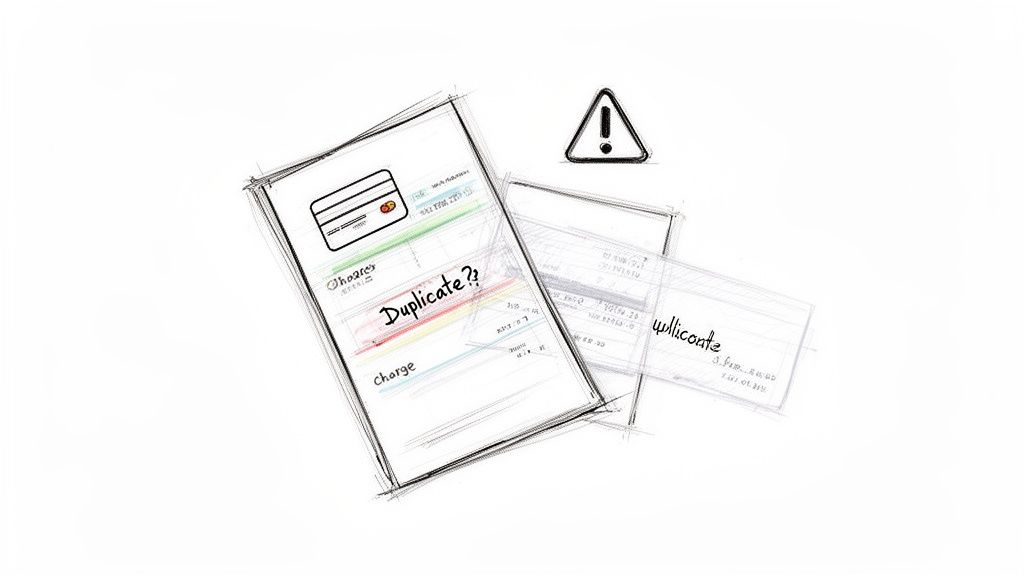
While less malicious than true fraud, these disputes directly impact customer trust and can be costly. For subscription and SaaS businesses managing complex billing cycles, billing errors can account for 10-15% of all disputes. They are often preventable and, if caught early through alerts, can typically be resolved with a simple refund before escalating to a chargeback.
Common Scenarios for Billing Errors
Billing-related disputes can arise from various technical and procedural missteps, leading to customer frustration and one of the more avoidable reasons for disputing a charge.
- System Glitch: A technical error in your payment gateway or billing system processes the same transaction multiple times. This can happen if a customer clicks the "submit" button more than once due to a slow-loading page.
- Post-Cancellation Charge: A customer cancels their subscription, but a charge is still processed in the following billing cycle due to a delay or error in updating the customer's status.
- Incorrect Amount: The customer is charged an amount different from what was advertised or agreed upon. For example, a SaaS customer is billed for both their old and new plan after an upgrade.
- Failed Payment Retry Logic: Automated retry logic for a failed payment attempts the charge multiple times, and several of these attempts end up posting successfully, leading to multiple debits.
Actionable Strategies for Prevention and Response
Preventing billing errors requires robust systems and clear communication, while the best response is often a quick refund to preserve the customer relationship.
Prevention Tactics:
- Implement Idempotency: Use unique transaction IDs to prevent your payment processor from processing the same order request more than once, even if it's received multiple times.
- Send Itemized Invoices & Confirmations: Dispatch clear, detailed invoices and receipts for every transaction. For cancellations, send an immediate confirmation email explicitly stating that no further charges will occur.
- Provide Billing Transparency: Your customer portal should prominently display the next billing date, the exact amount to be charged, and a clear history of past payments.
- Automate Billing Stops: Ensure your cancellation process is fully automated, triggering an immediate stop to all future billing for that account. This removes the risk of human error.
- Set Up Monitoring Alerts: Configure your system to flag multiple charge attempts from the same IP address, customer ID, or card number within a very short timeframe for manual review.
Response & Recovery: The vast majority of duplicate charge and billing error disputes are legitimate customer complaints. Using an alert service to intercept the dispute allows you to issue an immediate refund, which is almost always the correct action. Fighting these disputes is rarely successful and can damage your reputation. Instead, focus on identifying the root cause of the error to prevent it from happening again.
Key Insight: Proactive system audits and transparent communication are your best defense against billing error disputes. Instead of focusing on winning the dispute, focus on fixing the operational flaw that caused it. This protects both your revenue and your customer relationships. For guidance on identifying these issues, learn how to conduct a chargeback audit and strengthen your billing processes.
3. Product Not Received
A "Product Not Received" dispute is one of the most tangible reasons for disputing a charge from a customer's perspective. It occurs when a cardholder pays for goods but claims they never arrived. For ecommerce and direct-to-consumer (DTC) brands that rely on physical fulfillment, this dispute type is a constant operational challenge, directly tying revenue to the performance of third-party shipping carriers and the accuracy of fulfillment processes.
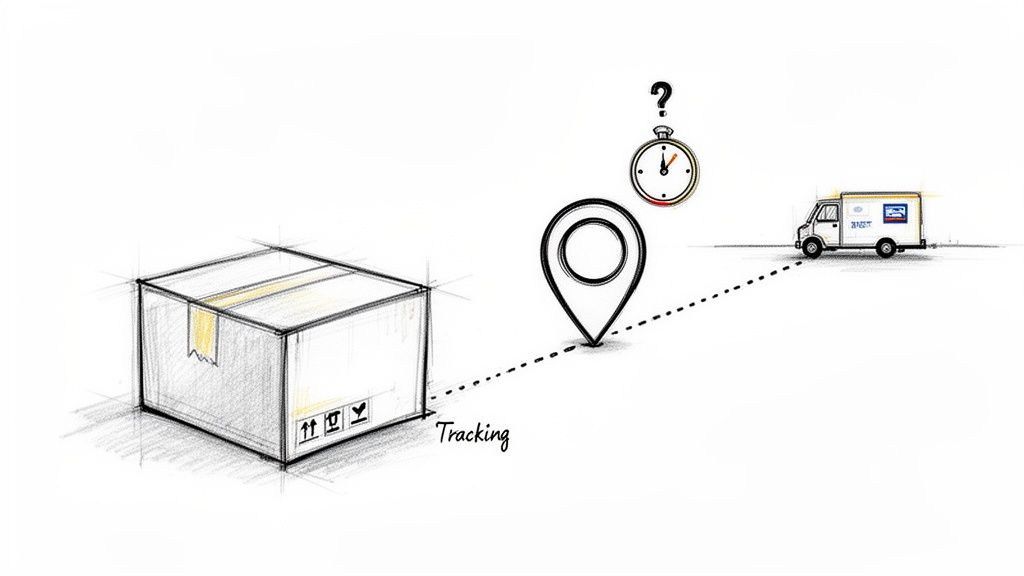
This issue typically arises 7 to 30 days post-transaction, once the customer’s patience runs out. It can account for 15-20% of all chargebacks a merchant faces. The root cause can range from legitimate lost packages and carrier errors to "porch piracy" or even intentional friendly fraud where a customer claims non-delivery despite receiving the item.
Common Scenarios for Non-Receipt Claims
Disputes over non-delivery often stem from a breakdown somewhere in the shipping and fulfillment chain. Understanding these scenarios is key to building a resilient process.
- Carrier Delivery Error: A shipping carrier marks a package as "delivered," but it was left at the wrong address, in an unsecured location, or was never actually dropped off.
- "Porch Piracy" or Theft: The package is correctly delivered to the customer’s doorstep but is stolen before the customer can retrieve it.
- Shipping Delays: An international shipment gets stuck in customs, or a domestic package is delayed in transit, causing the customer to lose patience and file a dispute before it arrives.
- Incorrect Address Entry: The customer enters an old or incorrect shipping address during checkout, causing the package to be misdelivered. The merchant is often held responsible.
Actionable Strategies for Prevention and Response
The key to mitigating these disputes is proactive communication and irrefutable proof of delivery. A strong defense is built long before the chargeback is ever filed.
Prevention Tactics:
- Utilize Tracked Shipping: Always use shipping methods that provide detailed, step-by-step tracking information. For orders over a certain threshold (e.g., $100), make signature confirmation mandatory.
- Automate Shipping Communications: The moment a shipping label is created, send the customer an email and/or SMS with the tracking number and a direct link to the carrier's portal. Provide updates at key milestones: shipped, in transit, and out for delivery.
- Verify Addresses at Checkout: Implement an Address Verification System (AVS) to catch typos and formatting errors in real-time. This simple step can prevent a significant number of misdeliveries.
- Set Clear Expectations: For international shipments or during peak seasons, clearly communicate potential delays on your product pages, at checkout, and in order confirmation emails. Managing expectations upfront can prevent premature disputes.
Response & Recovery: When you receive a non-receipt claim, your immediate goal is to prove delivery. Chargeback alerts from services like Ethoca and Verifi can give you a crucial window to provide the customer with tracking information or offer a replacement, potentially preventing the dispute from escalating. If you fight the chargeback, your compelling evidence must include the shipping date, the tracking number, the full delivery address provided by the customer, and a carrier confirmation showing the date, time, and location of delivery.
Key Insight: For "Product Not Received" disputes, the proof of delivery is your single most important asset. The more detailed your tracking and delivery confirmation, the stronger your representment case. Documentation like a signature or a photo of the package at the delivery location can make the difference between a won and lost dispute.
4. Service Not Rendered / Service Quality Issues
A dispute for services not rendered or of poor quality arises when a customer claims they did not receive a service they paid for, or that the service failed to meet the promised standards. This is one of the most challenging reasons for disputing a charge, especially for SaaS, subscription, and digital service businesses, as the "delivery" is intangible and quality is often subjective.
Unlike a dispute over physical goods where shipping and delivery can be tracked, service disputes hinge on proving access, usage, and adherence to agreed-upon terms. This category is particularly prevalent in the digital and subscription economy, where a customer might dispute a charge claiming a platform was down, a promised outcome wasn't achieved, or features were not as advertised. Industry estimates suggest these disputes can represent 20-25% of all chargebacks.
Common Scenarios for Service-Related Disputes
Service quality disputes can originate from a simple misunderstanding or a genuine failure to deliver, making clear communication and documentation essential.
- Failure to Deliver: A customer pays for a one-time website design service, but the agency fails to complete key deliverables outlined in the contract.
- Substandard Quality: A user subscribes to a fitness app promising personalized workout plans but receives only generic, non-customized routines.
- Service Unavailability: A SaaS customer disputes their monthly subscription fee, claiming the platform experienced significant downtime during a critical business period, violating the uptime guarantee.
- Outcome Not Met: A client disputes a charge for a digital marketing service, arguing that the promised traffic or lead generation targets were not achieved.
- Misrepresented Amenities: A customer books a hotel room through a travel site and disputes the charge, claiming the advertised amenities like a pool or Wi-Fi were unavailable or not functional.
Actionable Strategies for Prevention and Response
Preventing service disputes requires setting crystal-clear expectations, while responding effectively relies on comprehensive documentation of the service provided.
Prevention Tactics:
- Create Detailed Terms of Service (TOS): Your TOS and Service Level Agreements (SLA) must explicitly define what the service includes and excludes. Specify deliverables, performance metrics, uptime guarantees, and support response times.
- Document Service Milestones: For project-based services, use a system to document all milestones with timestamps, deliverables, and client sign-offs. For subscriptions, log user activity to prove the service was accessed and used.
- Maintain Proactive Communication: Send regular progress updates, performance reports, or usage summaries to customers. For SaaS platforms, send monthly emails that highlight the value delivered, such as "You used X feature to achieve Y result."
- Implement Clear Onboarding: Create an onboarding process that documents the customer has successfully gained access to the service and understands how to use it. This creates a record of initial service delivery.
Response & Recovery: When a service-related dispute arises, your ability to win depends on the quality of your evidence. Utilizing alerts from networks like Ethoca and Verifi can provide a crucial window to offer a service credit or partial refund before the issue escalates into a formal chargeback. If you decide to fight the dispute, gather all service agreements, login records, usage logs, customer support communications (emails, chat logs), and any documentation showing the customer's acceptance of deliverables.
Key Insight: For service-based businesses, proof of customer engagement is your most powerful evidence. Demonstrating that the customer logged in, used features, or interacted with your support team can effectively counter a claim that the service was not rendered or accessible. For more guidance on handling these complex cases, you can explore detailed resources to improve your customer support interactions and prevent disputes.
5. Refund Not Received / Cancelled Transaction
This dispute reason, also known as "Credit Not Processed," arises when a customer claims they were promised a refund or cancelled a service but never received the credited funds to their account. It's a dispute rooted in operational breakdowns or communication gaps and is particularly prevalent in ecommerce with physical returns and subscription businesses managing cancellations.
For merchants, this type of dispute is especially frustrating because the intent to refund was often present, but a failure in process led to the chargeback. This category can account for 8-12% of all disputes and highlights a direct disconnect between customer service promises and financial execution. The delay between the refund request and the dispute, typically 15-45 days, gives merchants a window for resolution, but only if their systems are efficient.
Common Scenarios for Refund/Cancellation Disputes
These disputes almost always stem from an error or delay in the merchant’s internal refund workflow. Understanding the common failure points is the first step to preventing them.
- Delayed Processing: A customer returns a product, receives confirmation of its arrival, but the finance team takes too long to process the refund, leading the customer to lose patience and file a dispute.
- System Glitches: A refund is initiated in the merchant's system but gets stuck or fails within the payment processor's queue without alerting the merchant. The customer sees no credit and assumes it was never sent.
- Subscription Cancellation Errors: A customer cancels their recurring subscription through a self-service portal, but the system fails to trigger an immediate prorated refund or stop the next billing cycle.
- Communication Breakdown: A customer service agent approves a refund via email, but the request is lost or never forwarded to the person or department responsible for processing it.
- Incorrect Refund Destination: The refund is sent to the original payment card, but the customer has since closed that account or been issued a new card, causing the funds to be lost in transit.
Actionable Strategies for Prevention and Response
Preventing these disputes requires robust internal processes and clear, proactive communication. Responding successfully depends on immaculate record-keeping.
Prevention Tactics:
- Automate Refund Workflows: Create a systematic, trackable workflow for all refund requests. When a return is received or a cancellation is confirmed, the refund process should be triggered automatically or with a single-click approval.
- Communicate Timelines Explicitly: Send an immediate email acknowledging the refund request and clearly state the expected timeline (e.g., "You will see the funds back in your account in 5-7 business days").
- Process Refunds Promptly: Aim to process all approved refunds within 24-48 hours. The faster the funds are returned, the lower the chance of a customer-initiated dispute.
- Send Multiple Confirmations: Dispatch one email when the refund is requested and another, more detailed confirmation the moment it has been processed. Include the refund amount and the transaction ID.
- Use Native Refund Features: Always process refunds directly through your payment processor’s platform (e.g., Stripe, Shopify Payments). This creates a clear digital trail linking the refund directly to the original transaction.
Response & Recovery: When you receive a dispute for a refund not processed, your ability to win depends entirely on your documentation. If you have already processed the refund, provide the acquiring bank with the refund transaction ID, the date and time of processing, and the amount. Screenshots from your payment processor dashboard showing the completed credit are powerful evidence. If the refund had not yet been processed, it is often best to accept the dispute and analyze the internal failure that caused the delay.
Key Insight: Transparency is your best defense against "Credit Not Processed" disputes. A customer who is kept informed about their refund status is far less likely to resort to a chargeback. Automating status updates and processing confirmations transforms the refund experience from a point of friction into an opportunity to build trust.
6. Merchandise Defective or Not as Described
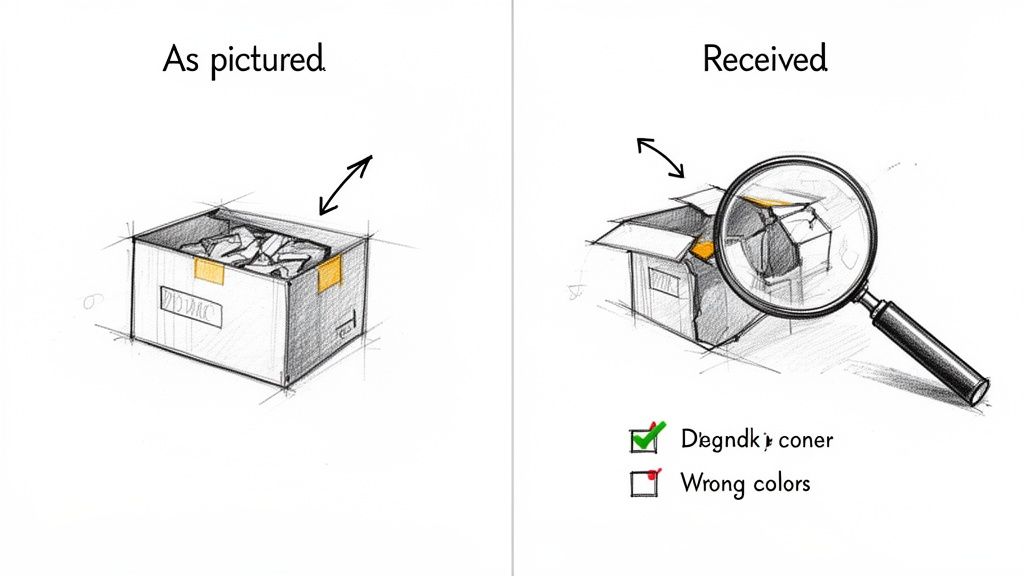
A “Merchandise Defective or Not as Described” dispute happens when a customer claims the product they received is damaged, faulty, or significantly different from how it was advertised. This is one of the most common reasons for disputing a charge in ecommerce, particularly for direct-to-consumer (DTC) brands, as it stems from a mismatch between customer expectations and the reality of the product.
This type of dispute is highly subjective and can account for 12-18% of all chargebacks a merchant receives. Root causes range from genuine quality control failures and shipping damage to misleading product photos or descriptions that create unrealistic expectations. For merchants, these disputes not only result in lost revenue and product but can also damage brand reputation if not handled properly.
Common Scenarios for Product-Related Disputes
These disputes can arise from various points in the customer journey, from product representation on your site to the final unboxing experience:
- Quality Discrepancy: A customer orders a piece of clothing that appears to be made of high-quality fabric online, but the item that arrives has visible stitching defects and feels cheap.
- Damage in Transit: An electronics item is shipped without adequate padding and arrives with a cracked screen protector or a bent case, rendering it defective upon arrival.
- Counterfeit Goods: A customer purchases what they believe is a branded product but receives a counterfeit or knockoff version of inferior quality.
- Inaccurate Representation: A supplements company shows vibrant, perfectly formed pills in its product photos, but the customer receives pills that are a different color and size, leading them to question authenticity.
- Missing Components: A product arrives with a key component broken or missing, and replacement parts are not included or readily available.
Actionable Strategies for Prevention and Response
Preventing these disputes hinges on transparency and accuracy, while responding requires clear documentation of your product and policies.
Prevention Tactics:
- Use High-Fidelity Visuals: Provide high-quality photos from multiple angles and lighting conditions. Include size comparisons, scale references, and even unboxing videos to show exactly what the customer will receive.
- Write Honest, Detailed Descriptions: Clearly state product materials, dimensions, specifications, and any known limitations. For supplements, including a Certificate of Analysis (COA) can build significant trust.
- Document Quality Control: Maintain and document your pre-shipment product inspection procedures. This creates a paper trail proving the item was in good condition when it left your facility.
- Offer Hassle-Free Returns: Implement an easy, clear return policy for quality concerns. A customer who knows they can easily get a refund is far less likely to file a chargeback.
Response & Recovery: When a customer reports an issue, respond immediately. Use chargeback alerts from services like Ethoca and Verifi to intercept the complaint and offer a resolution, such as a replacement or refund, before it escalates. If you must fight the dispute, your evidence should include the detailed product description from your website, high-quality images from the product page, and any proof of your quality control process. If the customer contacted you prior to the dispute, include that communication log to show your willingness to resolve the issue.
Key Insight: For "not as described" disputes, the burden of proof is on you to show that your product page was an accurate and honest representation of the item. The more detailed and transparent your listings are, the stronger your defense will be against these subjective claims.
7. Subscription / Recurring Billing Disputes
A recurring billing dispute arises when a customer contests a charge from a subscription service, claiming they cancelled, didn't agree to auto-renewal, or were unaware of ongoing payments. This is a critical and distinct reason for disputing a charge, especially for SaaS, streaming, and subscription box businesses. Unlike one-time purchases, the "set it and forget it" nature of subscriptions often leads to customer memory lapses and confusion.
This dispute category is a major pain point for merchants with recurring revenue models. It can represent between 15% and 22% of all disputes for these businesses, placing them at high risk of entering chargeback monitoring programs from Visa and Mastercard. The core of the issue often lies in a communication gap between the merchant's billing cycle and the customer's expectations.
Common Scenarios for Recurring Billing Disputes
Subscription-related disputes are often rooted in perceived lack of control or transparency from the customer's perspective:
- Trial Conversion Surprise: A customer signs up for a free or discounted trial and is surprised by the first full-price charge, claiming they only wanted the trial period.
- Cancellation Processing Lags: A customer sends a cancellation request, but it isn't processed before the next billing date, leading to a charge they believe is invalid.
- Third-Party Cancellations: A customer cancels a service through a third-party platform, like the Apple App Store or Google Play, but the merchant's system continues to bill their card directly.
- "Hard-to-Cancel" Frustration: A customer feels the cancellation process is intentionally obscure or difficult and resorts to a chargeback as the easiest way to stop payments.
- Forgotten Subscriptions: A customer signs up for a service, uses it infrequently, and forgets about the recurring charge until it appears on their statement months later.
Actionable Strategies for Prevention and Response
The key to mitigating these disputes is proactive communication and making the customer feel in complete control of their subscription.
Prevention Tactics:
- Use Explicit, Unambiguous Consent: Your checkout page must clearly state the subscription terms, including the renewal amount and frequency. Never use pre-checked boxes for recurring billing authorization.
- Provide Simple Cancellation: Offer a clear, prominent, and easy-to-find cancellation option within the customer's account dashboard. The process should take no more than one or two clicks.
- Send Pre-Billing Reminders: Dispatch an email notification 3-7 days before each recurring charge. This email should detail the amount, billing date, and provide a direct link to manage or cancel the subscription.
- Monitor Third-Party Signals: If your service is offered through app stores, monitor for cancellation signals from those platforms and proactively stop direct billing to prevent disputes.
- Confirm Cancellations Instantly: Process cancellation requests within 24 hours and send an immediate confirmation email to the customer, so they have a record that their request was received and acted upon.
Response & Recovery: When a subscription dispute is filed, it's often a sign of a frustrated customer. Using alert systems like Visa's RDR and Mastercard's CDRN is exceptionally effective here. These tools can notify you of a pending dispute, giving you a chance to issue a refund and cancel the subscription before it becomes a damaging chargeback, helping to retain the customer relationship. If you fight the dispute, provide clear evidence of the initial sign-up authorization (with IP address and timestamp), proof of pre-billing reminder emails, and records showing the customer accessed the service.
Key Insight: For recurring billing disputes, transparency is your best defense. Every communication, from the initial signup page to pre-renewal emails and cancellation confirmations, builds a record of clear consent and empowers the customer, reducing their likelihood of filing a chargeback.
7-Point Charge Dispute Comparison
| Item | 🔄 Implementation complexity | ⚡ Resource requirements | 📊 Expected outcomes | 💡 Ideal use cases | ⭐ Key advantages |
|---|---|---|---|---|---|
| Unauthorized Transaction | High — forensic investigation, long timelines | High — order logs, IP/device fingerprints, 3DS | High impact; 35–40% of disputes; winnable with strong docs | Fraud-prone ecommerce, subscription billing | Strong fraud reduction with 3DS/CVV and early alerts |
| Billing Error / Duplicate Charge | Low–Medium — fixable system/process changes | Medium — billing reconciliation, automation alerts | Moderate impact; 10–15% of disputes; 70–80% win rate | Subscription platforms, complex billing cycles | Easy wins via clear invoices, automated duplicate detection |
| Product Not Received | Medium — reliant on carrier data and proof | Medium — tracked shipping, signature capture, notifications | Significant; 15–20% of disputes; 80%+ winnable with tracking | High-volume ecommerce, DTC, international shipping | High defendability with tracking and signature confirmation |
| Service Not Rendered / Quality Issues | High — subjective evidence and timelines | Medium–High — usage logs, SLAs, support records | Notable; 20–25% of disputes; 60–70% winnable with docs | SaaS, subscriptions, digital services | Mitigatable with SLAs, usage metrics, documented milestones |
| Refund Not Received / Cancelled Transaction | Low — process and communication improvements | Low–Medium — refund workflow, processor integration | Lower impact; 8–12% of disputes; 75%+ win rate if proof exists | Ecommerce returns, subscription cancellations | Rapid resolution with refund logs and timely customer updates |
| Merchandise Defective / Not as Described | Medium — evidence collection and QC | Medium — photos, QC, returns process | Moderate; 12–18% of disputes; 60–70% winnable with photos | Product-heavy ecommerce, DTC brands | Preventable with realistic listings, photos, easy returns |
| Subscription / Recurring Billing Disputes | High — compliance + fast cancellation handling | High — clear consent, billing dashboard, reminders | High risk; 15–22% (subscription businesses); 70–80% winnable with auth | SaaS, membership, auto-renew services | Reduces monitoring risk with explicit consent, easy cancels and pre-bill reminders |
From Defense to Offense: Building a Proactive Dispute Strategy
Understanding the various reasons for disputing a charge is more than just a defensive exercise; it's the foundation of an offensive strategy that transforms your entire customer experience and protects your bottom line. Throughout this guide, we've dissected the most common dispute triggers, from clear-cut fraud to nuanced issues like product-not-as-described and recurring billing confusion. Each reason serves as a direct signpost, pointing to a specific weakness or opportunity within your business operations.
A duplicate charge, for instance, isn't just a chargeback to fight; it's a signal to review your payment gateway's API or your manual billing processes. A dispute over a canceled subscription highlights a need for a more transparent, user-friendly cancellation flow. By viewing these disputes as data points rather than just financial penalties, you can begin the crucial shift from a reactive to a proactive mindset. This approach moves your focus from merely winning chargebacks to preventing them entirely, which is the ultimate goal.
Key Takeaways: From Insights to Action
Mastering dispute management requires a two-pronged approach. First, you must have a rock-solid system for collecting and presenting compelling evidence when a dispute is unavoidable. Second, and more importantly, you must use the insights from every dispute to build a more resilient, customer-centric business.
Here are the most critical takeaways to implement immediately:
- Clarity is Your Best Defense: The root of many non-fraud disputes, such as unrecognized charges or subscription confusion, is a lack of clarity. Ensure your billing descriptors are crystal clear, your terms of service are easily accessible, and your communication regarding shipping, delivery, and recurring payments is proactive and unambiguous.
- Documentation is Non-Negotiable: For every transaction, your goal should be to create an unassailable record. This includes delivery confirmations with photographic evidence, IP logs, device information for digital goods, and clear customer communications like order confirmations and shipping updates. This evidence is your primary weapon in a representment case.
- Proactive Alerts are a Game-Changer: Waiting for a chargeback to hit your merchant account is a losing strategy. Implementing real-time alert systems from Visa (RDR), Mastercard (CDRN), and Ethoca is essential. These tools give you a critical window to resolve an issue directly with the customer or issue a refund before the dispute officially becomes a chargeback, protecting your dispute ratio and avoiding hefty fees.
Your Next Steps: Building a Dispute-Resilient Business
The true value in understanding the common reasons for disputing a charge lies in its power to drive strategic improvement. Don't just file this information away. Use it to conduct a comprehensive audit of your customer journey, from the moment they land on your site to the post-purchase follow-up.
Ask yourself and your team:
- Where are our communication gaps?
- Could our product descriptions be more precise to prevent "not as described" claims?
- Is our returns and refund policy not only fair but also prominently displayed and easy to understand?
- How can we make it easier for customers to contact us directly before they contact their bank?
By tackling these questions, you transition from playing defense against individual disputes to building an offensive strategy that strengthens customer loyalty, reduces revenue loss, and safeguards your merchant account. This isn't just about managing a business problem; it's about building a better, more trustworthy brand that customers value. Your efforts here will pay dividends far beyond simply lowering your chargeback rate.
Tired of reacting to chargebacks after the damage is done? Disputely integrates directly with alert networks like RDR and Ethoca, allowing you to intercept and resolve up to 99% of customer issues before they become costly chargebacks. Visit Disputely to see how you can shift from a defensive posture to a proactive, profit-protecting strategy today.


