
7 Essential Rebuttal Letter Examples to Win Chargebacks in 2026
Chargebacks are a costly reality for ecommerce and subscription merchants, eroding profits and threatening payment processing relationships. A single poorly handled dispute can cascade into higher processing fees or even account termination. Effectively managing this process is a core component of your financial operations, directly impacting both your accounts payable and accounts receivable ledgers. Winning a dispute isn't just about having the right evidence; it's about presenting it clearly and persuasively in a compelling rebuttal letter.
This guide provides seven battle-tested rebuttal letter examples, each broken down with strategic analysis, actionable takeaways, and a behind-the-scenes look at the specific evidence that persuades issuing banks. We will explore how to structure your response for different dispute reasons, from 'product not received' and 'friendly fraud' to complex subscription cancellations.
You will learn to craft responses that are impossible for issuers to ignore. We will also cover how using a real-time alert system like Disputely can provide a crucial 24-72 hour window to resolve customer issues before they escalate into damaging chargebacks. By mastering the art of the rebuttal, you can significantly improve your win rate, protect your revenue, and maintain a healthy relationship with your payment processor. Let's dive into the examples that will help you turn disputes into recovered revenue.
1. Transaction Documentation & Order Fulfillment Rebuttal
This rebuttal is the cornerstone defense against two of the most common dispute reasons: "Product Not Received" and certain types of "Transaction Not Recognized" or friendly fraud. It functions as a direct, evidence-based response proving a legitimate transaction occurred and you fulfilled your end of the bargain by successfully delivering the goods or services. Its strength lies in compiling undeniable, third-party proof that leaves no room for ambiguity.
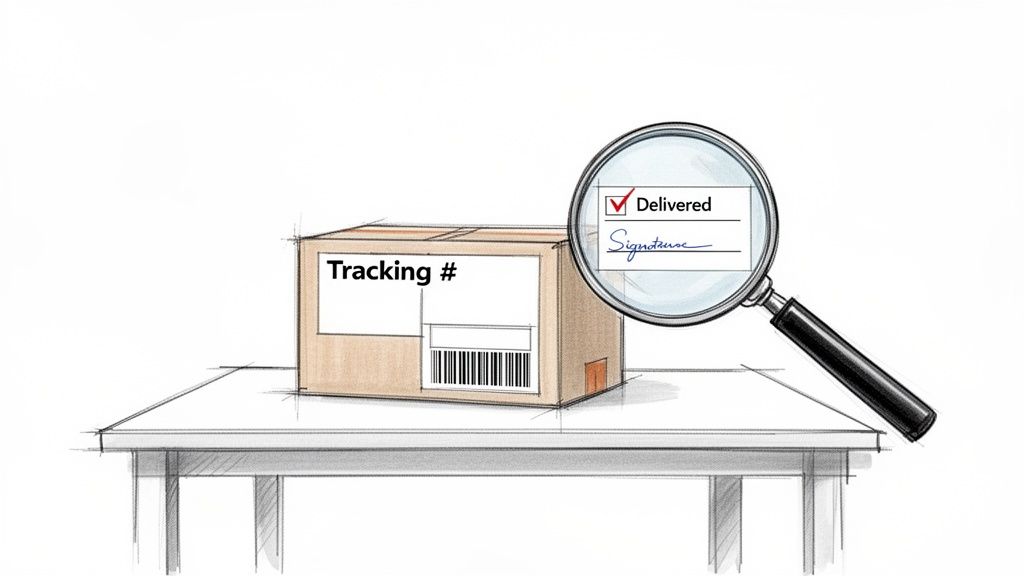
When a customer disputes a charge, the card issuer temporarily sides with them. Your job is to present a compelling case with clear, sequential evidence that methodically walks the bank through the entire transaction lifecycle, from purchase to delivery. This is one of the most essential rebuttal letter examples for any ecommerce merchant to master.
When to Use This Rebuttal
This template is your primary tool for disputes where the customer's claim directly contradicts your fulfillment records.
- "Product/Service Not Received" Claims: The customer states they never got their item. Your goal is to prove delivery.
- "Transaction Not Recognized" Claims: Often a form of friendly fraud where the customer did make the purchase but later forgot or denies it. Providing order and delivery evidence linked to their information refutes this.
- High-Ticket Item Disputes: For expensive products, this rebuttal is non-negotiable. It requires robust evidence like signature confirmation to protect significant revenue.
Crafting a Winning Rebuttal: Key Evidence to Include
Your rebuttal letter should be a concise summary, with the real power lying in your attached documentation. Organize your evidence to tell a clear story.
Transaction & Authorization Proof:
- Customer IP Address: Show the IP address used for the order and its geolocation.
- AVS & CVV Match: Include proof of a successful Address Verification System (AVS) and Card Verification Value (CVV) match.
- Device & Browser Information: Document the device type (e.g., iPhone 14) and browser (e.g., Chrome) used to place the order.
Order Fulfillment & Delivery Evidence:
- Shipping Confirmation Email: A screenshot of the email sent to the customer with the tracking number.
- Carrier Tracking Information: A direct link or screenshot from the carrier's (FedEx, UPS, USPS) website showing the tracking history.
- Proof of Delivery (POD): This is your most critical evidence. It should show the "Delivered" status, date, time, and the full delivery address that matches the AVS-verified address. For high-value orders, a customer signature is crucial.
Customer Communication & Account History:
- Order Confirmation: Include the initial order confirmation email or receipt.
- Prior Communications: Any emails or chat logs where the customer discussed the order, asked questions, or expressed satisfaction.
- Account History: If applicable, show a history of previous successful orders delivered to the same address.
Strategic Insight: The goal is to create an "evidence package" that makes it logically impossible for the bank to side with the cardholder. By matching the IP address to the delivery city and the AVS match to the delivery address, you create a tight, verifiable link between the person who paid and the person who received the goods. Using a service like Disputely can help automate the collection and formatting of this evidence, ensuring nothing is missed.
2. Subscription Billing Authorization & Recurring Charge Rebuttal
This rebuttal defends recurring charge disputes where customers claim they never authorized ongoing payments or simply forgot they had an active subscription. It leverages explicit consent records, proactive billing notices, and clear usage data to demonstrate compliance with Visa and Mastercard regulations on recurring transactions.
Recurring billing disputes can quietly erode your monthly revenue if left unchecked. This template equips SaaS and subscription merchants to assemble an airtight case that protects your MRR and reinforces your billing practices under card network rules.
Examples of Successful Implementation
- SaaS platforms retaining click-through logs showing users agreed to recurring billing
- Membership sites archiving email threads where customers reviewed renewal dates
- Nutraceutical subscription boxes attaching product and frequency disclosures to onboarding emails
- Digital service providers presenting login and usage data during the disputed period
When to Use This Rebuttal
Use this template for disputes that hinge on authorization or memory of recurring charges:
- Unauthorized Recurring Charge claims – Customer denies ever opting in
- Forgotten Subscription disputes – User forgot auto-renewal terms
- Membership Fee Disagreements – Gym, club or community site renewals
- Supplement/Membership Box Charges – Nutraceutical or beauty subscriptions
Crafting a Winning Rebuttal: Key Evidence to Include
Consent Documentation
- Click-wrap authorization screenshot capturing the opt-in checkbox
- Highlighted Terms and Conditions showing billing frequency
- Email confirmation logs with timestamps and subscription details
Pre-Charge Notices & Billing Transparency
- Monthly reminder emails sent 3–7 days before each charge
- Invoices or receipts specifying date, amount and auto-renewal terms
- UI captures of subscription settings in customer portal
Account Activity & Usage Evidence
- Login history and feature use during the disputed cycle
- Screenshots of active subscription dashboards or service usage logs
- Support tickets like password resets tied to the same account
Cancellation Process Documentation
- Proof of self-service cancellation link in emails or portal
- System logs showing no cancellation request before the charge
- Copy of refund and cancellation policy emailed at signup
Strategic Insight: By combining explicit consent proof with proactive billing reminders and actual usage data, you present an indisputable narrative. Disputely’s intelligent filtering flags subscription disputes early so you can build your evidence package before a chargeback escalates.
Actionable Tips
- Implement explicit dual-consent checkboxes rather than relying on pre-checked boxes
- Automate monthly billing reminders to reduce surprise charges
- Archive all consent and communication logs with a tool like Disputely
- Simplify cancellation so customers are less likely to dispute charges
- Audit signup and billing flows regularly for network compliance
Learn more about Subscription Billing Authorization & Recurring Charge Rebuttal on disputely.com
3. Customer Communication & Service Issue Resolution Rebuttal
This rebuttal is designed for disputes arising from subjective customer dissatisfaction, such as claims of poor service quality, unmet expectations, or incomplete service delivery. It shifts the focus from simple proof of delivery to demonstrating your good-faith efforts to communicate, address the customer's concerns, and fulfill your service agreements. Its strength lies in showcasing proactive and professional customer service, which can be a compelling counterargument to claims of merchant negligence or poor quality.
When a customer disputes a charge based on their experience, the card issuer looks for evidence that you, the merchant, upheld your terms and made reasonable attempts to resolve the issue. Your goal is to build a narrative supported by documented communication that proves you were responsive and acted professionally. This is one of the most critical rebuttal letter examples for service-based businesses, digital product sellers, and high-risk merchants where customer perception heavily influences satisfaction.
When to Use This Rebuttal
This template is your go-to response for disputes rooted in service quality rather than a complete failure of delivery.
- "Services Not as Described" Claims: The customer acknowledges receiving a service but claims it didn't meet the description. Your goal is to prove the service provided aligned with your terms and any attempts to remedy their specific complaints.
- "Defective Product" Claims (for intangible goods): In cases like digital courses or supplements, a customer might claim the product "didn't work." Your rebuttal should focus on the product provided and any support offered.
- "Credit Not Processed" Claims: The customer states they were promised a refund that was never issued. Your evidence must show communication logs about refund eligibility, or if a refund was denied in accordance with your policy.
Crafting a Winning Rebuttal: Key Evidence to Include
Your rebuttal letter must document your customer service efforts methodically. Organize your evidence to demonstrate responsiveness and fairness.
Terms of Service & Policies:
- Terms of Service/User Agreement: A screenshot showing the customer checked a box to agree to your terms during checkout.
- Refund/Cancellation Policy: A clear copy of the policy that was in effect at the time of purchase, proving the customer's claim is outside your stated terms.
- Service Level Agreement (SLA): For B2B or consulting services, provide the signed agreement outlining the scope of work.
Proof of Service Provision:
- For Digital Goods: Evidence of platform access, such as user login dates, IP addresses, and content download logs.
- For Services (e.g., travel, consulting): Booking confirmations, flight itineraries, proof of hours rendered, or project deliverables that match contractual terms.
- For Physical Goods (e.g., supplements): Proof of delivery combined with product batch numbers or quality control documentation.
Customer Communication Log:
- Initial Customer Complaint: Include the first email, chat log, or support ticket where the customer raised their issue.
- Your Responses: Provide timestamped evidence of your replies, demonstrating timely and helpful engagement. Show every attempt you made to understand and resolve the problem.
- Resolution Offers: Document any offers you made, such as a partial refund, store credit, or other remedies, and note the customer's response (or lack thereof).
Strategic Insight: The narrative you build is crucial. Frame the evidence to show that the customer's dispute is an attempt to bypass your clearly stated policies after you have already engaged with them in good faith. By documenting every interaction, you prove to the bank that a chargeback was not the customer's first or only resort, but an escalation after they failed to achieve a resolution outside of your agreed-upon terms. For merchants needing help organizing this documentation, you can learn more about our support process and how we assist in these cases.
4. Fraud & Identity Verification Rebuttal
This advanced rebuttal is your digital forensics toolkit against "Transaction Not Recognized" or true fraud claims where a stolen card was allegedly used. It moves beyond standard transaction details to present a sophisticated case built on modern fraud detection and identity verification data, proving the legitimate cardholder was present and in control of the transaction. Its power comes from weaving a compelling narrative using data points the cardholder cannot easily deny.

Unlike a simple fulfillment rebuttal, this response tackles the core of the fraud claim: identity. You are not just proving a package was delivered; you are proving it was the actual cardholder who initiated the purchase. This is one of the most powerful rebuttal letter examples for merchants who leverage modern security tools and need to protect themselves from sophisticated friendly fraud disguised as unauthorized use.
When to Use This Rebuttal
Deploy this evidence-heavy rebuttal for disputes where you have strong data pointing to the legitimate cardholder’s involvement.
- "Unauthorized Transaction" Claims: The customer claims they did not authorize the purchase, suggesting their card was stolen or used fraudulently.
- High-Risk Transactions: For orders flagged by your fraud systems that you approved after manual review, this evidence package justifies your decision.
- Digital Goods & Services: When there is no physical delivery to prove, digital evidence like IP logs, device fingerprints, and account history becomes your primary defense.
Crafting a Winning Rebuttal: Key Evidence to Include
Your goal is to build a profile of the user that overwhelmingly matches the legitimate cardholder's known digital and physical footprint.
Identity & Location Verification:
- IP Geolocation Match: Evidence showing the IP address used for the purchase matches the cardholder’s billing city and state.
- Device Fingerprinting: Data that shows the transaction was made from a device previously used by the customer to log in or make other purchases.
- Login & Account History: A log of successful account logins from the same IP address or device around the time of the transaction.
Authentication & Security Protocols:
- 3D Secure (3DS) Authentication: Proof of a successful 3DS challenge (e.g., a code sent to the cardholder's phone). This shifts liability for the fraud to the issuing bank.
- Multi-Factor Authentication (MFA): Documentation that the user successfully completed an MFA step, such as an SMS code or email confirmation link, during checkout or login.
- AVS & CVV Results: Reiterate the successful AVS and CVV matches as foundational security checks.
Customer Behavior & History:
- Past Order History: A record of previous, undisputed orders shipped to the same address or purchased from the same IP/device.
- Product Usage (for Digital Goods): For SaaS or digital products, show evidence of the customer logging in and using the service after the purchase.
- Consistent Information: Highlight that the customer name, email, phone number, and address used in the order are consistent with past transactions.
Strategic Insight: The core strategy is to connect the dots between the device, the location, the user account, and the payment information. By presenting evidence like a 3DS authentication or a history of logins from the same device, you make it extremely difficult for a cardholder to claim they were not involved. For merchants facing account holds due to fraud concerns, compiling this data is crucial. You can learn more about addressing these issues by understanding how to get a Shopify Payments hold released.
5. Digital Product & Instant Delivery Rebuttal
This rebuttal is specifically engineered for merchants who sell non-physical goods like software, e-books, digital courses, or subscriptions. It counters "Product Not Received" claims by replacing traditional shipping proof with concrete evidence of digital delivery and customer access. The core challenge is proving a customer received and could use an intangible product, and this response methodically builds that case using server logs, account activity, and IP data.
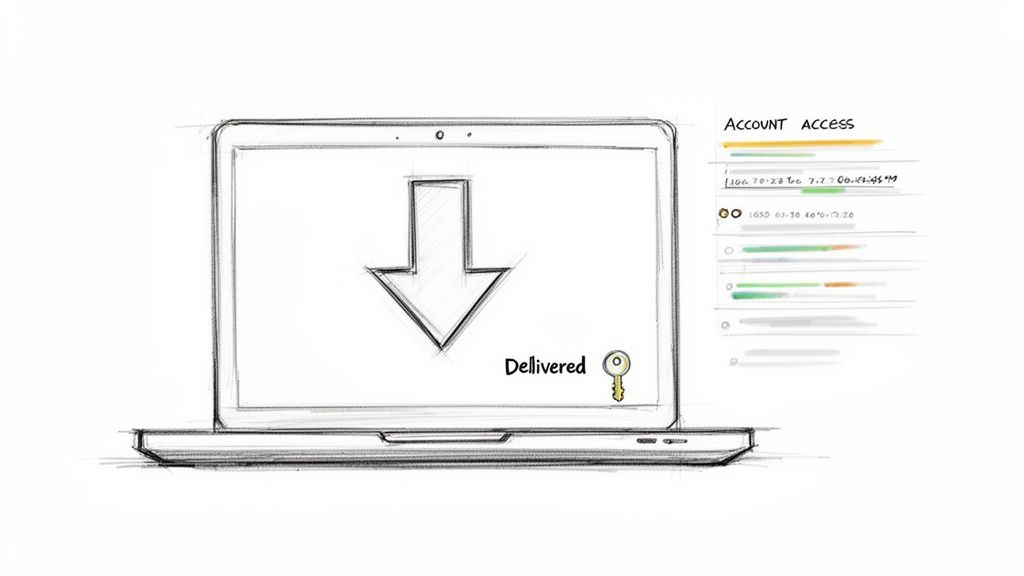
Unlike physical goods, there's no tracking number or delivery photo for a digital download. Therefore, your defense relies on creating a digital "paper trail" that proves fulfillment. This is one of the most critical rebuttal letter examples for SaaS, software, and e-learning businesses to perfect, as it directly protects their unique business model from friendly fraud.
When to Use This Rebuttal
This template is your essential defense whenever a dispute involves a product delivered electronically rather than physically.
- "Product/Service Not Received" Claims: The customer alleges they never received the download link, license key, or access to the service. Your goal is to prove it was sent and, ideally, accessed.
- "Transaction Not Recognized" Claims: A customer may forget a subscription or a one-off digital purchase. Evidence of account creation and usage tied to their information refutes this.
- SaaS & Subscription Disputes: For recurring charges, you can show a history of logins and service usage to validate the legitimacy of the ongoing billing relationship.
Crafting a Winning Rebuttal: Key Evidence to Include
Your rebuttal letter must tell a clear story of digital fulfillment. Organize your evidence chronologically from purchase to access.
Transaction & Authorization Proof:
- Customer IP Address & Geolocation: Match the IP address used at purchase to the customer's general location.
- AVS & CVV Match: Provide documentation of successful AVS and CVV security checks during the transaction.
- Purchase Device Information: Note the type of device and browser used to complete the purchase.
Digital Delivery & Access Evidence:
- Delivery Confirmation Email: A screenshot of the email sent to the customer containing the download link, license key, or account login credentials.
- Server or System Logs: This is your "proof of delivery." Show logs that document the customer's IP address downloading the file, activating the software key, or logging into their account.
- Account Creation & Usage Data: Provide screenshots of the customer's account profile showing the sign-up date, last login date, and any activity, such as courses viewed or features used.
Customer Communication & Terms:
- Order Confirmation: The initial receipt sent to the customer detailing the digital product purchased.
- Terms of Service Agreement: Proof that the customer agreed to your terms, which should outline your digital delivery and refund policies.
- Prior Support Interactions: Any emails or chats where the customer asked for help accessing their product, which proves they were aware of the purchase.
Strategic Insight: Your most powerful evidence is a log showing the disputing customer's IP address accessing the digital product after the purchase date. This creates a direct, undeniable link between the cardholder and the consumption of the product. Services like Disputely can help you quickly pull and format this digital evidence when a chargeback notice is received, ensuring you respond with the strongest case possible.
6. Refund & Return Policy Compliance Rebuttal
This rebuttal serves as a critical defense against "Product Not as Described" or "Credit Not Processed" disputes when you have acted entirely within your own publicly stated policies. It functions by proving the customer was made aware of your terms, agreed to them at the time of purchase, and either failed to follow the correct procedure or is making a request outside the policy's scope. Its effectiveness relies on meticulous documentation of your policy's visibility and the customer's acknowledgment of it.
When a customer disputes a charge because they are unhappy with your return or refund policy, the bank needs proof that this policy was clear, fair, and accessible before the transaction was completed. This response provides that proof, shifting the responsibility back to the cardholder who agreed to the terms. This is one of the most important rebuttal letter examples for businesses with strict or final-sale policies, such as those selling digital goods or custom products.
When to Use This Rebuttal
This template is your go-to response for disputes rooted in a disagreement over your established company policies.
- "Credit Not Processed" Claims: The customer was denied a refund because they were outside the return window, or the item was non-refundable, and they are disputing the charge to force the credit.
- "Product Not as Described/Defective" Claims: The customer is using this reason code to circumvent a return policy they dislike, especially if they never attempted to initiate a return through proper channels.
- Subscription Cancellation Disputes: A customer disputes a charge after their cancellation request came in past the billing cutoff date, as outlined in the terms of service they accepted.
Crafting a Winning Rebuttal: Key Evidence to Include
Your rebuttal letter should succinctly explain the situation, but the evidence you attach is what will win the case. Organize your documents to prove the policy was both visible and accepted.
Proof of Policy Visibility & Acceptance:
- Checkout Page Screenshot: A screenshot from the time of the transaction showing the return/refund policy linked or displayed clearly near the "Complete Purchase" button.
- Clickwrap Agreement Log: Evidence that the customer checked a box stating, "I have read and agree to the Terms of Service and Refund Policy."
- Policy Text: A copy of the exact policy in effect on the date of the customer's purchase.
Order & Communication Records:
- Order Confirmation Email: Include a screenshot of the confirmation email that contains or links to your return policy, proving it was sent to the customer post-purchase.
- Customer Service Communications: Provide any emails or chat logs where you explained the policy to the customer and denied their refund request, citing the specific terms.
- Return Attempt History: If the customer initiated a return and it was processed or denied according to policy, include this documentation.
Transaction Details:
- Customer IP Address & Geolocation: Match this data to the customer's billing information to confirm they are the one who made the purchase.
- AVS & CVV Match: Include this data as a foundational piece of evidence proving the transaction was legitimate.
Strategic Insight: The burden of proof is on you to demonstrate that the customer had every reasonable opportunity to understand your terms before paying. By documenting policy visibility at checkout and reinforcing it in post-purchase communication, you build a powerful case that the customer entered a binding agreement. Tools like Disputely are invaluable here, as they can automatically pull and attach timestamped policy evidence to your dispute response, ensuring accuracy and saving critical time.
7. Duplicate Charge & Processing Error Rebuttal
This rebuttal is a critical defense against claims of being charged multiple times for a single transaction or service period. It is designed to prove that each charge corresponds to a unique and legitimate order or that a genuine processing error was identified and corrected. For subscription businesses and high-volume merchants, mastering this response is essential for maintaining customer trust and preventing revenue loss from system glitches or customer misunderstanding.
Its strength lies in presenting meticulous transaction logs and reconciliation reports that clearly differentiate between separate orders or demonstrate that only one payment was successfully captured and settled, despite any initial authorization issues.
When a customer claims they were double-billed, the burden of proof falls on you to show otherwise. Your rebuttal must be an unambiguous, evidence-backed account of your payment processing, proving that either the charges were for separate, valid transactions or that any actual error was handled proactively and professionally. This is one of the most important rebuttal letter examples for businesses with recurring billing.
When to Use This Rebuttal
This template is your go-to response for any dispute involving claims of erroneous or multiple charges.
- "Duplicate Transaction" Claims: The customer alleges you charged them twice (or more) for the same item or service. Your goal is to show each transaction ID is unique or that only one was settled.
- "Incorrect Transaction Amount" (related): Sometimes a customer sees multiple authorization holds and mistakes them for final charges, leading to a dispute. This rebuttal clarifies the final, correct charge.
- Subscription Billing Confusion: A customer may not realize a previous month's failed payment was retried alongside the current month's charge, perceiving it as a duplicate.
Crafting a Winning Rebuttal: Key Evidence to Include
Your rebuttal letter must be supported by clear, indisputable data from your payment processor. Organize your evidence to illustrate the complete payment lifecycle for each disputed transaction.
Transaction & Reconciliation Proof:
- Separate Order IDs: For ecommerce, provide distinct order confirmations, invoices, and shipping details for each transaction to prove they were separate purchases.
- Payment Gateway Logs: Screenshots from your Stripe, PayPal, or Authorize.net dashboard showing unique transaction IDs for each charge, along with their authorization, capture, and settlement status.
- Processor Settlement Reports: Provide a settlement or batch report showing that only one of the alleged duplicate charges was actually transferred to your bank account.
Subscription & Service Period Evidence:
- Billing History: A screenshot of the customer's account dashboard showing the service period each charge corresponds to (e.g., "Invoice #123 for May," "Invoice #124 for June").
- Dunning & Retry Logs: If a charge was a retry of a previously failed payment, include communication records (dunning emails) and system logs showing the initial failure and subsequent successful retry.
Proactive Error Correction Evidence:
- Refund Transaction ID: If a genuine duplicate charge occurred and you refunded it, provide the transaction ID for the refund.
- Customer Communication: Include any emails or notifications you sent to the customer informing them of the error and the refund you issued before they filed the dispute.
Strategic Insight: The key to winning these disputes is demonstrating irrefutable control over your billing systems. By providing payment processor logs that link each charge to a unique authorization and settlement event, you prove the legitimacy of each transaction from a technical standpoint. For subscription businesses, clearly mapping each payment to a specific service period dismantles any claim of being charged twice for the same month. Using a service with real-time alerts can help you catch these errors and issue refunds before a dispute is ever filed, turning a potential chargeback into a positive customer service interaction.
Comparison of 7 Rebuttal Letter Examples
| Template | Implementation Complexity 🔄 | Resource Requirements ⚡ | Expected Outcomes 📊 | Ideal Use Cases 💡 | Key Advantages ⭐ |
|---|---|---|---|---|---|
| Transaction Documentation & Order Fulfillment Rebuttal | Medium–High — requires fulfillment integrations and timely assembly | Medium–High — shipping APIs, tracking, organized record-keeping | 📊⭐⭐⭐⭐ — Strongly reduces delivery/authorization disputes when docs complete | Ecommerce DTC, high-volume merchants, physical-goods retailers | ⭐Concrete delivery/tracking proof; automatable with alerts |
| Subscription Billing Authorization & Recurring Charge Rebuttal | Medium — consent management and audit trails needed | Medium — consent logs, billing history, pre-bill reminders | 📊⭐⭐⭐⭐ — Highly effective at preventing recurring-billing disputes | SaaS, memberships, subscription boxes | ⭐Demonstrates explicit authorization; reduces involuntary churn |
| Customer Communication & Service Issue Resolution Rebuttal | Medium — relies on disciplined CS workflows and documentation | Medium — ticketing system, response logs, refund/credit records | 📊⭐⭐⭐⭐ — Often prevents chargebacks by showing good-faith resolution | Service providers, travel, nutraceuticals, digital services | ⭐Shows responsiveness and attempts to resolve before chargeback |
| Fraud & Identity Verification Rebuttal | High — requires fraud-detection and identity systems | High — device fingerprinting, IP logs, MFA/3DS, analytics | 📊⭐⭐⭐⭐⭐ — Very effective defending unauthorized-transaction claims | High-risk merchants, high-ticket sales, subscription services | ⭐Persuasive identity/fraud signals; integrates with processors |
| Digital Product & Instant Delivery Rebuttal | Medium — needs reliable access logs and delivery timestamps | Medium — account logs, license activation, download records | 📊⭐⭐⭐⭐ — Strong when access/usage logs exist; immediate timestamps help | E-books, software/licenses, SaaS, digital courses | ⭐Instant delivery proof; easy to automate evidence collection |
| Refund & Return Policy Compliance Rebuttal | Low–Medium — policy display and consent capture processes | Low–Medium — checkout screenshots, confirmation emails, policy logs | 📊⭐⭐⭐ — Effective if policy was clearly disclosed at purchase | Retailers, subscription services with clear return rules | ⭐Proves policy compliance; deters bypassing return channels |
| Duplicate Charge & Processing Error Rebuttal | Medium — reconciliation and audit trails required | Medium — payment processor records, transaction logs, refund proof | 📊⭐⭐⭐⭐ — Effective at resolving technical/duplicate claims quickly | High-volume merchants, subscriptions, payment-heavy platforms | ⭐Shows transparency via reconciliation; enables proactive refunds |
From Reactive Defense to Proactive Prevention
Having explored the specific scenarios and detailed rebuttal letter examples—from transaction documentation disputes to subscription billing disagreements—it's clear that winning chargebacks is a science, not a game of chance. Each template we've dissected serves as more than just a pre-written response; it's a strategic blueprint built on the foundational principles of clarity, compelling evidence, and adherence to card network rules. Mastering these documents transforms your approach from a constant state of reactive damage control into a confident, proactive defense of your hard-earned revenue.
The core lesson woven through every example is that a successful rebuttal begins long before the dispute is ever filed. It starts with meticulous record-keeping, clear customer communication, and transparent policies. Whether it's proving delivery with detailed tracking information, demonstrating recurring billing authorization with customer sign-up records, or verifying an identity with AVS and CVV matches, the evidence you gather at the point of sale is your most powerful weapon.
Key Takeaways for Long-Term Success
To truly shift your chargeback management from a cost center to a strategic advantage, internalize these key takeaways:
- Evidence is Non-Negotiable: A rebuttal without concrete, compelling evidence is merely an opinion. Focus on gathering and organizing data like IP logs, shipping confirmations, customer service correspondence, and terms of service acceptance records.
- Clarity and Brevity Win: Issuing banks review hundreds of cases daily. Your rebuttal letter must be concise, professional, and easy to scan. Use bullet points, bold text, and a clear chronological narrative to guide the reviewer directly to the essential facts.
- Customize, Don't Copy-Paste: While the provided rebuttal letter examples are a powerful starting point, each dispute has unique nuances. Tailor every response to address the specific reason code and customer claim, demonstrating that you have thoroughly investigated the issue.
- Prevention is the Ultimate Goal: Winning a chargeback is good; preventing it from ever happening is better. A significant portion of disputes, especially those stemming from "friendly fraud" or buyer's remorse, can be avoided. This requires a deeper focus on the entire customer journey.
To truly shift from a reactive defense to proactive prevention, businesses must embrace strategies that address customer satisfaction and loyalty from the outset. This includes understanding how to stop losing customers through effective loyalty and retention programs, which can significantly reduce the likelihood of disputes arising from misunderstandings or poor service experiences.
The Proactive Pivot: Beyond Rebuttals
The ultimate strategy is to build an operational framework that minimizes dispute risk from the start. This involves robust fraud detection tools, transparent billing descriptors, accessible customer support, and fair, clearly-communicated return policies. However, even with the best practices in place, some disputes are inevitable.
This is where the power of early warning systems becomes critical. Services that provide real-time alerts from programs like Visa RDR and Mastercard CDRN act as a crucial buffer. They notify you of a customer's intent to dispute before it escalates into a formal, damaging chargeback. This gives you a vital window to issue a refund and resolve the customer's issue directly, thereby protecting your merchant account's health and avoiding steep chargeback fees.
By combining the powerful rebuttal strategies outlined in this guide with a forward-thinking, prevention-first mindset, you can take definitive control over your dispute management process. Stop letting chargebacks erode your profits and start building a resilient payment ecosystem that supports sustainable growth.
Ready to move from manually fighting chargebacks to proactively preventing them? Disputely integrates directly with your payment processor to provide real-time dispute alerts, allowing you to resolve issues before they become costly chargebacks. Explore how Disputely can automate your defense and protect your bottom line.


