
Account Under Review: What Merchants Should Do
Your Monday payout hasn't landed. Weekend card sales are still going through, so the money is clearly moving somewhere, and the status field on your dashboard says account under review. Nothing about the store feels different from last week. The first instinct is to refund the four open disputes so the numbers settle down and someone at the processor changes their mind.
That instinct is one of the most expensive moves in payments. An account under review is a risk workflow that can monitor your account, hold back settled funds, or block payouts entirely, and it often resolves without the account closing. The triggers behind it are measurable: dispute rates, transaction holds, and reserve durations all run on thresholds your processor sets, and crossing one is what flips the switch.
The phrase itself is the trap. It can stand for four different controls, each with a different remedy, and refunding a handful of disputes answers none of them. A reserve, the heaviest of the four, is a forward-looking decision about future losses, so no single evidence packet wins it back the way a chargeback response can.
What an Account Under Review Actually Means
The status appears on an account that is already live. An account under review is a monitoring and control status that your acquiring bank or processor applies to a merchant account that has already been approved and is still processing card payments. It isn't a support ticket, and it isn't a finding that the business is fake.
Airport security is the closest everyday parallel. Most travelers walk straight through. Some are pulled aside while their bags keep moving down the belt. A few are turned around entirely. The line hasn't changed. The level of attention on you has.
That attention follows a documented process. The Office of the Comptroller of the Currency's merchant processing handbook directs acquiring banks to review every merchant at onboarding for business validity, creditworthiness, and sales history, and to keep monitoring high-volume and high-risk merchants afterward, with review frequency and thresholds set by processing volume, industry risk, transaction concentration, and chargeback history.
The reason the review exists: your acquirer stands behind your sales. The same OCC guidance says acquirers may establish merchant reserve accounts or holdbacks to cover future losses from fraud, credit losses, refunds, and chargebacks. The status is how that obligation gets managed.
What this means practically is that approved charges aren't cancelled. Payments can keep processing while settled proceeds sit in a protected balance, or only the payout step is paused. A merchant who assumes the account is dead often stops shipping, which turns a temporary control into a real customer-service problem and a fresh wave of disputes. Keep fulfilling orders while you work out the control.
The useful question isn't "why me." It's which control is switched on, because monitoring, a reserve, a transaction hold, and a payout block don't share one remedy.
The Operating Changes That Trigger Scrutiny
One chargeback rarely starts this. A chargeback is a symptom. The trigger is a shift in your operating profile that raises what the processor might owe if orders don't ship or the company can't pay its bills.
Stripe's account review FAQ names the signals it watches: increased dispute activity, sharp processing-volume increases, high refund rates, long delivery or billing periods, and business-model or fulfillment risk. It also states that dispute rates above 0.75% are considered high risk.
The mechanism underneath all five is exposure. When you collect money before the customer receives anything, the processor holds an umbrella over refunds, disputes, and fees if fulfillment fails or you become insolvent. A merchant that ships same day from stock holds a small umbrella. A preorder business collecting in March for June delivery holds a large one.
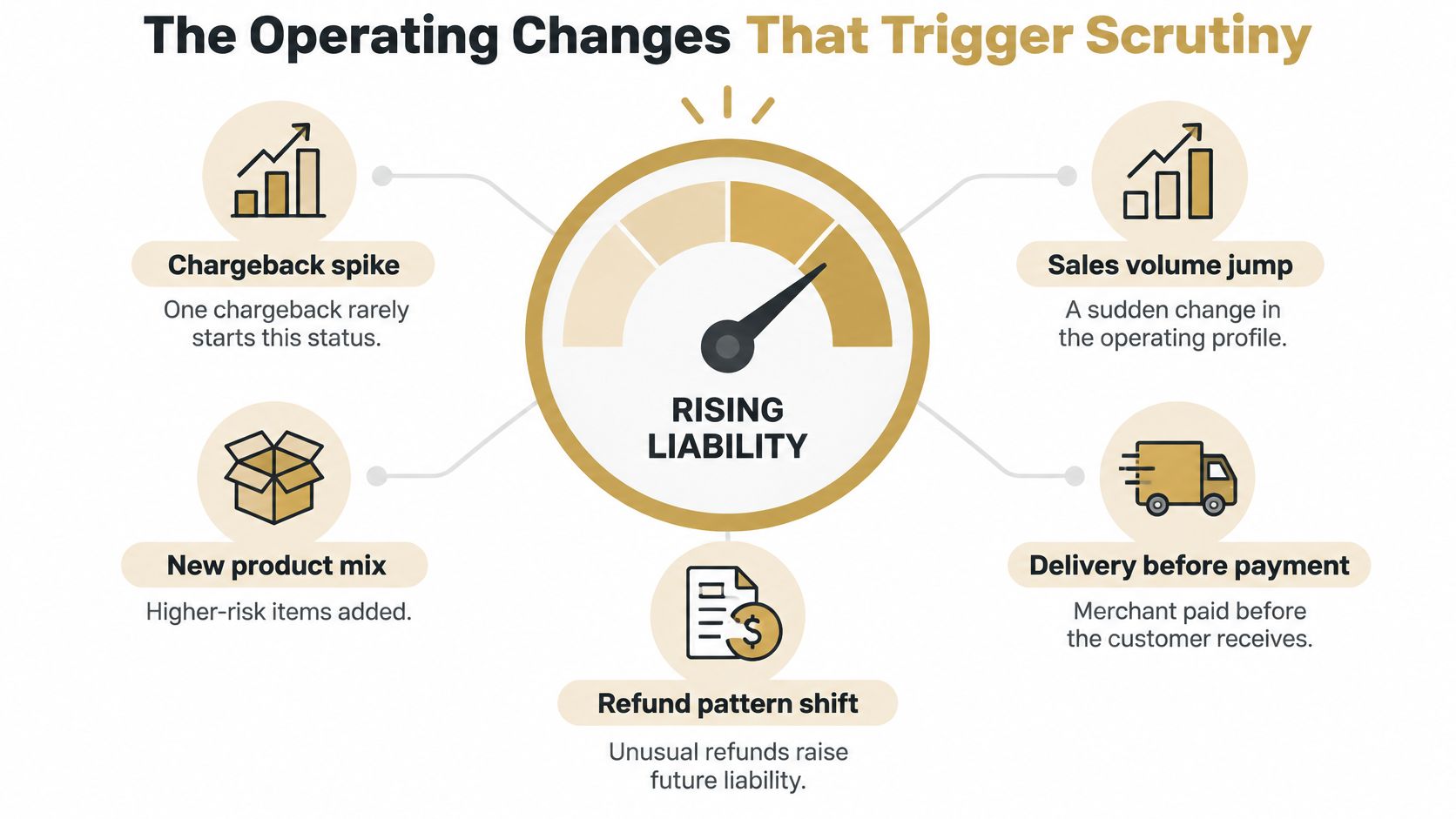
Five signals in merchant clothing
- Dispute activity above 0.75%. A SaaS company that bills annually and refunds heavily in month two of the term looks risky twice over, because the refund rate and the billing period both point at money held before service is delivered.
- A sharp volume jump. A supplement brand that doubles its daily processed volume in two weeks reads as unexplained growth until someone explains it, even if every order is legitimate and paid in full.
- A high refund rate. Refunding preemptively to avoid chargebacks can push this metric up while it pulls the dispute count down, which is one reason a blunt refund policy backfires.
- A long delivery or billing window. A 60-day preorder ship date is a long window by default. So is a subscription that collects twelve months of revenue on day one.
- Fulfillment or business-model risk. A new product category, a new supplier, or a shift from stocked goods to drop-ship changes who carries the fulfillment risk, and processors price that risk.
The processor may then ask for updated business, financial, processing-history, and fulfillment documentation. Depending on what those files show, it can impose a fixed or percentage reserve, slow payouts, restrict payment capabilities, or close the account in severe cases, per the same Stripe FAQ.
The number to watch before a letter ever arrives is the dispute rate. A merchant sitting at 0.3% has room to grow. A merchant creeping toward 0.75% is one bad product launch away from a review.
Five Statuses That Look the Same in Your Dashboard
Your dashboard probably shows one phrase, "account under review," for what are five different controls. Read the table before you read the rest of the notice, because the remedy changes with the row.
| Control | Funds affected | New payments | Typical timing | What changes it |
|---|---|---|---|---|
| Review only | None; processing and payouts continue | Yes | Ongoing monitoring until the profile looks normal | Volume, disputes, and fulfillment returning inside thresholds |
| Reserve | Fixed amount, percent of the balance, or a rolling percent of future payments | Usually yes | Set by the processor's reserve policy; revisited after a new credit review | A changed risk assessment, not more dispute evidence alone |
| Transaction hold | Up to 100% of that transaction | Other sales may continue | Limited and tied to the held transaction | Tracking or shipment evidence can release it earlier |
| Account or payout hold | All payouts blocked; capture or settlement may also stop | Sometimes accepted, sometimes not | Until the documented review is released | Business, financial, and fulfillment documents the notice requests |
| Account closure | Processing ends and remaining funds may stay reserved | No | Severe cases after review | Appeal if offered, or a new acquirer; not a support refund |
Review only is the mildest version. A follow-up review gets logged, processing continues, and payouts land on schedule. Worldpay's reserve management documentation separates this review-only action from the money controls below it, which is the distinction most merchants miss when they reply to a notice.
A reserve moves settled funds into a protected balance. It can be a one-time hold on your current balance, a percentage skimmed from future payments for a set number of days, or another predetermined amount. Here's the cash-flow point that catches people: approved charges keep settling while their proceeds sit in reserve, so revenue on the dashboard is not cash in the bank. Payroll doesn't care about the difference.
A transaction hold can reserve 100% of the funds tied to one transaction, per the same documentation, while the rest of the day's sales keep moving. This is the only row where a single piece of paper, usually tracking and delivery confirmation for that order, reliably changes the outcome.
An entity or account hold can restrict onboarding or processing, or block every account payout. The review workflow records when the hold was placed, reviewed, and released, which gives you an auditable timeline to work from when you escalate.
Closure is the severe end, where capabilities stop and remaining funds may stay reserved.
The reserve row is where merchants waste a week. Sending a second representment packet on an old dispute does not release a standing reserve. A reserve is a forward-looking risk decision, and it changes when the provider's assessment changes, not when you win an argument about one order.
Before you write to support, match three things: what the notice says, which balance is affected, and whether new charges still capture. A "yes" on new charges with a blocked balance points to a reserve or payout hold, which is a cash-forecast job. A request for bank statements, supplier agreements, or fulfillment records points to a documentation job, and the faster those files arrive complete, the faster the review closes.
How Reserves and Network Windows Hit Cash
A processor can approve every sale and still leave you short of cash. Say you process $100,000 a week and the processor applies a 10% rolling reserve held for 90 days. Week one withholds $10,000. Week two withholds another $10,000 while the first slice is still locked. After about 13 weeks, roughly $130,000 sits in the reserve at once. The stack only plateaus there.
Those charges were approved. None were reversed. A revenue forecast built from weekly volume still misses six figures, because the reserve is a forward-looking hold on future risk, not a penalty you clear by winning one old dispute. Payroll is paid from the bank balance, not from the sales total on the dashboard.
How fast the money returns depends on the shape of the reserve. Stripe's reserves FAQ notes that reserve decisions can reflect industry conditions, payment activity, dispute and refund rates, financial stability, delivery windows, and unexplained volume growth, and that a reserve can later be increased, reduced, or removed after another credit review. A higher percent or a longer hold stretches the plateau. A lower percent or a shorter hold brings the oldest slice back sooner.
Why the same disputes score differently
Card networks calculate dispute ratios over different time windows, so the same cluster of disputes can look mild in one report and sharp in another when volume is moving fast. Confirm the current method with your processor before you forecast a ratio or a reserve. A spike in sales and a late wave of disputes do not land on the same calendar the same way for every network.
| Item | How it is measured | Cash or ratio effect | What to track |
|---|---|---|---|
| Network dispute window | Ratio of disputes to payments over the window your network and processor use | The same disputes can read higher or lower when the payment base shifts | Current window, confirmed with your processor, plus dispute count and payment volume |
| Rolling reserve forecast | Percent of future payments held for a set number of days | Stacks each period until the oldest slice releases | 5%, 10%, and 15% forecasts on weekly volume |
| Dispute-rate pressure | Daily dispute rate against the level where your processor tightens review or reserve | Often where reserve or review pressure rises | Daily rate with an alert before that level |
Build daily cohort reporting by transaction date, fulfillment date, refund date, and dispute date. Then forecast reserve exposure at 5%, 10%, and 15% so you know what a second, harsher structure would do to payroll before it lands. Set one alert as the dispute rate climbs toward the level your processor treats as high.
If you want the mechanics of how a reserve gets set and released in more detail, this breakdown of the merchant account reserve walks through the structure.
How to Answer a Processor Review
Work the sequence in order. Skipping to a refund spree at step one is how merchants turn a documentation request into a cash crisis.
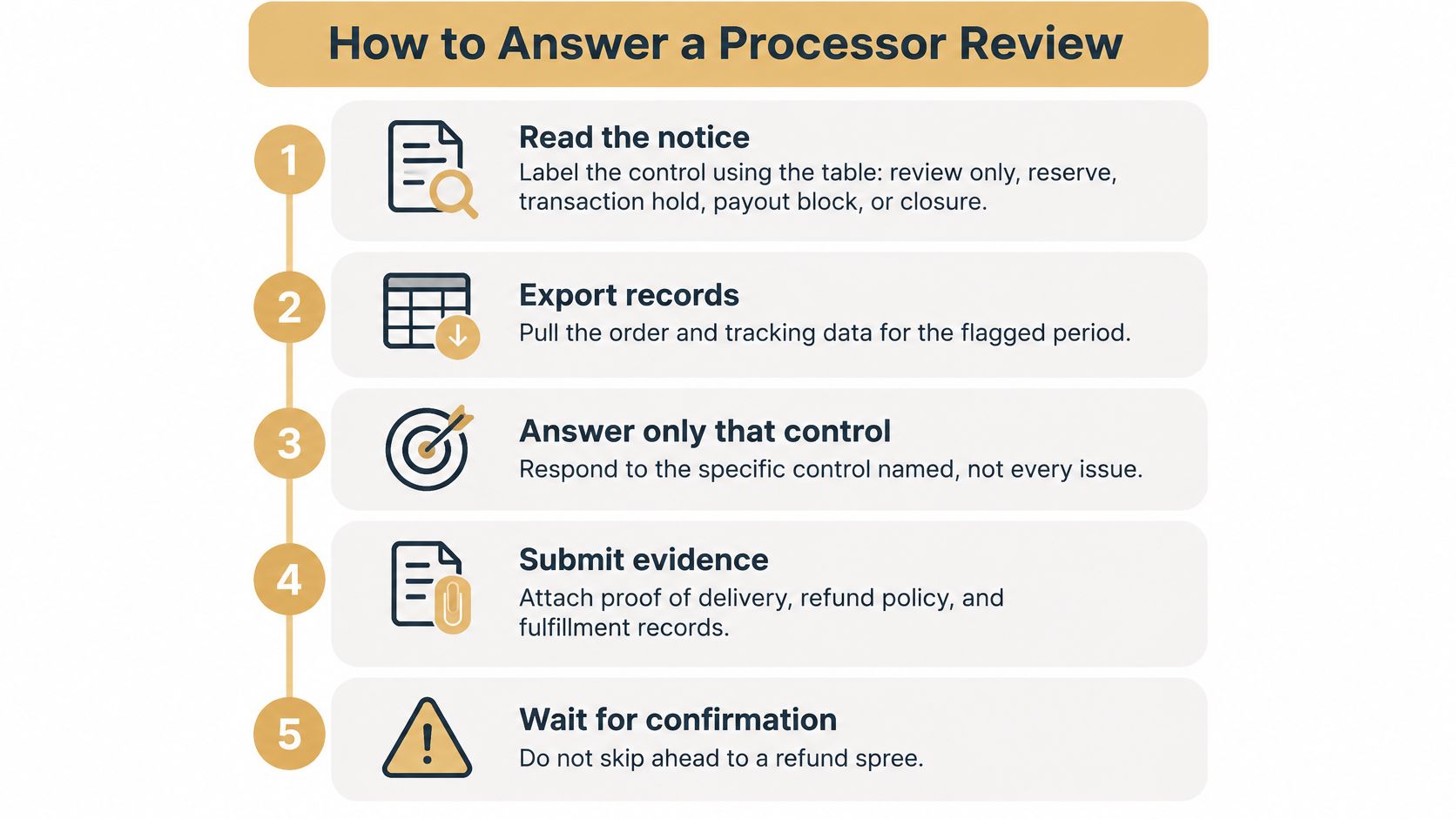
1. Read the notice and label the control. Use the table earlier in this piece. Review only, reserve, transaction hold, payout block, or closure. Write the label at the top of a page, because every later step branches from it. If the notice doesn't say, ask one direct question about which balance is affected.
2. Export three numbers. What is payable now, what is already reserved, and what is pending. Then forecast payroll against the reserve percentage. A merchant who discovers on Friday that the reserve is 15% rather than 5% has a much worse week than one who checked on Monday.
3. Build a single evidence packet. Recent processor statements, fulfillment SLAs, tracking for open orders, your refund and cancellation policy, customer-service logs, financial statements, and a reconciliation that maps each dispute to its order. One folder, consistent filenames, no duplicates. The underwriting questions behind it are usually simpler than they look: can you show the goods shipped, and can you show the business is solvent.
4. For a single-payment hold, send shipment proof first. That path can release funds earlier than waiting out the hold window, and it costs you nothing but a tracking export.
5. For a portfolio review, explain the change. Add a short written narrative covering why volume moved, what changed in product mix, and what your delivery times are, plus the owner identity documents the acquirer requests. A one-page explanation of a promotion that doubled volume in two weeks answers the question the analyst is already asking.
6. Split refunds from disputes. Refund the ones you'd issue anyway for service reasons, and defend the ones the business would clearly win, so the ratio falls without giving away every order. Alert networks such as Verifi and Ethoca can flag a dispute before it becomes a chargeback: our Verifi Network (CDRN) coverage gives you 72 hours to refund and stop the chargeback, and Ethoca's network covers Mastercard and other major card brands with a 24-48 hour window. Check each network's refund window in its own terms. An alert service handles prevention only, and Disputely doesn't independently decide refund eligibility, account actions, or processor outcomes.
7. Reply in the channel named in the notice. Keep a timeline of when each hold was placed, reviewed, and released. Don't open a second processor account to route around the review. Acquiring banks see the same merchant identity, and a duplicate account reads as evasion rather than diversification.
A complete reply looks like one PDF, labeled exhibits in the order the notice asked for them, and a named contact who can answer a follow-up within a business day.
Ecommerce Subscription and High Risk Examples
Three patterns cover most of what merchants face. Find the one that matches your dashboard.
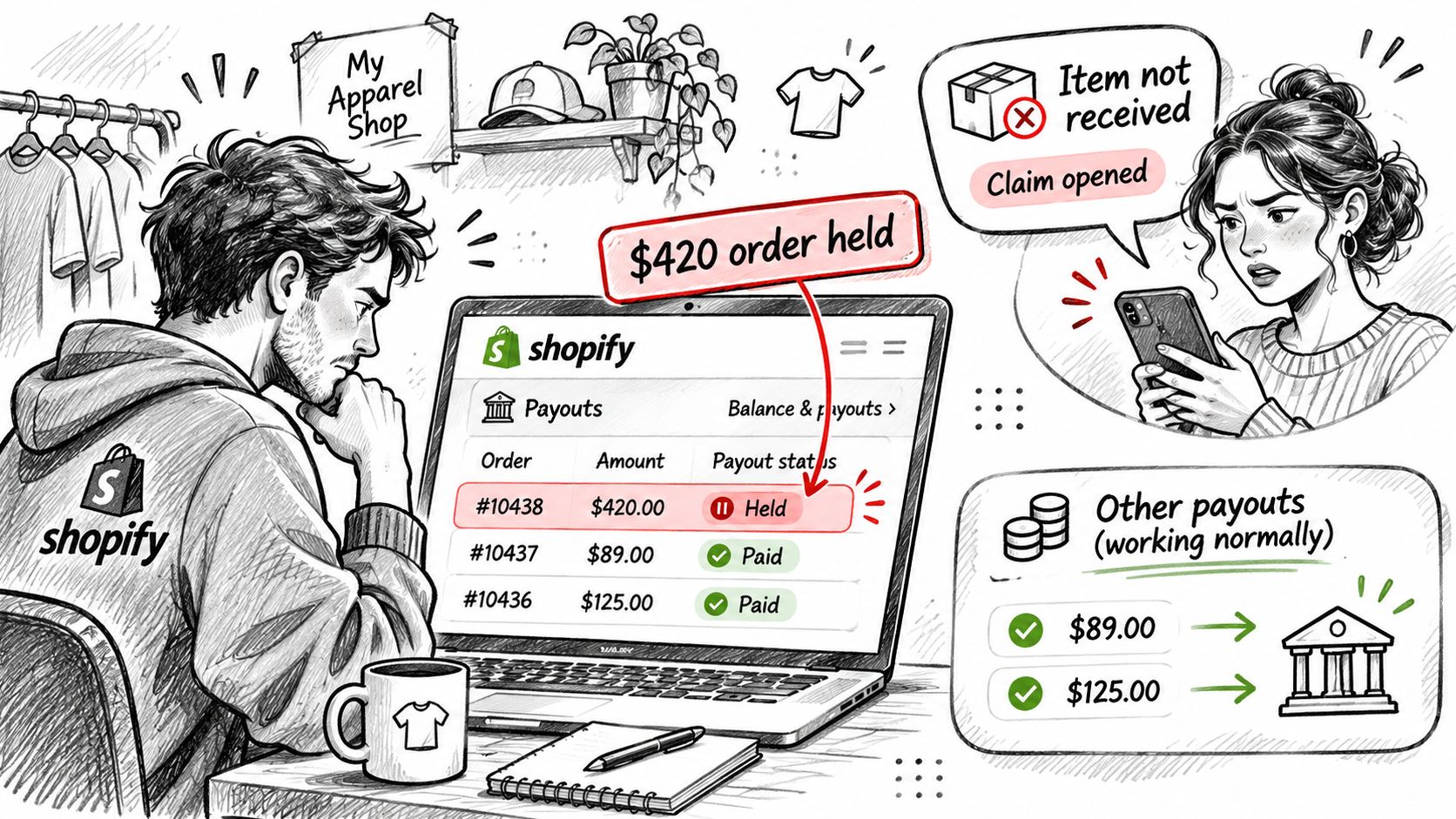
The Shopify apparel shop with one held order. Payouts are normal except a single $420 order, held after a buyer files an item-not-received claim. That is a transaction-level hold: the rest of the day's sales still pay out, and tracking plus delivery confirmation is the relevant proof. Payment Review's comparison of reserves and holds notes that risk-based holds on individual payments generally last up to 21 days and can release earlier once shipment evidence is provided. That is what separates a held payment from an account reserve, which touches every payout. Expect continued sales with one payment stuck.
The SaaS company that moved from monthly to annual billing. Cash looks healthy, disputes climb past 0.75%, and the status changes. This is a portfolio review. The processor is now pricing a full year of service that customers have already paid for, so a reserve or slower payout is far more likely than a hold on one order. Representment files on old cases will not lift that reserve on their own, because the reserve is a forward-looking risk decision: the acquirer is sizing up refunds and chargebacks that have not happened yet, and no packet about past disputes answers that question. Expect sales to continue with a percentage skimmed. If the business address on file does not match the acquirer's records, the review drags on longer than it needs to, so non-resident founders should check this Cloud Residents guide to Stripe addresses before submitting documents.
The supplement brand that tripled volume into a promotion. Higher-risk category, a spike nobody explained in advance, some orders shipping late, and dispute pressure on top. That mix of unexplained growth, fulfillment risk, and disputes can produce an account hold or a rolling reserve instead of watch-only monitoring.
Expect sales that cannot be paid out until the documents land. Merchants in this position often need the playbook for high-risk merchant processing alongside their response to the review.
The shared lesson is blunt. Three stories, three different controls: a held order, a priced portfolio, and a payout gate. A refund of one order solves only the first story. In the other two, the decision was made about the portfolio, and it gets revisited when the risk view changes.
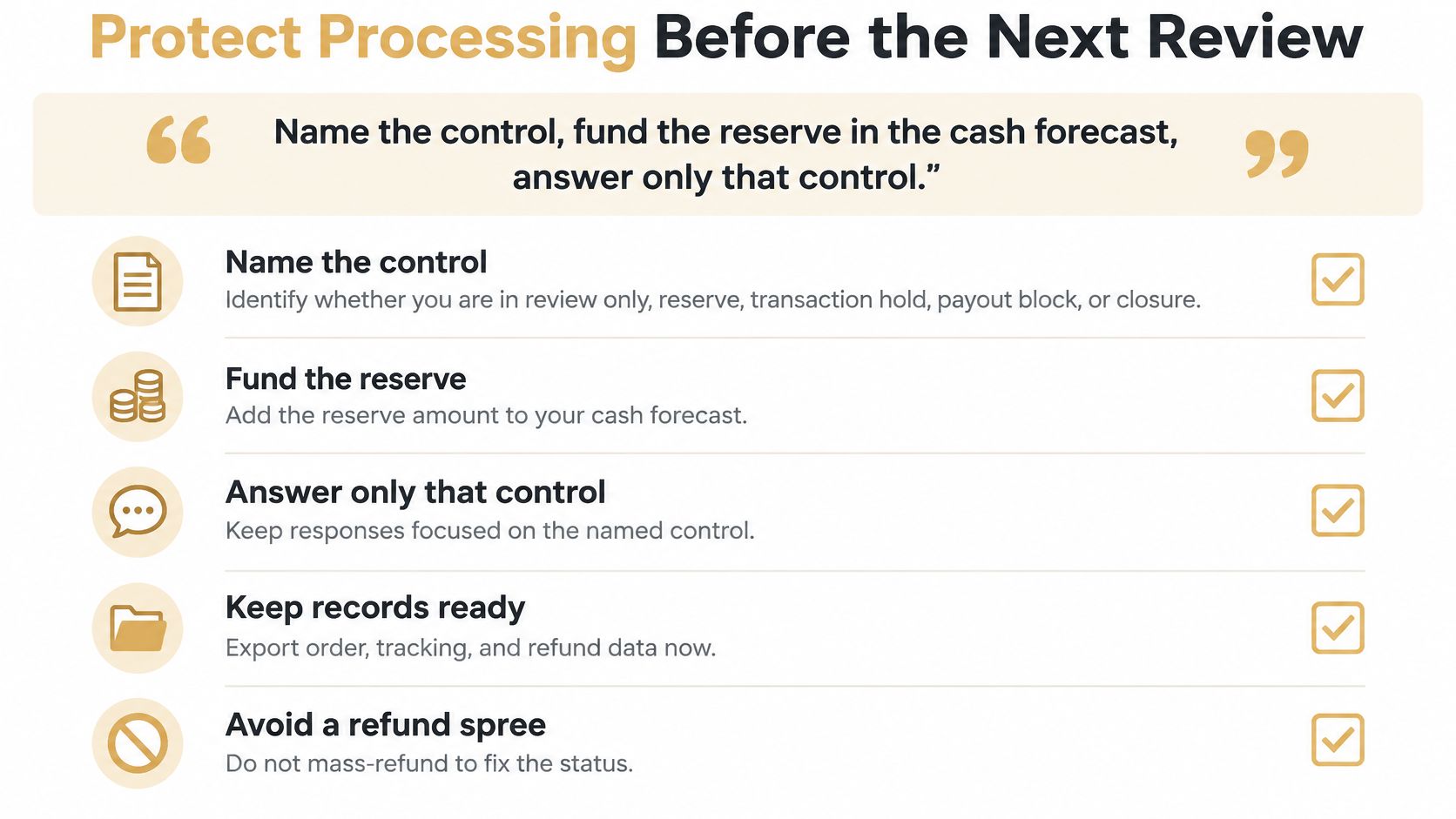
Protect Processing Before the Next Review
Name the control, fund the reserve in the cash forecast, answer only that control, and stop treating dispute evidence as a reserve release.
That sentence is the whole strategy compressed. Everything below is the standing habit that keeps you out of the next review.
- Keep the evidence packet current every month, not the week a hold appears. Statements, tracking exports, refund policy, and a dispute-to-order reconciliation in one folder, refreshed on a schedule.
- Watch two ratios, not one. Keep a Visa same-month view and a Mastercard prior-month view, and alert before either nears 0.75%.
- Refund the alerts that would become chargebacks. Stop auto-refunding disputes you'd clearly win, because that inflates the refund metric the processor also reads.
- Never route around a review. A second account under a related entity is the fastest way to turn a temporary reserve into a terminated relationship.
Disputely fits into that as configurable alert coverage rather than a processor. The lineup covers three stages: Resolve before the dispute, Alerts when one is filed, and Recover after the chargeback. Verifi by Visa alerts run $16 each, and our chargeback prevention rate is 91%. Confirm current pricing and any prevention results on the vendor's terms before you budget them. Fewer disputes keep a merchant away from the monitoring line, but no vendor can instruct an acquirer to lift a reserve.
This matters most for Shopify and custom-cart ecommerce, subscription and SaaS billing, and higher-risk direct-to-consumer categories that already sit near dispute thresholds. Those are the accounts where a single bad month moves the ratio enough to trigger scrutiny.
This week, do three things: label the status you're in, write the reserve percentage into your cash forecast, and turn on pre-dispute alerts if your dispute ratio is the reason the account is being watched.
Disputely monitors your transactions and connects directly to Visa's RDR, Mastercard's CDRN, and Ethoca alerts, so a dispute reaches you with 24 to 72 hours to refund it before it ever becomes a chargeback. Connect your processor in under five minutes, set your refund rules, and the alerts run in real time, keeping the ratio that triggered your review away from the threshold. Visit Disputely to see what your current dispute volume would cost to intercept.


