
Chargeback Fraud Protection: How to Stop Disputes Early
In 2024, worldwide credit, debit, and prepaid cards generated about $51.920 trillion in purchase and cash volume, while fraud losses totaled $33.41 billion, according to the Nilson Report. The fraud rate was about 6.43 cents per $100 of card volume. The United States held 26.31% of global card volume that year but 41.87% of worldwide card-fraud losses.
That gap is why chargeback fraud protection is a payment-operations problem, not a niche add-on. A small rate on trillions of dollars still produces tens of billions in losses, and U.S. card-not-present sellers carry more of that exposure than their share of volume would suggest. The practical job is narrower than "stop fraud." Every alert is a decision: refund, challenge, or talk to the customer before a bank files.
No stack stops every dispute. The win is refusing to pay to fight cases you should refund, and refusing to refund cases you can win.
Chargeback Fraud Protection Methods at a Glance
Chargeback protection works in layers, and each layer acts at a different point. One tool never covers stolen cards, forgotten renewals, and non-receipt claims at the same time.
| Protection method | What it stops | Where it acts |
|---|---|---|
| AVS and CVV checks | Mismatched billing data on card-not-present orders | At authorization |
| 3-D Secure authentication | Unauthorized use where liability may shift to the issuer | At checkout |
| Fraud scoring and velocity rules | Card testing and repeated attempts from one device | At authorization |
| Clear billing descriptor | Disputes caused by unrecognized charges | Before the charge |
| Delivery tracking and proof of delivery | Claims of non-receipt | After shipment |
| Alert network notifications (Ethoca, Verifi CDRN, Visa RDR) | Alerts that would otherwise become filed chargebacks | After the charge, before filing |
| Stored evidence file | Weak responses to filed disputes | After the dispute opens |
What each stage is actually for
Early layers cut bad orders before you ship. AVS and CVV compare billing data at authorization and are worth running on every card-not-present order, even though a match doesn't prove the shopper is the cardholder. 3-D Secure asks the issuer to authenticate the buyer at checkout. On many unauthorized-use cases, liability can sit with the issuer instead of you. Fraud scoring and velocity rules are the brake on card testing: repeated attempts from one device should fail closed, not become a pile of small approvals.
Later layers protect revenue on orders that already cleared. A billing descriptor the shopper recognizes stops the "what is this charge" dispute before it starts. Name the store, not a parent company nobody has heard of. Tracking and proof of delivery answer non-receipt after the carrier scans the parcel. Ethoca, Verifi CDRN, and Visa RDR notify you after the charge and before a formal filing, which is the window to refund or reach the customer. A stored evidence file is what you send once the dispute is already open. Without it, a winnable case looks empty.
Checkout advice aimed at shoppers, including guidance on protecting your payment info online, reduces stolen-card use on their side. It doesn't replace your rules. Tie those rules to the same signals you would use in ecommerce fraud detection, so an authorization decision and a later dispute file don't contradict each other.
Practical rule: List the seven layers and mark which ones you already run. Add the missing layer before you buy another scoring vendor.
Telling Fraud, Friendly Fraud and Honest Mistakes Apart
A chargeback is a bank asking you to prove a sale. The cause decides whether you refund, fight, or fix the order.
Three groups get mixed together because the reason code often looks the same.
True fraud means someone who isn't the cardholder used a stolen card or a taken-over account. Typical signals are a new device, a ship-to address far from the billing address, and rapid repeat orders on a first-time account. The chargeback is the cardholder getting their money back. Fighting it without a strong identity match usually loses, and it should.
Friendly fraud means the actual customer bought the item and disputed it anyway. Sometimes they forgot a subscription. Sometimes the descriptor didn't match the store name. Sometimes they want the money back and keep the goods. The Merchant Risk Council reported in 2024 that nearly three-quarters of surveyed merchants observed an average 18% increase in friendly fraud over the preceding three years. A delivered order plus a clean purchase history is a different problem from a stolen card, and the response should be different too. More patterns like these sit in any solid write-up of friendly fraud chargebacks.
Merchant error covers duplicate billing, the wrong amount, and a cancelled order that still captured. The customer is right. Refund, correct the system, and don't spend a response cycle defending a bad charge.
Four questions before you pick a side
The same "unauthorized" or "not received" code can hide any of the three. Check the order record, delivery data, and prior purchases before you act.
- Who placed it? Does the device, login, and ship-to match this customer's earlier undisputed orders?
- Did it arrive? Is there a carrier scan, a signature, or a digital access log at the address on the order?
- Did we cause it? Look for a double capture, a wrong SKU, or a cancellation that still billed.
- Did they try us first? A support ticket before the dispute usually means confusion or a product problem, not a stolen card.
If two of those answers point at the real customer and a fulfilled order, don't treat the alert like a fraud event.
When to Refund, Challenge or Communicate
A blanket "refund everything" rule looks safe and wrecks margin. It avoids a formal chargeback, then hands the product and the cash to someone who would have lost a fair fight. Fighting every dispute does the opposite kind of damage. Staff time goes into cases with no delivery proof, response windows get missed, and loss rates train the processor to watch you.
Triage sits between those two habits. Score the order on value, fulfillment status, prior undisputed purchases, customer history, delivery evidence, and the likely reason code. Mastercard's 2025 chargebacks research indicates that first-party and third-party fraud together represent about 45% of merchants' global chargeback volume. The rest includes dissatisfaction, transaction confusion, and other causes that a conversation can still fix. The same outlook identifies digital subscriptions as a leading category for first-party misuse, at 20% of reported misuse in one 2025 dataset. Recurring billing plus an unfamiliar descriptor is how a real subscriber files "fraud."
| Dispute scenario | Usual action | Evidence to hold |
|---|---|---|
| Confirmed unauthorized order, low value, no delivery | Refund quickly and don't fight | Order record and refund confirmation |
| Delivered with signed proof, customer claims non-receipt | Challenge with delivery evidence | Carrier tracking, signature, and address match |
| Forgotten recurring charge, prior undisputed use | Refund or cancel, then explain the charge | Usage logs, prior transactions, and cancellation terms |
| Defective or wrong item | Refund and resolve with the customer | Support tickets and return record |
| High-value order, strong identity signals | Challenge the dispute | Login history, device match, and customer communications |
| Unclear reason code, value above your threshold | Review and decide before the response window closes | Full order file and dispute notice |
Where the money actually leaks
The dollar size of a single case has moved. Sift reported that the average chargeback value increased from $235.57 in the first quarter of 2023 to $374.01 in the first quarter of 2024. A refund threshold set far below that number gives away recoverable revenue on every alert. A threshold set with no deadline means the case files while someone is still "looking into it."
Say a $28 supplement reorder has no tracking and a brand-new device. Refund it the same day. Say a $420 order shows the same card, the same laptop, and a signed delivery from three prior months of clean orders. That one is a challenge, not a gift.
Customers often dispute because they couldn't reach anyone. A staffed inbox or AI chat support for online stores gives a confused subscriber a path that isn't their bank. It won't convert a deliberate friendly-fraud claim into a happy renewal. It will catch the descriptor mix-up and the late package before they become filings.
Set two numbers in advance: a value threshold and a response deadline. Under the threshold, with weak evidence, refund. Over it, with delivery or usage proof, challenge. Either way, decide inside the window you already wrote down.
Building Evidence Before a Dispute Arrives
A dispute notice lands on a Tuesday. The device session from that checkout expired weeks ago, the support chat was never exported, and the carrier photo already aged out of the portal. Evidence either exists before the alert or it doesn't exist at all. That single difference decides whether an alert becomes a same-day refund or a challenge worth filing.
Visa's merchant dispute management guidelines require compelling evidence for card-absent fraud to be clearly tied to the disputed transaction, including payment-credential details, the transaction amount, and cardholder information. Eligibility still shifts by network, transaction type, and use case. Visa's Acquirer Monitoring Program replaced several former monitoring programs in April 2025, which is another reason to map each flow to the rule that applies instead of keeping one generic PDF checklist.
What to keep, and why it persuades
- Device and IP continuity: Shows this order came from the same environment as earlier undisputed purchases.
- Authenticated logins: A password or one-time code on the account is harder to wave away than a guest checkout.
- Delivery confirmation with the address: Tracking plus a match to the ship-to on the authorization is the core of a non-receipt response.
- Prior undisputed transactions: A string of paid orders on the same card undercuts a sudden "I didn't buy this."
- Account age: A two-year account behaves differently from one opened an hour before a high-ticket order.
- Customer communications: Emails, chats, and cancellation clicks show whether anyone tried to resolve it with you.
The packet is also what makes the refund-or-challenge call cheap. With these fields in hand, the triage question takes minutes. Without them, every alert defaults to a refund, including the ones you could have won.
A Shopify order, a WooCommerce subscription, and a high-risk supplement checkout don't all need the same packet. What they share is a link from payment, to account, to fulfillment, to alert. If your team is still assembling that packet by hand, start with a written evidence collection process so the fields exist before anyone asks for them.
The privacy limit
Collect what the network rule needs for that transaction type. Set a retention period, and delete fields no dispute will use. A full card number doesn't belong in a shared drive "just in case." Dispute volume keeps climbing, and a messy archive costs twice: once in cases you lose because the right field wasn't there, and once in personal data you held with no rule behind it.
Per order, store the authorization reference, amount, descriptor shown, device and login markers, ship-to, carrier proof, and any support thread. If a field isn't on that list and no rule asks for it, don't keep it.
Protection in Practice for Three Merchant Types
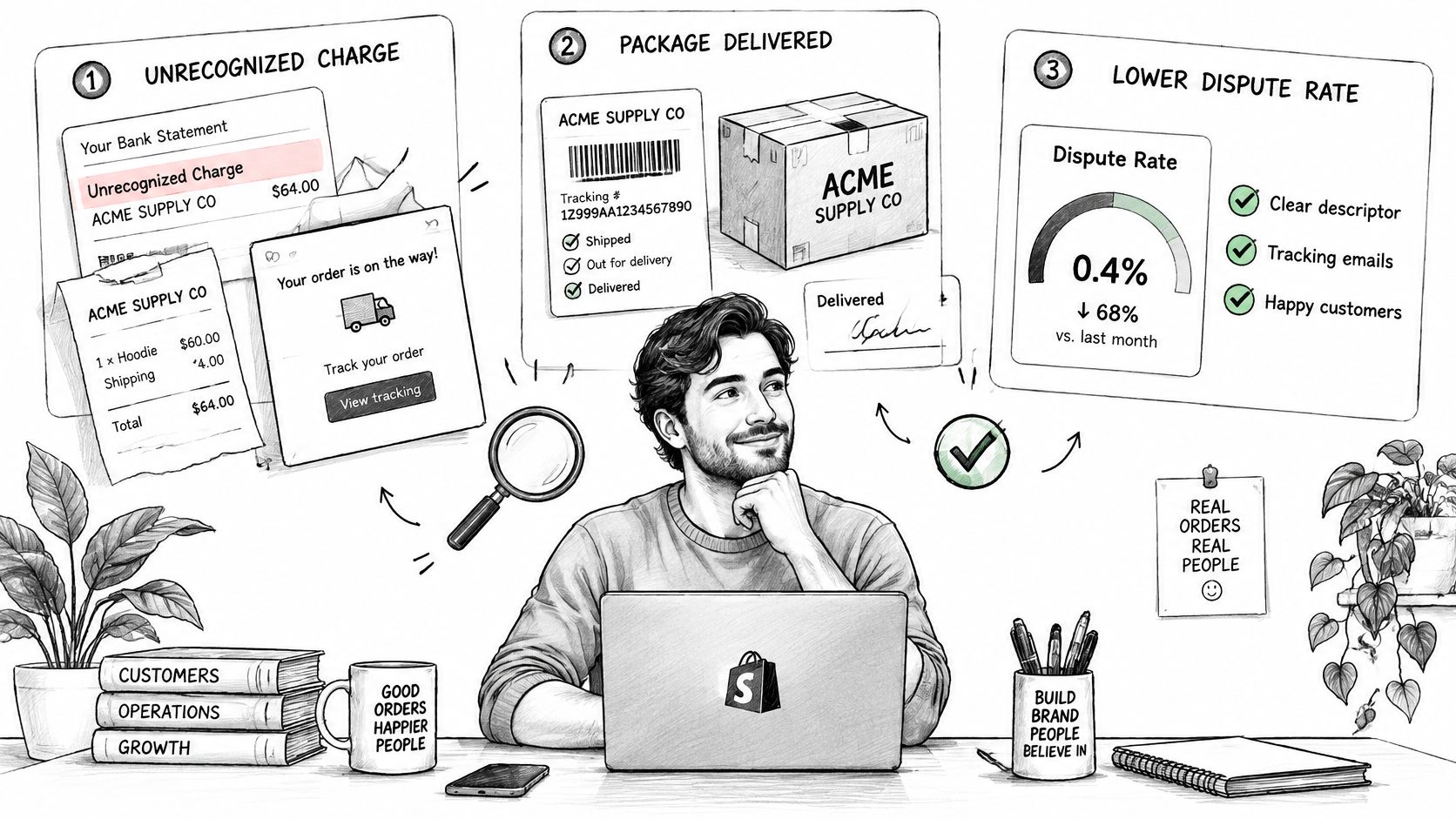
The same triage looks different once the catalog and the billing cycle change. None of these paths guarantees zero chargebacks. Results still depend on the processor, the network, and the data you kept.
A Shopify brand and unrecognized charges
Say a direct-to-consumer brand on Shopify sees disputes cluster around "I don't recognize this." The layer that changes isn't a new fraud score. It's the descriptor, rewritten to the store name shoppers remember, plus a tracking email the day the label prints. Alerts that remain, mostly low-value and already delivered without a signature fight worth having, get refunded inside a day. The decision rule is simple: unrecognized-charge pattern, weak identity conflict, refund. Signed delivery on a larger order, challenge.
A SaaS company and forgotten renewals
Say a software company bills monthly and most disputes are renewals the customer forgot. Fraud tools at checkout barely touch that. Renewal reminders seven days out, a visible cancellation path, and usage logs stored with the invoice do. The rule: if logs show no login since the last bill, refund or cancel and explain the charge. If logs show daily use on the same device, challenge. Fighting a silent account wastes the response. Refunding a heavy user trains the rest of the base to dispute instead of cancel.
A supplement seller and card testing
Say a high-risk supplement shop sees small authorizations hammering one device, then a large order to a new address. Velocity rules block the testing before capture. For the orders that ship, delivery proof settles most non-receipt claims. The rule: unmatched device plus no scan, refund and don't reship. Matched address plus a carrier delivery, respond with the proof.
Across the three, the cheapest fixes sit at the descriptor and the renewal reminder, not in a new vendor contract.
The timing of that pre-filing window is easier to see than to describe. This short walkthrough shows how an alert reaches a merchant before a chargeback posts:
Build and Verify Your Prevention Workflow
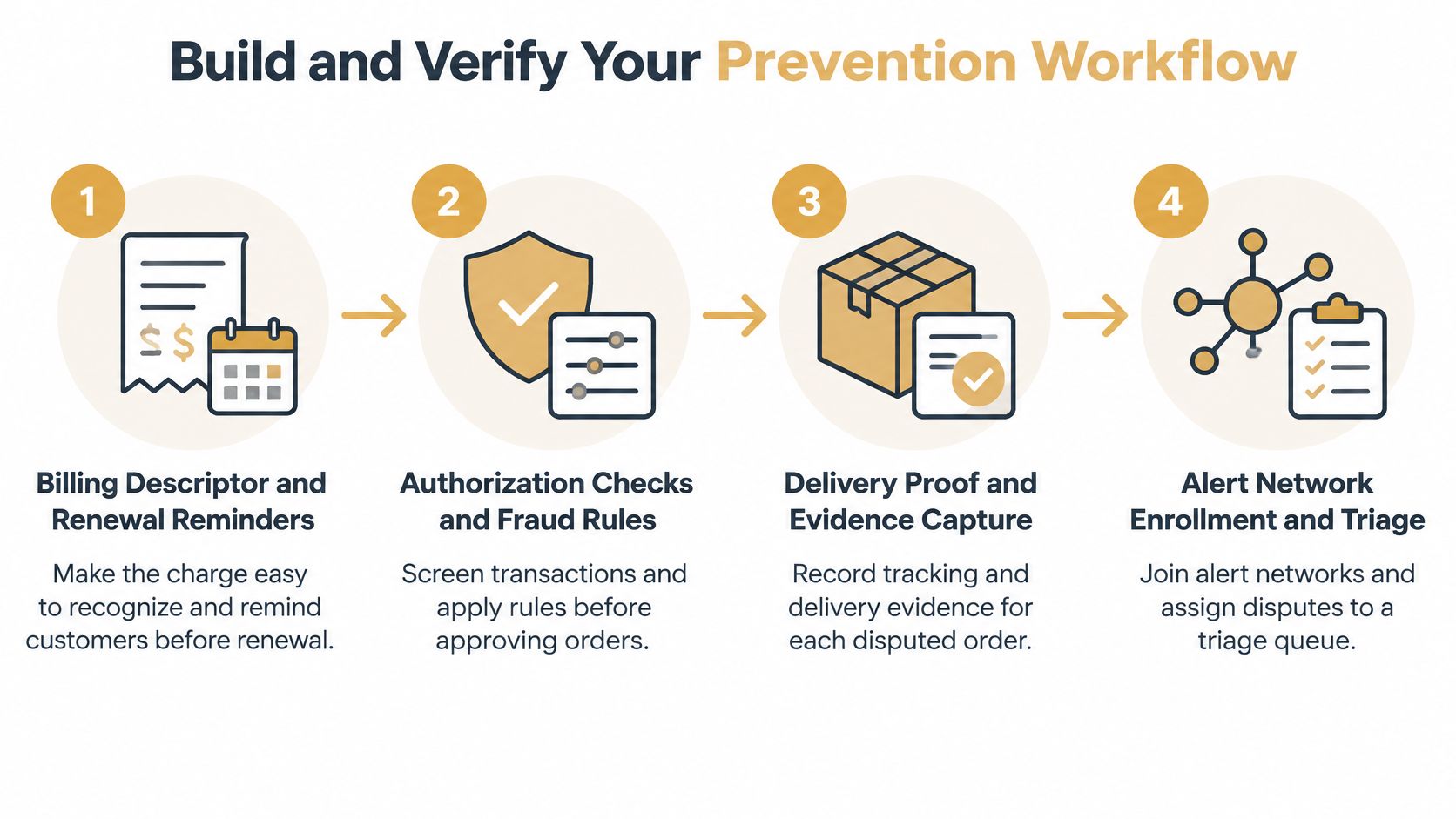
Roll the work out in this order: billing descriptor and renewal reminders, then authorization checks and fraud rules, then delivery proof and evidence capture, then alert-network enrollment and a written triage policy. Later tools can't fix a charge nobody recognizes.
Eight steps that close the loop
- Set the descriptor and a support contact so the statement line matches the store. The common slip is a legal-entity name the shopper has never seen.
- Run AVS, CVV, and 3-D Secure where the issuer supports it, and put velocity rules on at authorization. Card testing should die before capture.
- Store device, login, and IP markers with the order at checkout. You can't reconstruct a session a month later.
- Send the shipping confirmation with tracking and keep proof of delivery. The common slip is a high-value order with no scan saved.
- Subscribe to Ethoca, Verifi CDRN, and Visa RDR so you hear about a complaint before filing. The common slip is an alert sitting unread in a shared inbox.
- When an alert arrives, pull the order file and apply the triage table. Value, fulfillment, history, and reason code, in that sitting, not next week.
- Issue the refund or submit the response before the window closes. A perfect packet filed late is a loss.
- Log the outcome and the reason code so next month's rules reflect what happened, not what you assumed.
Three checks that the workflow is real
- Alerts reach a named person the same business day. If "the team" owns the inbox, nobody does.
- Every refund has a logged reason. Otherwise you can't tell a good refund from a panic refund.
- Review the dispute rate monthly against the prior quarter. A spike in one reason code is a descriptor, a carrier, or a product, not a mystery.
Disputely is one way to run the alert step. When we detect a chargeback threat, we automatically process a refund to prevent the chargeback, and you only pay when we prevent a chargeback from hitting your account. We connect alerts to Stripe, PayPal, and Shopify Payments, and we do not guarantee dispute prevention, chargeback reduction, processor approval, account standing, or avoidance of reserves, monitoring programs, or account termination. Check the log against your own orders before you treat any rate as yours.
This week, sort the last 30 days of disputes with the triage table. Mark refund, challenge, or communicate. The pile that should have been a same-day refund, and the pile you refunded with signed delivery on file, tell you exactly which step to fix first.
Chargeback fraud protection fails when every alert is treated as fraud and refunded on sight. Disputely connects Visa RDR, Verifi CDRN, and Ethoca alerts to refund rules you set, so a preventable filing can be stopped before it hits the merchant account, while cases you can win stay out of the automatic refund path. See how the workflow fits your processor at Disputely.


