
Chargeback Threshold Explained: Visa and Mastercard Limits
A combined fraud-and-dispute ratio of just 0.50% can put a Visa acquirer portfolio in the Above Standard category, according to Visa's VAMP fact sheet. That isn't a merchant-level chargeback threshold, and it doesn't measure chargebacks alone. Those distinctions explain why a single percentage rarely tells a merchant whether they're approaching formal monitoring.
To assess your exposure, you need to identify whose activity is being measured, which events count, and whether a minimum count also applies. A merchant-wide ratio, an acquirer portfolio trigger, and repeated disputes on the same card account are different tests. Treating them as interchangeable can lead you to investigate the wrong problem.
Chargeback Thresholds at a Glance
Visa and Mastercard threshold limits by program
Visa rules change over time, so confirm the effective thresholds for your region with your acquirer before making operational decisions.
| Program and tier | Ratio trigger | Volume floor | Scope and notes |
|---|---|---|---|
| Visa VAMP, Above Standard | 0.50% | No volume floor for this ratio trigger | Acquirer portfolio, combined fraud and dispute ratio |
| Visa VAMP, Excessive | 0.70% | No volume floor for this ratio trigger | Acquirer portfolio, combined fraud and dispute ratio |
| Visa VAMP merchant Excessive, US, Canada, Asia-Pacific, EU | 2.20% | 1,500 combined events per month | Merchant level, fraud and disputes combined |
| Visa VAMP merchant Excessive, Latin America and Caribbean | 1.50% | 1,500 combined events per month | Merchant level, fraud and disputes combined |
| Visa VAMP merchant Excessive, Central and Eastern Europe, Middle East, Africa | Ask your acquirer for the current regional ratio | 150 combined events and USD 75,000 combined amount | Merchant level, count and amount floor |
| Mastercard Excessive Chargeback Merchant (ECM) | 1.50%, with an ECM rate band of 150 to 299 basis points | 100 chargebacks per month | Merchant level, monthly test |
| Mastercard High Excessive Chargeback Merchant (HECM) | 3.00%, or 300 basis points or higher | 300 chargebacks per month | Merchant level, monthly test |
The count-and-rate criteria behind the Mastercard rows are documented in J.P. Morgan's Excessive Chargeback Program guide.
Read the scope before the percentage
Start with the merchant row for your operating region, not the acquirer portfolio rows. An acquirer manages a portfolio of merchants, so the 0.50% and 0.70% triggers describe the acquirer's combined book of business rather than your individual account. Merchants who read those figures as personal limits end up either complacent or alarmed over a test that was never measuring them.
For a merchant in the US Visa row, the ratio condition and combined-event floor must both be satisfied. A high ratio alone doesn't establish that the merchant meets that row's criteria. Conversely, a large event count doesn't establish eligibility if the ratio condition isn't met.
Neither condition alone is enough.
Run two merchants through that US row. One posts a 3.00% combined ratio on only 900 events: the ratio exceeds 2.20%, but the count sits below the 1,500-event floor, so the row's criteria aren't met. The second logs 2,000 combined events at a 1.00% ratio: the count clears the floor, but the ratio falls short. Both stay outside the Excessive criteria for opposite reasons.
Visa's combined measure includes card-not-present fraud reports as well as disputes. A dashboard that shows only chargebacks therefore doesn't give you the complete numerator for VAMP.
Understand where count floors apply
A volume floor works like a minimum sample size: the network wants enough events on record before it treats the ratio as a meaningful reading of your business. The volume-floor rule applies to the merchant-level Visa rows and Mastercard tiers, not the Visa acquirer-level ratio triggers. That distinction matters when your processor raises concerns about activity that hasn't reached a merchant monitoring floor.
The same count also carries different weight at different volumes. A hundred chargebacks meets the Mastercard ECM count floor, yet whether the rate lands inside the 150 to 299 basis point band depends entirely on how many transactions the merchant processed.
Practical rule: Match the network, reporting scope, region, and event definition before comparing percentages.
Don't fill a missing regional value with a figure borrowed from another market. Ask your acquirer to confirm the applicable ratio, minimum count, amount condition, and effective reporting period in writing. Then use the correct transaction denominator to calculate your position.
How Visa and Mastercard Calculate Your Ratio
Visa VAMP percentage = (eligible card-not-present fraud reports + disputes) ÷ settled card-not-present transactions × 100.
Mastercard rate in basis points = chargebacks received during the calendar month ÷ Mastercard transactions from the preceding month × 10,000.
The Mastercard Security Rules and Procedures manual specifies the preceding-month denominator and illustrates the calculation with 150 chargebacks divided by 10,000 prior-month transactions, producing 150 basis points, or 1.50%.
Work through the numerator and denominator
For that Mastercard example, begin with the chargebacks received during the reporting month. Divide that count by the merchant's Mastercard transaction count from the preceding month, not by revenue, order value, or transactions across every card brand.
Multiplying the result by the basis-point conversion factor produces the reported rate. The first row below uses that calculation; the remaining rows are hypothetical applications of the same formula and the program criteria.
Worked examples: chargebacks, volume and resulting tier
| Chargebacks in month | Prior-month transactions | Rate (basis points) | Tier result |
|---|---|---|---|
| 150 | 10,000 | 150 bps (1.50%) | ECM tier, count and rate both met |
| 300 | 20,000 | 150 bps (1.50%) | ECM tier, count met and rate in ECM band |
| 300 | 10,000 | 300 bps (3.00%) | High Excessive tier, count and rate both met |
| 80 | 5,000 | 160 bps (1.60%) | No ECM status, count below 100 floor |
The last row is the useful counterexample. Its percentage exceeds the ECM entry rate, but its count doesn't satisfy the floor. Calculate the ratio, then test the count separately.
Account for the reporting lag
A sales decline doesn't immediately replace Mastercard's denominator with the current month's lower volume. Instead, the effect appears when that lower-volume month becomes the reference month for a subsequent calculation.
That timing can surprise seasonal merchants. Chargebacks may continue arriving from earlier purchases while the reference transaction count has fallen, producing a higher reported rate without an increase in chargeback count.
For a hypothetical Visa calculation, 25 combined fraud reports and disputes divided by 5,000 settled card-not-present transactions equals 0.50%. That matches the acquirer portfolio Above Standard line in the lookup table, but it doesn't establish merchant-level Excessive status.
Keep the inputs visible alongside your chargeback rate calculation. A percentage without its reporting month, numerator, and denominator is difficult to reconcile.
- Separate Merchant IDs: Calculate results for each merchant account rather than relying solely on an enterprise average.
- Separate networks: Don't divide Mastercard chargebacks by transactions from other card brands.
- Forecast before promotions: Model incoming disputes against the relevant reference volume, rather than assuming new sales will immediately improve the reported ratio.
Monitoring Penalties and How Long Programs Last
A merchant can fix the immediate cause of a dispute spike and still have monitoring obligations afterward. Program entry and program exit are separate decisions, so your recovery plan needs to address both the underlying issue and the required period of sustained improvement.
Paystack's explanation of Mastercard's monitoring framework documents penalties that can begin at USD 1,000 in the second month, rise to USD 2,000 in the third month, and an exit requirement of staying below the 1.50% chargeback threshold for three consecutive months.
Follow the sequence, not just the latest result
Say a subscription merchant experiences a renewal problem. Customers receive charges they weren't expecting, support queues grow, and chargebacks arrive before the team corrects the billing communication.
The operational timeline can look like this:
- Threshold month: The merchant meets both the applicable count and ratio conditions. The team identifies the affected renewal group and stops repeating the billing mistake.
- Penalty stage: Financial exposure can begin while the merchant is still correcting support, cancellation, and refund processes.
- Recovery stage: Better results must persist long enough to satisfy the exit requirement. A single improved reporting month isn't enough.
The timeline below illustrates why the monitoring process can outlast the original incident.
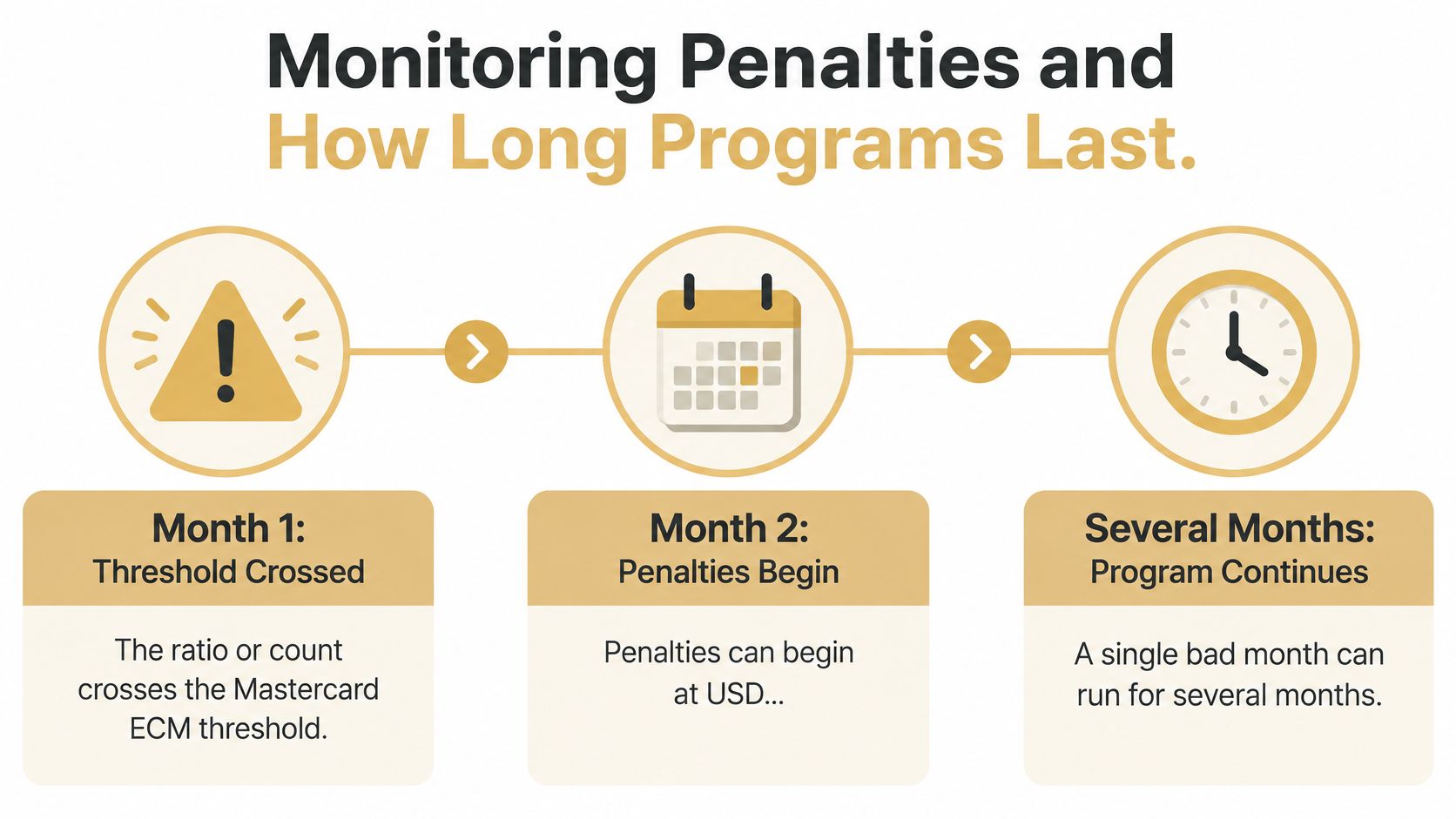
Don't treat that sequence as a universal invoice schedule for every merchant. Obtain the applicable assessment details and reporting dates from your acquirer, including how your agreement handles network charges.
Build a recovery file
The useful response isn't to wait for a better percentage. Assign someone responsibility for reconciling the network report, recording corrective actions, and confirming whether the merchant has satisfied the exit conditions.
A corrected checkout or billing flow stops new mistakes. It doesn't erase disputes already moving through the reporting process.
Maintain a recovery file with the issue description, affected transaction groups, customer communications, refund decisions, and evidence that the correction is live. That gives your payments team something concrete to review with the acquirer.
Use a weekly operational review to track unresolved alerts and emerging disputes, while keeping formal monthly calculations separate. Start the exit clock from the first qualifying below-threshold month, and have your acquirer confirm it rather than inferring it from a dashboard.
The Mastercard chargeback monitoring program guide can help your team organize the questions to resolve. For Visa, ask separately about regional eligibility and combined fraud-and-dispute exposure rather than applying the Mastercard timeline by analogy.
Card-Account Clusters and Patterns That Trigger Reviews
A merchant-wide percentage can conceal a concentrated problem. Say, hypothetically, merchants receive the same 50 disputes: against 5,000 transactions, that equals 1.00%; against 100,000 transactions, it equals 0.05%. Those are arithmetic comparisons, not complete monitoring eligibility tests.
The larger merchant may appear comfortable on a ratio dashboard while still needing to investigate whether the disputes came from the same credential, billing sequence, or issuer.
Distinguish a cluster from a program trigger
The Mastercard Chargeback Guide defines a condition involving more than 15 chargebacks on the same card account for specified reason codes. That isn't a universal merchant monitoring threshold, and it shouldn't be applied to every dispute category without checking the relevant rule.
A recurring-billing retry sequence could create multiple disputed transactions tied to one account. Alternatively, a fraud burst could involve several purchases using the same compromised credential. Those situations require transaction-level investigation even when the overall merchant ratio remains low.
A useful dashboard keeps account concentration visible beside aggregate metrics.
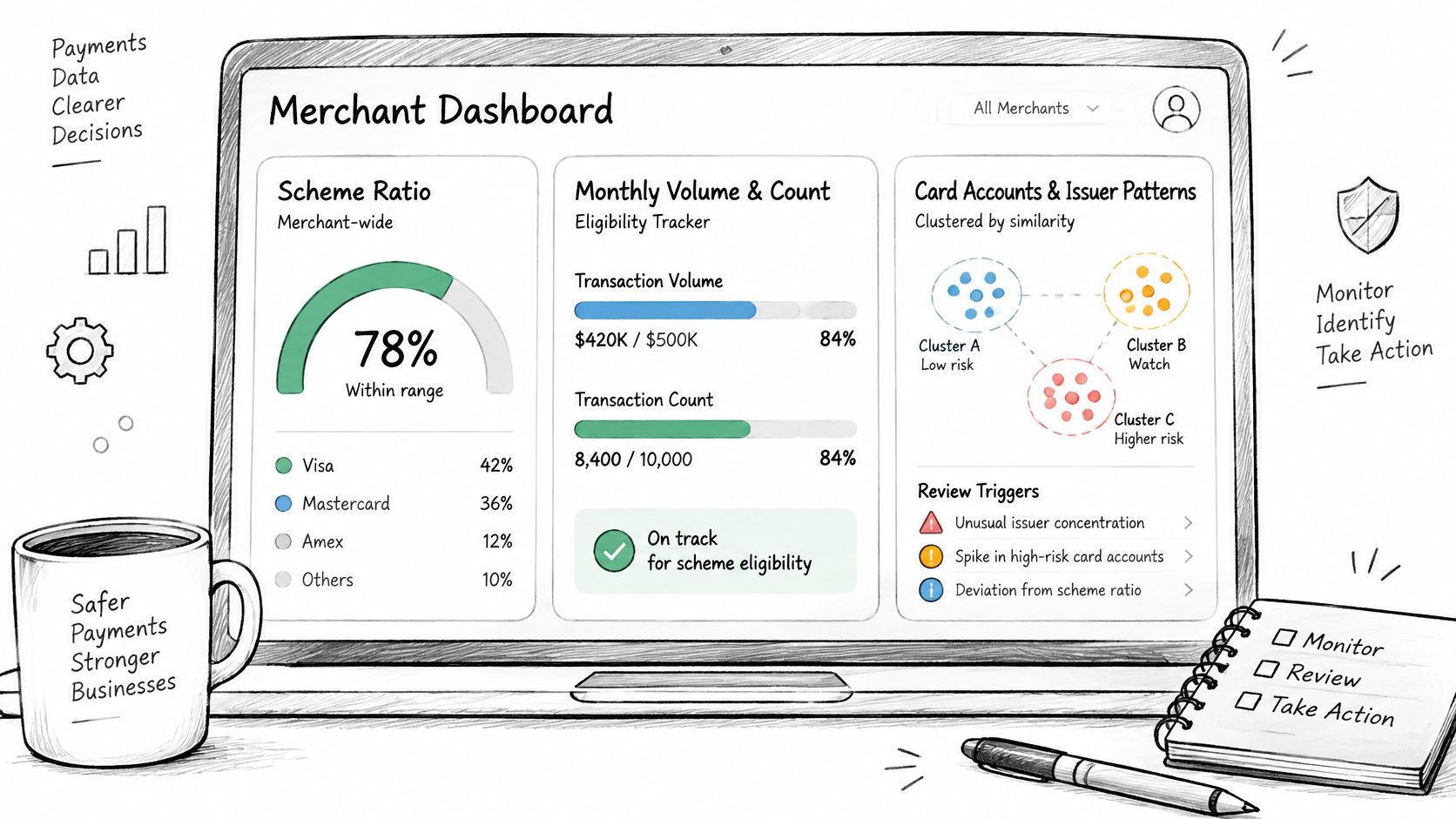
Keep separate views of the same events
Don't force each dispute into an exclusive category. The same event can affect a merchant ratio, contribute to a monthly count, and belong to a card-account cluster.
Maintain these parallel views:
- Scheme ratio view: Which eligible events enter the network numerator, and which transactions form its denominator?
- Eligibility view: Does the merchant satisfy the applicable count and any amount conditions?
- Concentration view: Do card accounts, issuers, billing retries, products, or fulfillment problems repeat unusually?
For a cluster, examine the transaction sequence before deciding what to change. Check renewal dates, cancellation requests, failed-payment retries, delivery records, and earlier customer contact. Use tokenized account references available through your payment systems rather than exporting unnecessary card information.
Early resolution also deserves its own status field. Some disputes resolved through specified channels can be excluded from VAMP reporting, but a merchant-issued refund isn't automatically proof of exclusion. Confirm the resolution channel and reporting treatment with your acquirer.
Keep original events, resolution outcomes, and reporting eligibility distinct. Otherwise, staff may remove a case from an internal workload queue and mistakenly assume it has disappeared from network reporting too.
Common Misconceptions About Dispute Ratios
A percentage is only one part of a monitoring rule. The same number of disputes can carry very different weight depending on transaction volume, while a program may also consider fraud, event counts, or activity concentrated on one card account.
A low chargeback rate means we're safe
The correction: A disputes-only dashboard may not show your full Visa position. Check eligible fraud reports alongside disputes, and confirm that the denominator includes the correct settled transactions.
Customer-service complaints can fall while unauthorized activity remains unresolved. Give fraud screening and dispute prevention separate owners, then have them reconcile their work against the same monitoring report.
A high percentage always triggers a program
The correction: A monitoring test may require a minimum event count as well as a rate condition. Check the count floor and any amount requirement before treating a percentage as proof of program eligibility.
A high rate can still signal a problem for a small merchant, even when the count is too low to meet a program's entry conditions. Formal eligibility and operational risk answer different questions.
Falling outside a monitoring tier does not make a broken cancellation flow or repeated unauthorized purchases harmless.
A single spike won't matter once we fix it
The correction: Disputes may still arrive after the underlying problem is fixed, and recovery requirements can take time to meet. Check the remaining dispute pipeline and confirmed exit status, rather than relying on whether customer complaints have stopped.
Keep the incident owner involved until reporting stabilizes. A closed support ticket does not, by itself, show that monitoring recovery is complete.
Our dashboard number is the network number
The correction: Your dashboard may use a different reporting period, event definition, or transaction population. Check the fields behind its percentage and compare them with the acquirer's report before relying on the display.
For example, a sales dashboard may group orders by purchase date, while a monitoring report groups events by receipt or reporting date. Both figures can be internally consistent while answering different questions.
Network rules can change. Keep a dated copy of the applicable rules and ask your acquirer to confirm changes before using an older threshold for a current decision.
Stay Below Limits and Decide Your Next Step
A useful prevention routine produces more than a green dashboard. It gives your team a reconciled calculation, an explanation for concentrated activity, and an action owner before the next promotion or billing run.
Use this process to turn monthly reporting into decisions.
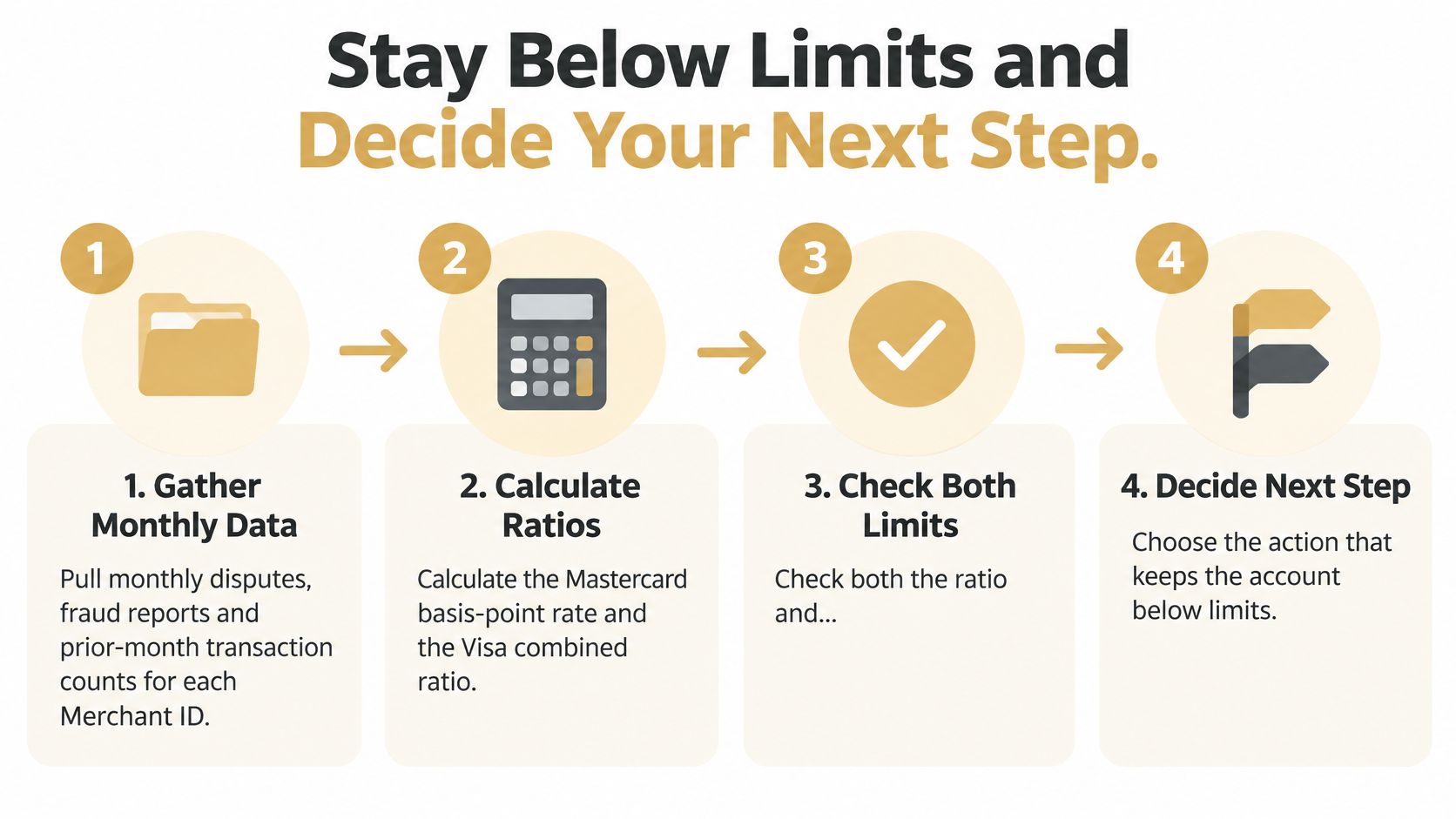
Prepare a report your team can act on
Gather the underlying records. Pull monthly disputes, fraud reports, settled card-not-present transactions, and the prior-month Mastercard transaction count for each Merchant ID. Preserve reporting dates and network labels so staff don't mix order activity with dispute receipts.
Calculate and reconcile. Produce the network-specific rate, then compare your inputs with the acquirer's report. Investigate missing events, unexplained exclusions, and transactions assigned to the wrong period before deciding that the merchant is below its chargeback threshold.
Set an internal warning below the applicable line. Don't use the formal entry threshold as your first alert. Choose a buffer that gives your team time to respond to pending disputes, and include count-based warnings so a comfortable-looking percentage doesn't conceal growing exposure.
Model the next billing or promotion cycle. Forecast likely disputes against the appropriate reference volume. Review the forecast before approving a large renewal batch, a new acquisition campaign, or a promotion with fulfillment demands your team hasn't handled before.
The report should identify who owns each response. Payments staff can reconcile network reporting, customer support can resolve cancellation problems, and operations can correct delivery failures. Without named owners, a detailed dashboard can still leave the underlying issue untouched.
Match prevention to the cause
Resolve eligible threats before formal filing. Route alerts to an authorized refund workflow and record the outcome. Distinguish a successful pre-dispute resolution from a refund issued after a chargeback has already entered reporting.
Connect shipping records to customer support. Check fulfillment status, tracking updates, delivery exceptions, and promised shipping dates. A support agent should be able to explain an order's status and offer an appropriate remedy without asking the customer to repeat the problem across teams.
Investigate repeat accounts and retries. Review recurring-billing attempts and card-account concentrations regularly. Apply account-level rules only to the reason codes and circumstances they cover, and correct retry behavior when it creates avoidable repeat charges.
Keep fraud prevention alongside dispute prevention. Review fraud reports independently of customer-service disputes. For Canadian merchants assessing checkout controls, Cleffex Digital ltd.’s resource on AI fraud detection for Canadian stores offers additional context for that evaluation.
Choose controls based on the cause, not just the final percentage. Clear cancellation instructions won't stop stolen-card purchases, and tighter fraud screening won't correct orders that never shipped. Use a practical chargeback prevention strategy that connects each recurring issue to a specific change.
For eligible prevention workflows, we automatically process a refund when Disputely detects a chargeback threat. We initiate refunds and communications with payment processors, alert networks, or related service providers only on the merchant's authorization, and customers pay only when chargebacks are successfully prevented.
Make one decision and record a review date
Run the check against your last complete reporting month. Bring the event counts, transaction denominators, combined fraud-and-dispute activity, and regional eligibility conditions into the same review.
Choose a clear outcome: keep the current process, tighten the internal alert, or add a prevention tool. Record the responsible person and a calendar date for reviewing the result before your next major promotion or billing run. Your routine is working when calculations reconcile, clusters have explanations, and the team acts before formal entry conditions are met.
Disputely offers chargeback prevention that automatically refunds detected threats under your authorization, helping you address eligible disputes before they become chargebacks. Visit Disputely to evaluate whether an authorized prevention workflow fits your monitoring risks and refund policy. Customers pay only when chargebacks are successfully prevented.


