
Cost and Revenue: How Chargebacks Hit Your Profit
You closed the month with a sales number that looked fine, then the processor statement landed. Three orders you already shipped came back as disputes. The goods are gone, the card fees stayed, and the full sale dropped off the revenue line. That gap between what you booked and what you kept is a cost and revenue problem, not a paperwork chore.
Each dispute is a unit decision. Refund it, fight it, or replace the order, and only one of those moves protects contribution on that sale. The checks below use a digital download, a subscription renewal, and a physical product, then stress-test the fight option against a low industry win rate instead of treating the chargeback ratio as the only number to shrink.
How Cost and Revenue Set Your Profit
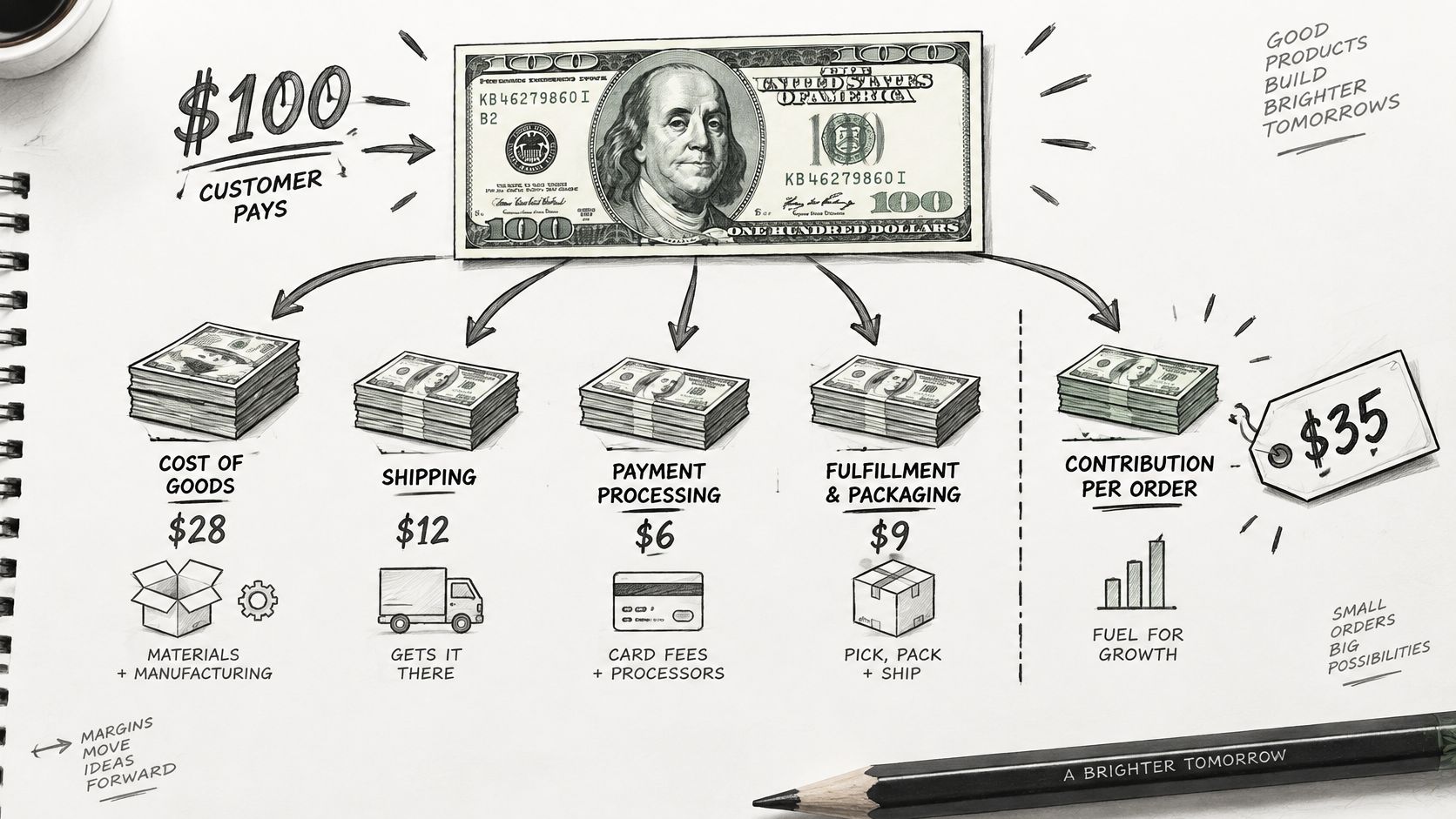
Say one customer pays $100. Before rent, ads, or salaries, that sale still has to cover the costs that travel with the unit.
The product costs $35, so $65 remains. Card processing at roughly 2.9% plus $0.30 is about $3.20, which leaves about $61.80. Fulfillment of $8 and packaging of $4 take another $12. Contribution before overhead is about $50.
Profit per order = revenue − cost of goods − card processing − fulfillment − packaging
That $50 is what a clean order contributes. A filed chargeback reverses the $100 while the goods, the shipping, and the labour are already spent. The same order can swing from about $50 of contribution to a loss equal to those sunk costs, plus any dispute fee the processor adds.
Two levers, one order
Profit moves in only two directions. You keep more revenue on each order, or you lower the cost of each order. A dispute hits the first lever. It is a cost event sitting on the revenue line, not a quiet row on the cost sheet.
Trimming the costs under every sale still matters. Snyp's cost control playbook shows how operators cut waste in those unit costs, which is the other half of the same equation.
Rebuild the formula from your own invoices. Pull cost of goods, the rate on the processor statement, and the pick-pack charge. If you can't name contribution per order, you can't tell whether fighting a dispute protects profit or spends more of it.
Why a Chargeback Costs More Than the Refund
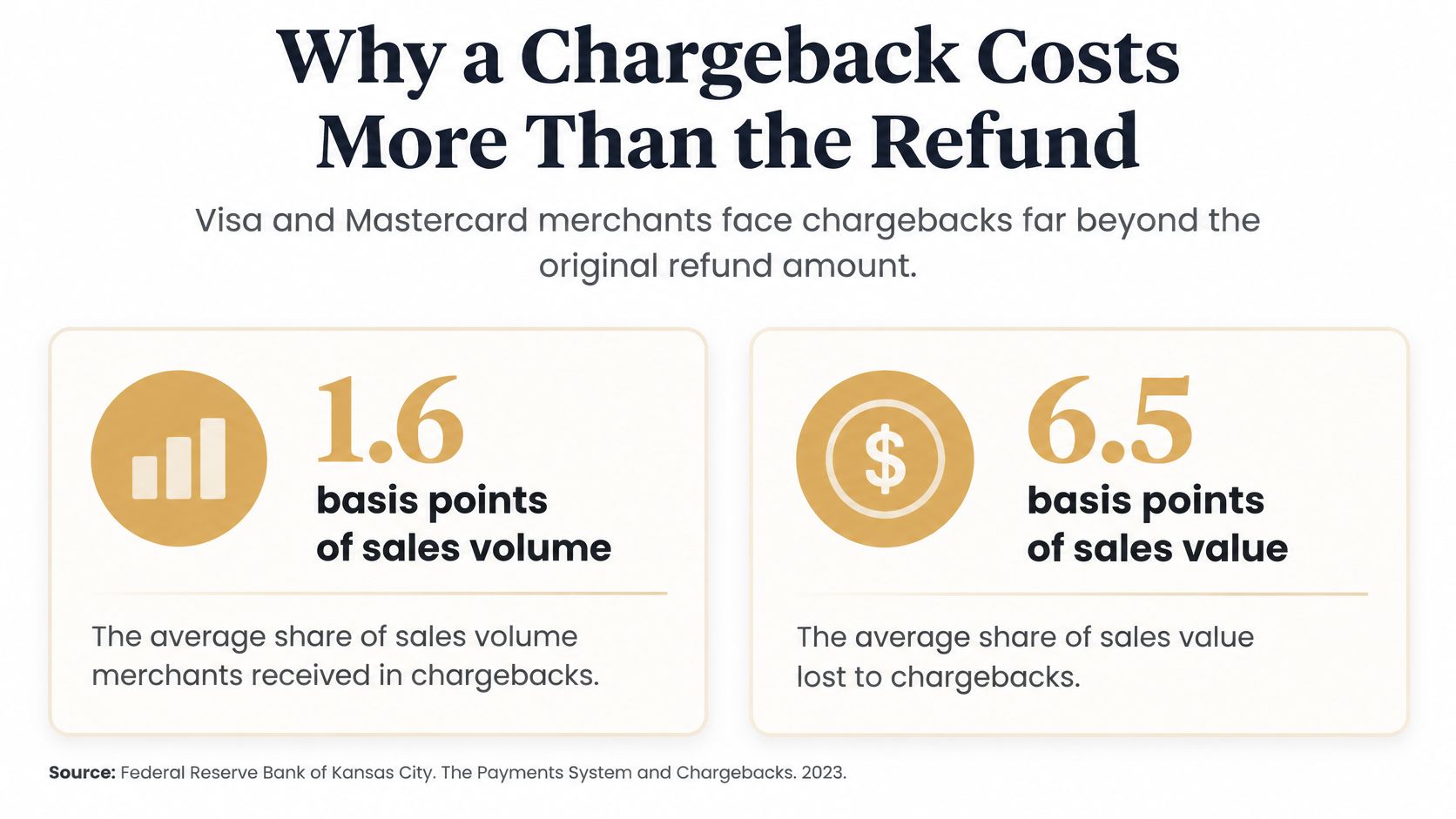
A Federal Reserve Bank of Kansas City study of merchant-processor data covering more than 20% of U.S. signature-based card transactions found that Visa and Mastercard merchants received chargebacks equal to an average of 1.6 basis points of sales volume and 6.5 basis points of sales value. On $10 million in annual sales, 6.5 basis points is roughly $6,500 in chargeback value before operating costs, processor fees, fulfillment losses, or customer-service labour.
That dollar figure is only the face value. The same study found merchants successfully disputed only 20–30% of chargebacks, so most of the extra cost is sunk. About 70–80% of chargebacks were resolved as merchant liability, and fraud represented about 50% of all chargebacks. Card-not-present sales, the pattern for ecommerce, subscriptions, and direct-to-consumer brands, carried materially higher chargeback and fraud rates than card-present sales.
What one dispute actually carries
The refund is the visible piece. Five costs land around it, and several of them don't come back when you win.
| Cost component | What it includes | When it lands |
|---|---|---|
| Refunded amount | Original sale value returned to the customer | At refund or chargeback |
| Lost goods or service | Product or service delivered and not recovered, plus shipping | At delivery, unless the item is returned |
| Processing and chargeback fees | Processor and network fees charged per dispute | At filing, often not returned if you win |
| Labour and evidence | Response preparation, tracking proof and support contacts | Each dispute, win or lose |
| Lost repeat revenue | Future purchases from customers who dispute once and leave | Over the following months |
A PayPal chargeback fee is a clear example of the third row. The fee is charged when the dispute is filed, and winning the case often doesn't put that fee back. Evidence time is the same shape. Someone still pulls tracking, writes the response, and answers the customer whether the network sides with you or not.
Actual losses in that Kansas City Fed work were about 1.3 basis points of sales count and 4.6 basis points of sales value after the cases merchants did win. Fraud losses alone ran 0.7 basis points by count and 2.6 basis points by value. Small rates become real money once volume scales, because every basis point is applied to the whole book, not to one bad order.
A short walkthrough of how these fees stack on a single sale makes the gap easier to see before you price your own cases.
Pull your last ten disputes and log each row above. Add the sale, the goods you didn't get back, the fee on the statement, the minutes your team spent, and whether that customer ordered again. The average of those ten files is your real cost per dispute.
Dispute Ratios That Turn Into Network Fees
Dispute count becomes a processing cost once it crosses a network threshold. Visa's VAMP method, described in TabaPay's network monitoring documentation, combines fraud reports and non-fraud disputes into one ratio over settled card-not-present transactions. Published documentation sets a 1,500-event monthly minimum for merchant-level applicability and a 1.5% excessive threshold in major regions beginning April 1, 2026. It also reports an $8 per-dispute excessive-merchant fee that acquirers may pass through. Treat that $8 as a pass-through. Your acquirer decides whether you see all of it, part of it, or a different schedule.
On 100,000 monthly settled transactions, 1.5% is 1,500 combined incidents and 2.0% is 2,000. At $8 each, 2,000 incidents is up to $16,000 a month before refunds, lost merchandise, labour, reserves, or account restrictions.
| Monthly settled transactions | Incidents at 1.5% | Incidents at 2.0% | Pass-through fee at 2.0% |
|---|---|---|---|
| 50,000 | 750 | 1,000 | Not assessed |
| 100,000 | 1,500 | 2,000 | up to $16,000 |
| 250,000 | 3,750 | 5,000 | up to $40,000 |
Who the fee actually hits
The 50,000-transaction row stays under the 1,500-event minimum at both 1.5% and 2.0%, so that merchant isn't assessed on count alone. The 100,000 row sits on the minimum at 1.5% and crosses it at 2.0%. The 250,000 row is inside the program at both ratios, and 5,000 incidents at $8 is up to $40,000 in a single month. How a chargeback threshold is counted matters here, because fraud reports and ordinary disputes share one numerator.
You control that numerator. Stopping a preventable dispute or a fraud report before it becomes a network event keeps both the ratio and the fee down. A refund you issue after a valid complaint can be cheaper than letting the same order become an incident that counts against the month.
Track four numbers every month, not a single rate.
- Incident count: fraud reports plus non-fraud disputes that qualify.
- Settled-transaction denominator: card-not-present sales that settled, not orders you merely attempted.
- Dispute reason: so you can see which causes are pushing the count.
- Ratio trend: this month against the prior three, with the 1.5% line marked.
A ratio that creeps from 1.2% toward 1.5% is a fee problem in the making, even when customer-service scores still look calm.
Working Out the Break-Even Point for a Dispute
Fighting is rational only when the expected cost of the fight is lower than the refund. Use this model, and label every input as an assumption until your own files replace it.
Expected cost of fighting = (1 − win rate) × order value + case cost. Refund cost = order value. Case cost here is $25, covering evidence time and the fee you still pay. A 2025 Datos Insights summary put global chargebacks at 261 million cases worth $33.8 billion, and merchants reported spending $100,000–$500,000 a year on chargeback-management technology. Visa Acceptance's 2025 fraud report, cited there, found the average cost to resolve a first-party-misuse dispute rose from $74 to $78 once operational costs, software, and fees were included. The $25 case cost below is a teaching assumption, not that $78 average. If your loaded cost is closer to $78, the fight gets harder to justify.
| Order type | Order value | Refund cost | Expected cost of fighting | Cheaper move |
|---|---|---|---|---|
| Digital download | $20 | $20 | $35 (50% win rate) | Refund |
| Monthly subscription renewal | $49 | $49 | $54 (40% win rate) | Refund, then review churn |
| High-margin physical product | $120 | $120 | $61 (70% win rate) | Fight |
Why the cheaper move flips
The download assumes a 50% win rate. You expect to lose half of $20 ($10) and still spend $25, so fighting costs about $35 against a $20 refund. Refund.
The renewal assumes a 40% win rate, which is harsher because cancellation confusion is hard to prove. Expected loss is 60% of $49, about $29, plus $25, about $54. Refund, then look at why renewals are being disputed, because the next cycle will repeat the same loss.
The physical product assumes a 70% win rate and delivery proof you can produce. Expected loss is 30% of $120, or $36, plus $25, about $61. Fight. The dispute amounts aren't wildly different across the first two rows, yet the answer changes because win rate and proof quality change.
Fight only when order value exceeds case cost divided by win rate.
At a $25 case cost, that threshold is $50 for the download (25 / 0.50), about $63 for the subscription (25 / 0.40), and about $36 for the physical product (25 / 0.70). A break-even analysis on your own orders should use your win rate and your loaded case cost, not these placeholders.
Industry results sit nearer a 20% to 30% win rate, so rerun the model at 25% before you trust a rosy segment rate. At 25%, the download costs about $40 to fight against a $20 refund. The subscription costs about $62 against $49. The physical product costs about $115 against $120, so fighting only just pays, and its threshold rises to $100 (25 / 0.25). Refunds also change whether that customer buys again. Price that separately, with your own repeat-purchase data, before you lock a rule.
Measuring Net Recovered Revenue, Not Chargeback Rate
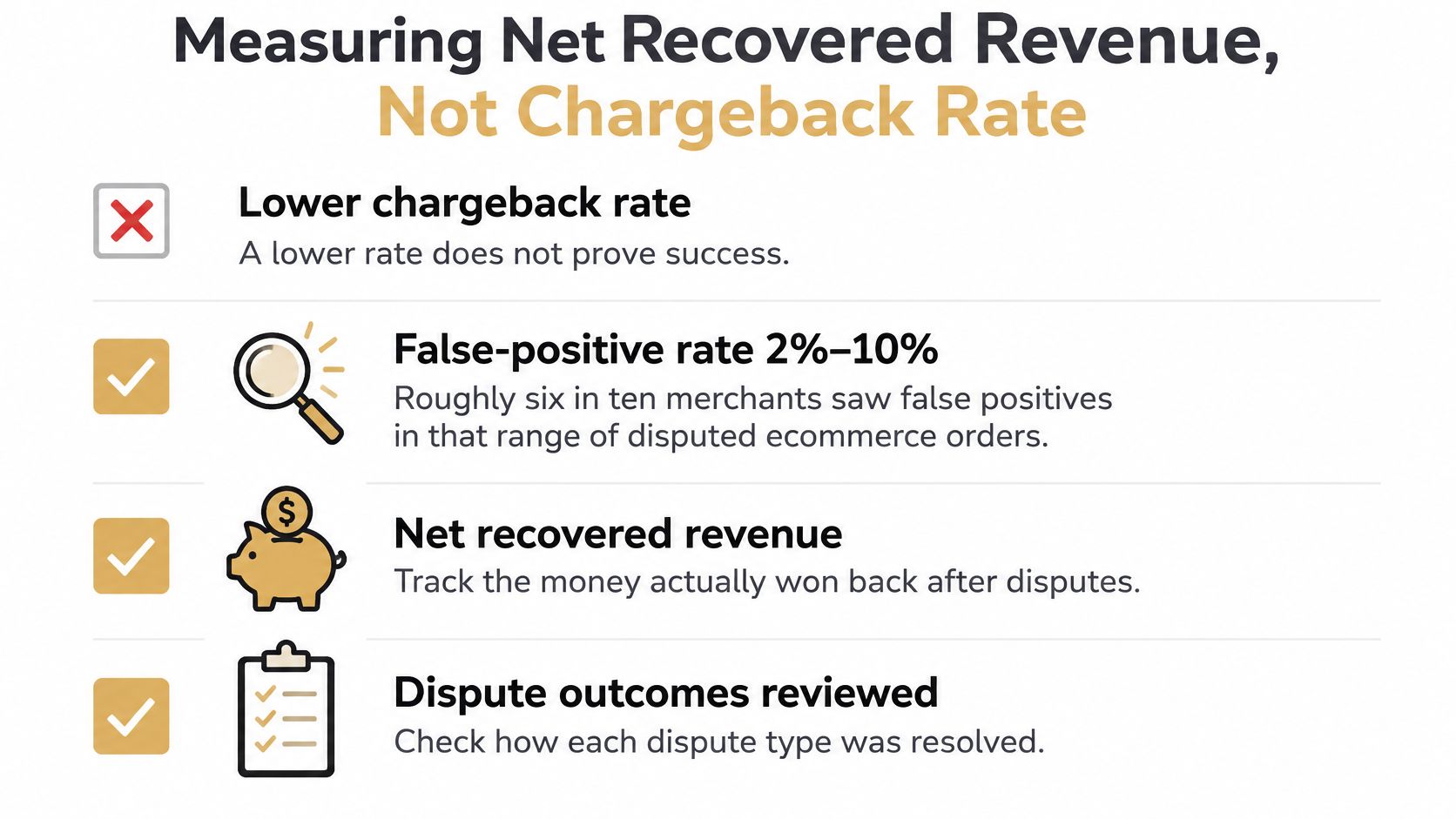
A lower chargeback rate doesn't prove you kept more profit. Digital Transactions, reporting Visa Acceptance's figures, noted that roughly six in ten merchants experienced false-positive rates between 2% and 10% of disputed ecommerce orders. Automatic refunds hit legitimate buyers in that band. The same coverage carried Mastercard's 2025 outlook, which estimated global disputed transaction value would grow from $33.79 billion in 2025 to $41.69 billion in 2028, a 23% increase. A shrinking ratio can hide a growing refund bill.
Net recovered revenue is what remains after refunds, lost repeat purchases, support costs, and false positives. It is the decision-quality number. Chargeback rate is only the compliance number.
Six records that replace the scoreboard
- Split by reason. Unauthorized payment, friendly fraud, fulfillment complaint, subscription confusion, and genuine service failure don't share one correct response.
- Win rate per reason. A strong delivery-proof win rate doesn't transfer to a "cancelled and still billed" case.
- Refund cost per reason. This is the cash you give back, not the sale you originally booked.
- Repeat purchase after a dispute. Customers who leave are a revenue line, not a closed ticket.
- False-positive share. Count legitimate buyers your rules refunded or blocked.
- Net recovered revenue by cohort. High-lifetime subscribers and one-time buyers shouldn't share a rule.
Disputely's dashboard lets you track every dispute, monitor the chargeback ratio, and see how much revenue is saved, so those six records can sit next to the ratio instead of in a side spreadsheet.
Say a cohort does $60,000 in gross monthly revenue and refunds $3,000 across 50 disputes. A refund-only view says you kept $57,000. Eight of those customers were legitimate buyers who would have ordered again at about $60 each, which is $480 you won't see, and support time adds $400. Net recovered revenue is $56,120, not $57,000.
A falling chargeback rate next to falling repeat sales means the rules cost more than they save.
Refund a low-value one-time buyer when the fight is expensive. Keep a high-value subscriber with a call or a replacement when the next few orders are worth more than this one dispute.
Choosing Refund, Fight or Replace by Dispute Type
Match the move to the reason. A blanket refund rule and a blanket fight rule both leak money, just on different orders.
Friendly fraud with a repeat pattern is a fight. Contest it with delivery proof and prior order history. A genuine one-off, where the cardholder didn't recognize the descriptor, usually costs more to contest than it returns, so don't spend the case cost there.
Unauthorized payment is a fraud claim with clearer liability. A fast refund inside the alert window often stops a filed chargeback. Our alerts automatically trigger a refund to avoid that filed-chargeback cost, but the filter still has to skip cases you would win on proof.
Fulfillment complaints should be fixed before they're refunded. Reship, or send the tracking the customer never received. For parcels that never arrive, courier insurance explained in plain terms is worth reading so a lost shipment is a claim, not an automatic write-off. Refund only after the fix fails.
Subscription confusion is a retention problem wearing a dispute label. Refund and cancel cleanly. Contesting a "I thought I cancelled" case saves one cycle and costs the next several.
Genuine service failure should be refunded quickly, and the cause fixed, so the same customer doesn't open a second dispute. Speed matters more than the win here.
Automatic refunds on alerts can act in the 24–72 hour window before a chargeback is filed. Without a reason filter, they also refund the physical-goods cases your proof would have won.
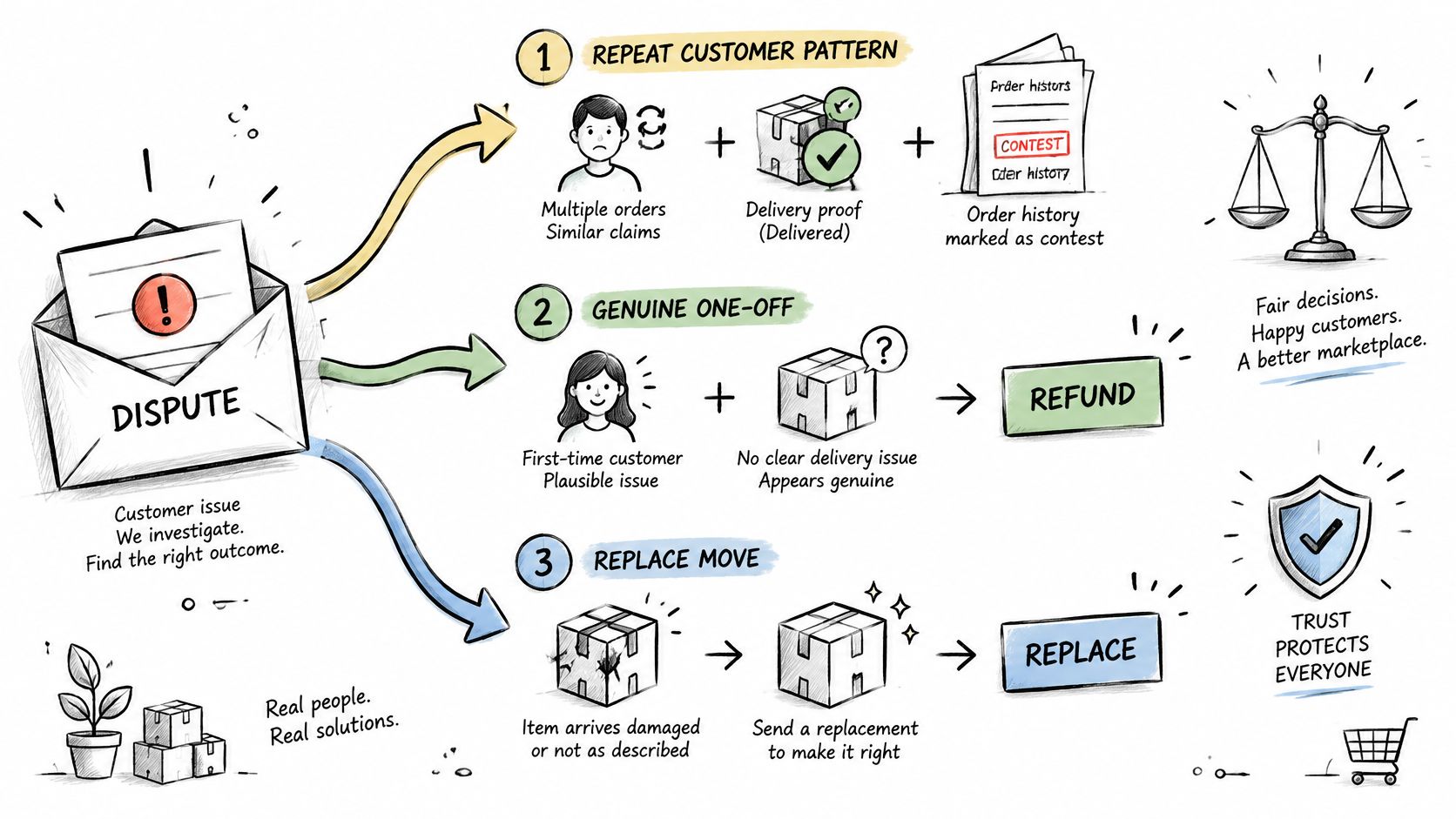
Replace any default order of operations with counts from your own 90-day export. If subscription confusion is half your file, the renewal rule matters more than the fraud rule.
Three questions settle a new dispute.
- Reason: which of the five types is this, based on the claim text and the order record?
- Threshold: does order value clear case cost divided by your win rate for that type?
- Lifetime value: is this a one-time buyer you can refund, or a subscriber you should keep with outreach or a replacement?
If the reason says fight, the threshold says refund, and lifetime value says keep, call the customer before you file anything.
Run a Break-Even Check on Your Next Dispute
Don't wait for a monitoring letter. Run the check on the next dispute and on the last 90 days in the same sitting.
- Export 90 days of disputes with order value, reason, and outcome. One row per case is enough.
- Calculate the win rate for each order type, not one blended rate for the whole file.
- Apply the threshold. Fight when order value exceeds case cost divided by that type's win rate. Refund when it doesn't.
- Write one rule per dispute type from the five-way split, and note who is allowed to override it.
Alert tools work inside the same 24–72 hour window, before the chargeback is filed and before it joins the monthly incident count. Disputely charges per alert, with no monthly fees and no setup costs, and you pay only when a chargeback is prevented. It connects to Stripe, PayPal, Shopify Payments, Authorize.net, and Square, so the export you already run can feed the rules without a second billing stack.
Put the next dispute through the four steps this week. Then compare what you kept against the refund-versus-fight table, using your win rates, not the sample ones.
Disputely stops chargebacks before they post by matching card-network alerts to the order and refunding only under rules you set, so cost and revenue stay intact instead of reversing after you've already shipped. You can see projected savings before you commit, and you pay per prevented dispute rather than a monthly platform fee. Visit Disputely to start protecting revenue or schedule a demo and run your last 90 days against the break-even check.


