
Credit Card Reversal Explained: Refunds vs Chargebacks
You cancelled the subscription. The confirmation email is still sitting in your inbox. Three weeks later the same merchant bills your card again, and now you're looking at a charge you thought you'd already handled.
Or the charge came from a company you've never heard of, and you're trying to work out whether to call the merchant, call your bank, or just wait. Cardholders usually start with the wrong call, because "reversal" sounds like one action when it's really three separate ones. Which of the three applies depends on two questions: has the money settled yet, and who starts the process.
Disputes like these add up to billions of dollars in U.S. credit-card charges each year, and a large share of them end up as formal chargebacks. The right first step is rarely a phone call. It's working out which of the three paths your charge is on.
What a Credit Card Reversal Means
A credit card reversal is the umbrella term for any process that cancels a card charge or returns money to the cardholder. Under that umbrella sit three distinct mechanisms: a payment that hasn't settled can be stopped at the network level, a payment that has settled can be returned by the merchant, and a charge you believe is wrong can be disputed through your bank. Each has a different decision maker, a different timeline, and a different answer to who ends up holding the loss.
Think of it as three ways to undo a payment at a shop. Stopping a payment before the bank processes it is like catching the cashier before the till closes. A refund is asking the shop to hand the money back after you've paid. A dispute is your bank stepping in on your behalf and pulling the money from the merchant's side while it investigates. Same outcome on paper, completely different machinery.
Practical rule: Before you call anyone, check whether the charge is pending or posted. That single fact decides which of the three paths is even open to you.
The machinery is busier than many assume. The Federal Register notice on card disputes reports that consumers disputed $3.03 for every $1,000 spent in 2024, down from $3.47 per $1,000 in 2023, while the amount returned to consumers fell from $1.87 to $1.63 per $1,000 over the same period. That gap is the whole point. A complaint is not the same as a completed reversal, because plenty of claims close without the merchant losing anything.
The same notice shows where disputes cluster. Cancelled recurring transactions, including subscriptions, memberships and utility bills, accounted for 40% of disputes on general-purpose cards in 2024, and the average credit issued after a dispute was $197 on general-purpose cards and $288 on private-label cards. If you're a subscriber who cancelled and kept getting billed, you're not an edge case. You're in the largest single category.
So the first question in your own case isn't "can I get my money back". It's "which kind of reversal is this". Everything that follows depends on the answer.
Reversal, Refund and Chargeback Compared
Three terms get used as if they mean the same thing. They don't, and the confusion is expensive for anyone trying to work out where their money went. The cleanest way to keep them apart is to ask two questions: has the payment settled, and who starts the action. This is the comparison to hold in your head.
| Term | Who starts it | When it happens | What changes for the cardholder |
|---|---|---|---|
| Authorization reversal | Merchant or acquirer, by network message | Before capture or settlement | The approved hold is cancelled or lowered and available credit is released |
| Merchant refund | Merchant | After capture and settlement | Money is returned to the cardholder and is normally final unless a processing error is corrected |
| Chargeback | Cardholder's issuing bank | After the cardholder files a dispute | Funds move from the merchant to the issuer, often provisionally, and the merchant can contest |
The settlement test
The dividing line is settlement, meaning the point at which the merchant captures the payment and it moves through the network to be paid. An authorization reversal is a network message that reduces or cancels an issuer-approved card authorization, and it exists only before capture. Mastercard's transaction processing rules separate a full reversal, which cancels the original authorization outright, from a partial reversal, which reduces it to a lower amount, including after a partial approval.
Those rules also put a clock on it: the acquirer has to send the reversal within 24 hours when a previously authorized transaction is cancelled or finalized below the approved amount. Say a merchant authorizes USD 100 but ships only part of the order and captures USD 70. The remaining USD 30 should be released through a partial reversal, not left sitting as a hold against the customer's available credit. When that step gets skipped, the customer sees a pending amount for an order the merchant has already decided not to collect, and calls support about a charge nobody intends to take.
Why the other two behave differently
A refund follows capture and settlement. The merchant already has the money, so the merchant is the party who gives it back, and the result is normally final unless a genuine processing error needs correcting. A chargeback runs through the banks instead: the cardholder's issuing bank pulls the transaction value back from the merchant's account, through the acquirer, toward the issuer. That direction explains something that confuses merchants. Funds can leave the merchant's account while the case is still being argued, because the chargeback moves first and the evidence debate follows.
Each side arrives at that argument with its own published rules. Retailers set their own refund windows and conditions, right down to niche policies like refund eligibility for football shirts, where a return window and the item's condition can decide whether money goes back at all. Card network rules sit underneath the seller's policy, and they decide what happens when the two disagree.
The one-line version: pending charge, look for an authorization reversal. Posted charge, look for a refund. Wrong charge the merchant won't refund, that's a dispute.
Deadlines That Govern Each Stage
Every stage in this process has a clock attached, and different authorities set the clocks. Miss one and you can lose the path entirely, so the timings below are worth knowing before a date starts to matter.
| Stage | Responsible party | Deadline or timing | Rule or note |
|---|---|---|---|
| Cardholder billing-error notice | Cardholder | Within 60 days after the statement with the error is sent | Must be in writing under the Fair Credit Billing Act |
| Issuer acknowledgment | Card issuer | Within 30 days of receiving the notice, unless already resolved | Must be in writing |
| Issuer investigation | Card issuer | Two complete billing cycles, and no later than 90 days | Ends in a correction or a written explanation |
| Authorization reversal | Merchant's acquirer | Within 24 hours after cancellation or when the final amount is known | Mastercard transaction processing rules |
| Full reversal of an uncompleted authorization | Merchant | Within 24 hours after the merchant knows the transaction will not complete | Visa authorization reversal rules |
| Matching window for inconsistent reversal data | Issuer | Roughly 1 to 8 days while funds stay outstanding | Timing set by the card and transaction type |
Two rulebooks, two sets of clocks
The cardholder side comes from the Fair Credit Billing Act and Regulation Z. The FTC's consumer guidance on billing errors walks through the same timeline in plain terms: the 60-day notice window, the issuer's 30-day acknowledgment, and the investigation cap of two billing cycles or 90 days. The merchant side comes from card network operating rules, which nobody coordinated with the consumer statute. That gap explains a common surprise: a merchant can be late on a reversal while the customer sits comfortably inside the notice window.
The Visa rows matter for a separate reason. Visa's authorization reversal guidance requires a transaction that will not complete to be fully reversed within 24 hours after the merchant knows it won't complete, and any excess between an estimated authorization and the final captured amount within 24 hours of completion. The same document identifies the fields issuers use to match a reversal to its original authorization, and notes that missing or inconsistent values can leave funds outstanding for roughly 1 to 8 days depending on the card and transaction type.
What the dates prove
Read together, the two rulebooks show that a reversal isn't an instant refund. It's a regulated resolution pathway with a notice stage, an investigation stage and a correction stage, and each one has a deadline somebody has to hit. During the investigation the consumer doesn't have to pay the disputed amount or its related finance charges, though undisputed portions of the bill stay payable.
Merchants should assume their records will be examined. Transaction logs, cancellation evidence, delivery confirmation, customer communications and refund documentation all become relevant once a case opens, even when the original payment was properly authorized.
The 60-day notice period is only the cardholder's opening move. Once a dispute is filed, a separate set of windows takes over, and the time limit on a credit card chargeback lays out how those deadlines run on their own clock. Sellers keep their own calendars too: a merchant return policy, for instance a supplier's peptide order return eligibility rules, sets its window on the seller's own terms, parallel to any card network deadline. An order can sit inside one window while falling outside the other.
The practical step is small and settles a lot. Find the statement date on which the error first appeared and count 60 days from it. Then note the date you cancelled, or the date the order failed, because that date is what proves timing on the merchant's side.
How a Reversal Moves From Charge to Resolution
A card transaction passes through stages, and each stage has a different escape hatch. If you know which stage you're looking at, you know who to contact and what to ask for.
The flow below is the short version of that path, from the moment the issuer approves the purchase to the moment the outcome becomes final.
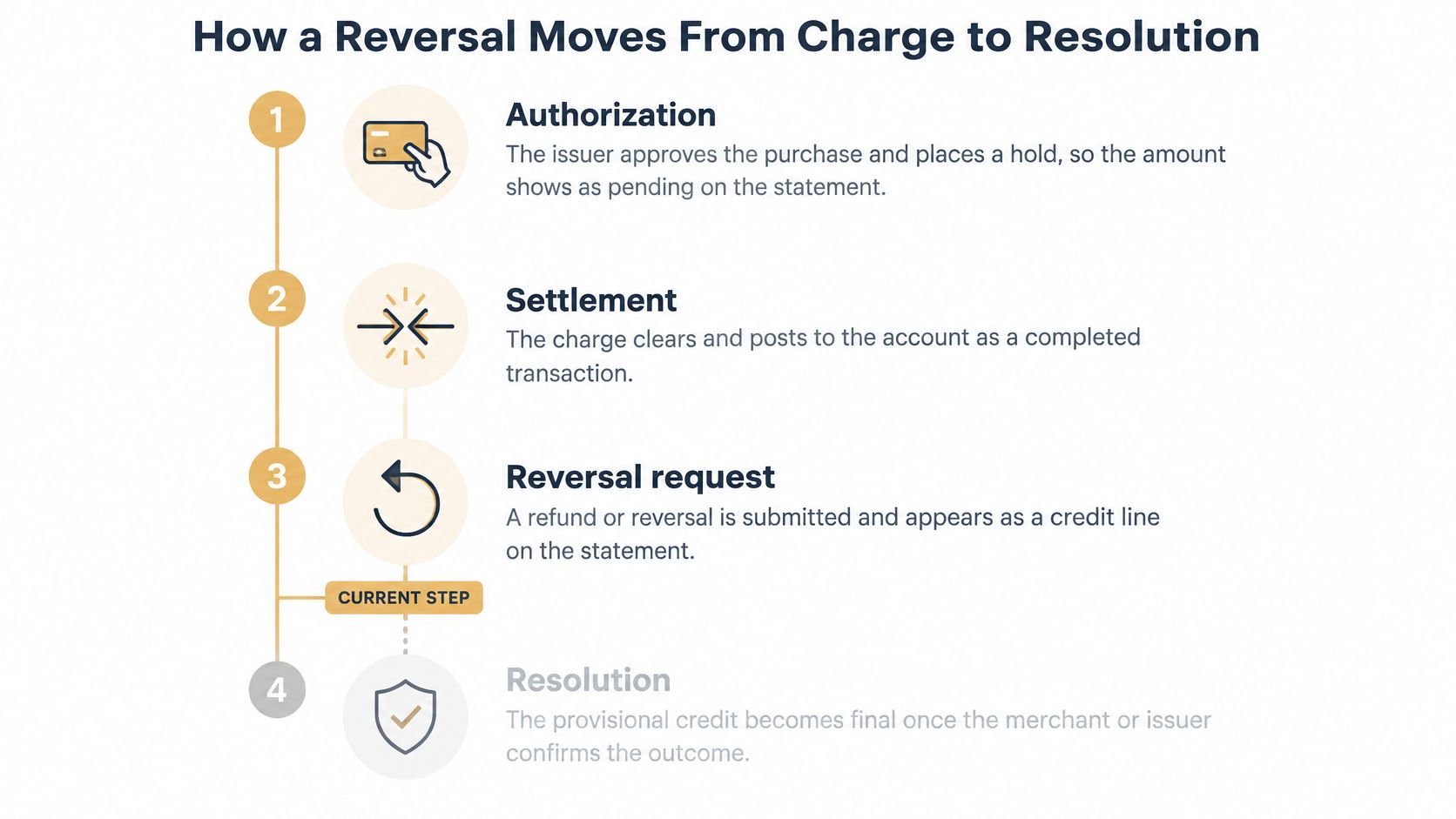
- Authorization. The issuer approves the amount and places a hold. On the statement it shows as pending, and what the merchant holds is a promise of payment rather than payment.
- Change before capture. If the order gets cancelled, the checkout runs twice, or the final amount lands below the estimate, the merchant or its acquirer sends an authorization reversal. It's full when the sale isn't happening and partial when only the unused portion should be released.
- Capture and settlement. The merchant collects the final amount and the charge posts. From this point a return is a merchant refund, and no authorization reversal can undo the capture.
- Cardholder notice. If the charge is unauthorized, the amount is wrong, or goods or services didn't arrive as agreed, the cardholder sends a written billing-error notice to the issuer. This is the step people skip when they call a support line and assume a complaint has been filed.
- Investigation. The issuer may post a provisional credit, the disputed amount and its finance charges don't have to be paid, undisputed charges remain due, and the merchant supplies cancellation records, delivery proof or order messages.
- Outcome. The issuer either corrects the account or rejects the claim in writing, with an explanation and, when requested, the documents it relied on.
Two of those stages end the story without a dispute ever being filed. A released hold at stage two or a merchant refund at stage three is a complete reversal in the everyday sense, and most cancelled orders resolve there. The dispute path only opens when the money has already moved and the two sides disagree about whether it should have.
That path has its own order of operations. The credit card dispute resolution process runs through these stages in sequence, and each step carries its own evidence requirements. Treat them as checkpoints rather than formalities, because an issuer can only decide on the record in front of it.
Real Cases From Subscriptions and Orders
Four situations account for most of the confusion, and each one turns on a different piece of evidence. Find the closest match to your own case and gather that record first.
The subscription that kept billing
Someone cancels a membership in March, the merchant's billing system keeps the mandate alive, and the April charge arrives. Cancelled recurring transactions are the largest single category of general-purpose card disputes, which is why issuers see this shape so often, and the outcome usually rests on the merchant's cancellation records rather than the customer's memory. The customer acted by cancelling; the merchant's record decides whether the later charge stands. Recurring billing raises a specific set of reversal questions, and payments and subscriptions covers how those play out across renewals, trials and failed cancellations.
The order that shipped short
A customer authorizes USD 100 for three items. Only two are in stock, so the merchant captures USD 70. The USD 30 difference belongs to the cardholder's available credit, and it's released with a partial reversal rather than a refund, because the money was never captured. If the merchant skips that step, the customer's limit stays reduced for an order that's already closed, and no amount of calling the bank fixes it. The correction has to come from the merchant side.
The duplicate that wasn't a double order
A checkout error makes a customer click twice, and two authorizations appear for one order. Cancelling one isn't enough. The second has to be reversed with reference data precise enough for the issuer to match it to the original, using the trace number and authorization code attached to the first request. When those fields don't line up, the reversal can't be matched automatically, and the hold sits on the customer's account while the two records are reconciled.
The parcel that never arrived
A cardholder orders goods, they don't show, and the merchant's tracking points at an address that isn't theirs. The cardholder files a written billing-error notice. The merchant responds with delivery confirmation and the order messages. The issuer weighs both and decides whether to credit the account. The turning point is documentary, which is why a screenshot of a tracking page beats a phone call to support every time.
Each case ends with a different party acting, and each depends on a record that already exists somewhere. That's the useful part. Before you contact anyone, identify which record decides your case and pull a copy, whether that's a cancellation email, a capture amount, an authorization code or a delivery scan.
Misconceptions and Limits of a Reversal
Three beliefs cause most of the bad decisions people make after seeing a reversed charge. Each is understandable, and each costs time or money.
Misconception one, a reversal is instant and final
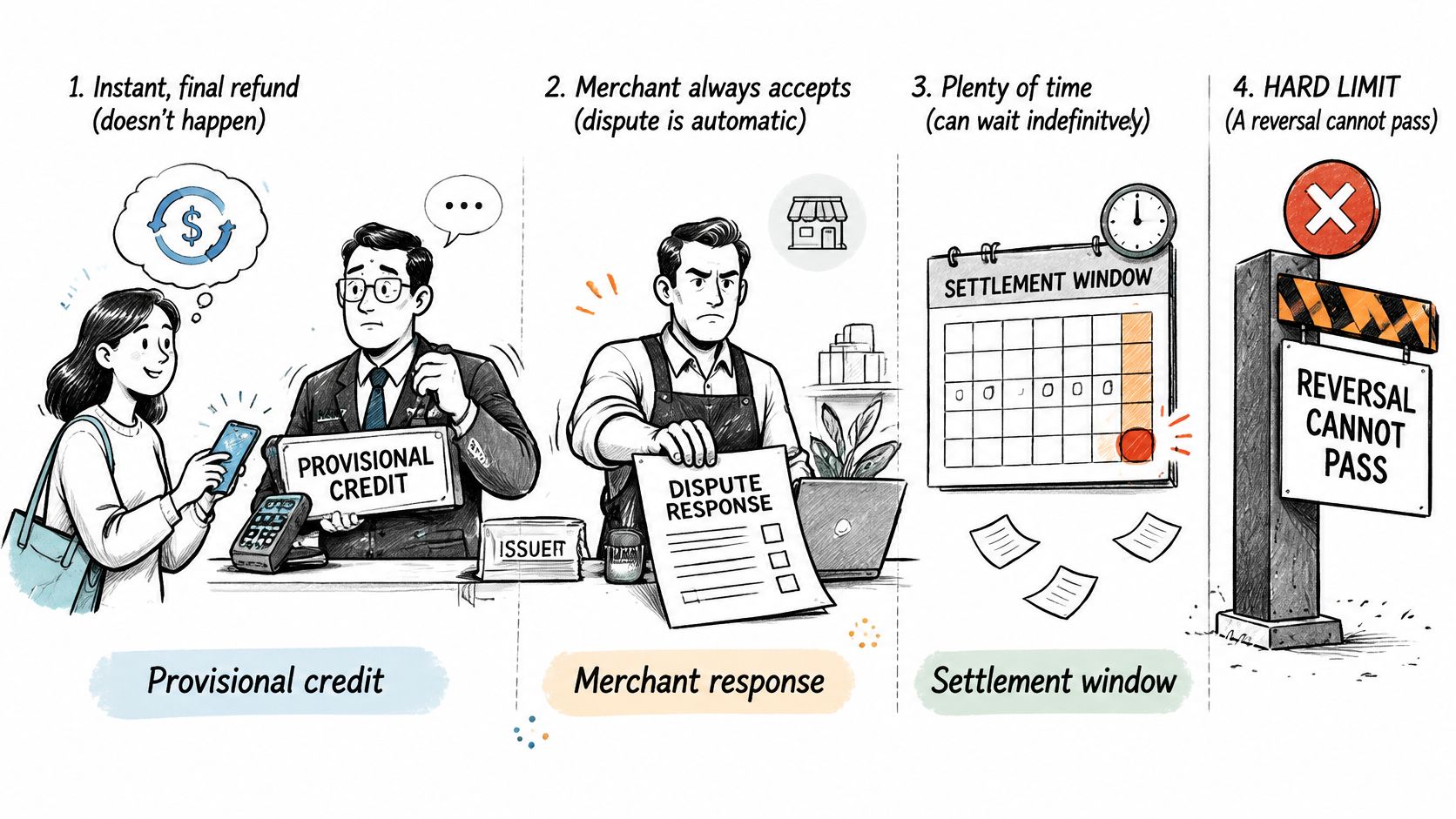
A cardholder sees money land back in the account and assumes the case is closed. The credit posts in days; the decision takes weeks. A chargeback is initiated by the cardholder's issuing bank, and it can credit the customer while the investigation is still running, so the visible result arrives before the verdict. That credit is provisional. U.S. Bank's explanation of chargebacks notes that a card issuer generally has 30 days to acknowledge a written billing-error notice and up to two billing cycles to finish investigating, and that Visa describes a dispute as a reversal of transaction value from issuer to acquirer and typically onward to the merchant's bank and merchant.
A provisional credit works like a deposit: the bank fronts the money while it works out who owes whom. The merchant can respond with evidence, and the issuer can reverse its own provisional result later. For subscriptions, digital services and high-volume ecommerce, that gap is where customers mistake a temporary bank credit for a completed refund and stop pursuing the fix that would close the case.
Here's how the stages line up when a provisional credit gets tested against the merchant's evidence.
Misconception two, a merchant can cancel any refund
Once a refund has been sent, it stops being a customer-service lever. Visa's public rules limit an acquirer's credit reversal to correcting an inadvertent processing error. Mastercard likewise limits reversing a refund transaction to correcting a documented clerical error. So whether a merchant can reverse a refund it already issued comes down to one question: was the refund itself a processing mistake? A genuine error can be corrected. Money that was owed stays refunded, however the merchant feels about it afterwards.
For merchants: a sent refund is a settled matter, and regret is not a processing error.
Misconception three, telling the bank is enough
What fixes a charge depends on where the money sits and whose move it is. A pending authorization needs a reversal from the merchant's side. A posted charge needs a refund. A charge already in dispute needs evidence; another complaint to the bank changes nothing at that stage. Refunding a charge that's already in dispute creates duplicate-credit risk, while delaying a valid refund tends to invite the chargeback you were trying to avoid. Check the state before you act.
The limits deserve a plain statement too. Outcomes depend on factors no single party controls, including merchant practices, issuer behavior, processor risk models and card network rules. Accepting a dispute is sometimes the safer choice: contesting a clear claim burns staff time, adds a chargeback to the merchant's ratio, and usually lands in the same place anyway.
Confirm Your Reversal Path Before the Deadline
A reversal is decided less by the complaint than by timing: who acts, whether the charge has settled, and which deadline falls first. Check both sides before choosing a path.
If you're the cardholder
- Find the statement date. Count 60 days from the date the statement containing the error was sent. The window is set by the Fair Credit Billing Act and it runs from the statement, not from the day you noticed the charge.
- Put the notice in writing. Name the account, the amount and the reason the charge is wrong, then keep a copy. A call to a support line doesn't start the clock.
- Save the record that matches your case. Cancellation confirmations, chat transcripts and renewal notices carry subscription disputes; order numbers, delivery scans and return labels carry goods disputes.
If you're the merchant
- Send the reversal inside 24 hours. If an order is cancelled, duplicated, or captured below the approved amount, send a full or partial authorization reversal, as when USD 100 is authorized and only USD 70 is captured.
- Keep the matching fields. The trace number, retrieval reference and authorization code are what the issuer uses to tie a reversal to its original authorization. Without them, the hold stays on the cardholder's account while the records are reconciled.
- Assemble evidence before a dispute opens. Delivery proof, refund records and order messages are what a representment will rest on, and pulling them after a deadline is harder than keeping them as you go.
The earliest deadline on the chart is the one that decides your case.
When an alert arrives before the chargeback is filed, a refund is usually cheaper than an argument. Disputely connects to Visa RDR, Mastercard CDRN and Ethoca alerts and, with your authorization, can issue the refund that closes the dispute before it reaches your merchant account; you pay only when a chargeback is successfully prevented. Connect your processor in a few minutes and see how many disputes you can stop at the alert stage by visiting Disputely.


