
Dispute Management Guidelines for Visa Merchants in 2026
Fighting every chargeback you can prove is one of the fastest ways to lose money and still put a merchant account at risk. Winning a representment returns the transaction amount, yet the dispute event can still sit on your monthly monitoring report, eat staff hours, and nudge your acquirer toward tighter underwriting.
Dispute volume isn't slowing down either. In a 2026 announcement from Visa's newsroom on dispute resolution services, Visa reported processing 106 million disputes globally in 2025, a 35% increase compared with 2019. Recovery performance varies widely across the industry: based on 2024 VisaNet data published in 2025, Visa's Dispute Management Service overview reported a 90% dispute recovery rate for its managed service compared with a 79% industry average. Even strong recovery rates leave high-volume merchants exposed when they treat every case as a legal argument instead of a financial calculation.
Effective dispute management guidelines for Visa merchants treat each incoming notice as a priced operational decision. You weigh the order value, your acquirer's fee, the time required to assemble transaction-specific proof, and your win probability against the compliance math of Visa's monitoring program. Sometimes contesting protects your margin; other times, refunding before a chargeback posts saves far more than the ticket price.
Dispute Stages and Response Deadlines at a Glance
A Visa dispute is a cost decision with a clock attached. The response window decides which options remain open, while the amount, fee exposure, proof quality, and acquirer monitoring math decide what is worth doing.
| Stage | Merchant action | Response window | Confirm with |
|---|---|---|---|
| Retrieval request | Locate the transaction records and send the documents the acquirer asks for | 10 business days | Acquirer dispute team |
| Chargeback received | Decide whether to refund, accept or represent the case | 20 calendar days | Acquirer notice and reason code |
| Representment | Submit compelling evidence that answers the reason code through the acquirer | 20 calendar days | Acquirer dispute team |
| Pre-arbitration | Respond to the issuer's pre-arbitration request or escalate the case | 10 business days | Acquirer, backed by Visa dispute rules |
| Arbitration | Accept Visa's decision or pursue the case if the acquirer allows it | 10 business days | Acquirer, through Visa's ruling notice |
The Visa Dispute Management Guide for Merchants gives these network windows. Your acquirer may set an internal cutoff earlier so its team can review and transmit the file. Treat the notice date as the start of the calculation, then work backward to the moment your evidence must be complete. A merchant with a $180 order, a $25 chargeback fee, and two hours of staff time to assemble proof is facing a different decision than a merchant with a $20 order and the same fee. Price the case before deciding to contest.
Why Deadlines Outweigh Evidence Quality
The guide states that each stage carries a strict response window and that a case can be lost automatically when a merchant or acquirer misses the deadline. A delivery signature, checkout log, refund receipt, or customer email does nothing while it sits in a draft folder past cutoff. Completeness matters, but timeliness decides whether the evidence is reviewed at all.
Operational rule: Treat your acquirer's submission deadline as a hard loss trigger, not a soft target. Aim to submit complete responses at least two business days early so portal formatting errors never forfeit a winnable case.
That buffer gives your team room to correct a missing order reference, attach the right transaction record, or resolve a portal upload failure. It also protects the monitoring side of the decision. Each refund, accept, or contest choice should be checked against the acquirer's VAMP ratio because a recovered transaction may still matter inside the monthly dispute count. Subscription, ecommerce, and card-not-present teams need fast retrieval of order records, shipping scans, refund receipts, and customer emails, not just authorization proof. Track dispute activity as a percentage of sales alongside response outcomes, then break down win and loss rates by product line, fulfillment channel, and customer-service trigger.
Building Your Daily Open Case Log
Before drafting a rebuttal, set up a centralized open-case log in a shared spreadsheet, ticketing board, or payment operations tool such as Stripe, Adyen, or Shopify Payments. Every active row needs five fields: transaction ID, current stage, reason code, dollar amount, and acquirer due date.
Review that log at the start of every business day and sort it by due date ascending, not by ticket value. High-value cases deserve close analysis, but first-in, first-out deadline control prevents a small claim from becoming a monitoring problem. Enter the exact acquirer deadline for every open dispute in your queue right now so nothing slips while you refine the broader workflow.
Who Holds Each Obligation Across Merchant, Acquirer and Issuer
Misunderstanding who owns each handoff causes avoidable losses. Three separate organizations touch every Visa dispute, and none of them shares the same financial incentive.
The issuing bank represents the cardholder. When a customer calls their bank or taps a button in their banking app to challenge a charge, the issuer assigns a reason code, opens the dispute on Visa's network, and reviews whatever evidence eventually comes back.
The acquiring bank or payment processor sits between you and Visa. It receives the issuer's notice, deducts or holds the disputed funds, sets the practical response deadline, and transmits your representment file into Visa's system. All funds movement occurs through the customer's payment processor or acquiring bank, and we don't hold or control merchant or customer funds. Third parties like payment processors, issuing banks, and card networks make their own decisions and timelines, and we aren't responsible for their actions, responses, or rulings.
The merchant owns the evidence and the business decision. Because you can't reverse a posted chargeback on your own once funds move through your processor, your obligations stay squarely inside your own systems:
- Preserve Complete Transaction Records: Keep checkout logs, fulfillment proof, and support threads searchable by order number and card transaction reference.
- Hit Acquirer Deadlines: Submit evidence inside your processor's stated portal window rather than relying on network-level estimates.
- Verify Cutoff Dates in Writing: Confirm operative timelines and submission formats with your acquirer account rep or dispute desk whenever you add a new processor or region.
- Report Volume and Outcomes Internally: Share dispute counts, win rates, and dollar losses with finance and product leadership every month so root causes get fixed.
Where Merchant Teams Usually Drop the Ball
The most common operational breakdown happens when a lean ecommerce team assumes its payment processor will chase missing paperwork or send repeated reminders. Processors automate notices to a single billing email that nobody checks daily. By the time finance spots a debit on a settlement payout, the submission window has already closed and the case is forfeited.
Prevent that handoff gap with a quick responsibility check today. Assign one named primary owner for each merchant account's dispute queue, one trained backup who covers vacations and sick days, and one documented acquirer dispute contact who confirms deadlines in writing.
Dispute Categories and What Each Claim Means
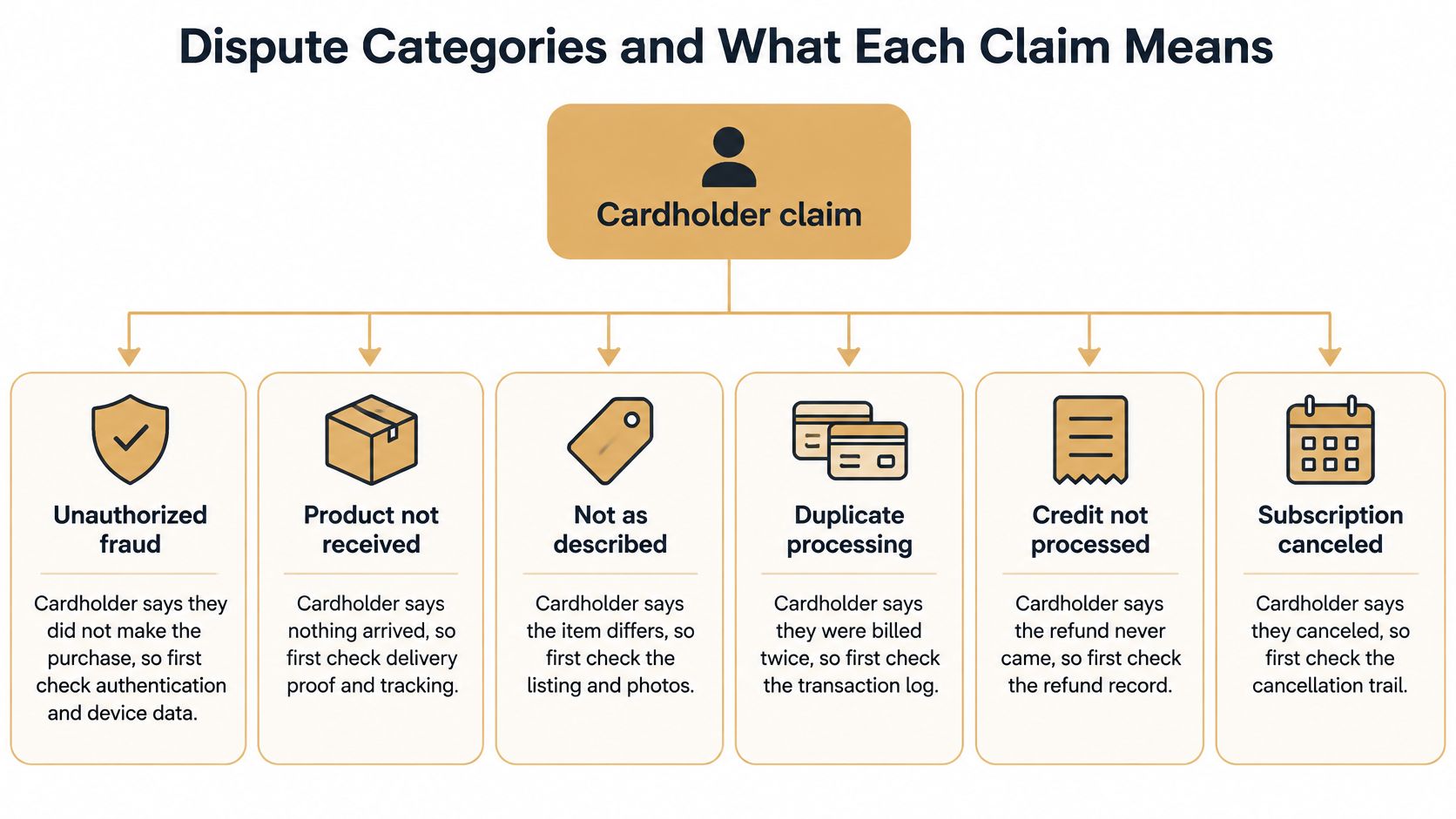
Pulling receipts before identifying the claim wastes hours because banks evaluate proof strictly against the cardholder's stated complaint. The flowchart below groups common cardholder challenges and shows the first verification step for each path.
Card networks and acquirers attach numeric identifiers to these claims. Rather than trying to memorize every code across updates, load your acquirer's current code directory directly into your case log and reference a dedicated breakdown of Visa chargeback reason codes when mapping incoming alerts.
| Category | Typical cardholder claim | First decision |
|---|---|---|
| Unauthorized fraud | I did not make this purchase | Was the transaction authorized and linked to a known account or device? |
| First-party misuse (friendly fraud) | I did not receive or recognize this charge, though the purchase happened | Does the record show the cardholder used the product or service? |
| Authorization | The transaction was not approved or exceeded the authorized amount | Was there a valid authorization for the full amount and date? |
| Non-receipt or fulfillment | I never received the item or service | Does delivery or usage proof match the stated claim? |
| Cancellation or refund not processed | I cancelled or was promised a refund | Is there a cancellation record and a refund policy shown at purchase? |
| Processing error | I was charged twice or charged the wrong amount | Does settlement data show a duplicate or incorrect charge? |
Walking Through the Six Claim Types
An unauthorized fraud claim means the cardholder insists a stranger stole their payment credentials. Your first move is checking authentication markers, AVS and CVV matches, and whether the order came from an established customer account or recognized device.
First-party misuse, widely called friendly fraud, looks identical on the surface when a buyer claims they don't recognize the charge, yet the purchase came from their household or account. Instead of hunting for card-theft clues, check whether account logs, delivery scans, or customer support messages prove the buyer received or used what they paid for.
With an authorization dispute, the bank challenges whether you ever held valid approval for the final settlement figure. Pull the original authorization code, date, and amount to see if a tip adjustment, partial capture, or delayed shipment pushed settlement past the approved limit.
Non-receipt or fulfillment claims focus purely on delivery. Physical goods require carrier tracking tied to the shipping address on the order; digital services require access or download logs confirming availability after payment.
A cancellation or refund not processed dispute means the buyer says they opted out of a subscription or returned an item and never saw their money back. Look straight at your CRM cancellation timestamps, return merchandise authorization records, and the exact policy displayed during checkout.
Finally, a processing error points to a mechanical billing mistake such as a duplicate capture, wrong currency, or incorrect total. Compare your order ledger against your gateway settlement batch before doing anything else, because a genuine duplicate charge should be refunded immediately rather than argued.
Separating True Fraud From First Party Misuse
The sharpest diagnostic line sits between unauthorized fraud and first-party misuse. Unauthorized fraud asks a single threshold question: did the legitimate account holder place this order? First-party misuse asks a different question: did the cardholder agree to the purchase, receive it, or benefit from it?
One single order can land in completely different categories depending on which reason code the issuer picks. A subscriber who forgets to cancel a quarterly box might file under unauthorized fraud because they forgot the descriptor, or under canceled recurring billing because they emailed the wrong inbox. Tag every open case in your log with its exact category before anyone drafts a response.
VAMP Ratio Thresholds by Region and Level
Winning disputes does not protect a high-volume merchant from network monitoring if fraud reports keep rising in the background. Visa replaced its legacy fraud and dispute monitoring tracks with the Visa Acquirer Monitoring Program (VAMP), which took effect on April 1, 2025, according to Adyen's dispute and fraud monitoring documentation.
| Level | Threshold | Minimum monthly events | Change or note |
|---|---|---|---|
| Acquirer above standard | 0.50% (50 bps) | Acquirer level | Published acquirer-level marker |
| Acquirer excessive | 0.70% (70 bps) | Acquirer level | Published acquirer-level marker |
| Merchant excessive: US, Canada, Europe, Asia-Pacific | 2.20% (220 bps) | 1,500 fraud plus dispute events | Drops to 1.50% (150 bps) effective April 1, 2026 |
| Merchant excessive: Latin America | 1.50% (150 bps) | 1,500 fraud plus dispute events | Regional merchant cutoff |
| Merchant excessive: CEMEA | 2.20% (220 bps) | Regional count-and-amount conditions | Regional count-and-amount rules apply |
Those values come from the Visa Acquirer Monitoring Program fact sheet, which also states the date change for the 1.50% merchant threshold. Read the table as a monitoring map, not a target to test. A portfolio sitting below the merchant cap can still draw scrutiny if its acquirer is under pressure at the acquirer level.
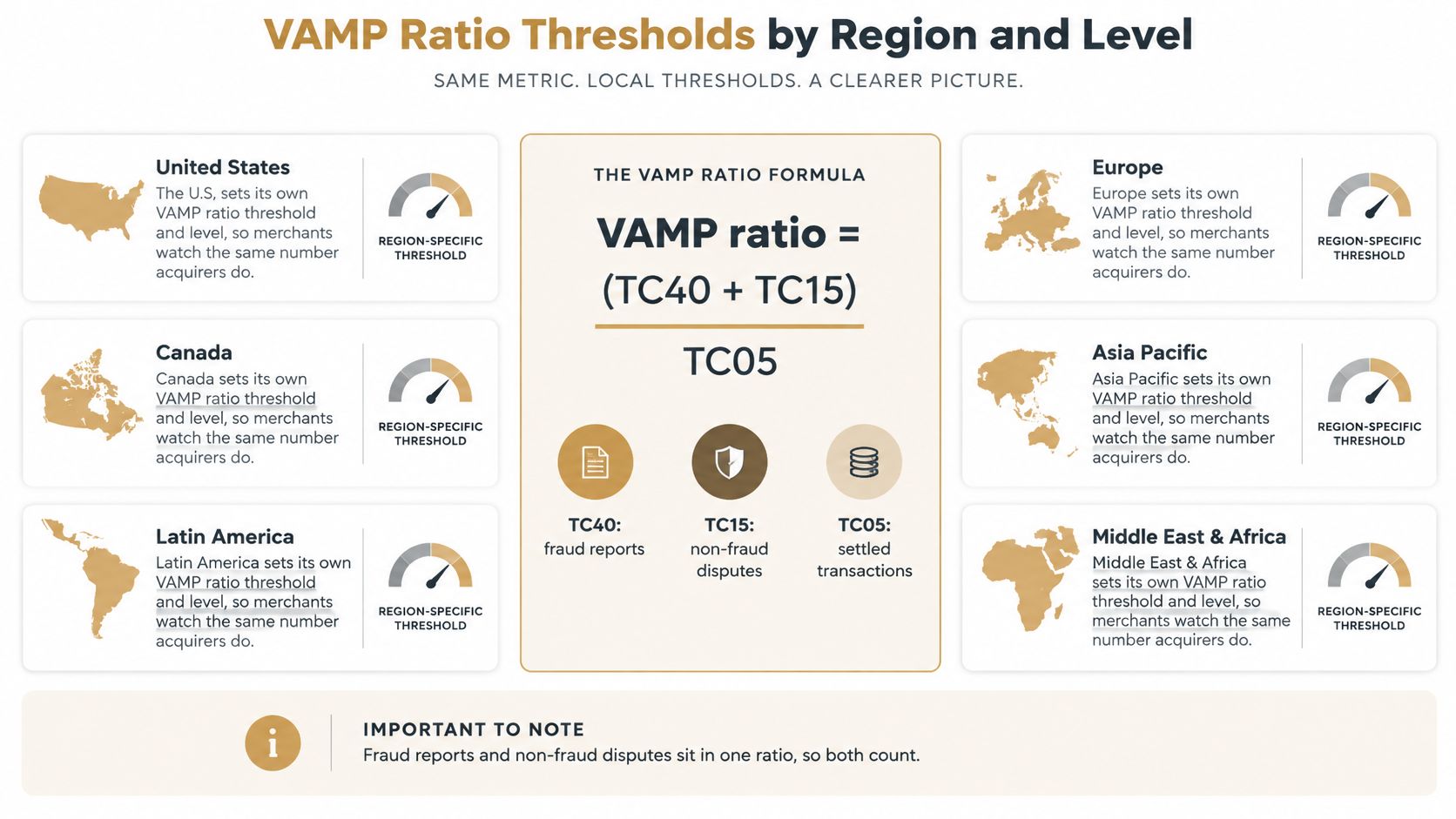
Under the published Visa fact sheet, Visa calculates the VAMP ratio by combining issuer fraud reports (TC40) and non-fraud disputes (TC15), then dividing that sum by settled transactions (TC05). Because both numerators sit inside one equation, cutting chargebacks alone will not rescue your standing if unauthorized fraud reports remain high.
How Regional Thresholds and Portfolio Pressure Work
The numbers shift by geography and enforcement window. Visa's published 2025 fact sheet sets acquirer above standard performance at 50 basis points (0.50%) and excessive performance at 70 basis points (0.70%). At the merchant tier, the initial excessive cutoff in the United States, Canada, Europe, and Asia-Pacific stood at 220 basis points (2.20%) with at least 1,500 combined monthly fraud and dispute events, before stepping down to 150 basis points (1.50%) effective April 1, 2026, while keeping the 1,500-event minimum outside the Middle East and North Africa.
Latin America already runs on the tighter 150-basis-point merchant cutoff, and CEMEA applies 220 basis points alongside regional count-and-amount rules. Definitions and rollout dates differ across regions and acquirers, so confirm the exact regional calculation with your processor in writing. Use a close look at the Visa Acquirer Monitoring Program when setting internal risk triggers.
The practical point is simple: set alerts against the ratio your processor will apply, not the loosest published number you can find. If your business spans regions, track each portfolio separately so one market's event volume does not hide another market's ratio problem.
Why Portfolio Monitoring Exposes Compliant Merchants
Many payment teams watch only the chargeback percentage displayed inside their gateway dashboard and feel safe at a moderate rate. That view misses two realities:
- Missing Numerator Data: Basic processor dashboards often highlight posted disputes while burying TC40 fraud reports that never turned into chargebacks.
- Acquirer Portfolio Heat: Because acquirers face their own tighter portfolio markers, an acquirer creeping toward its threshold will scrutinize or offboard merchants sitting well below Visa's merchant-level cap.
Tracking TC40 and TC15 both separately and together against settled TC05 volume lets you spot trouble months before an acquirer risk analyst emails you a remediation plan. Treat each alert, refund, accept, and contest choice as a cost decision. The direct cost is the order value, while the indirect cost is its effect on the ratio that feeds monitoring and processor review.
Refund, Accept or Contest by Expected Cost
Most merchants treat an incoming dispute as a binary coin flip: swallow the loss or fight it. That habit ignores portfolio economics. As noted in Convesio's guide to Visa chargeback rules, industry monitoring summaries describe heightened acquirer attention around ratios of 0.3% to 0.5% and remediation risk above 0.5% for merchants processing at least 1,000 monthly transactions. That means every dispute carries two distinct costs: the direct cash impact on that order and the indirect pressure on your processing relationship.
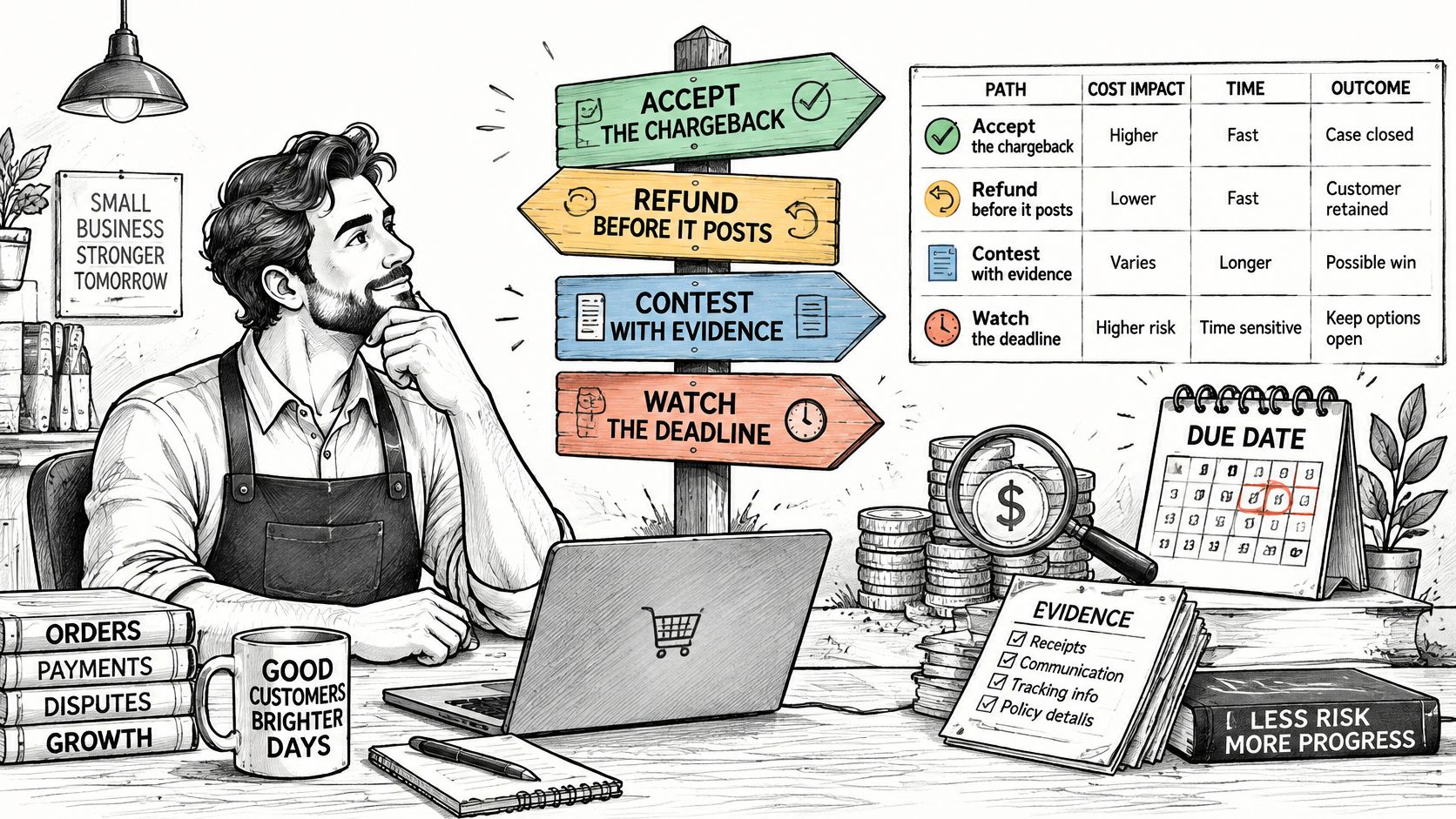
Before choosing a path, weigh all four operational options side by side.
| Response | Cost it creates | Effect on dispute ratio | Best fit |
|---|---|---|---|
| Accept the chargeback | Lost sale value, acquirer chargeback fee (per merchant agreement) and returned goods | Counts toward the ratio | Weak evidence or very low-value claims |
| Refund before the chargeback posts | Refund amount and lost margin, with no chargeback fee if the alert closes the case | Can keep the dispute from posting when alerts apply | Unclear claims where ratio risk is high |
| Contest through representment | Staff time, evidence preparation and the fee if the case is lost | Counts until the case is won | Clear evidence matched to the reason code |
| Escalate to pre-arbitration or arbitration | Higher fees, more time and a final decision by Visa | Counts and keeps exposure open | High-value cases with strong documentation |
Pricing a Dispute With a Worked Example
To compare paths objectively, price five variables: order value, your acquirer's chargeback fee, labor to compile evidence, realistic win probability for that reason code, and your current headroom under your acquirer's ratio ceiling.
Say an ecommerce store faces a hypothetical non-receipt dispute on a $180 order. Based on past outcomes for similar carrier scans, the team estimates a 35% representment win chance. Their acquirer charges a $25 fee on a lost case, and pulling order logs, tracking proof, and emails takes $20 in staff time.
- Accepting the chargeback locks in a $205 loss ($180 sale plus the $25 fee), and the dispute hits the ratio.
- Refunding before posting through a pre-dispute alert costs the $180 order value with no chargeback fee, keeping the event off the posted dispute count.
- Contesting via representment costs $20 in labor upfront plus a 65% probability of losing $205, for an expected cost of $153.
On pure expected cash cost, contesting beats refunding. Now flip the portfolio context. If this merchant is creeping close to its acquirer's ratio warning line, absorbing a 65% chance of another posted dispute can trigger rolling reserves or monitoring fees that easily dwarf that small cash savings. In that window, refunding pre-dispute is the cheaper commercial move.
Where Alerts Fit Without Rewarding Abuse
Pre-dispute networks change the math by giving you a short window to act before a chargeback formalizes. When Visa RDR, Verifi CDRN, and Ethoca alerts reach us as a dispute is filed, we match them to the order and refund them under your rules so they never hit your merchant account or dispute ratio.
Still, blind auto-refunding has a dark side. Refunding every alert indiscriminately destroys gross margin on high-ticket goods and teaches serial friendly-fraud buyers that disputing gets them free products. I'd set tiered rules: auto-refund low-value orders or ambiguous claims when ratio headroom is tight, and route high-ticket orders with verified delivery or strong usage logs to manual review and representment.
Contest when your evidence directly answers the reason code and the order value justifies the labor and loss risk; refund pre-dispute when proof is thin or ratio headroom is shrinking.
Building Evidence That Matches the Reason Code
Banks don't grade representment packets by page count. Under Visa's public core rules and merchant standards, submitted compelling evidence must directly address the dispute condition and link clearly to the specific transaction. Visa's rules also require acquirers to provide requested merchant information within five business days, which means your records must live in searchable, audit-ready storage long before an escalation hits.
Six Step Evidence Pack Procedure
Follow the same build sequence for every contested case so an issuer reviewer can verify your claim in under two minutes:
- Map the reason code to its dispute category. Confirm the exact claim before touching your order database so you gather targeted proof instead of dumping an entire CRM export.
- Lock onto one shared transaction identifier. Pick an order ID, invoice number, or processor reference that appears consistently across every document in the chain.
- Pull authorization and settlement records. Export the approval code, timestamp, settled amount, currency, and AVS or CVV match details from your payment gateway.
- Attach the order invoice and proof of fulfillment. Include the itemized receipt alongside carrier delivery confirmation, signed pickup slip, or service access logs proving delivery occurred.
- Add direct post-transaction communications. Include only support tickets, emails, or chat transcripts that explicitly rebut the cardholder's claim, such as a buyer confirming package arrival or acknowledging a policy.
- Redact unneeded personal data and trim filler. Strip out full card numbers, unrelated internal notes, or irrelevant marketing emails so the reviewer focuses purely on the facts proving your defense.
Relevance Always Beats Volume
Sending thirty pages of generic terms of service weakens a file instead of strengthening it. A carrier delivery scan won't rebut a claim that a customer canceled before renewal, and an authorization approval code never proves a parcel reached the doorstep. Each piece of paper has to close a specific logical gap.
Take a physical non-receipt dispute on a high-value apparel order. A winning packet doesn't need site-wide policies; it needs the order invoice showing the billing and shipping address, the UPS or FedEx delivery scan matching that exact address and zip code, and a post-delivery email or SMS confirmation from the customer referencing the item.
Recurring service businesses like fitness clubs, coaching studios, or membership venues run into a parallel requirement on cancellation disputes: if your signed contract is vague or missing, you can't prove billing terms. Operators who want clean documentation from day one often look at structured templates to download a gym membership contract with explicit notice periods and cancellation clauses before onboarding paying members.
Prepare a mapped evidence checklist for every reason family before disputes ramp up, and align your internal intake workflow with a documented evidence collection process so any analyst on your team builds consistent, scannable files.
Compelling Evidence for Subscriptions and Digital Goods
SaaS platforms, streaming apps, online courses, and membership brands can't lean on FedEx delivery scans. When there's no cardboard box on a porch, issuers look for proof that the cardholder consented to recurring charges and benefited from the digital product. Map your data retention to each stage of the customer lifecycle so proof is captured automatically at checkout and login.
| Lifecycle stage | Evidence to preserve | Why it matters |
|---|---|---|
| Consent to recurring terms | Timestamped checkout disclosures and the accepted terms | Shows the customer agreed to the renewal charge |
| Account activity | Login history, device and IP continuity | Links the disputed charge to the account holder |
| Product usage | Downloads, streaming activity and feature logs | Shows the customer received the benefit |
| Renewal notice | Reminder email or in-app notice sent before renewal | Answers a claim that the customer forgot about the renewal |
| Cancellation handling | Cancellation attempts, confirmations and effective dates | Shows whether cancellation was processed before the billing date |
| Refund policy | Policy text shown at purchase, with its timestamp | Confirms the refund terms the customer accepted |
Applying Compelling Evidence 3.0 Without Overloading Reviewers
As outlined in the Visa merchant dispute guidelines, compelling evidence must connect the disputed transaction clearly to the payment credential, amount, and cardholder identity while demonstrating that the customer participated in or benefited from the purchase. Under Visa's Compelling Evidence 3.0 framework, merchants can defend eligible fraud disputes by linking the disputed transaction to two prior undisputed transactions on the same account using at least two shared data points, such as device ID, IP address, email address, shipping address, login credentials, or phone number.
Capturing those fields is only half the work. Dumping raw server logs or JSON blobs into a PDF usually results in a lost case because bank analysts won't parse engineering output. Convert account continuity into a clean, privacy-conscious summary table showing dates, masked credentials, matched IP or device identifiers, and plain-English descriptions of activity (for example, "User logged in from recurring device ID and exported three client reports two days after renewal"). Retain these lifecycle logs long enough to cover dispute filing windows while honoring regional data-minimization rules.
Distinguishing Misuse From Compromised Accounts
Digital records also tell you when to walk away. Genuine account takeover leaves obvious footprints: a sudden jump to an unfamiliar country or device, a rapid email or password reset right before an upgrade, and zero historical overlap with prior billing cycles. First-party misuse shows the opposite pattern, with continuous logins from the customer's usual device before and after the renewal date.
Even when misuse is obvious, contesting isn't always smart. If a customer disputes a low-value monthly renewal where your product logs show zero logins since the billing date, refunding is usually safer commercially than spending staff time fighting a thin file. Before representing any digital dispute, run a simple three-part reviewer test:
Can an outside bank analyst see in sixty seconds that the customer agreed to the recurring charge, used the product after payment cleared, and never received a cancellation confirmation prior to billing?
If any one of those three answers is blurry, price a refund before committing hours to a losing rebuttal.
How to Respond to a Dispute Step by Step
A disciplined response workflow removes panic when notices hit your inbox. Use the visual overview below as a quick floor reference for your support and risk teams, then follow the eight detailed steps to move every case cleanly from intake to archive.
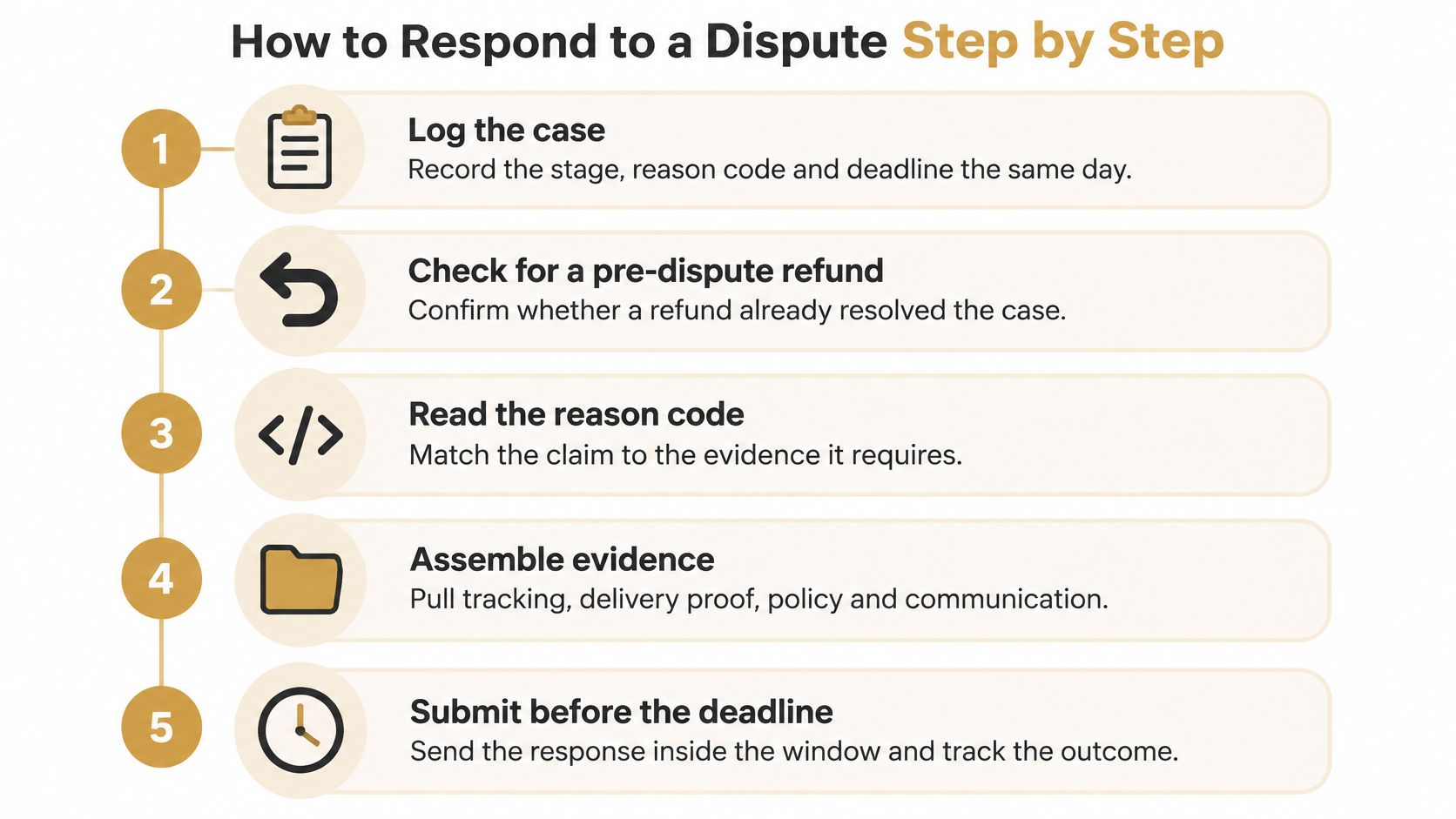
- Log the case the same day it arrives. Record the stage, reason code, transaction amount, and exact acquirer deadline immediately so the clock is visible to the whole queue. Common slip: Teams calculate a deadline from the day they opened the email rather than the date printed on the acquirer's notice, losing days before they start.
- Check for an open alert or prior refund. Confirm whether a pre-dispute refund window is still active or whether your support desk already credited the cardholder. When a customer disputes a charge after you already issued a credit, pull the Acquirer Reference Number (ARN) to prove the funds moved back; reviewing a guide on tracing refunds on card payments helps ops teams verify settlement paths and attach exact refund confirmation receipts. Common slip: Teams contest a chargeback without checking recent support refunds, triggering a double debit.
- Verify the claim category and factual validity. Cross-check the cardholder's reason code against your order ledger, shipping scans, or billing logs to see if you made an error. Common slip: Fighting a legitimate merchant mistake, such as a missed cancellation request or duplicate capture, wastes fees and damages credibility with your acquirer.
- Run the expected-cost decision. Compare your order value, labor cost, acquirer fee, estimated win rate, and current ratio headroom to pick accept, refund, or contest. Common slip: Automatically contesting every high-emotion case on principle even when the expected loss exceeds a quick resolution.
For a concise walkthrough of how acquirer portals, deadlines, and representment packets fit together in practice, watch this short breakdown before finalizing your internal response playbook.
- Assemble the matched evidence pack. Pull only the transaction-linked documents required for that specific category and redact extraneous personal details. Common slip: Uploading unedited email chains or generic store policies that obscure the key proof.
- Draft a concise, point-by-point rebuttal. Write a half-page cover summary at the top of your packet answering the cardholder's stated claim line by line, citing the exact page number of each attached exhibit. Common slip: Pasting a boilerplate paragraph that never mentions the transaction ID, delivery timestamp, or specific reason code.
- Submit through the required channel early and archive the receipt. Upload your PDF inside the acquirer's designated portal several days ahead of cutoff and save the confirmation ID or timestamped screenshot. Common slip: Emailing evidence to an account manager when the acquirer requires portal uploads, causing the submission to go unprocessed.
- Record the verdict and feed losses back into prevention. Update your case log with won or lost status, dollar recovery, and the root cause behind every defeat. Common slip: Closing lost tickets without telling product, fulfillment, or support teams why the bank ruled against you.
A complete, audit-ready case file always ends with three artifacts stored together: the updated case-log row, a one-page evidence index tied to the transaction ID, and the acquirer's submission confirmation receipt.
Preventing Disputes and Tracking Ratios Each Month
Representment recovers revenue after damage is already done. Sustainable Visa dispute operations shift effort upstream so avoidable claims never enter the network in the first place.
Start with routine monthly risk reporting that goes beyond top-line counts. Track total disputes, win and loss rates, and dispute-to-sales ratios segmented by product SKU, fulfillment channel, merchant outlet, and customer-service issue. A sudden spike isolated to one shipping carrier or one subscription tier jumps off the page immediately when your reports slice data properly.
Tying Prevention Levers Directly to Claim Categories
Every upstream fix should target a concrete dispute type rather than adding friction across your entire checkout:
- Clear Billing Descriptors: Put your consumer-facing brand name, website URL, and support phone number on card statements. Customers who recognize a charge stop calling their bank to file friendly-fraud claims.
- Pre-Purchase Term and Refund Disclosures: Display renewal frequency, trial end dates, and return rules right beside the checkout button, with an unchecked consent box where appropriate. Clear consent undercuts cancellation and policy disputes before billing starts.
- Visible Self-Serve Cancellation Paths: Put a working cancel button inside the customer portal and honor email cancellations promptly. Making users jump through phone trees pushes frustrated subscribers straight to their issuing bank.
- Tracked Delivery and Usage Logging: Require carrier scans for physical parcels and reliable event logging for digital goods so fulfillment claims get resolved fast or deterred outright.
- Frontline Support Refund Authority: Let support agents issue immediate refunds on low-value complaints within set dollar caps instead of forcing multi-day manager approvals. A fast voluntary refund always beats a posted chargeback.
- Pre-Renewal Reminder Emails: Send automated billing reminders ahead of annual or high-ticket renewals so buyers who want out can cancel with you instead of disputing with Visa.
- Targeted Fraud Screening: Deploy velocity checks, AVS/CVV rules, and selective 3D Secure challenges on risky checkouts to stop stolen cards before authorization, directly reducing unauthorized-fraud reports.
International ecommerce brands also reduce operational noise by keeping back-office payouts separate from customer acquiring flows. Teams working with remote developers, designers, or regional support contractors can pay freelancers across borders with Payoro while keeping merchant processing accounts dedicated strictly to customer checkouts, which keeps settlement ledgers and monthly dispute reconciliations clean.
Running Your Monthly Ratio Control Cycle
Set internal alert thresholds comfortably below your acquirer's regional monitoring limits, segment ratios by payment channel, and reconcile both TC40 fraud reports and TC15 disputes directly against your processor's monthly statements. Investigate immediately whenever unauthorized fraud reports and non-fraud disputes climb in tandem, because tightening refund policies alone won't rescue your ratio while card-testing or stolen-card traffic slips through checkout.
Run this five-step monthly governance rhythm on the first business week of every new month:
- Export every dispute and fraud report from the prior month across all merchant IDs and gateways.
- Reconcile internal records against processor settlement and TC40/TC15 files to catch unreported issuer fraud notices.
- Review win rates, loss reasons, and refund volume by category to spot creeping friendly fraud or fulfillment bottlenecks.
- Refresh evidence checklists whenever issuers reject a specific proof format or acquirers update portal requirements.
- Ship one targeted operational fix for the fastest-growing claim category, whether that's rewriting a checkout disclosure, switching a regional carrier, or tightening fraud rules.
Put that monthly review on the calendar today with one named owner, a thirty-minute fixed agenda, and representation from finance, risk, and customer support.
Set Up Deadline Tracking and Alerts Today
Turning written dispute management guidelines for Visa merchants into daily protection comes down to structuring your defense across three stages: resolving customer issues before a dispute starts, acting on alerts the moment a dispute is filed, and recovering funds through disciplined representment after a chargeback posts. At Disputely, our products cover those exact three stages: Resolve before the dispute, Alerts when a dispute is filed, and Recover after the chargeback.
Stay clear-eyed about operational boundaries when evaluating any dispute partner or alert network. We initiate refunds and communications with payment processors, alert networks, or related service providers only on your authorization, and funds always move through your payment processor or acquiring bank. No tool is a magic shield: we don't guarantee dispute prevention, chargeback reduction, processor approval, account standing, or avoidance of reserves, monitoring programs, or account termination. Technology enforces your rules faster than a manual inbox ever could, while your product quality, fraud controls, and billing clarity do the heavy lifting.
Your Implementation Checklist for This Month
Work through these five setup tasks in order over the next two weeks:
- Confirm your acquirer deadlines in writing. Email your processor's risk or dispute desk to verify portal submission cutoffs and regional VAMP calculation rules for every active merchant ID.
- Assign queue ownership and coverage. Name one primary dispute owner and one backup for each gateway account so notices never sit unread during holidays or team turnover.
- Configure early ratio warning levels. Set automated alerts well below your acquirer's regional cutoff using combined TC40 and TC15 counts against settled TC05 transactions.
- Document your tiered refund rules. Define exact dollar thresholds and claim categories where pre-dispute alerts auto-refund versus route to manual evidence review.
- Run one end-to-end test case. Walk a single live or closed transaction from intake log through evidence assembly and portal submission timing to expose missing records before volume spikes.
Pull your current acquirer merchant agreement and dispute fee schedule today, then compare how your existing workflow or any alert service handles cutoff tracking, authorized refund rules, and audit-ready record storage.
If you're ready to stop losing winnable disputes to missed deadlines and protect your VAMP ratio before chargebacks post, see how we connect real-time Visa RDR, Verifi CDRN, and Ethoca alerts directly to your refund rules alongside automated evidence recovery. Compare your current dispute workflow and explore three-stage chargeback protection at Disputely.


