
Dispute Management Services: Types and How to Choose
According to Digital Transactions, 41.2% of surveyed consumers disputed a card transaction after unsuccessfully trying to contact the merchant, while 55% named an unauthorized transaction as their main reason for disputing. Nearly half of those cardholders didn't start out trying to game the banking system. They hit a dead end in customer support, opened their banking app, and tapped the dispute button instead.
Most store owners treat chargebacks as a single courtroom fight after a bank pulls funds back. In reality, effective dispute management services operate as a sequence of business decisions: which claims to stop before they hit the card network, which ones to refund quickly, and which ones to contest with hard evidence. Judging a provider means looking past win-rate slogans and measuring two concrete outcomes: the revenue you keep and the formal disputes you stop from ever reaching your merchant account.
The Four Types of Dispute Management Services
Dispute management services are the software tools and specialist teams that handle a card dispute across its lifecycle, from the moment a customer questions a charge to the issuing bank's final ruling. Because a dispute changes shape as it moves from a billing complaint to a formal chargeback, different services intervene at different points.
This diagram maps the four primary categories of dispute support and where each one steps in.
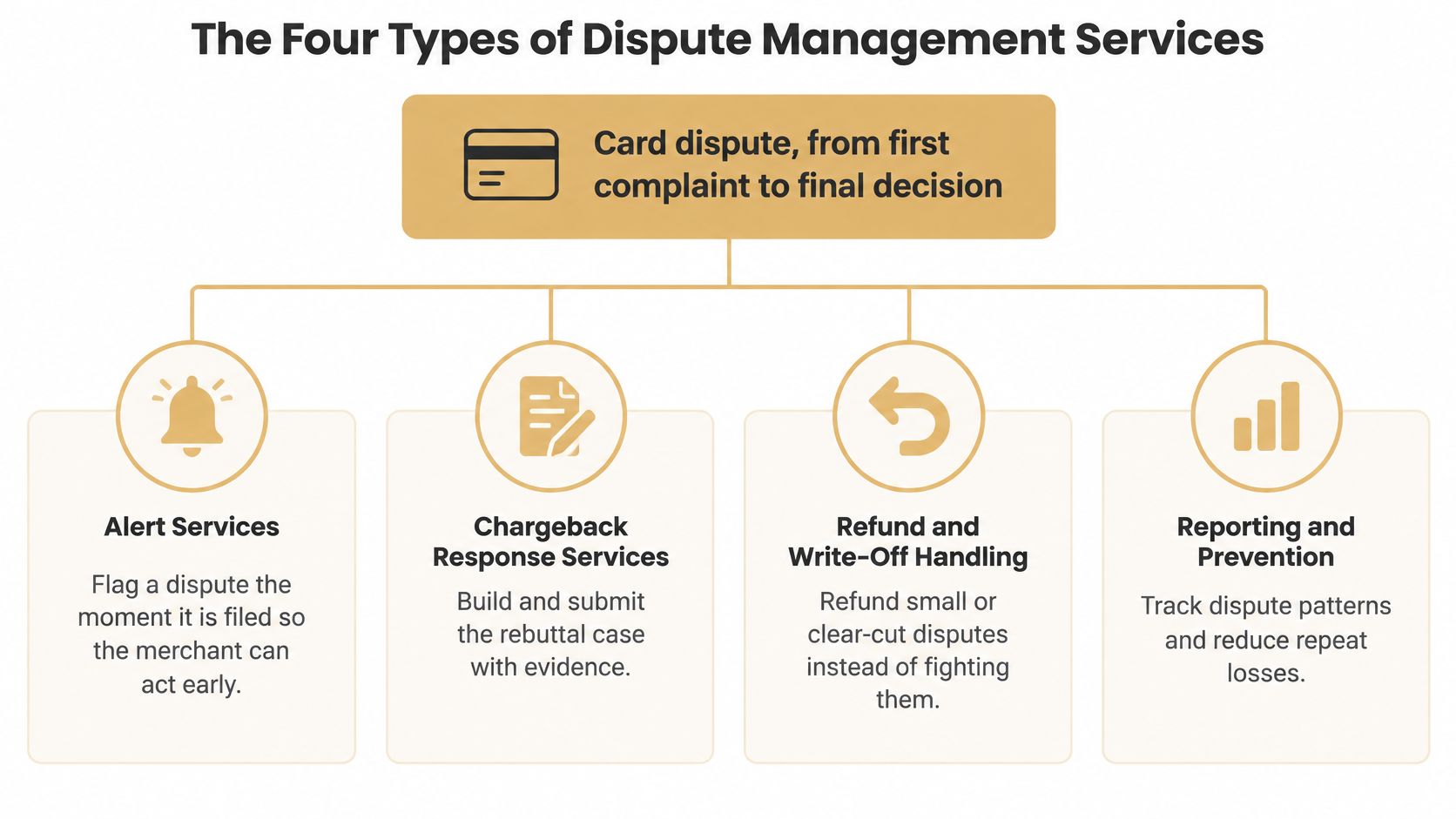
A helpful way to picture these categories is home fire safety. Prevention and alerts act like a smoke alarm that rings before flames spread across the room, giving you time to refund a charge before a chargeback lands. Chargeback response and evidence services work like the fire crew arriving after the alarm becomes a formal filing, assembling proof to save the sale. Consulting on dispute triggers is the electrician who inspects the wiring afterward so the same short circuit doesn't spark again next month.
| Service type | What it does | Stage | Typical fit |
|---|---|---|---|
| Prevention and alerts | Notifies the merchant when a customer disputes a charge so a refund can be issued before a chargeback is filed | Before filing | Merchants with rising dispute counts or recurring billing |
| Chargeback response and evidence | Compiles and submits evidence against each filed dispute within network deadlines | After filing | Merchants with steady chargeback volume and cases they can win |
| Recovery and reporting | Tracks outcomes, win rates and lost revenue, and feeds the results back into refund rules | After chargeback | Merchants who need data to set policy |
| Consulting on dispute triggers | Reviews billing descriptors, cancellation flows, shipping and customer contact to cut the causes of disputes | Ongoing | Subscription, high-volume or high-risk businesses |
How the Four Services Fit the Dispute Timeline
Every payment dispute travels through three distinct windows: before a formal filing, the moment a claim is filed, and after a chargeback posts to your account. One vendor might handle only a single window, such as submitting representment packets after the fact, while full-stack platforms connect tools across two or all three stages.
Disputely provides dispute management services that help businesses challenge chargebacks with major payment processors and financial institutions, organizing its product suite around those exact three windows: Resolve before the dispute, Alerts when a dispute is filed, and Recover after the chargeback. Grouping tools by stage keeps your team from buying an evidence-writing tool when your real problem is confusing subscription renewals.
Start with the leak: Pinpoint the stage where your losses begin before comparing vendors, because a response team won't fix a billing flow that triggers preventable complaints every week.
If most of your disputes stem from unrecognized charges or missed cancellation requests, pre-filing prevention and descriptor fixes will move the needle far more than aggressive representment. If most of your cases involve confirmed deliveries to valid accounts, an evidence-driven response workflow deserves priority.
What Disputes Cost Merchants Before Any Service Fee
Card disputes look tiny as a percentage of total orders until you count how many dollars walk out the door alongside each claim. This summary highlights the baseline rate reported by Federal Reserve researchers and the three cost layers attached to every filed chargeback.
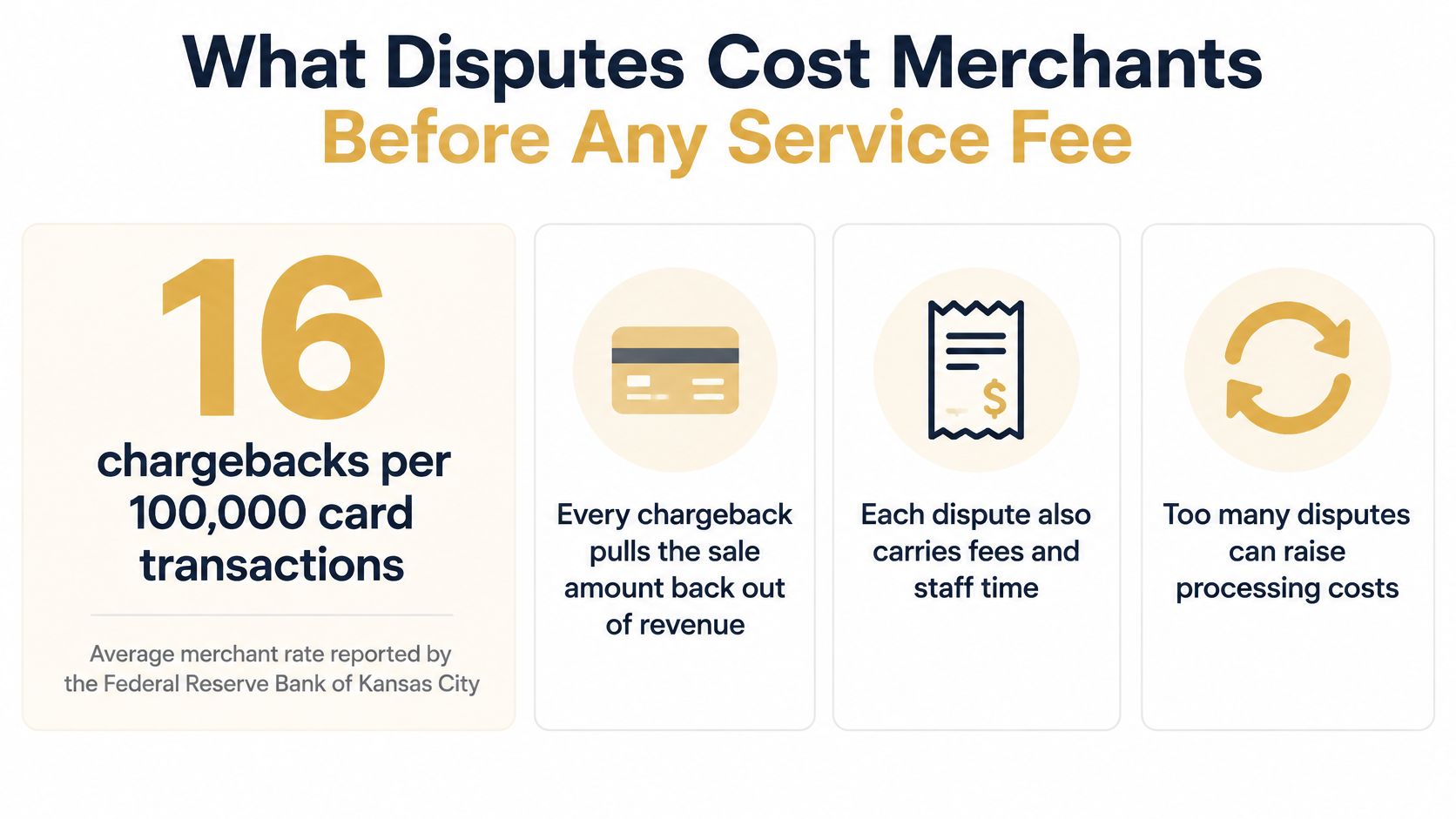
A 2016 working paper from the Federal Reserve Bank of Kansas City measured Visa and Mastercard signature-based transactions and found an average rate of 1.6 basis points by transaction count, equal to roughly 16 chargebacks per 100,000 transactions, and 6.5 basis points by sales value, or about 0.065% of sales. The paper also found that roughly 50% of all chargebacks were linked to fraud, and approximately 70% to 80% ended as merchant liability. Online sellers face steeper odds, because card-not-present transactions produced materially higher total and fraud chargeback rates than in-person swipes.
Consumer-side numbers show how large that pool has grown. The Consumer Financial Protection Bureau's 2025 credit card market report documented $9.8 billion in credit-card charges disputed by cardholders during 2024, resulting in $5.9 billion in chargebacks. Cancelled recurring transactions covering subscriptions, memberships, and utility bills accounted for 40% of all disputes, making recurring billing the single largest reported dispute trigger. Individual claims aren't pocket change either, with the average credit issued per dispute reaching $197 on general-purpose cards and $288 on private-label cards.
Beyond the refunded sale itself, each chargeback costs merchants an average of $128 in third-party fees and internal costs in 2025, according to Mastercard's 2025 chargeback cost analysis.
Turning Dispute Rates Into Monthly Dollars
Put those figures inside a realistic storefront. Say a direct-to-consumer merchant processes 50,000 card orders a month and receives 150 chargebacks. Even before counting the lost inventory or original transaction value, the administrative drag and third-party fees add up to thousands of dollars every single month across four distinct buckets:
- Processor and network fees: Acquirers charge a non-refundable dispute fee on every filed chargeback, even when you later win the case.
- Internal staff time: Support reps and finance staff spend hours digging through order logs, carrier portals, and chat transcripts to answer bank deadlines.
- Lost merchandise and shipping: On physical goods, you lose both the original revenue and the cost of fulfilling and shipping the order.
- Processor risk and reserves: Rising dispute counts can trigger rolling reserves, higher processing rates, or outright account holds.
The video below walks through how these hidden operational expenses stack up behind a single disputed order.
That combined monthly drain is the cost of doing nothing. Any dispute management service you pay for has to beat that baseline through prevented chargebacks, saved team hours, or recovered sales.
Prevention Services That Stop Disputes Before Filing
Pre-filing prevention sits between the customer's bank and the card network's formal chargeback rail. When a cardholder calls their bank or taps "dispute" inside a mobile app, an alert network sends an electronic notification to the merchant before the claim becomes an official chargeback. If the merchant issues a refund within the alert window, the bank closes the claim and no chargeback posts to the merchant account.
Three major channels carry most of these alerts. Visa runs Rapid Dispute Resolution (RDR), which automates pre-dispute refunds using rules set by the merchant. Mastercard supports CDRN alerts alongside Ethoca, a global merchant network covering Mastercard and other major card brands with a 24-48 hour window and fraud prevention. Exact cutoff windows vary by card network and alert provider, so always confirm the response timeframe in writing before turning on automated rules.
Our Resolve product works before a dispute is filed, while our real-time alert system notifies merchants within minutes of a dispute being filed and stops claims the moment they arrive so they never hit the merchant account. Reviewing how dispute early warning services connect to processors like Stripe, PayPal, and Shopify Payments shows how quickly an incoming alert can be matched to an order ID and refunded without manual intervention.
Why Card Network Monitoring Makes Speed Matter
Stopping a dispute before filing doesn't just save a dispute fee. It protects your standing with Visa and Mastercard monitoring programs, where ratios are calculated on event counts rather than dollar volume.
Under traditional Visa dispute monitoring detailed in the J.P. Morgan Visa VDMP and VFMP program guide, a merchant crossed the standard threshold with more than 100 disputes and a monthly ratio above 0.90%, and hit the excessive level above 1,000 disputes and 1.80%. At 100,000 monthly transactions, a store hits the 0.90% line at 900 disputes and the 1.80% line at 1,800 disputes.
Visa's newer Acquirer Monitoring Program (VAMP), described in the 2025 Visa VAMP fact sheet, tightens the lens further by combining fraud reports and disputes into a single metric: (TC40 fraud count + TC15 dispute count) / TC05 settled-transaction count. For acquirers in the United States, Canada, Europe, and Asia-Pacific, Visa classifies portfolios as "above standard" at 50 basis points and "excessive" at 70 basis points, subject to a minimum monthly volume of 1,500 fraud-plus-dispute events.
Preventing an alert from becoming a formally filed dispute shrinks the numerator in both frameworks. That keeps growing merchants out of costly remediation programs and protects processor relationships.
An alert refund protects your processing ratio, yet it still hands back the entire sale amount. Blindly refunding every alert trades chargeback penalties for silent revenue drain.
Because every alert-triggered refund forfeits the full order value, strong prevention tools use selective filtering rules. You want auto-refunds firing on duplicate charges, clear shipping errors, and low-dollar claims you wouldn't fight anyway, while routing high-value, winnable orders into your representment queue.
How Chargeback Response Services Build a Case
Once a dispute passes the alert stage and becomes a filed chargeback, the merchant has a strict deadline to submit representment evidence showing the transaction was valid. A response service works like a filing clerk, investigator, and project manager in one role. It pulls transaction records, matches proof to card-network reason codes, and formats the rebuttal packet for the issuing bank.
This diagram outlines how a response workflow moves from an incoming notice to a tracked decision.
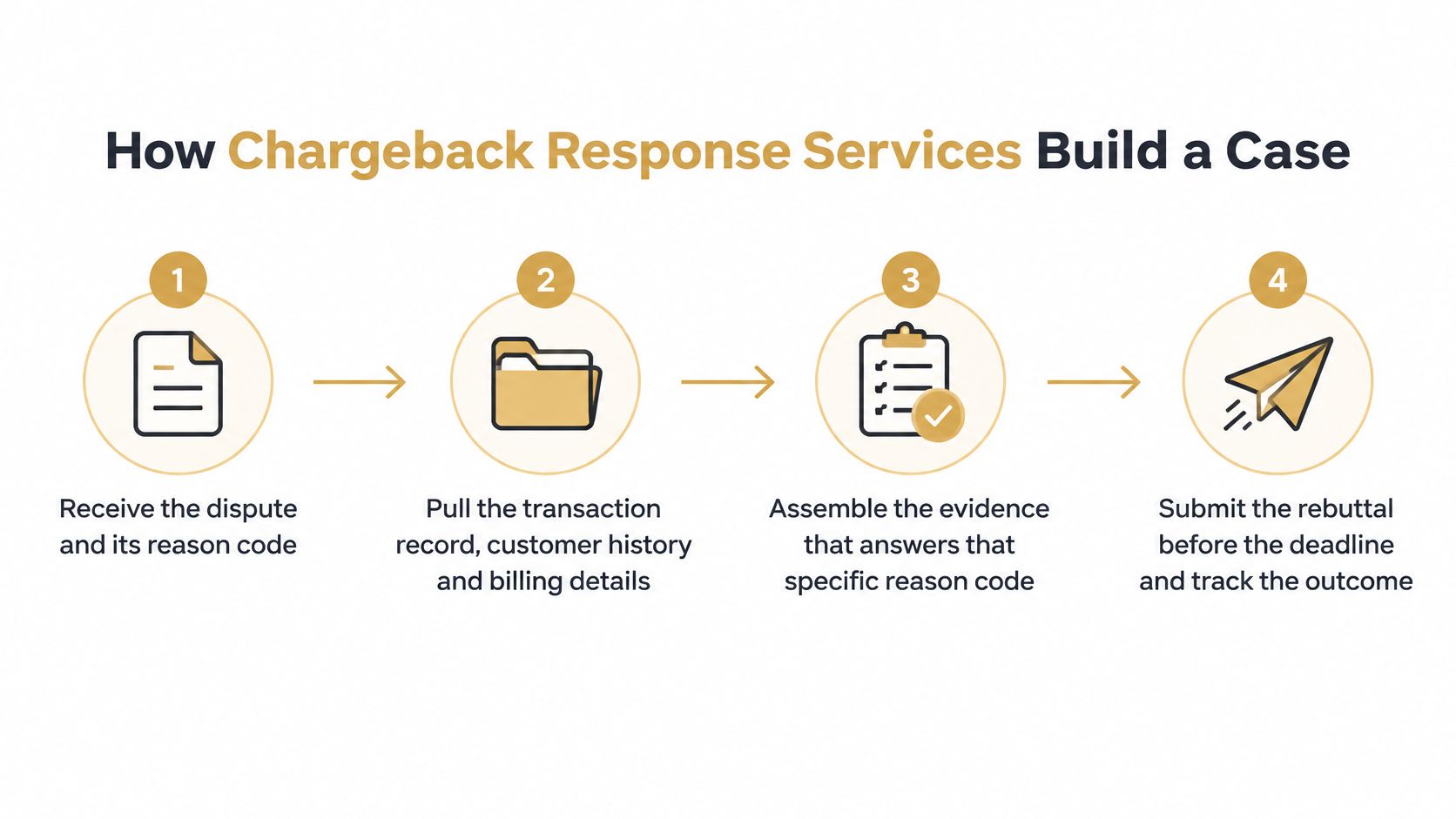
In day-to-day operations, a thorough response workflow follows five connected stages:
Intake the dispute and decode its reason code. Every card network assigns a code stating why the cardholder objected, such as merchandise not received, cancelled recurring billing, or unauthorized use. Submitting delivery proof for a "cancelled subscription" code guarantees a quick loss, so accurate classification comes first.
Pull the full transaction record and customer profile. The team gathers the billing descriptor shown on the bank statement, order timestamps, billing and shipping addresses, and prior order history. For an authorized purchase claim, showing two earlier undisputed orders from the same customer email and device carries real weight.
Assemble evidence matched specifically to the reason code. Different claims require different proof. For non-delivery disputes, you need carrier tracking and delivery confirmation, though carrier scans only help when the delivery destination matches the shipping address on file. For recurring-charge claims, you need the customer's terms acceptance, renewal reminders, and the exact timestamp of any cancellation request. Disputely's Chargeback Mitigation service automatically creates, submits, and tracks evidence for every dispute, while its Shipping & Tracking feature uses fulfillment data and tracking delivery status to pinpoint deliveries and flag non-deliveries. Understanding a structured evidence collection process keeps merchants from attaching bloated screenshots that bank analysts skip.
Compile and submit before the card network cutoff. By using the services, customers authorize Disputely LLC to act as their limited agent for dispute management, chargeback prevention, refund initiation, and related communications with payment processors, card networks, and issuing banks. Clean formatting matters because issuing bank reviewers often spend only a few minutes per case. Clear headings and highlighted dates beat a data dump.
Track the outcome and log results by reason code. Recording win and loss outcomes back to each reason code exposes weak spots in your documentation, such as a courier that does not capture signature proof on orders over a set dollar amount. The log also shows which claims keep repeating, so the merchant can change the order flow, shipping process, or billing notice tied to those disputes.
What Response Services Can and Cannot Promise
Issuing banks make the final call on every representment packet, and card networks update evidence standards regularly. Because third parties control the verdict, no response service can guarantee a win on any individual dispute, dispute prevention, chargeback reduction, processor approval, account standing, or avoidance of reserves, monitoring programs, or account termination.
Before signing an agreement, ask for written confirmation of submission deadlines, data access permissions, and liability boundaries. The strongest response operations do not promise miracles. They deliver consistent transaction records, rapid submission ahead of processor deadlines, and tight alignment between the reason code and the proof attached. That approach turns each case into a clear decision about what to prevent, refund, or contest.
Deciding Which Disputes to Refund and Which to Contest
Fighting every chargeback feels principled, yet blanket representment often loses more money than it saves. Not every dispute deserves an evidence packet, and treating genuine billing mistakes the same way you treat suspicious first-party claims drains both staff time and recovery margins.

Part of the problem is that banks and merchants don't even agree on what caused the dispute. Merchants identify approximately 45% of their chargebacks as fraudulent in 2025, according to Mastercard's 2025 Global Chargebacks Outlook. A 2025 report summary from Datos Insights illustrates that perception gap starkly: financial institutions labeled 70% of chargebacks as fraud-related, while merchants broke their 45% fraud estimate into 24% third-party fraud and 21% first-party fraud. The same summary notes Mastercard findings that merchants write off low-dollar transactions representing 16% of their chargebacks rather than spending money contesting them.
That gap proves classification must come before any automated refund or fight rule. If a bank codes an unrecognized subscription renewal as fraud, blindly trusting the bank's label leads you to the wrong response.
Triage Rules by Dispute Type
Use the matrix below as a starting blueprint to separate quick refunds from cases worth fighting.
| Dispute type | Usually better | Why |
|---|---|---|
| Duplicate or billing error | Refund at alert | Refund costs less than building a case |
| Confirmed delivery failure | Refund, unless tracking proves delivery | Customer still lacks the goods, so proof rarely settles the issue |
| Recurring charge after cancellation | Refund when the cancellation record is unclear | Cancelled recurring bills are the top credit-card dispute driver, and banks side with the cardholder when dates conflict |
| Unrecognized charge with clear descriptor | Contest with transaction records, then fix the descriptor | Clear records can win and the descriptor fix prevents repeats |
| Authorized purchase with strong evidence | Contest | Evidence is likely to win the case |
| Low-value dispute | Write off or refund | Evidence cost can exceed the amount recovered |
| Suspected first-party misuse | Contest with full evidence | Automatic refunds reward the misuse |
The Unit Economics Behind Every Decision
Every triage rule rests on simple expected-value math: multiply the disputed order amount by your realistic chance of winning, then subtract staff labor, filing fees, customer-retention impact, and monitoring-program risk. When an order is small and your win odds are slim, writing it off or issuing an alert-stage refund protects cash better than paying someone to assemble a rebuttal.
Suspected first-party misuse works in the opposite direction. Automatically refunding a high-ticket item that shows confirmed carrier delivery, matching IP logs, and prior purchases teaches repeat claimants that calling their bank yields free merchandise.
Economics over ego: Fighting a small order with weak delivery proof burns more in staff hours and fees than the order was worth, while auto-refunding high-ticket friendly fraud invites repeat claims.
Build your thresholds around your own average order value, subscriber lifetime value, and historical win rates by reason code rather than borrowing another company's blanket policy.
Audit Your Dispute Data Before You Choose a Provider
Before booking vendor demos or turning on automated refunds, pull six months of your own dispute history. Without a baseline, it's easy to overpay for alerts you don't need or hire a representment vendor when broken cancellation emails are causing half your cases.
Run through this six-step audit with a spreadsheet and your processor dashboard:
- Export six months of disputes by reason code. Pull full logs from Stripe, Shopify Payments, PayPal, or your acquiring bank so you see exact reason-code counts rather than rough guesses.
- Tag the operational root cause on each row. Mark whether the claim came from third-party fraud, a recurring renewal surprise, a lost package, a duplicate charge, or a cryptic billing descriptor.
- Calculate your monthly dispute ratio against settled transactions. Track the ratio month by month, not just as a six-month average, so a recent spike in one product line or subscription cohort doesn't stay hidden.
- Estimate your true monthly dispute expense. Add up processor dispute fees, unrecovered inventory or fulfillment costs, and the weekly hours your team spends researching and replying to claims.
- Split past cases into two actionable buckets. Label which claims you should have refunded immediately at the alert stage and which ones had solid delivery or usage proof that could have won representment.
- Identify where the biggest dollar leak begins. Check whether most losses stem from preventable triggers before filing, unstopped alerts when filed, or weak evidence after the chargeback posts.
Your finished spreadsheet points directly to the service category you need, not a specific brand name. Keep expectations grounded while comparing vendors, too: Disputely does not guarantee dispute prevention, chargeback reduction, processor approval, account standing, or avoidance of reserves, monitoring programs, or account termination. Ask every provider you evaluate for written service boundaries and a projected savings estimate modeled on your actual dispute counts.
Choose the service type that closes the stage where your audit shows the largest cash drain. Once the category is settled, compare shortlisted providers on total monthly outlay and what they explicitly commit to handle.
Judging Whether a Service Pays for Itself
Vendors price dispute management in several ways: per alert, as a percentage of recovered revenue, a flat per-case fee, or monthly consulting retainers. Headline rates rarely tell the full story, so judge every candidate against one monthly net-value formula:
Monthly Net Value = (Chargebacks Avoided × All-In Cost per Chargeback) + Revenue Recovered from Won Disputes − (Service Fees + Internal Staff Time)
The formula treats dispute management as a decision about which cases to prevent, refund or contest. Prevented chargebacks and won representments count as gains; fees and the hours your team spends overseeing alerts count as costs. Take a subscription brand whose audit puts its all-in expense at $120 per chargeback across processor fees, lost goods, and internal labor. An alert and mitigation setup that prevents 100 chargebacks in a month saves $12,000 in avoided cost. Add $1,500 recovered from contested cases that win, subtract $6,000 in combined service fees and internal oversight, and the net monthly value comes out to $7,500.
Run the same math on the in-house option before comparing vendors. Entering your own figures into a dispute cost savings calculator shows how quickly fee structures diverge at different dispute volumes. If you are weighing dedicated back-office staff who chase representment deadlines manually against automated alerts, a staffing benchmark such as Virtustant's year-one cost comparison helps put full-time overhead beside software and per-alert pricing in one calculation.
Pricing also differs within a single platform depending on which stage of the dispute lifecycle you use. Disputely's AI chargeback fighting is free, while its specialized consulting for payment dispute prevention and resolution applies when a merchant needs deeper workflow changes across billing descriptors, cancellation flows, or fulfillment rules. Whatever the fee model, scrutinize the win-rate and alert-coverage assumptions behind any projected savings figure. An optimistic win rate inflates expected recovered revenue just as easily as a low per-alert price understates the staff time still required.
Matching Service Types to Your Business Profile
Different business models experience very different dispute pressure, so the right setup depends on your order volume and billing structure.
| Merchant profile | Dispute pressure | Service most likely to pay off |
|---|---|---|
| Small store with few disputes | Low and sporadic | Manual response with a written checklist |
| Subscription or SaaS with recurring billing | High and cancellation-driven | Prevention alerts plus billing and cancellation review |
| High-volume DTC ecommerce | Medium to high | Alerts with automated refund rules and evidence submission |
| High-risk category such as supplements or travel | High and fraud-linked | Prevention, fraud monitoring and managed response |
| Approaching network monitoring thresholds | Rising ratio | Full stack with ratio tracking and root-cause reporting |
Before signing anything, ask one final filter question about every service on your shortlist: does it reduce the preventable disputes that trigger costs in the first place, or does it only process claims after the damage has already hit your account?
If your six-month audit shows disputes piling up from recurring renewals, shipping mix-ups, or rising network ratios, we organize our platform around all three stages of the dispute lifecycle: Resolve before filing, real-time Alerts when a claim hits, and Recover for automated evidence submission after a chargeback. Visit Disputely to explore how stage-based alerts, automated representment, and prevention consulting fit your payment stack and monthly dispute volume.


