
Dispute Resolution Request: What It Is and How to Respond
Forty minutes into your morning, a processor email lands. A customer has challenged a charge, the case carries a reason code, and there's a window to respond. The email doesn't make clear whether money has already left your account or whether you still have time to stop it. You open the order system, find the transaction, and start guessing.
That guess is expensive. A dispute resolution request is not a complaint you can answer when the queue clears. It's a network-defined event with a clock attached, and the clock starts before most merchants notice. The merchants who keep disputes cheap aren't working harder than everyone else. They know which stage the request is at and what that stage asks of them.
What a Dispute Resolution Request Really Is
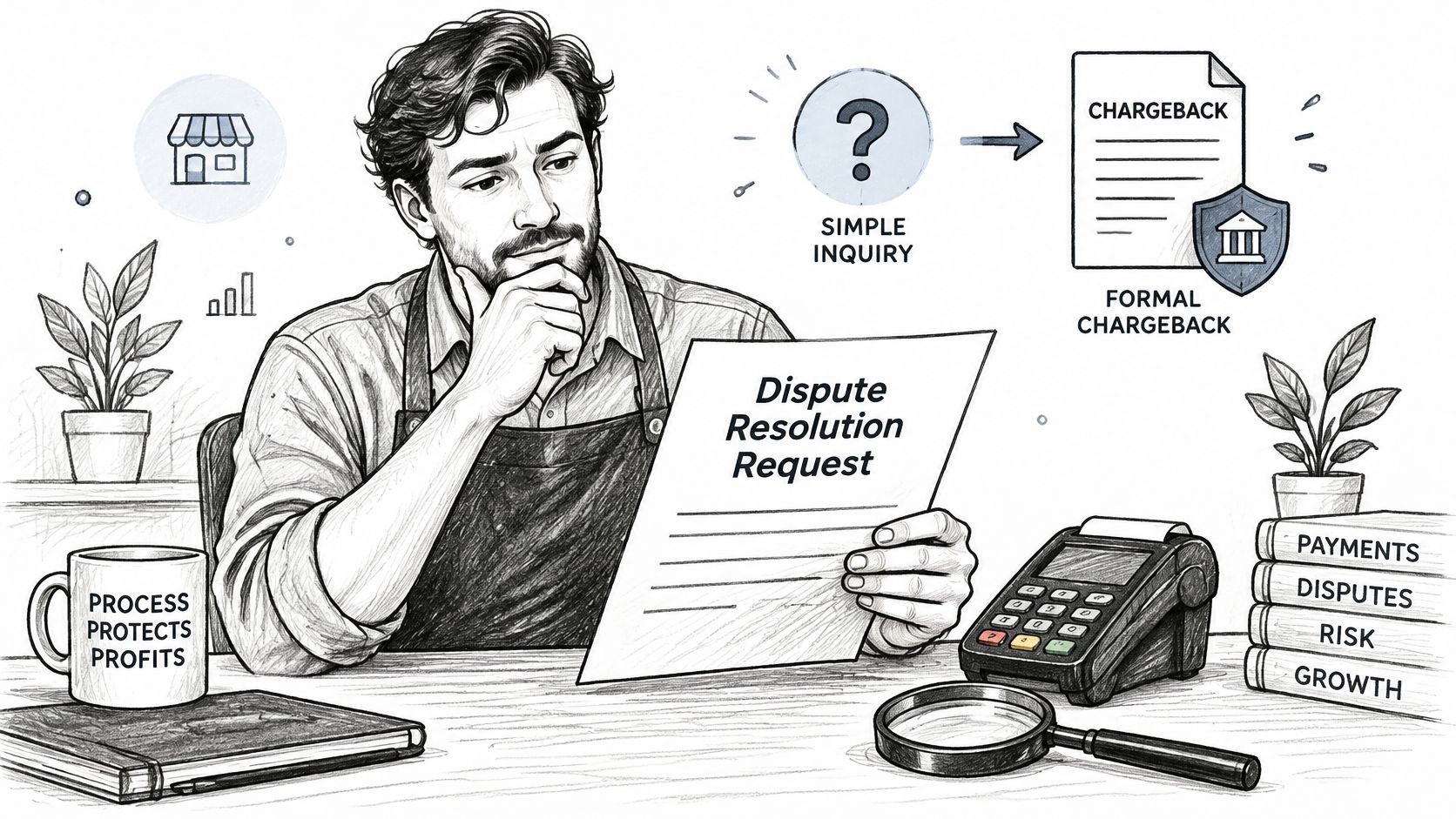
A dispute resolution request is any card-network or issuer-initiated step that asks a merchant to answer a challenged payment, from an information inquiry with no money attached to a formal chargeback that has already pulled funds out of your account. The cardholder's bank normally opens the case, so you rarely hear about it from the customer first. It reaches you through your acquirer or processor, which is why the alert shows up in a dashboard instead of your inbox.
Three alarms of increasing severity sort the stages. A retrieval request is the faint beep, the issuer asking whether the charge is real. A rule-based alert is the warning light, telling you a dispute is forming and can still be stopped before it's filed. A chargeback is the fire that has already moved money.
The distinction matters more than it did ten years ago. Card networks have spent years pushing resolution earlier. Visa Claims Resolution, introduced in 2018, cut 22 reason codes into four broad categories and added workflows meant to block invalid disputes from escalating, as Verifi's history of the dispute landscape sets out, and Mastercard's Cardholder Dispute Resolution Network arrived back in 2007 as a channel built for resolution before a formal chargeback.
One label, very different events, and that's the trap. Treat a retrieval request like a chargeback and you refund money you didn't owe. Treat a chargeback like a customer-service email and you lose by default. Sort the request before you touch it.
Stages From Retrieval Request to Chargeback
The table below is the reference point for everything that follows. Read it top to bottom and you have the escalation path in the order it usually happens.
| Stage | Who starts it | What it asks or does | Money moves? | Merchant action |
|---|---|---|---|---|
| Retrieval request | Card issuer | Requests transaction details before any monetary chargeback | No | Send records and clarify the charge |
| Visa RDR request | Visa network rules | Predefined merchant rules can resolve an eligible dispute automatically | Yes, liability transfers on acceptance | Accept under rules and do not refund separately |
| First chargeback | Card issuer | Filed under a reason code once the transaction meets its requirement | Yes, funds move between issuer and acquirer | Accept or send a second presentment |
| Second presentment | Acquirer | Submits documentation answering the original reason | Yes, if the case continues | Upload reason-specific evidence |
| Pre-arbitration and arbitration | Card network | Unresolved parties escalate for a financial decision | Yes, per network decision | Defend with a complete evidence record |
Start at the top row. A retrieval request is an issuer-to-merchant inquiry that can occur before any monetary chargeback, and it typically wants transaction details such as shipping information, the items purchased, customer verification, account activity, and recognizable IP or device information, according to Mastercard's Javelin chargeback white paper. Nothing has moved yet. You're being asked a question, and a fast, factual answer often closes the file.
The second row is where automation earns its keep. A rule-based request resolves under merchant-set conditions without an analyst assembling evidence, and the liability transfer happens the moment you accept, which is why the refund workflow and the acceptance workflow must never both fire. The middle rows are the formal machinery: a first chargeback filed under a reason code, then a second presentment where the acquirer submits documentation answering that specific reason. The bottom row is the expensive end, where the network decides financial responsibility and nobody is charmed by a generic receipt.
The one thing the stage tells you: whether funds are at risk right now. Everything else in your response plan is downstream of that answer.
The timing gap is the whole game. Respond while the case is an inquiry and your options are wide and cheap. Respond after a chargeback is filed and you're choosing between absorbing a loss and arguing with a fixed deadline and a narrow evidence standard.
Choosing Between Refund, Acceptance and Representment
A $15 billing error and an unauthorized high-value purchase should not enter the same workflow. Route each request by the cost of a refund, the strength of the evidence, and the stage of the case.
| Situation | Usually best response | Why it fits | Watch for |
|---|---|---|---|
| Low-value, high-confidence fraud or service complaint | Refund or accept under rules | Cheaper than a fight and stops escalation | Refund once only, using a shared idempotency key |
| Retrieval request with complete delivery and login records | Clarify and provide the records | Often settles the question before any monetary chargeback | Send only the fields the request asks for |
| Unrecognized charge with strong device and purchase history | Represent with reason-specific evidence | Evidence that matches the reason code beats a generic receipt | Avoid oversharing personal data |
| Repeat, high-value customer | Route to manual review | Automation may refund legitimate friendly fraud | Keep consent and data-use records for each case |
| Duplicate transaction or billing error | Refund promptly and confirm no network case is open | Settles the customer issue at the lowest cost | Check settlement data for a second refund |
The Two Expensive Defaults
Refunding every request protects time but can give away recoverable revenue. Fighting every request has the opposite cost: representment takes analyst time, and evidence that does not answer the reason code is unlikely to justify that effort. For a confused customer, a prompt refund may cost less than letting a small billing issue escalate.
Mastercard's 2025 First Party Trust initiative emphasizes purchase history, device details, delivery information, identity elements and geography, supplied at authorization or after a dispute is raised, according to Mastercard's announcement on First Party Trust. A receipt and tracking number may not address a claim that the customer did not authorize the charge.
Chargeback volume is expected to rise, increasing the pressure to route cases consistently. Blanket automation can refund legitimate friendly fraud claims; manual review of every case consumes time and money. Set rules for clean, low-value cases, and route repeat customers or high-value transactions to a person. Keep consent and data-use records for each case, and make it easy for customers to find help before contacting their issuer. For example, Nuvana Herbs contact details give customers a place to seek support and refund information.
Respond Within the First Hours
A customer disputes a charge, and the clock starts. A fast, well-ordered response can resolve a request before it becomes a chargeback. Once a chargeback is filed, the decision also affects cash flow and the time your team spends gathering evidence.
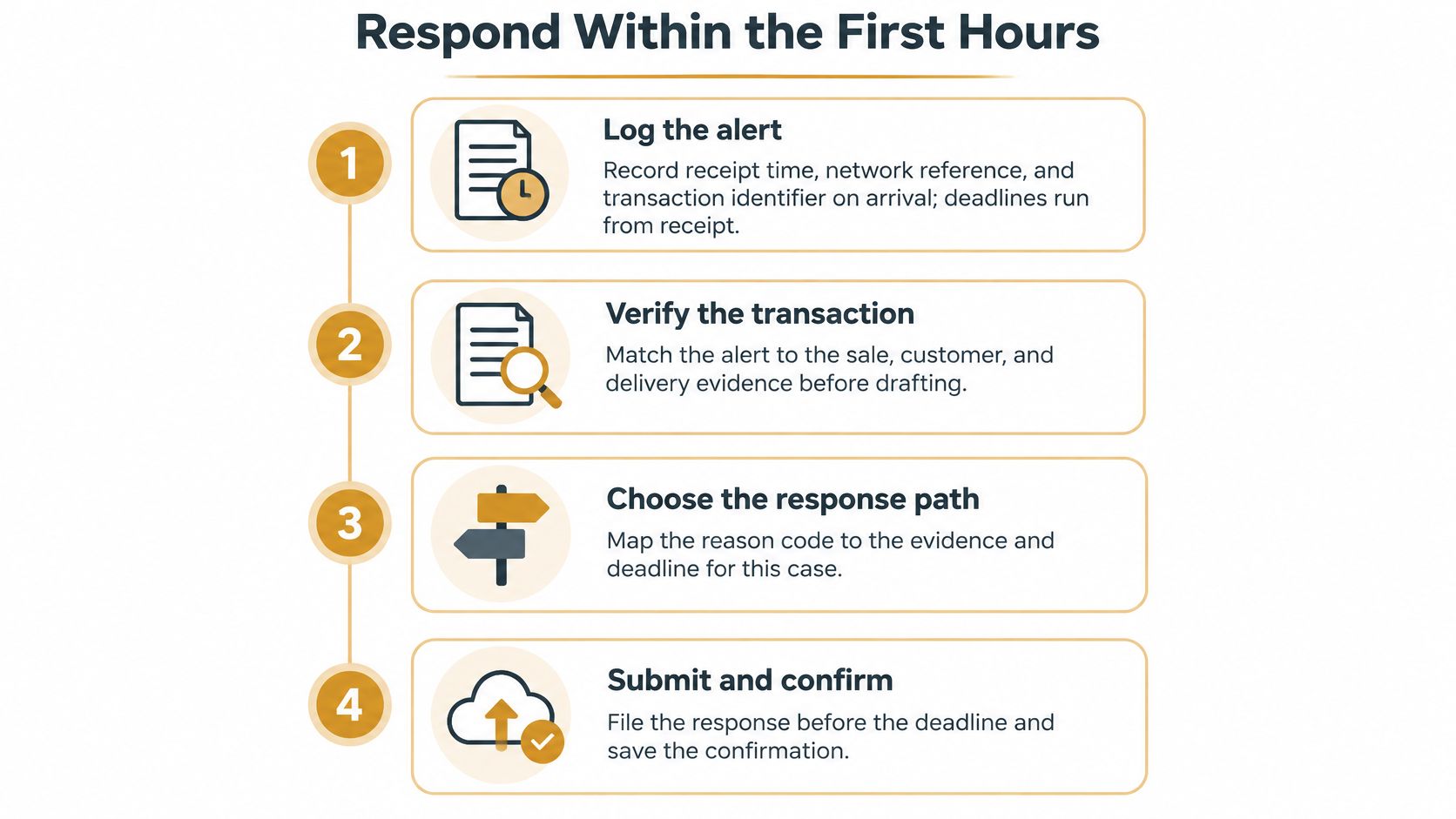
Use this sequence to keep the response tied to the request's stage and evidence.
The First Response, Step by Step
Log the alert immediately. Record when it arrived, the network reference and the transaction identifier. A delayed handoff can consume the response window before anyone reviews the evidence.
Identify the stage. Is this a retrieval request, an alert or a filed chargeback? The answer determines which actions are available and whether funds are already exposed.
Match the reason code to the evidence. Mastercard's chargeback guidance explains that an issuer initiates a first chargeback when a transaction meets a reason-code requirement, and the acquirer can accept responsibility or submit a second presentment addressing that reason. Generic documents often miss the point: the evidence must answer the specific condition behind the chargeback reason code.
Check whether an existing rule applies. If a configured rule covers the case, follow it and record the decision. For borderline cases, weigh the refund amount against the cost and strength of a possible response.
Choose one financial action. Refund or accept the request through the relevant workflow, then confirm the outcome before initiating another action. With Visa RDR, follow your processor's instructions for handling the transaction and avoid issuing a separate refund for the same charge unless your acquirer directs you to do so.
Represent only when the evidence supports it. Delivery records, account activity and prior undisputed purchases can help answer a specific claim. If the evidence is weak, a refund may cost less than contesting the case and risking a chargeback.
Record and reconcile the result. Keep the decision time, rule applied, refund status, network response and processor acknowledgment together. Check them against settlement data to catch unresolved actions or duplicate refunds.
Build the Evidence Record Before the Request Arrives
Evidence is most useful when it is linked to the transaction before a request comes in. Keep authorization details, order and fulfillment timestamps, delivery proof, refund records, customer communications, recurring-billing consent and the billing descriptor in one record.
For an unrecognized-charge claim, account activity, login history, device details and prior undisputed purchases may help establish the relationship between the customer and the transaction. Keep the evidence relevant to the reason code; more documents do not make an irrelevant document persuasive.
A practical test: Can an analyst identify what was delivered, to whom and when using the transaction identifier? If not, retrieving the records may cost time the response window does not allow.
Treat a request as both an evidence-ordering and a cash-flow decision. A refund can close a weak case sooner, while a well-supported response may justify contesting it. Disputely is notified within seconds after a customer creates a dispute and then offers a resolution. Its products cover three stages: Resolve before a dispute, Alerts when one is filed, and Recover after a chargeback.
Confirm response deadlines with your processor. The applicable window depends on the network, acquirer, reason code and stage, so use the deadline attached to the case rather than assuming one timeline applies to every request.
What One Request Can Really Cost
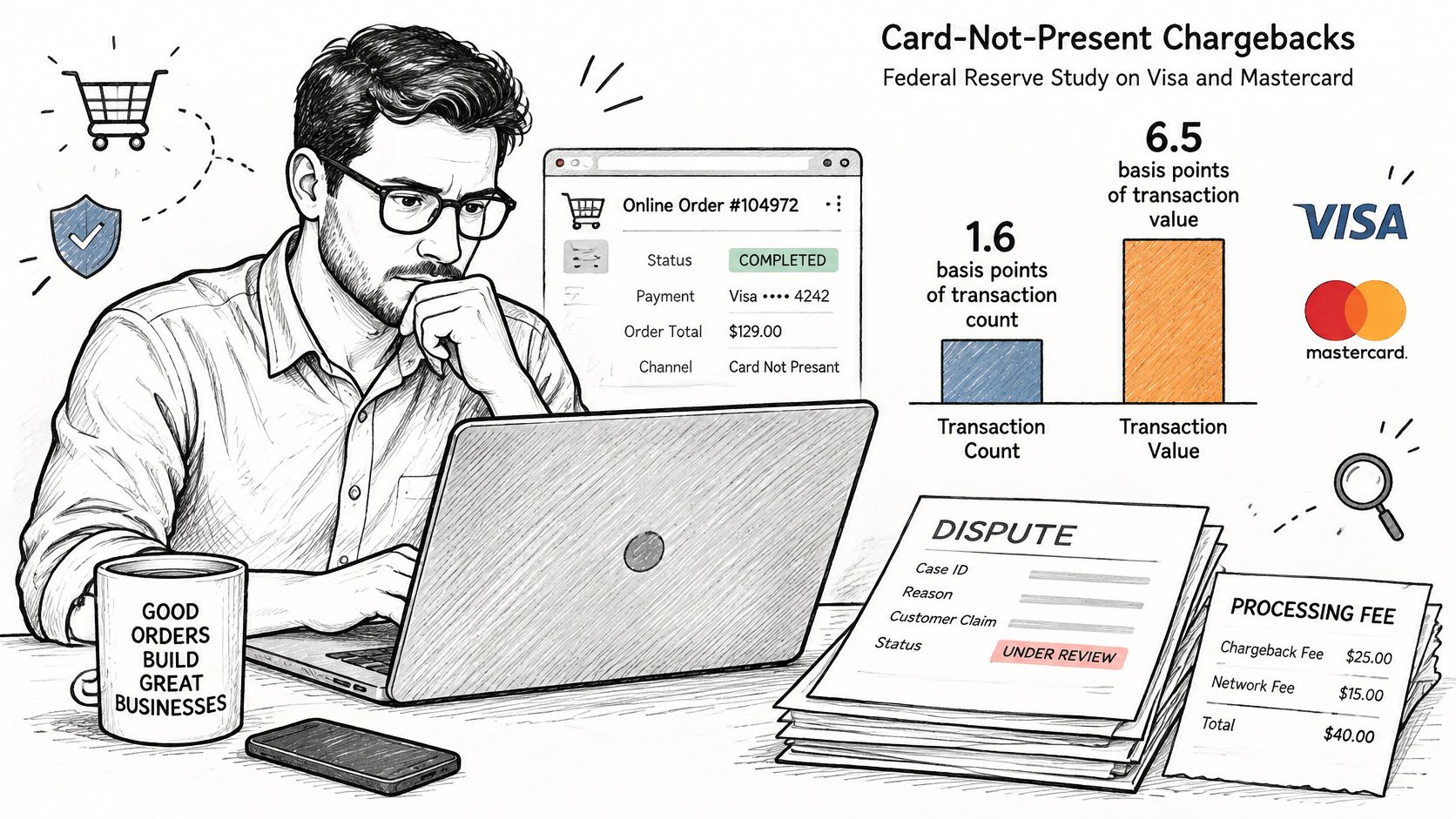
Small percentages hide real money. A foundational U.S. Federal Reserve study found that Visa and Mastercard chargebacks averaged 1.6 basis points of transaction volume and 6.5 basis points of transaction value, and one basis point is 0.01%, so those rates work out to roughly 0.016% of transactions and 0.065% of sales value, as the Federal Reserve Bank of Kansas City study reports.
Working the Calculation
Take a merchant with $10 million in annual card-not-present sales. Multiply by 6.5 basis points and you get roughly $6,500 in disputed transaction value before fulfillment costs, fees, labor, refunds and customer-acquisition costs. That's the gross exposure the study describes, not a worst case.
Now apply what happens next. The same study found merchants successfully disputed only 20% to 30% of chargebacks, which reduces realized losses to about 1.3 basis points by count and 4.6 basis points by value. On $10 million, that's about $4,600 still gone. The gap between $6,500 and $4,600 is what your response process is worth.
Scale the math to your own volume. A subscription business with $2 million in annual card-not-present sales faces about $1,300 in disputed value at 6.5 basis points and roughly $920 in realized loss at 4.6 basis points. Run the same two multiplications on your trailing twelve months of card-not-present revenue and you have a number your finance team will recognize.
Two things make that number worse than it looks. Fraud accounted for about 50% of all chargebacks in the study, and card-not-present transactions produced substantially higher total and fraud chargeback rates than card-present ones, so online and recurring revenue carries more of this weight than the blended figure suggests. And roughly 70% to 80% of chargebacks were resolved against merchants, which means the default outcome is against you unless the response changes it.
A small percentage is not a small bill. Every request needs one owner who sees it on arrival, a logged timestamp, and a deadline that comes from the network rather than from whenever the queue clears. Costs also stack with fees on top of lost sales, which is why the chargeback fee breakdown belongs in the same conversation as the disputed value.
Confirm Your Response Process Before the Next Request
Test your current setup against this list before changing anything. You may find two or three gaps, and the gaps are usually about ownership and logging rather than evidence quality.
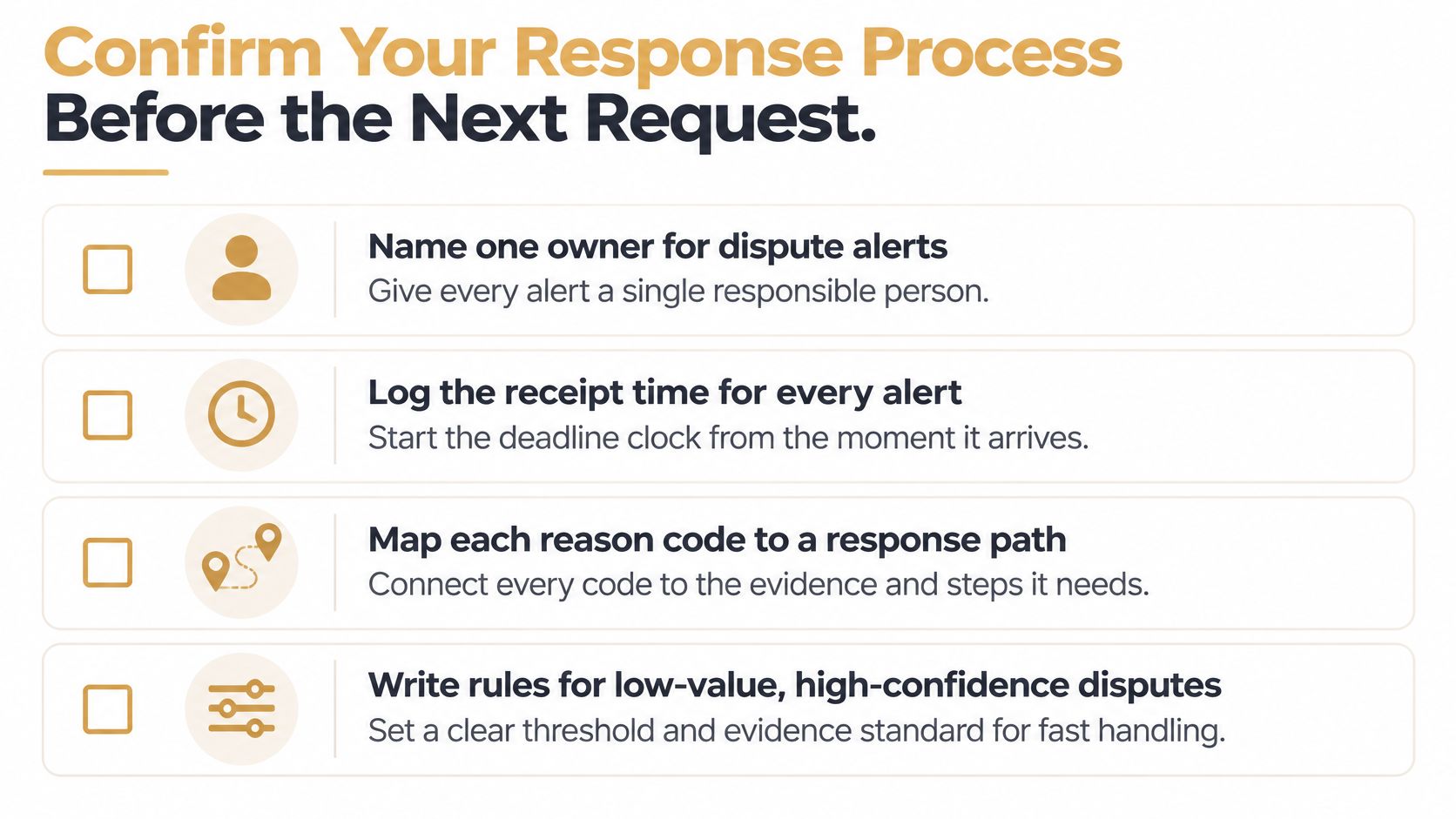
- Name one owner for dispute alerts. Shared inboxes produce shared silence.
- Log receipt time for every alert. The deadline starts on arrival, so the timestamp is the first control, not the last.
- Map each reason code to a response path. Code in, evidence set and decision rule out, no improvisation.
- Write rules for low-value, high-confidence cases and version them. Versioning is what lets you explain a refund six weeks later.
- Share one idempotency key across refund and acceptance workflows, built from the network transaction identifier rather than the order number.
- Run a reconciliation report against settlement data each week. Duplicate refunds and missed deadlines show up there first.
- Keep a human review queue for high-value and repeat customers. Automation should clear the noise, not decide the cases that carry real money.
If alert handling is where the gaps sit, compare the options rather than defaulting to the first one you're pitched. Disputely is notified within seconds after a customer creates a dispute, and its products cover three stages: Resolve before the dispute, Alerts when a dispute is filed, and Recover after the chargeback. Judge any provider against the list above, starting with how fast it tells you a dispute exists and how it prevents a second payment on the same transaction. The dispute management workflow guide walks through the handoffs that make the difference.
Then pick the setup that fits your volume and your evidence, and write down who owns the next alert.
Disputely handles the part of this that doesn't scale by hand. We catch disputes within seconds of a customer filing, resolve the ones worth resolving before they reach your merchant account, and recover the rest with evidence built for the reason code. Connect your processor, set your refund rules, and let the next request land somewhere with a clock on it at Disputely.


