
Dispute Resolution Services: Prevention vs Representment
In 2020 the EU Online Dispute Resolution platform drew about 3.3 million unique visitors, yet only 17,461 finalized complaints were submitted, and just 1% of those formally launched complaints reached an alternative dispute resolution body, according to the 2021 European Commission report on the ODR platform. Among consumers who started a complaint or a direct discussion, 20% said the dispute was already resolved, on the platform or off it.
That gap is the whole story of dispute resolution services. The expensive formal path is rarely where the money is saved. A cardholder who can't find a refund button calls the bank. The bank files a chargeback. You then race a deadline with a stack of screenshots. A short, clear reply from you, sent before that filing, often ends the same problem for the price of one refund.
Think of the lifecycle as four doors. The customer hasn't filed yet. The issuer has opened a dispute. A chargeback is already on your account. A neutral third party is asked to decide. Each service type sits at one door. The useful question isn't which service is best. It's which door is leaking revenue this month.
Dispute Resolution Services at a Glance
A dispute doesn't jump from "unhappy customer" to "court" in one move. It passes through stages, and a different person decides the outcome at each one.
Before anyone files, you still own the decision. A refund, a reshipment, or a plain explanation can close the matter with no network record. When the issuer files, the card network's alert window is open, and a timely refund can stop a chargeback from being recorded. After the chargeback is recorded, the acquirer and the issuer decide on the evidence you submit. When that fails, or when the dispute was never a card dispute, a mediator or an arbitrator takes over.
Our products follow that same map. Resolve acts before the dispute, Alerts acts when a dispute is filed, and Recover acts after the chargeback. Most merchants don't need every door staffed on day one. Prevention plus representment covers the two places where card volume turns into losses. Mediation and arbitration matter for the cases that card rules can't settle.
| Service type | Stage | Who decides | Typical outcome | Example |
|---|---|---|---|---|
| Prevention before filing | Before the customer files a dispute | Merchant, with the service's alerts | Refund issued before a chargeback exists | Resolve |
| Early issuer alerts | As the dispute is filed | Issuer and card network | Refund within the alert window stops the chargeback | Alerts |
| Chargeback representment | After the chargeback is recorded | Acquirer and issuer, on submitted evidence | Chargeback reversed or upheld | Recover |
| Mediation | After chargeback or direct complaint | Neutral mediator, with both parties agreeing | Non-binding settlement | Consumer mediation scheme |
| Arbitration | Formal escalation | Arbitrator | Binding decision | Consumer arbitration panel |
Read the rows left to right and the cost rises. Prevention spends a refund you might have issued anyway. Representment spends staff time and still might lose. Mediation spends weeks and ends in an agreement both sides can walk away from. Arbitration spends more and ends in a decision you have to live with.
Practical rule: Cover the earliest stage where your own file shows money leaving, then add the next stage only if cases are still slipping through.
Two stages is the usual starting set. If customers never hear from you before they call the bank, buying a stronger representment tool just helps you argue cases you could have refunded. If you refund everything and never keep delivery proof, you'll lose the cases that were worth fighting. The rest of this walk-through takes the stages in the order a real case hits them.
Prevention Services That Stop Disputes Before Filing
A smoke alarm warns you while the toast is still smoking. The fire crew arrives after the kitchen is already damaged. Prevention services are the alarm. Representment is the crew.
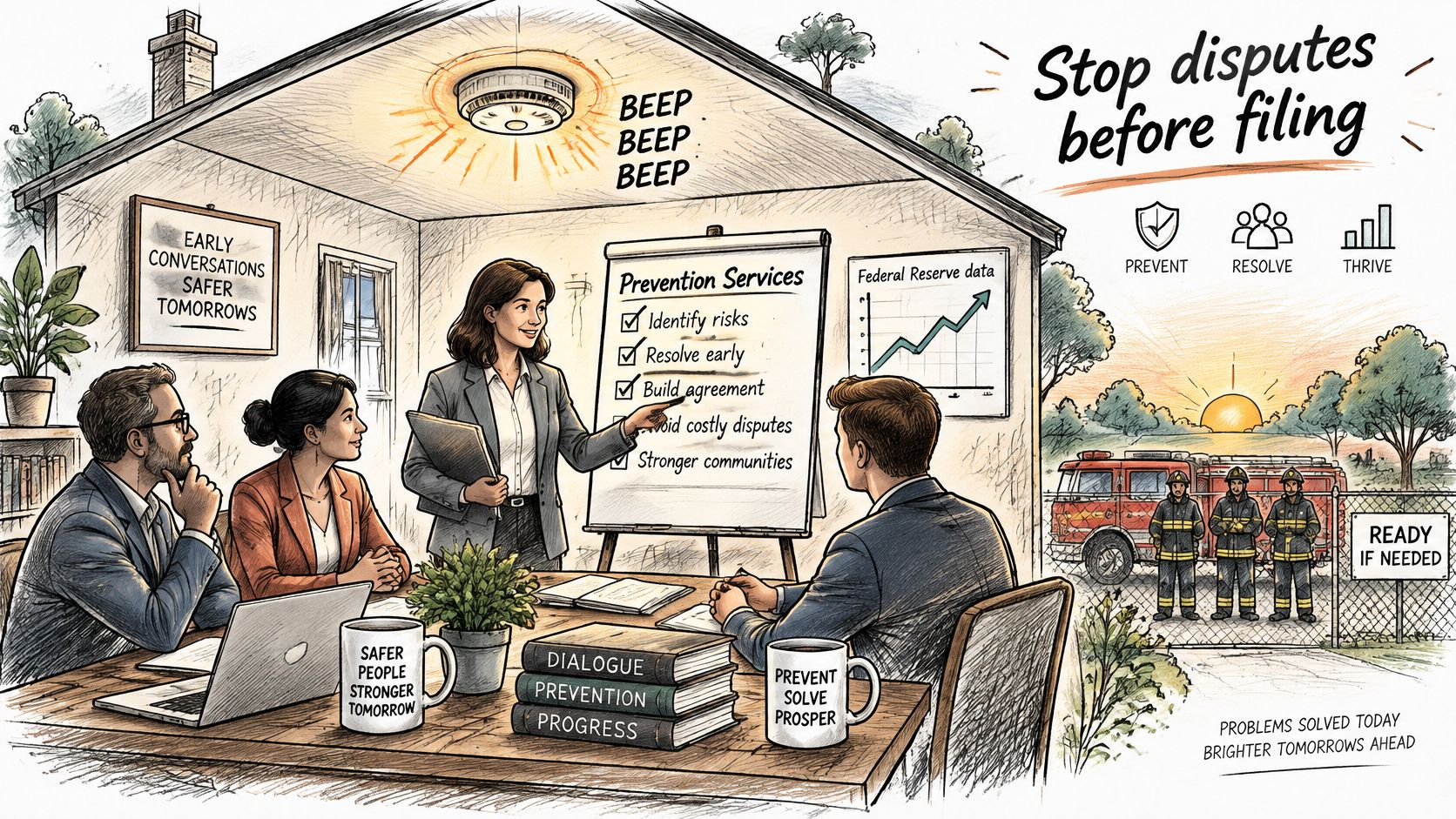
The rate looks small until you multiply it. A Federal Reserve Bank of Kansas City study of U.S. signature-based card transactions found merchants received about 1.6 chargebacks per 10,000 transactions and 6.5 basis points of sales value, and roughly 70–80% of chargebacks were resolved as merchant liability. On 1,000,000 transactions, those averages imply about 160 chargebacks, before fees, representment labor, and processor-risk consequences.
Say a supplement brand processes that million orders in a year. One hundred sixty chargebacks doesn't sound like a crisis in a weekly ops meeting. Then the acquirer adds dispute fees, a few large orders land in the liable pile, and the monitoring team starts asking about the ratio. Cutting even a slice of those 160 before they post protects revenue out of proportion to the raw rate, because most of them stay the merchant's problem once they're recorded.
How an alert becomes a stopped chargeback
The sequence is short, and the order matters.
- The issuer or network flags a dispute that isn't a chargeback yet. The customer has told the bank something is wrong. The chargeback has not been written to your merchant account.
- The prevention service receives that alert and routes it to you. We are notified within seconds after a customer creates a dispute, and then a resolution is offered. Resolve is the product built for this pre-filing moment.
- You refund inside the window the issuer and the network set. That refund stops the chargeback from being recorded. Miss the window and the same case becomes a formal dispute with a deadline attached.
Early-warning tools are worth comparing on one practical point: how fast the alert reaches the person who can issue the refund. A deeper look at dispute early warning services shows how that handoff is supposed to work.
Fix the practices that create the alerts
Alerts treat today's case. The second layer treats next month's volume. We help clients change the business practices that keep producing disputes. Three patterns show up again and again.
- Unclear billing descriptors. The card statement says "NX*PAY 402" and the customer doesn't recognize the brand. They call the bank, not you.
- Confusing cancellation paths. A subscription that takes four emails to cancel produces "I never agreed to this" disputes even when the signup was valid.
- Slow shipping updates. A tracking page that sits on "label created" for a week looks like a missing order.
Refund when the refund costs less than fighting the case, and keep the evidence when the expected return of representment is real.
Automated sorting should push clearly refundable and fraud-looking cases toward a fast refund, and hold the defensible ones for a proper evidence pack. That test, applied on every alert, is what turns prevention from a panic refund into an operating rule.
How to Respond to a Filed Chargeback
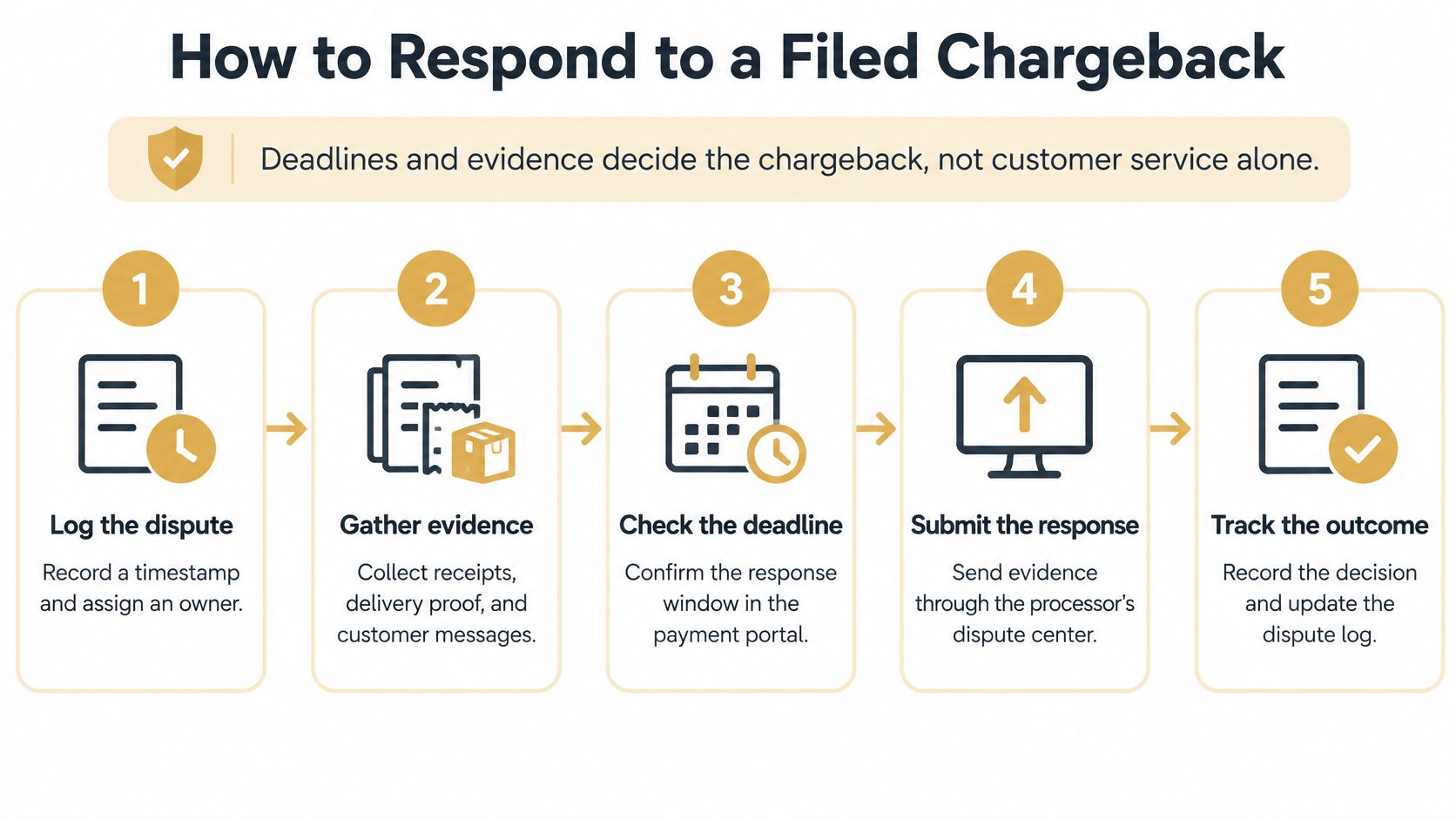
A filed chargeback is not a customer-service ticket with a longer subject line. Deadlines and evidence decide it. A polite agent and a true story still lose if the file arrives late.
Mastercard's guidance for merchants puts acquirer response windows at 10–35 days on average, with network-specific merchant deadlines commonly 20–45 days after notification, and the full process able to run to 120 days. Miss the acquirer's deadline and you lose by default, whatever the transaction facts are. That default-loss rule is why the clock starts at intake, not when someone finally opens the email.
| Deadline | Typical length | What it means for the merchant |
|---|---|---|
| Acquirer response window | 10–35 days on average | Missing it loses the case by default, whatever the facts |
| Network merchant deadline | 20–45 days after notification | Plan the submission to land before the earliest date |
| Complete process | Up to 120 days | Tracking must start at intake, not at the deadline |
Seven steps once the notice lands
- Log the dispute with a timestamp and name an owner. An unowned case sits in a shared inbox until the window is half gone. The timestamp is what lets you prove, later, that work started the day the notice arrived.
- Read the reason code and sort the case. "Fraud" and "merchandise not received" need different documents. Sorting first stops your team from building the wrong pack.
- Calculate the processor-specific due date from the notice. Don't use a generic 30-day habit. Work backward from the earliest of the acquirer window and the network deadline, and leave a buffer for a rejected upload.
- Apply the expected-value rule before you fight. Refund when likely recovery, including avoided fees, is lower than the cost of representment. Fight only when the transaction is defensible and the evidence is available.
- Assemble the evidence pack. You want the authorization record, proof of delivery, customer messages, and the terms the buyer accepted. Our Chargeback Mitigation service creates and submits that evidence for every dispute, including compilation, submission, and tracking. The evidence collection process is where teams usually lose days, not arguments.
- Submit before the deadline. A complete pack on day 46 is a loss. A thinner but accurate pack on day 12 can still win. Late is not "almost on time."
- Record the outcome. Note whether the chargeback was reversed or upheld, what it did to the dispute ratio, and how much revenue the decision saved or cost. Without that log, next month's queue looks identical to this month's.
A missed step beats a weak argument. Teams lose winnable cases because nobody calculated the due date, not because the delivery photo was slightly blurry. Manual queues make this worse at volume. Subscription and ecommerce businesses can turn recoverable disputes into automatic losses by letting notices age in a spreadsheet.
The 120-day tail is easy to forget once you've hit submit. The issuer can still come back, and a pre-arbitration stage can reopen the same facts. Keep the owner assigned until the network shows a final result, not until the upload confirmation email arrives.
If you want the deadline logic in motion rather than in a table, this short walk-through shows how a merchant response moves through the network.
Sorting Fraud From Service Failure
Banks and merchants are not describing the same pile of chargebacks. Recent cross-market research summarized by Datos Insights found financial institutions classified 70% of chargebacks as fraud-related, while merchants classified only 45% that way.
Treat every case as fraud and you'll represent orders that should have been refunded, burning fees on service failures. Treat every case as a service failure and you'll refund real fraud, then invite the next attempt. The gap is widest for subscription and ecommerce brands, where delayed refunds, missing deliveries, and other fulfillment problems drive a large share of disputes.
Customers often skip you entirely. In one 2025 study covered in that same summary, 75% of consumers went straight to their card issuer rather than contacting the merchant. When they did make contact, merchants resolved most inquiries with a refund, a replacement, or an explanation. The cheapest resolution is frequently one message, sent before a dispute exists, that makes contacting you easier than contacting the bank.
Route by cause, not by win rate
| Dispute reason | Evidence to gather | Usual route |
|---|---|---|
| Unauthorized card use | Authorization record, AVS and CVV results, device or IP data | Fight with evidence when the match is strong; otherwise refund and block the account |
| First-party misuse (claims item received) | Proof of delivery, signed-for record, customer messages | Representment with delivery proof |
| Recurring billing confusion | Sign-up record, cancellation log, reminder emails | Refund when cancellation was unclear; explain the plan when it was clear |
| Delayed or missing delivery | Tracking status and carrier scan history | Refund or reship; representment only when tracking shows delivery |
| Product not as described | Product page, listing copy and return policy | Refund when the listing was wrong |
Unauthorized use is the row people picture when they hear "chargeback." A strong AVS match, a CVV match, and a device that has bought from you before can support representment. A mismatch on all three is a refund and a block, not a debate.
First-party misuse is the buyer who received the goods and still tells the bank they didn't. Delivery proof carries this row. A photo of a doorstep with no scan history does not.
Recurring billing confusion is usually a wording problem. If cancellation was buried, refund and fix the flow. If the buyer got reminder emails and a clear cancel button, explain the plan and keep the signup record ready.
Delivery disputes are often preventable
For delayed or missing delivery, tracking status decides the route before any argument does. We use a store's fulfillment data and tracking scans to stop shipping-related chargebacks before they happen. If the carrier still shows the parcel in transit past the promised date, reship or refund. If the scan shows delivery to the address on the order, that is representment material, not a goodwill refund.
"Product not as described" is a listing problem more often than a fraud problem. When the page promised a result the product doesn't deliver, refund and correct the copy. Fighting that case teaches the issuer that your evidence is marketing language.
Some of these fights aren't card disputes at all. A wholesale buyer who refuses to pay an invoice, or a supplier who shipped the wrong goods under a contract, may need a civil claim rather than a reason code. The Texas breach of contract lawsuit steps from the Law Office of Bryan Fagan outline how a contract claim is filed when card rules don't apply. For ordinary card volume, though, start with the table. One clear customer message still beats both a lawsuit and a representment pack.
Mediation, Arbitration and Ombudsman Routes
Formal dispute services sit above the card networks. They exist for complaints a merchant and a customer can't close between themselves, including many that never touch a chargeback reason code.
The legal effect is the part people mix up. A European Parliament briefing on consumer ADR reports that consumer alternative dispute resolution handles about 300,000 eligible consumer–trader disputes a year across the 23 EU Member States that reported data. Most of those reporting states recorded resolution rates of 50% or higher among cases the ADR entities admitted. About 20% of ADR entities deliver outcomes binding on both parties, while 64% deliver non-binding outcomes.
What each route actually does
A mediator doesn't award a winner. The mediator helps both sides negotiate a settlement they can accept. Either party can refuse the proposal. That is why non-binding schemes dominate the European picture. They're a structured conversation, not a private court.
An arbitrator does decide. The decision can bind the parties who agreed to the process. You give up the option to walk away once the hearing is underway. Use arbitration when both sides want a final answer and the amount justifies the time, not when you want a referee for a $40 order.
An ombudsman scheme usually sits between those two. The ombudsman investigates, recommends, and in some schemes the trader is bound while the consumer can still reject the outcome and go elsewhere. Read the scheme rules before you treat a recommendation as optional.
A non-binding settlement you both sign is a business outcome. A binding award is a legal outcome. Don't enter the second process expecting the first.
When a merchant should use them
Cross-border consumer claims are the clearest fit. A buyer in another country, a local ADR body, and no shared small-claims court make a neutral scheme more practical than litigation. Service disputes that aren't card transactions fit too. A canceled trip package, a course that wasn't delivered, or a contractor invoice won't be solved by a chargeback representment pack.
Both sides have to want a neutral. If the customer has already filed a chargeback, finish that card process on its own rules. Don't run a mediation in parallel and hope the issuer waits.
Formal escalation is slow and costly relative to a refund or a rewrite of a billing descriptor. Consumers and businesses frequently settle before an ADR body issues anything, which is why direct resolution stays first for most merchants. A plain-language map of dispute resolution methods helps a payments lead explain that order to the rest of the company. Where the dispute is personal rather than commercial, the same binding-versus-voluntary distinction shows up in family practice. The Law Office of Bryan Fagan mediation notes are a useful contrast. They show how a neutral guides a settlement the parties still control, which is the same idea a consumer mediation scheme uses, applied to a different kind of conflict.
Choosing a Service and Your First Dispute Review
There isn't a single best dispute service. There's a fit between your file and a stage. Answer five questions from your own data, in this order, before you book a demo.
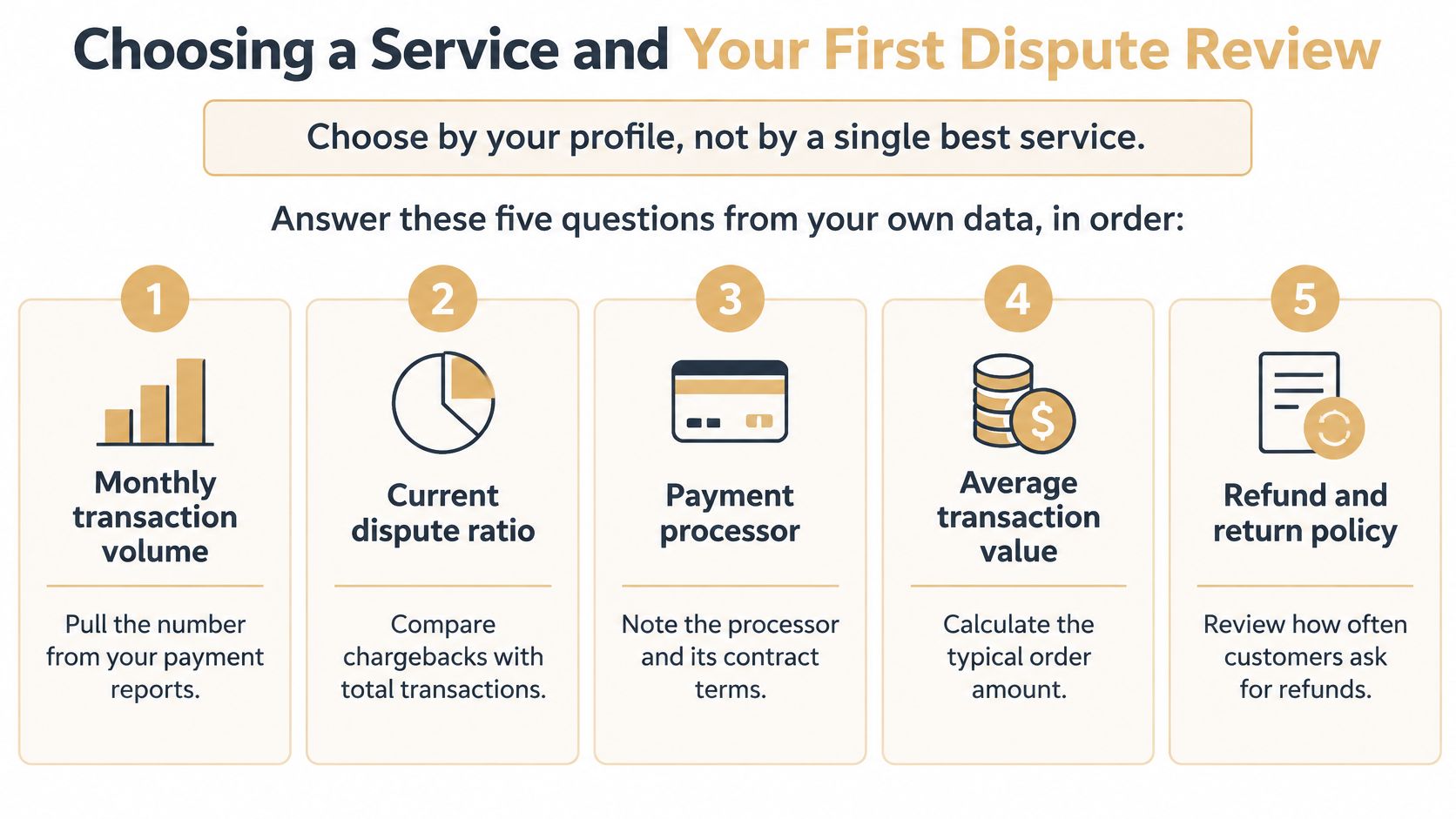
Monthly transaction volume tells you whether manual review can survive. A few dozen orders a day can live in a shared inbox. Thousands a day cannot. Current dispute ratio tells you whether the acquirer is already watching. Payment processor sets the portals, reason codes, and clocks you'll use. Billing model splits one-off checkout from renewals that confuse people months later. Risk category changes how strict your escalation rules need to be.
Match the profile to the stage
Subscription businesses with recurring billing usually need prevention and early alerts first. The dispute is often "I forgot I was still subscribed," and a fast refund beats a fraud affidavit. High-volume ecommerce needs evidence automation and deadline tracking, because the losses come from packs that never get submitted. High-risk categories such as supplements or travel need strict escalation rules. Refund the fuzzy cases, fight only the ones with clean delivery or usage proof, and don't let a hopeful win rate push you over a monitoring threshold.
Check the processors you run, whether that's Stripe, PayPal, Shopify Payments, Authorize.net, or Square, and confirm the service talks to those accounts. We provide dispute management that helps businesses challenge chargebacks with major payment processors and financial institutions. No honest provider, including us, can guarantee dispute prevention, chargeback reduction, processor approval, account standing, or the avoidance of reserves, monitoring programs, or account termination. Judge a vendor on reporting, deadline handling, and how refund rules are set, not on a promised ratio.
Run this week's review
- Export the last 90 days of disputes and refunds from the processor portal. Include reason codes, amounts, and dates, not just a count.
- Group them with the cause table. Separate unauthorized use, first-party misuse, recurring-billing confusion, delivery problems, and "not as described." A single "fraud" bucket hides the service failures.
- Calculate your dispute ratio and compare your own fraud share with the gap between how banks and merchants label the same disputes. If your internal label says fraud on almost everything, you're probably fighting service failures.
- Find the stage losing the most revenue. If an earlier refund would have stopped the case, the hole is prevention. If the evidence existed and was never submitted, the hole is representment. Leave formal escalation for the unresolved remainder, not for routine card volume.
- Shortlist services that cover that stage. Ask each one how alerts are reported, who calculates the due date, and which refund rules you can set yourself. We offer specialized consulting on payment dispute prevention and resolution, and the dashboard tracks every dispute, the chargeback ratio, and revenue saved, so the next 90-day export isn't a fresh archaeology project.
Export that 90-day dispute file today. The shortlist can wait until the reasons are grouped. A vendor conversation without that file turns into a feature tour, and you'll leave still unsure which door is open.
Disputely helps merchants stop disputes before they become chargebacks and, when a case is already filed, build and submit the evidence on time. If prevention, alerts, or representment is the stage your 90-day file points to, see how the workflow fits your processor at Disputely. Bring your reason-code export and compare it against the stages before you change tools.


