
Ecommerce Chargebacks: Costs, Causes and Prevention
Mastercard's 2025 Global Chargebacks Outlook projects roughly 261 million chargeback transactions worldwide in 2025, climbing 24% to 324 million by 2028, with the disputed value rising from $33.79 billion to $41.69 billion. That is a payments-system problem measured in hundreds of millions of forced reversals, and nearly all the advice written about it assumes a stolen card sits behind every one.
The assumption fails often enough to change how you should run the operation. A dispute can be a criminal using someone else's card, a real customer who forgot a renewal, or a parcel that arrived nine days late. Each one needs a different response, and treating them identically is how merchants end up refunding fraudsters and fighting customers who were wronged.
What follows is the mechanics first, then the money, then the sorting, then the rules you write down so the next alert doesn't get handled by whoever happens to open the inbox.
How a Chargeback Moves From Customer to Card Network
Picture a shop in 1975 that accepted a cheque for $240. The customer disputes it, the bank reverses the credit, and the shopkeeper finds out days later holding a receipt nobody has asked to see yet. A card chargeback runs on the same logic. The money moves first, the questions come later, and the merchant answers after the funds have already left the account.
Say you run a home-goods store and ship a $240 lamp. The buyer's statement shows a line she doesn't recognize, so she opens her banking app and taps dispute. That single tap starts a sequence with six fixed stages.
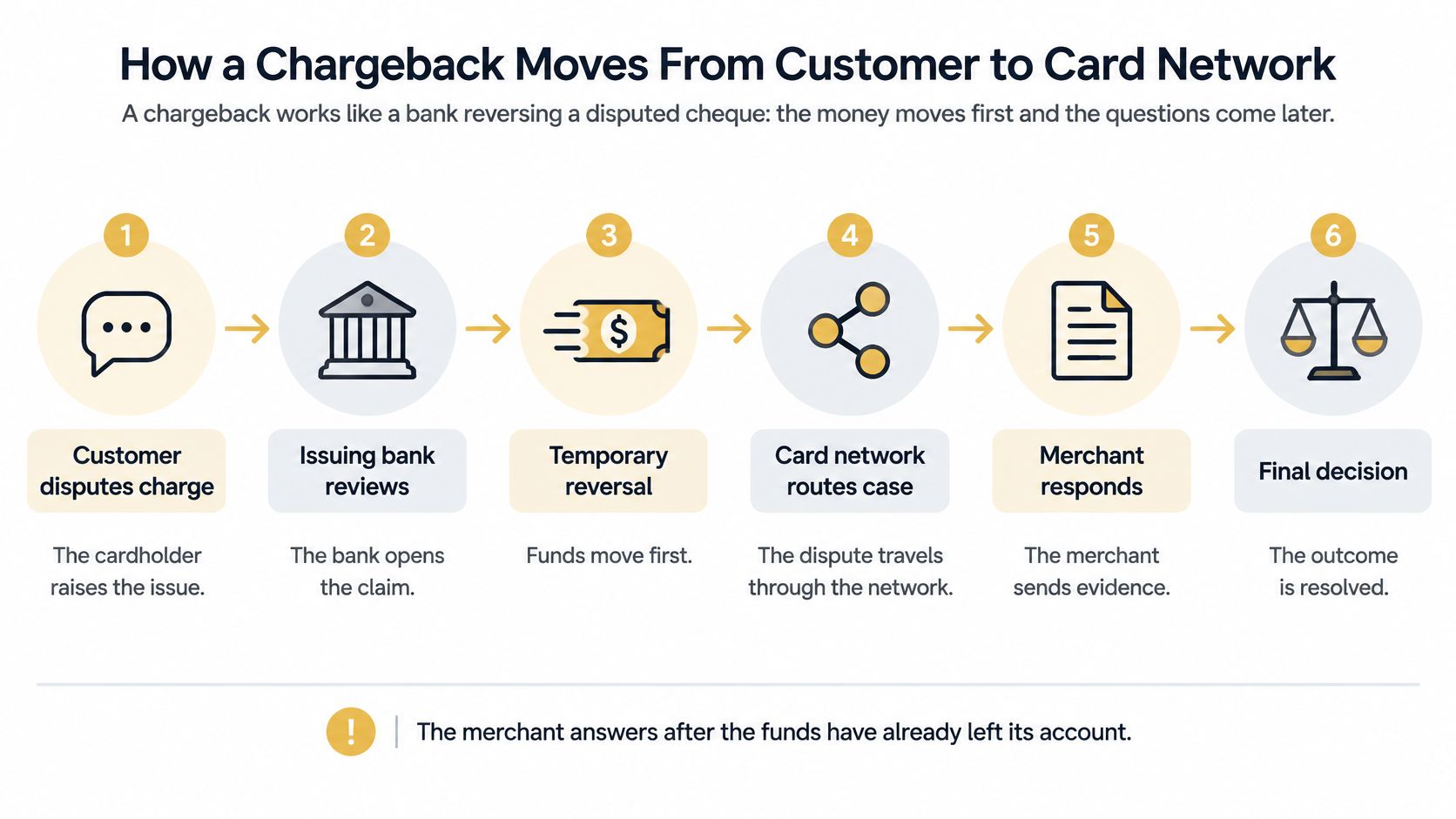
- The cardholder disputes the charge. She contacts her issuer, not you, and the claim records whatever she says: not received, not recognized, charged twice. You are not in the conversation yet.
- The issuing bank reviews the claim. The issuer usually credits her provisionally and continues investigating. Her money is back before anyone has proved anything about the order.
- The issuer files the dispute with the card network. It travels under a reason code, and that code is the label that decides which evidence will matter later.
- The acquiring bank debits the merchant. Your account is pulled for the transaction amount plus a fee, and a notification appears in your processor dashboard. This is the first moment you can act, and the first moment the cost is real.
- The merchant accepts or responds. You either let it stand or submit representment evidence before the network deadline. Everything you can still influence sits inside this step.
- The issuer decides, and disagreement escalates. If either side rejects the outcome, the case moves to pre-arbitration and then arbitration, where filing fees are added to the stakes.
Practical rule: the deadline in step five is your last real chance. Diary it the day the alert lands, not the week it expires, because evidence gathering always takes longer than it looks.
A refund and a chargeback are not two versions of the same thing. A refund is voluntary and merchant-initiated: you choose the amount, the timing, and the reason, and the customer ends the exchange still liking your brand. A chargeback is a forced reversal that has already happened. You can only contest it, and the best outcome available is getting your money back after spending hours proving you were right.
That asymmetry explains why timing decides so much. The earlier you learn about a problem, the more options stay open: a quick refund, a replacement parcel, a cancellation confirmation, a conversation. Understanding how chargebacks work matters less as trivia and more as a clock, because at stage four you're already spending money to defend a sale you could have saved at stage one.
What Ecommerce Chargebacks Cost Merchants
A chargeback isn't a refund with a fee attached. Mastercard's analysis of the true cost of a chargeback puts the average at $128 per dispute once third-party fees and internal operating costs are included, and roughly $82 of that is internal cost: investigating, collecting evidence, answering the customer, and reconciling the loss in finance.
The reversed sale is only the first line of the bill. Here is the arithmetic worth running on your own data.
Cost per dispute = refund amount + lost product + shipping + processing revenue lost + staff time.
Each of those pieces is real and none of them come back. The merchandise has shipped and won't return. The fulfillment cost was paid to a carrier. The processing revenue on the original sale stays with the parties that took it. And the staff hours spent pulling tracking, writing a rebuttal, or explaining the charge to your controller get spent whether you win or lose.
Independent survey data cited in that Mastercard analysis found that 76% of global ecommerce chargeback managers reported flat or rising chargeback rates year over year, and merchants estimated their annual chargeback costs at $54.5 billion. Disputes aren't tapering off as fraud tools improve. They're holding steady or growing.
| Measure | Value | Year or period | Source and note |
|---|---|---|---|
| Chargeback transactions worldwide | 261 million | 2025 | Mastercard Global Chargebacks Outlook projection |
| Forecast chargeback transactions | 324 million, up 24% | 2028 | Same projection |
| Chargeback value worldwide | $33.79 billion | 2025 | Same projection |
| Forecast chargeback value | $41.69 billion, up 23% | 2028 | Same projection |
| Average cost per chargeback | $128 | 2025 | Mastercard, including third-party fees and internal costs |
| Average internal cost per chargeback | $82 | 2025 | Mastercard internal cost research |
| Average chargeback rate | 0.26% | Q3 2025 | Datos Insights, up 53% from Q1 |
| Merchant annual chargeback cost estimate | $54.5 billion | Annual estimate in the 2025 report | Merchant estimate cited in American Express/PYMNTS report |
The scale is what breaks small operations. If you take 20,000 orders a month, a shift of a tenth of a percentage point in your dispute rate is 20 extra chargebacks, which at the $128 benchmark is $2,560 a month of cost that didn't exist the month before. At high volume, a rate change you'd barely notice in a dashboard produces thousands of affected transactions, a heavier operations queue, and closer attention from your processor.
If you want to put your own figures in context, find citable ecommerce data on transaction volumes and average order values before you set refund thresholds, because a rule that makes sense on a $30 order rarely makes sense on a $300 one.
Run the formula on your last 50 disputes and compare the result with the $128 benchmark. If your number is higher, the gap is usually internal labor rather than fees, and that's a process problem you can fix. The fee side deserves its own line in the review too, and this breakdown of what a chargeback fee covers shows why it's rarely the largest item on the bill.
Why Customers File Chargebacks Across Fraud, Delivery and Misuse
Most internal reports describe every dispute as fraud. The label survives because fraud is the easiest cause to act on: you tighten screening, block a device, add a rule. But when merchants in recent research sorted their own chargebacks by cause, they attributed only 45% to fraud, split between 24% third-party fraud and 21% first-party fraud, according to Datos Insights research on surging card disputes. Consumer research in the same report found 18% of disputes involved delayed refunds and 17% involved missing or late deliveries.
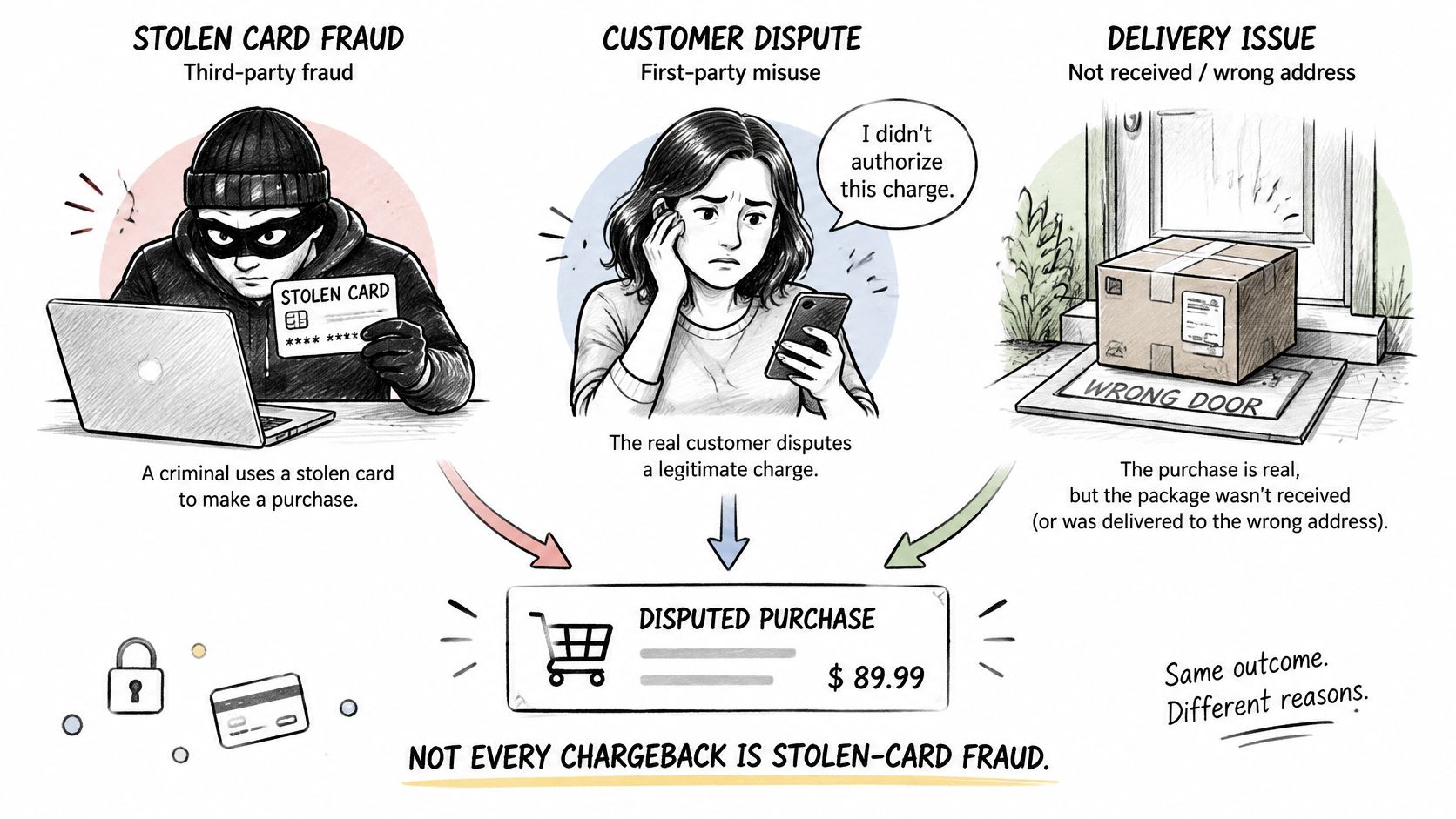
Third-party fraud is the version everyone pictures: a criminal uses a stolen card number or takes over an account, orders goods, and the legitimate cardholder disputes. Your defense is authentication and velocity checks, applied before the transaction settles.
First-party misuse looks different. The actual cardholder made the purchase, received it, and disputes anyway, because the statement line meant nothing to them, the subscription renewed without a reminder, or they wanted a refund outside your policy. There's no stolen credential to detect, so fraud tooling alone won't catch it.
Service failure is the group most merchants underrate. A refund that never arrived, a parcel that sat in a depot for a week, a renewal the customer thought they'd cancelled. Nobody is lying. The customer is using the dispute process because your process didn't resolve the problem first.
One order, three possible stories
A $60 order with tracking showing delivery, a signature on file, and a dispute reason of "not received" is not a policy problem. It needs evidence, submitted on time, not a new refund rule. The same $60 with tracking that shows the parcel returned to sender is a service failure, and no amount of representment evidence will fix the underlying cause.
| Dispute cause | Reported share | What it looks like | Intervention |
|---|---|---|---|
| Third-party fraud | 24% of chargebacks (merchant survey) | Stolen card or account takeover | Authentication, device checks and velocity screening |
| First-party misuse | 21% of chargebacks (merchant survey) | Legitimate purchase disputed after use | Clear descriptors, a visible refund path and delivery or usage evidence |
| Delayed refund | 18% of disputes (consumer survey) | Return or cancellation refund not received | Faster refund processing and status updates to the customer |
| Missing or late delivery | 17% of disputes (consumer survey) | Parcel delayed, lost or marked not received | Tracking, delivery confirmation and proactive delay alerts |
| Other causes, such as subscription confusion | About 55% of chargebacks (merchant survey remainder) | Renewal not recognized or product not as described | Renewal reminders, one-click cancellation and accurate product pages |
The two data sets measure different things, so don't add them together. The merchant figures split chargebacks by who caused them. The consumer figures count disputes by what went wrong. Both point the same way.
If you watch disputes arrive reason code by reason code over a few months, the pattern becomes obvious.
The rule the data supports: a dispute caused by a fulfillment or refund breakdown needs an operational fix, and a dispute filed without a fulfillment failure needs evidence. Sorting first saves you from applying the wrong remedy to both.
Metrics That Reveal Your Real Chargeback Risk
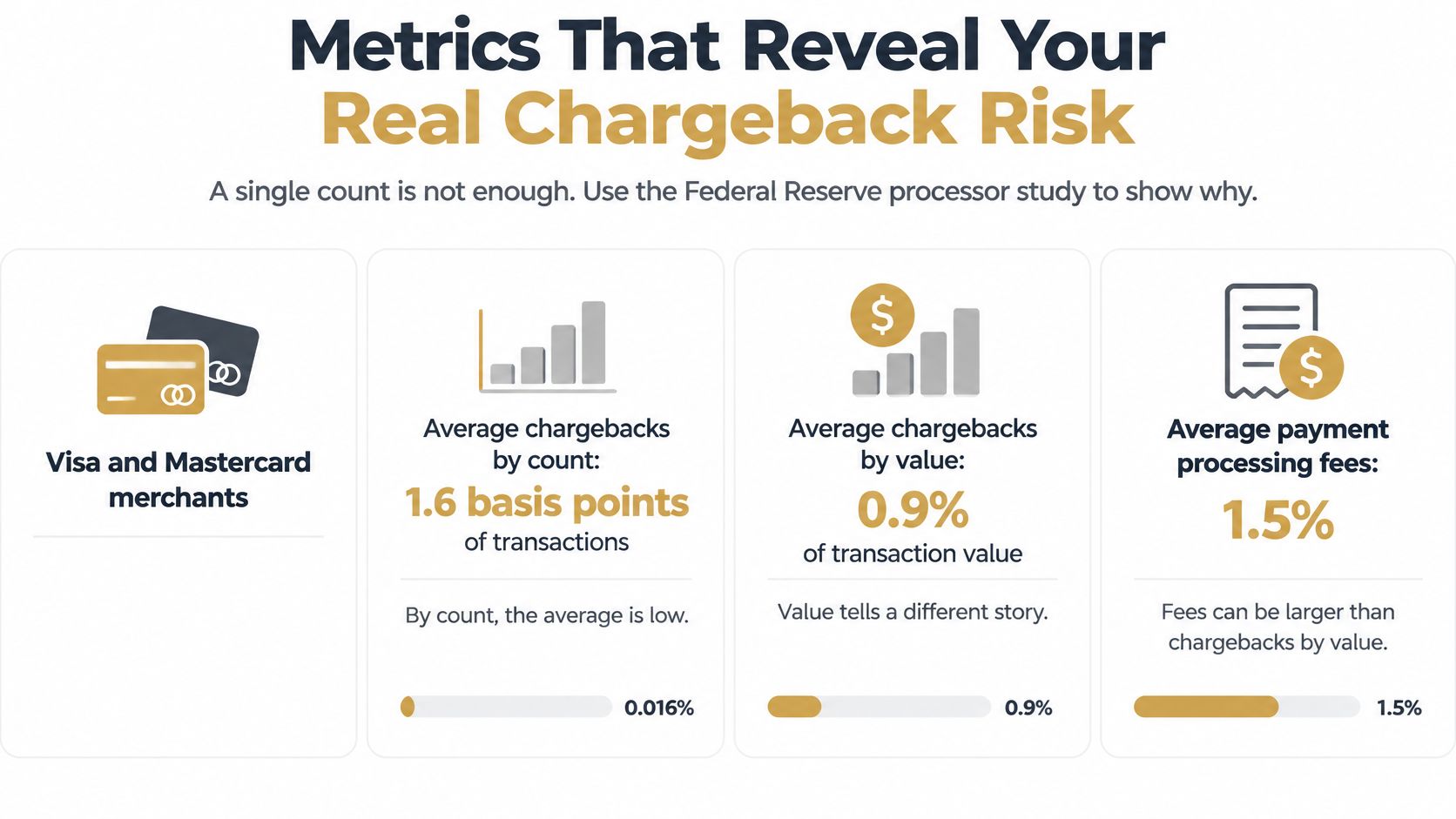
A count tells you how often customers dispute. It doesn't tell you how much money is exposed, and those two numbers can point in opposite directions. A Federal Reserve study of processor data covering more than 20% of U.S. signature-based card transactions found that Visa and Mastercard merchants received chargebacks on average for 1.6 basis points of transactions by count but 6.5 basis points of transaction value.
The gap between those two figures is the whole lesson. Disputes cluster on larger orders, so a count-only report understates your dollar exposure. The same study found that 70 to 80% of chargebacks were resolved as merchant liability, that fraud represented about 50% of all chargebacks, and that card-not-present transactions carried materially higher rates than card-present ones. If your dashboard reports a single blended number, it hides exactly the segment that matters most to an online store.
Build the report around five lines, each split by channel, card type, order value band and billing model.
| Metric | How to calculate | What it reveals | What to watch |
|---|---|---|---|
| Transaction chargeback rate | Chargebacks divided by settled transactions in the period | How often customers dispute | Trend by month, channel and card type |
| Dollar-loss rate | Disputed value divided by settled value | Financial exposure | Value rising while count stays flat |
| Card-not-present share | CNP chargebacks divided by all chargebacks | Where digital exposure sits | CNP rates above card-present rates |
| Recurring billing dispute rate | Subscription disputes divided by renewals charged | Cancellation and descriptor failures | Spikes after price changes or renewal notices |
| First-party code share | Misuse-coded disputes divided by total chargebacks | Operational versus fraud causes | Share rising while fraud codes fall |
Two habits make these numbers useful. First, track direction, not a single month. One bad week in a peak season tells you less than a six-month line that bends upward after a pricing change. Second, put recurring billing on its own line. A hundred renewals out of 40,000 charges looks trivial until you notice each one is a customer who didn't recognize a charge they'd authorized months earlier.
Monthly routine: open the transaction rate and the dollar-loss rate side by side, then ask which segments moved. If the rate is flat and the dollar figure is climbing, your problem is order value, not volume, and your refund thresholds are set at the wrong level.
Your acquirer's official ratio is the one that counts, and it can differ from the number your own dashboard shows because networks measure over a trailing window and count confirmed disputes differently. Pull the processor's figure for the review and reconcile it against yours. The full explanation of how the ratio is built sits in this guide to your chargeback rate, and it's worth reading before you set internal targets.
Choosing Refund, Evidence or Fight for Each Alert
Two alerts land in the same hour. One is a $35 hoodie from a customer with four clean orders and no dispute history. The other is an $800 order with a signature on delivery, a login record from the buyer's usual device, and a stored consent timestamp for the subscription attached to it.
The hoodie goes back as a refund the same day. You lose the garment, the shipping, and the margin, and you save the staff hours and the fee that a representment would consume for a $35 argument. The $800 order gets the evidence packet, because the amount justifies the work and the paperwork is already sitting in your systems.
Most published advice stops at that instinct and calls it a policy. It isn't, because the two examples sit at opposite ends of a spectrum and the middle is where merchants bleed.
Why blanket refunds fail as a strategy
Refunding every alert does cut formal chargebacks. It also teaches your customer base that a complaint produces money, and not everyone who learns that lesson is honest. Consumer research cited in Chain Store Age's analysis of rising chargeback rates found that 10% of surveyed consumers admitted using social-media refund-hack tactics, and 12% said they wanted their money back because they knew their card issuer would cover it.
That's the trade-off nobody puts in the pitch deck. A refund rule that's too generous converts disputes into refund leakage, and repeat abuse tends to arrive from the same accounts.
Segment before you decide: order value, customer history, delivery evidence, cancellation status, dispute reason and your odds of winning representment. Speed alone doesn't fix a decision that was wrong.
In that same research, clothing, accessories and cosmetics accounted for 20% of disputed purchases, digital subscriptions 18%, and home goods 16%. Those categories tell you where to set tighter evidence requirements and where a fast refund is cheaper.
| Response | Best when | Cost of acting | Main risk |
|---|---|---|---|
| Refund immediately | Low order value, confirmed service failure, clean customer history | Refund amount and lost product | Rewards abuse and increases refund leakage |
| Request evidence or contact customer | Reason unclear, tracking ambiguous or subscription status uncertain | Staff time and reply delay | Customer may file the chargeback while you wait |
| Allow representment | High-value order with strong delivery, login and consent evidence | Evidence compilation and the staff hours behind it | Loss if evidence is weak, and cost even when won |
Recurring billing is the exception that trips everyone
On a subscription charge, "the customer authorized it" answers the wrong question. A cancellation complaint can be completely legitimate even when the transaction was technically valid: the cancel button was buried, the confirmation email never arrived, the plan changed without notice. Refunding those alerts protects the ratio and keeps a customer who might otherwise have stayed.
The evidence you assemble for a representment should answer the specific claim, not restate your terms. Signed delivery or tracking proof for "not received". Login and download logs, plus prior order history, for "unrecognized". Subscription consent records and a cancellation timestamp for "cancelled recurring". Anything you can't produce in the deadline window shouldn't factor into the decision.
Prevention Routine and Refund Rules to Set Up Now
Merchants allocate an average of 11% of annual ecommerce revenue to fraud management, according to the Atlanta Fed's reporting on the costly war against ecommerce fraud. That's a large budget, and much of it goes to screening transactions rather than to the cheaper work of stopping disputes after a legitimate sale. Effort should follow outcomes, and the outcomes here are decided by descriptors, delivery records, refund speed and evidence.
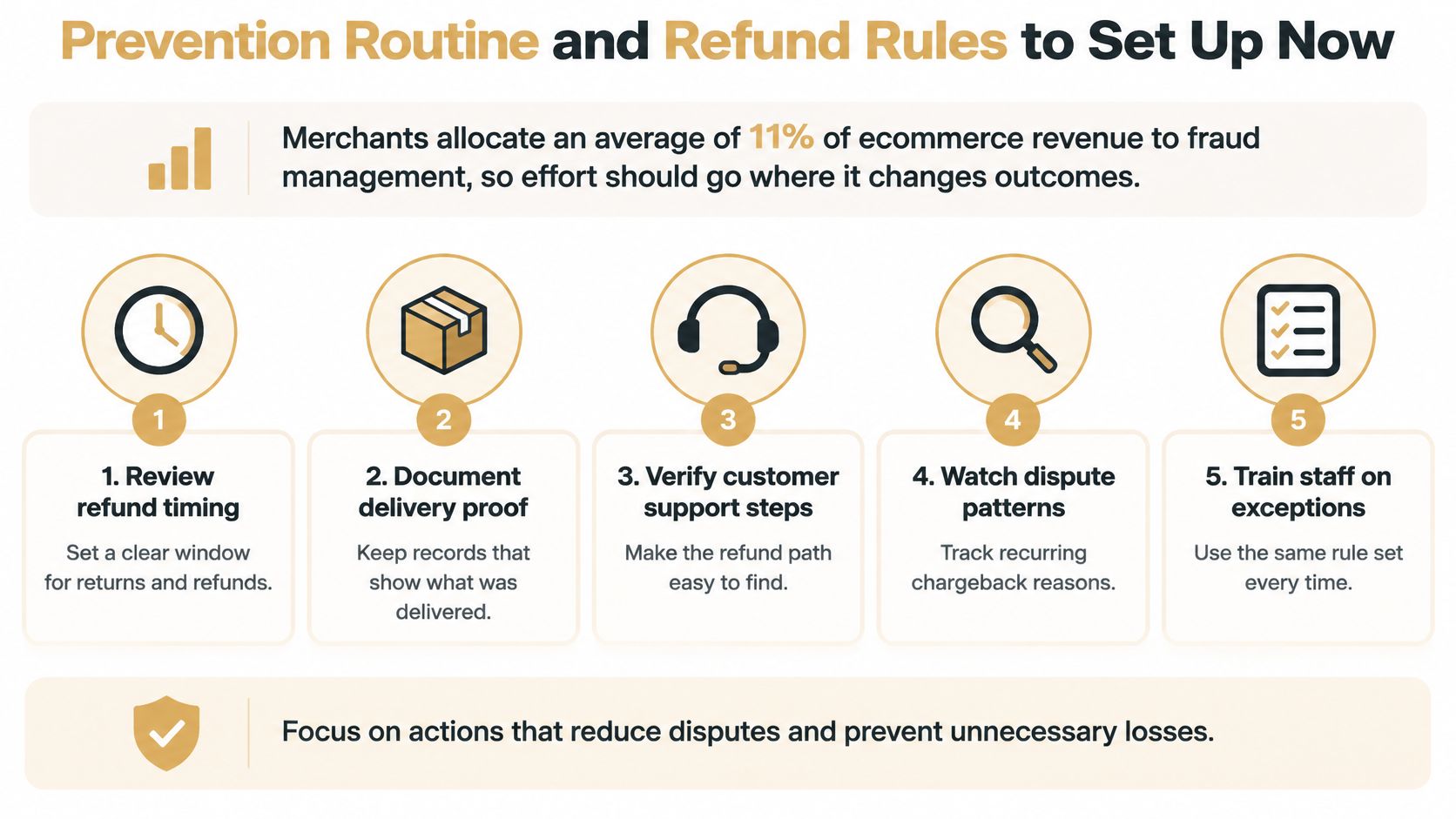
Five actions that map to a specific dispute cause
- Make the statement line recognizable. The descriptor on the customer's statement should show the store name they'd recognize and a support phone number. A trading name that differs from the website is the single most common reason a real purchase becomes an "unrecognized transaction" claim, and fixing it costs nothing but a configuration change in your processor.
- Remind before you renew, and make cancelling boring. Send a renewal notice before each charge with the amount, the date and a link to manage the plan. One-click cancellation reduces revenue slightly and reduces subscription disputes a lot. A customer who cancels in ten seconds doesn't call their bank three weeks later.
- Keep the delivery record for every shipment. Save the tracking number, the carrier's delivery confirmation, the timestamp and any signature or photo proof in the order record, not in a carrier portal that expires in 90 days. When a "not received" claim arrives six weeks later, that record is the difference between a won representment and a write-off.
- Publish a refund deadline and hit it. State how long a refund takes and then process inside that window. Most delayed-refund disputes start as a customer checking their bank balance twice and finding nothing.
- Log evidence per order as you go. Device and account identifiers, login or download activity, consent records, cancellation history, support messages. Subscription and SaaS stores need this most, because their disputes arrive months after the sale, when memory and goodwill have both expired.
The fifth action is the one that separates merchants who win representments from merchants who lose them by default. Evidence assembled after the deadline is evidence that doesn't exist.
Set the rules this week
Write your refund thresholds before the next alert. Use order value and dispute reason together. Something like: any alert under $50 with a clean history refunds automatically; anything between $50 and $250 gets a person to check tracking first; anything above that goes to evidence unless the claim is clearly a fulfillment failure you caused.
Connect your payment processor into one queue. Stripe, PayPal, Shopify Payments, Authorize.net, Square, whichever you run, all of them can feed alerts somewhere. Consolidating them means nothing sits unread in a second dashboard while the deadline passes.
Decide which alert types may refund automatically and which need eyes on the evidence. Subscription cancellation claims and low-value delivery complaints behave differently from a $900 order with a fresh device fingerprint. Automate the first group, review the second.
Put the metric review in the calendar as a recurring meeting. Same day each month, same five lines, same segments. Patterns only show up when someone compares one month to the next.
Before the next alert lands: write down the amount, the cause and the action for each of your last twenty disputes. If you can't classify them, you don't have a prevention routine yet. You have a queue.
That consolidation step is where a platform can help rather than replace the work. One option is Disputely, a chargeback alert platform that connects with Visa Rapid Dispute Resolution, Mastercard CDRN and Ethoca, and organizes its products into three stages: before the dispute, when it's filed, and after the chargeback. Customers pay only when chargebacks are successfully prevented, and refunds or communications with processors and alert networks start only on the merchant's authorization.
Set the thresholds, connect the sources, and write the rules down before the next alert arrives. The gap between an alert and a filed chargeback is measured in hours, and whoever opens that alert needs a decision already made for them.
Disputely watches your transactions around the clock and matches incoming alerts to the order behind them, so a complaint about a late parcel or a forgotten renewal gets answered before it hardens into a chargeback. You set the refund rules once, and our platform applies them, handles the alert, and only ever starts a refund on your authorization. Visit Disputely to connect your processor and see how many of last month's disputes you could have stopped.


