
Friendly Fraud Chargeback: Causes, Costs and Prevention
You ship the order, the card clears, and the customer keeps the product. A week later the bank reverses the payment. Nothing in your fraud queue flagged the sale, because the buyer was the legitimate cardholder. That reversal is a friendly fraud chargeback, and it lands on merchants who already did the work.
A chargeback is the card issuer reversing a payment and pulling the funds from you. You lose the sale, and you still pay the dispute fee, even when the order was correct. Friendly fraud, also called first-party misuse, is a dispute of a genuine purchase made by the cardholder or someone in their household. It is not the same problem as a stolen card, and it is not the same problem as a late parcel.
Sorting those cases is the whole job. Honest confusion is cheaper to fix with a receipt or a refund. Deliberate abuse is cheaper to fight when your records are strong. The sections below walk from the definition to that cost rule.
What Friendly Fraud and Chargebacks Really Mean
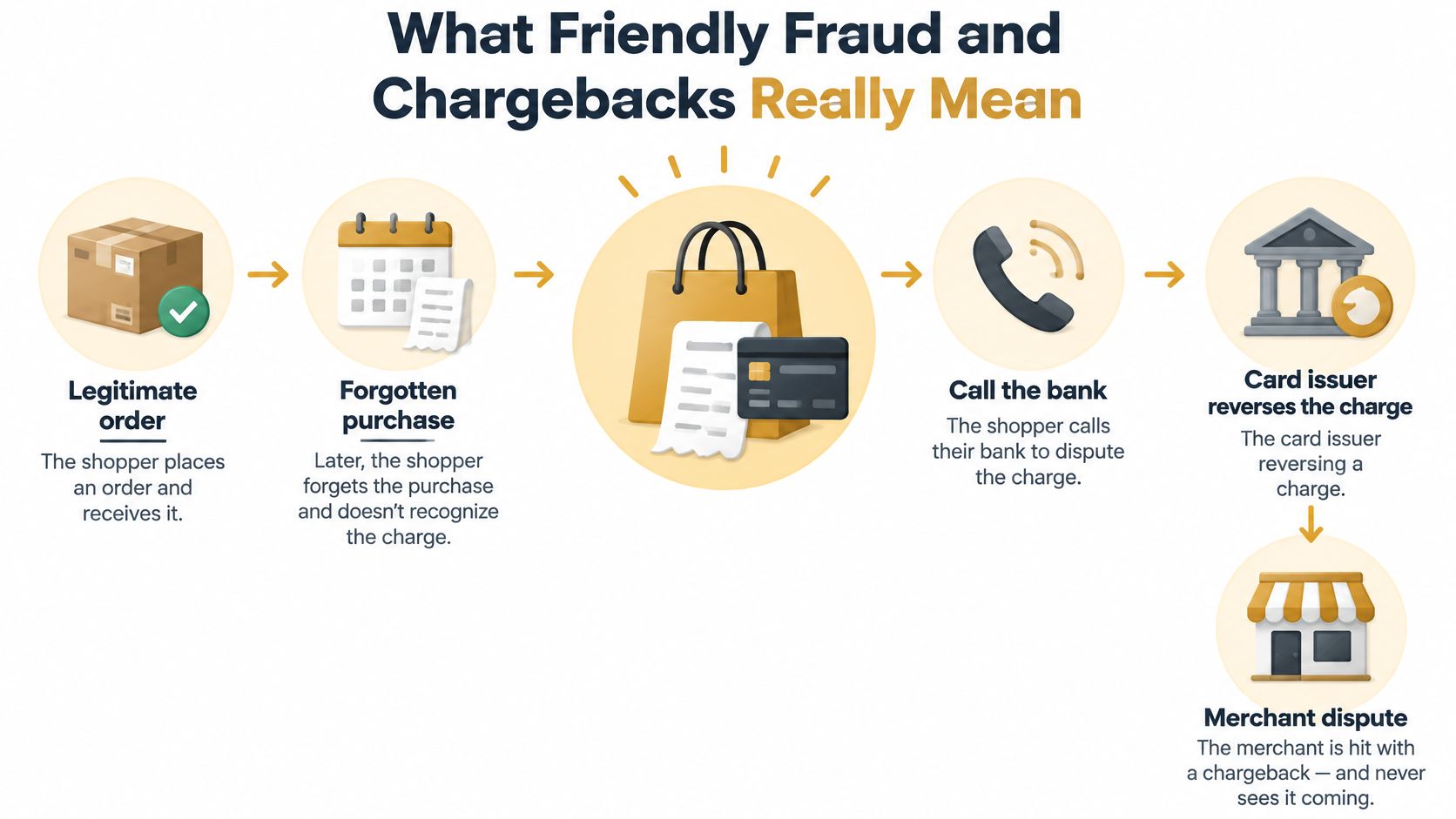
Say a shopper orders a jacket on Tuesday, gets it on Thursday, and forgets the purchase by the time the statement posts. The line doesn't look like the store they remember, so they call the bank. The issuer files a dispute you never see coming. You already paid for the goods, the shipping, and the processor fees.
A chargeback is that reversal. The issuer takes the payment back from the merchant, and the merchant loses the sale plus a fee even when fulfillment was correct. Friendly fraud, or first-party misuse, is the version where the cardholder, or someone in the household, disputes a purchase that was made. The credentials were valid. The order may have shipped on time. The case still enters the dispute process.
Third-party fraud is different. A criminal uses stolen card details, so the cardholder never agreed to the sale. An ordinary dispute is different again. The cardholder bought the item, but delivery was late, the goods were damaged, or the amount was wrong. Those claims can be fair. Treating them as abuse hides a fulfillment or billing problem.
Mastercard reported that merchants and issuers estimated first-party fraud, also called friendly fraud, represented around 20% of disputes in 2025, based on Mastercard and Javelin research. That share is large enough that a blanket "fight everything" rule, or a blanket "refund everything" rule, will miss the point.
| Dispute type | Who starts it | Card details stolen? | Typical trigger |
|---|---|---|---|
| Third-party fraud | Criminal using a stolen card | Yes | Unknown purchase on a compromised card |
| Friendly fraud (first-party misuse) | Genuine cardholder or household member | No | Forgotten subscription, unrecognised descriptor or intentional refund seeking |
| Ordinary dispute | Genuine cardholder | No | Late delivery, damaged item or billing error |
Practical rule: Sort every incoming dispute into one of these three types before you choose a response. The type decides whether you refund, explain, or represent.
Why Customers File Friendly Fraud Disputes
Most friendly fraud chargebacks start in one of four places. Three of them are often honest. The fourth is not.
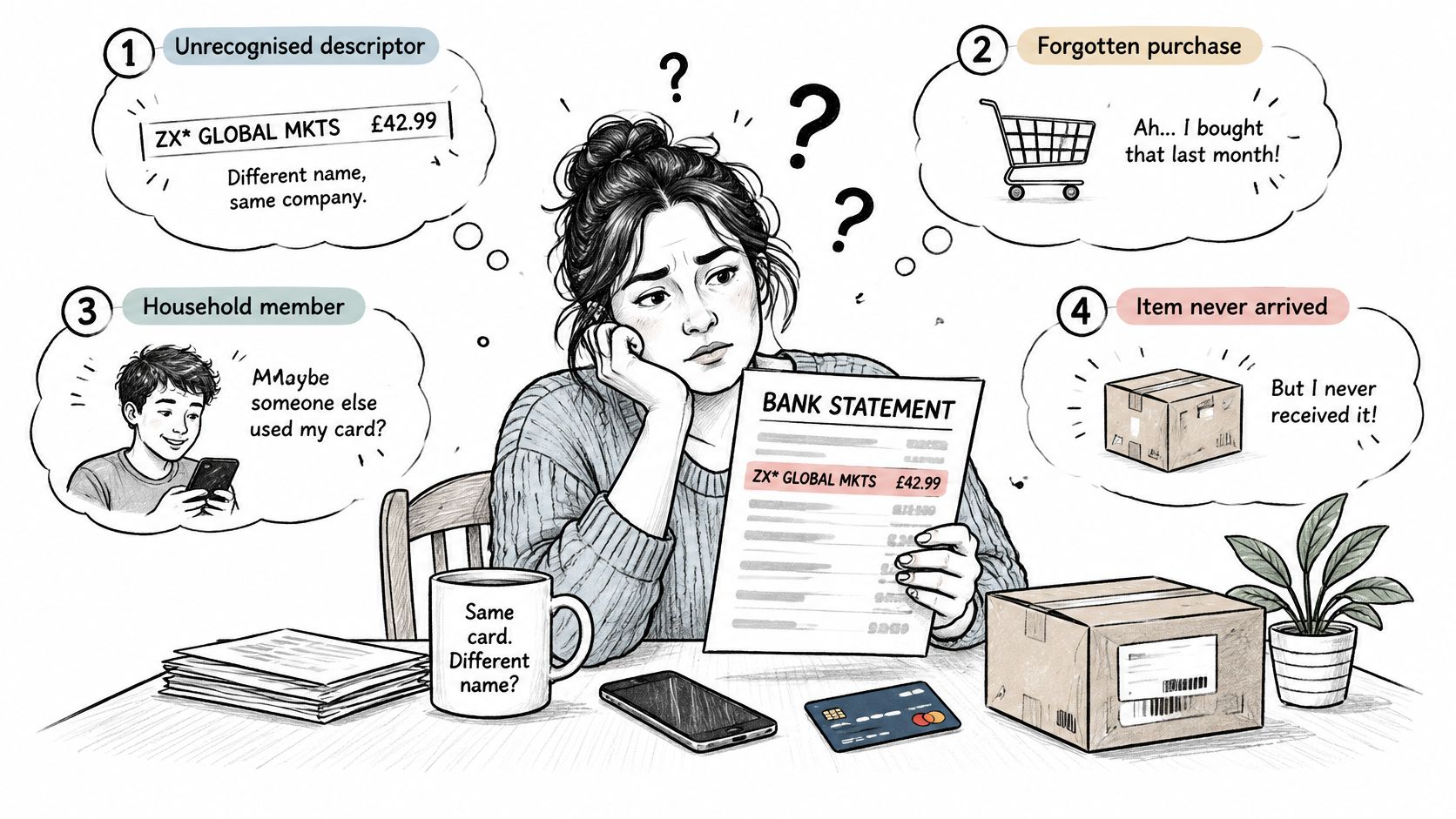
The name on the statement doesn't match the shop. A customer buys from Bright Home and the statement shows the parent company, Northline Retail LLC. They can't connect the charge, so they tell the bank it wasn't them. A recognisable descriptor, plus a phone number, would have stopped the call.
The renewal arrived months after signup. Someone starts a free trial in January and forgets it. The annual charge hits in February of the next year. They don't remember agreeing, so the renewal looks like fraud. A reminder with the amount, the date, and a cancel link would have jogged the memory.
They believe the parcel never came. Tracking shows a porch drop or a neighbour signature. The customer checks the wrong door, assumes theft, and files "not received." The carrier record exists. The customer never saw it.
They keep the item and want the money too. A buyer receives the goods, then claims non-receipt to force a refund through the bank instead of your return desk. Checkout.com reported that 25% of consumers surveyed in 2025 had deliberately attempted to claim a refund after receiving the desired item on at least two occasions.
The first three causes are often mistakes, not theft. Mastercard and Datos Insights found that 48% of consumers had disputed at least one charge they later realised was legitimate. Checkout controls miss all four paths. The sale passes authentication, address checks, CVV, and device screening, because the buyer is the genuine cardholder. The fix sits after checkout, in descriptors, reminders, delivery messages, and a cancellation log you can retrieve.
A short walkthrough of how these disputes move from a statement line to a reversal is here:
What Friendly Fraud Costs Merchants
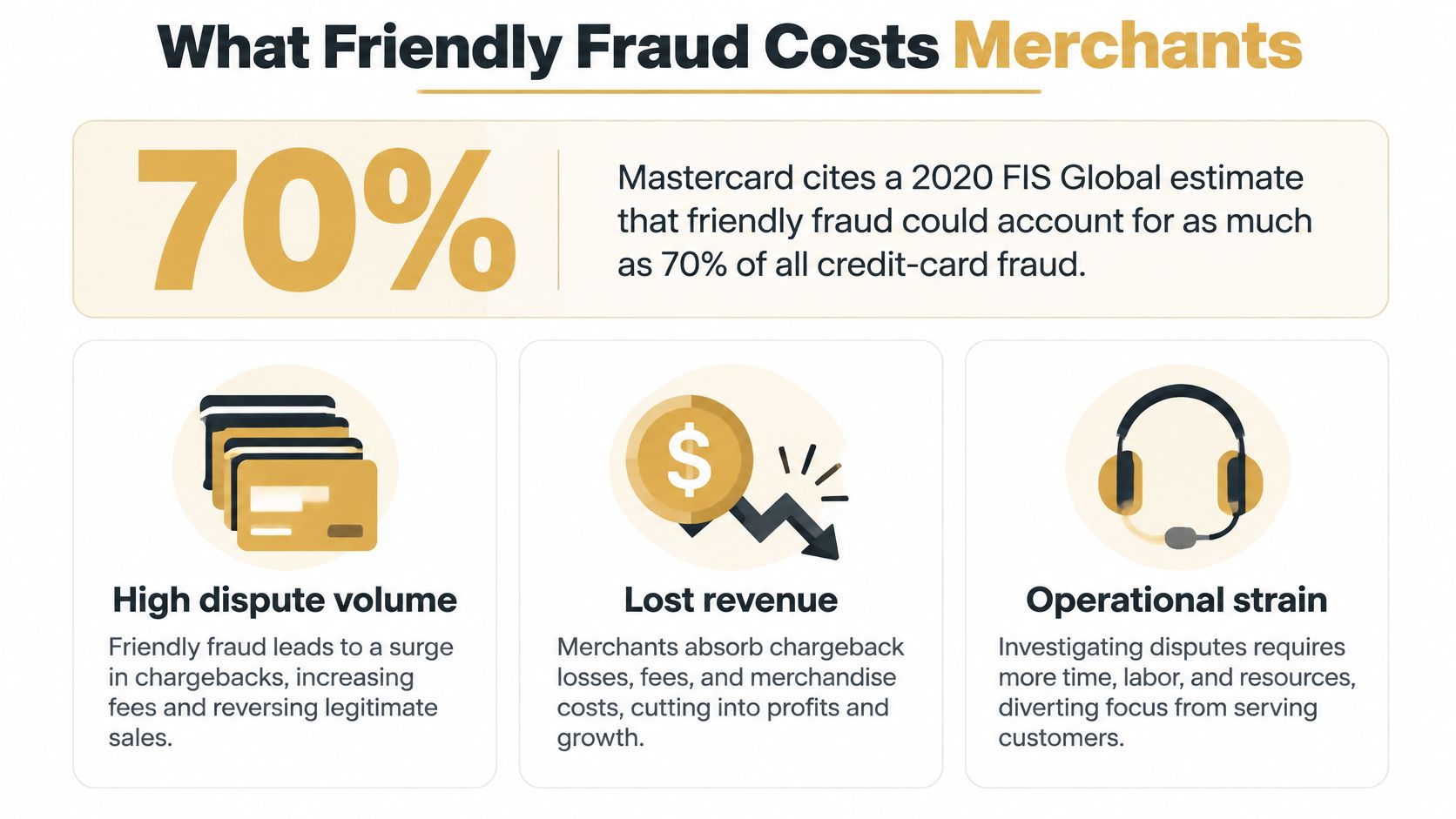
A friendly fraud dispute can cost more than the order itself. The sale may be reversed, while staff still spend time gathering records and responding. Mastercard cites a 2020 FIS Global report estimating that friendly fraud accounted for as much as 70% of all credit-card fraud.
The cost of an individual case is easier to apply to a decision. Research cited by PayPal puts the average resolution cost merchants estimate at $82 per first-party dispute. For broader context, Juniper Research, as reported by Bloomberg, reported that U.S. consumers filed 158 million transaction disputes in 2025.
| Measure | Figure | What it measures |
|---|---|---|
| Average resolution cost per first-party dispute | $82 (merchant estimate cited by PayPal) | Staff time, records and fees for one case |
| U.S. transaction disputes filed in 2025 | 158 million (Juniper Research, reported by Bloomberg) | Consumer dispute volume |
| Retailers raising prices due to chargeback costs | 32.5% of about 300 surveyed (2024) | Cost passed on to all customers |
Costs that never show as one line
The sale reversal is only one part of the loss. Staff must retrieve the transaction, delivery scan, emails, and any cancellation record. Processor dispute fees may apply whether you win or lose, and a rising dispute ratio can expose a business to monitoring programs or reserves. In a 2024 survey of nearly 300 retailers, the Chargeback Field Report found that 32.5% had raised prices in response to chargeback costs, as covered by Entrepreneur.
Digital and subscription merchants may have less delivery evidence to submit. Logins, downloads, and renewal notices can help establish what happened, but gathering them still takes time. Before deciding whether to refund or contest a dispute, compare the order value with the refund amount, chargeback fees, staff time, and the potential cost of a rising ratio. If those costs exceed the order value, fighting may cost more than refunding.
Prevention Steps Across Policy, Process and Tools
Prevention works when each step removes a specific cause. Run them in this order.
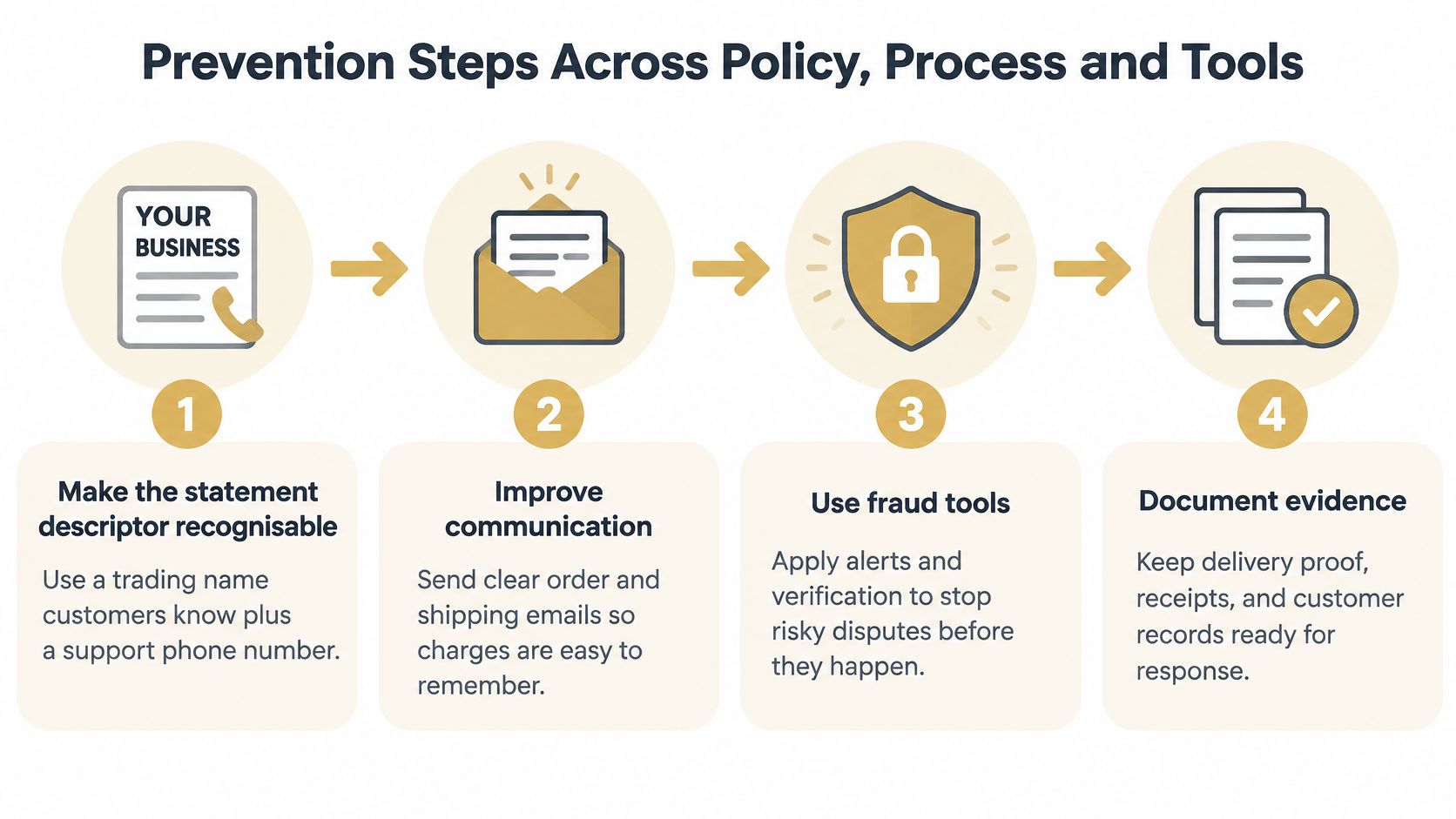
- Make the statement descriptor recognisable. Use the trading name the customer typed into the browser, not only the legal entity, and add a support phone number or a short URL. Check the live statement, including any processor prefix that truncates the name.
- Send a renewal reminder before every recurring charge. Show the amount, the date, and a cancel link. This is the fix for forgotten trials and annual renewals.
- Make cancellation easy and log every request. A timestamped cancel record is what decides a subscription dispute. If billing continued after a valid cancel, the customer has a fair claim.
- Send shipping notices with tracking, and require a signature on high-value orders. A porch photo and a matching address answer "not received" before the customer calls the bank.
- Connect processor alerts and card-network feeds. Visa Rapid Dispute Resolution, Ethoca, and Mastercard CDRN can surface a complaint before it is filed. That window is where a refund still stops the chargeback.
- Refund low-risk alerts automatically. When we detect a chargeback threat, we automatically process a refund to prevent the chargeback. A platform such as Disputely is one way to route those alerts, and the fit depends on your processor and volume.
- Review dispute reasons every month by product, descriptor, and channel. The pattern tells you whether the next fix is a name change, a reminder, or a delivery rule.
Steps 1 and 2 cut unrecognised and forgotten charges. Steps 3 and 4 cut false non-receipt and bad subscription claims. Steps 5 to 7 stop cases from being counted and show you where the next leak is. Alerts reduce disputes. They don't replace a clear descriptor, a cancel log, or a delivery record.
When to Refund and When to Fight
Fight a dispute only when the expected recovery is larger than the full cost of fighting it. Add the sale value you might get back, then subtract the dispute fee, the labour, and the evidence work. If the likely win doesn't clear that total, refund. The chargeback versus refund choice is a margin decision, not a matter of principle.
The alert stage is the cheap moment. A refund issued before a formal chargeback can stop the chargeback and its fees. Once the dispute is filed, you can't unfile it. Check the alert window your processor offers, often a day or two, and put the refund rule inside that window.
Signals that pick the path
Fight when you have a signature, login or usage after the date the customer claims they never bought, a cancellation request that arrived after the renewal, or a repeat pattern on one account or device. Refund when the order value is low, the descriptor was unclear, this is a first complaint, or the customer is likely to leave a public review that costs more than the sale.
| Scenario | Deciding signal | Best response |
|---|---|---|
| Low-value, ambiguous claim | Fight cost exceeds the sale value | Refund at alert stage |
| Unrecognised descriptor, customer contacts you | Customer has not connected the charge to a purchase | Send receipt and clarify; refund if still disputed |
| Delivered, signed, high-value order | Carrier proof and signature on file | Represent with delivery evidence |
| Subscription after a logged cancellation request | Cancellation timestamp before renewal | Fight with consent and cancellation records |
| Subscription with no cancellation request | No cancellation log and recent product use | Fight with usage and renewal reminder evidence |
| Repeat claimant across orders | Multiple disputes on one account or device | Fight with full history and flag the account |
| Claim with no usage or delivery proof | No login, download or tracking record | Refund if cheaper, and track the pattern |
Never refunding invites more abuse. Always refunding rewards it. Set a value threshold and a repeat-claimant flag, and decide each case with that written rule.
Building Evidence That Matches the Claim
Issuers review evidence against the reason the cardholder gave. A perfect receipt doesn't answer "I cancelled." A tracking number doesn't answer "I didn't authorise this." Match the packet to the claim.
Take a subscription renewal coded as unauthorised. Submit the signup consent screen, the terms accepted at checkout, the reminder sent before renewal, a cancellation log with no request, and login activity after the renewal date. That sequence answers the claim. A generic order PDF does not.
Build the pipeline so those files are one lookup, not a scavenger hunt. Link the transaction ID to the customer, prior orders, refunds, product-use logs, delivery confirmation, and earlier disputes. Keep only what the card-network process needs, and don't store card security codes after authorisation. Issuers often can't see repeat behaviour across merchants, so your linked history carries more weight than a single receipt.
| Claim type | Evidence to submit | Where to find it |
|---|---|---|
| Transaction not recognised | Descriptor history, prior purchases on the same card, customer contact | Order database and support tickets |
| Merchandise not received | Carrier delivery scan, signature, matching shipping address | Shipping provider tracking |
| Subscription not cancelled | Consent screen, accepted terms, renewal reminder, cancellation log | Billing system and CRM |
| Digital product used | Login timestamps, IP and device logs, download records | Product analytics |
| Refund not processed | Return label, return receipt, refund confirmation | Returns tool and payment processor |
For goods that are still in transit, the timing of the "out for delivery" message matters as much as the scan. Shipping SMS timing explained by YipSMS is a useful check on when customers learn an order has moved. Pair that notice with the carrier record before you represent. A tighter evidence collection process keeps the packet inside the processor deadline, which is often earlier than the network deadline.
Before you submit, read the reason code and ask one question. Does this file answer that claim, or does it only describe the order?
Audit Your Dispute Reasons This Month
Export the last 90 days of disputes this week. Sort each case into the four causes, unrecognised descriptor, forgotten renewal, believed non-delivery, and intentional abuse, and into the three dispute types. For each bucket, count the cases, the average order value, and what it cost you to close them.
Pick the two buckets with the highest cost. Give each one fix. Change the descriptor, add a renewal reminder, simplify cancellation, require a signature, or turn on alerts. Then write the refund-versus-fight rule with a value threshold and a repeat-claimant flag, using the break-even test. Set a 30-day checkpoint and compare the dispute rate, not the feeling that things improved.
We can help with alerts and refunds before a chargeback is filed, and customers pay only when chargebacks are successfully prevented. We don't guarantee dispute prevention, chargeback reduction, processor approval, account standing, or avoidance of reserves, monitoring programs, or account termination. Compare any provider's pricing with the two buckets from your audit before you commit.
If you can't name the cause of your last ten disputes, start with that export.
Disputely watches Visa Rapid Dispute Resolution, Ethoca, and Mastercard CDRN alerts so you can refund a friendly fraud chargeback before it posts, and fight the cases your records can win. If recurring billing or a confusing statement line is driving your disputes, see how the alert rules fit your processor. Visit Disputely and match the refund thresholds to the audit you just ran.


